|
 |
 |
 |
| Kellscraft
Studio Home Page |
Wallpaper
Images for your Computer |
Nekrassoff Informational Pages |
Web
Text-ures© Free Books on-line |
|
A HISTORY OF THE
BABYLONIANS AND ASSYRIANS
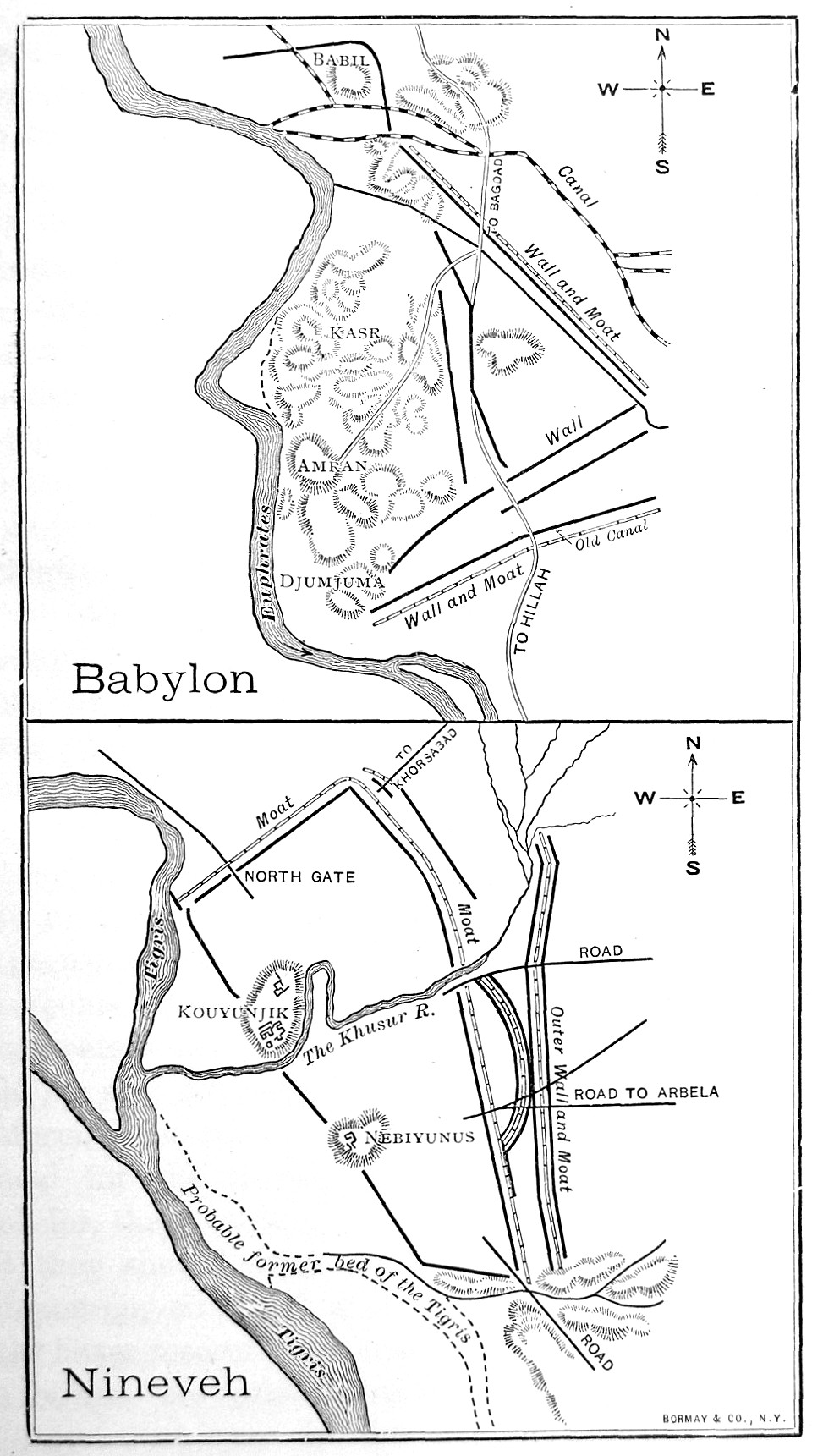
BY GEORGE STEPHEN GOODSPEED, PH.D. PROFESSOR OF ANCIENT HISTORY IN THE UNIVERSITY OF CHICAGO WITH A MAP AND PLANS NEW YORK CHARLES SCRIBNER'S SONS 1921 BY CHARLES
SCRIBNER'S SONS
Published October, 1902 PRINTED AT THE SCRIBNER PRESS NEW YORK, U. S. A. In Memoriam
C. R. G. JANUARY 20, 1900 PREFACE
THE
preparation of
this volume has occupied a much longer time than was anticipated when
the
invitation of the editors to contribute to this series was accepted.
The new
materials, constantly supplied by the indefatigable activity of
excavators and
by the scientific investigation of philological and historical
scholars,
require the unceasing adjustment, enlargement, and revision of
historical
conclusions, and force one quite to despair of reaching anything like
finality.
The historian of Babylonia and Assyria, therefore, must be satisfied to
sum up
fairly and fully the information at present in hand without undue
appreciation
of new and tentative theories. Accordingly, the present work finds its
justification in the desirability of putting a compact, popular, and
fairly
comprehensive sketch of the history of these ancient states, as it is
to-day
conceived, into the hands of all who are interested in the progress of
human
civilization in its earliest stages, and especially in the development
of the
peoples who came into so close relations with the Hebrews. It is
becoming
increasingly evident that the Old Testament in all its elements —
literary,
historical, and religious — cannot be adequately understood without
relating
them to the history of all the peoples round about Israel, and
especially to
that of the Babylonians and Assyrians, who exercised so potent and
permanent an
influence upon the fortunes and the thoughts of the Chosen People. A word is
desirable
concerning some special features of the book. (1) The
"Bibliography" does not pretend to he complete, but only to contain
the outstanding works in the vast field. (2) The
"References" are intended not merely to aid the reader in widening
the range of his knowledge of facts and details concerning the subject
under
consideration, but also to guide him in special investigation of
important
topics. (3) The
spelling of
the proper names does not rigidly follow any body of principles. When a
name
has become domesticated in a popular form, that form has usually been
chosen.
Otherwise it has been sought to give an orthographically accurate
reproduction
of the original. Often, at the first use of a name, hyphens have been
employed
to indicate its component parts. In the index of persons and places, an
attempt, doubtless quite imperfect, has been made to indicate the
proper
pronunciation of each name. No one can be more cognizant than the
author of the
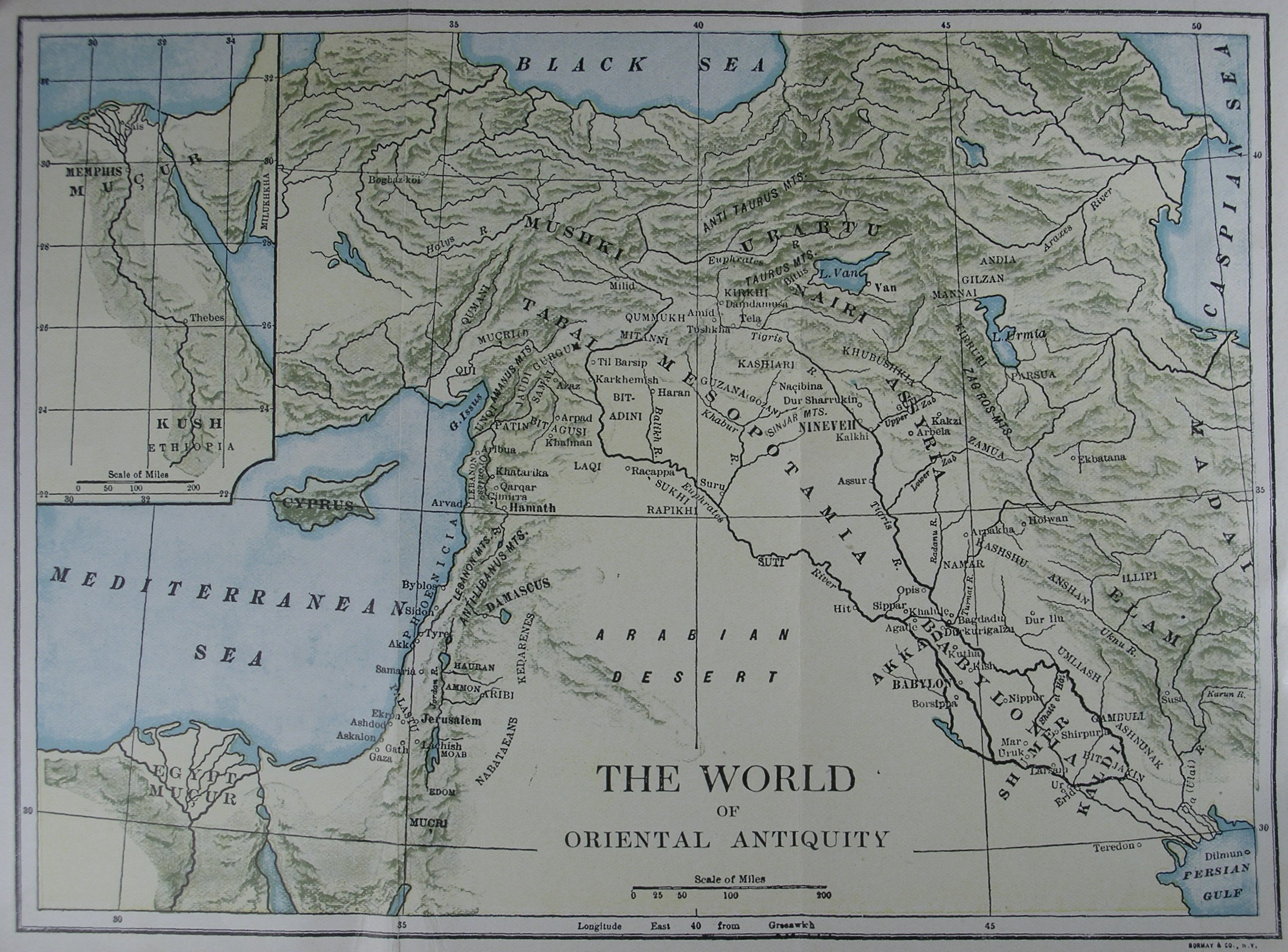
inadequate results achieved in respect to the whole matter. (4) The map has been
prepared with the purpose of indicating
the larger number of the places mentioned in the text. Accordingly,
some localities,
the positions of which with our present knowledge can be determined
only
tentatively, have been set down with what may seem to scholars not a
little
audacity. The desirability of being able to follow the description of a
campaign or to fix the location of a city mentioned has induced me to
run the
risk of seeming to be wise above what is known. My
obligations to
the scholars who for half a century have been working in the
Assyriological
field are manifest on every page of this work. Special mention should,
however,
be made where unusual service has been rendered, although I despair of
making
anything like complete acknowledgment. Abundant use has been made of
the
admirable series of translations contained in the Assyrian and Babylonian Literature,
edited by Professor R.
F. Harper. I am grateful to my colleague and friend, Professor Harper,
for the
cordial way in which he has assented to my request to employ these
translations. To my colleagues, Professors Ira M. Price and Benjamin
Terry, who
have read the proofs of the work throughout with critical and
painstaking zeal,
I am indebted far more than words can express for their invaluable
assistance.
I am likewise under obligation to my uncle, Dr. T., W. Goodspeed, who
has
rendered a similar service in connection with the manuscript. I have
been
favored with the generous help of another colleague, Professor W.
Muss-Arnolt,
who has placed at my disposal his admirable bibliographical knowledge
and his
wide and thorough acquaintance with the Assyrian field. If the work
shall be
found to represent, in some approximate measure, the present standard
of
Assyriological science, and to be reasonably free from faults of
expression,
the result is due in large part to the genial and sympathetic service
of these
friends, although they are not to be held accountable for either its
defects or
its opinions. To the editors of the series to which the volume belongs
I would
express my thanks for their encouragement and criticism in the course
of its
preparation; to the publishers, Messrs. Charles Scribner's Sons, for
their
generous co-operation in securing its typographical excellence, and to
the many
friends who have shown so warm an interest in the appearance of the
book. I
hope that to some extent it may serve the cause of sound learning, and
be
worthy, both in spirit and content, to stand beside the preceding
volumes of
the series. G. S. G.
THE UNIVERSITY OF CHICAGO, August, 1902. Since the
appearance of the first edition of this book some new discoveries have
been
made, chief among which has been that of the Stele of Khammurabi. This
important document has not, however, caused any material correction in
our
views of Babylonian life and history, but merely enlarged the details
of our
knowledge. Time has not permitted, nor has necessity required, any
considerable
changes in the text of this volume. Some " Additions and Corrections"
to the first edition will be found on page xiv. For most of the
emendations the
author is indebted to reviewers, whose interest in the volume, in most
cases
friendly, he here acknowledges heartily, and particularly to his
colleague, Dr.
J. M. P. Smith, who has placed at the author's disposal the results of
a
careful reading of the pages of the first edition. G. S. G.
December,
1903. P. 34,
lines 5-7
from top. Since these words were written the code of Khammurabi Of
Babylon has
been discovered (see below). P. 107, In the winter of
1901-1902 the French explorer De
Morgan discovered at Susa a broken stele about eight feet high, which
was found
to contain the law-code of king Khammurabi. After a prologue of about
300
lines, containing a glorification of the king for his services to the
gods and
the care of his subjects, follows a series of laws which is estimated
to have
contained originally some 282 separate regulations. Some 247 are now
legible.
The code is concerned little, if at all, with religious matters; the
chief
content is almost entirely civil and criminal, dealing with such
subjects as
marriage, the family, property rights, agricultural and commercial
activities. P. 115,
lines 5-9
from bottom. The Stele of Khammurabi declares that the king restored
the temple
at Nippur. Hence Hilprecht regards the ruins as due to an unrecorded
Elamite
invasion. See, also, the American
Journal of
Theology, vol. vii. p. 725. In the map
in the
front of the volume the site of Eridu is to be placed further down the
river
and on the western side. |