|
BLACKBOARD
SKETCHING
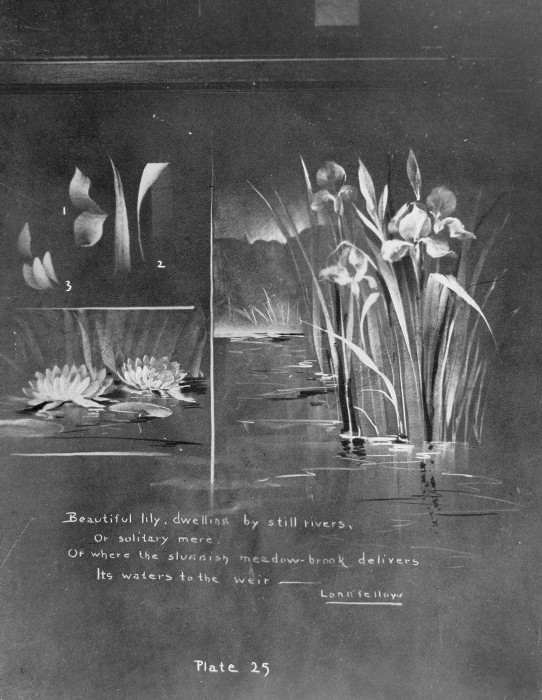
PLATE 25
This plate
was used
as an illustration for Longfellow's "Flower-de-luce." The pond-lily
may be used in nature study or as an illustration for some poem.
The
strokes necessary or useful in drawing these bits are shown at No. 1,
No. 2 and
No. 3. At No. 1 the chalk is placed in an oblique position, drawn
gradually
downward, and at the same time twisted to the horizontal position at
the middle
of the stroke. Try this stroke in a great variety of positions. The
spots
produced will be found useful in much of the flower and leaf drawing.
Apply
these in the fleur-de-lis.
The
strokes at 2
for the leaves were given and described on plate 4, and may be
appropriated
wherever reeds or grasses are to be drawn.
Stroke 3
is simple,
yet often found troublesome by pupils. Place the chalk in a vertical
position,
draw it quickly downward, twisting it to a nearly horizontal position.
Let the
accent be at the upper end of the stroke. Try a number of these
strokes,
letting them meet at the centre of the flower. In making the drawing of
the
pond-lily, accent the nearest petals.
The
reflection in the water, and the reeds in
the background are obtained by delicate vertical strokes, crossed in
the water
by occasional horizontal touches. Use simple curving strokes for the
lily pads.
|


 Click the book image to turn
to the next Chapter.
Click the book image to turn
to the next Chapter.