 Web
and Book design,
Web
and Book design, Copyright, Kellscraft Studio 1999-2007 (Return to Web Text-ures) |
Click
Here to return to Sand Dunes and Salt Marshes Content Page Return to the Previous Chapter |
 (HOME) |
|
CHAPTER X BIRDS OF THE SALT MARSHES
“TH’
Eele-murthering
Hearne,” or, as Chaucer has it, “the ele’s foo, the heroune,” is
perhaps the
most characteristic, certainly the most spectacular bird of the salt
marshes.
There are several different kinds of these hearnes or herons. The
smallest,
the little green heron, prefers fresh water, yet it is common enough in
the
marshes, especially on the muddy edges of the creeks at low tide, where
the
hunting is good. As it stands or walks it may draw in its head until it
appears
to have no neck, or it may extend it as long as its body. If one has
ever blown
a blade of grass stretched tightly between the thumbs side by side, one
will
recognize the voice of this bird, which mimics exactly the music of the
grass
blade. The night
heron,
half as large again as the green heron, is a familiar bird in these
regions.
Although, as its name would imply, it is largely a bird of the night,
yet, when
it has insatiable young in the nest clamoring for food, it must needs
work by
day. Indeed at all seasons it is commonly seen by day, but, when the
young
shift for themselves, it generally spends the hours of light in
slothful ease,
dozing in companies on the tops of bushes or trees. At dusk it is all
alert,
and flies to the beach and the marshes, squawking as it goes. It
delights most
in the lowest tides, for then it can fish in the pools and meandering
streams
of the sand flats. As one pushes a canoe along a winding creek in the
darkness
and silence of the night, there is nothing more startling than the
uncanny
cries with which these birds suddenly pierce the gloom. The adult
night
heron is a handsome bird, with its pearl-gray back and white breast and
with
its black crown and slender drooping plumes. It is very conspicuous as
it
stands like a sentry in the green marsh, but on the white sands it is
far less
noticeable. The most striking pictures made by these birds are to be
seen some
five miles away in the heronry — the source of supply for the whole
region. The
parent birds on the tree-tops, in a setting of graceful larch sprays
against a
clear blue sky, make up a scene which in beauty contrasts strangely
with the
hideous blackness and nakedness, as well as with the reptile-like
actions of
the young birds in the nests and on the branches below, and with the
filth that
assails the eyes and nostrils, and with the discordant cries that rend
the
air. Perhaps it is no more fair to judge of the family life and customs
of
night herons from a trip below the trees in which they are nesting,
than it
would be to judge of the customs of the Parisians by a journey through
their
sewers. Be this as it may, the noise and the stench of a large heronry
remain
long in the memory. The great
blue
heron is indeed a splendid bird, for it stands more than four feet
high, and it
is full six feet from tip to tip of its extended wings. Although it
formerly
bred in these regions, it does not do so now as far as I can discover,
yet it
may be seen there throughout the summer. It is most common, however, in
April
and May and after the middle of July. Exceedingly picturesque it is as
it
stands motionless in the green marsh, or stalks sedately along the edge
of a
creek, or flaps majestically over the water. Herons
were one of
the favorite quarries in the days of falconry, and Hamlet showed his
familiarity with this fact, as well as his sanity, in stating that he
knew “a
hawk from a hernshaw.” It has never been my fortune to see a hawk fly
at a
heron, but I once saw a common tern attack a great blue heron in a way
that
brought to mind some of the old hawking pictures. The screaming tern
darted at
the noble bird from above and behind, as it was winging its course high
above
the marsh. The heron screamed hoarsely, partly dropped its legs from
their
extended position behind, and, erecting the feathers on its head in
anger,
stretched and turned around its long neck in the endeavor to reach its
tormentor.
John Shaw
wrote in
1635 “that the heron or hernsaw is a large fowle that liveth about
waters,” and
that “hath a marvellous hatred to the hawk, which hatred is duly
returned. When
they fight above in the air, they labour both especially for this one
thing —
that one may ascend and be above the other. Now, if the hawk getteth
the upper
place, he overthroweth and vanquisheth the heron with a marvellous
earnest
flight.” In the
spring and
early summer one of the most characteristic sounds of the marsh is the
booming
or pumping of the bittern, a sound that always recalls to me many
pleasant memories
of a camp in the fresh water marshes of the Ipswich River, where
bitterns are
more abundant. The curious sound, which seems to come from nowhere in
particular, is in reality the love song of the bittern, and it so
exactly
resembles the working of an old pump that one expects to hear the
grateful
sound of gushing water. The unk-a-chunk
is repeated from three to eight times.
At a considerable distance the last syllable only is audible, and this
chunk so
closely resembles the driving of a stake into a bog that the bird is
sometimes
called by the country people the “stake-driver.” On one
occasion I
was so fortunate as to have a very good view of a bittern engaged in
the
production of this extraordinary song. By paddling my canoe vigorously
while
the bird was absorbed in his performance, and by remaining motionless
while he
was resting, I had eluded observation and had approached within a short
distance. This method is similar in plan to that employed in the
murderous
stalking of the capercaillie. As a preliminary, the bittern opened wide
its
bill, which it held straight up, and audibly gulped the air six or
eight times.
Then the “pumping” began, and with each pump the throat was swelled and
the
head ducked, as if the bird were terribly nauseated, and were
endeavoring to
rid its stomach of the air. It was not a graceful performance, or one
that
would seem to be especially attractive to a lady bittern, — but I
suppose it
was. Besides this curious song the birds have an interesting courtship display of soft fluffy white feathers which are ordinarily concealed, but which on this occasion are spread conspicuously on each side of the breast while the gallant cock-bird struts before the hen. 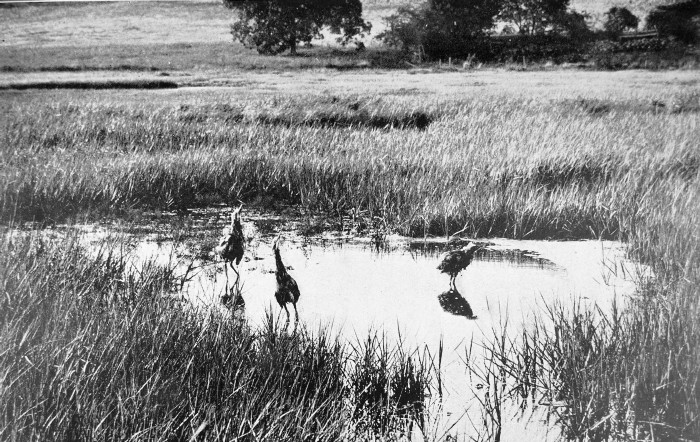 YOUNG BITTERNS Another
interesting
trait possessed by the bittern is its power of concealment. This is due
partly
to the streaked brown and pale buff plumage which matches admirably the
dead
tufts of grass, but chiefly to the motionless and un-bird-like
posture, with
upward pointing bill, assumed by the bird. It is sometimes almost
impossible
to point out a bird in this position that one has been fortunate enough
to see,
to another who has not seen it, so perfect is the protection afforded
by the
colors and the posture. I once started a bittern from the black-grass
region
of the marsh on a June day, and soon after realized that four objects
that I
had supposed were the stakes of a dilapidated gunner’s blind were, in
reality,
the outstretched necks of four young bitterns. When closely approached
they
abandoned this method of deception, snapped their bills loudly in
anger,
erected the feathers of their necks, spread their feeble pin-feathered
wings
and, emitting faint hissing snarls, sprang defiantly at me. Their
deserted nest
was near at hand, a thin, flat platform of dry grasses. The assumption
of this
posture-concealing habit early in life shows its antiquity and long
inheritance. Although I
have
described the beautiful evolutions of herring gulls as seen from the
dunes,
they must again be mentioned here, for the marsh in the autumn is a
favorite
resort for these birds. Then it is that one sees an acre or more of
brown marsh
become white like snow with these splendid gulls. Suddenly they rise,
the snow
vanishes as they turn in shadow, again to flash out in a brilliant
white cloud
high in the air. As they circle about, first one way then another, all
calling
and talking together, they rise higher and higher, when with a common
impulse
they descend with great rapidity, circling sharply and tipping their
wings from
side to side, and the patch of snow reappears in the brown marsh. At all
seasons the
herring gulls are fond of feeding in the creeks and estuaries at low
tide, and
one can often float in a canoe within close range of these wary birds.
They are
adepts at picking from the surface of the water any edible flotsam and
jetsam,
and they often do this without wetting a feather, save only the tip of
the
tail, which they spread and curve downwards to check their course.
Occasionally, however, they throw themselves at the water in order to
obtain
food below the surface, and, on rare occasions, actually disappear for
a
moment, bobbing up later to swallow their prey. Although
herring
gulls often spend the night on the beach, I have sometimes seen them
collect on
the marsh in the latter part of the evening, as if they were preparing
to sleep
there. One June day, between five and six o’clock in the afternoon, I
counted
over nine hundred of these birds slowly winging their way, singly and
in small
bands to a narrow island of green marsh, where they settled in closely
crowded
ranks. They were still coming in undiminished numbers when I stopped
counting. A long
list could
be made of the ducks that have been seen in the salt marshes, but alas,
in
these degenerate days, most of those on the list are of but rare or
accidental
occurrence. The early days are long passed when, in the words of
William Wood,
writing in 1634, “The Duckes of the countrey be very large ones and in
great
abundance, so is there of Teak likewise; the price of a Ducke is six
pence, of
a Teale three pence. If I should tell you how some have killed a
hundred Geese
in a weeke, 50. Duckes at a shot, 40. Teales at another, it may be
counted
impossible, though nothing more certaine.” The red-breasted merganser
or
sheldrake is still common enough in winter, and I have already
described at
some length this interesting bird. The whistler or golden-eye and the
black
duck are the only others sufficiently common to be included here. The
whistler
comes from the north early in October and remains with us until the
last of
April. The drake is a handsome bird, with its iridescent green head, a
round
white spot below its golden eye and its snowy breast and flanks. The
duck is
considerably smaller and has a dull brown head. They are shy birds and
are
always on the lookout for danger, and like the “fearefull Gull” are
quick to
“shunne the murthering Peece.” As they fly by or overhead they make
loud whistling
music with their wings, and it is from this that they get their common
name. Their
courtship is
still more spectacular than that of the sheldrake and would take long
to tell.
Suffice it to say that the drake bobs his head back so that it rests on
the
rump, — a most singular and undignified position for a suitor, — that
he
displays his orange-red legs with a spurt of water, and that he emits
an
extraordinary double note which is loud and rasping. In fact, he is
perfectly
irresistible, and the ladies all succumb, and each drake finds a duck.1
At sunset
all the
whistlers leave the marshes, where they have been feeding during the
day, and
fly out to sea to spend the night. It would be manifestly unsafe for
ducks to
sleep on the surface of the narrow creeks, for they would either be
carried by
the wind or tide against the banks or stranded on the flats, whereas on
the
surface of the ocean they can rest undisturbed. In the daytime I have
noticed
that sleeping ducks, with their bills buried in the feathers of the
back, head
up into the wind, and that they paddle gently so as to keep in the same
place.
Sometimes, with one leg tucked under a wing, the bird paddles with the
other,
so that it revolves in a circle. The black duck has a different outlook on life, for he prefers to feed by night, and when the whistler goes to sleep on the sea, he arises from his daytime slumbers in the same region and repairs to the marshes. These two ducks are the Box and Cox of the marshes. I have seen great flocks of black ducks floating in a long line off the beach in the bright sunlight, most of them fast asleep. They are alert birds, however, and cannot be caught napping, for there are always some on the watch, and even the sleepiest awake from time to time, stretch their wings and yawn, as they look about before settling down for another nap. Occasionally, and especially in stormy weather, one may be fortunate enough to find a great black mass of these birds sleeping on the beach. They present a curious sight, and loud is the roar of their wings as they rise into the air. Unlike the sheldrake, the black duck does not need a run to launch his aeroplane into the air, but has strength of wing enough to rise straight up even in a dead calm. Unlike the sheldrake, also, the black duck is present in the summer as well as the winter, for it breeds in near-by swamps, and visits the salt marshes for food. There are reasons for believing that our summer black duck is a different race from the winter one, which comes from the north and is a larger bird, with a thickly spotted throat, yellow bill and bright red legs. 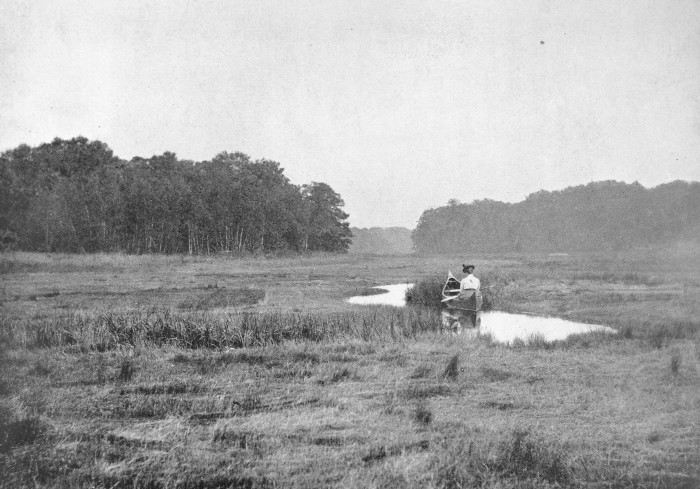 IN THE UPPER REACHES OF THE CASTLE NECK RIVER Rails are
familiar
birds in certain salt marsh regions. Not so at Ipswich, for only during
the
migrations are they found in these marshes, and then only at rare
intervals,
for they seem to prefer fresh-water swamps. I have several times found
sora
rails in the fall there; once I heard what I believed to be a black
rail; and
once I was treated to a very near view of the rare clapper rail, as he
ran
crouching along a mud flat and disappeared into the thatch. I quickly
landed
from my canoe and ran into the grass, when he arose from under my very
feet
with feeble wings and dangling legs, and flew off a few yards into the
marsh.
His large size, long curved bill and gray color made his identification
certain. The king rail is uncommon but less rare here than the clapper
rail,
which it resembles closely except that it is of a rich brown color. Although
many shore
birds are nearly as much at home on the marsh as on the beach, most of
those
that are found on the marsh are distinct from the beach-loving birds.
The
smallest sandpiper of all, the mud-peep or least sandpiper, has the
manners and
customs of its cousin of the beaches already described. It is a gentle,
confiding bird and when it is intently feeding one can almost catch it
under
one’s hat. From the sand-peep it is distinguished by its slightly
smaller
size, by its browner back, by its slightly decurved bill and by the
greenish-yellow legs. A sand-peep in a flock of these birds of the
marsh looks
decidedly sandy-colored and out of place. A larger
edition of
the least sandpiper, as Ralph Hoffmann has well called it, is the
pectoral
sandpiper or grass bird, a bird I have never seen outside of salt
marshes.
Unlike most of the members of the sandpiper family, the male grass bird
is
larger than the female. It is a bird that at times visits the marshes
in
numerous flocks, pouring down in great flights from the north in the
fall, but
in the spring it is not to be seen here, for it goes to its breeding
grounds by
an inland route. Its note is a rolling whistle like that of the peep,
but it
also emits a characteristic grating kriek.
A familiar
bird of
the marshes, and one that visits also the upper regions of the beaches,
is the
spotted sandpiper or teeter-peep, so named because the adults are
spotted and
because they all, young and old, have a nervous trick of teetering the
body,
sending the tail up and down as if it were on springs, and jerking the
head and
neck in and out. When this is accompanied by short walks back and
forth, and by
frequent turnings of the body, the effect is almost ludicrous. Their
flight
with vigorous down-curved wings and alternate scaling, is as
characteristic as
their teetering and their loud double whistle. In the spring they
often repeat
their whistle rapidly while they are flying about on quivering wings —
a
nuptial song and dance, no doubt. They are interesting birds and would
doubtless
increase if the boy with the gun would leave them alone, for they breed
back of
beaches and on the islands along the coast. A near
relative of
the spotted sandpiper, one that resembles it in many ways, is the
solitary
sandpiper, frequenter of mud holes in the marsh as far removed as
possible from
salt water. It teeters, but in a much less exuberant manner than its
spotted
cousin, and, when it flies, its beautiful tail with white feathers
veined with
black and its pointed black wings make it easy of recognition. Both
spring and
fall, on its journeys to and from its breeding place in the north, the
solitary
sandpiper is to be found in the marsh in small numbers, for it
generally lives
up to its name and is solitary, although occasionally two or three are
seen
together. Only within a few years have its eggs been found, and, like
the
redshanks of England, it lays them in the deserted nest of some other
bird in a
low tree or bush. The
dowitcher
resembles the snipe, but it lacks the robust, almost corpulent form of
that
bird, for it is decidedly more slender. While the snipe bears the name
of
English, the dowitcher
is for some reason named German,
for “dowitcher” is
believed to be a corruption of deutsche.
Owing to its red breast it is commonly
called “red-breasted snipe” or “robin snipe,” while from the color of
its back
it is also known as “brown-back.” The local names for our shore birds
are
legion. Gurdon Trumbull, in his “Names and Portraits of Birds which
interest
Gunners,” gives eleven other names besides those already mentioned. He
has
also collected as many as twenty-seven names for the black-bellied
plover! 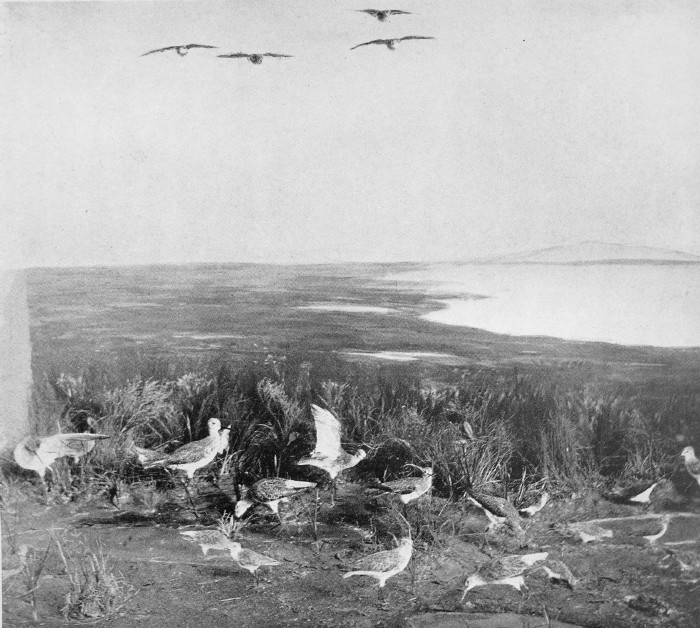 GROUP OF BIRDS OF THE MARSH Boston Society of Natural History The
dowitcher is a
confiding bird, and is only too anxious to fly in among the gunner’s
decoys, so
that it has dwindled ominously in numbers of late years. Fortunately
most of
the birds go south in July and early August, and as the opening of the
shooting
season is now delayed until the middle of August, there is still a
chance that
this charming bird may not be totally exterminated. Another
bird that
has been in danger of extinction is the upland plover, which is now
protected
by law at all seasons. Although, as its name implies, it frequents the
uplands,
it occasionally alights in the black-grass region of the marsh, and,
as it
extends its wings straight up over its back and then slowly folds them,
it is a
beautiful object. After this preliminary it stretches its neck and
looks carefully
about, for it is extremely cautious and shy, and takes alarm at the
least sight
of man. In walking, the neck and breast are thrust in and out in a
dove-like
manner, and the short tail is held parallel with the ground. It is a
fast
runner and generally manages to get some object between it and the
prying man.
When it stands still, it nods its head like a nervous hen. Its call
note is a
delightful bubbling sound that drops down from the sky as the bird
flies over.
I have heard it by night as well as by day, and its sweet but mournful
character, and a certain strange unbirdliness, make it very
interesting. One
can only hope that this bird — which, by the way, is a sandpiper and
not a
“plover” — will some day breed here regularly, as in the days gone by. Perhaps
the most
characteristic shore birds of the salt marshes, birds that very rarely
wander
to the beach, are the yellow-legs, both greater and lesser, or, as they
are
generally called in these Ipswich regions, “winter” and “summer.” The lesser
or
summer yellow-leg is very rare in the spring migration, for it goes
north by an
inland route, but in the fall it is generally an earlier migrant than
the
greater, as it is rarely seen after the middle of September, while
that bird
is generally most common in October, and is, moreover, an abundant
spring
migrant. Both birds have long yellow legs, long necks and bills and
white
rumps, but the greater, le grand
Chevalier a pieds jaunes of the Acadians, is a
third larger than the lesser, and is indeed a fine bird. Both birds
have long
pointed wings, and they alternately scale and fly with down-curved
strokes;
both lift their wings high over their backs before folding them on
alighting,
and both nervously teeter. They peck at their food with sudden thrusts,
more in
the manner of a plover than a sandpiper, and both have call notes,
which,
although very similar in the two species, are yet easily distinguished.
The
alarm notes are a series of loud wheus,
deep and in volleys of six or eight in
the case of the “winter,” but in less number and higher pitched in the
case of
the “summer.” Not
infrequently in
the spring the marshes are filled with sweet and plaintive whistlings,
the love
song of the greater yellow-legs. If a man appears on the scene, the
tone
changes to one of loud alarm, which warns not only their own species of
danger,
but all other shore birds within hearing. At times they give vent to a
prolonged roll, like that of a flicker, but the notes follow each other
so
slowly it is possible to count them, an impossibility in the case of
the
flicker. This roll is heard at times in the fall, and is also given,
but in a
more rapid fashion, by the lesser yellow-legs. So much
for the
water birds of the salt marshes; they are a charming group and much
more could
be said of their delightful ways. There are certain land birds to be
mentioned,
however, that are equally at home in these regions. Chief and most
characteristic of these is the sharp-tailed sparrow, a bird that bears
the same
relation to salt marshes that marsh wrens do to fresh water marshes.
The
sharp-tails are difficult birds to find, and are generally an unknown
quantity
to the casual observer. They conceal their nests in the grass of the
higher
parts of the marshes, and under windrows of dead thatch. They move
about like
mice running with head low, and, when flushed, fly concealed, if
possible,
between the banks of a ditch. On alighting they at once disappear in
the grass.
However, one can become intimate with them by the exercise of due
caution and
patience, and they will even sit near at hand on a swaying grass blade
and pour
forth their song. I have heard the song given fifteen times in a minute
by an
ardent performer, and I suppose that his lady-love appreciated it.
There is no
accounting for tastes, as the song of the sharp-tail is a peculiar
melody that
resembles more closely the hiss of a hot iron in water, or the sinking
of the
foot into the oozy marsh than it does a song. Near at hand one can hear
two
short notes that follow immediately after the song. Occasionally the
bird is so
carried away by the rapture of his passion and music that he mounts in
the air
with quivering wings to the height of thirty or forty feet and pours
forth his
soul in rapid repetitions of the song as he drops to earth again. He is
frequently unable to fly high enough to unwind his complete repertoire in the
descent, for he often continues to sing after he has alighted in the
grass. 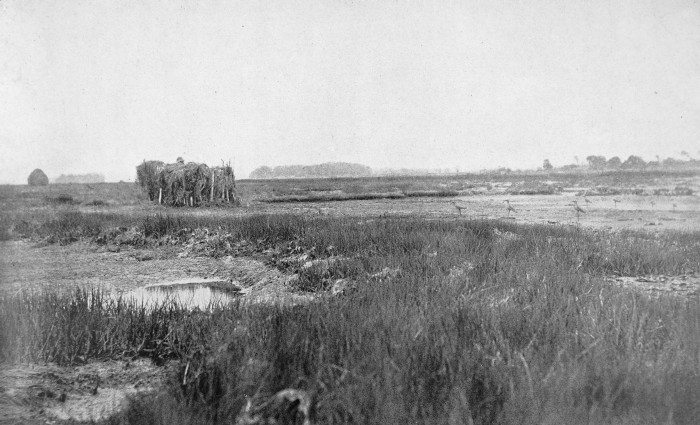 THE GUNNER’S BLIND AND DECOYS AT THE SLOUGH The
sharp-tail
sparrows bring forth two broods of young, which wear a very different
dress
from their parents, and look in their yellow and buff the exact
counterpart of
female bobolinks, but much smaller. Closely
related to
these birds of our marshes is the Acadian sharp-tail, which breeds
farther
north, along the northern half of the Maine coast and in New Brunswick
and Nova
Scotia. It passes through the Ipswich marshes late in May and early in
June,
and has similar habits and song, but can be distinguished by its
slightly
larger size and by its buffy and faintly striped breast. The
Savannah
sparrow, already described in the chapter on dune birds, is a common
frequenter
of the marsh and one that breeds in the same situations chosen by the
sharp-tail. Its famous cousin, the Ipswich sparrow, very rarely strays
marshward, and when it does its gray, sandy-colored plumage is very
noticeable.
Besides
those
already mentioned the list of land birds that visit the salt marshes is
like
that of the plants, somewhat limited. The marsh hawk, with its long
tail and
flashing white rump, frequently sails close to the surface, and rarely
the
short-eared owl may be seen there. The kingfisher — almost a water bird
— is
often there, and, in the absence of dead trees or of masts of boats,
watches
for its prey from the marsh bank. The crow and all the swallow tribe
are very
fond of the salt marshes, while the meadowlark, bobolink, red-winged
blackbirds
and grackles are as much at home there as in the upland meadows. The
kingbird,
robin, and song sparrow, the pipit, horned lark and, rarely, the snow
bunting
and Lapland longspur are also to be found there. I have seen yellow
warblers
drop down into the black grass from the near-by uplands, and several
times in
February I have found little flocks of myrtle warblers flitting from
pile to
pile of thatch where it extended above the ice, hunting for dormant
spiders and
other insects. Strange surroundings for a member of the delicate tribe
of wood
warblers! ______________________
1 For a full account of
the courtship
action of this bird and of the eider see “A Labrador Spring,” pp.
84-95. |
 Click the book image to turn
to the next Chapter.
Click the book image to turn
to the next Chapter.