 Web
and Book design,
Web
and Book design, Copyright, Kellscraft Studio 1999-2007 (Return to Web Text-ures) |
Click
Here to return to Sand Dunes and Salt Marshes Content Page Return to the Previous Chapter |
 (HOME) |
|
CHAPTER XI THE HORSESHOE CRAB AND OTHER DENIZENS OF SAND AND MUD
THE
horseshoe or
king crab is an interesting beast, the sole survivor of an ancient and
high-born lineage. Ancient in that it is related to the trilobites,
highborn
because it suggests an alliance with the curious ostracoderms. The
first of
these, the trilobites, are found in the rocks of the Cambrian period,
the most
ancient of all fossil‑bearing rocks, and they became an important race
in the
lower Silurian age, only to dwindle and die out before the Palaeozoic
times
ended. Incidentally we may learn a lesson from their fall as well as
from the
fall of other groups of animals now extinct, for they all, like the
ancient
Romans, indulged in bizarre and extravagant developments just before
their
decadence. The ostracoderms form a strange group of animals that
flourished in
the Devonian period, and, while neither fish nor crab, they combined
certain
features of both. To these relations of our humble horseshoe crab is
given,
therefore, somewhat tentatively it may be, the distinguished honor of
being the
progenitors of the vertebrates, of linking this highest group of
animals with
the lowly invertebrates, of bridging the yawning chasm between the
back-boned
and the back-boneless. 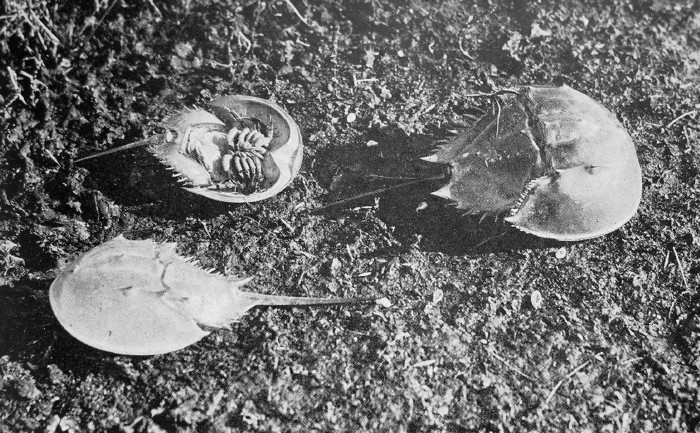 HORSESHOE CRABS 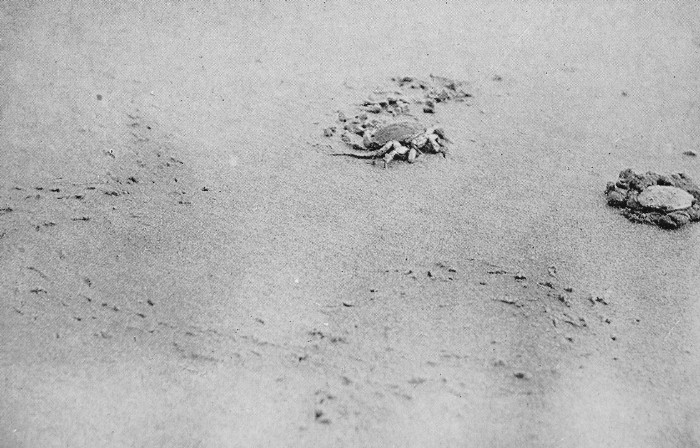 ROCK CRABS AND THEIR TRACKS When one
meets a
horseshoe crab, therefore, it is well to treat him with respect for
the sake
of the trilobite and the ostracoderm with their strange histories. His
days are
probably numbered, for, although he is abundant in these regions,
there are
only two living species left in his class, one, this friend of ours of
the
marsh and beaches, which extends its range from Maine to Mexico, the
other, a
species that lives on the eastern Asiatic coast. In the
early part
of the summer these strange beasts are busy depositing their eggs in
all the
sandy and muddy estuaries. They go about in pairs, the larger female,
often
dark and weather beaten, followed tenaciously by the smaller male.
Later in
the summer the high tides float up the delicate empty shells of the
young
horseshoes in hundreds on the marsh, for, like all crabs, growth is
accomplished only by splitting and shedding the outside skeleton or
shell.
From this discarded cuticle emerges a soft-shelled and helpless
individual. In
this state, however, they are not often found, first, because the stage
is
short, and secondly, because they remain concealed until they harden
sufficiently to brave the rough world. When in the usual condition they
are
provided with a weapon, which, for a bare-footed man at least, is most
formidable. I refer to the long terminal sharp-pointed spine or tail,
which
they can erect at will. The horseshoe is a fair swimmer and walker,
and
advances straight forward, disdaining the indirect methods of true
crabs, and
it burrows deep in the sand by pushing its rounded front under the
surface. The beach
flea, he
of the large eyes, a plump, clean, shrimp-like creature about half an
inch
long, owes its name to its hopping powers only, — for it does not bite
the
living but only the dead. It is one of the most important beach
scavangers, and
dwells in holes from eight to ten inches deep near high-water mark. In the
early
morning, before the sun has dried the sand or the wind blown it away,
one may
see a continuous city of conical mounds made by these little workers
stretching
in a band along the upper beach. If one can lose all sense of
proportion, a
state of mind easily acquired by viewing these mounds on the ground
glass of a
camera, they suggest pictures of the mounds of white ants, or of the
tents of
an encamped army. As the waves of the flood tide wash away these
erections, the
water, entering the holes of the beach flea, expells air which bubbles
up for
several seconds at a time, leaving multiple craters like those of the
moon. In
the daytime this crustacean rarely ventures abroad, but at nightfall
the
upper beach is fairly alive with their little plump forms, hopping
about,
seeking what they may devour. Their night of feasting and play over,
they dig
their holes, in which they remain for the day. Another
beach flea,
a smaller, browner creature, exists in immense numbers in the
sea-wrack of the
beach, where it serves both as a scavanger and as a food for shore
birds, — two
very laudable purposes, but not equally appreciated by the beach flea. Another
little
crustacean that I will call the beach sow-bug, as it lacks a common
name, is
flattened from above downwards instead of from side to side, like the
beach
flea, and makes interesting wandering marks between tides, for instead
of
hopping like its nimble cousin it progresses very slowly below the
surface.
Similar marks are made by periwinkles and other small mollusks, while
the
clam-worm writes its name in the same way but more plainly. The
clam-worm is
worthy of more than passing notice, for, if one looks fairly at it, it
is not a
disgusting beast but one of considerable beauty. Indeed it is called
scientifically
a sea nymph. It is often a
foot or more in length, of a bluish green color and
somewhat iridescent, and it is provided on each side of its flattened
body with
innumerable bristle-bearing legs. It is a voracious creature, and
comes out of
its burrow in the sand or mud to feed on other worms and on small
shrimps and
snails, which it captures with a pair of horny notched jaws that are
kept
concealed in its gullet until needed. While on the subject of worms, I must mention the sea-mouse, an extraordinary worm from three to six inches long, which is occasionally cast up after a storm on the beach. Its broad back is so thickly covered with bristles that it appears to be clad in fur and remotely suggests a mouse. 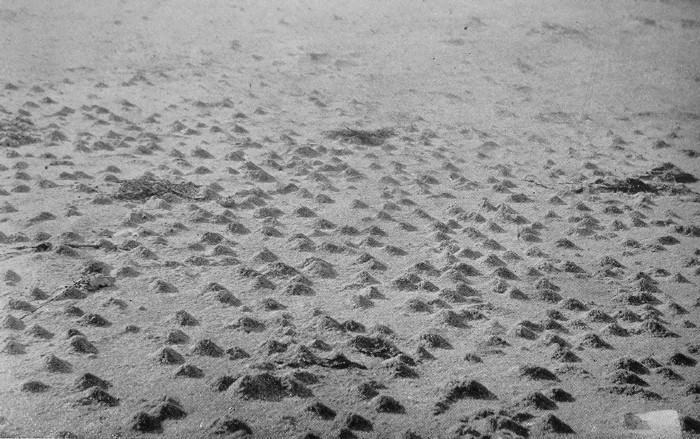 MOUNDS MADE BY BEACH FLEAS 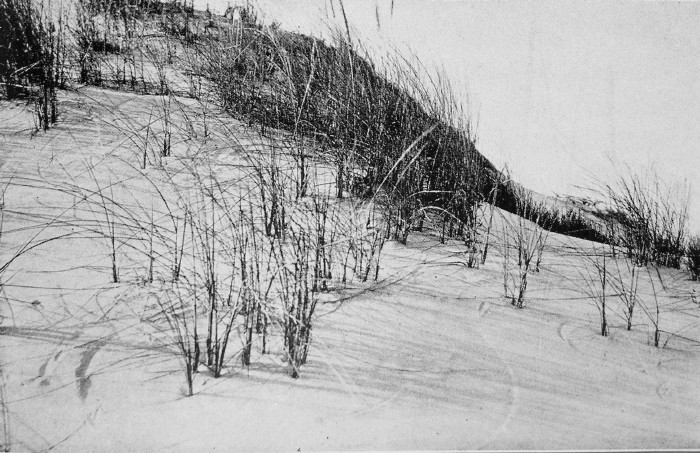 CIRCLES MADE BY THE GRASS BLOWN BY THE WIND The green
crab,
called by the scientific crazy — moenas
— and by the French enragé,
on account
of its lively behavior and reckless audacity when brought to bay, is
fonder of
the milder water south of Cape Cod, where the gulf stream meanders,
than it is
of the shores washed by the arctic current. In the summer of 1901,
however, it
appeared in scanty numbers in the waters of Fox Creek, a tributary of
the
Ipswich River. The next year it had spread to the Castle Neck and Essex
Rivers
and was reported as far north as Kittery in southern Maine, while in
the
summer of 1903 it was abundant everywhere in the creeks, marshes and
beaches.
The winters, for some time mild, took on an arctic severity in 1903-4,
and I
was unable to find, any green crabs the following summer. Milder
winters have
followed, and by 1910 this crab was fairly abundant again. Although
green in
color with yellow markings when alive, it becomes reddish when dead and
cast up
on the shores, but its shape easily distinguishes it from the common
rock crab.
Whether it has established itself firmly here or has made but a
transient
extension from its more southern home I do not know. Our own
common rock
crab, notwithstanding its name, is an abundant frequenter of these
sandy
shores, both on the outside beaches and in the more sheltered
estuaries. It is
fully as lively as its crazy cousin, and at dead low tide one can
quickly pick
up a basket full in the shallow waters if he is skilled in avoiding the
nipping
claws — otherwise it will be a long and painful process. It has a
habit of
burrowing in the sand of the beach, where it remains concealed, with
the
exception of a narrow crevice in which may be seen its watchful eyes.
The gulls
often find them there, pull them out and batter them to pieces. They
are good
eating — almost equal to the lobster, which is comparatively rare here.
Occasionally
one
notices a rougher, more massive looking crab, otherwise similar to the
rock
crab. This is the Jonah crab, the origin of whose suggestive name is to
me
unknown. The
sea-urchin,
lover of rocky bottoms, is only occasionally thrown up on these sandy
shores.
When I meet him I wonder why I can always recall his elaborate name,
Strongylocentrotus
drobachiensis, with such readiness, when for the life of me
I often fail to connect Mrs. Brown or Mrs. Jones with their somewhat
simpler
cognomens. Strongylocentrotus, however, is an old friend of mine, and
years
ago, when I combined the study of marine invertebrates with ornithology
as a
member of the Champlain Society at Mount Desert, I used often to bring
up a
dredge packed full of sea-urchins. These
spiny balls
suggest Shakespeare, for Shakespeare calls a hedgehog an “urchin.” “Ten thousand
swelling toads, as many urchins,” and to this day the
dwellers in
Warwickshire, through which the Avon flows, call the hedgehog
“urchin,” and is
not the sea-urchin as bristly as a land-urchin? Broken pieces of
sea-urchins
are not uncommon on the sides of the marsh drumlins, where they have
been borne
by crows and gulls and dropped from a height to break their shells, a
fate that
is abundantly meted out to the large sea-snails by the same birds.
Another
member of
this group of echinoderms is the sand-dollar, which delights in sandy
bottoms
and is found at and below low-water mark on the outer beach. Like the
rock crab
it burrows in the sand, but reveals its presence there by a slight
circular
elevation of the beach. In life it is covered with short spines, which
give it
a brown color, but to most persons its bleached and spineless cases
thrown up
on the upper beach are more familiar. The more
distinctly
five-rayed members of this family, the starfishes, are in places
abundantly
represented on these shores below low water by the common starfish and
by the
Forbes’ starfish. The latter resembles the common kind very closely but
is
easily distinguished from it by its light orange madreporic plate —
the
porous stony plate through which the sea water enters the wonderful
system of
canals that end in the innumerable foot tubes by which the animal drags
itself
along. Starfishes are ravenous creatures, and have a habit of
protruding part
of their stomachs and sucking in their prey. They are much disliked by
oyster
men, who, it is said, used formerly to cut up any starfishes they
caught and
throw them overboard, not realizing that an arm with a portion of the
body
attached will, by pushing out new arms, become a new individual. Thus
they
increased rather than diminished their enemies. It is common to find
individuals
with one or more baby arms just appearing to take the place of those
lost by
accident. If one
takes the
trouble to examine the great devil’s aprons that are thrown up on the
beach
after a storm, he will find among the powerful root-like extensions
from the
stem, which are fastened tightly to a mussel or stone, a veritable
museum of
lowly marine life. Among these are not infrequently to be seen some
odd-looking
starfishes with distinct disk-like bodies and spider-like arms which
break
easily on handling. These are the so-called “brittle-stars,” and if
they are
uninjured by their shipwreck, they will wriggle about actively and
actually
break off one or two of their legs in their desire to escape. It would
almost
seem as if they were inspired with the same object that leads lizards
to shed
their tails in order to distract their pursuers from the real thing. As the
tide ebbs
one often finds on the sand — but not denizens of it, as the heading of
this
chapter would imply — the once free-swimming jellyfishes. They are
sadly
bedraggled by the waves, and entirely lack the graceful form and
throbbing
rhythmical movements which so excite our wonder when the animals are at
home on
the surface of the sea. The commonest of these is aurelia, with its
transparent
bluish-white disk eight or ten inches in diameter, and its group of
four sacs
in the middle, conspicuously straw colored or yellow in the females and
pinkish
in males. In the early part of the summer these jellyfishes swim
strongly, and
generally avoid the beach, but towards the end of the summer they
become old
and feeble, and are more often cast ashore. At this time the strange
looking
young, which are retained in the folds under the disks, are set free
and attach
themselves to rocks or seaweed, where they develop into little saucers
piled
one above the other, to be released and become veritable jellyfish the
next
spring. Less
frequently the
large red arctic jellyfish is thrown up on the beach, looking like a
great
disorganized mass of coffee jelly. In its prime at sea this is a
wonderful
animal, as it has been known to measure seven and a half feet across
the disk,
and to have tentacles more than one hundred feet long. These same
Medusa-like
tentacles are to be avoided like the Gorgon’s locks, for they are
plentifully
supplied with lasso-cells, which sting the naked skin as with nettles. Among the
collections of delicate and graceful seaweeds that are carefully
spread out
and dried by the amateur, one often finds beautiful silvery, branching
specimens, which are in reality not seaweeds at all, but hydroids,
humble
relatives of the jellyfishes we have just been considering. On close
examination one sees a multitude of little horny caps attached to these
plant-like stems. They are great colonies of animals living together,
and are
not far removed from the corals. A still
more lowly
group of animals, several of whose representatives are thrown up on the
beach,
is the group of sponges often considered plants, but which the great
Aristotle
rightly contended were animals. These northern sponges are, however,
lacking
in the elastic qualities which make the sponge of commerce so
valuable, for,
when dry, they are brittle and easily pressed to powder. The commonest
species
is the finger sponge, which is orange-red in color when the animal is
alive,
but which later bleaches to gray or white. Its powerful sulphurous odor
when
brilliantly colored is apt to discourage the attempts of amateurs to
preserve
it. Another common species is appropriately called the bread sponge,
for it
looks for all the world like a piece of soggy bread. It is generally
about the
size of a small muffin, but I once found one as large as a ten-cent
loaf. A whole
book could
be written on the group of mollusks, or indeed on any of the groups of
marine
animals, but the true shell-fish are more abundantly represented in
number of
species than any other group. A few of these only can be considered.
Like the
horseshoe crab, the great sea-snail, scientifically known as Polynices,
— the
son of Oedipus the tyrant, — pushes the sand along in a little mound as
it
advances below the surface. When it is moving on the surface, one is
astonished
at the large size of the animal, with its immense foot, as the portion
on which
it creeps is called, and wonders how it can possibly retire into its
shell. If
one picks it up, it at once pours out water as from a watering pot,
rapidly
shrinks in bulk, and not only draws its entire body into the shell, but
shuts
the door after itself with a tightly fitting, horny operculum. This
sea-snail,
like all dwellers in or near the sea, has a tremendous appetite, and
devours
all sorts of game, dead and alive. It is particularly fond of other
members of
the same group of mollusks, and, in order to suck out their insides, it
has a
habit of boring a little hole through their shells as smoothly as if it
had
used a drill. This it does by means of a fleshy ribbon armed with rows
of teeth
that it conceals in its mouth, an instrument known as the lingual
ribbon.
Everywhere along the beaches curious sand collars, as the children call
them,
are to be found. These are shaped like the small boy’s broad collar and
are
open in front. When wet they are flexible, and, if held up to the
light, they
are seen to be studded with small, round transparent bodies. These are
the
eggs of the sea-snail, and she makes for them these curious egg cases
of sand
granules firmly glued together. Lining the
beach in
windrows are generally to be found the pretty shells of another
mollusk, which
I shall call the wicker-basket shell, for that is the translation of
its Latin
name. Nearly all these shells are bored, and there is reason to believe
that
they are the victims of their own brothers and sisters, for like the
son of
Oedipus, the tyrant snail, they are provided with lingual ribbons,
fierce
appetites and loose morals. It is a
relief to
turn to a vegetarian mollusk, and one which has a common English name.
I refer
to the periwinkle, — the same that Leech’s delectable Tom Noddy enjoyed
eating
with a pin on the top of a London bus. Indeed, the great ugly, dingy
gray
European periwinkle now swarms along our coast, and is crowding out the
smaller, brighter-colored and more delicate native species. It is the
English
sparrow among mollusks. Another
univalve
which is common to both sides of the northern Atlantic is the “purple”
snail,
whose shell is white or yellow or brown, plain or banded. If one has
ever
broken this little mollusk, and used it for bait, he will remember how
deeply
crimson stained became his fingers. In former times red must have been
called
purple, as witness the purple finch, which is red, and the old Tyrian
purple,
which was crimson, and was indeed obtained from near relatives of this
same
“purple” snail. Another snail of wide distribution that is found on
this beach
is the whelk. In England it is cooked and eaten. So much
for the
shells with one valve, the gastropods as they are called, because they
walk
upon their stomachs. The shells with two valves are equally numerous on
this
coast, and we can begin with the edible mussel, the blue mussel that is
common
to both the European and the northern part of the American coast.
Abroad it is
an important article of diet, but in wasteful America it is as yet
almost
totally disregarded. It occurs in great blue-black beds in the tidal
estuaries,
where it is held in place by tough fibrous threads called the byssus.
Although
its yellow contents are scorned by most Americans, it is much
appreciated by
certain sea ducks, especially by the great group of scoters, who
swallow the
mussels shell and all, and grind them up in their powerful gizzards. The sea
mussel is a
stouter, larger species with variously colored shells, and these are
generally
cast up on the beach after a storm, tightly embraced in the roots of
large
devil’s aprons. Another mussel which lives partly embedded in the mud
or peat
of the salt marshes is the ribbed marsh-mussel. The empty
shells of
the razor-fish are common objects on the shores of the estuaries. They
are
long and narrow and sharp on the edges, all of which characters
probably account
for the name. They live in burrows in. the sand near low-water mark,
and are
able to descend with such rapidity to a depth of two or three feet that
one
must be a rapid digger to catch them. By approaching quietly and making
a
sudden thrust with the spade obliquely below them, one may sometimes
cut off
their retreat. The method of their descent is interesting, and easily
observed
in a captive razor. The foot is thrust downward into the sand in a
point, and
then expanded at the end into a bulb or disk, which acts as an anchor
so that
the animal can pull itself down. The act is rapidly repeated, and the
razor
soon disappears from sight. Thrown up
on the
outer beach after storms one often finds the thick, heavy shells of a
mollusk
that is shaped like the little-necked clam or quohog, but it is larger
than
that bivalve as usually served on the dinner table, Its scientific name
is
suggestive of the north, for, being translated, it is called the
“Icelandic
Arctic.” It has no common name, but it may be called the northern
quohog from
its resemblance to its more southern relative. Still more
common
on the beach are the delicate valves with greenish-yellow and highly
glazed
epidermis of Count Yoldi’s shell. But
perhaps the
most conspicuous dead and empty shells that are to be seen thrown up on
the
outer beaches are those of the sea-clam, or giant clam, as they are
sometimes
called. These are the kind one finds in farmhouses on the coast
wonderfully
decorated with pictures of lighthouses or of vessels floating on blue
waves.
This clam is from five to seven inches long, white within and without
when dead
and weather beaten, but covered on the outside when alive with a pale
brown
epidermis. It lives close to low-water mark and so near to the surface
that it
is easily dug with a short stick or the fingers. The clammer walks
along with a
clam fork and prods every suspicious hole or slight elevation of the
sand. If
the clam is there, its tough, hard shell is easily detected and soon
brought to
view. An expert can follow an amateur over the same stretch of beach
and find
six to his one. I remember years ago riding a bronco pony along a
lonely beach
on Cape Cod, and jumping off whenever I saw signs of one of these
clams. As
far as I know this form of clam hunting is unique. It takes but a few
of these
great clams to make a chowder of ample proportions and most excellent
flavor. But after all the most famous bivalve of these shores, one which in its turn has made Ipswich famous, is the clam, — sand clam or soft-shell clam. Here indeed it is a sand clam, and its shells are thin and white and clean, and its flesh clear and transparent, very different from the dirty and dwarfed clams that are to be found in black dock mud. According to John Winthrop the clams at Ipswich feed only on the white sand! Much has been written on this mollusk, and its charms have even been extolled in verse. An Ipswich poet, in reviewing the attractions of his native town, ends his list as follows:
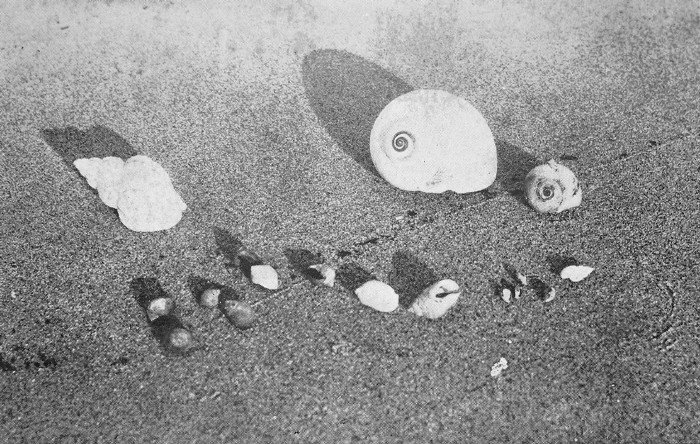 Whelk Sea-Snail Wicker-Basket Snail Periwinkle Purple Snail Black-footed Snail 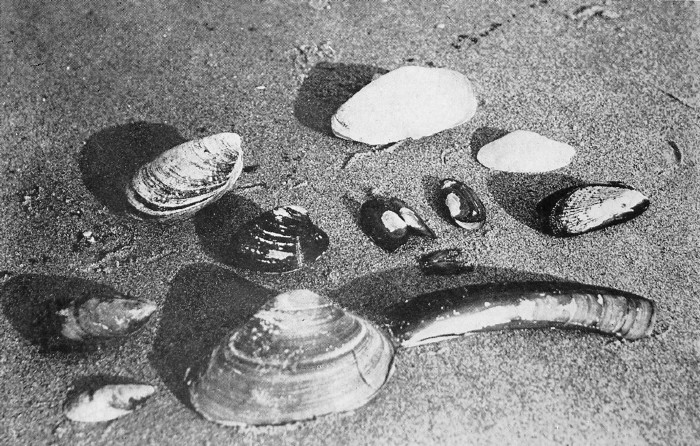 Northern Quohog Sea Mussel Common Clam Marsh Mussel Edible Mussel Sea Clam Count Yoldi's Shell Razor Shell William
Wood says
of these New England clams: “Clamms or Clamps is a shelfish not much
unlike a
cockle, it lyeth under the sand, every six or seaven of them having a
round
hole to take ayre and receive water at. When the tide ebs and flowes, a
man
running over these Clamm bankes will presently be made all wet, by
their
spouting of water out of those small holes: . . . In some places of the
countrey
there bee Clamms as big as a pennie white loafe, which are great
dainties
amongst the natives, and would bee in good esteeme amongst the English
were it
not for better fish.” He also speaks of the Indian squaw,
The
digging of
clams is indeed free, but at times much bitterness and some blows have
resulted
when the inhabitants of one town encroach on the clam flats of a
neighboring
town. The clam digger is a picturesque individual. He always appears
to be
solitary, even if there are a number working together, for each is bent
and
silent, intent on his own work. With a short rake with long teeth or a
fork
they skilfully dig up a square foot of sand, which falling down reveals
the
white clams. An amateur is sure to stick the fork through the clams, or
to
break them in raking them out, and to cut his fingers with the sharp
edges. With
the expert the clams seem to lead a charmed life, and escape intact
into the
hand and thence into the coarse, shallow clam-baskets, which are then
soused up
and down in the salt water to free the clams from the adhering sand.
Nowadays
the clammers reach the flats in motor boats, — noisy and vile-smelling,
—
which, sad to say, have all but displaced the dories in which they
formerly
rowed, or sailed if the wind was fair, to and from their work.
Occasionally the
clammers live in weather-beaten huts near the flats, and take their
spoil to
the towns. One such clammer lived a solitary life on the edge of the
dunes,
varying his shell-fish diet with an occasional sea-fowl. But alas! he
loved
the bottle, and one day his dory was found containing clam-baskets and
fork,
but nothing was ever heard or seen of him more. A clouded brain, a
misstep, the
swirling tide, and the vast sea, — it is a common fate and an all too
common
cause. A few days after this a fortune of great proportions to such
simple folk
was left to this poor man. But it was well that his end came as it did,
for he
might else have died in some gilded saloon, and had an ordinary burial,
instead
of the soft sand of the sea floor, and the free dirge of gulls and
waves and
storm. In the
highest
group of mollusks, those which occur in the group of “feet around the
head,”
belong the nautilus and the cuttlefish. Of these only the small squid
is found
hereabouts, and it is sometimes thrown up dead or dying in great
numbers on
the beach. It is from eight inches to a foot long, and when caught in a
pool by
the receding tide it is very difficult to see, for it simulates closely
the
color of the sand. As it swims along it changes color almost instantly
by a
muscular action of the pigment cells covering the surface, so that
from a dark
brown creature it suddenly becomes gray, or yellow, or spotted, or
nearly
white. Its large eyes and sucker-bearing tentacles, which stick tightly
when
applied to the hand, are strange things, while its mouth is provided
with two dark,
horny jaws, like the beak of a parrot. I have found the jaws of two
dozen
squids in the stomach of one shearwater I shot off the end of Cape Ann,
which
goes to show not only the voracity of this bird but the plentifulness
of
squids. Locomotion
in the squid
is generally backwards and swift by the forcible ejection of water
from the
interior of the mantle, but the animal can also propel itself forward
by turning
its siphon back, as well as by the propeller-like action of the tail.
When much
disturbed and desirous of escaping observation, it does not hide its
head in
the sand, as does the fabled ostrich, but it obscures its surroundings
and
itself by the ejection of an inky fluid. The last
sea-dweller to which I shall refer is one that would seem to belong to
the lowest
order of animals, or even to the group of vegetables, but it is in
reality at
the top of the invertebrate tree. I refer to the seasquirt, — that one
called
clavata, or “like to a
club or knotty branch.” It is an orange-colored wrinkled
affair about the size of a pullet’s egg, which squirts when touched. It
is set
on a long stem adorned with seaweed-like hydroids and is attached to
stones in
deep water. A winter’s storm is generally needed to tear these
creatures from
the bottom and throw them up on the beach. The warm-weather
beach-combers
rarely find them. The reason this singular animal, for such it is, is
placed
high up on the tree of invertebrate life is because in the larval stage
it has
the beginnings, so to speak, of a backbone — the notochord. Having
advanced
thus far it seems to despair, and degenerates in the adult stage into
the soft,
backboneless creature with vegetable tendencies we have just seen. I am
tempted to
conclude this very inadequate, but I hope suggestive, survey of the
lowly life
of the seashore by an account of something which does not belong to
this group
of marine invertebrates, — something that in very truth is neither
fish, flesh
nor fowl, nor good red herring, and which, although I have looked for
it these many
years, I have never found. But I do not despair, and some day I hope to
justify
my beach-wanderings in the eyes of my more practical friends, by
finding a
fortune in the shape of a piece of ambergris. However, I do not let the
subject
weigh heavily on my mind, and even if I fail in my quest my
beach-wanderings
have paid me well in ways not dreamed of by those same
commercial-minded ones.
Ambergris, or gray amber, as its name would imply, is a gray, greasy
substance
which is formed as the result of disease in the intestines of the sperm
whale,
and, when cast out by the animal, floats on the surface of the water
and may be
thrown ashore on any beach. There are many curious theories as to its
nature,
and that by old Josselyn is not the most curious. He says in his
“New-Englands
Rarities:” “Now you must understand this Whale feeds upon Ambergreece, as is
apparent, finding it in the Whales
Maw in great quantity, but altered and
excrementitious: I conceive that Ambergreece
is no other than a kind of Mushroom
growing at the bottom of some Seas; I was once shewed (by a Mariner) a
piece of
Ambergreece having a
root to it like that of a land Mushroom, which the Whale
breaking up, some scape his devouring Paunch, and is afterwards cast
upon
shore.” It has
been known
to form masses weighing over two hundred pounds, and, as it is worth
many
dollars an ounce for the manufacture of perfumery, one can easily
estimate that
a fortune awaits the lucky finder of the larger pieces. The tale is
told of the
finding of a piece at sea by the master of a fishing schooner, who,
ignorant of
the true value of the substance, had it used for greasing the masts. On
his
return to port the value of the small portion remaining was recognized,
and he
sold it for two thousand dollars, yet he was a very unhappy and
dissatisfied
man! Life to him became one long regret! |
 Click the book image to turn
to the next Chapter.
Click the book image to turn
to the next Chapter.