 Web
and Book design,
Web
and Book design, Copyright, Kellscraft Studio 1999-2006 (Return to Web Text-ures) |
Click
Here to return to Mississippi Valley Content Page Return to the Previous Chapter |
 (HOME) |
|
VII
LIFE IN THE OZARKS THE only portion of the Mississippi valley that lifts itself to heights sufficiently lofty to be called mountains is in western Missouri. Here are the Ozarks. The name has a savage resonance very suggestive of the rugged wilderness, and I selected Cedar Gap, on the topmost crest, for my destination with eager anticipations. But I did not find the romantic region of my fancy. There were no mountains, and not even cedars or a gap. The gap had been filled across for the railroad, and the cedars which formerly “growed in the gap” had been cut. As to the mountains, they had evidently received their title by grace of contrast with the interminable levels that environ them. They are merely a vast upheaval of rounded hills, and nowhere do they lift into imposing peaks or ridges. However, I found the country had an interesting individuality of its own, and the pure bracing air, and the puffs of apple bloom in the abounding orchards, made beautiful the hillslopes and went far to compensate for the lack of wildness. Cedar Gap Village, where I made my home for the time being, was very small and very rustic. Storekeeping was the chief industry. There were no less than six tiny emporiums, while the hamlet did not contain above a score of dwellings. The one street was littered with tin cans and papers, and on its margin were occasional woodpiles, farm wagons, and similar encumbrances. A scattering of teams and saddled horses was usually hitched to the wayside posts. One conspicuous feature of the village was a barn close to the highway that was pasted over with gay posters announcing that a travelling show was coming. The show was to be in a tent, “admission twenty cents, children under ten years half price, reserved seats ten cents extra.” There was nothing mild and insipid about it; for the posters said, “You’ll laugh, you’ll yell, you’ll scream with delight — a hurricane of fun, a whirlwind of amusement, a blizzard of mirth — doors open at 7 — trouble at 8 o’clock sharp.” The hotel was simply a two-story dwelling. The front of its piazza was even with the street walk and had a low picket fence around the edge to keep the children from tumbling off, and to prevent stray cows or pigs from walking up on it. There was a gate in this fence opposite the front door, fastened with a halter snap; and the inconvenience of the fastening was such that the male habitants of the hotel generally stepped over the gate rather than trouble to open it. Most of the outlying farms were off on brushy byways, and the farm homes in themselves and their surroundings were marked by a good deal of careless neglect. You would naturally conclude the owners were unthrifty and made no more than a bare living; but this I was told was not so. Many of them had money laid away. They were not ambitious to have a fine house or make a show and outdo the neighbors. They had been used to frugal living and with it were content. Often the homes were linked to each other and the village by obscure paths through the woods and fields, and I liked to follow these paths across the “breaks,” as the steep forest hollows are called. It was ideal spring weather. The sky was clear, there was a gentle, beneficent warmth, and all the world of vegetation was putting off the winter lethargy, bursting buds and unfurling leaves and blossoms. Butterflies flitted about, insects buzzed and frolicked, and lively little lizards at my approach scurried with a sudden rustle through the dry leaves to the shelter of stump or fence. May-apples, violets, and anemones were in flower, brightening the undergrowth; and occasionally I came across thorny clusters of wild crab trees crowded with blushing bloom. Cattle were feeding in the woodland, and I often encountered a little group of them and always was within hearing of the irregular tink-a-link of the cow-bells. The chief highway of the region passed a mile or two east of the village. It was a main travelled road from Arkansaw to the northwest, and one day I was surprised and delighted to meet on it a caravan of white-topped wagons — veritable prairie schooners, with two entire families and the dogs and poultry emigrating to new homes. How like a vision of the past! The caravan had paused at the top of a rise to rest the horses, and when I drew near the patriarch of the tribe said, “Howdy,” to me. “This hyar is a rough road,” he added — “jolt and thump all the time; but I reckon the kind o’ shake we been gittin’ hyar is better for your liver than the kind we been havin’ in the bottoms whar we come from. The children had got the color of a Yankee punkin with the malaria, and I thought it was time to leave.” At a farmhouse where I stopped later, I mentioned meeting these people, and the woman of the house said: “They were travellers. That’s what we call ‘em, and that’s what they call themselves. Sometimes several wagons pass in a day; but they ain’t so numerous as they used to be. Two years ago last fall we counted twenty-eight o’ those covered wagons that went by hyar in one day. I’ve seen six or seven of ‘em all in a string. Sometimes the people have cows a-leadin’, and a calf in the wagon. They go all times of the year, but ginerally when a man wants to move thataway he pulls out in the fall when he can find plenty of corn along the road and live off the country. A good many of the travellers are like the bums on the railroad. They understand the ropes and how to strike the ole settlers for what things they need without spendin’ nothin’. They camp at night in the timber and help themselves to rails off your fences to burn; and it ain’t much trouble to git their horse feed free. All they got to do is to slip over into a field and fill a bag with corn. Then the children run hyar and yender, to beg a little milk and a little bread and such like. People don’t often take pay. It don’t look generous, and if pay is offered they say, ‘Oh, never mind the money. It’s only a little we’ve given you. ‘Tain’t worth talkin’ about.’ “Thar was a woman traveller told my ole man the other day that she and her family had been nine years in a wagon and never had stopped to settle yet; and I allow that most of ‘em are folks that ain’t quite satisfied nowhar. The good place is always just ahead, you know. Yes, they’re shifty people — kind of an idle, gypsy set, though they’re clever enough and good talkers. Some of ‘em are well off and are on the lookout for bargains. They will buy a farm or a piece of town property if it can be got cheap, and then when they have a favorable chance sell it. But they are apt to be short up for money. Some of ‘em travel in the middle of winter and the snow knee deep. They’ll have a stove in the wagon with a fire in it and the stovepipe stuck out through the canvas. “I wa’n’t raised in this country. We used to live in the upper part of the state, and while we was thar they had a bad year in Kansas — no rain and everything e’t up by grasshoppers. That set the travellers all goin’ east, and every man, when we ask him, say he was goin’ to his wife’s folks in Ioway. It got to be terribly amusin’ after a while, and we made a regular ole rhymed song about it. We had a dry season whar we was, too. There wa’n’t any rain from the 13th of June till sometime in October. We owned about a dozen head of cattle and seven horses, and we had to draw water for ‘em five miles. Our corn wouldn’t ripen the ears, and we cut it and put it in shocks for fodder.” As I rose to leave, the woman went to the door and shading her eyes from the sunlight looked for some moments at a man passing along the road on horseback. “That’s Grandpap Carver, I’m confidenced,” she remarked. “Last I knew he was sick. This is trading day, and he’s got a basket on his arm and is carryin’ his eggs and butter up to the village. Saturday, some one from every family has to go to the village to carry the small truck we have to sell and buy what is needed. I usually send the children. They walk; but if I go I have a team. Things ain’t bringin’ as much as they did one while. Eggs have been as high as twenty-five cents a dozen, and butter twenty cents a pound. Now we only get fifteen cents for butter, or ten cents if we sell to a neighbor. Eggs are sixteen cents, and ‘tain’t likely we’ll be gittin’ that much longer. I’ve known ‘em to go down to four cents.” That it was a trading day was quite apparent when I returned to the village. The place was not exactly lively, but an unusual number of people were hanging about the stores and the sidewalks, and this continued to be the case till late in the evening. However, after sundown, there was less trading than visiting going on in the stores, and if you looked in you were likely to see by the light of the dim kerosene lamps little groups of slouchy men, with rough clothing and misshapen hats, talking and smoking as they sat or lounged on counters, chairs, and boxes. It was customary in the neighborhood to have frequent “singings.” The young people assemble at one home or another for the purpose nearly every Saturday night. This time the musically inclined gathered at a small dwelling next door to the hotel. The house was packed, and for two hours I heard the participants singing Gospel Hymns with loud, uncultured, unabashed voices. I listened to more of the same kind of singing the next day at a church I attended in a good-sized town a few miles distant. A chorus of about twenty gathered around a cabinet organ, and how they did sing! There was no lack of energy. They stood up and opened their mouths and shouted. Modulation and delicacy were beyond their ken. They enjoyed singing, and the people in the pews enjoyed hearing them and had not a suspicion of the crudity. Their earnestness and vigor were attractive; but those hard metallic tones gave one’s sensibilities a jarring, and I wanted to stop my ears and run. 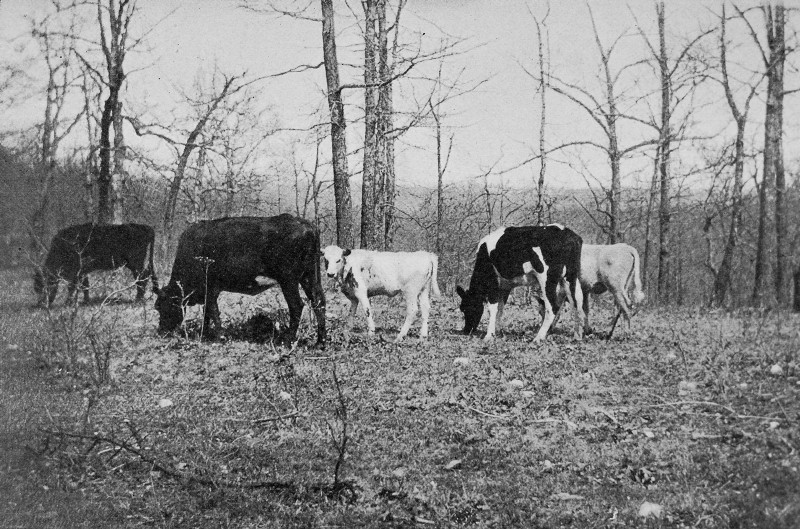 Browsing in the Woods The preacher, too, was a man of noise rather than of refined perceptions; and he had something also of the dramatic and sentimental about him. Often he became decidedly frenzied and would thrash around with his arms in red-faced, sweating fervor and have to mop his features with his handkerchief. One of his assertions was that all the great business men of the country were persistent church-goers. “There is Mr. Rockefeller,” said he, “who is worth billions. Nothing would keep him from going to church short of putting him in the penitentiary.” “And that’s just where he ought to be,” whispered a belligerent-looking man in front of me, to himself. The minister preached what the Ozarks folks call “a graveyard sermon.” He worked on the feelings of his auditors cruelly, and made some of the women cry. Among other things he told with great detail the story of Abraham’s preparations to sacrifice Isaac, and lingered especially over the father with knife in hand ready to “cut his son’s throat.” It was barbaric and horrible. Of course he made some good points; but as a whole the service was pretty harassing, and I was glad when it ended and I could escape into the mild outer sunshine. Even then I was not in “the Elysian fields,” to quote a phrase of the preacher’s; for a skunk had visited the neighborhood and perfumed it most thoroughly, and the worshippers hastened along the board walks making comments that had nothing to do with the sermon. There were five churches in the town, but some were only open once a month, and none oftener than every other Sunday. They were all weaklings, and to an outsider it seemed as if they were exalting denominationalism above Christianity. I have spoken of the place as “good-sized,” but that was only by comparison with other communities in the region. The streets, though wide and regular, were nearly overgrown with grass, except in the very centre of the village where the stores were. The stores fronted toward a large, open square which was a desert of stumps; but young trees had been started, and it would perhaps sometime be an oasis of shadowed lawn. The pigs rambled and investigated singly and in groups about the municipal thoroughfares and did the city scavenging. They were lean, lanky creatures of the variety known as razorbacks, and some of them, as one man said, “had noses long and slender enough to drink out of a jug.” The city dwellings were nearly all of the cottage type, and few attained to a second story. Many of them were set on blocks and had no cellars. Trees were plentiful, but none were large enough to have dignity and impressiveness. The place was still infantile, and many years would have to pass before it acquired repose and charm. I walked out into the country and found lodging for a few days at a log house in a glen among the hills. The soil in this vicinity was thin and full of flinty rocks, and the woodland on the slopes was ragged and un-thrifty; but in the bottoms the stones are laboriously picked off the meadows and you find pleasant tracts of green. Near where I lodged several fine springs welled forth unceasingly their crystal fountains, and the water formed pretty little “branches” that wandered away through the grasslands and cultivated fields. Here and there amid the shrubbery that bordered the rivulets I saw the white blossoms of the wild plums and haws, and still more noticeable were the frequent red-bud bushes, every twig loaded with pink bloom. At a certain turn of the road, a half mile from my dwelling-place, was a level bit of grass convenient to a stream where the “travellers,” with their canvas-topped wagons, often camped for the night. The charred coals and remnants of their fires, the husks of corn left over from feeding the horses, and some empty tin cans, showed plainly their recent presence. Log houses were plentiful, and some of them were new. To erect one was no great task or expense. A man could get the logs ready himself, and then he would invite the neighbors to the house-raising. The usual dimensions are fourteen by sixteen feet. “A pretty good working crowd will hoist the logs into place and get roof and all done in a day; but if too many gassers are there, and they put in a lot of time tellin’ stories, it may take another day.” I noticed that one local cabin had no windows. Its eight inmates were a family of ne’er-do-wells, who, rather than exert themselves to cut a window opening, preferred to light a lamp when cold or storms obliged them to keep the door shut. The children went barefoot all winter, and they were said to live largely on bread and molasses and wild onions; and yet they seemed healthy, and the smallest girl was declared to be, “jis’ as fat as you ever saw a little pig in your life.” Another building that interested me was a white schoolhouse on a hilltop. It was set well back in a stony yard, with thin oakwoods roundabout ruddy with the first hints of new leafage. There was no fence, and often as many hogs, sheep, and cows were around the building as children. The outer appearance of the schoolhouse was not bad except that the door was cracked and rickety, and nearly one-fourth of the window lights were broken. It was set on blocks, and sometimes the wandering hogs slept under it at night, or reposed there in the heat of the day while the school was in session. The worst of this was that they left their fleas behind, and there were times when the teacher and scholars had distressing experiences with the vermin. 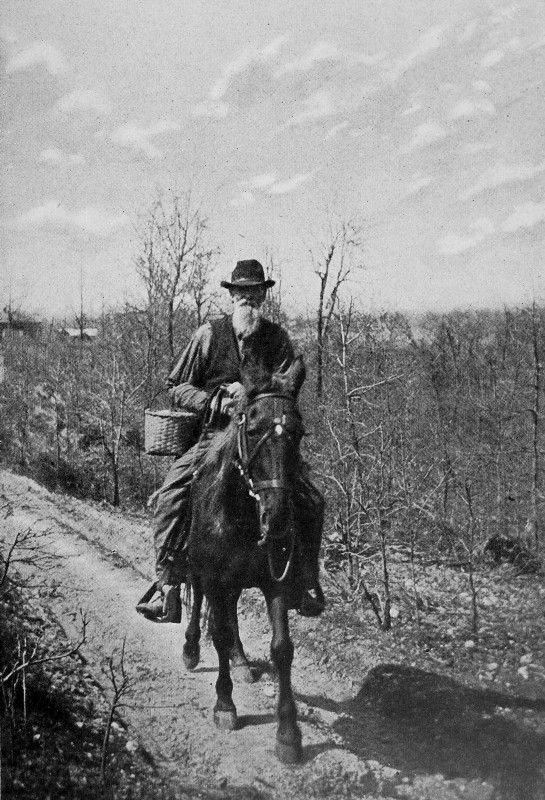 Going to Market The interior was decidedly dingy, with unpainted, sheathed walls, and the floor dirty and littered. There were two rows of long desks with seats attached to the front, and each seat could be made to hold five or six pupils by squeezing, and would give comfortable accommodation for four. The desks were made of splintery hemlock boards, and were much marked with chalk, pencils, and ink by idling occupants. One or two were gone entirely to smash and the fragments lay in a rear corner. A big rusty stove, with the name “Solid Comfort” in raised letters on either side, stood in the middle of the room, and a wobbly stovepipe connected it with the chimney. The stove had seen hard times. One leg was broken and had been pieced out with half a brick, and a stout wire encircled the entire stove just under the rim to keep the sides from caving out. For the teacher there was a rude little table, hammered together by some farmer. No chair accompanied it, though one had originally been supplied by the school authorities; but it had gradually become very decrepit. In its last days it had lost its back, and to supply this deficiency the teacher when she used it would place it against the wall. After it finally went to entire ruin, the teacher “either fetched one herself or did without.” It was not thought worth while to put a lock on the door, because it would be soon broken; for the boys liked to go in there evenings and Sundays “to tear around.” Often tramps took possession for the night, built a fire in the stove, and made themselves at home. School began some time in August and kept continuously for twenty-four weeks. The first half of the period attendance was good; but the long term became wearisome and many dropped out later. The school might start with thirty or forty pupils and end with ten. One evening we had a long talk about schools at my boarding-place. I had sat down in the best room. The sagging uneven floor was half covered by a rag carpet, and the walls were pasted over with newspapers. In one corner was a bed and at its foot was a cot bed. In all the houses of the region beds were a conspicuous article of furniture. Few rooms were without at least one, usually from necessity, but in part from force of habit. People of means put a bed in the parlor just as their neighbors did, even when the house was large and it could easily have been spared. The weather was chilly, and Mr. Doten, the man of the house, brought in some coals on a shovel from the kitchen stove and put them in the fireplace. Then he knelt down on the rough hearth, laid on some kindlings, and encouraged a blaze by wafting his cap. The fire soon flamed up brightly and began to eat away at the backlog, and the whole room was lit up with its fitful glow. “I tell you this fire keeps me busy in the winter,” said the man. “We use a two-horse load of wood a week. But that wood warms a fellow twice — once outdoors cutting it up and again in here burning.” He had seated himself in a rocking-chair to enjoy the heat and smoke his pipe. The man’s grandson, a little boy in overalls and cowhide boots, had lounged down on the convenient cot bed and was watching the flames. The man wore boots, too. This was partly because the soil of the country was full of flints, that were very destructive to light footwear, and partly on account of ticks. “You’re bound to get acquainted with them ticks in summer,” explained the man; “and there’s a little kind of a bug we call jiggers that’s worse still.” Presently Mrs. Doten and her daughter came in. The family had moved from Iowa a few years before, because, as Mrs. Doten said, “It didn’t agree with our health there. When you woke up in the morning you were tired and had a bitter taste in your mouth. Besides, wood was scarce. That’s what broke me of roastin’ my own coffee. I only made a fire when I had to.” The daughter was a school-teacher. “We tried to get Jenny the school here,” said Mrs. Doten, “when we first come; but they didn’t think she was strong enough, and they jis’ got somebody no account to beat and thump, and who didn’t learn the scholars a thing. You see each district has three directors to manage the schools, and some of ‘em don’t know beans. There’s school directors that can’t read or write; and often they’ll never visit the school the whole year through.” “Where I was last year,” said Jenny, “I had to wait quite a while for my pay because the president of the directors was in jail for gambling.” “How much are teachers paid?” I asked. “From twenty-five to forty dollars a month,” was Jenny’s reply; “and out of that comes our expense for board, sometimes only five dollars a month, sometimes as much as seven and a half. One thing a teacher is expected to do is to go once during the year to each home that sends children and stay over night. You have to do it or the people feel slighted and think you are proud. You get into some pretty poor houses. I’ve been where the snow fell through holes in the roof on to the table while we were eating; and I’ve been where the whole family slept in one room. “Every one judges your work at school by the order you keep, whether the children learn anything or not. I almost lost my reputation one year through a girl who wouldn’t mind; and if I tried to use force she would scratch and fight. Finally the directors came in and turned her out, and then the rest of the children in that family left, too. “The studies we make the most of are spelling and arithmetic. The people go wild about those. We always used to have a head and a foot to the spelling class, and whoever stood at the head when the day ended received a credit and began at the foot the next day. On the last day of the term the scholar who had the most headmarks was given a prize. But that custom is gradually going out. There’s one girl in this district has studied her spelling book so much she spells page after page without having a word pronounced for her; yet she’s not much in anything else. We often have spelling-downs in the school, and you need only ask, ‘Who wants to choose up? — Who wants to be captain?’ — to have half a dozen calling out, ‘Me.’ They like to cipher down, too. That’s done on nearly the same plan as the spelling contests. Sides are chosen, and the last one in each company goes to the board, the teacher gives an example, and they figure as fast as they can. The one that gets done first beats and the other is out of the game. The next child from the side of the beaten one steps to the board and a second example is given. So the contest goes on until all on one side are beaten. 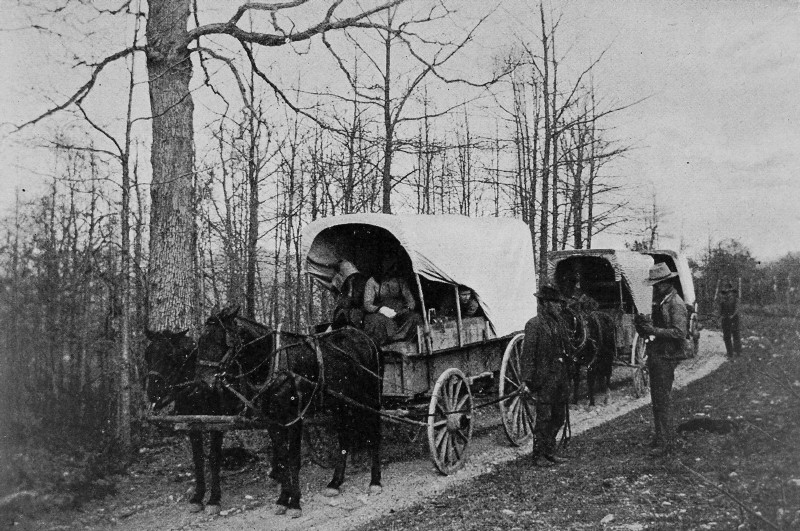 Travellers “Some time during the term we have a school entertainment. Perhaps it will be a box supper, and each lady will bring a box filled with a nice lunch. Her name is inside, and all the boxes are put together, and then each man buys a box for fifteen cents. When he looks inside he may trade boxes with some other man.” “That’s not because he don’t like the grub,” interrupted Mr. Doten; “but he’d rather have some other lady. You see he has to take the one whose name is in his box and eat the lunch with her.” “I like the pie suppers best,” said Mrs. Doten. “ Each lady brings a pie with her name on the bottom, and the pies are sold for ten cents apiece. There’s all kinds — apple, peach, blackberry, sorrel, pumpkin, sweet potato, and I don’t know what.” “The proceeds are used for buying a dictionary or books for the school library,” continued the teacher, “or a new blackboard or an organ. Besides the eating, there’s a short programme. A stage has been built at one end of the schoolroom on as small a plan as possible, and the scholars get up there and have their recitations, singing, and dialogues. The room is sure to be crowded, all the seats full and some persons standing. A good many come early — even an hour beforehand — to make sure of a good place to sit.” “They have another great time last day of school,” remarked Mr. Doten. “Yes,” said the teacher, “and the children come in the morning dressed in their best. Sometimes we have a big dinner at the schoolhouse. The patrons bring all sorts of good things to eat, and after dinner, perhaps the children spell down, and there’s speeches. The pupils make the teacher a present of an inkstand, album, card tray, or something of the sort; and she has to supply a treat of candy for them. I usually get a pailful — twenty-eight pounds. Then I have to put it up in bags or boxes, a half pound for each scholar, and what is left is passed around among the visitors. If you didn’t buy that candy the children’d feel terribly insulted, and think you were the stingiest old thing that ever was.” “We have the biggest crowd at our schoolhouse when there’s a spelling-down between our scholars and those of some other district,” said Mrs. Doten. “I don’t know about that,” Mr. Doten commented. “I’ve seen it packed fullest when we was havin’ protracted meetin’s.” It seemed that these meetings were revivals of religion, and there had been three series the previous winter, each under a different minister, and each continued from evening to evening for about two weeks. “People come for miles,” said Mr. Doten, “and the warmer the meetin’s get the more they come. A good many are there jis’ to see the fun, same as they’d go to a dog fight or a horse race. The minister does all he can to have an excitement, and when he sees people’s feelin’s are all worked up he begins to clap his hands and shout, ‘Bless God! Bless God!’ over and over again. “You never saw anything like it,” added the teacher. “The people will laugh and cry and scream and holler, and it’s as good as a circus. They walk around and are hystericky as can be. I remember how one old man last winter wagged his head and snivelled and squealed and looked real idiotic. If he had been my father and cut up like that I’d have slunk off home.” “It’s what I call a ‘distracted’ meetin’,” said Mrs. Doten, “they make such a big fuss. You can’t tell what they say; but they’re havin’ what they speak of as ‘a good time.’ After the service the minister calls for ‘seekers’ or ‘mourners’ to come up in front; and friends of the unconverted will go about in the audience and talk to those they think ought to respond to the minister’s call; and if they have a strong will they’ll get those to the mourners’ bench that didn’t want to be there at all. Then one o’ the local men will get down to pray and say, ‘We ax thee, Lord, to reveal thyself to these poor sinners,’ and such things, and some of the seekers will stand up and make a profession and say a few words. The persons that get religion at such times are mostly women and girls, and perhaps a few young boys not over fifteen or sixteen years old, and they generally backslide and are ready for the next big meetin’.” “Well, the preachers make a good thing out of it,” said Mr. Doten. “I know the Methodist minister that come here was paid eighteen dollars in money and given twenty-five dollars’ worth of provisions. The provisions and part of the cash was begged for him around at the houses, and the rest of the money was got in the two Sunday collections.” “I didn’t like him,” was the teacher’s comment. “That’s because he claimed the girls would go to hell if they had beaus to and from service,” responded Mr. Doten. “He said they thought so much about the fellers that was goin’ to take ‘em home they didn’t listen to the sermon.” 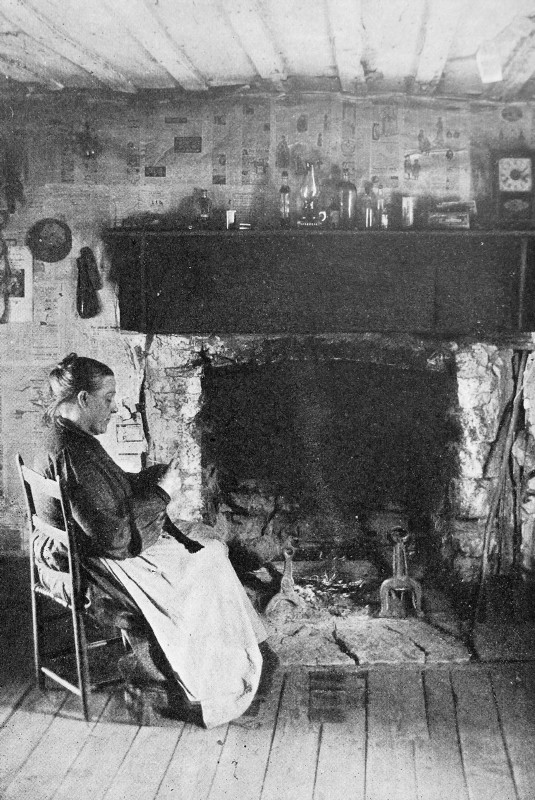 Beside the Kitchen Fire “These meetings pretty nearly ruin the schoolhouse,” said the teacher. “We had a prayer-meeting where I taught last year, and the room was in such a condition the next morning I sent the smaller children home, and then I had the older ones get water and we scrubbed out. There was tobacco juice all over the floor and on the desks and stove and in the water pail.” “Yes,” corroborated Mrs. Doten, “they spit till I wish I had an umbrella. I have to gather up my skirts, for there’ll be great pools, and you need a boat to get out.” “In the town churches there’s a fine for chewing and spitting on the floor,” said Mr. Doten. “I like to chew gum,” remarked the boy, who was now sitting on a stool near the fire, knife in hand, making a corncob pipe for his “grandpaw”; “but our teacher won’t let us chew it in school time. We chew at recess, and when we come in we stick it on the stoppers of our ink bottles. If we keep it in our mouths she makes us throw it in the stove.” “Some of the young men that chew gum put theirs, when not in use, behind one of their ears,” observed the teacher. “But for downright greenness,” said Mrs. Doten, “you ought to see the young fellers and their sweethearts that come from back in the country at the Fourth of July picnic in the town. They walk swinging along hold of hands like little children. That’s their idea of courting. Right around here the usual way for a young man to court is to call on his girl Sunday evening and sit by the fire with her after the old folks have gone to bed. They are great hands, too, for corresponding even when they live not more than three or four miles apart. Often they go for a buggy ride on Sunday afternoon. Some think it ain’t quite proper for lovers to ride in the evening. The people here are always suspicious of what they’re not used to, and suspicion is a bad sort of coin for anybody. One of our best neighbors is a woman that a good many call a foreignor. ‘She don’t talk like other folks,’ they say; but she’s jis’ a broad Yankee from Boston. She’s real good if there’s sickness, and is frequently sent for. When she gets to the sickroom she takes charge at once and ain’t at all backward about tellin’ what ought to be done. I went with her once. — A girl was sick, and soon as we were in the house she said, ‘Goodness alive! we’ve got to clean up some of this dirt, or the girl will die. That’s what’s the matter with her.’ “So we begun cleanin’, and at the same time she sent home most of the relatives. They all come if any one is seriously sick, the whole outfit of ‘em, perhaps twenty or thirty, and sit around in the way. “Two years ago the Massachusetts woman’s mother who had been living with her died, and our people never see such a funeral. Talkin’ afterward they said, ‘Why, she never made a bit of fuss. I don’t believe she cared a cent; and besides, she dressed up like she was goin’ to a fine dinner.’ “They thought she showed disrespect. The habit here is to go to funerals in your work clothes. Often the men wear their overalls. It’s the same at the country churches — the older men have on overalls and the brown duck coats they work in, and the married women all wear sunbonnets. The young men dress up some, but in warm weather they’ll go to meetin’ without coat or vest.” “Well,” remarked Mr. Doten, “I’ve seen the preacher take off his coat in the middle of his sermon when he got warm.” “The minister has a good long sermon at the funerals,” Mrs. Doten resumed, “often three-fourths of an hour, and I’ve heard ‘em go on for twice that time. The near relatives think they got to show how sorrowful they feel, and there’s lots of rippin’ around, cryin’, and screamin’; and they tell how bad they’ve been to the dead and how they wish they’d been better; and the preacher helps that sort o’ thing along all he can. If there’s anything especially distressing or touching about the person’s sickness and death he’s sure to bring that in; for it’s supposed to be a credit to him — shows his power — the more screechin’ there is. I used to have a good deal of sympathy for the near relatives of the deceased, they seemed to be so overcome at the funerals; but their screechin’ is jis’ the fashion, and now it don’t affect me no more than to hear the piggy squealing out here. “At one funeral last summer a man had lost his wife, and when time come for the service he felt so bad he didn’t want to do anything but wander around outside, and ‘twas all we could do to get him into the house. But he was married again in six months. He could have kept a loaf of bread over of his first wife’s baking for his second wife’s eating if he’d had a real good place to put it. They always remark and joke about a man that don’t wait a year after his wife’s death.” 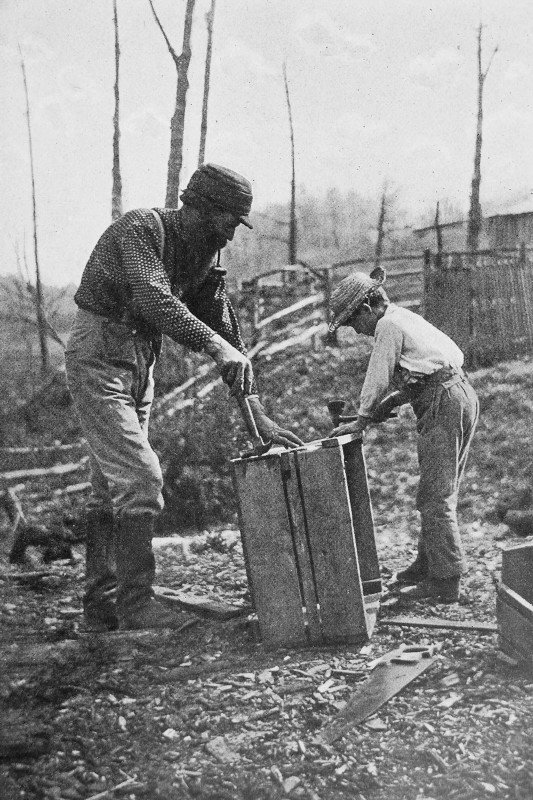 Making a Hen-coop “I suppose,” said the school-teacher, “that a man misses his wife here in the Ozarks more than anywhere else in the United States. She does the housekeeping and she does a good deal of field work, too. I know I’ve been spending half my time lately dropping corn and helping plant potatoes. The women do the milking, and they go out sprouting with axe and mattock in the fields and pastures, and they pick up loose stones off the grassland, and do all sorts of jobs. Then there’s no conveniences around the houses. It’s an old saying, if a woman marries a Missouri man she’ll have to carry water half a mile up hill all her life, and that’s about so. Our spring isn’t more than three rods from the house, but not many families are so lucky.” The little clock soberly ticking on the fireplace mantel showed that we were sitting up late for dwellers in that region, their habit being to retire early, and likewise to get up early. The boy had long ago left his knife and the cob pipe he was making and was asleep on the cot bed; and now I was shown to my apartment, and soon the house was quiet. NOTE. — The Ozarks as mountains have no attractions worth mentioning, but as big, rolling, half-wild hills they are very handsome. Seymour is an excellent stopping-place and is near the crest of the ridges. The landscape environing the town is commonplace, but the tumbled waves of upland are within easy driving distance, and in what you see there, and in your contact with the inhabitants, you will find much that is decidedly enjoyable. |
 Click the book image to turn
to the next Chapter.
Click the book image to turn
to the next Chapter.