
|
Click
Here to return to Mississippi Valley Content Page Return to the Previous Chapter |
 (HOME) |
|
VI
TRAVELLING IN ARKANSAW 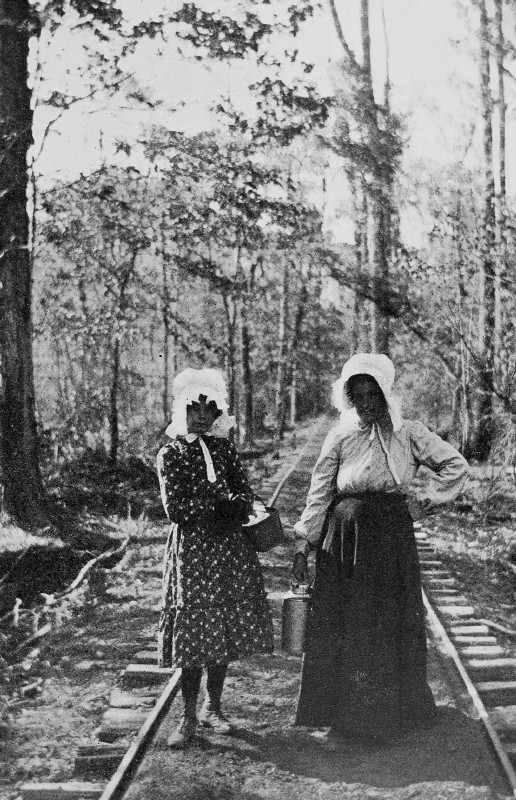 Returning to Camp from the Village THERE is no “Arkansas” in the nomenclature of the lower Mississippi valley — at least I never heard it until I was as far north as St. Louis. However, I understand that the name “Arkansaw” is not universally acceptable to the inhabitants of the state; and at one time the commonwealth’s two senators had such decided and opposing preferences on this subject that in Congress one was always addressed as “the gentleman from Arkansas” and the other as “the gentleman from Arkansaw.” Among the state’s immediate neighbors it is customary to speak slightingly of conditions across the line, and you would gather the impression that life and manners there were rather cruder than anywhere else in the great valley. The outside dwellers take particular pleasure in repeating a curious legend known as “The Arkansaw Traveller.” This tale has been a favorite for more than half a century, and, told properly, it has a musical accompaniment. Formerly, whenever there was a social gathering that included a man with a violin, this man was sure to be asked to play “The Arkansaw Traveller”; and the listeners took equal delight in the cheery jig of the music and in the medley of jokes that went with it. “Well,” says the musician, “thar was an old feller in Arkansaw who was settin’ out in front of his cabin on a stool one evenin’. He had his fiddle an’ was playin’ away on this tune.” (Plays, but breaks short off in the middle.) “‘Bout that time along comes a traveller ridin’ on his horse, an’ he stops an’ says, ‘Hello!’ “‘Hello yourself,’ says the man. “‘Can you give me a night’s lodging?’ says the traveller. “The man allowed he couldn’t nohow. ‘We got no room, stranger,’ he says. “‘Can’t you make room?’ the traveller asks. “‘No, sir,’ says the man. ‘It might rain.’ “‘And what if it does rain?’ says the traveller. “‘Why,’ the man says, ‘thar’s only one dry spot in the house, and me ‘n’ Sal sleeps on that.’ “Then he begun sawin’ away on his fiddle again.” (Plays, but stops suddenly, as before.) “Everything was terrible tumbledown, and the traveller see how leaky the roof was, and he says: ‘Why don’t you mend your roof?’ “‘When it’s pleasant I don’t need to,’ says the man; ‘and when it rains I can’t.”‘ (Plays the tune again half way through and stops.) “‘What makes your corn so yaller?’ says the traveller, lookin’ at the field over the fence. “‘Oh, we plant the yaller kind, hyar,’ says the man.” (Plays the half tune.) “‘How do your potatoes turn out this season?’ asks the traveller. “‘They don’t turn out at all,’ says the man. ‘We have to dig ‘em.’” (Plays.) “‘Whar does this road go to?’ asks the traveller. “‘It don’t go nowhar, stranger,’ the man says. ‘I been hyar an all-fired long time, and that road has always stayed right whar it’s at.’” (Plays.) “‘How many years have you lived in this country?’ says the traveller. “‘Do you see that mountain over yender?’ the man says. ‘Well, that was thar when I come hyar.”‘ (Plays.) “‘What are you playin’ that tune so often for?’ says the stranger. “‘Only heard it yisterday,’ says the man. ‘I’m afraid I’ll forgit it.’ “‘Why don’t you play the rest of it?’ the traveller says. “‘That part is good enough for me,’ says the man; ‘and besides, that’s all I know.’ “‘Give me the fiddle,’ says the traveller. “The man handed it to him, and the stranger played the whole tune like this.” (Plays.) “Soon as he begun playin’ the second part the man jumped up and started to dance, and at the end of the tune, he says, ‘Walk in, stranger, and stay as long as you please. If it rains you c’n sleep on the dry spot. Zeke!’ he says to his boy, ‘put this man’s horse in the corncrib and stop the door with a haystack. Sal, take the grubbin’ hoe and go dig some sassafras to make tea for the stranger.” I found plenty of people who could repeat the jokes; but it was not so easy to discover a fiddler. At last, in one of the river towns, a waiter at my hotel gave me the address of a colored man by the name of Jack Hamilton who he said could play the tune. The address took me to a dingy corner saloon frequented wholly by negroes. Jack was there, and so was his partner Ed Smith, sitting together at one side of the dark, grimy, and odorous room. Jack was black as a coal. Ed was a mulatto, with handsome features and a touch of refinement and poetry about his slender figure that seemed incongruous in such a place. He played his violin with great facility and charm, and Jack’s accompaniment on the guitar was spirited and pleasing. Jack sat stiff and upright with his brows twisted, and a far-away look in his eyes, and a cigar stump cocked up in the corner of his mouth. Some of the hangers-on of the saloon gathered about to listen to the music. Others continued with their drinking and noisy talking. As to the melody, it was a quick reel tune, lively and attractive, and I did not wonder at its popularity. One of my first stops in Arkansaw was at a sawmill village in the woods. The forest was being worked up into barrel material, and all day the place resounded with the buzz and whir of machinery and the shrill, ravenous notes of the saws. It was a strange little hamlet that gathered about the mill — a settlement of forest-wreckers, devoid of the least touch of beauty. The land was low and level, and puddles and pools and shallow ponds abounded, but these would gradually dry away as the season advanced. The schoolhouse was in the middle of one of the larger ponds, and several lines of boards were laid along on blocks and stumps to the building. These improvised bridges were common all through the village. Everywhere was scattered rubbish from the mill — sawdust and slabs and fragments of boards. The houses were small and rude, and looked like temporary shelters, which perhaps they were; for when the mill has finished its devastation, and its devouring saws are silent, most of the population will move away. On the outskirts of the hamlet were several little farms carved out of the wilderness. Just how to get to them I was in doubt. I went through a village door-yard, and climbed the back fence, crossed a pasture, climbed another fence, and found myself in a slough where water so abounded that I was tempted to retreat. But the ground was strewn with a chaotic mass of brush and limbs left behind by the choppers, and this helped me over the water shallows and the mud to a big corn field amidst a scattering of girdled trees. The field was boggy, too, and it was bristled everywhere with withered last-year’s stalks so that the walking was far from easy. However, I continued to pick a way to the farther side, where I encountered a man pulling up stalks and gathering up branches fallen from the girdled trees. He was piling these in heaps and burning them. “I ain’t gittin’ along very well this year,” he said. “It’s been a wet spring, and every time I think o’ startin’ to work it rains. I have to wear my gum boots constant.” He did not own the land, and one-third of the corn he raised and one-fourth of the cotton went to the landlord for rent. The soil was difficult to cultivate, it was so heavy, and the crops were uncertain. “The bugs and worms git after the cotton,” he explained. “Last year we had a bug what we call the sharpshooter. It come when the bolls was just formin’ an’ blasted ‘em so they dried up an’ stuck thar hard an’ fast.” The man showed me a better route back than the one by which I had come. “ Do you see that roof off thar?” he said. “That’s on the main road. I’ll put you on a path and all you need do is to foller it. The building you see the roof of pretends to be a grocery; but it’s ‘way outside the village, and thar’s mighty few goods on its shelves. I reckon it’s a blind tiger. I’ve seen men goin’ to it, and I’ve seen ‘em comin’ away, and they walk a great deal straighter goin’ than they do comin’.” 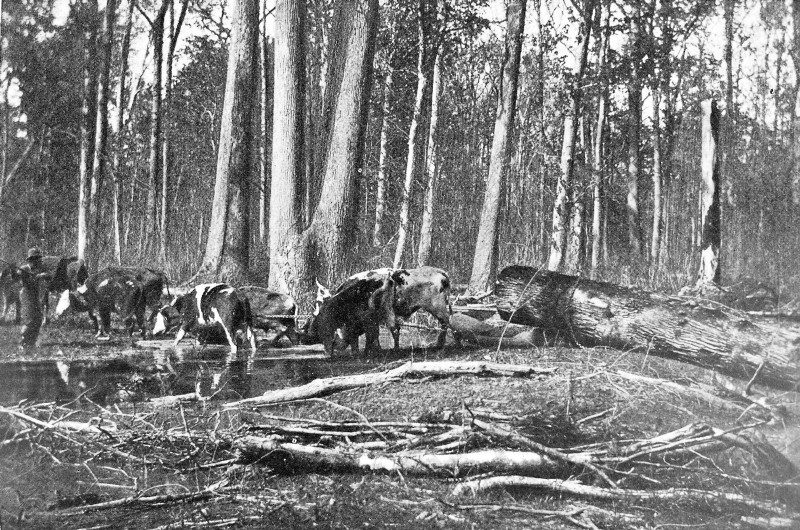 Work in the Woodland When I reached the main road I considered continuing by it farther out into the country; but it was too deeply rutted and watery to encourage travel, and I betook myself instead to a tramway that went off three miles into the woods, to where trees were being felled for the mill. Along this track stout little cars went back and forth, two at a time, drawn by a plodding mule. The day was quiet and sultry, the sunlight flickered through the foliage, the birds sang, the woodpeckers clattered on the dead trees, and once I saw a king-snake basking in the warmth on an exposed bank. This snake was the most gorgeous monster I have ever beheld — its entire length of fully a yard being ringed with narrow bands of brilliant red, black, and light yellow. Near the end of the track was a choppers’ settlement, consisting of a score of structures loosely grouped among the trees. They had floors and sides of boards; but the roofs were of canvas, put up tent fashion. Such construction made it a simple matter to pull them to pieces and move them when the vicinity had been chopped over. The moving of the homes to be nearer the work was necessary every six or seven months. The woodsmen had their wives and children with them; and there were bevies of pigs and chickens wandering about, so that the village was quite domestic. The work that interested me most was the herculean task of dragging the logs from where they had been felled to loading-places beside the track. This was done by ox power, four yokes to a team, and even then the bigger logs were almost beyond the oxen’s strength amid the mud and stumps and brush. The creatures seemed very willing and patient and intelligent; yet the drivers were always pouring forth a torrent of oaths and abuse, and cracking the long lashes of their savage whips with reports like pistol shots. Perhaps the string of beasts would come to a full stop in some miry pool. Then there were exciting times. The driver became volcanic, the whip hissed and snapped, and the oxen twisted and strained and occasionally voiced their feelings with a complaining low. The forward end of the log lay on a “lizard,” a rude V-shaped sledge about six feet long, upturning at the point, and made out of the fork of some large tree. The woodland not yet invaded was full of giant timber, mostly clean-trunked gum trees, pluming out above into the foliage that formed the forest roof. Little was left standing when the choppers had passed on, save shattered or dead trees and ragged sapplings. It was nearly sundown when I returned to the village around the mill. The only place to get anything to eat was at the mill boarding-house, and I was there in the washroom when the whistle blew for quitting work. The men came flocking in and scrubbed at the sink and combed their hair. Afterward they sat or stood around, chaffing, smoking cigarettes, and spitting at the stove. Pretty soon a man appeared on the porch with a hand bell, swung it vigorously a few times, and at that cheering signal every one started for the dining room. We had a good and hearty supper; but the workers in shirt sleeves and overalls did not linger over it. They were soon out engaged in a game of ball. The place was not very well suited to the sport; for there were buildings in the way, and there were stumps and bogs and pools, and there were wandering cows and horses which the ball sometimes encountered with a resounding thump, much to their consternation. The ball was erratic. It rolled under buildings, or it flew higher and put the windows in jeopardy, it went over fences, it embedded itself in the mud, and it dropped in the ponds and had to be poked after with poles. But these vicissitudes did not discourage the players, and they kept at the game till the full moon that hung in the east above the ragged woodland had changed from silver to ruddy gold, and the gloaming had deepened into darkness. I went away that evening on the train; but a few hours later stopped off at a little town which was a trading centre in a prosperous farming country. A one-armed man was at the station to take charge of such travellers as wanted a lodging-place, and he piloted us up a rough hillslope toward the town’s only hotel. Somewhere a calf was bleating, and we heard a whippoorwill singing. “That’s the first whippoorwill that’s turned up this spring,” said the one-armed man. “I reckon winter’s broke.” Our guide took us to a two-story wooden hostelry, “Delmonico’s” by name, “Strictly Firstclass.” In the dingy office, with its dim kerosene lamp and rusty stove, were about as many men as the apartment would hold, some playing cards at a small table, some merely talking, and all smoking. The landlord was in a brown study, trying to figure out where he would put his guests. They were so numerous that they could not have a bed apiece, and some objected to sleeping double. It was late, and I was ready to agree to almost anything. So he sent me with another man into a dirty little corner room, where we occupied a bed that creaked dismally at the least provocation, and the night was far from satisfactory. In the morning, after breakfast, I looked around the premises in an effort to discover why the hotel was called “Delmonico’s — Strictly Firstclass.” The yard was a gritty slope of stone and gravel, with a speckling of grass growing on it, and bestrewn with sticks, tin cans, old shoes, and similar litter. Beyond its narrow confines the hillside was piled with telegraph poles and shaggy cedar fence posts. At the rear was a barren fenced-in space that served as a poultry ranch, cow yard, and pig-pen, and a depository for wood piles and for rubbish in great variety. All the neighboring backyards were put to much the same uses. Near the hotel were ten or twelve stores, mostly in narrow one-story brick blocks, and the place also had its bank, its newspaper, and its photograph gallery, the proprietor of which described his art as that of “catching shadows.” Business was dull in town and would be until fall. From March to October the farmers have little cash, and during this period they very generally “go on tick” at the stores, and do not buy at all freely. In carrying these accounts the stores either put on an extra price or charge ten per cent interest. When the crops begin to be marketed the farmers settle old scores and make more liberal purchases, but by spring most of the produce has been turned into cash, and the cash spent. If the crops fail there are dubious times all around. The farmers cannot pay what they owe nor buy more, and the merchants cannot collect or sell, and every one has to pinch and economize till nature is once more bountiful. The country roundabout the town flowed away in pleasant hills and hollows for I know not how far. The fields were ample and rich and well-cultivated, and the winding streams delightful. My longest walk was an all-day ramble off westward. The air was very still and mild, and the soft blue sky was unsullied by a single cloud. I could hear voices, the low of cattle, and the crowing of cocks for a long distance; and with these domestic sounds was mingled the whistle of the quails, the cooing of turtle-doves, the cluck of blackbirds, the tapping of the “whickers” or yellowhammers, and the clatter and songs of many other birds. The highway for some distance followed the valley of a creek — an innocent-looking stream with quiet pools and rippling rapids; but which evidently had its spells of savagery, for the ground on either side was much torn and furrowed by floods. All the space it rampaged over was abandoned to it and to the road, and this space was often very wide. The stream wandered wilfully to right and left with many a turn, and the road was continually crossing it. Nowhere was there any bridge, and in high water it must have been impassable, even for teams. Beside some of the fords was an irregular line of stepping-stones, but many of these stones were precariously unstable and overflown by the water. Most crossings, however, had no aids other than a few sticks or a dead branch some foot traveller had thrown in. Along the creek grew great sycamores, “ellums,” and gum trees, misty-green with tender, new-starting foliage. The half-wild highway was common pasturage for cows and pigs, and a pleasure-ground for boys and fishermen. The boys fished, too; but that was only a small part of their fun. The streamside was to them enchanted land, a place for dreaming, for new discoveries, for flowers and birds and other things of youthful interest. I talked with some of the boys — honest-eyed little fellows in ragged and patched overalls. They showed me the swimming-hole, and farther up the creek pointed out a pool where lurked a veteran pike, too wise to be caught, that was a foot and a half long; and they told me about the suckers and eels and trout, and about “the little topwaters, which stay near the surface and take your bait.” 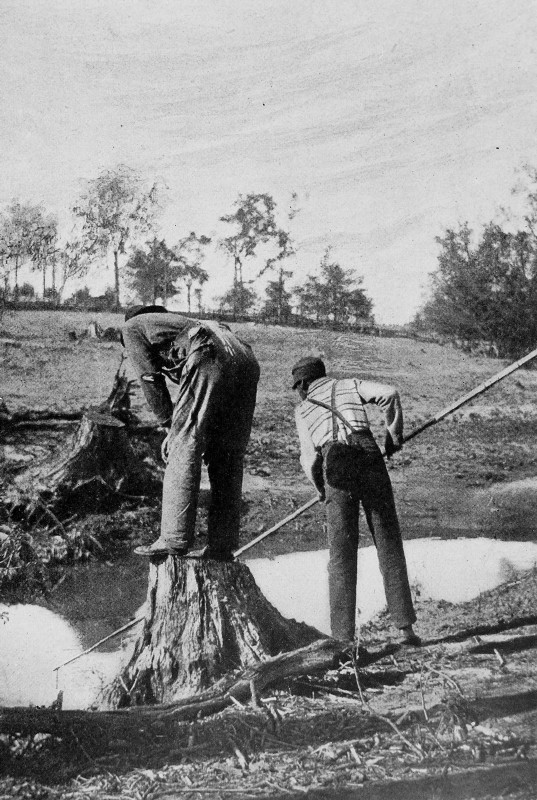 The Fishermen One pause that I made during the morning was at a cemetery on a prominent slope by the roadside. It was a large, ragged plot abounding in stumps, and growing up to thin grass, weeds, and bushes. Here and there were straggling flowers. Some graves were unmarked, and others had only rough fragments of native stone. Often the family lots were fenced in, but most of the fences were broken and half-fallen. Narrow boards were the common fence material; but there were several lots enclosed with pickets so that they resembled miniature hen yards. Frequently the single graves were fenced. Some had fence rails laid up around them, one was enclosed by great posts set snug to each other like palisades, and two or three were roofed over with rude little shanties. This unkempt, neglected ground of the dead looked strangely out of place among the clean fields about. Noon came and I stopped for dinner at a log-cabin off on a byway. An old man and woman and their daughter constituted the family. The man had been furrowing out a field for corn with a little bull-tongue plough, and his daughter had been dropping the seed. He complained that the lower half of the field was as yet too wet for planting, and he reckoned he would have to shoot the corn into the mud with a gun. He was also disturbed because the field was inclined to be weedy, and later would abound in “cuckle burs.” The house was quite primitive, and consisted of one room, a shed, a porch, and “a mud and stick chimney.” I could see light through numerous cracks in the walls as I sat at the table. There were two beds in the room, and a meagre supply of other furniture. Chairs were not at all plentiful, and the man ate dinner sitting in a creaking rocker, and the girl sat on a three-legged stool. We had pokeweed and sour-dock greens with fat pork, corn-bread, oats boiled with sugar, and lastly a vinegar pie. Some of these things were not at all bad, but my palate rebelled at the pie. For drink we had both coffee and buttermilk. The latter was in a jar on the table, and the members of the family dipped and drank several cupfuls. The woman did her cooking over a rickety stove that troubled her by smoking when the wind was in the east. During the winter, the fire in the fireplace was kept constantly going, and she cooked over that. “If you have a good skillet,” she added, “meat is better fried in the fireplace; and fireplace corn-bread is better, too.” “If people e’t corn-bread right smartly the way they did years ago, they wouldn’t need so many pills,” affirmed the man. “Me ‘n’ my daughter like biscuit,” averred the woman; “but flour’s so high I don’t make ‘em only once a day.” After dinner we adjourned to the porch, and the man took a chew and the woman lit her pipe. She said a good many women used snuff; but she didn’t believe in it and told about a neighbor who recently died. “She was a great hand for snuff,” said my hostess, “and I’m satisfied it caused her death. She jus’ sucked it down her windpipe and it clogged her lungs.” I said something about the inconvenience of getting mail off on that byway, but they responded they never had any mail. Still, they would have preferred being on the big road, especially in the months of frost and snow. “We have a tolerable rough winter hyar,” said the woman. “What work is there to do then?” I inquired. “We split oak rails for our fences and garden palings,” the man answered, “cut cordwood, and cle’r land.” They were early settlers, and the man told how his folks came from Illinois about 1850. “I was goin’ on fifteen,” he said, “and pretty well grown. We had a pair of steers hitched to a covered wagon. It was a long journey, and sometimes we’d git the chills an’ have to lay up a while.” “We hadn’t no doctor’s medicine then,” said the woman; “but we’d git things out of the woods — black root, bur-vine root, wild cherry, dogwood — I can’t name over all the weeds an’ things my pap use to git. Mother’d dry ‘em an’ fix ‘em up to take when we needed ‘em.” “Yes,” said the man, “we use to do a heap of our own doctorin’ thataway. To break up the chills we’d go to bed and drink something hot and cover up head and years to throw us into a sweat. Boneset tea was good, and so was dog fennel, and walnut bark. The walnut bark we’d boil down till it was pitchy and make pills, or we’d take the bark and slap her on the front of the wrist where the nerve is to draw a blister. We’d try lots o’ things like that for the chills. “This was a wild country when we got hyar. There was only half a dozen families in all the region, and there was bears and pant’ers a-plenty. They’d steal a right smart of sheep and hogs; but when people got settled pretty thick around they drove the critters out or killed ‘em. The last pant’er I knowed of was seen seven years ago. It run a nigger four miles down the river road, and then he clumb a tree near a chu’ch house whar they was havin’ a meetin’. The people heard him hollerin’ thar for his life, and they come hurryin’ out to see what the matter was, and the pant’er scooted off into the woods. Thar ain’t no savage animals left, but we have a good many wild turkeys and coons, ‘possums and rabbits, and thar’s some deer run around in the hills.” 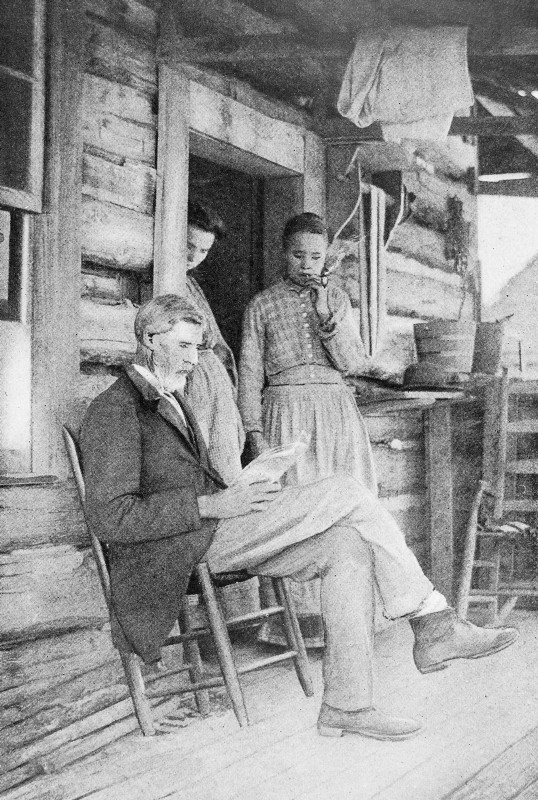 The Weather in the Almanac “Well,” remarked the woman, “even if the dangerous critters are gone, this was a better country to live in then than now. The seasons has changed and ever’-thing else. We had a heap better rains then and none of these dry years when you can’t raise hardly anything. We use to set fires late in the fall and let ‘em run through the woods to make feed for the cattle; but that ain’t allowed no more, and the leaves and bushes smother out the grass.” “The cattle’d go to the range then in February,” continued the man, “and in a little while they’d be plumb slick. We didn’t have to feed ‘em more’n three months, but now we have to feed ‘em mighty nigh six.” They were old-fashioned people, pioneers by nature, and they could not adapt themselves to any but the ways of their youth; yet no doubt the changes have nearly all been for the better, and this part of Arkansaw seemed to me to have genuine pastoral charm. NOTE. — Travellers who wish a closer contact with rural Arkansas than they get from the car window would do well to stop at a hotel in some large town and make short trips out into the country as the spirit moves. Some may, however, prefer to go at once to the lesser places and take their chances, as I did. The latter method is more entertaining, but it has its drawbacks and would not suit every one. The country as whole is too featureless to attract sightseers, and yet the life has a character of its own and repays acquaintance. |
 Click the book image to turn
to the next Chapter.
Click the book image to turn
to the next Chapter.