Web
and Book design, Web
and Book design, Copyright, Kellscraft Studio 1999-2003 (Return to Web Text-ures) |
Click Here to return to Inca Lands Content Page Click Here to return to previous chapter |
 (HOME) |
|
Web
and Book design, Copyright, Kellscraft Studio 1999-2003 (Return to Web Text-ures) |
Click Here to return to Inca Lands Content Page Click Here to return to previous chapter |
(HOME) |
|
CHAPTER
XIV CONSERVIDAYOC WHEN Don Pedro Duque
of Santa
Ana was helping us to
identify places mentioned in Calancha and Ocampo, the references to
“Vilcabamba
Viejo,” or Old Uilcapampa, were supposed by two of his informants to
point to a
place called Conservidayoc. Don Pedro told us that in 1902 Lopez
Torres, who
had traveled much in the montaña looking
for rubber trees, reported the discovery there of the ruins of an Inca
city.
All of Don Pedro’s friends assured us that Conservidayoc was a terrible
place
to reach. “No one now living had been there.” “It was inhabited by
savage
Indians who would not let strangers enter their villages.” When we reached
Paltaybamba,
Señor Pancorbo’s manager
confirmed what we had heard. He said further that an individual named
Saavedra
lived at Conservidayoc and undoubtedly knew all about the ruins, but
was very
averse to receiving visitors. Saavedra’s house was extremely difficult
to find.
“No one had been there recently and returned alive.” Opinions differed
as to
how far away it was. Several days later,
while
Professor Foote and I were
studying the ruins near Rosaspata, Señor Pancorbo, returning from his
rubber
estate in the San Miguel Valley and learning at Lucma of our presence
near by,
took great pains to find us and see how we were progressing. When he
learned of
our intention to search for the ruins of Conservidayoc, he asked us to
desist
from the attempt. He said Saavedra was “a very powerful man having many
Indians
under his control and living in grand state, with fifty servants, and
not at
all desirous of being visited by anybody.” The Indians were “of the
Campa
tribe, very wild and extremely savage. They use poisoned arrows and are
very
hostile to strangers.” Admitting that he had heard there were Inca
ruins near
Saavedra’s station, Señor Pancorbo still begged us not to risk our
lives by
going to look for them. By this time our
curiosity was
thoroughly aroused.
We were familiar with the current stories regarding the habits of
savage tribes
who lived in the montaña and whose
services were in great demand as rubber gatherers. We had even heard
that
Indians did not particularly like to work for Señor Pancorbo, who was
an
energetic, ambitious man, anxious to achieve many things, results which
required more laborers than could easily be obtained. We could readily
believe
there might possibly be Indians at Conservidayoc who had escaped from
the
rubber estate of San Miguel. Undoubtedly, Señor Pancorbo’s own life
would have
been at the mercy of their poisoned arrows. All over the Amazon Basin
the
exigencies of rubber gatherers had caused tribes visited with impunity
by the
explorers of the nineteenth century to become so savage and revengeful
as to
lead them to kill all white men at sight. Professor Foote and I
considered the matter in all
its aspects. We finally came to the conclusion that in view of the
specific
reports regarding the presence of Inca ruins at Conservidayoc we could
not
afford to follow the advice of the friendly planter. We must at least
make an
effort to reach them, meanwhile taking every precaution to avoid
arousing the
enmity of the powerful Saavedra and his savage retainers.
On the day following
our
arrival at the town of
Vilcabamba, the gobernador, Condoré,
taking counsel with his chief assistant, had summoned the wisest
Indians living
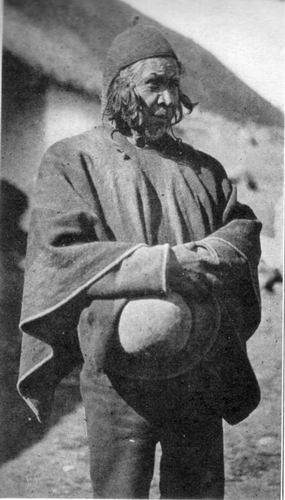
in the vicinity, including a very picturesque old fellow whose name,
Quispi
Cusi, was strongly reminiscent of the days of Titu Cusi. It was
explained to him
that this was a very solemn occasion and that an official inquiry was
in
progress. He took off his hat — but not his knitted cap — and
endeavored to the
best of his ability to answer our questions about the surrounding
country. It
was he who said that the Inca Tupac Amaru once lived at Rosaspata. He
had never
heard of Uilcapampa Viejo, but he admitted that there were ruins in the
montaña near Conservidayoc.
Other
Indians were questioned by Condoré. Several had heard of the ruins of
Conservidayoc, but, apparently, none of them, nor any one in the
village, had
actually seen the ruins or visited their immediate vicinity. They all
agreed
that Saavedra’s place was “at least four days’ hard journey on foot in
the montana beyond Pampaconas.” No
village
of that name appeared on any map of Peru, although it is frequently
mentioned
in the documents of the sixteenth century. Rodriguez de Figueroa, who
came to
seek an audience with Titu Cusi about 1565, says that he met Titu Cusi
at a
place called Banbaconas. He says further that the Inca came there from
somewhere down in the dense forests of the montaña
and presented him
with a macaw and two hampers of peanuts — products of a warm region. We had brought with
us the
large sheets of
Raimondi’s invaluable map which covered this locality. We also had the
new map
of South Peru and North Bolivia which had just been published by the
Royal
Geographical Society and gave a summary of all available information.
The
Indians said that Conservidayoc lay in a westerly direction from
Vilcabamba,
yet on Raimondi’s map all of the rivers which rise in the mountains
west of the
town are short affluents of the Apurimac and flow southwest. We
wondered
whether the stories about ruins at Conservidayoc would turn out to be
as barren
of foundation as those we had heard from the trustworthy foreman at
Huadquina.
One of our informants said the Inca city was called Espiritu Pampa, or
the
“Pampa of Ghosts.” Would the ruins turn out to be “ghosts”? Would they
vanish
on the arrival of white men with cameras and steel measuring tapes? No one at Vilcabamba
had seen
the ruins, but they
said that at the village of Pampaconas, “about five leagues from here,”
there
were Indians who had actually been to Conservidayoc. Our supplies were
getting
low. There were no shops nearer than Lucma; no food was obtainable from
the
natives. Accordingly,
notwithstanding
the protestations of
the hospitable gobernador, we
decided
to start immediately for Conservidayoc. At the end of a long
day’s
march up the Vilcabamba
Valley, Professor Foote, with his accustomed skill, was preparing the
evening
meal and we were both looking forward with satisfaction to enjoying
large cups
of our favorite beverage. Several years ago, when traveling on
mule-back across
the great plateau of southern Bolivia, I had learned the value of
sweet, hot
tea as a stimulant and bracer in the high Andes. At first astonished to
see how
much tea the Indian arrieros drank,
I
learned from sad experience that it was far better than cold water,
which often
brings on mountain-sickness. This particular evening, one swallow of
the hot
tea caused consternation. It was the most horrible stuff imaginable.
Examination showed small, oily particles floating on the surface.
Further
investigation led to the discovery that one of our arrieros
had that day placed our can of kerosene on top of one
of
the loads. The tin became leaky and the kerosene had dripped down into
a food
box. A cloth bag of granulated sugar had eagerly absorbed all the oil
it could.
There was no remedy but to throw away half of our supply. As I have
said, the
longer one works in the Andes the more desirable does sugar become and
the more
one seems to crave it. Yet we were unable to procure any here. After the usual
delays, caused
in part by the
difficulty of catching our mules, which had taken advantage of our
historical
investigations to stray far up the mountain pastures, we finally set
out from
the boundaries of known topography, headed for “Conservidayoc,” a vague
place
surrounded with mystery; a land of hostile savages, albeit said to
possess the
ruins of an Inca town. Our first day’s
journey was to
Pampaconas. Here and
in its vicinity the gobernador told
us he could procure guides and the half-dozen carriers whose services
we should
require for the jungle trail where mules could not be used. As the
Indians
hereabouts were averse to penetrating the wilds of Conservidayoc and
were also
likely to be extremely alarmed at the sight of men in uniform, the two gendarmes who were now accompanying us
were instructed to delay their departure for a few hours and not to
reach
Pampaconas with our pack train until dusk. The gobernador
said that if the Indians of Pampaconas caught sight of
any brass buttons coming over the hills they would hide so effectively
that it
would be impossible to secure any carriers. Apparently this was due in
part to
that love of freedom which had led them to abandon the more comfortable
towns
for a frontier village where landlords could not call on them for
forced labor.
Consequently, before the arrival of any such striking manifestations of
official authority as our gendarmes, the
gobernador and his friend
Mogrovejo
proposed to put in the day craftily commandeering the services of a
half-dozen
sturdy Indians. Their methods will be described presently. Leaving modern
Vilcabamba, we
crossed the flat,
marshy bottom of an old glaciated valley, in which one of our mules got
thoroughly mired while searching for the succulent grasses which cover
the
treacherous bog. Fording the Vilcabamba River, which here is only a
tiny brook,
we climbed out of the valley and turned westward. On the mountains
above us
were vestiges of several abandoned mines. It was their discovery in
1572 or
thereabouts which brought Ocampo and the first Spanish settlers to this
valley.
Raimondi says that he found here cobalt, nickel, silver-bearing copper
ore, and
lead sulphide. He does not mention any gold-bearing quartz. It may have
been
exhausted long before his day. As to the other minerals, the
difficulties of
transportation are so great that it is not likely that mining will be
renewed
here for many years to come. At the top of the
pass we
turned to look back and
saw a long chain of snow-capped mountains towering above and behind the
town of
Vilcabamba. We searched in vain for them on our maps. Raimondi,
followed by the
Royal Geographical Society, did not leave room enough for such a range
to exist
between the rivers Apurimac and Urubamba. Mr. Hendriksen determined our
longitude to be 73° west, and our latitude to be 13° 8’ south. Yet
according to
the latest map of this region, published in the preceding year, this
was the
very position of the river Apurimac itself, near its junction with the
river
Pampas. We ought to have been swimming “the Great Speaker.” Actually we
were on
top of a lofty mountain pass surrounded by high peaks and glaciers. The
mystery
was finally solved by Mr. Bumstead in 1912, when he determined the
Apurimac and
the Urubamba to be thirty miles farther apart than any one had
supposed. His
surveys opened an unexplored region, 1500 square miles in extent, whose
very
existence had not been guessed before 1911. It proved to be one of the
largest
undescribed glaciated areas in South America. Yet it is less than a
hundred
miles from Cuzco, the chief city in the Peruvian Andes, and the site of
a
university for more than three centuries. That Uilcapampa could so long
defy
investigation and exploration shows better than anything else how
wisely Manco
had selected his refuge. It is indeed a veritable labyrinth of
snow-clad peaks,
unknown glaciers, and trackless canyons. Looking west, we saw
in front
of us a great
wilderness of deep green valleys and forest-clad slopes. We supposed
from our
maps that we were now looking down into the basin of the Apurimac. As a
matter
of fact, we were on the rim of the valley of the hitherto uncharted
Pampaconas,
a branch of the Cosireni, one of the affluents of the Urubamba. Instead
of
being the Apurimac Basin, what we saw was another unexplored region
which
drained into the Urubamba! At the time, however,
we did
not know where we were,
but understood from Condoré that somewhere far down in the montaña
below
us was Conservidayoc, the sequestered domain of Saavedra and his savage
Indians. It seemed less likely than ever that the Incas could have
built a town
so far away from the climate and food to which they were accustomed,
The “road”
was now so bad that only with the greatest difficulty could we coax our
sure-footed mules to follow it. Once we had to dismount, as the path
led down a
long, steep, rocky stairway of ancient origin. At last, rounding a
hill, we
came in sight of a lonesome little hut perched on a shoulder of the
mountain.
In front of it, seated in the sun on mats, were two women shelling
corn. As
soon as they saw the gobernador approaching,
they stopped their work and began to prepare lunch. It was about eleven
o’clock
and they did not need to be told that Señor Condoré and his friends had
not had
anything but a cup of coffee since the night before. In order to meet
the
emergency of unexpected guests they killed four or five squealing cuys
(guinea pigs), usually to be found scurrying about the mud floor of the
huts of
mountain Indians. Before long the savory odor of roast cuy,
well basted,
and cooked-to-a-turn on primitive spits, whetted our appetites.
In the eastern United States one
sees guinea pigs only as pets or laboratory victims; never as an
article of
food. In spite of the celebrated dogma that “Pigs is Pigs,” this form
of “pork”
has never found its way to our kitchens, even though these “pigs” live
on a
very clean, vegetable diet. Incidentally guinea pigs do not come from
Guinea
and are in no way related to pigs — Mr. Ellis Parker Butler to the
contrary notwithstanding!
They belong rather to the same family as rabbits and Belgian hares and
have
long been a highly prized article of food in the Andes of Peru. The
wild
species are of a grayish brown color, which enables them to escape
observation
in their natural habitat. The domestic varieties, which one sees in the
huts of
the Indians, are piebald, black, white, and tawny, varying from one
another in
color as much as do the llamas, which were also domesticated by the
same race
of people thousands of years ago. Although Anglo-Saxon “folkways,” as
Professor
Sumner would say, permit us to eat and enjoy long-eared rabbits, we
draw the
line at short-eared rabbits, yet they were bred to be eaten. I am willing to admit
that this
was the first time
that I had ever knowingly tasted their delicate flesh, although once in
the
capital of Bolivia I thought the hotel kitchen had a diminishing
supply! Had I
not been very hungry, I might never have known how delicious a roast
guinea pig
can be. The meat is not unlike squab. To the Indians whose supply of
animal
food is small, whose fowls are treasured for their eggs, and whose thin
sheep
are more valuable as wool bearers than as mutton, the succulent guinea
pig,
“most prolific of mammals,” as was discovered by Mr. Butler’s hero, is
a highly
valued article of food, reserved for special occasions. The North
American
housewife keeps a few tins of sardines and cans of preserves on hand
for
emergencies. Her sister in the Andes similarly relies on fat little
cuys. After lunch, Condoré
and
Mogrovejo divided the
extensive rolling countryside between them and each rode quietly from
one
lonesome farm to another, looking for men to engage as bearers. When
they were
so fortunate as to find the man of the house at home or working in his
little
chacra they greeted him pleasantly. When he came forward to shake
hands, in the
usual Indian manner, a silver dollar was unsuspectingly slipped into
the palm
of his right hand and he was informed that he had accepted pay for
services
which must now be performed. It seemed hard, but this was the only way
in which
it was possible to secure carriers. During Inca times the
Indians
never received pay for
their labor. A paternal government saw to it that they were properly
fed and
clothed and either given abundant opportunity to provide for their own
necessities or else permitted to draw on official stores. In colonial
days a
more greedy and less paternal government took advantage of the ancient
system
and enforced it without taking pains to see that it should not cause
suffering.
Then, for generations, thoughtless landlords, backed by local
authority, forced
the Indians to work without suitably recompensing them at the end of
their
labors or even pretending to carry out promises and wage agreements.
The peons
learned that it was unwise to perform any labor without first having
received a
considerable portion of their pay. When once they accepted money,
however,
their own custom and the law of the land provided that they must carry
out
their obligations. Failure to do so meant legal punishment. Consequently, when an
unfortunate Pampaconas Indian
found he had a dollar in his hand, he bemoaned his fate, but realized
that
service was inevitable. In vain did he plead that he was “busy,” that
his
“crops needed attention,” that his “family could not spare him,” that
“he
lacked food for a journey.” Condoré and Mogrovejo were accustomed to
all
varieties of excuses. They succeeded in “engaging” half a dozen
carriers.
Before dark we reached the village of Pampaconas, a few small huts
scattered
over grassy hillsides, at an elevation of 10,000 feet. In the notes of one
of the
military advisers of
Viceroy Francisco dc Toledo is a reference to Pampaconas as a “high,
cold
place.” This is correct. Nevertheless, I doubt if the present village
is the
Pampaconas mentioned in the documents of Garcia’s day as being “an
important
town of the Incas.” There are no ruins hereabouts. The huts of
Pampaconas were
newly built of stone and mud, and thatched with grass. They were
occupied by a
group of sturdy mountain Indians, who enjoyed unusual freedom from
official or
other interference and a good place in which to raise sheep and
cultivate
potatoes, on the very edge of the dense forest. We found that there was
some
excitement in the village because on the previous night a jaguar, or
possibly a
cougar, had come out of the forest, attacked, killed, and dragged off
one of
the village ponies. We were conducted to
the
dwelling of a stocky,
well-built Indian named Guzman, the most reliable man in the village,
who had
been selected to be the head of the party of carriers that was to
accompany us
to Conservidayoc. Guzman had some Spanish blood in his veins, although
he did
not boast of it. With his wife and six children he occupied one of the
best
huts. A fire in one corner frequently filled it with acrid smoke. It
was very small
and had no windows. At one end was a loft where family treasures could
be kept
dry and reasonably safe from molestation. Piles of sheep skins were
arranged
for visitors to sit upon. Three or four rude niches in the walls served
in lieu
of shelves and tables. The floor of well-trodden clay was damp. Three
mongrel
dogs and a flea-bitten cat were welcome to share the narrow space with
the
family and their visitors. A dozen hogs entered stealthily and tried to
avoid
attention by putting a muffler on involuntary grunts. They did not
succeed and
were violently ejected by a boy with a whip; only to return again and
again,
each time to be driven out as before, squealing loudly. Notwithstanding these
interruptions, we carried on a
most interesting conversation with Guzman. He had been to Conservidayoc
and had
himself actually seen ruins at Espiritu Pampa. At last the mythical
“Pampa of
Ghosts” began to take on in our minds an aspect of reality, even though
we were
careful to remind ourselves that another very trustworthy man had said
he had
seen ruins “finer than Ollantaytambo” near Huadquina. Guzman did not
seem to
dread Conservidayoc as much as the other Indians, only one of whom had
ever
been there. To cheer them up we purchased a fat sheep, for which we
paid fifty
cents. Guzman immediately butchered it in preparation for the journey.
Although
it was August and the middle of the dry season, rain began to fall
early in the
afternoon. Sergeant Carrasco arrived after dark with our pack animals,
but,
missing the trail as he neared Guzman’s place, one of the mules stepped
into a
bog and was extracted only with considerable difficulty. We decided to
pitch
our small pyramidal tent on a fairly well-drained bit of turf not far
from
Guzman’s little hut. In the evening, after we had had a long talk with
the
Indians, we came back through the rain to our comfortable little tent,
only to
hear various and sundry grunts emerging therefrom. We found that during
our
absence a large sow and six fat young pigs, unable to settle down
comfortably
at the Guzman hearth, had decided that our tent was much the driest
available
place on the mountain side and that our blankets made a particularly
attractive
bed. They had considerable difficulty in getting out of the small door
as fast
as they wished. Nevertheless, the pouring rain and the memory of
comfortable
blankets caused the pigs to return at intervals. As we were starting to
enjoy
our first nap, Guzman, with hospitable intent, sent us two bowls of
steaming
soup, which at first glance seemed to contain various sizes of white
macaroni —
a dish of which one of us was particularly fond. The white hollow
cylinders
proved to be extraordinarily tough, not the usual kind of macaroni. As
a matter
of fact, we learned that the evening meal which Guzman’s wife had
prepared for
her guests was made chiefly of sheep’s entrails!
Rain continued
without intermission during the whole of a very cold and dreary night.
Our
tent, which had never been wet before, leaked badly; the only part
which seemed
to be thoroughly waterproof was the floor. As day dawned we found
ourselves to
be lying in puddles of water. Everything was soaked. Furthermore, rain
was
still falling. While we were discussing the situation and wondering
what we
should cook for breakfast, the faithful Guzman heard our voices and
immediately
sent us two more bowls of hot soup, which were this time more welcome,
even
though among the bountiful corn, beans, and potatoes we came
unexpectedly upon
fragments of the teeth and jaws of the sheep. Evidently in Pampaconas
nothing
is wasted. We were anxious to
make an
early start for
Conservidayoc, but it was first necessary for our Indians to prepare
food for
the ten days’ journey ahead of them. Guzman’s wife, and I suppose the
wives of
our other carriers, spent the morning grinding chuño
(frozen potatoes)
with a rocking stone pestle on a flat stone mortar, and parching or
toasting
large quantities of sweet corn in a terra-cotta olla. With chuño
and tostado, the body of the
sheep, and a
small quantity of coca leaves, the Indians
professed themselves to be
perfectly contented. Of our own provisions we had so small a quantity
that we
were unable to spare any. However, it is doubtful whether the Indians
would
have liked them as much as the food to which they had long been
accustomed. Toward noon, all the
Indian
carriers but one having
arrived, and the rain having partly subsided, we started for
Conservidayoc. We
were told that it would be possible to use the mules for this day’s
journey.
San Fernando, our first stop, was “seven leagues” away, far down in the
densely
wooded Pampaconas Valley. Leaving the village we climbed up the
mountain back
of Guzman’s hut and followed a faint trail by a dangerous and
precarious route
along the crest of the ridge. The rains had not improved the path. Our
saddle
mules were of little use. We had to go nearly all the way on foot.
Owing to
cold rain and mist we could see but little of the deep canyon which
opened
below us, and into which we now began to descend through the clouds by
a very
steep, zigzag path, four thousand feet to a hot tropical valley. Below
the
clouds We found ourselves near a small abandoned clearing. Passing this
and
fording little streams, we went along a very narrow path, across steep
slopes,
on which maize had been planted. Finally we came to another little
clearing and
two extremely primitive little shanties, mere shelters not deserving to
be
called huts; and this was San Fernando, the end of the mule trail.
There was
scarcely room enough in them for our six carriers. It was with great
difficulty
we found and cleared a place for our tent, although its floor was only
seven
feet square. There was no really flat land at all. At 8:30 P.M. August
13, 1911,
while lying on the
ground in our tent, I noticed an earthquake. It was felt also by the
Indians in
the near-by shelter, who from force of habit rushed out of their frail
structure and made a great disturbance, crying out that there was a temblor. Even had their little thatched
roof fallen upon them, as it might have done during the stormy night
which
followed, they were in no danger; but, being accustomed to the stone
walls and
red tiled roofs of mountain villages where earthquakes sometimes do
very
serious harm they were greatly excited. The motion seemed to me to be
like a
slight shuffle from west to east, lasting three or four seconds, a
gentle
rocking back and forth, with eight or ten vibrations. Several weeks
later, near
Huadquina, we happened to stop at the Colpani telegraph office. The
operator
said he had felt two shocks on August 13 — one at five o’clock, which
had
shaken the books off his table and knocked over a box of insulators
standing
along a wall which ran north and south. He said the shock which I had
felt was
the lighter of the two. During the night it
rained
hard, but our tent was
now adjusting itself to the “dry season” and we were more comfortable.
Furthermore, camping out at 10,000 feet above sea level is very
different from
camping at 6000 feet. This elevation, similar to that of the bridge of
San Miguel,
below Machu Picchu, is on the lower edge of the temperate zone and the
beginning of the torrid tropics. Sugar cane, peppers, bananas, and
grenadillas
grow here as well as maize, squashes, and sweet potatoes. None of these
things
will grow at Pampaconas. The Indians who raise sheep and white potatoes
in that
cold region come to San Fernando to make chacras or small clearings.
The three
or four natives whom we found here were so alarmed by the sight of
brass
buttons that they disappeared during the night rather than take the
chance of
having a silver dollar pressed into their hands in the morning! From
San
Fernando, we sent one of our gendarmes back
to Pampaconas with the mules. Our carriers were good for about fifty
pounds
apiece. Half an hour’s walk
brought us
to Vista Alegre,
another little clearing on an alluvial fan in the bend of the river.
The soil
here seemed to be very rich. In the chacra we saw corn stalks eighteen
feet in
height, near a gigantic tree almost completely enveloped in the embrace
of a
mato-palo, or parasitic fig tree. This clearing certainly deserves its
name,
for it commands a “charming view” of the green Pampaconas Valley.
Opposite us
rose abruptly a heavily forested mountain, whose summit was lost in the
clouds
a mile above. To circumvent this mountain the river had been flowing in
a
westerly direction; now it gradually turned to the northward. Again we
were
mystified; for, by Raimondi’s map, it should have gone southward. We entered a dense
jungle,
where the narrow path
became more and more difficult for our carriers. Crawling over rocks,
under
branches, along slippery little cliffs, on steps which had been cut in
earth or
rock, over a trail which not even dogs could follow unassisted, slowly
we made
our way down the valley. Owing to the heat, humidity, and the frequent
showers,
it was mid-afternoon before we reached another little clearing called
Pacaypata. Here, on a hillside nearly a thousand feet above the river,
our men
decided to spend the night in a tiny little shelter six feet long and
five feet
wide. Professor Foote and I had to dig a shelf out of the steep
hillside in
order to pitch our tent. The next morning, not
being
detained by the vagaries
of a mule train, we made an early start. As we followed the faint
little trail
across the gulches tributary to the river Pampaconas, we had to
negotiate
several unusually steep descents and ascents. The bearers suffered from
the
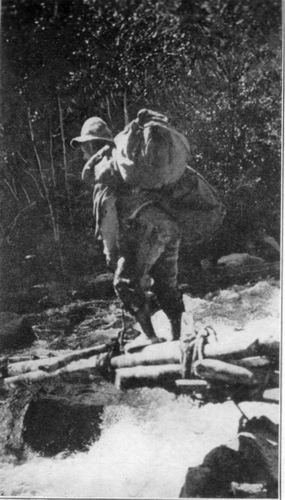
heat. They found it more and more difficult to carry their loads. Twice
we had
to cross the rapids of the river on primitive bridges which consisted
only of a
few little logs lashed together and resting on slippery boulders. By one o’clock we
found
ourselves on a small plain
(ele. 4500 ft.) in dense woods surrounded by tree ferns, vines, and
tangled
thickets, through which it was impossible to see for more than a few
feet. Here
Guzman told us we must stop and rest a while, as we were now in the
territory
of los salvajes, the savage
Indians
who acknowledged only the rule of Saavedra and resented all intrusion.
Guzman
did not seem to be particularly afraid, but said that we ought to send
ahead
one of our carriers, to warn the savages that we were coming on a
friendly
mission and were not in search of rubber gatherers; otherwise they
might attack
us, or run away and disappear into the jungle. He said we should never
be able
to find the ruins without their help. The carrier who was selected to
go ahead
did not relish his task. Leaving his pack behind, he proceeded very
quietly and
cautiously along the trail and was lost to view almost immediately.
There
followed an exciting half-hour while we waited, wondering what attitude
the
savages would take toward us, and trying to picture to ourselves the
mighty
potentate, Saavedra, who had been described as sitting in the midst of
savage
luxury, “surrounded by fifty servants,” and directing his myrmidons to
checkmate our desires to visit the Inca city on the “pampa of ghosts.” Suddenly, we were
startled by
the crackling of twigs
and the sound of a man running. We instinctively held our rifles a
little
tighter in readiness for whatever might befall — when there burst out
of the
woods a pleasant-faced young Peruvian, quite conventionally clad, who
had come
in haste from Saavedra, his father, to extend to us a most cordial
welcome! It
seemed scarcely credible, but a glance at his face showed that there
was no
ambush in store for us. It was with a sigh of relief that we realized
there was
to be no shower of poisoned arrows from the impenetrable thickets.
Gathering up
our packs, we continued along the jungle trail, through woods which
gradually
became higher, deeper, and darker, until presently we saw sunlight
ahead and,
to our intense astonishment, the bright green of waving sugar cane. A
few
moments of walking through the cane fields found us at a large
comfortable hut,
welcomed very simply and modestly by Saavedra himself. A more pleasant
and
peaceable little man it was never my good fortune to meet. We looked
furtively
around for his fifty savage servants, but all we saw was his
good-natured
Indian wife, three or four small children, and a wild-eyed
maid-of-all-work,
evidently the only savage present. Saavedra said some called this place
“Jesús
Maria” because they were so surprised when they saw it. It is difficult to
describe our
feelings as we
accepted Saavedra’s invitation to make ourselves at home, and sat down
to an
abundant meal of boiled chicken, rice, and sweet cassava (manioc).
Saavedra
gave us to understand that we were not only most welcome to anything he
had,
but that he would do everything to enable us to see the ruins, which
were, it
seemed, at Espiritu Pampa, some distance farther down the valley, to be
reached
only by a hard trail passable for barefooted savages, but scarcely
available
for us unless we chose to go a good part of the distance on hands and
knees.
The next day, while our carriers were engaged in clearing this trail,
Professor
Foote collected a large number of insects, including eight new species
of moths
and butterflies. I
inspected Saavedra’s plantation. The soil having
lain fallow for centuries, and being rich in humus, had produced more
sugar
cane than he could grind. In addition to this, he had bananas, coffee
trees,
sweet potatoes, tobacco, and peanuts. Instead of being “a
very powerful chief
having many Indians under his control” — a kind of
“Pooh-Bah” — he was merely a
pioneer. In the utter wilderness, far from any neighbors, surrounded by
dense
forests and a few savages, he had established his home. He was not an
Indian
potentate, but only a frontiersman, soft-spoken and energetic, an
ingenious
carpenter and mechanic, a modest Peruvian of the best type. Owing to the scarcity
of arable
land he was obliged
to cultivate such pampas as he could find — one an
alluvial fan near his
house, another a natural terrace near the river. Back of the house was
a
thatched shelter under which he had constructed a little sugar mill. It
had a
pair of hardwood rollers, each capable of being turned, with much
creaking and
cracking, by a large, rustic wheel made of roughly hewn timbers
fastened
together with wooden pins and lashed with thongs, worked by hand and
foot
power. Since Saavedra had been unable to coax any pack animals over the
trail
to Conservidayoc he was obliged to depend entirely on his own limited
strength and
that of his active son, aided by the uncertain and irregular services
of such
savages as wished to work for sugar, trinkets, or other trade articles.
Sometimes the savages seemed to enjoy the fun of climbing on the great
creaking
treadwheel, as though it were a game. At other times they would
disappear in
the woods. Near the mill were
some
interesting large pots which
Saavedra was using in the process of boiling the juice and making crude
sugar.
He said he had found the pots in the jungle not far away. They had been
made by
the Incas. Four of them were of the familiar aryballus
type. Another was of a closely related form, having a
wide mouth, pointed base, single incised, conventionalized, animal-head
nubbin
attached to the shoulder, and band-shaped handles attached vertically
below the
median line. Although capable of holding more than ten gallons, this
huge pot
was intended to be carried on the back and shoulders by means of a rope
passing
through the handles and around the nubbin. Saavedra said that he had
found near
his house several bottle-shaped cists lined with stones, with a flat
stone on
top — evidently ancient graves. The bones had entirely disappeared. The
cover
of one of the graves had been pierced; the hole covered with a thin
sheet of
beaten silver. He had also found a few stone implements and two or
three small
bronze Inca axes. 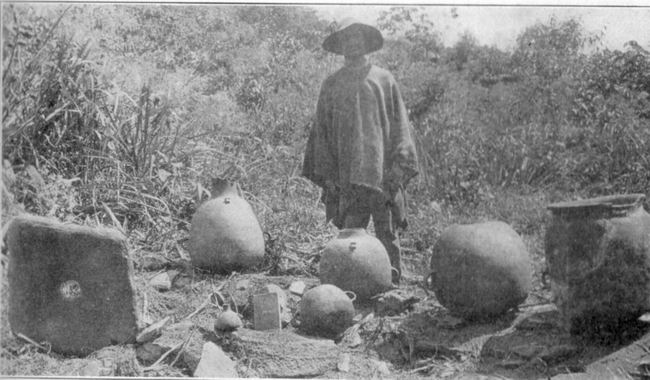 SAAVEDRA AND HIS INCA POTTERY 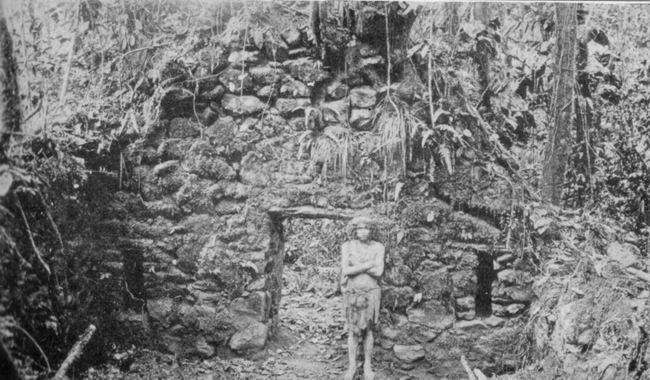 INCA GABLE AT ESPIRITU PAMPA On the pampa,
below
his house, Saavedra had constructed with infinite labor another sugar
mill. It
seemed strange that he should have taken the trouble to make two mills;
but
when one remembered that he had no pack animals and was usually obliged
to
bring the cane to the mill on his own back and the back of his son, one
realized that it was easier, while the cane was growing, to construct a
new
mill near the cane field than to have to carry the heavy bundles of
ripe cane
up the hill. He said his hardest task was to get money with which to
send his
children to school in Cuzco and to pay his taxes. The only way in which
he
could get any cash was by making chancaca,
crude brown sugar, and carrying it on his back, fifty
pounds at a time,
three hard days’ journey on foot up the mountain to Pampaconas or
Vilcabamba,
six or seven thousand feet above his little plantation. He said he
could
usually sell such a load for five soles, equivalent
to two dollars and a
half! His was certainly a hard lot, but he did not complain, although
he
smilingly admitted that it was very difficult to keep the trail open,
since the
jungle grew so fast and the floods in the river continually washed away
his
little rustic bridges. His chief regret was that as the result of a
recent
revolution, with which he had had nothing to do, the government had
decreed
that all firearms should be turned in, and so he had lost the one thing
he
needed to enable him to get fresh meat in the forest. In the clearing
near the
house we were interested to see a large turkey-like bird, the pava
de la
montãna, glossy black, its most striking feature a high,
coral red comb.
Although completely at liberty, it seemed to be thoroughly
domesticated. It
would make an attractive bird for introduction into our Southern States. Saavedra gave us
some very
black leaves of native
tobacco, which he had cured. An inveterate smoker who tried it in his
pipe said
it was without exception the strongest stuff he ever had encountered! So interested did I
become in
talking with Saavedra,
seeing his plantation, and marveling that he should be worried about
taxes and
have to obey regulations in regard to firearms, I had almost forgotten
about
the wild Indians. Suddenly our carriers ran toward the house in a great
flurry
of excitement, shouting that there was a “savage” in the bushes near
by. The
“wild man” was very timid, but curiosity finally got the better of fear
and he
summoned up sufficient courage to accept Saavedra’s urgent invitation
that he
come out and meet us. He proved to be a miserable specimen, suffering
from a
very bad cold in his head. It has been my good fortune at one time or
another
to meet primitive folk in various parts of America and the Pacific, but
this
man was by far the dirtiest and most wretched savage that I have ever
seen. He was dressed in a
long,
filthy tunic which came
nearly to his ankles. It was made of a large square of coarsely woven
cotton
cloth, with a hole in the middle for his head. The sides were stitched
up,
leaving holes for the arms. His hair was long, unkempt, and matted. He
had
small, deep-set eyes, cadaverous cheeks, thick lips, and a large mouth.
His big
toes were unusually long and prehensile. Slung over one shoulder he
carried a
small knapsack made of coarse fiber net. Around his neck hung what at
first
sight seemed to be a necklace composed of a dozen stout cords securely
knotted
together. Although I did not see it in use, I was given to understand
that when
climbing trees, he used this stout loop to fasten his ankles together
and thus
secure a tighter grip for his feet. By evening two other
savages
had come in; a young
married man and his little sister. Both had bad colds. Saavedra told us
that
these Indians were Pichanguerras, a subdivision of the Campa tribe.
Saavedra
and his son spoke a little of their language, which sounded to our
unaccustomed
ears like a succession of low grunts, breathings, and gutturals. It was
pieced
out by signs. The long tunics worn by the men indicated that they had
one or
more wives. Before marrying they wear very scanty attire — nothing more
than a
few rags hanging over one shoulder and tied about the waist. The long
tunic, a
comfortable enough garment to wear during the cold nights, and their
only
covering, must impede their progress in the jungle; yet they live
partly by
hunting, using bows and arrows. We learned that these Pichanguerras had
run
away from the rubber country in the lower valleys; that they found it
uncomfortably cold at this altitude, 4500 feet, but preferred freedom
in the
higher valleys to serfdom on a rubber estate. Saavedra said that he
had named
his plantation Conservidayoc, because
it was in truth
“a spot where one may be preserved from harm.” Such was the home of the
potentate from whose abode “no one had been known to return alive.”
Click
 here to continue to the next chapter of Inca Lands
|