Web
and Book design, Web
and Book design, Copyright, Kellscraft Studio 1999-2003 (Return to Web Text-ures) |
Click Here to return to Inca Lands Content Page Click Here to return to previous chapter |
 (HOME) |
| Web
and Book design, Copyright, Kellscraft Studio 1999-2003 (Return to Web Text-ures) |
Click Here to return to Inca Lands Content Page Click Here to return to previous chapter |
(HOME) |
|
CHAPTER
XV THE PAMPA OF GHOSTS TWO days later we
left
Conservidayoc for Espiritu
Pampa by the trail which Saavedra’s son and our Pampaconas Indians had
been
clearing. We emerged from the thickets near a promontory where there
was a fine
view down the valley and particularly of a heavily wooded alluvial fan
just
below us. In it were two or three small clearings and the little oval
huts of
the savages of Espiritu Pampa, the “Pampa of Ghosts.” On top of the
promontory was
the ruin of a small,
rectangular building of rough stone, once probably an Inca watch-tower.
From
here to Espiritu Pampa our trail followed an ancient stone stairway,
about four
feet in width and nearly a third of a mile long. It was built of uncut
stones.
Possibly it was the work of those soldiers whose chief duty it was to
watch
from the top of the promontory and who used their spare time making
roads. We
arrived at the principal clearing just as a heavy thunder-shower began.
The
huts were empty. Obviously their occupants had seen us coming and had
disappeared in the jungle. We hesitated to enter the home of a savage
without
an invitation, but the terrific downpour overcame our scruples, if not
our
nervousness. The hut had a steeply pitched roof. Its sides were made of
small
logs driven endwise into the ground and fastened together with vines. A
small
fire had been burning on the ground. Near the embers were two old black
ollas
of Inca origin. In the little chacra,
cassava, coca,
and
sweet potatoes were growing in haphazard fashion among charred and
fallen tree
trunks; a typical milpa farm. In the clearing were
the ruins of eighteen
or twenty circular houses arranged in an irregular group. We wondered
if this
could be the “Inca city” which Lopez Torres had reported. Among the
ruins we
picked up several fragments of Inca pottery. There was nothing Incaic
about the
buildings. One was rectangular and one was spade-shaped, but all the
rest were
round. The buildings varied in diameter from fifteen to twenty feet.
Each had
but a single opening. The walls had tumbled down, but gave no evidence
of
careful construction. Not far away, in woods which had not yet been
cleared by
the savages, we found other circular walls. They were still standing to
a
height of about four feet. If the savages have extended their milpa
clearings
since our visit, the falling trees have probably spoiled these walls by
now.
The ancient village probably belonged to a tribe which acknowledged
allegiance
to the Incas, but the architecture of the buildings gave no indication
of their
having been constructed by the Incas themselves. We began to wonder
whether the
“Pampa of Ghosts” really had anything important in store for us.
Undoubtedly
this alluvial fan had been highly prized in this country of terribly
steep
hills. It must have been inhabited, off and on, for many centuries. Yet
this
was not an “Inca city.” While we were
wondering whether
the Incas themselves
ever lived here, there suddenly appeared the naked figure of a sturdy
young
savage, armed with a stout bow and long arrows, and wearing a fillet of
bamboo.
He had been hunting and showed us a bird he had shot. Soon afterwards
there
came the two adult savages we had met at Saavedra’s, accompanied by a
cross-eyed friend, all wearing long tunics. They offered to guide us to
other
ruins. It was very difficult for us to follow their rapid pace. Half an
hour’s
scramble through the jungle brought us to a pampa or
natural terrace on
the banks of a little tributary of the Pampaconas. They called it
Eromboni.
Here we found several old artificial terraces and the rough foundations
of a
long, rectangular building 192 feet by 24 feet. It might have had
twenty-four
doors, twelve in front and twelve in back, each three and a half feet
wide. No
lintels were in evidence. The walls were only a foot high. There was
very
little building material in sight. Apparently the structure had never
been
completed. Near by was a typical Inca fountain with three stone spouts,
or conduits.
Two hundred yards beyond the water-carrier’s rendezvous, hidden behind
a
curtain of hanging vines and thickets so dense we could not see more
than a few
feet in any direction, the savages showed us the ruins of a group of
stone
houses whose walls were still standing in fine condition. 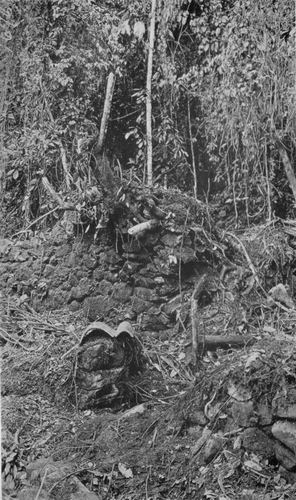 INCA RUINS IN THE JUNGLES OF ESPIRITU PAMPAS One of the buildings
was
rounded at one end.
Another, standing by itself at the south end of a little pampa,
had
neither doors nor windows. It was rectangular. Its four or five niches
were
arranged with unique irregularity. Furthermore, they were two feet
deep, an
unusual dimension. Probably this was a storehouse. On the cast side of
the
pampa was a structure, 120 feet long by 21 feet wide, divided
into five
rooms of unequal size. The walls were of rough stones laid in adobe.
Like some
of the Inca buildings at Ollantaytambo, the lintels of the doors were
made of
three or four narrow uncut ashlars. Some rooms had niches. On the north
side of
the pampa was another rectangular building. On the
west side was the
edge of a stone-faced terrace. Below it was a partly enclosed fountain
or
bathhouse, with a stone spout and a stone-lined basin. The shapes of
the
houses, their general arrangement, the niches, stone roof-pegs and
lintels, all
point to Inca builders. In the buildings we picked up several fragments
of Inca
pottery. Equally interesting
and very
puzzling were half a
dozen crude Spanish roofing tiles, baked red. All the pieces and
fragments we
could find would not have covered four square feet. They were of widely
different sizes, as though some one had been experimenting. Perhaps an
Inca who
had seen the new red tiled roofs of Cuzco had tried to reproduce them
here in
the jungle, but without success. At dusk we all
returned to
Espiritu Pampa. Our
faces, hands, and clothes had been torn by the jungle; our feet were
weary and
sore. Nevertheless the day’s work had been very satisfactory and we
prepared to
enjoy a good night’s rest. Alas, we were doomed to disappointment.
During the
day someone had brought to the hut eight tame but noisy macaws.
Furthermore,
our savage helpers determined to make the night hideous with cries,
tom-toms,
and drums, either to discourage the visits of hostile Indians or
jaguars, or
for the purpose of exorcising the demons brought by the white men, or
else to
cheer up their families, who were undoubtedly hiding in the jungle near
by. The next day the
savages and
our carriers continued
to clear away as much as possible of the tangled growth near the best
ruins. In
this process, to the intense surprise not only of ourselves, but also
of the
savages, they discovered, just below the “bathhouse” where we had stood
the day
before, the well-preserved ruins of two buildings of superior
construction,
well fitted with stone-pegs and numerous niches, very symmetrically
arranged.
These houses stood by themselves on a little artificial terrace.
Fragments of
characteristic Inca pottery were found on the floor, including pieces
of a
large aryballus. Nothing gives a
better idea of
the density of the
jungle than the fact that the savages themselves had often been within
five
feet of these fine walls without being aware of their existence. Encouraged by this
important
discovery of the most
characteristic Inca ruins found in the valley, we continued the search,
but all
that any one was able to find was a carefully built stone bridge over a
brook.
Saavedra’s son questioned the savages carefully. They said they knew of
no
other antiquities. Who built the stone buildings of Espiritu Pampa and
Eromboni
Pampa? Was this the “Vilcabamba Viejo” of Father Calancha, that
“University of
Idolatry where lived the teachers who were wizards and masters of
abomination,”
the place to which Friar Marcos and Friar Diego went with so much
suffering?
Was there formerly on this trail a place called Ungacacha where the
monks had
to wade, and amused Titu Cusi by the way they handled their monastic
robes in
the water? They called it a “three days’ journey over rough country.”
Another
reference in Father Calancha speaks of Puquiura as being “two long
days’
journey from Vilcabamba.” It took us five days to go from Espiritu
Pampa to
Pucyura, although Indians, unencumbered by burdens, and spurred on by
necessity, might do it in three. It is possible to fit some other
details of
the story into this locality, although there is no place on the road
called
Ungacacha. Nevertheless it does not seem to me reasonable to suppose
that the
priests and Virgins of the Sun (the personnel of the “University of
Idolatry”)
who fled from cold Cuzco with Manco and were established by him
somewhere in
the fastnesses of Uilcapampa would have cared to live in the hot valley
of
Espiritu Pampa. The difference in climate is as great as that between
Scotland
and Egypt, or New York and Havana. They would not have found in
Espiritu Pampa
the food which they liked. Furthermore, they could have found the
seclusion and
safety which they craved just as well in several other parts of the
province,
particularly at Machu Picchu, together with a cool, bracing climate and
food-stuffs more nearly resembling those to which they were accustomed.
Finally
Calancha says “Vilcabamba the Old” was “the largest city” in the
province, a
term far more applicable to Machu Picchu or even to Choqquequirau than
to
Espiritu Pampa. On the other hand
there seems
to be no doubt that
Espiritu Pampa in the montaña does
meet the requirements of the place called Vilcabamba by the companions
of
Captain Garcia. They speak of it as the town and valley to which Tupac
Amaru,
the last Inca, escaped after his forces lost the “young fortress” of
Uiticos.
Ocampo, doubtless wishing to emphasize the difference between it and
his own
metropolis, the Spanish town of Vilcabamba, calls the refuge of Tupac
“Vilcabamba the old.” Ocampo’s new “Vilcabamba” was not in existence
when Friar
Marcos and Friar Diego lived in this province. If Calancha wrote his
chronicles
from their notes, the term “old” would not apply to Espiritu Pampa, but
to an
older Vilcabamba than either of the places known to Ocampo. The ruins are of late
Inca
pattern, not of a kind
which would have required a long period to build. The unfinished
building may
have been under construction during the latter part of the reign of
Titu Cusi.
It was Titu Cusi’s desire that Rodriguez de Figueroa should meet him at
Pampaconas. The Inca evidently came from a Vilcabamba down in the montãna, and, as has been said, brought
Rodriguez a present of a macaw and two hampers of peanuts, articles of
trade
still common at Conservidayoc. There appears to me every reason to
believe that
the ruins of Espiritu Pampa are those of one of the favorite residences
of this
Inca — the very Vilcabamba, in fact, where he spent his boyhood and
from which
he journeyed to meet Rodriguez in 1565.1 In 1572, when Captain
Garcia
took up the pursuit of
Tupac Amaru after the victory of Vilcabamba, the Inca fled “inland
toward the
valley of Simaponte ... to the country of the Manaries Indians, a
warlike tribe
and his friends, where balsas and canoes were
posted to save him and
enable him to escape.” There is now no valley in this vicinity called
Simaponte, so far as we have been able to discover. The Manaries
Indians are
said to have lived on the banks of the lower Urubamba. In order to
reach their
country Tupac Amaru probably went down the Pampaconas from Espiritu
Pampa. From
the “Pampa of Ghosts” to canoe navigation would have been but a short
journey.
Evidently his friends who helped him to escape were canoemen. Captain
Garcia
gives an account of the pursuit of Tupac Amaru in which he says that,
not
deterred by the dangers of the jungle or the river, he constructed five
rafts
on which he put some of his soldiers and, accompanying them himself,
went down
the rapids, escaping death many times by swimming, until he arrived at
a place
called Momori, only to find that the Inca, learning of his approach,
had gone
farther into the woods. Nothing daunted, Garcia followed him, although
he and
his men now had to go on foot and barefooted, with hardly anything to
eat, most
of their provisions having been lost in the river, until they finally
caught
Tupac and his friends; a tragic ending to a terrible chase, hard on the
white
man and fatal for the Incas. It was with great
regret that I
was now unable to
follow the Pampaconas River to its junction with the Urubamba. It
seemed
possible that the Pampaconas might be known as the Sirialo, or the
Coribeni,
both of which were believed by Dr. Bowman’s canoe-men to rise in the
mountains
of Vilcabamba. It was not, however, until the summer of 1915 that we
were able
definitely to learn that the Pampaconas was really a branch of the
Cosireni. It
seems likely that the Cosireni was once called the “Simaponte.” Whether
the
Comberciato is the “ Momori” is hard to say. To be the next to
follow in the
footsteps of Tupac
Amaru and Captain Garcia was the privilege of Messrs. Heller, Ford, and
Maynard. They found that the unpleasant features had not been
exaggerated. They
were tormented by insects and great quantities of ants — a small red
ant found
on tree trunks, and a large black one, about an inch in length,
frequently seen
among the leaves on the ground. The bite of the red ant caused a
stinging and
burning for about fifteen minutes. One of their carriers who was bitten
in the
foot by a black ant suffered intense pain for a number of hours. Not
only his foot,
but also his leg and hip were affected. The savages were both fishermen
and
hunters; the fish being taken with nets, the game killed with bows and
arrows.
Peccaries were shot from a blind made of palm leaves a few feet from a
runway.
Fishing brought rather meager results. Three Indians fished all night
and
caught only one fish, a perch weighing about four pounds. The temperature was
so high
that candles could
easily be tied in knots. Excessive humidity caused all leather articles
to
become blue with mould. Clouds of flies and mosquitoes increased the
likelihood
of spreading communicable jungle fevers. The river Comberciato
was
reached by Mr. Heller at a
point not more than a league from its junction with the Urubamba. The
lower
course of the Comberciato is not considered dangerous to canoe
navigation, but
the valley is much narrower than the Cosireni. The width of the river
is about
150 feet and its volume is twice that of the Cosireni. The climate is
very
trying. The nights are hot. Insect pests are numerous. Mr. Heller found
that
“the forest was filled with annoying, though stingless, bees which
persisted in
attempting to roost on the countenance of any human being available.”
On the
banks of the Comberciato he found several families of savages. All the
men were
keen hunters and fishermen. Their weapons consisted of powerful bows
made from
the wood of a small palm and long arrows made of reeds and finished
with
feathers arranged in a spiral. Monkeys were
abundant.
Specimens of six distinct
genera were found, including the large red howler, inert and easily
located by
its deep, roaring bellow which can be heard for a distance of several
miles;
the giant black spider monkey, very alert, and, when frightened, fairly
flying
through the branches at astonishing speed; and a woolly monkey, black
in color,
and very intelligent in expression, frequently tamed by the savages,
who “enjoy
having them as pets but are not averse to eating them when food is
scarce.”
“The flesh of monkeys is greatly appreciated by these Indians, who
preserved
what they did not require for immediate needs by drying it over the
smoke of a
wood fire.” On the Cosireni Mr.
Maynard
noticed that one of his
Indian guides carried a package, wrapped in leaves, which on being
opened
proved to contain forty or fifty large hairless grubs or caterpillars.
The man
finally bit their heads off and threw the bodies into a small bag,
saying that
the grubs were considered a great delicacy by the savages. The Indians we met at
Espiritu
Pampa closely
resembled those seen in the lower valley. All our savages were
bareheaded and
barefooted. They live so much in the shelter of the jungle that hats
are not
necessary. Sandals or shoes would only make it harder to use the
slippery
little trails. They had seen no strangers penetrate this valley for
about ten
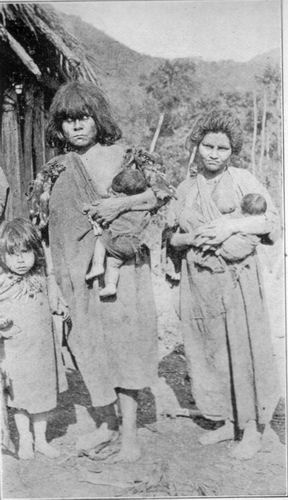
years, and at first kept their wives and children well secluded. Later,
when
Messrs. Hendriksen and Tucker were sent here to determine the
astronomical
position of Espiritu Pampa, the savages permitted Mr. Tucker to take
photographs of their families. Perhaps it is doubtful whether they knew
just
what he was doing. At all events they did not run away and hide.
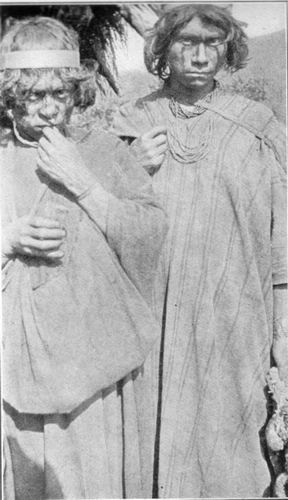
All the men and older
boys wore
white fillets of
bamboo. The married men had smeared paint on their faces, and one of
them was
wearing the characteristic lip ornament of the Campas. Some of the
children
wore no clothing at all. Two of the wives wore long tunics like the
men. One of
them had a truly savage face, daubed with paint. She wore no fillet,
had the
best tunic, and wore a handsome necklace made of seeds and the skins of
small
birds of brilliant plumage, a work of art which must have cost infinite
pains
and the loss of not a few arrows. All the women carried babies in
little
hammocks slung over the shoulder. One little girl, not. more than six years old,
was carrying on her back a child of two, in a hammock supported from
her head
by a tump-line. It will be remembered that forest Indians nearly always
use
tump-lines so as to allow their hands free play. One of the wives was
fairer
than the others and looked as though she might have had a Spanish
ancestor. The
most savage-looking of the women was very scantily clad, wore a
necklace of
seeds, a white lip ornament, and a few rags tied around her waist. All
her children
were naked. The children of the woman with the handsome necklace were
clothed
in pieces of old tunics, and one of them, evidently her mother’s
favorite, was
decorated with bird skins and a necklace made from the teeth of monkeys. Such were the people
among whom
Tupac Amaru took
refuge when he fled from Vilcabamba. Whether he partook of such a
delicacy as
monkey meat, which all Amazonian Indians relish, but which is not eaten
by the
highlanders, may be doubted. Garcilasso speaks of
Tupac
Amaru’s preferring to
entrust himself to the hands of the Spaniards “rather than to perish of
famine.” His Indian allies lived perfectly well in a region where
monkeys
abound. It is doubtful whether they would ever have permitted Captain
Garcia to
capture the Inca had they been able to furnish Tupac with such food as
he was
accustomed to. At all events our
investigations seem to point to
the probability of this valley having been an important part of the
domain of
the last Incas. It would have been pleasant to prolong our studies, but
the
carriers were anxious to return to Pampaconas. Although they did not
have to
eat monkey meat, they were afraid of the savages and nervous as to what
use the
latter might some day make of the powerful bows and long arrows. At Conservidayoc
Saavedra
kindly took the trouble to
make some sugar for us. He poured the syrup in oblong moulds cut in a
row along
the side of a big log of hard wood. In some of the moulds his son
placed
handfuls of nicely roasted peanuts. The result was a confection or
“emergency
ration” which we greatly enjoyed on our return journey. At San Fernando we
met the pack
mules. The next day,
in the midst of continuing torrential tropical downpours, we climbed
out of the
hot valley to the cold heights of Pampaconas. We were soaked with
perspiration
and drenched with rain. Snow had been falling above the village; our
teeth
chattered like castanets. Professor Foote immediately commandeered Mrs.
Guzman’s fire and filled our tea kettle. It may be doubted whether a
more
wretched, cold, wet, and bedraggled party ever arrived at Guzman’s hut;
certainly nothing ever tasted better than that steaming hot sweet tea. ---------------------------------------
1 Titu
Cusi was an illegitimate son of Manco. His mother was not of royal
blood and
may have been a native of the warm valleys.
Click
 here to continue to the next chapter of Inca Lands
|