Web
and Book design, Web
and Book design, Copyright, Kellscraft Studio 1999-2003 (Return to Web Text-ures) |
Click Here to return to Inca Lands Content Page Click Here to return to previous chapter |
 (HOME) |
| Web
and Book design, Copyright, Kellscraft Studio 1999-2003 (Return to Web Text-ures) |
Click Here to return to Inca Lands Content Page Click Here to return to previous chapter |
(HOME) |
|
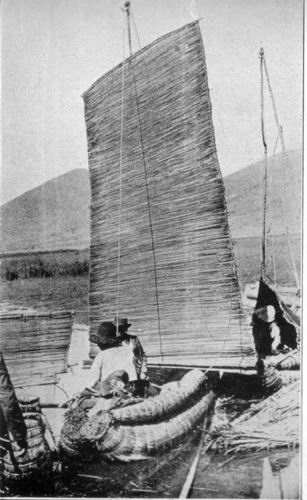
CHAPTER V TITICACA AREQUIPA is one of the pleasantest places in the world: mountain air, bright sunshine, warm days, cool nights, and a sparkling atmosphere clear to the hearts of star-gazers. The city lies on a plateau, surrounded by mighty snow-capped volcanoes, Chachani (20,000 ft.), El Misti (19,000 ft.), and Pichu Pichu (18,000 ft.). Arequipa has only one nightmare — earthquakes. About twice in a century the spirits of the sleeping volcanoes stir, roll over, and go to sleep again. But they shake the bed! And Arequipa rests on their bed. The possibility of a “terremoto” is always present in the subconscious mind of the Arequipeno. One evening I happened to be dining with a friend at the hospitable Arequipa Club. Suddenly the windows rattled violently and we heard a loud explosion; at least that is what it sounded like to me. To the members of the club, however, it meant only one thing — an earthquake. Everybody rushed out; the streets were already crowded with hysterical people, crying, shouting, and running toward the great open plaza in front of the beautiful cathedral. Here some dropped on their knees in gratitude at having escaped from falling walls, others prayed to the god of earthquakes to spare their city. Yet no walls had fallen! In the business district a great column of black smoke was rising. Gradually it became known to the panic-stricken throngs that the noise and the trembling had not been due to an earthquake, but to an explosion in a large warehouse which had contained gasoline, kerosene, dynamite and giant powder! In this city of 35,000 people, the second largest of Peru, fires are so very rare, not even annual, scarcely biennial, that there were no fire engines. A bucket brigade was formed and tried to quench the roaring furnace by dipping water from one of the azequias, or canals, that run through the streets. The fire continued to belch forth dense masses of smoke and flame. In any American city such a blaze would certainly become a great conflagration. While the fire was at its height I went into the adjoining building to see whether any help could be rendered. To my utter amazement the surface of the wall next to the fiery furnace was not even warm. Such is the result of building houses with massive walls of stone. Furthermore, the roofs in Arequipa are of tiles; consequently no harm was done by sparks. So, without a fire department, this really terrible fire was limited to one warehouse! The next day the newspapers talked about the “dire necessity” of securing fire engines. It was difficult for me to see what good a fire engine could have done. Nothing could have saved the warehouse itself once the fire got under way; and surely the houses next door would have suffered more had they been deluged with streams of water. The facts are almost incredible to an American. We take it as a matter of course that cities should have fires and explosions. In Arequipa everybody thought it was an earthquake! A day’s run by an excellent railroad takes one to Puno, the chief port of Lake Titicaca, elevation 12,500 feet. Puno boasts a soldier’ s monument and a new theater, really a “movie palace.” There is a good harbor, although dredging is necessary to provide for steamers like the Inca. Repairs to the lake boats are made on a marine — or, rather, a lacustrine — railway. The bay of Puno grows quantities of totoras, giant bulrushes sometimes twelve feet long. Ages ago the lake dwellers learned to dry the totoras, tie them securely in long bundles, fasten the bundles together, turn up the ends, fix smaller bundles along the sides as a free-board, and so construct a fishing-boat, or balsa. Of course the balsas eventually become water-logged and spend a large part of their existence on the shore, drying in the sun. Even so, they are not very buoyant. I can testify that it is difficult to use them without getting one’s shoes wet. As a matter of fact one should go barefooted, or wear sandals, as the natives do. The balsas are clumsy, and difficult to paddle. The favorite method of locomotion is to pole or, when the wind favors, sail. The mast is an A-shaped contraption, twelve feet high, made of two light poles tied together and fastened, one to each side of the craft, slightly forward of amidships. Poles are extremely scarce in this region — lumber has to be brought from Puget Sound, 6000 miles away – so nearly all the masts I saw were made of small pieces of wood spliced two or three times. To the apex of the “A” is attached a forked stick, over which run the halyards. The rectangular “sail” is nothing more nor less than a large mat made of rushes. A short forestay fastened to the sides of the “A” about four feet above the hull prevents the mast from falling when the sail is hoisted. The main halyards take the place of a backstay. The balsas cannot beat to windward, but behave very well in shallow water with a favoring breeze. When the wind is contrary the boatmen must pole. They are extremely careful not to fall overboard, for the water in the lake is cold, 55° F., and none of them know how to swim. Lake Titicaca itself never freezes over, although during the winter ice forms at night on the shallow bays and near the shore. When the Indians wish to go in the shallowest waters they use a very small balsa not over eight feet long, barely capable of supporting the weight of one man. On the other hand, large balsas constructed for use in crossing the rough waters of the deeper portions of the lake are capable of carrying a dozen people and their luggage. Once I saw a ploughman and his team of oxen being ferried across the lake on a bulrush raft. To give greater security two balsas are sometimes fastened together in the fashion of a double canoe.
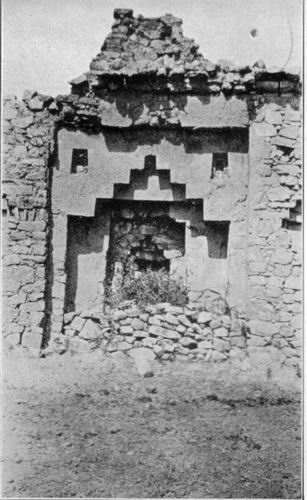
One of the more highly speculative of the Bolivian writers, Señor Posnansky, of La Paz, believes that gigantic balsas were used in bringing ten-ton monoliths across the lake to Tiahuanaco. This theory is based on the assumption that Titicaca was once very much higher than it is now, a hypothesis which has not commended itself to modern geologists or geographers. Dr. Isaiah Bowman and Professor Herbert Gregory, who have studied its geology and physiography, have not been able to find any direct evidence of former high levels for Lake Titicaca, or of its having been connected with the ocean. Nevertheless, Señor Posnansky believes that Lake Titicaca was once a salt sea which became separated from the ocean as the Andes rose. The fact that the lake fishes are fresh-water, rather than marine, forms does not bother him. Señor Posnansky pins his faith to a small dried seahorse once given him by a Titicaca fisherman. He seems to forget that dried specimens of marine life, including starfish, are frequently offered for sale in the Andes by the dealers in primitive medicines who may be found in almost every market-place. Probably Señor Posnansky’s seahorse was brought from the ocean by some particularly enterprising trader. Although starfish are common enough in the Andes and a seahorse has actually found its resting-place in La Paz, this does not alter the fact that scientific investigators have never found any strictly marine fauna in Lake Titicaca. On the other hand, it has two or three kinds of edible fresh-water fish. One of them belongs to a species found in the Rimac River near Lima. It seems to me entirely possible that the Incas, with their scorn of the difficulties of carrying heavy burdens over seemingly impossible trails, might have deliberately transplanted the desirable fresh-water fishes of the Rimac River to Lake Titicaca. Polo de Ondegardo, who lived in Cuzco in 1560, says that the Incas used to bring fresh fish from the sea by special runners, and that “they have records in their quipus of the fish having been brought from Tumbez, a distance of more than three hundred leagues.” The actual transference of water jars containing the fish would have offered no serious obstacle whatever to the Incas, provided the idea happened to appeal to them as desirable. Yet I may be as far wrong as Señor Posnansky! At any rate, the romantic stories of a gigantic inland sea, vastly more extensive than the present lake and actually surrounding the ancient city of Tiahuanaco, must be treated with respectful skepticism. Tiahuanaco, at the southern end of Lake Titicaca, in Bolivia, is famous for the remains of a pre-Inca civilization. Unique among prehistoric remains in the highlands of Peru or Bolivia are its carved monolithic images. Although they have suffered from weathering and from vandalism, enough remains to show that they represent clothed human figures. The richly decorated girdles and long tunics are carved in low relief with an intricate pattern. While some of the designs are undoubtedly symbolic of the rank, achievements, or attributes of the divinities or chiefs here portrayed, there is nothing hieroglyphic. The images are stiff and show no appreciation of the beauty of the human form. Probably the ancient artists never had an opportunity to study the human body. In Andean villages, even little children do not go naked as they do among primitive peoples who live in warm climates. The Highlanders of Peru and Bolivia are always heavily clothed, day and night. Forced by their climate to seek comfort in the amount and thickness of their apparel, they have developed an excessive modesty in regard to bodily exposure which is in striking contrast to people who live on the warm sands of the South Seas. Inca sculptors and potters rarely employed the human body as a motif. Tiahuanaco is pre-Inca, yet even here the images are clothed. They were not represented as clothed in order to make easier the work of the sculptor. His carving shows he had great skill, was observant, and had true artistic feeling. Apparently the taboo against “nakedness” was too much for him. Among the thirty-six islands in Lake Titicaca, some belong to Peru, others to Bolivia. Two of the latter, Titicaca and Koati, were peculiarly venerated in Inca days. They are covered with artificial terraces, most of which are still used by the Indian farmers of to-day. On both islands there are ruins of important Inca structures. On Titicaca Island I was shown two caves, out of which, say the Indians, came the sun and moon at their creation. These caves are not large enough for a man to stand upright, but to a people who do not appreciate the size of the heavenly bodies it requires no stretch of the imagination to believe that those bright disks came forth from caves eight feet wide. The myth probably originated with dwellers on the western shore of the lake who would often see the sun or moon rise over this island. On an ancient road that runs across the island my native guide pointed out the “footprints of the sun and moon” — two curious effects of erosion which bear a distant resemblance to the footprints of giants twenty or thirty feet tall. The present-day Indians, known as Aymaras, seem to be hard-working and fairly cheerful. The impression which Bandelier gives, in his “Islands of Titicaca and Koati,” of the degradation and surly character of these Indians was not apparent at the time of my short visit in 1915. It is quite possible, however, that if I had to live among the Indians, as he did for several months, digging up their ancient places of worship, disturbing their superstitious prejudices, and possibly upsetting, in their minds, the proper balance between wet weather and dry, I might have brought upon myself uncivil looks and rough, churlish treatment such as he experienced. In judging the attitude of mind of the natives of Titicaca one should remember that they live under most trying conditions of climate and environment. During several months of the year everything is dried up and parched. The brilliant sun of the tropics, burning mercilessly through the rarefied air, causes the scant vegetation to wither. Then come torrential rains. I shall never forget my first experience on Lake Titicaca, when the steamer encountered a rain squall. The resulting deluge actually came through the decks. Needless to say, such downpours tend to wash away the soil which the farmers have painfully gathered for field or garden. The sun in the daytime is extremely hot, yet the difference in temperature between sun and shade is excessive. Furthermore, the winds at night are very damp; the cold is intensely penetrating. Fuel is exceedingly scarce, there is barely enough for cooking purposes, and none for artificial heat. Food is hard to get. Few crops can be grown at 12,500 feet. Some barley is raised, but the soil is lacking in nitrogen. The principal crop is the bitter white potato, which, after being frozen and dried, becomes the insipid chuño, chief reliance of the poorer families. The Inca system of bringing guano from the islands of the Pacific coast has long since been abandoned. There is no money to pay for modern fertilizers. Consequently, crops are poor. On Titicaca Island I saw native women, who had just harvested their maize, engaged in shucking and drying ears of corn which varied in length from one to three inches. To be sure this miniature corn has the advantage of maturing in sixty days, but good soil and fertilizers would double its size and productiveness. Naturally these Indians always feel themselves at the mercy of the elements. Either a long rainy season or a drought may cause acute hunger and extreme suffering. Consequently, one must not blame the Bolivian or Peruvian Highlander if he frequently appears to be sullen and morose. On the other hand, one ought not to praise Samoans for being happy, hospitable, and light-hearted. Those fortunate Polynesians are surrounded by warm waters in which they can always enjoy a swim, trees from which delicious food can always be obtained, and cocoanuts from which cooling drinks are secured without cost. Who could not develop cheerfulness under such conditions? On the small island, Koati, some of the Inca stonework is remarkably good, and has several unusual features, such as the elaboration of the large, reentrant, ceremonial niches formed by step-topped arches, one within the other. Small ornamental niches are used to break the space between these recesses and the upper corners of the whole rectangle containing them. Also unusual are the niches between the doorways, made in the form of an elaborate quadrate cross. It might seem at first glance as though this feature showed Spanish influence, since a Papal cross is created by the shadow cast in the intervening recessed courses within their design. As a matter of fact, the cross nowy quadrant is a natural outcome of using for ornamental purposes the step-shaped design, both erect and inverted. All over the land of the Incas one finds flights of steps or terraces used repeatedly for ornamental or ceremonial purposes. Some stairs are large enough to be used by man; others are in miniature. Frequently the steps were cut into the sacred boulders consecrated to ancestor worship. It was easy for an Inca architect, accustomed to the stairway motif, to have conceived these curious doorways on Koati and also the cross-like niches between them, even if he had never seen any representation of a Papal cross, or a cross nowy quadrant. My friend, Mr. Bancel La Farge, has also suggested a striking resemblance which the sedilia-like niches bear to Arabic or Moorish architecture, as shown, for instance, in the Court of the Lions in the Alhambra. The step-topped arch is distinctly Oriental in form, yet flights of steps or terraces are also thoroughly Incaic. The principal structure on Koati was built around three sides of a small plaza, constructed on an artificial terrace in a slight depression on the, eastern side of the island. The fourth side is open and affords a magnificent view of the lake and the wonderful snow-covered Cordillera Real, 200 miles long and nowhere less than 17,000 feet high. This range of lofty snow-peaks of surpassing beauty culminates in Mt. Sorata, 21,520 feet high. To the worshipers of the sun and moon, who came to the sacred islands for some of their most elaborate religious ceremonies, the sight of those heavenly luminaries, rising over the majestic snow mountains, their glories reflected in the shining waters of the lake, must have been a sublime spectacle. On such occasions the little plaza would indeed have been worth seeing. We may imagine the gayly caparisoned Incas, their faces lit up by the colors of “rosy-fingered dawn, daughter of the morning,” their ceremonial formation sharply outlined against the high, decorated walls of the buildings behind them. Perhaps the rulers and high priests had special stations in front of the large, step-topped niches. One may be sure that a people who were fond of bright colors, who were able to manufacture exquisite textiles, and who loved to decorate their garments with spangles and disks of beaten gold, would have lost no opportunity for making the ancient ceremonies truly resplendent. On the peninsula of Copacabana, opposite the sacred islands, a great annual pageant is still staged every August. Although at present connected with a pious pilgrimage to the shrine of the miraculous image of the “Virgin of Copacabana,” this vivid spectacle, the most celebrated fair in all South America, has its origin in the dim past. It comes after the maize is harvested and corresponds to our Thanksgiving festival. The scene is laid in the plaza in front of a large, bizarre church. During the first ten days in August there are gathered here thousands of the mountain folk from far and near. Everything dear to the heart of the Aymara Indian is offered for sale, including quantities of his favorite beverages. Traders, usually women, sit in long rows on blankets laid on the cobblestone pavement. Some of them are protected from the sun by primitive umbrellas, consisting of a square cotton sheet stretched over a bamboo frame. In one row are those traders who sell parched and popped corn; in another those who deal in sandals and shoes, the simple gear of the humblest wayfarer and the elaborately decorated high-laced boots affected by the wealthy Chola women of La Paz. In another row are the dealers in Indian blankets; still another is devoted to such trinkets as one might expect to find in a “needle-and-thread” shop at home. There are stolid Aymara peddlers with scores of bamboo flutes varying in size from a piccolo to a bassoon; the hat merchants, with piles of freshly made native felts, warranted to last for at least a year; and vendors of aniline dyes. The fabrics which have come to us from Inca times are colored with beautifully soft vegetable dyes. Among Inca ruins one may find small stone mortars, in which the primitive pigments were ground and mixed with infinite care. Although the modern Indian still prefers the product of hand looms, he has been quick to adopt the harsh aniline dyes, which are not only easier to secure, but produce more striking results. As a citizen of Connecticut it gave me quite a start to see, carelessly exposed to the weather on the rough cobblestones of the plaza, bright new hardware from New Haven and New Britain — locks, keys, spring scales, bolts, screw eyes, hooks, and other “wooden nutmegs.” At the tables of the “money-changers,” just outside of the sacred enclosure, are the real moneymakers, who give nothing for something. Thimble-riggers and three-card-monte-men do a brisk business and stand ready to fleece the guileless native or the unsuspecting foreigner. The operators may wear ragged ponchos and appear to be incapable of deep designs, but they know all the tricks of the trade! The most striking feature of the fair is the presence of various Aymara secret societies, whose members, wearing repulsive masks, are clad in the most extraordinary costumes which can be invented by primitive imaginations. Each society has its own uniform, made up of tinsels and figured satins, tin-foil, gold and silver leaf, gaudy textiles, magnificent epaulets bearing large golden stars on a background of silver decorated with glittering gems of colored glass; tinted “ostrich” plumes of many colors sticking straight up eighteen inches above the heads of their wearers, gaudy ribbons, beruffled bodices, puffed sleeves, and slashed trunks. Some of these strange costumes are actually reminiscent of the sixteenth century. The wearers are provided with flutes, whistles, cymbals, flageolets, snare drums, and rattles, or other noise-makers. The result is an indescribable hubbub; a garish human kaleidoscope, accompanied by fiendish clamor and unmusical noises which fairly outstrip a dozen jazz bands. It is bedlam let loose, a scene of wild uproar and confusion. The members of one group were dressed to represent female angels, their heads tightly turbaned so as to bear the maximum number of tall, waving, variegated plumes. On their backs were gaudy wings resembling the butterflies of children’s pantomimes. Many wore colored goggles. They marched solemnly around the plaza, playing on bamboo flageolets, their plaintive tunes drowned in the din of big bass drums and blatant trumpets. In an eddy in the seething crowd was a placid-faced Aymara, bedecked in the most tawdry manner with gewgaws from Birmingham or Manchester, sedately playing a melancholy tune on a rustic syrinx or Pan’s pipe, charmingly made from little tubes of bamboo from eastern Bolivia. At the close of the festival, on a Sunday afternoon, the costumes disappear and there occurs a bull-baiting. Strong temporary barriers are erected at the corners of the plaza; householders bar their doors. A riotous crowd, composed of hundreds of pleasure-seekers, well fortified with Dutch courage, gathers for the fray. All are ready to run helter-skelter in every direction should the bull take it into his head to charge toward them. It is not a bullfight. There are no picadors, armed with lances to prick the bull to madness; no banderilleros, with barbed darts; no heroic matador, ready with shining blade to give a mad and weary hull the coup de grace. Here all is fun and frolic. To be sure, the bull is duly annoyed by boastful boys or drunken Aymaras, who prod him with sticks and shake bright ponchos in his face until he dashes after his tormentors and causes a mighty scattering of some spectators, amid shrieks of delight from everybody else. When one animal gets tired, another is brought on. There is no chance of a bull being wounded or seriously hurt. At the time of our visit the only animal who seemed at all anxious to do real damage was let alone. He showed no disposition to charge at random into the crowds. The spectators surrounded the plaza so thickly that he could not distinguish any one particular enemy on whom to vent his rage. He galloped madly after any individual who crossed the plaza. Five or six bulls were let loose during the excitement, but no harm was done, and every one had an uproariously good time. Such is the spectacle of Copacabana, a mixture of business and pleasure, pagan and Christian, Spain and Titicaca. Bedlam is not pleasant to one’s ears; yet to see the staid mountain herdsmen, attired in plumes, petticoats, epaulets, and goggles, blowing mightily with puffed-out lips on bamboo flageolets, is worth a long journey. Click  here to continue to the next chapter of Inca Lands
 |