Web
and Book design, Web
and Book design, Copyright, Kellscraft Studio 1999-2003 (Return to Web Text-ures) |
Click Here to return to Inca Lands Content Page Click Here to return to previous chapter |
 (HOME) |
|
Web
and Book design, Copyright, Kellscraft Studio 1999-2003 (Return to Web Text-ures) |
Click Here to return to Inca Lands Content Page Click Here to return to previous chapter |
(HOME) |
|
CHAPTER
IV FLAMINGO LAKE THE Parinacochas Basin is at an
elevation of between
11,500 and 12,000 feet above sea level. It is about 150 miles northwest
of
Arequipa and 170 miles southwest of Cuzco, and enjoys a fair amount of
rainfall. The lake is fed by springs and small streams. In past
geological
times the lake, then very much larger, had an outlet not far from the
town of
Puyusca. At present Parinacochas has no visible outlet. It is possible
that the
large springs which we noticed as we came up the valley by Puyusca may
be fed from
the lake. On the other hand, we found numerous small springs on the
very
borders of the lake, generally occurring in swampy hillocks — built up
perhaps
by mineral deposits — three or four feet higher than the surrounding
plain.
There are very old beach marks well above the shore. The natives told
us that
in the wet season the lake was considerably higher than at present,
although we
could find no recent evidence to indicate that it had been much more
than a
foot above its present level. Nevertheless a rise of a foot would
enlarge the
area of the lake considerably. When making preparations in New
Haven for the
“bathymetric survey of Lake Parinacochas,” suggested by Sir Clements
Markham,
we found it impossible to discover any indication in geographical
literature as
to whether the depth of the lake might be ten feet or ten thousand
feet. We
decided to take a chance on its not being more than ten hundred feet.
With the
kind assistance of Mr. George Bassett, I secured a thousand feet of
stout fish
line, known to anglers as “24 thread,” wound on a large wooden reel for
convenience in handling. While we were at Chuquibamba Mr. Watkins had
spent
many weary hours inserting one hundred and sixty-six white and red
cloth
markers at six-foot intervals in the strands of this heavy line, so
that we
might be able more rapidly to determine the result in fathoms. Arrived at a low peninsula on
the north shore of the
lake, Tucker and I pitched our camp, sent our mules back to Puyusca for
fodder,
and set up the Acme folding boat, which we had brought so many miles on
mule-back, for the sounding operations. The “Acme” proved easy to
assemble,
although this was our first experience with it. Its lightness enabled
it to be
floated at the edge of the lake even in very shallow water, and its
rigidity
was much appreciated in the late afternoon when the high winds raised a
vicious
little “sea.” Rowing out on waters which we were told by the natives
had never
before been navigated by craft of any kind, I began to take soundings.
Lake Titicaca
is over nine hundred feet deep. It would be aggravating if Lake
Parinacochas
should prove to be over a thousand, for I had brought no extra line.
Even nine
hundred feet would make sounding slow work, and the lake covered an
area of
over seventy square miles. It was with mixed feelings of
trepidation and
expectation that I rowed out five miles from shore and made a sounding.
Holding
the large reel firmly in both hands, I cast the lead overboard. The
reel gave a
turn or two and stopped. Something was wrong. The line did not run out.
Was the
reel stuck? No, the apparatus was in perfect running order. Then what
was the
matter? The bottom was too near! Alas for all the pains that Mr.
Bassett had
taken to put a thousand feet of the best strong 24-thread line on one
reel!
Alas for Mr. Watkins and his patient insertion of one hundred and
sixty-six
“fathom-markers”! The bottom of the lake was only four feet away from
the
bottom of my boat! After three or four days of strenuous rowing up and
down the
eighteen miles of the lake’s length, and back and forth across the
seventeen
miles of its width, I never succeeded in wetting Watkins’s first
marker!
Several hundred soundings failed to show more than five feet of water
anywhere.
Possibly if we had come in the rainy season we might at least have wet
one
marker, but at the time of our visit (November, 1911), the lake had a
maximum
depth of 4 1/2 feet. The satisfaction of making this slight
contribution to
geographic knowledge was, I fear, lost in the chagrin of not finding a
really
noteworthy body of water. Who would have thought that so
long a lake could be
so shallow? However, my feelings were soothed by remembering the story
of the
captain of a man-of-war who was once told that the salt lake near one
of the
red hills between Honolulu and Pearl Harbor was reported by the natives
to be
“bottomless.” He ordered one of the ship’s
heavy boats to be
carried from the shore several miles inland to the salt lake, at great
expenditure of strength and labor. The story told me in my boyhood does
not say
how much sounding line was brought. Anyhow, they found this
“fathomless” body
of water to be not more than fifteen feet deep.
Notwithstanding my disappointment at the depth of Parinacochas, I was
very glad that we had brought the little folding boat, for it enabled
me to
float gently about among the myriads of birds which use the shallow
waters of
the lake as a favorite feeding ground; pink flamingoes, white gulls,
small
“divers,” large black ducks, sandpipers, black ibis, teal ducks, and
large
geese. On the hulks were ground owls and woodpeckers. It is not
surprising that
the natives should have named this body of water “Parinacochas” (Parina
=
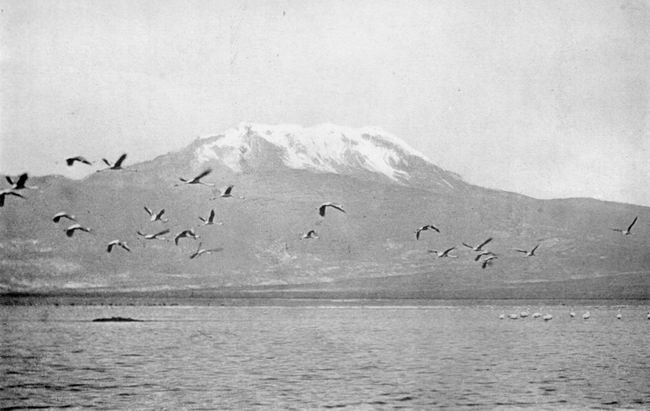
“flamingo,” cochas = “lake”). The flamingoes are
here in incredible
multitudes; they far outnumber all other birds, and as I have said,
actually
make the shallow waters of the lake look pink. Fortunately they had not
been
hunted for their plumage and were not timid. After two days of
familiarity with
the boat they were willing to let me approach within twenty yards
before
finally taking wing. The coloring, in this land of drab grays and
browns, was a
delight to the eye. The head is white, the beak black, the neck white
shading
into salmon-pink; the body pinkish white on the back, the breast white,
and the
tail salmon-pink. The wings are salmon-pink in front, but the tips and
the
under-parts are black. As they stand or wade in the water their general
appearance is chiefly pink-and-white. When they rise from the water,
however,
the black under-parts of the wings became strikingly conspicuous and
cause a
flock of flying flamingoes to be a wonderful contrast in
black-and-white. When
flying, the flamingo seems to keep his head moving steadily forward at
an even
pace, although the ropelike neck undulates with the slow beating of the
wings.
I could not be sure that it was not an optical delusion. Nevertheless,
I
thought the heavy body was propelled irregularly, while the head moved
forward
at uniform speed, the difference being caught up in the undulations of
the
neck.
The flamingo is an amusing bird
to watch. With its
haughty Roman nose and long, ropelike neck, which it coils and twists
in a most
incredible manner, it seems specially intended to distract one’s mind
from
bathymetric disappointments. Its hoarse croaking, “What
is it,” “What is
it,” seemed
to express deep-throated sympathy with the sounding operations. On one
bright
moonlight night the flamingoes were very noisy, keeping up a continual
clatter
of very hoarse “What-is-it’s.” Apparently they failed to find out the
answer in
time to go to bed at the proper time, for next morning we found them
all sound
asleep, standing in quiet bays with their heads tucked under their
wings.
During the course of the forenoon, when the water was quiet, they waded
far out
into the lake. In the afternoon, as winds and waves arose, they came in
nearer
the shores, but seldom left the water. The great extent of shallow
water in
Parinacochas offers them a splendid, wide feeding ground. We wondered
where
they all came from. Apparently they do not breed here. Although there
were
thousands and thousands of birds, we could find no flamingo nests,
either old
or new, search as we would. It offers a most interesting problem for
some
enterprising biological explorer. Probably Mr. Frank Chapman will some
day
solve it. Next in number to the
flamingoes were the beautiful
white gulls (or terns?), looking strangely out of place in this Andean
lake
11,500 feet above the sea. They usually kept together in flocks of
several
hundred. There were quantities of small black divers in the deeper
parts of the
lake where the flamingoes did not go. The divers were very quick and
keen, true
individualists operating alone and showing astonishing ability in
swimming long
distances under water. The large black ducks were much more fearless
than the
flamingoes and were willing to swim very near the canoe. When
frightened, they
raced over the water at a tremendous pace, using both wings and feet in
their
efforts to escape. These ducks kept in large flocks and were about as
common as
the small divers. Here and there in the lake were a few tiny little
islands,
each containing a single deserted nest, possibly belonging to an ibis
or a
duck. In the banks of a low stream near our first camp were holes made
by woodpeckers,
who in this country look in vain for trees and telegraph poles. Occasionally, a mile or so from
shore, my boat would
startle a great amphibious ox standing in the water up to his middle,
calmly
eating the succulent water grass. To secure it he had to plunge his
head and
neck well under the surface. While I was raising blisters
and frightening oxen
and flamingoes, Mr. Tucker triangulated the Parinacochas Basin, making
the
first accurate map of this vicinity. As he carried his theodolite from
point to
point he often stirred up little ground owls, who gazed at him with
solemn,
reproachful looks. And they were not the only individuals to regard his
activities with suspicion and dislike. Part of my work was to construct
signal
stations by piling rocks at conspicuous points on the well-rounded
hills so as
to enable the triangulation to proceed as rapidly as possible. During
the night
some of these signal stations would disappear, torn down by the
superstitious
shepherds who lived in scattered clusters of huts and declined to have
strange
gods set up in their vicinity. Perhaps they thought their pastures were
being
preempted. We saw hundreds of their sheep and cattle feeding on flat
lands
formerly the bed of the lake. The hills of the Parinacochas Basin are
bare of
trees, and offer some pasturage. In some places they are covered with
broken
rock. The grass was kept closely cropped by the degenerate descendants
of sheep
brought into the country during Spanish colonial days. They were small
in size
and mostly white in color, although there were many black ones. We were
told
that the sheep were worth about fifty cents apiece here. On our first arrival at
Parinacochas we were left
severely alone by the shepherds; but two days later curiosity slowly
overcame
their shyness, and a group of young shepherds and shepherdesses
gradually
brought their grazing flocks nearer and nearer the camp, in order to
gaze
stealthily on these strange visitors, who lived in a cloth house,
actually
moved over the forbidding waters of the lake, and busied themselves
from day to
day with strange magic, raising and lowering a glittering glass eye on
a
tripod. The women wore dresses of heavy material, the skirts reaching
halfway
from knee to ankle. In lieu of hats they had small variegated shawls,
made on
hand looms, folded so as to make a pointed bonnet over the head and
protect the
neck arid shoulders from sun and wind. Each woman was busily spinning
with a
hand spindle, but carried her baby and its gear and blankets in a
hammock or sling
attached to a tump-line that went over her head. These sling carry-alls
were
neatly woven of soft wool and decorated with attractive patterns. Both
women
and boys were barefooted. The boys wore old felt hats of native
manufacture,
and coats and long trousers much too large for them. At one end of the upland basin
rises the graceful
cone of Mt. Sarasara. The view of its snow-capped peak reflected in the
glassy
waters of the lake in the early morning was one long to be remembered.
Sarasara
must once have been much higher than it is at present. Its volcanic
cone has
been sharply eroded by snow and ice. In the days of its greater
altitude, and
consequently wider snow fields, the melting snows probably served to
make
Parinacochas a very much larger body of water. Although we were here at
the
beginning of summer, the wind that came down from the mountain at night
was
very cold. Our minimum thermometer registered 22° F. near the banks of
the lake
at night. Nevertheless, there was only a very thin film of ice on the
borders
of the lake in the morning, and except in the most shallow bays there
was no
ice visible far from the bank. The temperature of the water at 10:00 A.M. near the shore, and
ten inches below
the surface, was 61° F., while farther out it was three or four degrees
warmer.
By noon the temperature of the water half a mile from shore was 67.5°
F.
Shortly after noon a strong wind came up from the coast, stirring up
the
shallow water and cooling it. Soon afterwards the temperature of the
water
began to fall, and, although the hot sun was shining brightly almost
directly
overhead, it went down to 65° by 2:30 P.M. The water of the lake is
brackish, yet we were able
to make our camps on the banks of small streams of sweet water,
although in
each case near the shore of the lake. A specimen of the water, taken
near the
shore, was brought back to New Haven and analyzed by Dr. George S.
Jamieson of
the Sheffield Scientific School. He found that it contained small
quantities of
silica, iron phosphate, magnesium carbonate, calcium carbonate, calcium
sulphate, potassium nitrate, potassium sulphate, sodium borate, sodium
sulphate, and a considerable quantity of sodium chloride. Parinacochas
water
contains more carbonate and potassium than that of the Atlantic Ocean
or the
Great Salt Lake. As compared with the salinity of typical “salt”
waters, that
of Lake Parinacochas occupies an intermediate position, containing more
than
Lake Koko-Nor, less than that of the Atlantic, and only one twentieth
the
salinity of the Great Salt Lake. When we moved to our second
camp the Tejada brothers
preferred to let their mules rest in the Puyusca Valley, where there
was
excellent alfalfa forage. The arrieros engaged at
their own expense a
pack train which consisted chiefly of Parinacochas burros. It is the
custom
hereabouts to enclose the packs in large-meshed nets made of rawhide
which are
then fastened to the pack animal by a surcingle. The Indians who came
with the
burro train were pleasant-faced, sturdy fellows, dressed in “store
clothes” and
straw hats. Their burros were as cantankerous as donkeys can be, never
fractious or flighty, but stubbornly resisting, step by step, every
effort to
haul them near the loads. Our second camp was near the
village of Incahuasi,
“the house of the Inca,” at the northwestern corner of the basin.
Raimondi
visited it in 1863. The representative of the owner of Parinacochas
occupies
one of the houses. The other buildings are used only during the third
week in
August, at the time of the annual fair. In the now deserted plaza were
many low
stone rectangles partly covered with adobe and ready to be converted
into
booths. The plaza was surrounded by long, thatched buildings of adobe
and
stone, mostly of rough ashlars. A few ashlars showed signs of having
been carefully
dressed by ancient stonemasons. Some loose ashlars weighed half a ton
and had
baffled the attempts of modern builders. In constructing the large
church, advantage was
taken of a beautifully laid wall of close-fitting ashlars. Incahuasi
was well
named; there had been at one time an Inca house here, possibly a temple
— lakes
were once objects of worship — or rest-house, constructed in order to
enable
the chiefs and tax-gatherers to travel comfortably over the vast
domains of the
Incas. We found the slopes of the hills of the Parinacochas Basin to be
well
covered with remains of ancient terraces. Probably potatoes and other
root
crops were once raised here in fairly large quantities. Perhaps
deforestation
and subsequent increased aridity might account for the desertion of
these
once-cultivated lands. The hills west of the lake are intersected by a
few dry
gulches in which are caves that have been used as burial places. The
caves had
at one time been walled in with rocks laid in adobe, but these walls
had been
partly broken down so as to permit the sepulchers to be rifled of
whatever
objects of value they might have contained. We found nine or ten skulls
lying
loose in the rubble of the caves. One of the skulls seemed to have been
trepanned. On top of the ridge are the
remains of an ancient
road, fifty feet wide, a broad grassy way through fields of loose
stones. No
effort had been made at grading or paving this road, and there was no
evidence
of its having been used in recent times. It runs from the lake across
the ridge
in a westerly direction toward a broad valley, where there are many
terraces
and cultivated fields; it is not far from Nasca. Probably the stones
were
picked up and piled on each side to save time in driving caravans of
llamas
across the stony ridges. The llama dislikes to step over any obstacle,
even a
very low wall. The grassy roadway would certainly encourage the
supercilious
beasts to proceed in the desired direction. In many places on the hills
were to be seen outlines
of large and small rock circles and shelters erected by herdsmen for
temporary
protection against the sudden storms of snow and hail which come up with
unexpected fierceness at this elevation (12,000 feet). The shelters
were in a
very ruinous state. They were made of rough, scoriaceous lava rocks.
The
circular enclosures varied from 8 to 25 feet in diameter. Most of them
showed
no evidences whatever of recent occupation. The smaller walls may have
been the
foundation of small circular huts. The larger walls were probably
intended as
corrals, to keep alpacas and llamas from straying at night and to guard
against
wolves or coyotes. I confess to being quite mystified as to the age of
these
remains. It is possible that they represent a settlement of shepherds
within
historic times, although, from the shape and size of the walls, I am
inclined
to doubt this. The shelters may have been built by the herdsmen of the
Incas.
Anyhow, those on the hills west of Parinacochas had not been used for a
long
time. Nasca, which is not very far away to the northwest, was the
center of one
of the most artistic pre-Inca cultures in Peru. It is famous for its
very
delicate pottery. Our third camp was
on the south side of the lake. Near us the traces of the ancient road
led to
the ruins of two large, circular corrals, substantiating my belief that
this
curious roadway was intended to keep the llamas from straying at will
over the
pasture lands. On the south shores of the lake there were more signs of
occupation than on the north, although there is nothing so clearly
belonging to
the time of the Incas as the ashlars and finely built wall at
Incahuasi. On top
of one of the rocky promontories we found the rough stone foundations
of the
walls of a little village. The slopes of the promontory were nearly
precipitous
on three sides. Forty or fifty very primitive dwellings had been at one
time
huddled together here in a position which could easily be defended. We
found
among the ruins a few crude potsherds and some bits of obsidian. There
was
nothing about the ruins of the little hill village to give any
indication of
Inca origin. Probably it goes back to pre-Inca days. No one could tell
us
anything about it. If there were traditions concerning it they were
well
concealed by the silent, superstitious shepherds of the vicinity.
Possibly it
was regarded as an unlucky spot, cursed by the gods. The neighboring slopes showed
faint evidences of
having been roughly terraced and cultivated. The tutu potato would grow
here, a
hardy variety not edible in the fresh state, but considered highly
desirable
for making potato flour after having been repeatedly frozen and its
bitter
juices all extracted. So would other highland root crops of the
Peruvians, such
as the oca, a relative of our sheep sorrel, the añu,
a kind of nasturtium,
and the ullucu (ullucus tuberosus). On the flats near the shore
were large corrals still
kept in good repair. New walls were being built by the Indians at the
time of
our visit. Near the southeast corner of the lake were a few modern huts
built
of stone and adobe, with thatched roofs, inhabited by drovers and
shepherds. We
saw more cattle at the east end of the lake than elsewhere, but they
seemed to
prefer the sweet water grasses of the lake to the tough bunch-grass on
the
slopes of Sarasara. Viscachas
were common amongst the gray lichen-covered rocks. They are hunted for
their
beautiful pearly gray fur, the “chinchilla” of commerce; they are also
very
good eating, so they have disappeared from the more accessible parts of
Peru.
One rarely sees them, although they may be found on bleak uplands in
the
mountains of Uilcapampa, a region rarely visited by any one on account
of
treacherous bogs and deep tarns. Writers sometimes call viscachas
“rabbit-squirrels.” They have large, rounded ears, long hind legs, a
long,
bushy tail, and do look like a cross between a rabbit and a gray
squirrel. Surmounting one of the higher
ridges one day, I came
suddenly upon an unusually large herd of wild vicuñas. It included more
than
one hundred individuals. Their relative fearlessness also testified to
the
remoteness of Parinacochas and the small amount of hunting that is done
here.
Vicuñas have never been domesticated, but are often hunted for their
skins.
Their silky fleece is even finer than alpaca. The more fleecy portions
of their
skins are sewed together to make quilts, as soft as eider down and of a
golden
brown color. After Mr. Tucker finished his
triangulation of the
lake I told the arrieros to find the shortest road
home. They smiled,
murmured “Arequipa,” and started south. We soon came to the rim of the
Maraicasa Valley where, peeping up over one of the hills far to the
south, we
got a little glimpse of Coropuna. The Maraicasa Valley is well
inhabited and
there were many grain fields in sight, although few seemed to be
terraced. The
surrounding hills were smooth and well rounded and the valley bottom
contained
much alluvial land. We passed through it and, after dark, reached
Sondor, a
tiny hamlet inhabited by extremely suspicious and inhospitable drovers.
In the
darkness Don Pablo pleaded with the owners of a well-thatched hut, and
told
them how “important” we were. They were unwilling to give us any
shelter, so we
were forced to pitch our tent in the very rocky and dirty corral
immediately in
front of one of the huts, where pigs, dogs, and cattle annoyed us all
night. If
we had arrived before dark we might have received a different welcome.
As a
matter of fact, the herdsmen only showed the customary hostility of
mountaineers and wilderness folk to those who do not arrive in the
daytime,
when they can be plainly seen and fully discussed. The next morning we passed some
fairly recent lava
flows and noted also many curious rock forms caused by wind and sand
erosion.
We had now left the belt of grazing lands and once more come into the
desert.
At length we reached the rim of the mile-deep Caraveli Canyon and our
eyes were
gladdened at sight of the rich green oasis, a striking contrast to the
barren
walls of the canyon. As we descended the long, winding road we passed
many fine
specimens of tree cactus. At the foot of the steep descent we found
ourselves
separated from the nearest settlement by a very wide river, which it
was
necessary to ford. Neither of the Tejadas had ever been here before and
its
depths and dangers were unknown. Fortunately Pablo found a forlorn
individual
living in a tiny hut on the bank, who indicated which way lay safety.
After an
exciting two hours we finally got across to the desired shore. Animals
and men
were glad enough to leave the high, arid desert and enter the oasis of
Caraveli
with its luscious, green fields of alfalfa, its shady fig trees and
tall
eucalyptus. The air, pungent with the smell of rich vegetation, seemed
cooler
and more invigorating. We found at Caraveli a modern
British enterprise,
the gold mine of “La Victoria.” Mr. Prain, the Manager, and his
associates at
the camp gave us a cordial welcome, and a wonderful dinner which I
shall long
remember. After two months in the coastal desert it seemed like home.
During
the evening we learned of the difficulties Mr. Prain had had in
bringing his
machinery across the plateau from the nearest port. Our own troubles
seemed as
nothing. The cost of transporting on mule-back each of the larger
pieces of the
quartz stamping-mill was equivalent to the price of a first-class pack
mule. As
a matter of fact, although it is only a two days’ journey, pack
animals’ backs
are not built to survive the strain of carrying pieces of machinery
weighing five hundred pounds over
a desert
plateau up to an altitude of 4000 feet. Mules brought the machinery
from the
coast to the brink of the canyon, but no mule could possibly have
carried it
down the steep trail into Caraveli. Accordingly, a windlass had been
constructed on the edge of the precipice and the machinery had been
lowered,
piece by piece, by block and tackle. Such was one of the obstacles with
which
these undaunted engineers had had to contend. Had the man who designed
the
machinery ever traveled with a pack train, climbing up and down over
these
rocky stairways called mountain trails, I am sure that he would have
made his
castings much smaller. 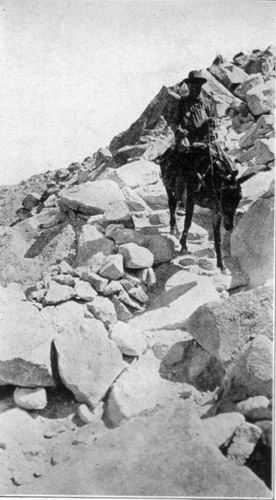
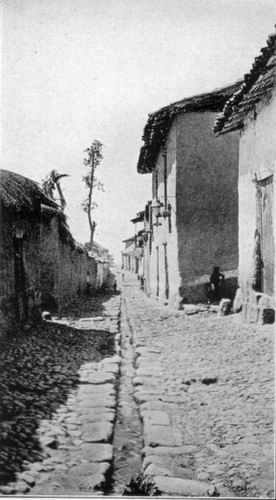 MR. TUCKER ON A MOUNTAIN TRAIL THE MAIN STREET OF NEAR CARAVELI CHUQUIBAMBA It is astonishing how often
people who ship goods to
the interior of South America fail to realize that no single piece
should be
any heavier than a pack animal can carry comfortably on one
side. One hundred and fifty pounds ought to be the extreme
limit of a unit. Even a large, strong mule will last only a few days on
such
trails as are shown in the accompanying illustration if the total
weight of his
cargo is over three hundred pounds. When a single piece weighs more
than two
hundred pounds it has to be balanced on the back of the animal. Then
the load
rocks, and chafes the unfortunate mule, besides causing great
inconvenience and
constant worry to the muleteers. As a matter of expediency it is better
to have
the individual units weigh about seventy-five pounds. Such a weight is
easier
for the arrieros to handle in the loading,
unloading, and reloading that
goes on all day long, particularly if the trail is up-and-down, as
usually
happens in the Andes. Furthermore, one seventy-five-pound unit makes a
fair
load for a man or a llama, two are right for a burro, and three for an
average
mule. Four can be loaded, if necessary, on a stout mule. The hospitable mining engineers
urged us to prolong
our stay at “La Victoria,” but we had to hasten on. Leaving the
pleasant shade
trees of Caraveli, we climbed the barren, desolate hills of coarse
gravel and
lava rock and left the canyon. We were surprised to find near the top
of the rise
the scattered foundations of fifty little circular or oval huts
averaging eight
feet in diameter. There was no water near here. Hardly a green thing of
any
sort was to be seen in the vicinity, yet here had once been a village.
It
seemed to belong to the same period as that found on the southern
slopes of the
Parinacochas Basin. The road was one of the worst we encountered
anywhere,
being at times merely a rough, rocky trail over and among huge piles of
lava
blocks. Several of the larger boulders were covered with pictographs.
They
represented a serpent and a sun, besides men and animals. Shortly afterwards we descended
to the Rio Grande
Valley at Callanga, where we pitched our camps among the most extensive
ruins
that I have seen in the coastal desert. They covered an area of one
hundred
acres, the houses being crowded closely together. It gave one a strange
sensation to find such a very large metropolis in what is now a
desolate
region. The general appearance of Callanga was strikingly reminiscent
of some
of the large groups of ruins in our own Southwest. Nothing about it
indicated
Inca origin. There were no terraces in the vicinity. It is difficult to
imagine
what such a large population could have done here, or how they lived.
The walls
were of compact cobblestones, rough-laid and stuccoed with adobe and
sand. Most
of the stucco had come off. Some of the houses had seats, or small
sleeping-platforms, built up at one end. Others contained two or three
small
cells, possibly storerooms, with neither doors nor windows. We found a
number
of burial cists — some square, others rounded — lined with small
cobblestones.
In one house, at the foot of “cellar stairs” we found a subterranean
room, or
tomb. The entrance to it was covered with a single stone lintel. In
examining
this tomb Mr. Tucker had a narrow escape from being bitten by a boba, a venomous snake, nearly three
feet in length, with vicious mouth, long fangs like a rattlesnake, and
a
strikingly mottled skin. At one place there was a low pyramid less than
ten
feet in height. To its top led a flight of rude stone steps. Among the ruins we found a
number of broken stone
dishes, rudely carved out of soft, highly porous, scoriaceous lava. The
dishes
must have been hard to keep clean! We also found a small stone mortar,
probably
used for grinding paint; a broken stone war club; and a broken compact
stone
mortar and pestle possibly used for grinding corn. Two stones, a foot
and a
half long, roughly rounded, with a shallow groove across the middle of
the
flatter sides, resembled sinkers used by fishermen to hold down large
nets,
although ten times larger than any I had ever seen used. Perhaps they
were to
tie down roofs in a gale. There were a few potsherds lying on the
surface of
the ground, so weathered as to have lost whatever decoration they once
had. We
did no excavating. Callanga offers an interesting field for
archeological
investigation. Unfortunately, we had heard nothing of it previously,
carne upon
it unexpectedly, and had but little time to give it. After the first
night camp
in the midst of the dead city we made the discovery that although it
seemed to
be entirely deserted, it was, as a matter of fact, well populated! I
was
reminded of Professor T. D. Seymour’s story of his studies in the ruins
of
ancient Greece. We wondered what the fleas live on ordinarily. Our next stopping-place was the
small town of
Andaray, whose thatched houses are built chiefly of stone plastered
with mud.
Near it we encountered two men with a mule, which they said they were
taking into
town to sell and were willing to dispose of cheaply. The Tejadas could
not
resist the temptation to buy a good animal at a bargain, although the
circumstances were suspicious. Drawing on us for six gold sovereigns,
they
smilingly added the new mule to the pack train; only to discover on
reaching
Chuquibamba that they had purchased it from thieves. We were able to
clear our arrieros of any
complicity in the theft.
Nevertheless, the owner of the stolen mule was unwilling to pay
anything for
its return. So they lost their bargain and their gold. We spent one
night in
Chuquibamba, with our friend Señor Benavides, the sub-prefect, and once
more
took up the well-traveled route to Arequipa. We left the Majes Valley
in the
afternoon and, as before, spent the night crossing the desert. About three o’clock in the
morning — after we had
been jogging steadily along for about twelve hours in the dark and
quiet of the
night, the only sound the shuffle of the mules’ feet in the sand, the
only
sight an occasional crescent-shaped dune, dimly visible in the
starlight — the
eastern horizon began to be faintly illumined. The moon had long since
set.
Could this be the approach of dawn? Sunrise was not due for at least
two hours.
In the tropics there is little twilight preceding the day; “the dawn
comes up
like thunder.” Surely the moon could not be going to rise again! What
could be
the meaning of the rapidly brightening eastern sky? While we watched
and
marveled, the pure white light grew brighter and brighter, until we
cried out
in ecstasy as a dazzling luminary rose majestically above the horizon.
A
splendor, neither of the sun nor of the moon, shone upon us. It was the
morning
star. For sheer beauty, “divine, enchanting ravishment,” Venus that day
surpassed anything I have ever seen. In the words of the great Eastern
poet,
who had often seen such a sight in the deserts of Asia, “the morning
stars sang
together and all the sons of God shouted for joy.”
Click
 here to continue to the next chapter of Inca Lands
 |