 Web
and Book design, Web
and Book design, Copyright, Kellscraft Studio 1999-2003 (Return to Web Text-ures) |
Click Here to return to Inca Lands Content Page Click Here to return to previous chapter |
 (HOME) |
|
Web
and Book design, Copyright, Kellscraft Studio 1999-2003 (Return to Web Text-ures) |
Click Here to return to Inca Lands Content Page Click Here to return to previous chapter |
(HOME) |
|
CHAPTER VI THE VILCANOTA COUNTRY AND THE PERUVIAN HIGHLANDERS IN the northernmost part of the Titicaca Basin are the grassy foothills of the Cordillera Vilcanota, where large herds of alpacas thrive on the sweet, tender pasturage. Santa Rosa is the principal town. Here wool-buyers come to bid for the clip. The high prices which alpaca fleece commands have brought prosperity. Excellent blankets, renowned in southern Peru for their weight and texture, are made here on hand looms. Notwithstanding the altitude — nearly as great as the top of Pike’s Peak — the stocky inhabitants of Santa Rosa are hardy, vigorous, and energetic. Ricardo Charaja, the best Quichua assistant we ever had, came from Santa Rosa. Nearly all the citizens are of pure Indian stock. They own many fine llamas. There is abundant pasturage and the llamas are well cared for by the Indians, who become personally attached to their flocks and are loath to part with any of the individuals. Once I attempted through a Cuzco acquaintance to secure the skin and skeleton of a fine llama for the Yale Museum. My friend was favorably known and spoke the Quichua language fluently. He offered a good price and obtained from various llama owners promises to bring the hide and bones of one of their “camels” for shipment; but they never did. Apparently they regarded it as unlucky to kill a llama, and none happened to die at the right time. The llamas never show affection for their masters, as horses often do. On the other hand I have never seen a llama kick or bite at his owner. The llama was the only beast of burden known in either North or South America before Columbus. It was found by the Spaniards in all parts of Inca Land. Its small two-toed feet, with their rough pads, enable it to walk easily on slopes too rough or steep for even a nimble-footed, mountain-bred mule. It has the reputation of being an unpleasant pet, due to its ability to sneeze or spit for a considerable distance a small quantity of acrid saliva. When I was in college Barnum’s Circus came to town. The menagerie included a dozen llamas, whose supercilious expression, inoffensive looks, and small size — they are only three feet high at the shoulder — tempted some little urchins to tease them. When the llamas felt that the time had come for reprisals, their aim was straight and the result a precipitate retreat. Their tormentors, howling and rubbing their eyes, had to run home and wash their faces. Curiously enough, in the two years which I have spent in the Peruvian highlands I have never seen a llama so attack a single human being. On the other, hand, when I was in Santa Rosa in 1915 some one had a tame vicuņa which was perfectly willing to sneeze straight at any stranger who came within twenty feet of it, even if one’s motive was nothing more annoying than scientific curiosity. The vicuņa is the smallest American “camel,” yet its long, slender neck, small head, long legs, and small body, from which hangs long, feathery fleece, make it look more like an ostrich than a camel. In the churchyard of Santa Rosa are two or three gnarled trees which have been carefully preserved for centuries as objects of respect and veneration. Some travelers have thought that 14,000 feet is above the tree line, but the presence of these trees at Santa Rosa would seem to show that the use of the words “tree line” is a misnomer in the Andes. Mr. Cook believes that the Peruvian plateau, with the exception of the coastal deserts, was once well covered with forests. When man first came into the Andes, everything except rocky ledges, snow fields, and glaciers was covered with forest growth. Although many districts are now entirely treeless, Mr. Cook found that the conditions of light, heat, and moisture, even at the highest elevations, are sufficient to support the growth of trees; also that there is ample fertility of soil. His theories are well substantiated by several isolated tracts of forests which I found growing alongside of glaciers at very high elevations. One forest in particular, on the slopes of Mt. Soiroccocha, has been accurately determined by Mr. Bumstead to be over 15,000 feet above sea level. It is cut off from the inhabited valley by rock falls and precipices, so it has not been available for fuel. Virgin forests are not known to exist in the Peruvian highlands on any lands which could have been cultivated. A certain amount of natural reforestation with native trees is taking place on abandoned agricultural terraces in some of the high valleys. Although these trees belong to many different species and families, Mr. Cook found that they all have this striking peculiarity — when cut down they sprout readily from the stumps arid are able to survive repeated pollarding; remarkable evidence of the fact that the primeval forests W Peru were long ago cut down for fuel or burned over for agriculture. Near the Santa Rosa trees is a tall bell-tower. The sight of a picturesque belfry with four or five bells of different sizes hanging each in its respective window makes a strong appeal. It is quite otherwise on Sunday mornings when these same hells, “out of tune with themselves,” or actually cracked, are all rung at the same time. The resulting clangor and din is unforgettable. I presume the Chinese would say it was intended to drive away the devils — and surely such noise must be “thoroughly uncongenial even to the most irreclaimable devil,” as Lord Frederick Hamilton said of the Canton practices. Church bells in the United States and England are usually sweet-toned and intended to invite the hearer to come to service, or else they ring out in joyous peals to announce some festive occasion. There is nothing inviting or joyous about the bells in southern Peru. Once in a while one may hear a bell of deep, sweet tone, like that of the great bell in Cuzco, which is tolled when the last sacrament is being administered to a dying Christian; but the general idea of bell-ringers in this part of the world seems to be to make the greatest possible amount of racket and clamor. On popular saints’ days this is accompanied by firecrackers, aerial bombs, and other noise-making devices which again remind one of Chinese folkways. Perhaps it is merely that fundamental fondness for making a noise which is found in all healthy children. On Sunday afternoon the plaza of Santa Rosa was well filled with Quichua holiday-makers, many of whom had been imbibing freely of chicha, a mild native brew usually made from ripe corn. The crowd was remarkably good-natured and given to an unusual amount of laughter and gayety. For them Sunday is truly a day of rest, recreation, and sociability. On week days, most of them, even the smaller boys, are off on the mountain pastures, watching the herds whose wool brings prosperity to Santa Rosa. One sometimes finds the mountain Indians on Sunday afternoon sodden, thoroughly soaked with chicha, and inclined to resent the presence of inquisitive strangers; not so these good folk of Santa Rosa. 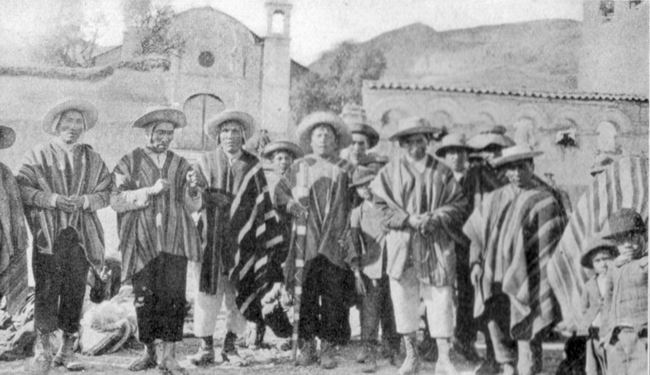 INDIAN ALCALDES AT SANTA ROSA 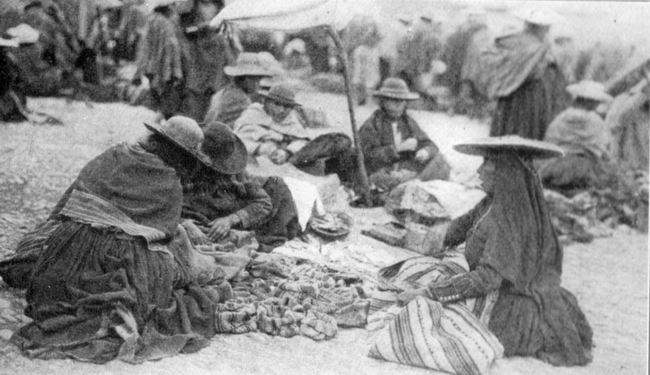 NATIVE DRUGGISTS IN THE PLAZA OF SICUANI To be sure, the female vendors of eggs, potatoes, peppers, and sundry native vegetables, squatting in two long rows on the plaza, did not enjoy being photographed, but the men and boys crowded eagerly forward, very much interested in my endeavors. Some of the Indian alcaldes, local magistrates elected yearly to serve as the responsible officials for villages or tribal precincts, were very helpful and, armed with their large, silver-mounted staffs of office, tried to bring the shy, retiring women of the market-place to stand in a frightened, disgruntled, barefooted group before the camera. The women were dressed in the customary tight bodices, heavy woolen skirts, and voluminous petticoats of the plateau. Over their shoulders were pinned heavy woolen shawls, woven on hand looms. On their heads were reversible “pancake” hats made of straw, covered on the wet-weather side with coarse woolen stuff and on the fair-weather side with tinsel and velveteen. In accordance with local custom, tassels and fringes hung down on both sides. It is said that the first Inca ordered the dresses of each village to be different, so that his officials might know to which tribe an Indian belonged. It was only with great difficulty and by the combined efforts of a good-natured priest, the gobernador or mayor, and the alcaldes that a dozen very reluctant females were finally persuaded to face the camera. The expression of their faces was very eloquent. Some were highly indignant, others looked foolish or supercilious, two or three were thoroughly frightened, not knowing what evil might befall them next. Not one gave any evidence of enjoying it or taking the matter as a good joke, although that was the attitude assumed by all their male acquaintances. In fact, some of the men were so anxious to have their pictures taken that they followed us about and posed on the edge of every group. Men and boys all wore knitted woolen caps, with ear flaps, which they seldom remove either day or night. On top of these were large felt hats, turned up in front so as to give a bold aspect to their husky wearers. Over their shoulders were heavy woolen ponchos, decorated with bright stripes. Their trousers end abruptly halfway between knee and ankle, a convenient style for herdsmen who have to walk in the long, dewy grasses of the plateau. These “high-water” pantaloons do not look badly when worn with sandals, as is the usual custom; but since this was Sunday all the well-to-do men had put on European boots, which did not come up to the bottom of their trousers and produced a singular effect, hardly likely to become fashionable. The prosperity of the town was also shown by corrugated iron roofs. Far less picturesque than thatch or tile, they require less attention and give greater satisfaction during the rainy season. They can also be securely bolted to the rafters. On this wind-swept plateau we frequently noticed that a thatched roof was held in place by ropes passed over the house and weights resting on the roof. Sometimes to the peak of a gable are fastened crosses, tiny flags, or the skulls of animals — probably to avert the Evil Eye or bring good luck. Horseshoes do not seem to be in demand. Horses’ skulls, however, are deemed very efficacious. On the rim of the Titicaca Basin is La Raya. The watershed is so level that it is almost impossible to say whether any particular raindrop will eventually find itself in Lake Titicaca or in the Atlantic Ocean. The water from a spring near the railroad station of Araranca flows definitely to the north. This spring may be said to be one of the sources of the Urubamba River, an important affluent of the Ucayali and also of the Amazon, but I never have heard it referred to as “the source of the Amazon” except by an adventurous lecturer, Captain Blank, whose moving picture entertainment bore the alluring title, “From the Source to the Mouth of the Amazon.” As most of his pictures of wild animals “in the jungle” looked as though they were taken in the zoological gardens at Pam, and the exciting tragedies of his canoe trip were actually staged near a friendly hacienda at Santa Ana, less than a week’s journey from Cuzco, it is perhaps unnecessary to censure him for giving this particular little spring such a pretentious title. The Urubamba River is known by various names to the people who live on its banks. The upper portion is sometimes spoken of as the Vilcanota, a term which applies to a lake as well as to the snow-covered peaks of the cordillera in this vicinity. The lower portion was called by the Incas the Uilca or the Uilcamayu. Near the water-parting of La Raya I noticed the remains of an interesting wall which may have served centuries ago to divide the Incas of Cuzco from the Collas or warlike tribes of the Titicaca Basin. In places the wall has been kept in repair by the owners of grazing lands, but most of it can be but dimly traced across the valley and up the neighboring slopes to the cliffs of the Cordillera Vilcanota. It was built of rough stones. Near the historic wall are the ruins of ancient houses, possibly once occupied by an Inca garrison. I observed no ashlars among the ruins nor any evidence of careful masonry. It seems to me likely that it was a hastily thrown-up fortification serving for a single military campaign, rather than any permanent affair like the Roman wall of North Britain or the Great Wall of China. We know from tradition that war was frequently waged between the peoples of the Titicaca Basin and those of the Urubamba and Cuzco valleys. It is possible that this is a relic of one of those wars. On the other hand, it may be much older than the Incas. Montesinos,1 one of the best early historians, tells us of Titu Yupanqui, Pachacuti VI, sixty-second of the Peruvian Amautas, rulers who long preceded the Incas. Against Pachacuti VI there came (about 800 A.D.) large hordes of fierce soldiers from the south and east, laying waste fields and capturing cities and towns; evidently barbarian migrations which appear to have continued for some time. During these wars the ancient civilization, which had been built up with so much care and difficulty during the preceding twenty centuries, was seriously threatened. Pachacuti VI, more religious than warlike, ruler of a people whose great achievements had been agricultural rather than military, was frightened by his soothsayers and priests; they told him of many bad omens. Instead of inducing him to follow a policy of military preparedness, he was urged to make sacrifices to the deities. Nevertheless he ordered his captains to fortify the strategic points and make preparations for defense. The invaders may have come from Argentina. It is possible that they were spurred on by hunger and famine caused by the gradual exhaustion of forested areas and the subsequent spread of untillable grasslands on the great pampas. Montesinos indicates that many of the people who came up into the highlands at that time were seeking arable lands for their crops and were “fleeing from a race of giants” — possibly Patagonians or Araucanians — who had expelled them from their own lands. On their journey they had passed over plains, swamps, and jungles. It is obvious that a great readjustment of the aborigines was in progress. The governors of the districts through which these hordes passed were not able to summon enough strength to resist them. Pachacuti VI assembled the larger part of his army near the pass of La Raya and awaited the approach of the enemy. If the accounts given in Montesinos are true, this wall near La Raya may have been built about 1100 years ago, by the chiefs who were told to “fortify the strategic points.” Certainly the pass of La Raya, long the gateway from the Titicaca Basin to the important cities and towns of the Urubamba Basin, was the key to the situation. It is probable that Pachacuti VI drew up his army behind this wall. His men were undoubtedly armed with slings, the weapon most familiar to the highland shepherds. The invaders, however, carried bows and arrows, more effective arms, swifter, more difficult to see, less easy to dodge. As Pachacuti VI was carried over the field of battle on a golden stretcher, encouraging his men, he was killed by an arrow. His army was routed. Montesinos states that only five hundred escaped. Leaving behind their wounded, they fled to “Tampu-tocco,” a healthy place where there was a cave, in which they hid the precious body of their ruler. Most writers believe this to be at Paccaritampu where there are caves under an interesting carved rock. There is no place in Peru to-day which still bears the name of Tampu-tocco. To try and identify it with some of the ruins which do exist, and whose modern names are not found in the early Spanish writers, has been one of the principal objects of my expeditions to Peru, as will be described in subsequent chapters. 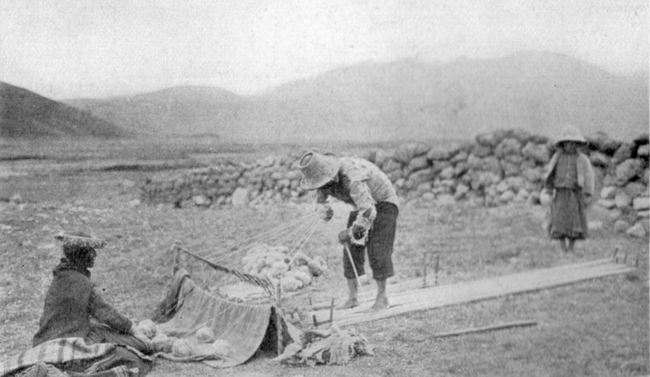 LAYING DOWN THE WARP FOR A BLANKET; NEAR THE PASS OF LA RAYA 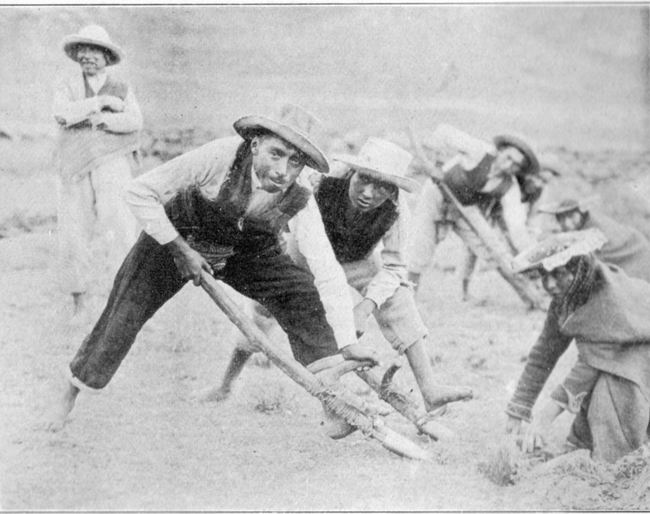 PLOWING A POTATO-FIELD AT LA RAYA Near the watershed of La Raya we saw great flocks of sheep and alpacas, numerous corrals, and the thatched-roofed huts of herdsmen. The Quichua women are never idle. One often sees them engaged in the manufacture of textiles — shawls, girdles, ponchos, and blankets — on hand looms fastened to stakes driven into the ground. When tending flocks or walking along the road they are always winding or spinning yarn. Even the men and older children are sometimes thus engaged. The Younger children, used as shepherds as soon as they reach the age of six or seven, are rarely expected to do much except watch their charges. Some of them were accompanied by long-haired suncca shepherd dogs, as large as Airedales, but very cowardly, given to barking and slinking away. It is claimed that the sunccas, as well as two other varieties, were domesticated by the Incas. None of them showed any desire to make the acquaintance of “Checkers,” my faithful Airedale. Their masters, however, were always interested to see that “Checkers” could understand English. They had never seen a dog that could understand anything but Quichua! On the hillside near La Raya, Mr. Cook, Mr. Gilbert, and I visited a healthy potato field at an elevation of 14,500 feet, a record altitude for potatoes. When commencing to plough or spade a potato field on the high slopes near here, it is the custom of the Indians to mark it off into squares, by “furrows” about fifteen feet apart. The Quichuas commence their task soon after daybreak. Due to the absence of artificial lighting and the discomfort of rising in the bitter cold before dawn, their wives do not prepare breakfast before ten o’clock, at which time it is either brought from home in covered earthenware vessels or cooked in the open fields near where the men are working. We came across one energetic landowner supervising a score or more of Indians who were engaged in “ploughing” a potato field. Although he was dressed in European garb and was evidently a man of means and intelligence, and near the railroad, there were no modern implements in sight. We found that it is difficult to get Indians to use any except the implements of their ancestors. The process of “ploughing” this field was undoubtedly one that had been used for centuries, probably long before the Spanish Conquest. The men, working in unison and in a long row, each armed with a primitive spade or “foot plough,” to the handle of which footholds were lashed, would, at a signal, leap forward with a shout and plunge their spades into the turf. Facing each pair of men was a girl or woman whose duty it was to turn the clods over by hand. The men had taken off their ponchos, so as to secure greater freedom of action, but the women were fully clothed as usual, modesty seeming to require them even to keep heavy shawls over their shoulders. Although the work was hard and painful, the toil was lightened by the joyous contact of community activity. Every one worked with a will. There appeared to be a keen desire among the workers to keep up with the procession. Those who fell behind were subjected to good-natured teasing. Community work is sometimes pleasant, even though it appears to require a strong directing hand. The “boss” was right there. Such practices would never suit those who love independence. In the centuries of Inca domination there was little opportunity for individual effort. Private property was not understood. Everything belonged to the government. The crops were taken by the priests, the Incas and the nobles. The people were not as unhappy as we should he. One seldom had to labor alone. Everything was done in common. When it was time to cultivate the fields or to harvest the crops, the laborers were ordered by the Incas to go forth in huge family parties. They lessened the hardships of farm labor by village gossip and choral singing, interspersed at regular intervals with rest periods, in which quantities of chicha quenched the thirst and cheered the mind. Habits of community work are still shown in the Andes. One often sees a score or more of Indians carrying huge bundles of sheaves of wheat or barley. I have found a dozen yoke of oxen, each a few yards from the other in a parallel line, engaged in ploughing synchronously small portions of a large field. Although the landlords frequently visit Lima and sometimes go to Paris and New York, where they purchase for their own use the products of modern invention, the fields are still cultivated in the fashion introduced three centuries ago by the conquistadores, who brought the first draft animals and the primitive pointed plough of the ancient Mediterranean. Crops at La Raya are not confined to potatoes. Another food plant, almost unknown to Europeans, even those who live in Lima, is caņihua, a kind of pigweed. It was being harvested at the time of our visit in April. The threshing floor for caņihua is a large blanket laid on the ground. On top of this the stalks are placed and the flail applied, the blanket serving to prevent the small grayish seeds from escaping. The entire process uses nothing of European origin and has probably not changed for centuries. We noticed also quinoa and even barley growing at an elevation of 14,000 feet. Quinoa is another species of pigweed. It often attains a height of three to four feet. There are several varieties. The white-seeded variety, after being boiled, may be fairly compared with oatmeal. Mr. Cook actually preferred it to the Scotch article, both for taste and texture. The seeds retain their form after being cooked and “do not appear so slimy as oatmeal.” Other varieties of quinoa are bitter and have to be boiled several times, the water being frequently changed. The growing quinoa presents an attractive appearance; its leaves assume many colors. As we went down the valley the evidences of extensive cultivation, both ancient and modern, steadily increased. Great numbers of old terraces were to be seen. There were many fields of wheat, some of them growing high up on the mountain side in what are called temporales, where, owing to the steep slope, there is little effort at tillage or cultivation, the planter trusting to luck to get some kind of a crop in reward for very little effort. On April 14th, just above Sicuani, we saw fields where habas beans had been gathered and the dried stalks piled in little stacks. At Occobamba, or the pampa where oca grows, we found fields of that useful tuber, just now ripening. Near by were little thatched shelters, erected for the temporary use of night watchmen during the harvest season. The Peruvian highlanders whom we met by the roadside were different in feature, attitude, and clothing from those of the Titicaca Basin or even of Santa Rosa, which is not far away. They were typical Quichuas — peaceful agriculturists — usually spinning wool on the little hand spindles which have been used in the Andes from time immemorial. Their huts are built of adobe, the roofs thatched with coarse grass. The Quichuas are brown in color. Their hair is straight and black. Gray hair is seldom seen. It is the custom among the men in certain localities to wear their hair long and braided. Beards are sparse or lacking. Bald heads are very rare. Teeth seem to be more enduring than with us. Throughout the Andes the frequency of well-preserved teeth was everywhere noteworthy except on sugar plantations, where there is opportunity to indulge freely in crude brown sugar nibbled from cakes or mixed with parched corn and eaten as a travel ration. The Quichua face is broad and short. Its breadth is nearly the same as the Eskimo. Freckles are not common and appear to be limited to face and arms, in the few cases in which they were observed. On the other hand, a large proportion of the Indians are pock-marked and show the effects of living in a country which is “free from medical tyranny.” There is no compulsory vaccination. One hardly ever sees a fat Quichua. It is difficult to tell whether this is a racial characteristic or due rather to the lack of fat-producing foods in their diet. Although the Peruvian highlander has made the best use he could of the llama, he was never able to develop its slender legs and weak back sufficiently to use it for loads weighing more than eighty or a hundred pounds. Consequently, for the carrying of really heavy burdens he had to depend on himself. As a result, it is not surprising to learn from Dr. Ferris that while his arms are poorly developed, his shoulders are broader, his back muscles stronger, and the calves of his legs larger and more powerful than those of almost any other race. The Quichuas are fond of shaking hands. When a visiting Indian joins a group he nearly always goes through the gentle ceremony with each person in turn. I do not know whether this was introduced by the Spaniards or comes down from prehistoric times. In any event, this handshaking in no way resembles the hearty clasp familiar to undergraduates at the beginning of the college year. As a matter of fact the Quichua handshake is extremely fishy and lacks cordiality. In testing the hand grip of the Quichuas by a dynamometer our surgeons found that the muscles of the forearm were poorly developed in the Quichua and the maximum grip was weak in both sexes, the average for the man being only about half of that found among American white adults of sedentary habits. Dr. Ales Hrdlicka believes that the aboriginal races of North and South America were of the same stock. The wide differences in physiognomy observable among the different tribes in North and South America are perhaps due to their environmental history during the past 10,000 or 20,000 years. Mr. Frank Chapman, of the American Museum of Natural History, has pointed out the interesting biological fact that animals and birds found at sea level in the cold regions of Tierra del Fuego, while not found at sea level in Peru, do exist at very high altitudes, where the climate is similar to that with which they are acquainted. Similarly, it is interesting to learn that the inhabitants of die cold, lofty regions of southern Peru, living in towns and villages at altitudes of from 9000 to 14,000 feet above the sea, have physical peculiarities closely resembling those living at sea level in Tierra del Fuego, Alaska, and Labrador. Dr. Ferris says the Labrador Eskimo and the Quichua constitute the two “best-known short-stature races on the American continent.” So far as we could learn by questions and observation, about one quarter of the Quichuas are childless. In families which have children the average number is three or four. Large families are not common, although we generally learned that the living children in a family usually represented less than half of those which had been born. Infant mortality is very great. The proper feeding of children is not understood and it is a marvel how any of them manage to grow up at all. Coughs and bronchial trouble are very common among the Indians. In fact, the most common afflictions of the tableland are those of the throat and lungs. Pneumonia is the most serious and most to be dreaded of all local diseases. It is really terrifying. Due to the rarity of the air and relative scarcity of oxygen, pneumonia is usually fatal at 8000 feet and is uniformly so at 11,000 feet. Patients are frequently ill only twenty-four hours. Tuberculosis is fairly common, its prevalence undoubtedly caused by the living conditions practiced among the highlanders, who are unwilling to sleep in a room which is not tightly closed and protected against any possible intrusion of fresh air. In the warmer valleys, where bodily comfort has led the natives to use huts of thatch and open reeds, instead of the air-tight hovels of the cold, bleak plateau, tuberculosis is seldom seen. Of course, there are no “boards of health,” nor are the people bothered by being obliged to conform to any sanitary regulations. Water supplies are so often contaminated that the people have learned to avoid drinking it as far as possible. Instead, they eat quantities of soup. 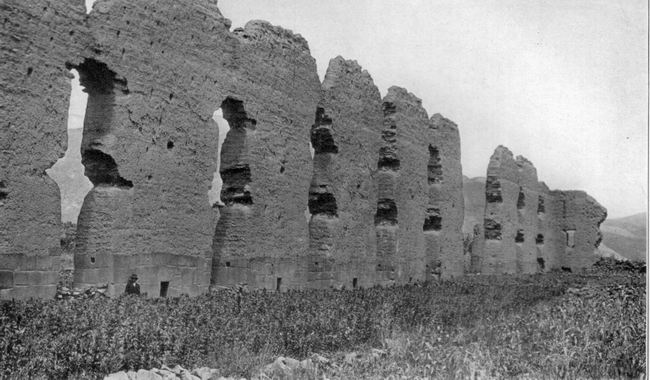 THE RUINS OF THE TEMPLE OF VIRACOCHA AT RACCHE In the market-place of Sicuani, the largest town in the valley, and the border-line between the potato-growing uplands and lowland maize fields, we attended the famous Sunday market. Many native “druggists” were present. Their stock usually consisted of “medicines,” whose efficacy was learned by the Incas. There were forty or fifty kinds of simples and curiosities, cure-alls, and specifics. Fully half were reported to me as being “useful against fresh air” or the evil effects of drafts. The “medicines” included such minerals as iron ore and sulphur; such vegetables as dried seeds, roots, and the leaves of plants domesticated hundreds of years ago by the Incas or gathered in the tropical jungles of the lower Urubamba Valley; and such animals as starfish brought from the Pacific Ocean. Some of them were really useful herbs, while others have only a psychopathic effect on the patient. Each medicine was in an attractive little parti-colored woolen bag. The bags, differing in design and color, woven on miniature hand looms, were arranged side by side on the ground, the upper parts turned over and rolled down so as to the contents. Not many miles below Sicuani, at a place called Racche, are the remarkable ruins of the so called Temple of Viracocha, described by Squier. At first sight Racche looks as though there were here a row of nine or ten lofty adobe piers, forty or fifty feet high! Closer inspection, however, shows them all to be parts of the central wall of a great temple. The wall is pierced with large doors and the spaces between the doors are broken by niches, narrower at the top than at the bottom. There are small holes in the doorposts for bar-holds. The base of the great wall is about five feet thick and is of stone. The ashlars are beautifully cut and, while not rectangular, are roughly squared and fitted together with most exquisite care, so as to insure their making a very firm foundation. Their surface is most attractive, but, strange to say, there is unmistakable evidence that the builders did not wish the stonework to show. This surface was at one time plastered with clay, a very significant fact. The builders wanted the wall to seem to be built entirely of adobe, yet, had the great clay wall rested on the ground, floods and erosion might have succeeded in undermining it. Instead, it rests securely on a beautifully built foundation of solid masonry. Even so, the great wall does not stand absolutely true, but leans slightly to the westward. The wall also seems to be less weathered on the west side. Probably the prevailing or strongest wind is from the east. An interesting feature of the ruins is a round column about twenty feet high — a very rare occurrence in Inca architecture. It also is of adobe, on a stone foundation. There is only one column now standing. In Squier’s day the remains of others were to be seen, but I could find no evidences of them. There was probably a double row of these columns to support the stringers and tiebeams of the roof. Apparently one end of a tiebeam rested on the circular column and the other end was embedded in the main wall. The holes where the tiebeams entered the wall have stone lintels. Near the ruins of the great temple are those of other buildings, also unique, so far as I know. The base of the party wall, decorated with large niches, is of cut ashlars carefully laid; the middle course is of adobe, while the upper third is of rough, uncut stones. It looks very odd now but was originally covered with fine clay or stucco. In several cases the plastered walls are still standing, in fairly good condition, particularly where they have been sheltered from the weather. The chief marvel of Racche, however, is the great adobe wall of the temple, which is nearly fifty feet high. It is slowly disintegrating, as might be expected. The wonder is that it should have stood so long in a rainy region without any roof or protecting cover. It is incredible that for at least five hundred years a wall of sun-dried clay should have been able to defy severe rainstorms. The lintels, made of hard-wood timbers and partially embedded in the wall, are all gone; yet the adobe remains. It would be very interesting to find out whether the water of the springs near the temple contains lime. If so this might have furnished natural calcareous cement in sufficient quantity to give the clay a particularly tenacious quality, able to resist weathering. The factors which have caused this extraordinary adobe wall to withstand the weather in such an exposed position for so many centuries, notwithstanding the heavy rains of each summer season from December to March, are worthy of further study. It has been claimed that this temple was devoted to the worship of Viracocha, a great deity, the Jove or Zeus of the ancient pantheon. It seems to me more reasonable to suppose that a primitive folk constructed here a temple to the presiding divinity of the place, the god who gave them this precious clay. The principal industry of the neighboring village is still the manufacture of pottery. No better clay for ceramic purposes has been found in the Andes. It would have been perfectly natural for the prehistoric potters to have desired to placate the presiding divinity, not so much perhaps out of gratitude for the clay as to avert his displeasure and fend off bad luck in baking pottery. It is well known that the best pottery of the Incas was extremely fine in texture. Students of ceramics are well aware of the uncertainty of the results of baking clay. Bad luck seems to come most unaccountably, even when the greatest pains are taken. Might it not have been possible that the people who were most concerned with creating pottery decided to erect this temple to insure success and get as much good luck as possible? Near the ancient temple is a small modern church with two towers. The churchyard appears to be a favorite place for baking pottery. Possibly the modern potters use the church to pray for success in their baking, just as the ancient potters used the great temple of Viracocha. The walls of the church are composed partly of adobe and partly of cut stones taken from the ruins. Not far away is a fairly recent though prehistoric lava flow. It occurs to me that possibly this flow destroyed some of the clay beds from which the ancient potters got their precious material. The temple may have been erected as a propitiatory offering to the god of volcanoes in the hope that the anger which had caused him to send the lava flow might be appeased. It may be that the Inca Viracocha, an unusually gifted ruler, was particularly interested in ceramics and was responsible for building the temple. If so, it would be natural for people who are devoted to ancestor worship to have here worshiped his memory. 
_____________________ 1 Fernando Montesinos, an ecclesiastical lawyer of the seventeenth century, appears to have gone to Peru in 1629 as the follower of that well-known viceroy, the Count of Chinchon, whose wife having contracted malaria was cured by the use of Peruvian bark or quinine and was instrumental in the introduction of this medicine into Europe, a fact which has been commemorated in the botanical name of the genus cinchona. Montesinos was well educated and appears to have given himself over entirely to historical research. He traveled extensively in Peru and wrote several books. His history of the Incas was spoiled by the introduction, in which, as might have been expected of an orthodox lawyer, he contended that Peru was peopled under the leadership of Ophir, the great-grandson of Noah! Nevertheless, one finds his work to be of great value and the late Sir Clements Markham, foremost of English students of Peruvian archeology, was inclined to place considerable credence in his statements. His account of pre-Hispanic Peru has recently been edited for the Hakluyt Society by Mr. Philip A. Means of Harvard University.
Click
 here to continue to the next chapter of Inca Lands
|