 Web
and Book design,
Web
and Book design, Copyright, Kellscraft Studio 1999-2007 (Return to Web Text-ures) |
Click
Here to return to Sand Dunes and Salt Marshes Content Page Return to the Previous Chapter |
 (HOME) |
|
CHAPTER VI WATER BIRDS SEEN FROM THE DUNES
WHILE the
seacoast
is a favorable region for the observation of land birds, it is doubly
so for
that of water birds, which stream along the coast during both spring
and fall
in great numbers. It is much to the advantage of the bird student that
the
migration period of water birds occupies a very considerable part of
the year,
for the fall migration begins as early as the first week in July, and
extends
through December and even into January, while the spring migration
extends from
February to the middle of June. Not only this, but a large number — not
of
species, it is true, but of individuals — spend the summer, while in
the winter
the number both of individuals and of species is large, and there is
always a
chance of rare visitors from the north at this season. While a
rain or
snow storm, or even a wind, makes the observation of land birds
difficult or
even impossible, the same conditions on the seashore are to a certain
extent
favorable to the bird student, because birds that habitually stay out
at sea
may be driven to the beach, or may wing their way in the storm close to
the
dunes. There are
two main
classes of water birds that can be watched from the sand dunes and
surrounding
beaches, namely those that obtain their food on or in the water, and
those
that feed on the beaches. The herring gull belongs to both classes, and
on this
account, and also because it is found at all seasons of the year at
Ipswich,
and on occasions in enormous numbers, it deserves first place in our
consideration. Although
No-Man’s-Land in Penobscot Bay, over a hundred miles northeast, is the
nearest
breeding place of the herring gull, yet throughout the breeding season
this
bird is to be found in flocks of several hundred or even several
thousand on
and near Ipswich beach. Many of these, sometimes as many as ninety per
cent.,
are in the gray and mottled immature plumage, and are probably
non-breeding
birds. It is possible, however, that some adults, perhaps only a few,
are daily
excursionists from their breeding places in Maine to the beaches of
Essex
County. The moving
cause
for the accumulation of gulls in summer in this region is the great
abundance
of dead fish so often found here, and the herring gull is a very useful
scavenger. Young herring in their mad flight from larger fish meet
their death
by thousands on the sands, while hake, haddock and cod, as well as
dog-fish —
those fierce and ravenous sharks — are often stranded in the shallow
water,
and, battered by the waves, are cast up on the beach, — pursued and
pursuer
together. Skates — curious kite-shaped sharks — and the still more
curious
angler-fish or fishing-frog also furnish food for gulls. The
angler-fish is so
named because it is supposed to allure its prey within reach of its
great jaws
by means of a dangling tentacle that resembles a rod, line and bait.
One of
these fish that I found on the beach was three and a half feet long and
had a
mouth a foot wide — a singularly open countenance. While the
herring
gull feeds principally on dead fish and other refuse on the water and
on the
beach, it also devours crabs and snails and sea urchins whenever it
gets a
chance, and, on very rare occasions, plunges like a tern for small
living fish.
I treasure
in my
memory a stormy July day, when the wind was sweeping down cold and wet
on to
the shore, when a fog-bank lay to the east and great dark cumuli to the
north
of a gray sea studded with white-caps, when patches of fleecy scud
drove
overhead, revealing here and there spots of blue sky, and when the
surf moaned
on the bar. Herring gulls were everywhere, for the sea had cast up for
them a
bountiful feast. The sand flats were splashed with great patches of
young
herring, here shining like silver, there looking dark and colorless,
while
windrows of hake and pollack and schools of dog-fish dotted the shore.
The
sand was covered with the gulls’ footprints, and marked with great
white
splashes, while feathers were blowing about as from an open
feather-bed. As I
stood on the edge of the beach, bracing myself against the wind, I
noticed that
a bar on one side was so thickly covered with the great birds that no
sand was
to be seen, while on the other that the broad flat beach for at least a
mile
was thronged with them, a great army of gray and white. Overhead they
were
continually passing and re-passing, drifting along before the wind or
sailing
straight into the teeth of it. Physicists have shown, it seems to me
conclusively, that an up-current is needed in these cases, where gulls
glide
directly against a strong wind, as they often do for miles close to
steamers,
taking advantage of the up-currents there present. Over land or sea,
under
other conditions, it is rare that birds are able to glide far, for
up-currents,
although common for shorter spaces, are not so continuous as they are
beside a
moving steamer. Headley in his “Flight of Birds” says: “In Algeria I
once saw
two Eagles sail straight ahead against the wind for about a mile and a
half
without moving their wings till they reached a high mountain ridge,
blowing
over which the wind had got an upward trend.” 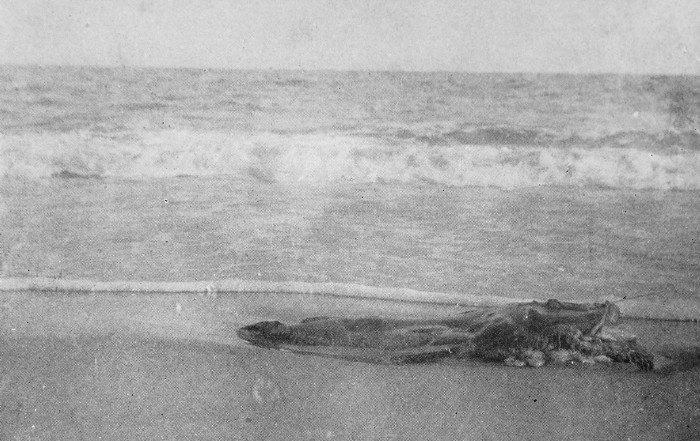 AN ANGLER FISH THROWN UP ON THE BEACH 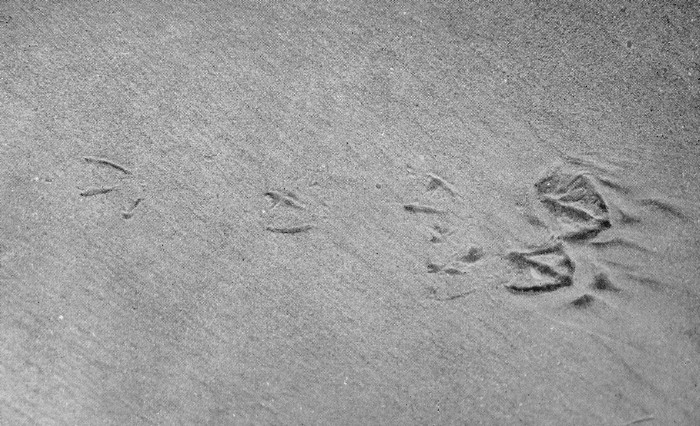 TRACKS OF HERRING GULL MADE ON ALIGHTING ON THE BEACH It is a
difficult
matter to estimate the numbers of gulls in these large flocks, — it is
impossible
to count them, — and I have adopted several expedients in order to
arrive at
some idea of their magnitude. For example I have measured the size of a
sand
bar on which a flock had been so closely packed that the birds stood
for the
most part shoulder to shoulder. Again I have paced the distance
occupied by a
flock on the beach, or the distance along which the birds stretched
when
alighted in the water opposite the beach. Even allowing one bird to a
square
yard or eight or ten to each linear yard, the numbers sometimes went up
as high
as twenty-five thousand birds. I have never dared to record an estimate
of over
six thousand birds, for fear of exaggeration, but perhaps it is as
unscientific
to underestimate as to overestimate. It would
take long
to write down all the interesting traits of this splendid gull. A few
of them
have incidentally been set down in the chapter on tracks. In these
days, when
young men dream dreams and see visions of themselves in aeroplanes,
they cannot
do better than to study the flight of this bird, and the marvelous
manner in
which it uses its aeroplanes. I believe that there is much to be
learned by
this study, much that will prove of immense interest and value to
aviators, and
they are even now discovering that by skilful management aeroplanes,
like
birds, can remain in the air for a considerable period of time and
move in
various directions without motive force. 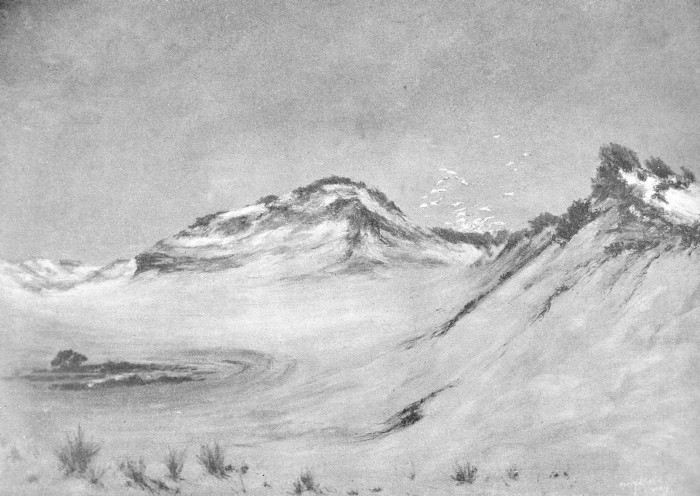 HERRING GULLS IN THE IPSWICH DUNES While herring gulls in calm weather often flap along like herons, in stormy days they are totally different creatures, and appear to delight in the blasts, sometimes sailing, with wings slightly bent, straight into the wind.
One can
but admire
the ease with which they circle and sail in calm weather or in storm,
sometimes
rising with imperceptible effort to a great height, their white plumage
flashing in the sunlight. “Now shaves with
level wing the deep, then soars.” In the
descent they
circle slowly down, or drop with great rapidity, tipping frequently
from side
to side to spill the wind in order to quicken the pace, and often
slowly sinking
the last twenty or thirty feet with outstretched legs and upraised
wings. It
will be a long time before human aeroplanes can compete with these past
masters
in the art. One March
day I
noticed a gull rise from the water and fly with all speed directly at a
golden-eye duck who was peacefully swimming not far off. The duck dove
to
avoid the blow that seemed imminent, and the gull took its place on the
surface
of the water. In a few seconds he was off to repeat the game on another
duck,
and so it went on. The victim always dove in time, the gull never
picked up
any food or appeared to be looking for anything the duck might have
dropped,
and the other ducks swam close to the marauding gull without any show
of fear
on their part or of malice on the part of the gull. I believe that the
whole
performance was in the nature of play between the different species
living in a
familiar and friendly manner in the same region. I was once
watching
an immature herring gull as it flew slowly close to the water at
Ipswich, when
a great fish, possibly a shark, threw itself completely out of the
water at the
bird. The gull flew up quickly, but soon circled down and dipped close
to the
water where the fish had disappeared, as if to satisfy its curiosity as
to the
cause of the strange disturbance. The great
black-backed gull is a fine fellow, larger than the herring gull, and
is distinguished
by black wings and back that contrast well with his snow-white head and
tail.
To this arrangement of plumage he also owes his name of “saddle-back.”
His bill
is of a bright lemon hue, excepting the front part of the lower
mandible, which
is washed with brilliant carmine that shades out on the edges. When he
opens
his mouth his gape is seen to be orange and his tongue salmon in color.
His
eyes are pale straw colored stenciled with delicate gray lines, and his
eyelids
are edged with vermilion. A close acquaintance is needed before all
these
charms are revealed. In the
migrations
and during the winter the saddle-backs are common birds on this shore,
and,
although their nearest breeding place is Nova Scotia, two or three
generally
spend the summer. Their cries are generally deeper than those of the
herring
gull and wonderfully varied and expressive. This is particularly the
case
during the breeding season on their home grounds. On the Labrador coast
I have
listened many times to these splendid birds, whose voices seemed almost
human
as they suggested anger, grief or derision. They often spoke in low
conversational tones to each other as they sailed by, and at other
times they
scolded in no uncertain manner. I remember watching a pair of them
eating a
fish; their manners were extremely good; they ate in turns, never
interfered
greedily, and never quarreled. Saddle-backs are apt to be tyrannical,
however,
and chase and harry other gulls. It is
indeed a
red-letter day for the ornithologist when he sees a glaucous or
burgomaster
gull, or an Iceland gull on this coast. These two species, denizens of
the
north, can be distinguished on close scrutiny from the herring gull by
the
absence of black tips to the white wings. The glaucous gull is slightly
larger,
the Iceland gull slightly smaller than the herring gull. Both have a
mantle of
slaty blue covering their backs when adult, but the immature are of a
uniform
creamy white above and below. Bonaparte’s
gull,
one of the smallest gulls, is a common migrant, and kittiwakes and
ring-billed
gulls, although less common, are far from rare. The common
tern,
often called mackerel gull, is easily identified by its swallow-like
flight,
its bill pointing downwards as it flies, and by its habit of hovering
and
plunging for fish, as well as by its loud cries of te-arr. Its bill is
red with
a black tip, its cap is black, its back of a lovely pearl gray, its
lower parts
white, and its tail long and forked. Not so many years ago various
fragments
and the whole skins of these beautiful birds were fastened on women’s
hats,
just as scalps and feathers are fastened in the head-dresses of
savages.
Thousands of the birds were shot down where they could be most easily
obtained,
namely, on their breeding grounds, for they are plucky little birds and
valiantly attack any marauder who intrudes on their homes, and they do
not
seek to escape. These, as well as other species of terns, were greatly
reduced
in numbers by this cold-hearted combination of fashion and
slaughterers, when,
through the strenuous efforts of the Audubon Society and of other bird
lovers,
the killing was stayed, and, to the great joy of all naturalists, the
graceful
birds are again increasing. I have hopes that the least tern, which
bred at
Ipswich over forty years ago, and has been brought almost to extinction
in the
same way, may return again to its old haunts, now that fashion has been
curbed
by law. The arctic
tern
closely resembles the common tern, but lacks the black tip to its
bill, and
has a somewhat different voice. It is far less common. Still rarer are
the
roseate and the great Caspian tern, but the little black tern is a
fairly
common migrant. All of these, I believe, are happily increasing in
numbers
since they have been afforded better protection. It is a
great
pleasure to watch the graceful terns as they sport along the shore, now
covering
some sand bank as with a great white sheet composed of many hundreds of
individuals.
now rising and wheeling first one way and then another, all screaming
loudly,
now scattering and plunging for fish. Every now and then the bird
watcher will
notice a brown or mottled or jet black bird, lithe and graceful as a
hawk, dart
in amongst the snowy terns, and scatter them to the right and left. Now
he
singles out one bird and chases it vigorously as it twists and turns
in a vain
effort to escape. Wearied at last, the tern drops a fish, which is at
once
seized by the intruder before it strikes the water. This is the way the
jaegers, as these hunters are called, obtain their daily food, for they
are
robber barons, not laboring men. But “there are as good fish in the sea
as ever
were caught,” and the terns do not suffer much, I suppose, from this
tyranny.
Occasionally, however, the victim appears to lose its temper and turns
and
chases the jaeger. The screaming is incessant and the two twist about
in a
bewildering way, as each tries to rise above the other, but I have
never seen
any harm result. There are three kinds of jaegers to be seen at
Ipswich, the
Pomarine, the parasitic and the long-tailed, and all have a light and a
dark
plumage, which are as different from each other in appearance as the
red fox is
from the black fox. Perhaps the most spectacular performance by birds along this coast is the herring fishing in which the gannets indulge. Gannets are migrants only, birds of passage, and are often common in the fall when herrings swarm in Ipswich Bay. I have counted over two hundred gannets, all busily engaged in fishing, which with them is a lively and not a contemplative occupation. When a large flock are throwing themselves from considerable heights at the water, one bird after another in quick succession, or a number at once, sending the water up in great spouts, one is reminded of a naval battle, or at least of its counterfeit presentments. The fishing process in detail is as follows: the gannet flies rapidly over the water and begins to soar at a height of from thirty to a hundred feet, often rising just before the plunge. At the plunge the head is pointed down, while the wings are partly spread, so that the bird appears like a great winged arrow. The speed of the descent is great, and the wings are closed just before the bird enters the water, which spurts up to a height of five feet or more. After the waters have subsided, following the splash, and all is still, the bird suddenly and buoyantly comes to the surface, the head and neck stretched out first. It then sits quietly on the water for half a minute or so, to finish swallowing its prey and to rest, when it slowly and laboriously rises to windward, with its long neck and tail stretched to their full extent. Gaining a sufficient height, it swings round to leeward, and is soon soaring and plunging again. 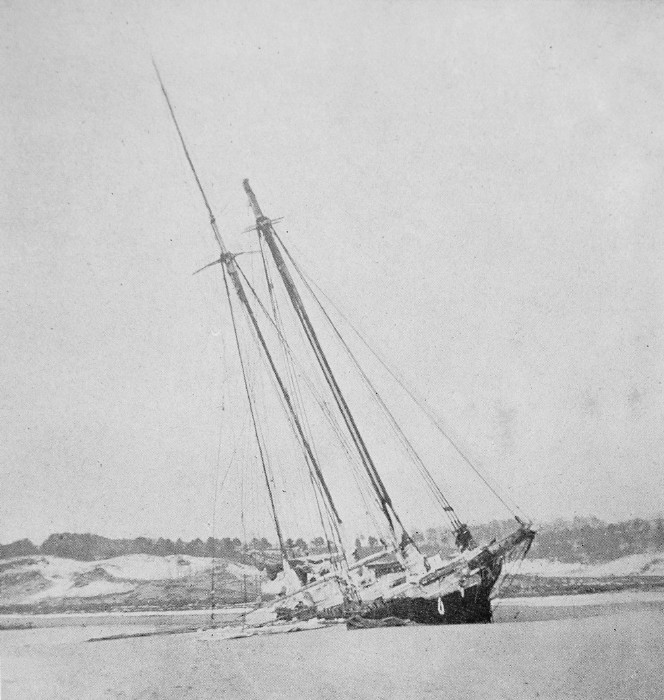 THE WRECK OF THE SAND SCHOONER 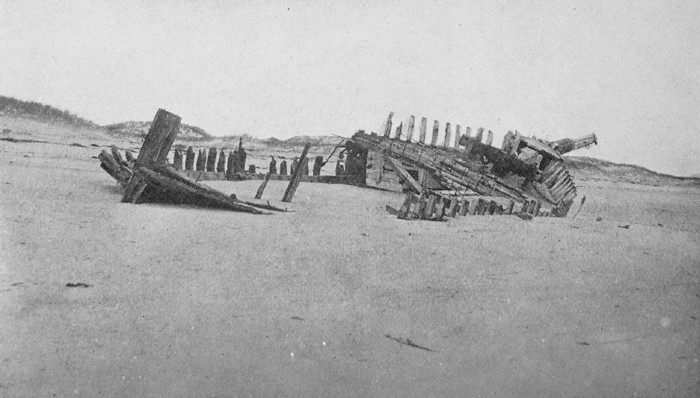 THE WRECK A YEAR LATER The adult
gannet is
chalky white all over except for the outer halves of the wings, which
look as
if they had been dipped in ink. The shape of the bird is characteristic
with
its long neck and tail, but the spectacular plunging makes its
recognition an
easy one. While the
gannet is
sometimes called a “Solon goose,” its cousin, the shag or cormorant,
is called
in the South a “nigger goose” on account of its black color. The
derivation of
cormorant, namely from corvus
marinas, also points to its dusky hue. There are
two kinds of cormorants seen along this coast in the migrations, the
commoner
of which is the double crested cormorant, and the rarer bears,
paradoxically,
the name of common cormorant. The latter bird in small numbers
sometimes passes
the winter here. They are uncanny looking birds, veritable imps of
darkness. The double
crested
cormorant has two little tufts of feathers, one on either side of its
head, and
while its whole plumage is black with a purple metallic sheen, it is
provided
with several points of brilliant color. Thus its throat is bare of
feathers
and is of an orange color, as is also the bare skin at the base of the
bill and
in front of the eye. The eyelids are jet black with a beading of blue
spots,
while the eyes themselves are an emerald green, and the inside of the
mouth is
painted a vivid blue. Its neck is long and snake-like, while its great
feet are
like bats’ wings with webs connecting all the toes. Perched on a spar
buoy, a
favorite spot, it sits upright, resting on its tail with its neck
curiously
curved. It frequently sits in spread-eagle style, with wings stretched
widely,
the head turned to one side and upward, looking for all the world like
the
eagle on an old mirror. This position is sometimes held for ten minutes
at a
time, and is occasionally indulged in by the birds even when they are
sitting
on the water. That
cormorants in
flight are sometimes mistaken for geese is not surprising, yet their
uniform
black color, their broader and more slowly flapping wings, as well as
the
slight curve in their necks, makes their recognition easy. They fly in
flocks
of from ten to a hundred or more, and may stretch out in a long line
abreast
or one behind the other, or the flock may even assume the typical V
shape which
is supposed to belong only to flocks of ducks and geese. On the water
they look
like loons, except for their blackness, and they are most expert in
diving and
catching fish. Occasionally they alight on the beach, where their
attitudes
and motions may be watched and their footprints examined. One pair in
rising
into the air made five hops before they could clear the beach, a
distance of
four yards. Another bird, with a stronger wind to help him, pushed the
beach
back only three times. Wood in
his “New
England Prospect,” written in 1634, says of these birds: “Cormorants
bee as
common as other fowles, which destroy abundance of small fish ... they
used to
roost upon the tops of trees, and rockes, being a very heavy, drowsie
creature,
so that the Indians will go
in their Cannowes in the night, and take them from
the Rocks, as easily as women take a Hen from roost.” Old Josselyn,
however,
says: “I cannot commend them to our curious palats.” I have ventured
so far as
to eat their eggs, but that was in Labrador. In thick
stormy
weather Mother Carey’s chickens or petrels — either Wilson’s or Leach’s
—
sometimes fly close to the beach. They are black birds nearly the size
of
robins, with white patches on their rumps. Leach’s petrel has a forked
tail and
short legs, while in Wilson’s petrel the tail is not forked, and the
legs are
so long that when stretched out behind, as the bird is flying, they
reach
beyond the tail. While the Leach’s petrel breeds along the Maine coast
and
farther north, Wilson’s petrel breeds in the antarctic regions in the
summer,
our winter, and comes north across the equator to spend the northern
summer
with us. Much might
be said
about various loons, auks, and grebes that can be seen from the dunes,
but many
of these prefer rocky shores. The loon — that splendid great diver that
advances
more rapidly below the water than on the surface — the smaller
red-throated
loon, and the horned and Hoelbell’s grebes are, however, familiar birds
along
these sandy shores. In the
duck family
the first on the list is the red-breasted merganser or sheldrake, he
with the
saw-like bill, the bec-scie of
the Acadians. Of late years this bird appears
to have increased in numbers, owing, I believe, to the stopping of
spring
shooting, and also, I am inclined to think, to the action of M.
Meunier, the
chocolate king of France. This gentleman has acquired the great island
of
Anticosti in the Gulf of St. Lawrence, and has excluded all guns from
his
realms. Anticosti is a wonderful breeding ground for various
water-fowl, and
among them the sheldrake abounds. On a late
October
day in 1910 the water outside of Ipswich beach for its entire length
seemed to
be filled with sheldrakes. Everywhere one looked were small and large
flocks
of these birds, either sitting on the water, swimming about and diving,
or
restlessly rising up and flying to and fro. It was a wonderful sight,
and my
companion, a most cautious and conscientious observer, estimated in
his
enthusiasm at least fifty thousand birds. There may have been many
more. But it
can safely be said that there were at least twenty-five thousand. Although
it is not
uncommon to find two or three red-breasted mergansers spending the
summer, none
breed here, but in the autumn great hordes come from the north. After
the first
or middle of November they fall off greatly in numbers but are still
abundant
throughout the winter, while in the spring they again increase. In the
early
autumn all these mergansers appear to be in the modest dress of the
female and
young, — brown heads, ashy gray backs and white breasts. Towards the
end of
November it is evident that some of them, perhaps a quarter, are
changing into
the beautiful dress of the adult drake, while by the last of December
and
throughout January and February it is very rare to see a bird in
female
attire. In March the females put in an appearance, and courting begins,
and by
the last of April and in May the birds are largely paired, although
flocks of
either or both sexes are common. Both the drake and the duck have
crests, but
while that of the duck is dull brown, the crest of the drake is colored
like
the whole of his head and neck, a dark metallic green. The drake has
also a
white ring around his neck and a band of reddish brown streaked with
black on
his breast, while his flanks and wings show much more white than is to
be seen
in the duck. His bill is colored red. The
explanation of
the seasonal distribution is interesting. It is evident that the great
multitudes in the fall — all in somber plumage — are made up of young
of both
sexes and of adult females; but it is not so clear, although it is a
fact that
the flocks also contain adult males which are in the so-called eclipse plumage.
The males of nearly all species of ducks, soon after the period of
courtship is
over, change, by moulting, from their conspicuous nuptial dress to the
quiet
and dull-colored dress of the female. This is what is meant by going
into the
eclipse plumage, and the
fact is in itself a strong argument in favor of the
theory of sexual selection. In the
case of the
eider, the drakes in nuptial plumage are wonderfully brilliant in
their dress
of creamy white, jet black, deep blue and pale green. It is evident
that they
appreciate their own beauty, for during courtship they display their
charms by
various antics, including the rising up from the water so as to show
the
splendid black belly shield otherwise hidden. In all situations,
whether on
the open sea or on land, among ice, rocks, spruces or mosses, they are
extremely conspicuous, while the duck, in the modest but tasteful dress
of
brown, is always difficult to distinguish. Immediately after the
courtship
period the drake also assumes this dress, which becomes for him an
eclipse
plumage in very truth. Now, in
the case of
the mergansers, the drakes emerge from their eclipse in late November,
but
their charms are wasted for a time, because the ducks with their young,
as
sometimes happens with the females of the human species, betake
themselves to a
warmer climate. The males are left to fight the battle alone in the
north,
until the more genial weather of the spring brings back the females and
young
from the south. The
southern side
of this picture, which rounds out and corroborates my northern
observations,
has been given me by Mr. William Brewster, who says that in Florida in
winter
he has seen large flocks of female and immature red-breasted
mergansers, and
by Mr. Arthur T. Wayne, who, in his “Birds of South Carolina,” says of
this
species: “From the time when the fish-eating ducks arrive until the
first week
in February the adult drakes are seldom, if ever, seen, but towards the
second
week in February they make their appearance in large numbers.” The old
males brave
the rigors of the northern climate, while the females and young seek
warmer
regions during the winter, but it would seem as if some of the
impatient
suitors were unable to await the return of their partners from the
south, and
must needs go and fetch them. The
red-breasted
merganser has a spectacular and distinctive courtship display, which
varies
somewhat in its details but is essentially as follows: the drake
begins by
stretching up his long neck so that the white ring is much broadened,
and the
metallic green head, with its long crest and its narrow red bill, makes
a
conspicuous object. After a preliminary bow, the bill is opened wide
and the
bird stiffly bobs or teeters as if on a pivot, in such a way that the
breast
and the lower part of the neck are immersed, while the tail and the
back part
of the body swing upward. This motion brings the neck and head from a
vertical
position to an angle of forty-five degrees. All the motions are stiffly
executed, and suggest a formal but ungraceful courtesy. When the bill
is
opened, a loud, rough or purring and slightly double note is emitted, a
note
that remains long in the memory after one has heard it repeated over
and over
again by a number of merganser suitors. Although
the female
may remain passive and coyly indifferent to the ardent actions of the
male, as
is the habit of her sex, she sometimes responds by a bobbing which is
similar
to that of the male, but of considerably less range, and sometimes she
emits a
single note which is louder than that of her partner but of a different
quality
and less rasping. The nuptial performance is always at its best when
several
drakes are displaying their charms of movement, voice and plumage
before a
single duck, and each vies with the others in the ardor of the
courtship. I have records of some thirty other different kinds of ducks of this region, but it is possible to speak of only a few and that but briefly. Of these there are three species that go by the name of “coots,” and their pursuit is termed “although the name coot belongs properly to that species of rail which is commonly called a mud hen. With such confusion of popular epithets it is no wonder that scientific names are preferred by those who wish to be exact. These “coots” that I speak of are really ducks, and they are known as the American scoter or butter-bill, the surf scoter or skunk-head, and the white-winged scoter. 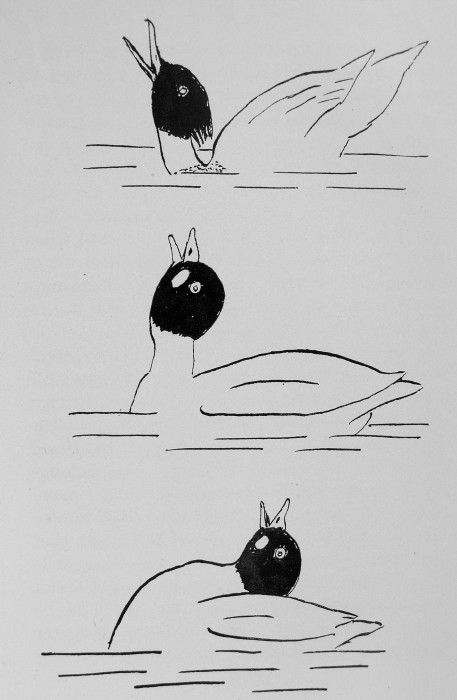 UPPER FIGURE — COURTSHIP POSE OF SHELLDRAKE. LOWER FIGURES — COURTSHIP POSES OF WHISTLER. During
October and
November they pour along the coast, sometimes in great numbers, and at
times flock
succeeds flock as far as the eye can see off the beach at Ipswich. On
days of
great flights it is a fascinating study to watch these birds from the
top of a
tall dune near the beach as they sweep by with irresistible energy. On
reaching the angle at Annisquam where Cape Ann juts boldly out, the
birds
often appear at a loss what to do. Sometimes they fly first one way
and then
another, rising higher and higher all the time, finally to strike out
towards
the end of the Cape, over which they resume their southerly course.
Another
flock will turn at the angle without pausing and skirt the shore around
the
Cape, but occasionally a flock will become discouraged on reaching the
solid
barrier and will turn back to drop in the water and talk it over. All
this
shows the dislike of the scoter to fly over the land, yet in stormy
weather
they fly directly over the base of the Cape. Ducks are
not
famous as songsters, but there is a somewhat musical duck that appears
in these
waters, namely the old squaw, oldwife, or long-tailed duck. This
handsome bird
comes with the winter in a livery of snow white and jet black, and he
bears a
long and slender tail which he jauntily cocks up at an angle. In
Labrador these
ducks were spoken of as “hounds” by Cartwright over a hundred years
ago, and
they still bear this name there, and it is an appropriate one, for the
voice of
a flock is like the music of a pack of hounds in full cry. According to
Preble
the Cree Indians along the Athabasca call this bird ca-ca-wee, the Chipewayans
of the Mackenzie River refer to it as
a-ha-lik; while the Eskimos give it the
name a-hau-lin. All of these
names are very fair attempts to repeat some of the
notes used by these birds. William Wood in his “New Englands Prospect”
says
“The Oldwives, be a foule that never leave tatling day or night.” Occasionally
one
may see in May a few old squaws that have changed to the summer dress
in which
they appear like negatives of their winter plumage. Instead of having a
white
neck and a dark spot about the eye, they have a black neck and a light
spot.
The color of the feathers near the eye remains in reality nearly the
same — a
mouse gray — but it appears dark with a white neck, and white with a
black
neck. By far the
most
characteristic frequenters of the beach are the shore birds, a charming
group
in plumage, habits and call notes, a group that includes sandpipers and
plovers. Up to half a dozen years ago the piping plover bred regularly
in the
dunes and raid its eggs in the sand. It belongs to a dying race, and
although
it is protected by law at all seasons, I fear this is not sufficient to
stop
its path to extinction. So long as the law permits the shooting of
other
plovers of the same size and the small sandpipers, one cannot expect
the
ordinary gunner to discriminate, as in fact he is unable to do, and the
piping
plover is shot with the rest. Only by stopping all shooting, or by the
creation
of bird refuges, can the tendency to extinction of this and other shore
birds
be prevented. Would that the Ipswich dunes, beaches and marshes could
be made a
bird refuge! It would be the greatest blessing to the birds and to
bird-lovers
alike, and incidentally to sportsmen elsewhere. At present a land
owner
prohibits the shooting of shore birds around the shores of a small pond
at
Ipswich Great Neck. The results are extraordinary and are well worth
imitation, for the shore birds resort there in great numbers, both of
individuals and of species. More than all this they become so tame and
so much
at home, that one can watch at close range traits and habits that are
rarely
seen on the open beaches, where the wary bird is constantly on the
alert lest
it lose its life. The piping
plover,
meloda, has one of the
sweetest and saddest notes I know, — a clear double
whistle. It generally prefers to hunt its food in the dry sand, which
it
matches closely in color. While the
piping
plover matches the dry sand, the ring-neck or semi-palmated plover
matches the
wet sand where it generally hunts, and its notes are cheerful and
business-like
in comparison with those of its piping cousin. It is a robust bird,
always on
the alert for food and for the prowling gunner, and it still holds its
own in
considerable numbers. An advantage that plovers have over sandpipers
is that
they scatter when they alight on the sand to feed, while sandpipers
hurry along
in close ranks. Consequently the pot-hunter spends many anxious moments
waiting
for a chance to get a large number of plovers in a line with his aim,
and often
misses them altogether as the frightened birds take wing. As we have
already
seen, the habits of these two groups of shore birds in this respect can
be
discovered by their tracks. The golden
plover
is rarely found on this shore, and then only when it is blown out of
its usual
course, some two hundred miles or more to the eastward, for it has the
extraordinary
habit, after coming from its arctic breeding grounds, of migrating from
Nova
Scotia to South America, a distance of 2,400 miles over the ocean. From
the
northern coast of South America it journeys to Argentina, where it
spends our
winter, the South American summer. In the spring it migrates up the
Mississippi
valley, and finally reaches its home by the Arctic Ocean. The
black-bellied
plover or beetle-head is, however, more a bird of our coast, for it
migrates
along our shore both spring and fall. It is a little bigger than the
golden
plover and is indeed a splendid bird with a body as large as that of a
pigeon.
It differs from the golden plover also in having a little knob of a
hind toe,
while the golden plover has no hind toe at all, and its under wing
feathers or
axillaries are black, while those of the golden plover are ashy. Its
white
rump is, however, its most distinguishing mark when it flies. I know of
no more
interesting shore bird to watch than the stately black-bellied plover,
as it
runs hither and thither on the sand, dabbing here and there with its
short
bill, or standing pensively, slowly folding its great wings after
alighting. In
the spring one may study all phases of plumage in a single flock, from
those in
winter dress with pure white breasts and bellies, through the slightly
and
profusely spotted ones, to those with splendid jet black breasts that
contrast
well with their white sides and necks. Thus on May 21, 1905, a flock of
sixty-six of these birds ran by me as I lay concealed on the beach
within a hundred
yards, and I made the following census: nineteen were full black
bellies;
twenty-seven were in various stages of incompleteness; twenty were
pale
bellies. Their
whistle is
somewhat like that of the piping plover, but is deeper and longer and
differs
in accent. As a flock flies over, their voices come down as a shower of
sweet
yet mournful sounds. The
commonest
sandpiper of the beach is the gentle little peep, a term that includes
both the
mud-peep or least sandpiper, which is more often found in the marsh,
and the
sand-peep or semi-palmated sandpiper, a typical sandy colored beach
bird. In
flocks large and small they eagerly glean the sand, running all
together up the
beach when threatened by a wave and following it as it recedes. Again
they
spring into the air and twist and turn like one bird with military
precision,
displaying now their gray backs, now like a flash their white breasts.
The
young, with the faint smoky wash on their breasts, come about the
middle of
August, a month or so later than the earliest arrivals among their
elders, and
at first are very tame and confiding, not having yet learned the
depravity of
the human race ‘or the range of their guns. They soon learn, or pay the
penalty
with their lives. One never tires of watching these birds, and desolate
indeed
would be the beach without them, — yet their extermination still goes
on. In the
spring one
is sometimes treated to their flight song, a musical quavering trill,
which the
bird pours out continuously as it rises on quivering wings. The song
ends with
a few sweet notes that suggest some of those of the goldfinch, and,
after the
excited bird has fallen to the ground, it emits a few low clucks. The
whole
performance is altogether delightful and unexpected. The
sanderling,
locally known as “whitey” on account of its white appearance, is an
abundant
bird on the migrations both in spring and fall. It is somewhat larger
than the
peep, and its gray and white plumage makes it a conspicuous object as
it flies
in closely crowded ranks. In full breeding plumage it has a ruddy
brownish
throat and upper breast, but many go north in the spring still in the
white of
their winter plumage. The early arrivals in August or late July on the
journey
south are often ruddy-throated, but the change to winter plumage by
moulting
soon spots the throat with white until all the red feathers are gone. In the
middle of
August the young, sadly inexperienced, arrive, and in their tameness
fall an
easy prey to the gunner. They are beautiful birds, with faint smoky
bands
across their white breasts. It is a great pleasure to watch a flock as
they
crowd together along the shore, probing every spot of sand for the
small
molluscs and crustaceans which constitute their food. As the season
advances
our pleasure is somewhat dimmed by the fact that cripples, with a foot
shot
away or bloodstained sides, are common in their ranks. Josselyn
in his “Account
of two voyages to New England,” published in 1675, says of sandpipers:
“There
are little Birds that frequent the Sea-shore in flocks called Sander-lins,
they are about the biggness of a Sparrow, and in the fall of the
leaf they be
all fat; when I was first in the Countries the English cut them into small
pieces to put into their puddings instead of suet, I have known twelve
score
and more kill’d at two shots.” There is
always a
chance of seeing less common or even rare shore birds on the beach,
but it is
out of the question to more than mention some of them here. One
beautiful
Sunday morning in May, I heard the discharge of a gun, and immediately
after a
flock of knots — canutus,
named after King Canute — flew by me on the beach. I
looked to see who was breaking two laws by shooting on Sunday and in
the
spring, when I perceived that the offender had broken also a third law
by
shooting from a sailing dory off the beach. It was evident that his
conscience
was too guilty to allow him to look a man with binoculars in the face,
for he
put about and soon disappeared in the morning mists, leaving, however,
three
beautiful specimens dead on the beach. They were not wasted. The knot
in the
full nuptial dress is a handsome bird with breast like that of a robin
and a
steel gray back. In this stage it is called a red-breasted plover,
while the
fall birds in winter dress and the young with their white breasts and
bluish
gray backs are locally known as “blue plover.” By these marks is the
knot
known, but especially by his short legs and squatty form. The
dunlin, with
his curved bill, is a marked bird in the spring, on account of his
bright
chestnut back and black belly, while in the fall he retires into
obscurity with
a mouse-colored back and white under-parts. One would hardly connect the family of Napoleon with a sandpiper, but the nephew of Napoleon the First, Charles Lucien Bonaparte, was an ardent worker in American ornithology, and the white-rumped sandpiper is also known as Bonaparte’s sandpiper. It is not much larger than a peep, but its white rump, noticeable in flight, furnishes a ready means of identification. 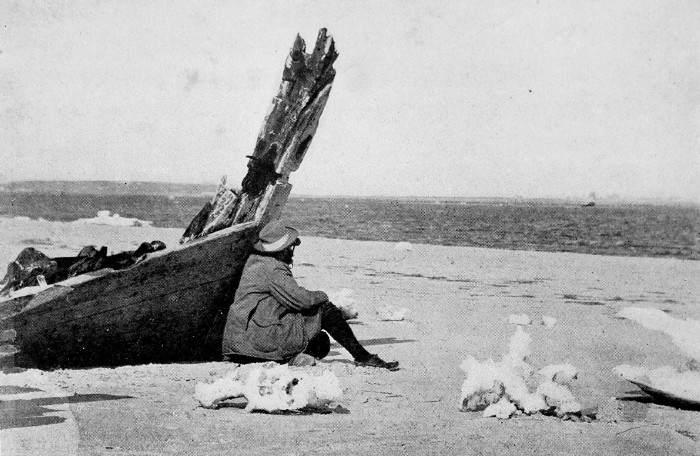 WATCHING WATER BIRDS AND SEALS FROM THE WRECK 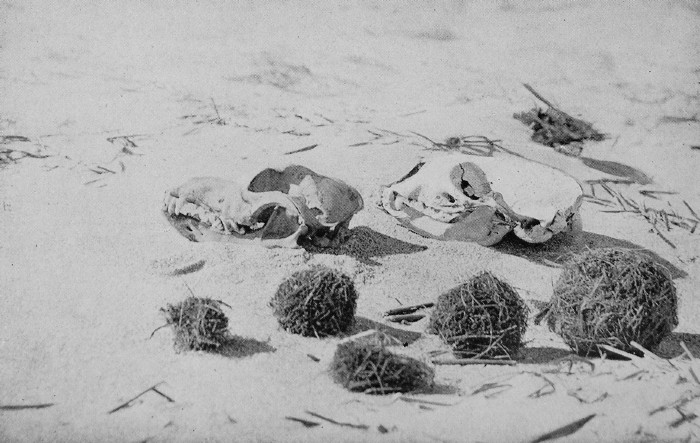 SKULL OF DOG AND OF SEAL. — GRASS BALLS The Eskimo
curlew —
the dough bird of old New England gunners — is a bird of the past, for
it is
now close to extinction, although in former days it sometimes visited
this
coast in the fall in large flocks. The last record I have in this
region is of
two shot at Newburyport in August, 1908. Audubon in his “Birds of
America”
says: “Previous to my voyage to Labrador I had seen only a single bird
of that
species, which was kindly given me by my learned friend William Oaks
Esq. of
Ipswich, Massachusetts, who had procured it in his immediate
neighborhood,
where as I have since ascertained, the Esquimaux curlew spends a few
days in
early autumn while on its way southward.” The
Hudsonian
curlew, however, is a not uncommon migrant. It is an interesting fact
that
young males of this species have such short bills that they are
mistaken for
Eskimo curlews, while old females have such long bills that gunners
report them
as sickle-bills, the very rare large curlew of that name. I have a
young male
in my collection with a bill 2.25 inches long and an adult female whose
bill
measures 3.65 inches. It is evident that the males in this race are
hen-pecked!
The
Hudsonian
godwit with upturned bill, the willet, the Baird’s and the stilt
sandpipers, I
must merely mention by name, but the turnstone or chicken plover
compels more
than passing notice. His coral red legs and his black and tan and white
“calico” back make him a marked bird, and his great variety of call
notes adds
to his distinction. He derives his name “turnstone” from the singular
but
useful habit he possesses of turning over stones for the small
crustaceans
concealed there. But he does not stop at turning stones, for he is
particularly
adept at turning over masses of seaweed, sometimes almost as large as
himself.
In fact he literally “roots” in the seaweed like a pig, and like a pig
he grows
inordinately fat. Although
very shy
when pursued with a gun, I have found the turnstone a delightful bird
to study
with a glass, for he appears to grasp the situation and to recognize
the
friendly attitude so well that I have been able to approach within a
few feet
of the “rooting” bird and watch every motion. What a joy
it would
be to have a return of the old conditions, when terns and piping plover
bred in
the dunes, and when shore birds large and small thronged the beaches,
and when
the sea teemed with water fowl. Many of the birds I have mentioned in
this chapter
are on the way to extinction, some have already disappeared forever; a
few,
happily as a result of protection, are increasing. In Japan it is said
that
when travelling artisans see an eagle, they take out their sketching
tablets
and record its beautiful shape and attitudes. The barbarians of this
part of
the world try to shoot it, a fate they have often meted out to every
large or
unusual bird they came across, even if it were of no value to them, and
they
left it to rot where it fell. Fortunately times are changing and the
people
are gradually awakening to the idea that money value in food or
plumage, or
even in work done for man, is not the only thing for which birds should
be
protected. We are also beginning to realize that the interest which
finds
pleasure in the sport of bird destruction is a very limited and a very
selfish
one, and that the claims of the sportsman are not paramount to those
of the
nature student or even of the lover of natural beauty. |
 Click the book image to turn
to the next Chapter.
Click the book image to turn
to the next Chapter.