 Web
and Book design,
Web
and Book design, Copyright, Kellscraft Studio 1999-2007 (Return to Web Text-ures) |
Click
Here to return to Sand Dunes and Salt Marshes Content Page Return to the Previous Chapter |
 (HOME) |
|
CHAPTER V SWALLOW ROOSTS AND SWALLOW MIGRATION
SWALLOWS
begin to
gather near the shore at Ipswich, as well as elsewhere on our coast, as
early
as the first of July, and their numbers rapidly increase from day to
day. At
the end of that month and during August and early September, great
multitudes
of these interesting birds are to be found in the neighborhood of the
sea. In
these flocks all four of our common species occur, but by far the most
abundant
is the tree swallow. Next in numbers comes the barn swallow, and next
the bank
swallow, although the latter is less common in Ipswich than the eave
swallow,
which appears to be a rather more exclusive bird, and one that is more
apt to
keep by itself than to mingle in the large mixed flocks. From the
great
numbers of swallows that congregate here in the fall it is evident that
many
must come from a distance, for there are more than the immediate
country would
support during the nesting season. It is their annual excursion to the
seashore, and although they gather about the neighboring roadsides,
pastures
and marshes, their favorite resorts are the dunes and upper beaches.
Although
some of these birds migrate south early in the season, the majority
remain together
for days or even weeks before starting for their winter homes; yet it
is
possible that some are constantly leaving, and their places are so
quickly
taken by others that we do not notice any diminution in their numbers. Although
many of
the swallows scatter far and wide in the search for food, yet such is
the
social disposition of these birds that great flocks are commonly to be
found
during July, August and early September, even at midday in various of
their
favorite haunts. Perhaps the most familiar of these haunts, and
certainly the
most conspicuous to the passer-by, is the roadside. Here they
congregate and
line fence rails and telegraph wires. Before the extension of the wires
to the
beach road at Ipswich, the swallows often clustered on the fence rails,
but
since the erection of these “way-side crucifixes,” as Frank Bolles
called
telegraph poles, the lowlier perches have been forsaken. 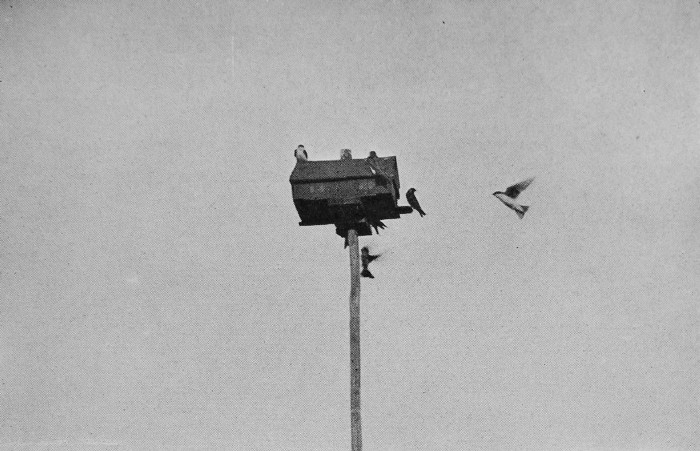 TREE SWALLOWS INVESTIGATING A BIRDHOUSE 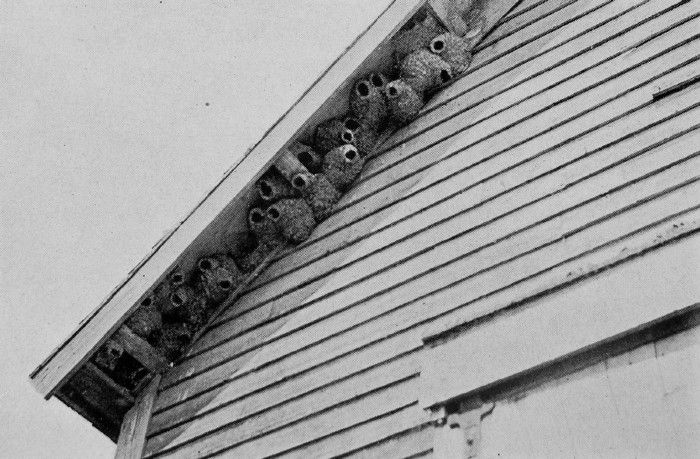 NESTS OF EAVE SWALLOWS ON AN OLD BARN One may
see lines
of these birds stretching, with but few gaps, on a couple of wires for
a mile.
Such congregations number several thousand, and all four species may be
seen
sitting shoulder to shoulder in the most friendly and democratic
manner. At
times, especially on marsh roads, where there are neither retaining
fences nor
overhead wires, the swallows cover the ground itself in patches, taking
flight
reluctantly as the wayfarer advances upon them. Another
favorite
resting place by day is in the salt marshes, where the birds cover
every
available projection such as fence posts, staddles, gunner’s blinds
and
stranded branches of trees. Swallows
are
certainly fond of the water and delight to gather about ponds near the
seashore. I have seen as many as two thousand in such a situation in
Ipswich.
The great majority of these were tree swallows, but here and there a
barn
swallow and a diminutive bank swallow were to be seen. They were
constantly
alighting on the bushes, fence wires, and rails, particularly on those
that
were over the water. Every few moments, with a loud whirring noise from
their
many wings, they would rise and wheel about in bands, showing first
dark and
then white, as they turned alternately their backs and their breasts to
the
observer. Again they would distribute themselves irregularly over the
sky, and
a little later they would throw themselves at the water with such
violence that
the surface would be covered with little splashes, as if a bombardment
were in
progress. Such
exhibitions as
this display not only the social and gregarious characteristics of
swallows,
but also the love of what appears to deserve the name of play. It has
been
said, as a reproach to their intelligence, that birds do not play when
young as
do the young of mammals, but the evolutions I have just described seem
to show
a spirit of enjoyment or play in flight, the natural exercise of birds,
just as
do spurts of running, or wrestling or butting contests in mammals. Another
interesting
trait of these flocking birds is their habit of inspecting holes in
posts and
trees, and bird-houses that come in their way, as well as of collecting
feathers in their bills as they fly. This autumnal revival of the
nesting
instincts is an interesting trait, and appears to be a common one in
birds.
Examples of this are the autumnal revival of song, notably in the
meadow-lark,
bluebird, song and Savannah sparrows, as well as in the barn and tree
swallows;
of the inspection of nesting localities by bluebirds and phoebes as
well as by
tree swallows; and of the courtship actions of grouse, sandpipers,
plovers and
ducks. Among the apple orchards near the coast at Ipswich are to be found many ancient trees, picturesque veterans, partly killed by the struggles with many winters, storm-beaten and time-worn, yet surprisingly full of vigor in their living branches, as shown by their wealth of blossoms in the spring and of apples in the fall. Among the dead branches of these old trees swallows love to congregate; here they proclaim their presence, even in their absence, by the numerous white droppings that spot the dead branches; here they roost for the night in great numbers. From these dead tree-tops they arise in the early morning with the whirring f many wings, and betake themselves to the roofs of neighboring barns, where they sun themselves, preen their feathers and gossip with one another. These roosts among the orchards may be frequented for many days or weeks before all the birds disappear for the south. The sand
dunes and
beaches, however, are the most popular resort of this interesting group
of
birds. Here they alight on the beach itself, on the smooth expanses in
the
dunes, or among the bayberry bushes, where the tree swallows gorge
themselves
with the waxy berries. I once found forty-one of these large berries
in the
small alimentary tract of a tree swallow. As far as I know this is the
only
species of swallow that enjoys such an unusual diet, for insects are,
of
course, the swallow’s favorite prey.
In a
thicket of
birches among the dunes just to the south of my camp a multitude of
swallows
spend the nights in the latter part of the summer, and they are
interesting
neighbors. On one August evening I watched them from the top of a dune.
They
began to arrive about six o’clock, and the majority came from the west,
— from
the region of the setting sun, — and flew in a continuous sheet,
perhaps a
third of a mile wide, skimming for the most part close to the sand, but
mounting occasionally high into the sky. As the birds sped by me, they
often
flew within a few feet or inches, and at times barely grazed the sand.
Tree
swallows were in the majority, while barn swallows formed perhaps a
fourth part
of the whole, and there were a few bank but no eave swallows. The
characteristic notes of the three species could be heard from time to
time, but
the birds were for the most part silent, although occasionally a barn
swallow
would break forth into his always delightful song. The flight was an
irregular
and wavering one, but the multitudes were intent on their goal,
wearied, no
doubt, by the day’s work and play. Occasionally two would stop in their
onward
career, playfully to attack each other in mid-air, and at times, for no
apparent reason but as the impulse seized them, a sudden upward or even
retrograde movement of all the birds would occur. The sun set at five
minutes
of seven, but the birds still poured by in the gathering dusk, while
the air to
the north and west appeared filled with black forms against the
luminous yellow
haze made by the rays of the departed sun. At ten minutes past seven,
already
dusk, the birds were pressing’ on in undiminished numbers. Two minutes
later
they suddenly stopped coming, with the exception of a few stragglers,
while a
great mass of whirling, twittering birds could be seen over the birch
thicket
to the south. A minute later, at thirteen minutes after seven, another
army of
birds was flying south, but the movement ceased at a quarter past
seven,
although a few belated ones straggled by in the darkness. At
half-past seven
I ventured to investigate the roost, which I found to be somewhat over
an acre
in extent and to consist of small birch trees about fifteen feet high,
closely
crowded together. The blackness of the undergrowth of ferns was
relieved by the
numerous white droppings of the roosting birds. In the darkness not a
swallow
could be seen amid the thick foliage, but a constant conversational
twittering
revealed their presence. As I entered the grove the noise became
greater, and
a number of birds above my head took flight. I shook a tree and a
frightened
mass of swallows flew out with whirring wings. The disturbance,
however, was
local and soon quieted when I had beaten a hasty retreat. The
morning flight
from this roost was certainly an interesting performance. I slept that
night
on the top of a pointed dune a short distance to the west of the
swallows.
About four o’clock I heard a few swallows going over, and ten minutes
later a
large number of these birds sprang suddenly into the clear, cool
morning air
that was already faintly glowing with the light of the coming sun.
Hither and
yon they flew in the exuberance of their joy of living, describing
irregular
curves and partial circles, fluttering their wings rapidly and bursting
out
into song which proclaimed their identity. The song was that of the
barn
swallow, and the combined effect of the great multitude of singers was
delightful in the extreme. All appeared to be barn swallows, although
in the
imperfect light identification by sight was difficult. In a few minutes
the
joyful birds dispersed. Many, still singing, flew over my sandy couch
high in
the air towards the west, and soon all were gone. The song of the barn
swallow
is one of the most delightful of our bird songs, yet it is but little
known. For nearly
ten
minutes only a few scattered swallows were to be seen, when suddenly a
great
whirring of wings was heard, and the simple song of the tree swallow,
poured
from a multitude of throats, burst upon my ear. The effect was a
pleasing
musical jingling, that seemed to shower down from the sky, as many
hundreds,
perhaps thousands, of tree swallows rose in the air. As they went north
and
west they flew for the most part lower than the previous band of barn
swallows,
that now seemed small in comparison. They did not skim close to the
cold sand,
however, as at night, but were perhaps one hundred feet up. At a
quarter f five
a mixed flock of about a hundred swallows flew over me as I lay on my
dune-top.
In this group barn, tree, and bank swallows could all be distinguished.
The sun
rose out of the sea at eight minutes of five. Another day of hunting
and sport!
The
southward
migration of swallows in the autumn occurs by day. Swallows are not
obliged to
fly by night, like most of the smaller birds, for two very good
reasons. In the
first place they are strong and swift flyers, and can accomplish more
in half a
day than many other birds in a whole one, and secondly they can feed
while on
the wing. Hence night work is not necessary for them, and the hours of
daylight
easily suffice for both feeding and travelling. I have
often seen
in the fall great numbers of swallows flying leisurely towards the
south over
the beach and dunes at Ipswich during nearly the entire day. Now they
skim
close to the white sand, snapping up the surface flies and other
delectable
insects. Again they mount high in the air, and continue their southward
journey, far removed from the earth. Again they alight to feed on
bayberries,
to rest and converse with each other. In the air they call to each
other as
they fly, just as do the nocturnal hosts, whose lack of skill on the
wing and
whose feeding habits, being of the earth or trees, require the extra
night
hours of labor. These night migrants, although heard, are invisible in
the
darkness, while the swallows delight the eye with their graceful
flights in the
full light of day. A more
spectacular
migration of swallows I have sometimes observed. Here the resting
hosts, moved
by a common impulse, or in response to some mysterious signal, mount
into the
air in irregular circles, at times drifting together and whirling about
like
masses of smoke, all the time rising higher and higher. When so high
that the
individual birds can with difficulty be distinguished, they move off
towards
the south, and with their rapid flight are soon lost to sight. With the
evidence of migration so apparent, it is a curious fact that for many
years it
was believed that swallows retired to the bottoms of ponds in the fall
and
spent the winter dormant in the mud! |
 Click the book image to turn
to the next Chapter.
Click the book image to turn
to the next Chapter.