
Web
and Book design,
Copyright, Kellscraft Studio 1999-2007 (Return to Web Text-ures) |
Click
Here to return to Sand Dunes and Salt Marshes Content Page Return to the Previous Chapter |
 (HOME) |
|
CHAPTER IV LAND BIRDS OF THE DUNES
THE sandy
and
desert character of the dunes would at first sight seem to be inimical
to
numbers or variety in the bird-life there, but the fact that the
seacoast is
one of the great highways of bird migration renders this region a
particularly
favored spot for the ornithologist. The thickets of bushes and trees
are so
limited in extent that the bird population during the migrations is
often much
crowded together, instead of being spread out over wider areas as in
upland
country. The sea on the one side and the marsh on the other are each
equally
inhospitable to land birds, so that the concentration in the thickets
of the
dunes is sometimes extreme. Another fact which is of advantage to the
bird
student is that the trees in the dunes are so low that one can often
look down
on the tallest of them from the peak of a dune. Besides the great
number of
migrants, which include practically all the birds that stream along
the coast
in the spring and fall, and find rest, shelter and food in the dunes,
there are
a number of interesting birds that spend part or all of the winter
there, some
of which are rarely found elsewhere than in sand dunes. The birds
that nest
in the dunes, and rear their young there, are comparatively few in
number and
are quickly enumerated. The robin builds in the trees or about the few
houses
and shanties; the yellow warbler and Maryland yellow-throat are common,
and the
song sparrow is everywhere in the bushes. Still more common is the
Savannah
sparrow nesting at the foot of clumps of tall beach grass throughout
the dunes
and on the edges of the tidal inlets from the marsh. Its song, such as
it is,
is heard on every hand during the spring and summer, — two chirps,
followed by
two trills, the first exceedingly high pitched, thin and
grasshopper-like, the
second rather sweet and musical. The first trill is inaudible to some
whose
hearing is otherwise good. A few tree
swallows
nest in the hollow trees and a few bank swallows in holes in the
wind-cuttings
of the dunes. Red-winged blackbirds, bronzed grackles and crows are
all common
nesters, as well as kingbirds and a few black-billed cuckoos and
flickers.
There are a few other breeding birds of the dunes, but these are the
chief
ones. I doubt
not that
the hummingbird has raised its young there, for I have occasionally
seen it
among the dunes, although I have not found its nest. One could not wish
a more
accurate or charming description of this bird than that of William Wood
in his
“New England’s Prospect.” He says: “The Humbird is one of the wonders
of the
Countrey, being no bigger than a Hornet, yet hath all the dimensions of
a Bird,
as bill, and wings, with quills, spider-like legges, small clawes: For
colour,
she is as glorious as the Raine-bow; as she flies, she makes a little
humming
noise like a Humble-bee: wherefore shee is called the Humbird.” Crows are
worthy of
more than passing notice. They are found in the dunes at all seasons of
the year,
but in far greater numbers in winter than in summer. In summer they are
so hard
put to it to find trees of sufficient size for their nest that they
sometimes
build only six feet from the ground. In winter, when the inland country
is
frost-bound in ice and snow, crows resort to the seashore in great
numbers and
live on the varied diet which the beaches and the marshes afford. The
character
of this diet is well shown in the ejected pellets described in the
chapter on
tracks and tracking. The nights are spent in roosts in the thickets in
the
dunes, but chiefly in the pine woods of Cape Ann and Essex. In the
morning one
may see the crows flying out from their night roosts, starting from
half an
hour to an hour before sunrise. They fly singly and in groups of from
ten to
thirty, and by sunrise all are about the day’s business, scattered to
feed
along the beaches and throughout the marshes of Ipswich, Essex and
Rowley.
These early morning flights are less direct than are the return flights
at
night, for the birds are evidently hungry and on the lookout for food. Most of
these crows
that spend the winter at the seashore go elsewhere in summer, and on
pleasant
days in the early spring I have seen the departure of some of them. On
a March
morning, just as the sun came from behind some clouds, a flock of
thirty or
forty crows rose from the dunes, circled irregularly upwards until they
were
mere specks in the sky, when they all started off in a direct course
for the
northeast. An hour later a flock of twenty-seven rose from the marsh
and did
likewise. Crows are social beings, and even in the midst of the
breeding season
flocks of fifteen or twenty adults often feed together. The crow
is
commonly accredited with only one note, — the notorious caw. That he possesses
this note, no one will deny, but he also has numerous other notes, and
indeed
his vocabulary is an extensive one. As a songster, however, he is not
a
success. Conversational notes and tones of every description issue
from his
throat, and nothing is more entertaining than the varied notes
exchanged by a
family of these birds, now low and confidential, sometimes pleasing or
slightly melodious, again raucous and scolding, even torrential in
their
abusiveness. The notes are so constantly changing in inflection that
one feels
sure that each has its meaning. A common spring note is a hoarse
rattling,
sometimes likened to the gritting of teeth; at other times the birds
laugh a
loud ha, ha, ha, while a
nasal taunting nev-ah, nev-ah and ah, ah, expressive
of great relief, as well as wailing cries, are common. Sir John
Richardson
called this bird “the barking-crow,” and old Chaucer spoke of “the crow
with
vois of care.” A still
more
peculiar note I have heard from the mouth of a crow. This was at
sunrise on a
frosty December day close to my house at Ipswich. Near my bedroom
window sat a
crow that from time to time emitted two low clucks, followed by a
single
booming sound, the whole a phrase of unknown meaning, which I wrote
down thus:
cluck-cluck, whoooo.
Between these phrases the crow cawed in an orthodox
manner. If one
should
attempt to describe all the birds that pass through the dunes in the
spring and
fall, he would be obliged to write a general book on ornithology. An
illustration
of the abundance and variety of the migrants is the fact that on a day
in May
my friend, Mr. Ralph Hoffmann, saw within the space of three minutes
eleven
different members of the warbler family pass through a single tree in
the
dunes. Besides these I have myself seen ten other species, or a total
of
twenty-one warblers in the dunes, as follows: black and white,
Nashville,
parula, yellow, black-throated blue, myrtle, magnolia, chestnut-sided,
bay-breasted, black-poll, Blackburnian, black-throated green, pine,
yellow
palm, prairie, Wilson’s, and Canadian warblers, and oven-bird,
water-thrush,
Maryland yellow-throat and redstart. It is difficult to describe the feelings of a bird lover on a perfect May day in such an environment as these Ipswich dunes, especially if he has come from a long confinement in the city.
One’s every sense is appealed to, and every sense must be on the alert that he may enjoy the full beauty of the scene, recognize all his bird and flower friends, and distinguish each note and song and perfume. While he is endeavoring to catch a glimpse of an elusive warbler that persists in dodging about on the far side of a bush or tree, he distinguishes half a dozen songs or call notes and catches glimpses of as many more birds. It is a great satisfaction for him to recognize a call note which perhaps he last heard two or three years before in Cape Breton or Labrador, and, after as skilful stalking as that of any hunter, bring the bird plainly into the field of his glasses and thus confirm the diagnosis. But it is
not
merely the rare birds that gladden the heart of the bird-lover in
these wonderful
spring days; it is the meeting with old friends — birds that return
with each
spring and sing their familiar songs — that satisfies so deeply his
soul. Have
I not felt thrills run up and down my back when the first brown
thrasher of the
season has mounted a swinging branch of barberry and carolled forth
his jolly
song, so well emphasized by repetitions of each theme, and have I not
almost
wept for joy on hearing for the first time “Hear me, Saint Theresa”
coming from
the pines, for I knew, although I saw him not, that the black-throated
green
warbler had arrived from the south again. The older one grows the more he appreciates these days, and each successive spring appears more divinely wonderful, more of a miracle than he has ever thought it in the past. One can but hope that the same joy and the same enthusiasm for this glorious feast spread by nature’s hands will continue for all of us for many years to come.
There is one migrant land bird that is rarely seen in the spring, but is very abundant in the dunes and about the marshes in the fall from the middle of September to the end of the first week in November. This is the pipit, sometimes called titlark, a slender bird dressed in delicate shades of buff and gray. While with us it utters nothing but its call notes — seet-see-whit — but in its summer home in Labrador it revels in a flight song. This is a simple refrain, a vibratory che-whee, which is rapidly repeated both as the bird flies up into the heights and as he descends to earth. 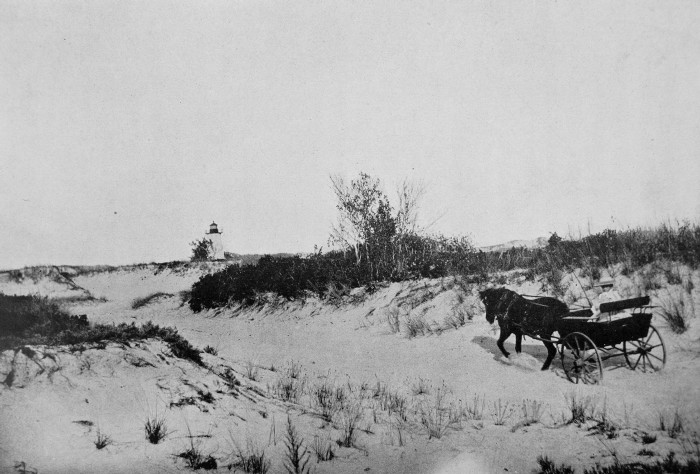 THE ROAD TO THE LIGHTHOUSE At Ipswich
pipits
appear in flocks in the fall, and walk about the sand dunes with
dovelike
motions of the head and neck. They frequently wag their tails up and
down, a
nervous trick which makes their recognition in the field an easy one.
It is
rare that they alight anywhere but on the ground, yet I have
occasionally seen
them on old stumps and fence rails, and a very few times in the
branches of
trees. Swallows
are at
some seasons so abundant in the dunes that they deserve a separate
chapter and
will be considered later. The most
characteristic birds of the sand dunes, however, are the migrants from
the
north that spend the whole or a greater part of the winter. The myrtle
warbler
is one of these and is considered in some detail in the twelfth
chapter. It is
the only warbler that spends the winter so far north, and one has an
opportunity to watch it changing by the spring molt to the brilliant
summer
dress. The process begins as early as the last of March, and the birds
sing
before the molt is finished. As early as April 7th, I have heard a
myrtle
warbler, who was in extensive molt and very shabby, sing a feeble
warbling
song. Such
northern birds
as the two species of crossbills, the pine grosbeak, the redpolls and
the pine
finch, that come here only when the food supply fails them in the
north, or perhaps
when the wanderlust strikes
them, are at times familiar birds in the dune
groves. They are always interesting, and much could be said of their
charming
ways. All are but little afraid of man, for they have come from
northern
wildernesses where he does not disturb them. I believe it was Buffon
who said
that the crossbills were deformed by the severe climate in which they
lived,
but if one has watched them extracting the seeds from a pine cone, he
realizes
what a perfect instrument for that purpose their “deformed” bill is.
They
often hang from the branches and the cones by bill and feet like
parrots, and
their red and green and yellow plumage enhances the illusion. Sometimes
one
breaks off a cone and flies with it in its bill to a convenient perch,
where
it holds the cone with its foot while extracting the seeds. With their
small
and ordinary bills the little pine finches are able to accomplish the
same
thing. A flock of these birds hanging to the cones and branches is a
pretty
sight. The seeds are deftly extracted, the meat is eaten and the dry
wings left
to flutter down to the ground. All of
these
northern birds have distinct and characteristic call notes, whose
recognition
in the field is a great pleasure. As a flock of crossbills passes
overhead in
undulatory flight, a shower of notes, sounding like the skipping of
stones on
the ice, tells us that they are red crossbills, while if the notes have
a
rattling or chinking character, we know that the birds are the
white-winged
species. One is
rarely
treated in Essex County to the spring song of these birds, but they may
be
heard on the northern breeding grounds. Of all their songs nothing
exceeds in
beauty the joyous carolling of the white-winged crossbill in the
height of his
courtship. Perched on the top of a spruce, he begins his lay, but its
vehemence
is such that it generally lifts him up into the air, and as he flies
about
slowly, he pours forth his soul. The song is a wonderful succession of
trills,
now low and deep, now swelling into a loud all-pervading melody which
resembles
that of the canary-bird; now it dies away to a low warbling, and again
bursts
out into a joyous trill which takes the bird exhausted to his perch. The song
of this
bird, as of many others in this country, is worthy of the poet’s pen.
Many
people suppose that our song birds are few and inferior as compared
with those
in England, with whose ways and songs they are familiar from poems and
from
references in literature. A songster, no matter how commonplace, that
has been
praised by Chaucer and Shakespeare and Tennyson, has a prestige that
our
unheralded birds lack, be their voices ever so fine. Some day they will
come
into their own and be as much appreciated as their relatives over the
water. Entirely
different
from these song birds are two species of owls occasionally seen in the
dunes.
One of these, the short-eared owl, a bird widely distributed throughout
the
world, is rare in winter but not uncommon during the migrations. I have
seen it
but seldom, however, during the last half dozen years. Colored like the
sand
and the leafless bushes, it is rarely noticed until it mounts into the
air and
flaps, and sails away. I have
thrice been
so fortunate as to see a snowy owl in the Ipswich dunes. On the first
occasion
I had nearly walked by the bird, as it sat in its characteristic
attitude, bent
at an angle of forty-five degrees, when I discovered that the gray
stump about
seventy yards away was a snowy owl. His eyes were narrow slits more
than twice
as long as broad, but he kept one of them on me, and he occasionally
turned
his head so that one eye relieved the other. After watching him in
return for
fifteen minutes I relaxed my “frozen” posture, and dropping to the
ground,
endeavored to stalk him. Notwithstanding all my care, he took alarm at
once,
and, spreading his great wings and throwing his feathered feet out
behind, he
flew off with broad wing sweeps. Both of
these owls
are well able to see by day in the broad glare of the sun, and are not
birds of
the night alone. Both are great mousers, and as such are of service to
agriculture.
It is recorded that in the year 1580 there was a “sore plague of
strange mice”
in Essex, England, but that owls thronged from all sides and helped to
exterminate the pests. Occasionally these owls vary their diet with a
bird, and
I once started a short-eared owl in the dimes who had been feasting on
a robin.
A snowy owl in my collection smells strongly of skunk. But the odor of
skunk on
one’s clothes does not necessarily mean that one has eaten the animal! One of the
characteristic bird notes heard in the dunes in the fall is the
sibilant
squeaky note of the horned lark. This northern bird takes the place of
the
prairie horned lark which in smaller numbers spends the summers.
Indeed it
begins to come during the last of September before its smaller relative
is
gone, and in November and December flocks of fifty or a hundred are not
uncommon in the dunes. Toward the end of January and in February and
early
March comparatively few are to be found, while in the latter half of
March they
again increase in numbers, but are never so common as in the fall.
Early in
April the last survivors of the winter leave for the north. The horned
lark is
a handsomely marked bird with its black patches below the eyes and on
the
breast, and its yellow throat and eye lines. At times, especially in
the
spring, the long black feathers extending from the forehead above the
eyes
appear to stand out as horns. It is a swift walker and picks at the
seeds of
weeds and grasses from the ground, never alighting on them as do
longspurs, Ipswich
sparrows and snow buntings, its three other companions of the winter.
It
sometimes flies up from the ground, seizing the seeds on the tall grass
or
weed-stalks, at the same time shaking many off on to the ground, which
it picks
up before repeating the process. It is a
persistent
fighter or extremely playful, and is constantly engaged in chasing its
fellows. I have seen two face each other for a moment, with heads down
like
fighting cocks, the next instant twisting and turning in the air, one
in hot
pursuit of the other. In a rough
turf
field horned larks are particularly difficult to see, as they are apt
to squat
in depressions behind stones or sods, and their colors harmonize well
with the
ground. It is probable that they spend the night in these situations,
for in
crossing a field, one dark November night, my dog started up two or
three
horned larks that flew off emitting their characteristic notes. The flight
song of
the horned lark I have heard in Labrador. The bird springs up from the
ground
and mounts silently into the air, rising in irregular circles or almost
vertically until it appears but a little speck in the sky, or perchance
is lost
to sight in the scudding fog. Then it soars and pours forth in great
ecstasy a
song that begins with one or two notes followed by a series of squeaks,
high
notes and fine trills, suggestive at times of distant sleigh bells and
again of
un-oiled gates. The song finished, the bird flaps its wings a few
times, closes
them and then sails again, and again repeats its song. One bird I timed
remained in the air three minutes, during which it repeated its song
thirty-two
times. When the bird has finished singing it silently and very rapidly
plunges
back to earth. The performance is well worth hearing and, although not
highly
musical, is very pleasing and decidedly spectacular. The snow
bunting is
indeed a bird of the snows, and as a flock of these white birds whirl
about in
their fitful manner, now rising, now falling, as if blown by gusts of
wind,
they are very suggestive of a snow flurry. On their arrival in late
October
their bodies are largely “veiled” in chestnut brown, for many of the
feathers
look as if they had been dipped in a brown wash. As the winter season
advances
and spring approaches, the brown tips are more and more frayed and worn
away,
and without any molt the birds become in the spring beautifully black
and white.
The nuptial dress, therefore, is present in the fall but is concealed
beneath
a brown duster. It is thought by some that the brilliant spring dress
of male
birds is due to the exuberant life and passion of the male at that
season, but
in the case of the snow bunting, as well as of the Lapland longspur, to
be
presently described, and of a number of other birds, the nuptial dress
is in
reality produced at the end of the previous summer, when the passions
are at
their lowest ebb. The call notes of the snow bunting are sweet and melodious whistles, interspersed with rippling trills, but changed to rasping tzees when the birds chase each other. Early in April, before they leave us, they indulge at times in low warbling songs, suggestive of those of the purple finch, and when a flock of a hundred or more are singing together the effect is very pleasing. This song is doubtless as inferior to the songs heard on the breeding grounds, as that of the fox sparrow heard here is inferior to the wonderful bursts of melody it pours forth in more northern regions in the presence of its nesting mate. 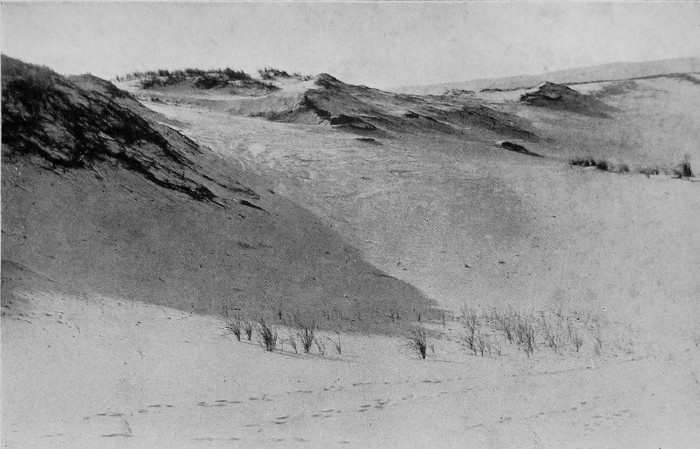 THE DUNES IN SUMMER 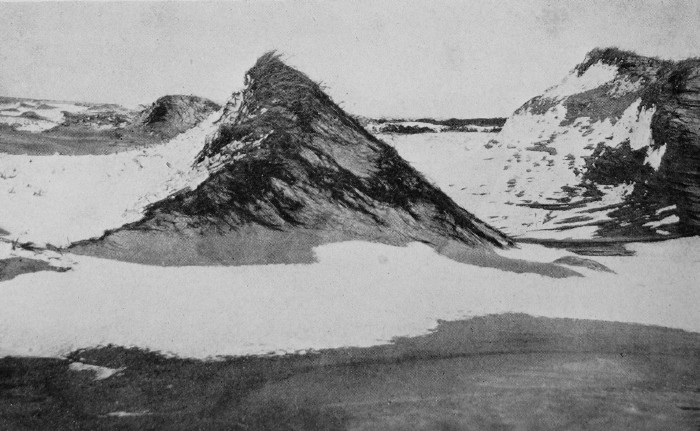 THE DUNES IN WINTER The
Lapland
longspur has long spur-like hind claws, and breeds throughout the
arctic parts
of the northern hemisphere, including Lapland. From these two facts the
bird takes
its name. It is not as common as the snow bunting, but is sometimes
found in
flocks of from twenty-five to fifty. It often associates with both the
snow
bunting and the horned lark, while the Ipswich sparrow is occasionally
added
to the company. The Lapland longspur arrives from the north early in
October
and is common in December and often throughout January. In February,
March and
April it is rare, but more have been seen in these spring months of
late years
than ever before. Although fluctuations of this sort in bird-life
occur, it is
possible that the increase is only apparent, and is due to the growing
number
of acute bird students. Sir John
Richardson
wrote that the Indians on the Dease River, near the Arctic Ocean,
believed that
the Lapland longspur “availed itself of the strength of wing of the
Hutchins
Goose, and nestled among its feathers during its flight. When a goose
is shot,
they often see the small bird flying from it.” And he naïvely adds:
“Neither
Mr. Rae nor I noticed such an occurrence, nor did I obtain a
confirmation of
it from the personal observation of any of the gentlemen resident in
the
country, but it is generally affirmed by the Indians.” In the
fall Lapland
longspurs are inconspicuous and sparrow-like, especially the females
and
young, but in the latter part of the winter and spring the male
acquires a jet
black bib, by the simple process of wearing off the gray veiling tips
of the
feathers. This can be shown by a series of specimens extending from the
fall to
the spring, and it is no more wonderful than the process which any one
may
watch in our city streets — in fact it is exactly similar. The adult
male
English sparrow in the fall has a gray shirt-front with scarcely a
suspicion of
the black bib or shield that forms his chief adornment in the spring.
It is
present, however, but concealed by the veil which gradually wears away
and
reveals his charms. Not only is the black shield revealed in the
English
sparrow by this process of wear, but the black and chestnut markings on
the
back and neck become more distinct, while the white of the sides of the
throat
and abdomen becomes whiter. How few there are who have any idea of
these
changes in the common English sparrow, yet they are constantly going
on before
our eyes! The call
notes of
the longspur are very similar to those of the snow bunting, except
that they
are slightly sibilant, and that a hoarse rattle or chirr replaces the pleasing
trill of the bunting. The last
and most
interesting of this group of winter birds is the Ipswich sparrow, a
bird rarely
found outside of sand dune regions. Breeding on Sable Island off Nova
Scotia,
it spreads along the coast in winter from Nova Scotia to Georgia,
wherever sand
dunes are found. Its relationship to the Savannah sparrow is
interesting and
is discussed in the last chapter of this book. On
December 4,
1868, Mr. C. J. Maynard shot at Ipswich one of these birds. It was at
first
thought by Professor Baird to be the rare Baird’s sparrow, but in 1870,
after
two more specimens had been taken, the fact was discovered that this
was a bird
entirely new to science. Mr. Maynard called it the large barren-ground
sparrow,
but the name Ipswich sparrow has always clung to it, and the former
name has
been forgotten. As soon as the bird had been pointed out by Mr.
Maynard, ornithologists
began to discover it all along the sandy coasts. It is common at
Ipswich during
November and December, very rare during January and February, but not
uncommon
during the latter part of March and the first part of April. My extreme
dates
are October 11th and April 12th. It is
natural that
ornithologists, after discovering the winter haunts, should wish to
know the
breeding home of this bird. The presence in the National Museum at
Washington
of a series of eggs from Sable Island, Nova Scotia, labelled “Savannah
sparrow,” but somewhat larger than the eggs of that bird, strongly
suggested
the possibility that they might belong to the nearly related but larger
Ipswich
sparrow. To settle this point, Dr. Jonathan Dwight, Jr., made an
ornithological
pilgrimage to this island in May, 1894, and discovered the Ipswich
sparrow
breeding there in numbers. Indeed the bird has never been found
breeding
anywhere else, although diligent search has been made. The first
descriptions
of the Ipswich sparrow stated that it was very wild, that it rose at a
considerable distance, flew wildly and far and at once concealed itself
on
alighting, so that collectors were obliged to shoot the bird on the
wing. This
method of pursuit was not very favorable for observation. I must
confess that
my first Ipswich sparrow was found and shot in this mariner, but I very
soon
learned that if treated properly the bird could be studied at close
range. In
fact I have often watched them within a few yards for long periods of
time, and
have therefore been able to note every peculiarity. The beach, where
the view
is unobstructed by grass, is the best place for the study of Ipswich
sparrows.
It is moreover one of their favorite resorts, as they are fond of the
small
flies that abound on the seaweed and thatch thrown up there. Ipswich
sparrows
very rarely hop; they almost invariably walk or run. In walking the
head and
shoulders move back and forth in a charmingly dove-like manner, while
in
running the head is held low and the bird disappears behind a clump of
grass
or a dune in exceedingly quick time. As a catcher of torpid flies in
the
sea-wrack they are fairly expert, and they occasionally jump into the
air
after their game, usually without success, however, as far as I have
observed.
Like many other sparrows they occasionally scratch for food, and they
do it in
such a vigorous manner that they fairly make the litter fly. This
sparrow-scratching is done in a different manner from the scratching of
barn-yard
fowls. The latter scratch with one foot and then the other alternately,
while
sparrows jump forward and scratch with both feet together, as if they
were on
springs. Why they do not fall forward on their heads, I never could
understand.
The call
note of
the Ipswich sparrow is a sharp tsip,
to my ears exactly like that of the
Savannah sparrow. They rarely sing while with us, but Dr. Dwight says
the song
on their breeding grounds is like that of the Savannah sparrow but
“more
polished and tuneful.” I have been so fortunate as to hear the Ipswich
sparrow
sing once on an April day at Ipswich, but unfortunately the song was
rather
imperfect, certainly not a “polished” one. Birds rarely sing their best
away
from their breeding grounds. In
appearance the
Ipswich sparrow resembles its cousin, the Savannah sparrow, but is
larger and
is protectively colored for a sandy habitat. One does not realize how
gray or
sandy-colored it is until one is so fortunate as to come across it in
the
marsh. The contrast with the color of the background then emphasizes
the true
color of the bird so that it seems almost white. |
 Click the book image to turn
to the next Chapter.
Click the book image to turn
to the next Chapter.