
|
Click
Here to return to Mississippi Valley Content Page Return to the Previous Chapter |
 (HOME) |
|
IX
MARK TWAIN’S COUNTRY
MARK TWAIN has been a good deal of a wanderer, but the region that is peculiarly his own and that his memory lingers over most fondly is the land of his boyhood. Again and again he recurs to it in his books, and portrays with rare vividness the old life he then knew. His home was at Hannibal, Missouri, a loafing, out-at-the-elbows, slave-holding river town. As matters were then, the Mississippi was far more interesting than anything else to the inhabitants, and the big steamboats arriving daily out of the mysterious unknown of the North and South never failed at their approach to rouse the town from its usual torpor into alert activity. The world lay whence they came and whither they went; but now they are infrequent, and their work is done by the prosaic railroads. Hannibal has grown a good deal in the last fifty years, but here and there the old lingers amidst the new, and surrounding nature in its wild hills and glens is essentially unchanged. Great ragged bluffs rise successively along the river front, and the loftiest height of all, with an altitude of three hundred feet, almost overhangs the heart of the town. This is one of the “Lover’s Leaps” you find all along the river; for wherever a particularly bold cliff rises above the stream it has been given the title mentioned and a vague legend has grown that long ago some lovesick Indian jumped off the height to his death. At any rate these bluffs are quite appropriate for such a performance. About Hannibal they slope away from the stream in green, tree-dotted pastures, for the most part. On the hills inland are scattered farmhouses and many orchards, patches of forest, fields of grass, corn, and small fruits. There are clear streams in all the hollows, and so much variety everywhere in the landscape that the region seems a boyhood paradise, unfailingly stimulating to the youthful imagination and full of possibilities. The house the humorist lived in still stands and is much the same as it always was — a stumpy, two-story, clapboarded dwelling close to the sidewalk. It is just off the main street snugged in among other similar buildings. The senior Clemens had a printing shop upstairs in the L of the house, and as there were several children the living rooms must have been pretty well crowded. “All the family was the nicest people you ever saw,” I was told; “but they were very poor and the father died bankrupt when Mark was twelve years old.” On the next street lived “Huckleberry Finn,” whose real name was Tom Blankenshipp. In the books this lad turns out to be quite an admirable character, but in actual life he and all his relatives were a very rough lot, and when he left town it was to go to the penitentiary. The author’s descriptions of Huckleberry’s father fit the person who was “the town drunkard — old man Finn.” His end could hardly have been more tragic even in fiction. He was locked up one night in the calaboose, and in lighting a match to have a smoke set fire to the building and was burned to death. The Huckleberry Finn house was always rude, but it has not yet succumbed to either age or chance, and its ruinous, unkempt antiquity is quite worthy of its associations. Two or three negro families now live in it, and I made the acquaintance of one of the women inmates who was sitting out in front lunching on bread and a dish of greens. Once in a while she gave a bit of the bread to her little dog that hovered about expectantly. “I’d be eatin’ indoors,” she remarked to me, “but it kind er wet in dar sence dis yere big rain yisterday.” There were holes in the roof, and I asked if the water came down through from the upper story. “Oh, no, honey,” she responded. “It flowed right in de door. I live at de bottom er de house three steps lower dan de sidewalk, an’ de water have an easy chance to git in; but it mos’ dried away now.” “This is the Huckleberry Finn house, isn’t it?” I inquired. 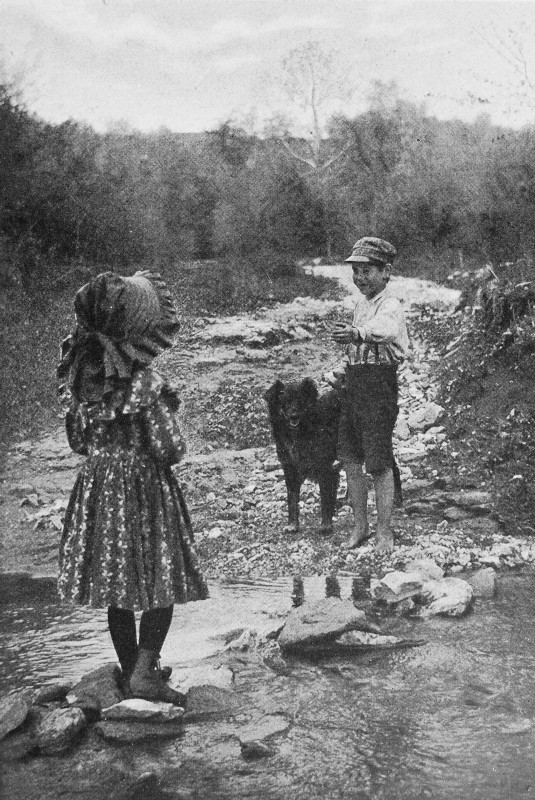 The Stepping-stones at the Ford “It sholy is,” was the reply, “an’ las’ year Huckleberry Finn and Mark Twain both was hyar to see it. Dey come togedder in a two-horse coach, an’ dey each one give me a quarter.” “Yo’ doan’ know nothin’ what yo’ talkin’ about,” said an irritated male voice from inside the lower room. “Huckleberry Finn is daid long ago.” “No, he ain’t,” was the woman’s reply. “He was hyar las’ year an’ give me a quarter. He was a little dried up ole man and he had whiskers an’ look some like Santa Claus. You seen Santa Claus picture, ain’t you, mister? Mark Twain is a heap bigger’n Huckleberry Finn.” “He’s daid, I tell yo’!” said the voice indoors in gruff anger. From a window upstairs a dishevelled young colored woman was looking down. The window-glass was mostly gone, and she had her head thrust through a hole left by a missing pane and one arm through a similar opening just below, so that she could rest her chin on her hand; and she made a very grotesque sort of a tableau. The woman below referred the matter in dispute to this looker-on, who said it was Huckleberry Finn that called with Mark Twain, and no mistake. Her response maddened the man inside past endurance, and he began swearing and stamping about and finally slammed the door. The woman with the lunch rolled up her eyes deprecatingly. “My man git plumb crazy over his own mistakes,” she declared. “ He doan’ know he wrong when I tell him so, an’ when all de neighbors tell him so, too. God has sent a judgment on me for marryin’ dat man. I gwine go away to St. Louis an’ jine a show if it ain’t nothin’ but de hoochy-koochy!” The part of the town I was in lay at the foot of a steep and lofty hill with little homes clinging to it, and here and there stairways and zigzag paths. Farther north were other hills and among these the boys used sometimes to dig for treasure, and here, according to the Tom Sawyer book, was a haunted house. Even now there is a “Ghost Holler.” I was told about it by a woman who lived near by. “It’s a very lonely place,” said she. “It’s shady and awful deep, with high rocks on both sides, and it’s always damp, and the ferns grow there. It looks ghostly — it really does; and some people say they see things. I know the children have been in there and heard strange sounds and come running home they were so afraid. Folks claim some one was murdered in that holler a long time ago.” The woman was standing at her garden gate, and I had interrupted her in the midst of a chat with another woman, her nearest neighbor. “Speakin’ of Ghost Holler,” said the latter, “reminds me of when Will and I was first married. Don’t you remember, Marne, the old house in the west part of the town we moved into? People told that the house was haunted by a woman who had died there, and my Aunt Isabel, when she found I was goin’ to live in the house, she give me a talkin’ to. She said, ‘Don’t you do it. You’ll never have no peace. That woman comes back nights and she takes the tin pans and the dishes and makes such a rattlin’ no one can’t sleep.’ “I got so nervous over what she said I told Will I wouldn’t go there. But he laughed at me, and he said Aunt Isabel was superstitious or she wouldn’t ‘a’ repeated such nonsense; and he said once when he was a boy and was out in the dark he see a big black thing in the woods that seemed like some terrible monster, and he thought to himself, ‘Maybe it is, and maybe it ain’t. If it is, I’m a goner anyhow whether I run or not, and so I’ll just find out.’ Then he went right to it, and it was nothin’ but a half-burnt stump. Ever since that time, when he sees anything strange in the dark he jus’ goes straight to it, and he says he wants his children to do the same. He does hate raisin’ children up cowards. Well, we went to the house he’d rented, and my pans and things stayed quiet on the shelves same as they would in any house.” The hill where the boys used to dig for treasure with most enthusiasm, expecting to find “a brass pot with a hundred dollars in it, or a rotten chest full of di’monds,” was two miles north of the town up the “river road” that creeps along the verge of the stream. According to tradition, the old Spanish explorers buried vast riches there. Adults as well as youngsters have delved after the fabled treasure, and the search has not even yet been abandoned; but if the scrubby pasture height holds any golden hoard in its stony soil it has thus far kept the secret well. Another attraction that the hill has is an Indian mound. This is on the loftiest crest of the bluff, an impressive spot commanding an immense sweep of river and valley. The mound is eight or ten feet high and has a base some twenty feet across. These mounds are common on the uplands, but they have all been dug into and pillaged by the whites. The most notable of the Tom Sawyer adventures occurred in a cave three miles beyond the town in the other direction. The cave entrance is in a low valley to which a long winding road descends from the main highway on the hills. This road has been abandoned, and I found it gullied by rains and growing up to bushes, and the bridges across the brooks had rotted out and fallen in. But I contrived to get along until a big black storm came swooping across the sky. Luckily I was now near the bottom of the valley, and I soon came out of the woods into a clearing and saw a house not far away. Great drops of rain were beginning to pelt down out of the gloomy sky, and I ran. I did not escape altogether; but the worst of the storm came afterward and was mingled with a dash of hail. 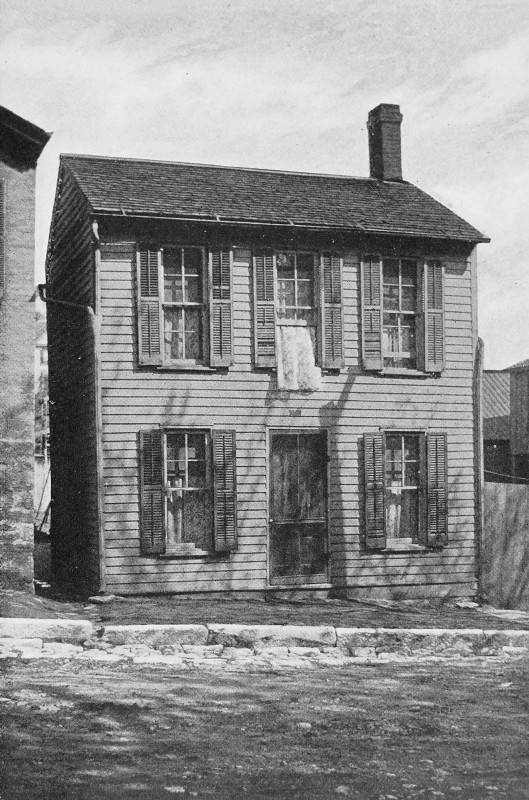 Mark Twain’s Boyhood Home The house was empty when I entered it. However, a few moments later a woman hurried in with five children. She said: “They been playing down to the creek. I can’t keep ‘em away from there, talk all I will. Do you see that there blanket out on the line? I’ve washed it three times to-day, and every time the line has broken and let the blanket down in the dirt. Now, it was jis’ gettin’ tolerable dry, and see how the rain is soakin’ it. I never was so discouraged in my life. We moved here a month ago, and we ain’t had nothin’ but rain since. We’ve put in our garden, but seems like the seeds was all goin’ to rot on us before they can come up. I don’t know what’s got into our climate, it’s so different from what it was when I was a girl.” The children for a time looked at me while their mother talked, and then glanced around to find other amusement. Presently the mother exclaimed sharply, “Come away from that cat, Harry!” and turning again to me remarked, “I ain’t much stuck on livin’ in the country.” The boy had not been quelled, and the cat was making audible protests at his treatment. “Harry,” said his mother with more energy than before, “leave that cat alone”; and she continued half to herself and half to me, “What does make a young one keep on a-doin’ a thing thataway after you’ve tol’ him to quit?” Two of the children stepped to the door and held their hands out to the rain. The mother called them back and then observed: “I don’t want ‘em wet because they got the whoopin’-cough and might be made sick. They ain’t havin’ it powerful bad though. They don’t whoop. They jis’ cough hard an’ gag an’ throw up; but throwin’ up is a good sign, you know.” She gazed out of the window. “There’s too many hills here,” said she. “It’s all so up and down that it’s discouragin’ to look at it. I don’t see why any one should want to live in Missouri. I reckon Illinois is better; but law! I might not think so if I was there. “Until late years my husband always lived in the town. Me ‘n’ him was raised on the same street; and when I was young folks I used to say I wouldn’t marry a countryman, no matter how rich he was. One of our best friends is a man that is a farmer and always has been. We was still livin’ in town when we got acquainted with him, which was jis’ after we was married; and he said if he’d seen me sooner he’d ‘a’ married me instead of his own wife. I turned up my nose at that because I wouldn’t have looked at any one but a city man for a husband then; and yet I might as well have taken a countryman that knowed something as a city man that didn’t know anything. A countryman understands how to do everything about crops and buildings and tools; but a city man when he’s put out on a farm is mighty unhandy. Oh, it’s so dead here from what I’m used to!” Now the storm was past and the sun was shining forth on the wet earth and the dripping trees, and I resumed my walk. The woman told me the cave was “sort o’ on the bum,” and I found the evidences of its being a run-down pleasure resort quite apparent. Near the entrance were a few shabby buildings including a pavilion. The passage into the earth had been roughly enlarged, and a slatted door, whacked together by some tinkerer, had been put up. I joined a party that was just going in with a guide who distributed candles and then led the way. The cavern honeycombs the earth with several miles of devious and tangled passages, and it was among these passages that Tom Sawyer and Becky Thatcher were lost on that Saturday of the picnic, and they did not get out until Tuesday afternoon. The walls of the cave are a monotonous gray, and the channels never have width or height enough to be impressive; but the age of it all, the silence and the gloom, are not easily forgotten. Mostly, the interior is quite dry, but in certain spots the water drips through, and in one of the little side channels is a crystal-clear pool at which every visitor stops for a drink. Except for the smudgy and odorous candles the air is perfectly pure. There are other caves in the hills, and a resident of the vicinity mentioned to me that, “Some of ‘em have got satelites in ‘em”; but only the Mark Twain cave has been made accessible to the public. Our guide had read Mark Twain’s works and was quite capable of discussing them. “They’re entertaining,” he said; “but they’re mostly fictition. Mark was here last year. I was expecting to see a great tall man, and yet he’s no larger’n you or me, and just an ordinary man to look at. He’s got a big reputation, though — probably because he’s kind of an oddity — something on the ancient order I might say. He has a rambling disposition, and I expect it’s his nature to be uneasy and to think some other place would suit him better’n the one he’s in — same like a tramp. He’s livin’ in Italy just at present and writin’ the history of the world so far as he knows it.” The author’s birthplace was Florida, a little town up Salt River, twenty or thirty miles away. I decided to see it, but the railroad does not go nearer than a half-dozen miles and I walked the rest of the distance. It was a pretty savage sort of a highway that I travelled — a chaos of ruts and ridges, mud and pools. It looked as if it had been ploughed by Satan and his imps to plague mankind. The low spots were a wild mixture of sticks and stones and liquid clay, and how a team could get along and keep right-side up was a mystery. In places I was puzzled what to do myself, and once or twice I climbed along on the fence. I grew tired of the monotony of the rolling landscape. There was a constant succession of houses and fenced fields and grazing herds; but the houses were far apart, and the fields very large, and the roads distressingly straight. I struggled on until I came to Salt River, and there beside the swift, muddy current I made the acquaintance of two old ladies sitting on a log fishing in great quiet and contentment. They had thus far caught only one fish; but they had the enticement of hope to cheer them; and apparently the companionship of each other and the stream and the fresh leafage of spring putting forth on the banks and the songs of the birds were happiness enough, fish or no fish. 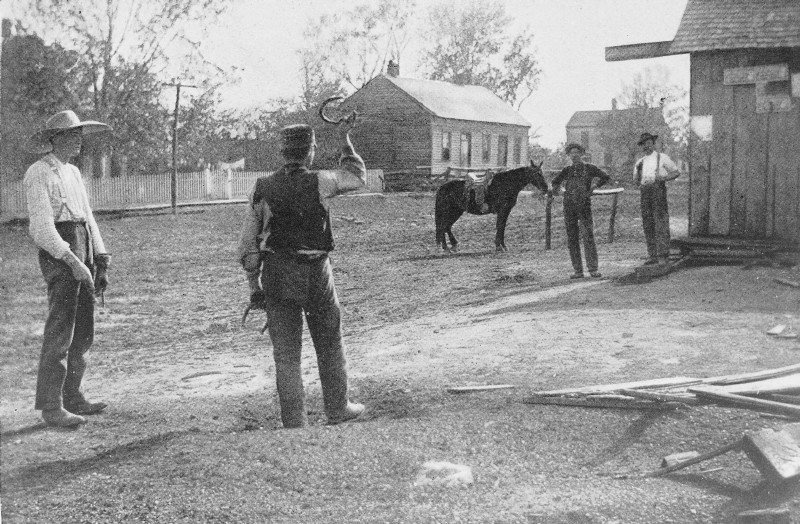 A Game of Quoits On the crest of the hill beyond was the village, a primitive hamlet well away from the busy world, and seldom stirred from its placidity. Its visible life, as I saw it, consisted largely of loiterers around the store porches and numerous wandering pigs on the streets. These pigs had no qualms about lying down to sleep in the middle of the highways, and their miry rooting-places were everywhere. The majority of them belonged to the proprietor of the village drugstore, and it was his habit to feed them directly in front of his place of business. I found lodging at an old-fashioned farmhouse. The floors were covered with rag carpets, some of which were quite new and calculated to put a rainbow to shame with the variegated brightness of their stripes. Rag carpets are the standard kind throughout the Missouri country among sensible people of moderate means. In a back shed of one of the Florida dwellings was a carpet in process of weaving, and before I left town I went in and watched the work. The woman weaver said she earned twelve or fifteen dollars each spring and fall. She charged ten cents a yard and had to work very persistently to do five yards in a day. “It’s hard on your clothes doing this weaving,” she added, “and I wear out enough in a season to make a rag carpet for myself out of ‘em.” It was very pleasant that first evening at the old farmhouse after the day’s tramping to sit on the back porch and rest. The robins carolled in the trees, the swallows soared and twittered, the Bob Whites called in the distant fields, and the odor of apple blossoms filled the air with gentle perfume. My landlord and his wife were old like the house they lived in, and their recollections went back to pioneer times. After supper I had their company on the porch, and also that of a few mosquitoes. “We don’t have the mosquitoes the way we used to have ‘em when this country was first settled,” my landlord remarked; “but you’d find plenty yet down in the bottom lands. There ain’t much water up hyar on the hill for ‘em to hatch in.” “No,” said his wife, “though there’s a right smart of ‘em come from our water barrels, and I’ve always heard they’re a heap mo’ friendly raised thataway. “When I was a little girl,” she continued, “hit was all woods around hyar for four or five miles north and south of the river — oak and wa’nut, cottonwood, ellum — everything. We didn’t have any wire fences then. They was all of split rails. Our first-class timber is pretty much gone now. We got plenty of wood to keep our houses warm, but we don’t cut down any good trees and burn ‘em on the ground to get ‘em out of the way, as we did once. Wood’s worth something. Why, we took up a rail fence last winter was a year ago, and sold hit for firewood and got enough to buy a wire fence to take hits place.” “I’ve got that fence around my cornland down by the river,” said the man. “The river put a terrible sediment on the bottoms this year — more than I’ve seen in any fresh for a long time, and we’ll have a powerful crop. Most of our land ain’t very good until you get out on the prairies beyond this strip that used to be wooded; but the first settlers didn’t take that up because hit was all covered with great coarse grass, and there was what they called the greenhead fly on the prairies that you couldn’t get along with nohow. Them flies would light on your horses like a swarm of bees and bite and suck blood so your horses would be unmanageable and you’d have to race ‘em for timber land along the nearest crick. When the settlers began to cultivate the prairie they had to plough nights to git shet of them flies. The flies was raised in slues and stagnated water, I reckon, and after the grass was cut and the land opened up to the sun the way hit was when the settlers begun to come pretty thick, the hatching places was dried up or was drained away and the flies jis’ naturally disappeared.” I mentioned seeing an old ruin of some sort on the river bank. “That was a water mill,” explained the man. “Back in 1840 we had two hyar, and the farmers would drive from twenty-five miles around to get their grain ground. They’d put on all the wheat they could draw with four horses and come twice a year. Often, there’d be wagons waiting ahead of ‘em and they’d stay two or three days befo’ hit was their turn. While they waited they’d camp out. I’ve seen ‘em camped around the mills most as thick as the campers that used to come to our picnics.” “What picnics were those?” I asked. “Until late years we been having a picnic in August every year,” said my landlady. “All the people in the village and round about helped to organize hit, and we’d select a place in the bottom by the stream and set up some posts eight or ten feet high and put crosspieces on the tops and lay on bresh so as to make an arbor about fifty feet square. Thousands of people would come, and some of ‘em would be from forty miles away and would start the day before. These distant ones would get along that afternoon or evening with their buggies and surreys and wagons, and then they’d camp. Everybody brought food, and on the picnic day hit was all turned over to a man in charge, who’d make one big spread of hit and invite the people to come up and help themselves.” 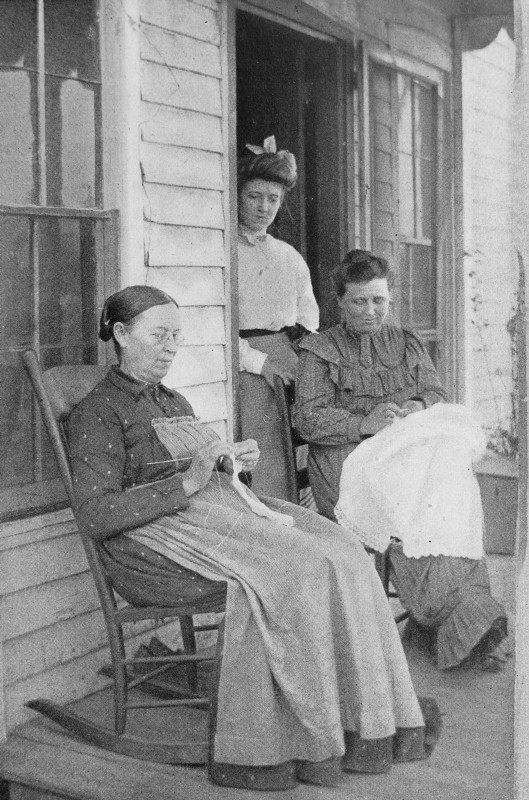 Afternoon Comfort “And there was plenty of grub for the whole crowd,” added the man. “They wouldn’t eat nearly all of hit. We had speeches and songs, and in the arbor there was fiddling and dancing till late in the night. Around the sides of the arbor we fixed planks on blocks so the ladies could sit down, and if we’d got the arbor high enough so the bresh didn’t tech a feller’s hat we was all right. Ah, the picnic was a great thing; but she’s run down now.” “This town has changed a good deal since I can remember,” remarked the woman. “Befo’ the war,” commented the man, “we had niggers here as thick as blackbirds; but now thar are mighty few left. We were all Democrats then, and if a New England man that was a Republican come here and stuck to his principles he might as well ‘a’ been a cat in hell without claws.” “I shall never forget the war,” observed my landlady. “We had quite a little fight right hyar in the village. Some Federal soldiers was chased by a party of Confederates, and they all come gallopin’ into the village jis’ at daylight, and the Federals got into the schoolhouse. The guns begun poppin’ and we was all scared most to death. I and my folks was in our summer kitchen, and my mother tol’ me to keep away from the window or I’d get shot; but I wanted to see and I looked out. Two Confederates was killed and I saw one fall from his horse. The soldiers was always raidin’ through hyar, one side or the other, and my mother she didn’t want her silver spoons stolen; so she wrapped ‘em up in a towel and dropped ‘em into a barrel of feathers. But some of the Federals come pokin’ around one day and they found ‘em, and they laughed and handed ‘em to her and tol’ her to keep ‘em where they belonged.” “We were all secesh,” explained the man, “and helped off our bushwhackers as much as we could. That made the Federals mad. I know once, when they’d been on a chase that didn’t succeed, the Federal. commander rode our streets east, west, north, and south, and shouted he’d jis’ devastate this country for ten miles around if we didn’t quit givin’ the enemy information.” “One man they wanted to get was ole man Hickman,” my landlady continued. “He was a terrible Southern man and a spy. The Federals surrounded the town once and ‘most got him. They come within six feet of where he was hiding in a little hollow among some bushes.” “I bet his breath was short then,” interrupted my landlord. “He said he didn’t breathe at all,” responded the woman. “But, come night, he crept away gruntin’ to imitate a hog so they wouldn’t be suspicious if they heard him movin’.” “People was mighty mean in time of the war,” mused the man — “though they’re mean enough any time, as fur as that is concerned. They thought nothin’ of droppin’ in on you with ten or fifteen horses to feed and not payin’ a cent; and they was always on the watch to find out whether you was helpin’ the other side. I tell you it made a fellow’s eyes bug out to have one of their shinin’ guns poked in the window at you unawares. The twilight was deepening into gloom and the air was growing chilly. Overhead the swallows were taking their last flights. I stepped out into the yard to look at them. There they were, hundreds of them, flying all in unison in a vast circle with wonderful swiftness. At one point this winged ring was directly above the cavernous chimney, which thrust up from the heart of the house, and the birds, after making many feints as if they would dart into the orifice, at last began in earnest to disappear within it, each dropping with such suddenness as almost to deceive the eyes. The circling continued, but with lessening numbers, till the last feathered meteor was gone. The chimney adjoined my chamber, and that night, whenever I awoke, I heard from inside it a light rumble of wings and intermittent twitterings. Morning came. A brisk breeze blew, and my landlord said, as he sat down to breakfast: “Well, I do despise this wind. Hit kind o’ makes me uneasy. But they say we don’t have any such broadcast blowing as they do out in Kansas. Two fellers from there was hyar one day and the wind was blowing so I couldn’t hardly keep my hat on my head, and I was speakin’ of hit, and they said, ‘If this don’t suit you, don’t never go west. We’d call this a very ca’m day. Why,’ they said, ‘where we come from, if you put your hat on the windward side of the house, the wind will blow so hard and steady hit’ll stay there all day.’” “I can get along with most any wind but a cyclone,” said his wife; “and I feel thankful we got a cyclone cellar handy to the back door. I’m always on the watch when we have a day that’s extry warm and still.” “Hit’s a bad sign, such a day, if you see a black cloud raisin’ in the west,” said the man. “Last year a cyclone passed within sight of us. We watched hit and kept all ready to go into our cellar until hit got too far over to do any devilment hyar. Hit was only a mild away, and how hit rattled — my, what a fuss thar was! Forty old wagons on a rough road wouldn’t begin to make as much noise. Thar was a funnel an’ what seemed to be smoke bilin’ up like from a locomotive. My sakes! I never saw so black a smudge, and down low was a queer, yellow glimmer. Hit made a track about one hundred yards wide and hit taken everything before it. Trees a little decayed hit would twist off leavin’ only a stump, and trees that was sound hit would jerk right up by the roots, no matter how big they was. Hit cleared everything right off down to the ground, and I been tol’ hit struck some hens and took their feathers off jis’ as clean as you could ‘a’ picked ‘em off yourself. I heared tell, too, about a farmer who had a lot of corn stored in a bin. At one side of the bin was a knot-hole, and the cyclone caught that corn and drove the cobs all through the knot-hole. That scraped off the kernels and left ‘em in a nice heap inside the bin. One place thar was a man settin’ in his house, and the wind tuck that house right up and busted it plumb to pieces, but left the floor and the man settin’ thar in his chair.” 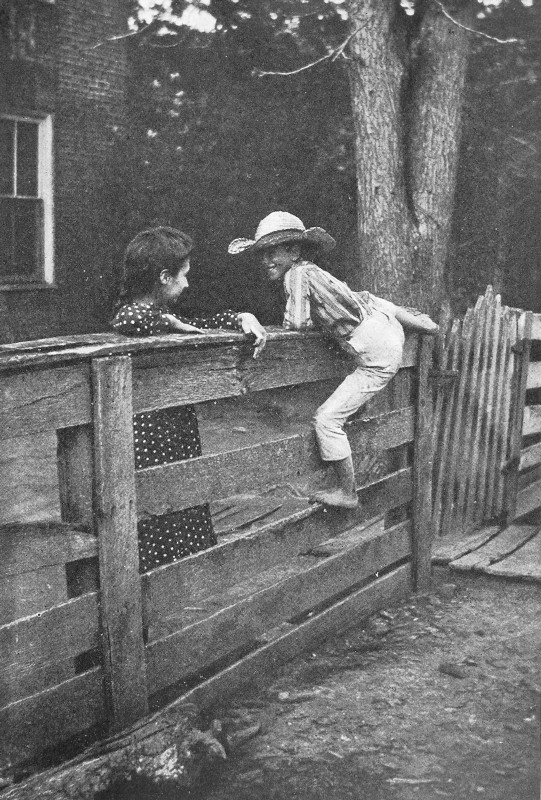 Visiting All this was quite interesting; but what interested me most during my stay in Florida was to meet an old lady eighty-three years of age, who remembered distinctly when the Clemens family were residents of the place. The father was for a time a merchant here and built a log house to live in. While this log dwelling was being erected, the family occupied a little two-room frame house, and in the kitchen of that house Mark Twain was born, November 30, 1835. The house still stands, though now vacant and rather ruinous. The family moved to the log dwelling when the baby was three or four weeks old. That survived until recently, but during its later years no one lived in it and people got in the habit of taking away bits of it as Mark Twain relics. “Why, they tore the house pretty near to pieces!” said the old lady. “They’d carry off brickbats from the chimney and pieces of glass from the windows and splinters of wood from the doors and other parts, until they’d got about everything but the logs. “Mr. Clemens took his family to Hannibal when Mark Twain was still a very little boy, and since the boy has growed up he ain’t been here more’n once or twice. He’s famous — and yet I couldn’t see that he was different from most folks, except he had long hair and wa’n’t very neat. I’ve read his travels some. They’re light and trashy; but they’re jovial, and I suppose that’s what people like about ‘em.” When I returned to Hannibal I met other old-time acquaintances of the humorist. According to two ancients whom I interrupted in an endless series of checker games at the back of a store, Mark Twain is “the most overrated man in America. There’s about as much truth in those sayings in his books,” I was informed, “as there is in a ten-cent novel. His brother Orion who was a printer knew more in a minute than Sam ever did know; and yet Orion never made no reputation. As a boy, Sam was just like other boys, except he might have been a little slower. He was considered blamed dull, to tell you the truth. It was his peculiar drawl and accent that made him famous, I’ll be dogged if it wa’n’t.” But another man, one of the author’s old schoolmates, discoursed thus: “He was a mighty still sort of a boy. He was distant, and had as a rule rather be by himself than with the rest of the boys. Most of us used to like to get in a skift after school and go off fishin’. We’d have our poles and boxes o’ worms all ready under the schoolhouse and we’d grab ‘em out soon as school was done and go off across the river to the slues and ponds and stay till dark drove us home. But I never ricolect of Sam a-goin’ fishin’ with us or a-huntin’ with us, though he liked to go down to the cave. “He was a good talker and had the same slow way o’ speakin’ he’s got now. If he was to come along this minute and say, ‘Charlie, let’s me ‘n’ you go down to the cave,’ I’d know him just by the tone of his voice. “Whatever he told about, he’d talk so to make sport. He’d tell things in a different way from what the rest of us could, and it sounded funny. He used to tell us tales and we loved to listen at him. His father had a book — ‘The Arabian Nights’ — that no one else had in town, and Sam would get us boys together of evenings and tell us stories from that book, and we was glad to listen as long as he’d talk. “In the spring of ‘58 he went on the river to learn piloting, because then the steamboats was more interestin’ than anything else, and you found people from all parts of the world travellin’ on ‘em. It ain’t thataway now. Our river up here is played out.” The river carried Mark Twain away to new scenes, and he has seldom returned; yet the half-rustic life of the town of his boyhood, and the rugged hills and vales around, no doubt contributed much in developing and furnishing inspiration for his peculiar genius. NOTE. — Any one who likes Mark Twain’s books will find Hannibal and the region around keenly interesting. With its varied hills and dales, caves and rude cliffs, the district is worth exploring on its own account, but when you have added to that the sentiment imparted by the famous books which have made it a background for many of their incidents the attraction is superlative. The town of Florida, which I also describe, is not very accessible, and has not even a poor hotel, but if you nevertheless make the visit you will carry away many entertaining memories. 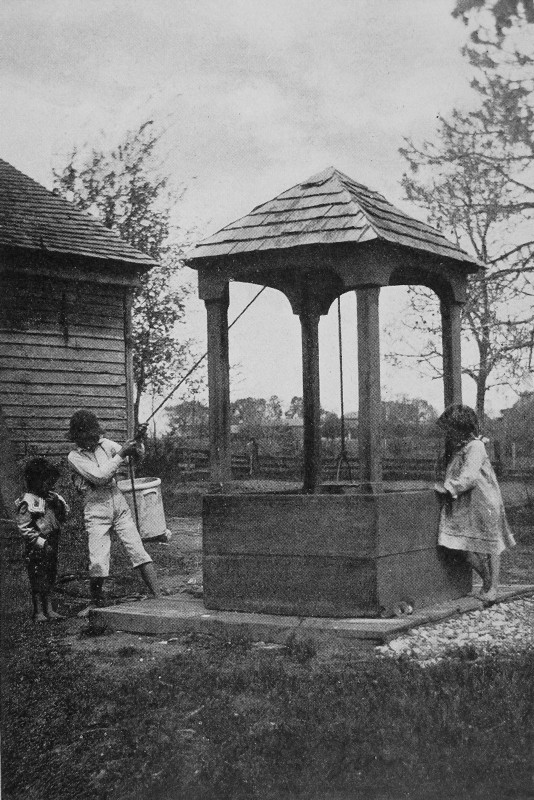 The Prophet’s Well |
 Click the book image to turn
to the next Chapter.
Click the book image to turn
to the next Chapter.