 Web
and Book design,
Web
and Book design, Copyright, Kellscraft Studio 1999-2006 (Return to Web Text-ures) |
Click
Here to return to Mississippi Valley Content Page Return to the Previous Chapter |
 (HOME) |
|
II
MOSQUITOES AND ALLIGATORS IN the delta country of the lower Mississippi, swamplands are everywhere predominant, and the watersoaked marshes alternate endlessly with ponds, lakes, and sluggish streams. It is a region not easily brought under subjection by man, and though the sawmills and the fires sweep off the forests, the country they leave behind is almost as lonely and lacking in human inhabitants as before. There the creatures of the wilderness make their homes, and one would have to go far to find any district that presents so many advantages for their safety. Yet they are not left in peace, for no difficulties can wholly daunt the hunters and the native trappers. To get a first-hand view of conditions in the swamp country, I made several visits to a little place a few miles out of New Orleans. My acquaintance with it began on a Sunday. There is always an exodus from the city on pleasant Sabbaths, and the train on which I went was crowded. Everybody seemed to be starting on a picnic — old and young, singly, in friendly groups, and in family parties — and they were all well laden with baskets and boxes of food, and with guns or nets and fishpoles. Many got off at each station, and when I, too, left the train, it was with the usual crowd. The hunters and the fishermen lost no time in dispersing to their favorite haunts and I was left alone. 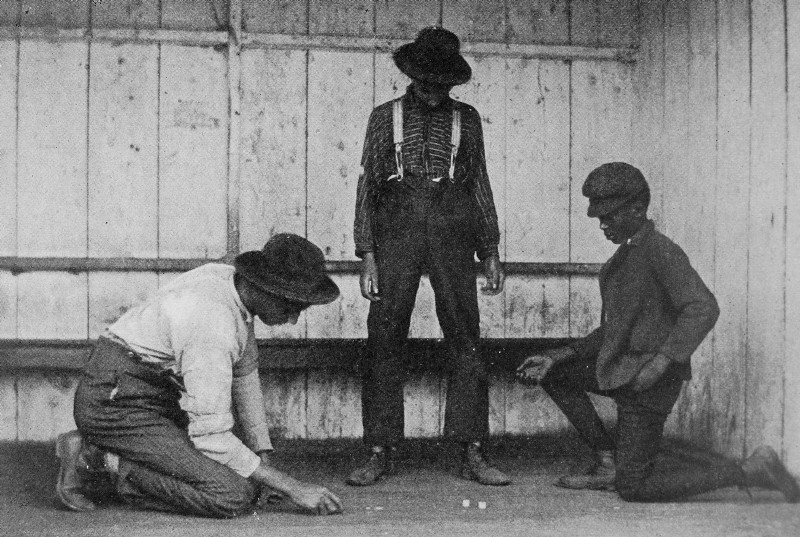 “Shooting Craps” Four or five cabin homes and meagre garden patches were within sight, and the rest was ragged forest and reedy marshes. It was all so forlorn that I wished myself back in the city, but there was no train till toward night. I sat down in the rude little shed that served for a station to consider, and a few score of mosquitoes promptly began to investigate me and take some sample bites. Pretty soon two young white fellows and a colored boy came loafing along to the station and started a game of “craps.” One of the whites played against the colored boy, and the third fellow looked on. The players knelt on the platform opposite each other, and the game continued until the unlucky colored boy had lost all his money, five or ten cents at a bet. The game was played with two dice, which each player would in turn shake in his hand and then give a little throw along the planking. Every throw was accompanied by a half-articulate exclamation and a snap of the fingers. The thrower lost or won according to the number of dots that turned up on the dice. All around the station grew weeds, grass, and low shrubs, except for an acre or so that had been cleared and was used for stacking moss. This moss draped the forest everywhere with its gray, pendent masses, and the gathering of it was the principal industry in this particular region. When prepared for market it makes a very good substitute for horsehair to put in mattresses and in sofas and other upholstering. Sometimes the gatherers go in a boat and pull the moss from the trees beside the waterways. Others pick it off fallen trees or from the ground, where it has been strewn by the winds. However, the commonest method is to resort to the forest, put on climbing spurs, and go up in the trees to gather it. Two hundred pounds is a fair yield for a tree, but some of the big oaks have half a ton or more on them. A good worker will easily secure five hundred pounds in a day, for which he will be paid two dollars. The main substance of the moss is like a coarse leathery thread, but this is encumbered with a fuzzy outer covering and numerous narrow leaflets which must be gotten rid of, and the stems are full of sap. Those who gather moss in a small way soak it in some swamp hole to remove the leaves and cuticle and then hang it on a fence to dry. But in the clearing adjoining the station it was heaped in great square flat piles fully fifteen feet across and three feet high. The piles were kept thoroughly wet down for about a month, and afterward the moss was dried on some wire fencing erected for the purpose. Lastly it was baled and shipped. These details were imparted to me by a tall lean-visaged man named Dakin. I had gone from the station to look at the moss piles and found Dakin sitting on the edge of one of the heaps smoking his pipe. He was the chief citizen of the region — the agent of a vast estate covering twelve square miles which was owned by some one over in France. Formerly a part of the estate had been cultivated as a sugar plantation, and this was populous with slaves and quite thriving, but since the war no crops had been raised and the old fields have degenerated into their original wild jungle and morass. There are hardly a score of families on the whole tract now, and it only returns about enough income to pay the taxes. The rental for each of the families who live on it is twenty-five dollars a year. That sum gives a cabin home, a garden patch, and the privilege of free firewood, and of fishing, trapping, picking moss, etc. If a household comes to the estate and builds its own cabin no rent is charged for the first year. The value of the house is thus appraised at twenty-five dollars. Really, the frail little shanties that serve for dwellings are worth no more, and the home of the agent of the estate was not much better than the others. It was not far away, across a marsh-bordered bayou, which was spanned by a long causeway of oak slabs and discarded railroad ties. Dakin invited me to go to the house with him. To get there was rather a delicate matter, for parts of the causeway were missing and other parts dislocated, as the result of a flood two years before. My companion had some thoughts of repairing it; but he said it served well enough to cross on foot, and he seldom needed to use it for animals or vehicles. When he did there was another bridge three miles distant that served instead. The bayou was rather impressive from the middle of the bridge. It was an almost stagnant waterway, with many giant, half-dead trees on its shores reaching aloft their gaunt, moss-draped limbs. Along its margin were frequent fallen trunks, and a green scum covered much of the surface. The water itself was dark and full of tadpoles. I could hear a bullfrog’s deep, resonant voice at intervals from near by. I could see mud-turtles sunning on the snags that rose above the level of the water, and in spots there were water-lilies — angels of the swamp — chaste and beautiful amid their sinister and noisome surroundings. Dakin’s house stood on slightly rising ground. It was an unshaded, irregular, one-story structure made of a single thickness of unplaned boards. Cracks were numerous and none of the three rooms had ceilings. The furniture was of the harum-scarum order and not abundant at that. The hens walked familiarly in and out, and several hounds and bird dogs were loafing around. 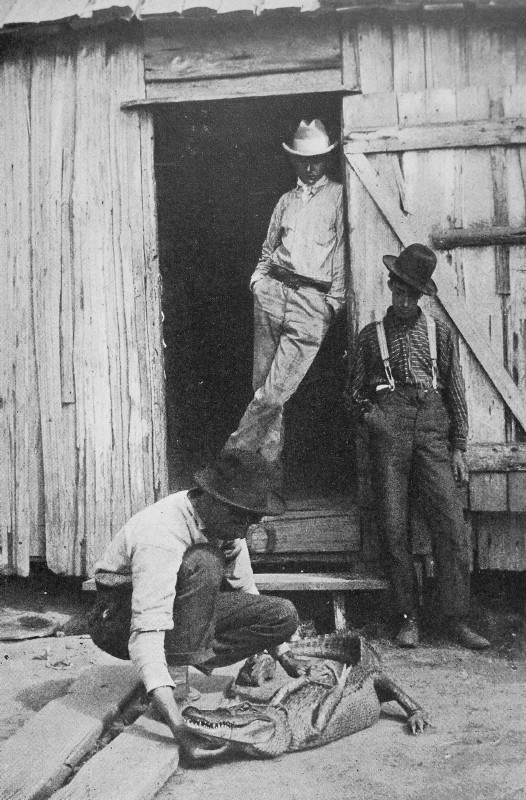 The Captive “You have cats, too?” I suggested. “Yes,” replied Mr. Dakin, “sometimes we have a dozen, and again not any. Depends on what kind of a humor I get in. They ain’t much good for contendin’ with such rats as we have hyar. Why, some of our rats are as big as raccoons and’ll weigh ten pounds. We’ve got rats right in this house that have been hyar seven years. They make more noise nights movin’ aroun’ than a man. I bought a steel trap once and tried to ketch ‘em; but I never got only one. After that they knew too much.” We had sat down on the piazza, or “gallery,” as it is called in the lower Mississippi valley. I had to adjust myself with care, partly because my chair was rickety, partly because the floor boards were loose and much worn and broken. Moreover, one of the little girls of the family approached every little while to have a silent look at me, and she would step on the warped-up ends of the boards that ran under my chair and joggle me in a way that was quite discomposing. “I been a-threatening to build over this hyar floor,” remarked Mr. Dakin; “but it skeers me the price they done been puttin’ on lumber. If lumber keeps gettin’ mo’ expensive the nex’ ten years the way it been a-doin’ the las’ ten, a poor man like me won’t be able to buy no boards, even to save himself from bein’ hung. We’ll have to live in dirt houses.” Right before the main door to the dwelling was a yawning hole in the gallery floor nearly a foot across. It was perfectly round and had charred edges. I noticed that every time Mr. Dakin finished speaking he would spit into the floor hole, and he did this with a precision that reflected great credit on his markmanship. It was a new kind of a spittoon to me, and I asked how the hole came there. “Well, I’ll tell you,” said Mr. Dakin, ejecting a spirt of saliva through the subject of his remarks. “We fixed up a mosquito smudge in a tin pail one evenin’ and set it there front o’ the door, and the fire burned through the bottom o’ the pail and through the floor, too. We discovered what was goin’ on jus’ in time to save the whole house from burnin’ up.” One of the crap players I had seen at the station had joined us and lounged down on a bench that was on the gallery. “This’d be the fines’ country thar is if ‘twa’n’t for the mosquitoes,” he affirmed; “but thar’d be so many people flock in hyar they’d spoil the huntin’ an’ fishin’.” “Yes, Jake, you done spoke the truth for once,” said Mr. Dakin. “There’d be a man to every fish, if mosquitoes wa’n’t so bad. Why,” he added, turning to me, “we have mosquitoes hyar all the year round-Even in winter, when hit’s freezin’ outside, you c’n build up a good hot fire in the house and they’ll come out from somewhar and bite you.” “I’ve known it to snow,” said Jake, “and then jus’ let the sun shine half a day, to melt it off, and the mosquitoes’d eat you up. They’re worst though in August when the weather is hottest. You can’t work without gloves, then, and you got to put your coat on and tie up your head and years.” “Did you ever notice how swift they can fly?” asked Mr. Dakin. “They c’n go faster’n a railway train. I’ve sat in the cyars with the winder open and seen a mosquito racin’ with the train and tryin’ his darndest to git me; and he’d gain a little and a little mo’, and then in he’d come right on to my hands or face.” “One thing I don’t understand is why they bite night and day both,” observed Jake. “Hit seem like they had ought to rest one time or the other.” “A rag smoke’ll make ‘em hop,” said Mr. Dakin. “You fill up your room good with smoke and out they go lively.” The house and garden were hemmed in by a high paling fence of such rude strength that the premises looked as if they were palisaded against marauding enemies. Within the enclosure were various small fig, pomegranate, and other fruit trees, and on the fence grew several grapevines. “Them vines are scupernons,” Mr. Dakin said. “They’re a wild grape, but you cultivate ‘em — and gee whiz! the bunches grow big as your head. The blossoms are jus’ comin’ out now, but the vines’ll be plumb full of grapes later. We’ll git all we want to eat, and the chickens’ll pick the rest.” “That flood we had two years ago killed a good many things which would be comin’ on and lookin’ pretty now,” said Jake. “You see it was salt water. The gulf is a hundred miles away; but a heavy southeast gale raises it right up all along our coast. It’s been four feet over this place a’ready and has set back mighty nigh sixty miles farther.” “This is a great country for crops,” said Mr. Dakin. “You c’n raise anything hyar. You shore can.” “You can’t raise watermelons,” objected Jake. “I can,” declared Mr. Dakin, “and so could others if they’d only tend to ‘em, but the folks hyar are too lazy.” “Well, you can’t raise sweet potatoes,” said Jake. “Yes, I can too,” said Mr. Dakin. “But they don’t grow big as your finger.” “Huh! what are you talkin’ about?” Mr. Dakin retorted. “I never did see better potatoes than mine anywhar. I do my planting early. The trouble with the rest of you is that you don’t plant till September. Common sense would tell a man he couldn’t get potatoes in two weeks. Yes, sir! you c’n raise good crops hyar, and your cattle’lI pretty near take care of themselves. I don’t cut any hay. I buy oats some for my horses in the winter, but the cows feed on the wild canes. We have a cold spell now and then, and we feel it because we ain’t used to it; but the cold never lasts long. We git only two or three days freeze at a time, and ice never forms thick enough to bear your weight. The leaves fall the last of October and they begin to come again in February.” 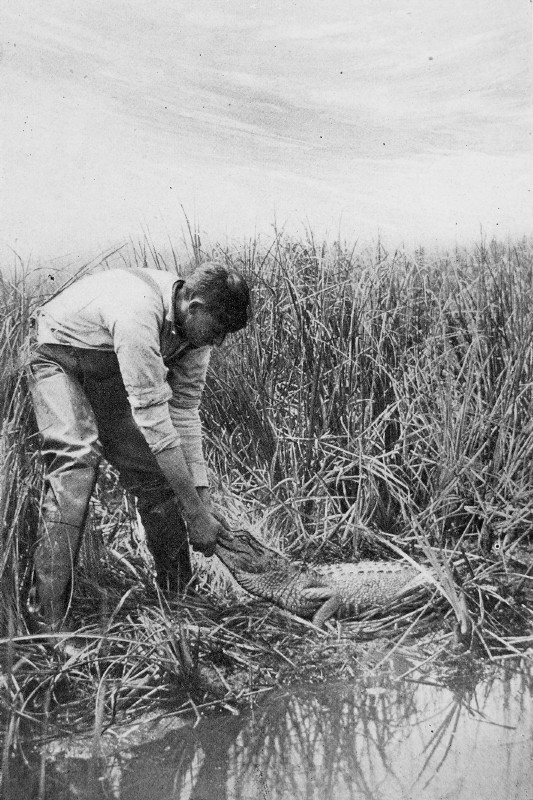 Dragging an Alligator from its Hole “I see one o’ your cattle yesterday goin’ up the road just a bustin’ it,” said Jake. “They c’n run like deer if anything’s the matter,” was Mr. Dakin’s response. “They’re wild cattle and they used to be all over the swamps hyar and didn’t belong to nobody. Finally I went and chased aroun’ and caught ‘em. I got twenty-three. If they hadn’t ‘a’ been killed off by hunters there’d been a thousand. Them cattle are jus’ suited to this country. They c’n go anywhar. You take an ordinary cow and she would soon get stuck in the mud hyar, and that would be the end of her. Such a cow wouldn’t last in this country as long as a snowball in hell. When a cow o’ mine is crossin’ a bayou and gets tired, she stops and rests, or if she’s in mud, she’ll lay right down. After a while she goes on, and she’ll rest and go by spells till she gits to solid ground. Now, an ordinary cow, when she finds she’s beginnin’ to be stuck, makes a few big lunges that sink her in so deep she never can get out. “Thar was a German hyar from New Orleans a while ago. He wanted to know everything, and he kep’ a-askin’ questions the whole time. He was white as a lily when he come out hyar, but in four days he was brown as I am. To them that’s acquainted with things in this country he acted crazy; but he wa’n’t — he was jus’ green and hadn’t seen nothin’. Why the fool would ketch a rattlesnake in his hands if you didn’t look out for him. I had my cattle fenced in hyar one day, and I happened to speak of their bein’ wild. The Dutchman got excited right off. He took his dern little old thing — his snap-shot picture machine, you know — and he’d have jumped right in whar the cattle were if I hadn’t grabbed him by the coat-tails. Those cattle wouldn’t ‘a’ let God git in amongst ‘em. “It’s funny, ain’t it, the things people’ll say and do when they’re in country that’s new to ‘em. Not long ago I was at the station when the train come in and I see a little girl and her father at a car window, and she pointed to some of the trees with the moss on ‘em and she said, ‘Oh, papa, papa, these trees have got whiskers!”‘ Presently Mrs. Dakin came to the door and announced dinner. She looked pensive and worn — as if the drudgery and narrowness of her life had quenched all joy. “ Come, Colonel,” said my host to me as he rose, “have something to eat with us.” To address a stranger as if he were an army officer is a compliment. In Louisiana I was often accosted by the military title he gave me; but in other parts of the South I have never risen higher than “captain.” Our dinner was served in the kitchen next the stove. The room was dismally barren, and it was hot and full of flies. “Make yourself at home,” said Mr. Dakin, cordially, pushing a chair into place for me. I looked at the chair rather doubtfully, for the woven cane of the seat was entirely gone. However, I contrived to sit on the edge, and was comforted by the fact that the chair on my right was in the same condition. To my left Jake was established on a grocery box. The table ware was scanty, and my knife was clumsily short because half the blade was gone. We all helped ourselves to the pork and beans, the beets, sweet potatoes, corn bread, rice, and coffee. The food was not especially appetizing, but it was eatable. We were soon back on the gallery, and I asked where the local inhabitants went to church. “They don’t go anywhar,” was Mr. Dakin’s reply, “except a few of the niggers, who go to the next village four or five miles west. Some o’ these niggers got so much o’ this hyar church religion they won’t play craps.” “A nigger is a funny animal,” remarked Jake. “He sure is!” continued Mr. Dakin. “Now do you actually believe a nigger is human? I know he ain’t. He originates from a monkey or a baboon. I done been in the museums and looked at skeletons, and I can’t see any difference between a nigger’s skeleton and a gorilla’s, only that the gorilla has got tushes. Another thing — did you ever know of an honest nigger? I don’t say they’re all dishonest. About one in seven hundred is all right; but even that one you ain’t sure of. He may be honest for ninety-nine years and then steal if he gets a rael good chance.” “They steal,” said Jake, “but that ain’t a circumstance to their laziness. If you want a nigger to work, always keep him broke. If he’s got six dollars and a good suit of clothes and a pretty good hat, he thinks it’s an insult to be asked to work.” About this time a visitor arrived. He was a short, stout, jovial man who had a whiskey bottle with him that he at once passed around. Mr. Dakin addressed him as “ Babe,” and asked him if he had eaten dinner. “No, and I don’t want none,” replied Babe. “Well, you ain’t a-goin’ away from hyar till you git somethin’ to eat,” affirmed Mr. Dakin. “Myra,” he called to his wife, “hyar’s Babe ‘most starved to death;” and Mrs. Dakin began dinner preparations again. Later in the afternoon there came a second visitor — an old man carrying a string of fish he had caught. He sat down on a plough that was on the gallery with various other farm tools, and said, “ I was in a boat up whar the bayou jines the lake and I see somethin’ movin’ in the water that long” — holding his hands about a yard apart. “What was it?” inquired Mr. Dakin. “I don’t know.” “Didn’t it have any eyes or years or nose?” persisted Mr. Dakin. “I don’t know whether it did or not.” “When did you see it?” “‘Bout a hour ago.” 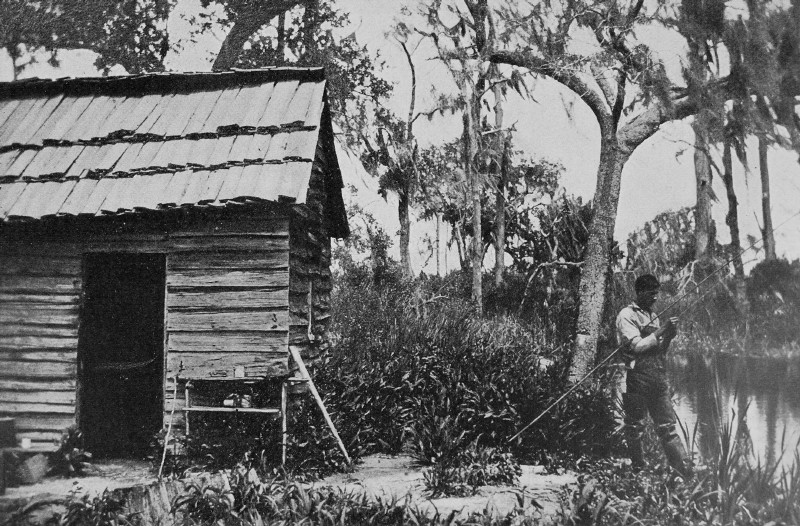 A Camp in the Swamps “Then you ain’t clean forgot in that time how it looked. What species of animal was it?” “I done tol’ you a hundred times I don’t know.” “Might ‘a’ been a rhinoceros,” suggested Babe. “Like enough hit was jus’ a sucker or a minnow,” scoffed Mr. Dakin. “I reckon hit was a young whale,” said Jake. “I’ll take my pole an’ whale you side o’ the head if you say any more,” exclaimed the fisherman. “I see the thing comin’ with its big mouth wide open, and I tells myself, ‘It’s time for me to dig out.’ I didn’t stop to learn what kind of a animal it was.” Jake had taken his dice out of his pocket and was tossing them thoughtfully along the bench on which he was sitting. The fisherman noted what he was about and offered to “shoot craps” with him, but dickered for some advantage that Jake would not allow. “Let’s have a look at your dice, Jake,” said the fisherman at length. “Them have been lucky dice for me,” remarked their owner as he passed them over, “though the first night I ever had ‘em I lost good and deep; but in the next month I made that up and was forty dollars to the good.” “Are they crooked?” asked the fisherman. “No, they’re as honest dice as ever was made.” “ Jake,” said the fisherman, “if you don’t want to roll dice with me I’ll make ye a bet. I’ll bet one dollar to four bits that eleven and eleven are twenty-two and ten and ten are twenty too.” By four bits he meant fifty cents — a bit being an old-time coin worth about twelve and a half cents. The company discussed the proposition and twisted and turned it for some time. They affirmed very decidedly that ten and ten were not twenty-two, but no one would take the bet for fear there was some catch in it. Then the fisherman said he would bet at similar odds that no person present could put his left shoe on first, and he pulled out his money and wanted me to hold the stakes. However, the others were wary, and after fruitlessly urging them to show their courage, he explained his ambiguous proposals. Time sped along, and the afternoon shadows lengthened, and by and by I started for the station. On the way I stopped to look into a small enclosure on the Dakin premises which contained a tiny pond. Several glossy wild ducks were afloat on the muddy water. They had been captured when wounded, and now their wings were clipped. Jake pointed out two of them which he said were poodledoos, but he had no names for the others. 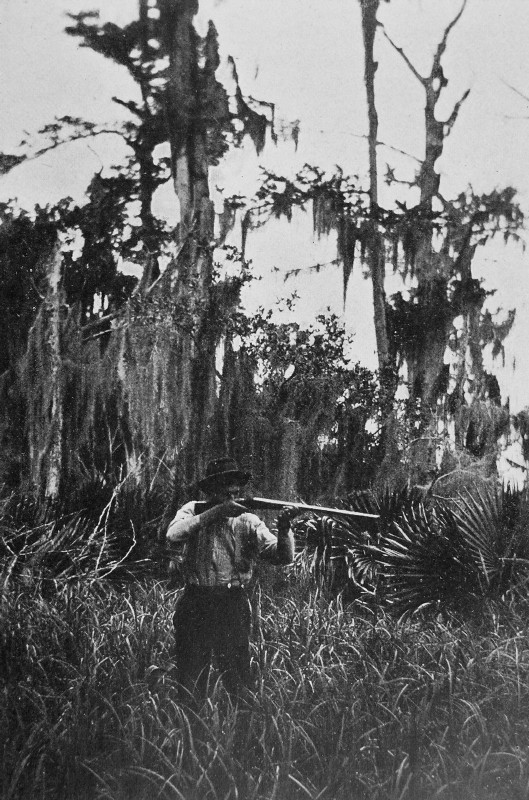 A Shot at a Deer Adjoining this enclosure was a pen built around a mudhole, and there I could see numbers of young alligators half embedded in the reek. It seemed Jake was an alligator hunter, and he had caught that year fully two hundred little fellows and twenty-five big ones. Anything over two feet long he called big. There was a ready sale for them in New Orleans to ship to zoos and to whoever had a fancy for owning one of these grotesque quadrupeds. Jake had his largest specimen imprisoned in his home hut, and he led the way to the two-room shanty where he had his bachelor quarters, and pulled forth a scaly monster with its jaws muzzled and its feet tied above its back. I was careful not to get very near the creature. It was helpless enough, but it could still give vicious lunges with its big tail. Jake did not always get the alligators alive. When he killed one of any size he skinned it and cured the hide. He cooked the flesh to feed the dogs, though he often fried a portion of the tail for his own use. It tasted like fish, he said, and was very good eating. When we went over to the station shed we found the picnickers returning, and some had lain down in the shadow of the building, and some were prowling around in the weeds looking for blackberries; but most were in the station playing craps or looking on. Nickels, dimes, and quarters were constantly changing hands, and there was rough and sulphurous language, the snap of fingers, and the light clatter of the dice as they were shaken up and rolled along the floor. It was a promiscuous crowd of old and young, negroes and whites, all intently interested and eager. Then the train was announced to be approaching, and there was a hasty finish of games and a pocketing of coin and dice, and the company gathered on the platform. Before I left I made arrangements with Jake to go on an alligator hunt, and early one morning later in the week I again was at the little station amid the swamplands. Jake and several negro men were sitting on the heaps of curing moss. The men were moss-pickers. They were ready for work and were only waiting for the spirit to move; but they would perhaps loaf there two or three hours to learn what passers-by and those who joined their group had to say. The gathering served all the purposes of a daily newspaper as far as local interests were concerned. Jake had the toothache. “Yo’ better try cold iron,” advised one of the negroes. “Yes,” said another, “cold iron de bes’ thing for yo’. Hit certain will stop de toothache.” But there was no dentist at hand, and Jake presently rose to go with me. He said the trip would be too boggy for my clothing, and he took me to his hut and furnished me with some of his garments, including a great heavy pair of shoes. For his own footwear he decided to put on rubber boots. He found a pair and discarded them because they lacked holes and the heat would make them unendurable. Another pair, however, was exhumed which were satisfactorily leaky, and he pulled them on. Then he adjusted a bag over one shoulder, stuck a hatchet into his belt, and took in his hand a slender iron rod, six feet long and hooked at one end. Off we went along “the dirt road,” intending to go to a hunting-camp Jake had seven miles off in the wilds. The road was a narrow trail of single cart width, with streaks of grass and weeds growing between the wheel tracks, and it was hedged in on either side by the rankest kind of a jungle, in which canes were predominant. This was the main highway of the region, but it ran off into nowhere, and grew more and more grassy as we advanced. Sometimes we walked in the shade of lofty, moss-hung trees, — live-oaks, gums, magnolias, and cypress, — sometimes through blasted tracts devastated by recent fires. Ordinarily these fires only burn till nightfall, and then are extinguished by the heavy dew. The woods were vocal with bird songs, and buzzards were soaring high in the ether. “Hit’s tolerable hot,” remarked Jake; and so it was, for the sun shone clear and burning, and the breeze that fluttered the treetop leafage did not penetrate into the forest depths of cane and briers and palmetto scrub. The heat was not our only discomfort. Hordes of ravenous mosquitoes assailed us and could not be kept from our hands and faces except by persistent fighting. The creatures lit on our clothing and clung to it and prodded with their poisoned lances in savage eagerness. After a few miles we turned off from the dirt road into an indistinct path, and waded through mucky lowlands to a dark silent bayou, which we crossed on some half-sunken logs embedded in the mud of its shallows. On we went, following the irregular windings of the path, long-legged Jake striding on ahead and I coming after, taking care to step along briskly enough not to be left behind in that lonely wilderness. Presently Jake stopped and cut a cane a dozen or fifteen feet long that he intended to use as a prod when we came to the marshes where the alligators lurked. A little farther on the trees and woody undergrowth disappeared, and we had before us the marshlands, spreading away like a green endless sea to the horizon, an unbroken level of saw-grass, flags, and prairie canes. Last year’s growths had all been burned off during the winter except for a few scattering stalks, tall and withered and rustling in the wind. The rank new shoots were waist high and grew in tufts from the charred stubs. These stubs were a foot tall and the size of one’s fist, and they were set in mud that varied from a watery thinness to a stiff consistency. What sweaty, weary work it was pushing through that monotony of mud and coarse grasses! It made the breath come hard and fast and the muscles ache. We went perhaps a mile, and then Jake said I might wait where I was until he had done a little investigating. I was glad enough to stop, and I stood still and looked around. Far behind me was the forest whence we had come, and all about was the vast waste of marsh which would have seemed utterly deserted if I had not now and then heard the lonely cries of waterfowl. Jake had disappeared from sight, but I occasionally saw the long cane pole he carried reaching up above the marsh growths. When that too was gone from view, I was a trifle uneasy in the forsaken and unfamiliar void, and I questioned whether, left to my own resources, I could find my way back by the devious and scarcely distinguishable path through the barbaric swamps. By and by I saw smoke curling up from the marsh grass. Jake had set it on fire to clear a path and make walking and seeing easier. I hoped the fire would not burn in my direction; for if it forged ahead with any rapidity I could not have gotten away from it. Anything more than a snail’s pace was impossible in such a sticky mud and resisting stubble. But I need not have feared. So little of the marsh growths was dry enough for the flames to lick up that the fire made slight headway. Finally I heard a distant shout. Jake had got on the trail of an alligator, and I plodded in his direction. The soil became more watery and I sank half leg deep. Several times I had to call to Jake before I came in sight of him, to make sure of his whereabouts. He was on the borders of a narrow channel of brown water that he spoke of as an “alligator slue,” and which the alligator used as a highway when in search of food. The creature had a hole just aside from the slue, and Jake ran his pole half its length into the muddy cavity to let the inmate know that something was going on. Then he bent over, and holding his nose between his thumb and finger grunted with a peculiar guttural in imitation of the voice of an old alligator. He cautioned me to keep perfectly still. Near by was a muskrat’s home — a heap of dry reeds. A water moccasin came from somewhere and stopped, startled at the sight of us, and then slid hastily away. We roused a marsh hen which uttered a harsh cry and fluttered up into view and with frightened wings sped to safety. Jake watched the water intently, repeating the grunting at intervals. There was a slight movement at the surface, and he made a sudden grab and out came a little alligator a foot long. He grunted again and secured another little fellow, and pretty soon a third. Then the ground quivered faintly and the long pole trembled. “That’s the big one — the mother,” whispered Jake, and resumed his vocal gymnastics. In a few moments there was just the least ruffling of the water, and before I could discern the cause Jake had plunged in both hands and was pulling forth a seven-foot monster firmly gripped by the jaws. But it was bedaubed with clay so that it was very slippery, and when it gave a sudden twist and turn Jake lost his hold. The beast rolled over into the slue, and with a vigorous splash of its muscular tail sent the water flying over us and in a twinkling was back in its hole. Jake was mad, and he made some remarks more vigorous than elegant and began thrusting his iron rod into the soil. He could prod the creature out, he said, but as that was likely to injure it he soon decided to try the persuasion of his voice once more. This time he imitated the cries of the little alligators. The monster responded to this appeal to its maternal instinct, and Jake caught it in the same way as before, drew it out on the mud, and jumped on its back. Then he took a cord from his pocket, tied its mouth fast shut and fastened its legs over its back and had the beast at his mercy. It was the personification of ugliness, yet I could not help feeling sorry for it and sorrier still for the little alligators, with their soft bodies and pathetic eyes. In the unmitigated loneliness of the bog, the pleasures of life were not very apparent. Nevertheless, I suppose these creatures are in their nature suited to the environment. Jake said the marshes were pretty thickly populated with them, and that there were at least forty big ones in a lagoon not far from where we were. My comrade had put the little alligators into the sack he had brought, and he now fastened it around himself and hoisted the big beast on his shoulder. Then he staggered away through the mire and shallow pools and slues toward the comparatively firm ground of the swamp — and what a relief it was when we escaped from the dismal barren of the marshlands! Our next objective was Jake’s camp, about a mile distant; for there we could get drinking water, and we were very thirsty. Jake said he did not like to drink from the swamp pools and bayous, because the water was apt to make one sick — “though I have drank it a many a time,” he added, “when I couldn’t get any other handy.” We did not carry the alligators to the camp. Jake tied a cord around the body of the big one and then doubled the creature up and put it in the bag, the mouth of which he tied up securely. Afterward he fastened the cord that was attached to the alligator’s body to a stump. He said these precautions were necessary because it would perhaps flop around and try to get loose, and if it succeeded he would have serious trouble finding it again. “Hit can go a whole lot faster’n I can walk,” he declared. My shoes were full of muddy water that churned about at every step, and my feet were chafed and blistered, so that when we started for the camp I could not muster up much speed. A vague path led thither through tangles of buck brush and palmetto scrub. Often we had to step over fallen tree trunks or make a detour around the larger ones. The region had been heavily wooded a few years before, but in a dry spell a fire had burned for twenty days among the great oaks, cedars, and magnolias, and few escaped. Yet many dead giants still stood, and the rotting forms of numerous others strewed the undergrowth. By and by we came to a dark stream which we had to wade. It was knee deep, and my shoes became more water-logged than ever. I was so weary I could hardly drag myself along, and the swarming mosquitoes never ceased persecuting us. The camp was in a pretty spot on the borders of a bayou that was alive with fish constantly making little leaps above the surface. Here stood a hut built of rough boards split out of cypress, and here Jake and Mr. Dakin lived most of the time in the winter, hunting and trapping. “We got a right smart of game hyar last winter,” said Jake. “We had eighty steel traps set, and we caught five otter that fetched us from six to twelve dollars a skin; and we caught coon and mink and wildcats and all sorts of varmints.” A trough under the eaves of the hut ran the roof water into a barrel, and to this receptacle Jake resorted with a rusty tin can and drank with evident relish. “Is it good?” I inquired. “You bet it is!” was his response, and I drank, too, but not with his enthusiasm; for the surface was strewn with leaves and mosquitoes, and both in color and taste the water was far from perfect. We loafed around for a half hour, ate a lunch we had brought, and then started on the long tramp homeward. We picked up the alligators on the way and kept on steadily for four or five miles when Jake put down his load remarking, “I reckon I’ve packed that alligator far enough. He’ll weigh nigh a hundred pounds, and he’s gin me all I want to do for one day. I’ll come up hyar and get him to-morrow.” So he thrust it into the sack and tied sack and all to a small tree. The little alligators he wrapped up in his handkerchief to carry along; but before we started he pulled off his boots and took a look inside. “My feet are on fire,” he said. “Hit’s jus’ a-smokin’ in thar,” and he heaved the boots over into the brush where the alligator was, and walked the rest of the way in his stocking feet. About two miles from the hamlet we came to an empty wagon in the road with three stalwart negro moss-pickers standing around it. “What are you all doing?” asked Jake. “Our horse done run away home,” was the reply. They had unhitched it to let it feed, and it had taken advantage of the opportunity to depart. They could have worked the remainder of the afternoon loading the wagon, but they were apparently glad of any excuse to quit, and they each lit a cigarette and went on with us single file through the forest jungle. We arrived at Dakin’s stiff and lame, and sat down on his gallery to revive. Dakin soon came in from a field where he had been planting corn, and began spitting through the hole in the gallery floor and asking what luck we had had. After we finished relating our adventures, Jake, who had been watching the approach of a boy on the broken causeway that spanned the bayou, said, “Hyar comes Rob toting a snappin’ turtle. That boy’ll waste a whole day to ketch one o’ them, when he had ought to be workin’; though he ain’t strong enough for his work to amount to much. He got a laig about as big as a good-sized crane’s.” Rob soon came in at the gate. He eyed Jake and said, “Look like you half dead.” “Half dead!” exclaimed Jake. “I could jump up and lick ten such as you this minute.” Rob unloosed the big, horny turtle on the gallery and amused himself by poking it with a stick, at which it would snap its jaws with savage courage. Presently a colored woman came to the house on some errand and stopped to observe the turtle rear and bite. “What’ll you give for him?” asked Mr. Dakin. “You need some fresh meat at your house, don’t you?” She thought the turtle was worth fifty cents, and Mr. Dakin had Rob secure it so she could carry it. This the boy did by letting it close its jaws on a cord which he passed around under the rim of the shell and knotted near the tail. It was now well muzzled, and the woman went off with it. The people on the swamplands plainly lived close to nature, but it was a closeness that was half barbaric. Their dwellings were primitively rough, their farming and gardening of the crudest sort, their discomforts many, their pleasures few. They looked to the forest and waters to support them and to supply much of their daily food. Hunting, trapping, and fishing were their chief interests, and they were always on the watch to waylay the wild denizens of the boggy jungles. To me as an onlooker all this was quite fascinating, yet sharing the life even for a short period had serious drawbacks. The mosquitoes had blotched my hands and face with poisoned swellings, the numerous wood-ticks and red-bugs I had encountered had left their marks, and it was many days before my blistered feet healed. I could not help feeling that I had hitherto never half realized the comforts of civilization. NOTE. — Any very intimate acquaintance with the moss-pickers and alligator-hunters entails some hardships. Food, shelter, and travelling are all poor, and you never know just what unusual discomforts you may encounter. The country where these primitive people live is, however, quite accessible from New Orleans, and one can go out on the train, stay a few hours, and then return. Even then the enterprise is more picturesque than agreeable, unless you have a fancy for roughing it. |
 Click the book image to turn
to the next Chapter.
Click the book image to turn
to the next Chapter.