 Web
and Book design, Web
and Book design, Copyright, Kellscraft Studio 1999-2003 (Return to Web Text-ures) |
Click Here to return to Inca Lands Content Page Click Here to return to previous chapter |
 (HOME) |
| Web
and Book design, Copyright, Kellscraft Studio 1999-2003 (Return to Web Text-ures) |
Click Here to return to Inca Lands Content Page Click Here to return to previous chapter |
(HOME) |
|
CHAPTER
X SEARCHING FOR THE LAST INCA CAPITAL THE events described
in the
preceding chapter
happened, for the most part, in Uiticos 1 and
Uilcapampa, northwest of
Ollantaytambo, about one hundred miles away from the Cuzco palace of
the
Spanish viceroy, in what Prescott calls “the remote fastnesses of the
Andes.”
One looks in vain for Uiticos on modern maps of Peru, although several
of the
older maps give it. In 1625 “Viticos” is marked on de Laet’s map of
Peru as a
mountainous province northeast of Lima and three hundred and fifty
miles
northwest of Vilcabamba! This error was copied by some later
cartographers,
including Mercator, until about 1740, when “Viticos” disappeared from
all maps
of Peru. The map makers had learned that there was no such place in
that
vicinity. Its real location was lost about three hundred years ago. A
map
published at Nuremberg in 1599 gives “Pincos” in the “Andes” mountains,
a small
range west of “Cusco.” This does not seem to have been adopted by other
cartographers; although a Paris map of 1739 gives “Picos” in about the
same
place. Nearly all the cartographers of the eighteenth century who give
“Viticos” supposed it to be the name of a tribe, e.g., “Los Viticos” or
“Les
Viticos.” 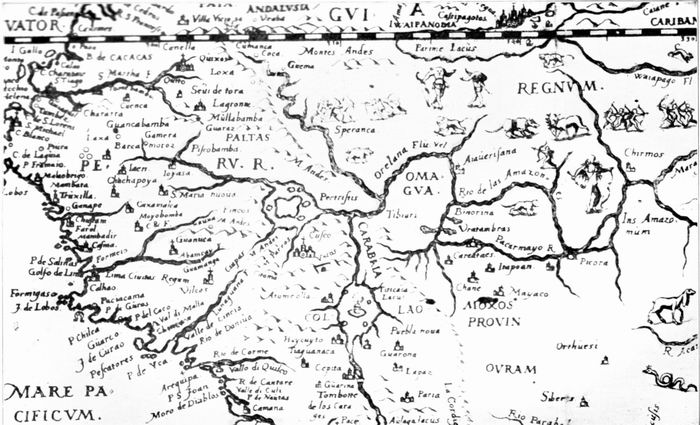 PART OF THE NUREMBURG MAP OF 1599, SHOWING PINCOS AND THE ANDES MOUNTAINS The largest official
map of
Peru, the work of that
remarkable explorer, Raimondi, who spent his life crossing and
recrossing Peru,
does not contain the word Uiticos nor any of its numerous spellings,
Viticos,
Vitcos, Pitcos, or Biticos. Incidentally, it may seem strange that
Uiticos
could ever be written “Biticos.” The Quichua language has no sound of
V. The
early Spanish writers, however, wrote the capital letter U exactly like
a
capital V. In official documents and letters Uiticos became Viticos.
The
official readers, who had never heard the word pronounced, naturally
used the V
sound instead of the U sound. Both V and P easily become B. So Uiticos
became
Biticos and Uilcapampa became Vilcabamba. Raimondi’s marvelous
energy led
him to penetrate to
more out-of-the-way Peruvian villages than any one had ever done before
or is
likely to do again, He stopped at nothing in the way of natural
obstacles. In
1865 he went deep into the heart of Uilcapampa; yet found no Uiticos.
He
believed that the ruins of Choqquequirau represented the residence of
the last
Incas. This view had been held by the French explorer, Count de
Sartiges, in
1834, who believed that Choqquequirau was abandoned when Sayri Tupac,
Manco’s
oldest son, went to live in Yucay. Raimondi’s view was also held by the
leading
Peruvian geographers, including Paz Soldan in 1877, and by Prefect
Nunez and
his friends in 1909, at the time of my visit to Choqquequirau.2 The
only
dissenter was the learned Peruvian historian, Don Carlos Romero, who
insisted
that the last Inca capital must be found elsewhere. He urged the
importance of
searching for Uiticos in the valleys of the rivers now called
Vilcabamba and
Urubamba. It was to be the work of the Yale Peruvian Expedition of 1911
to
collect the geographical evidence which would meet the requirements of
the
chronicles and establish the whereabouts of the long-lost Inca capital. That there were
undescribed and
unidentified ruins
to be found in the Urubamba Valley was known to a few people in Cuzco,
mostly
wealthy planters who had large estates in the province of Convencion.
One told
us that he went to Santa Ana every year and was acquainted with a
muleteer who
had told him of some interesting ruins near the San Miguel bridge.
Knowing the
propensity of his countrymen to exaggerate, however, he placed little
confidence in the story and, shrugging his shoulders, had crossed the
bridge a
score of times without taking the trouble to look into the matter.
Another,
Señor Pancorbo, whose plantation was in the Vilcabamba Valley, said
that he had
heard vague rumors of ruins in the valley above his plantation,
particularly
near Pucyura. If his story should prove to be correct, then it was
likely that
this might be the very Puquiura where Friar Marcos had established the
first
church in the “province of Uilcapampa.” But that was “near” Uiticos and
near a
village called Chuquipalpa, where should be found the ruins of a Temple
of the
Sun, and in these ruins a “white rock over a spring of water.” Yet
neither
these friendly planters nor the friends among whom they inquired had
ever heard
of Uiticos or a place called Chuquipalpa, or of such an interesting
rock; nor
had they themselves seen the ruins of which they had heard. One of Señor
Lomellini’s
friends, a talkative old
fellow who had spent a large part of his life in prospecting for mines
in the
department of Cuzco, said that he had seen ruins “finer than
Choqquequirau” at
a place called Huayna Picchu; but he had never been to Choqquequirau.
Those who
knew him best shrugged their shoulders and did not seem to place much
confidence in his word. Too often he had been over-enthusiastic about
mines
which did not “pan out.” Yet his report resembled that of Charles
Wiener, a
French explorer, who, about 1875, in the course of his wanderings in
the Andes,
visited Ollantaytambo. While there he was told that there were fine
ruins down
the Urubamba Valley at a place called “Huaina-Picchu or Matcho-Picchu.”
He
decided to go down the valley and look for these ruins. According to
his text
he crossed the Pass of Panticalla, descended the Lucumayo River to the
bridge
of Choqquechacca, and visited the lower Urubamba, returning by the same
route.
He published a detailed map of the valley. To one of its peaks he gives
the
name “Huaynapicchu, ele. 1815 m.” and to another “Matchopicchu, ele.
1720 m.”
His interest in Inca ruins was very keen. He devotes pages to
Ollantaytambo. He
failed to reach Machu Picchu or to find any ruins of importance in the
Urubamba
or Vilcabamba valleys. Could we hope to be any more successful? Would
the
rumors that had reached us “pan out” as badly as those to which Wiener
had
listened so eagerly? Since his day, to be sure, the Peruvian Government
had
actually finished a road which led past Machu Picchu. On the other
hand, a
Harvard Anthropological Expedition, under the leadership of Dr. William
C.
Farrabee, had recently been over this road without re-porting any ruins
of
importance. They were looking for savages and not ruins. Nevertheless,
if Machu
Picchu was “finer than Choqquequirau” why had no one pointed it out to
them? To most of our
friends in Cuzco
the idea that there
could be anything finer than Choqquequirau seemed absurd. They regarded
that
“cradle of gold” as “the most remarkable archeological discovery of
recent
times.” They assured us there was nothing half so good. They even
assumed that
we were secretly planning to return thither to dig
for buried treasure! Denials were of no avail. To a people
whose ancestors made fortunes out of lucky “strikes,” and who
themselves have
been brought up on stories of enormous wealth still remaining to be
discovered
by some fortunate excavator, the question of tesoro
— treasure, wealth,
riches — is an ever-present source of conversation. Even the prefect of
Cuzco
was quite unable to conceive of my doing anything for the love of
discovery. He
was convinced that I should find great riches at Choqquequirau — and
that I was
in receipt of a very large salary! He refused to believe that the
members of
the Expedition received no more than their expenses. He told me
confidentially
that Professor Foote would sell his collection of insects for at least
$10,000! Peruvians have not been
accustomed to
see any one do scientific work except as he was paid by the government
or
employed by a railroad or mining company. We have frequently found our
work
misunderstood and regarded with suspicion, even by the Cuzco Historical
Society. 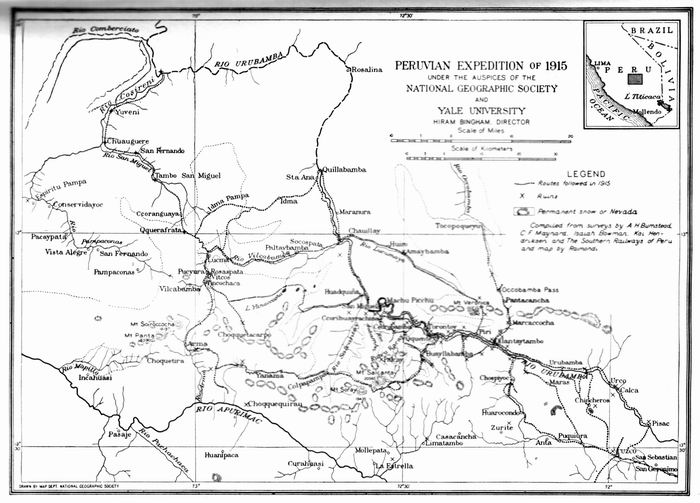 The valley of the
Urubamba, or
Uilcamayu, as it used
to be called, may be reached from Cuzco in several ways. The usual
route for
those going to Yucay is northwest from the city, over the great Andean
highway,
past the slopes of Mt. Sencca. At Ttica-Ttica (12,000 ft.)
the road crosses the lowest pass at the western
end of the
Cuzco Basin. At the last point from which one can see the city of
Cuzco, all
true Indians, whether on their way out of the valley or into it, pause,
turn
toward the east, facing the city, remove their hats and mutter a
prayer. I
believe that the words they use now are those of the “Ave
Maria,” or some other familiar orison of the Catholic
Church.
Nevertheless, the custom undoubtedly goes far back of the advent of the
first
Spanish missionaries. It is probably a relic of the ancient habit of
worshiping
the rising sun. During the centuries immediately preceding the
conquest, the
city of Cuzco was the residence of the Inca himself, that divine
individual who
was at once the head of Church and State. Nothing would have been more
natural
than for persons coming in sight of his residence to perform an act of
veneration. This in turn might have led those leaving the city to fall
into the
same habit at the same point in the road. I have watched hundreds of
travelers
pass this point. None of those whose European costume proclaimed a
white or
mixed ancestry stopped to pray or make obeisance. On the other hand,
all those,
without exception, who were clothed in a native costume, which
betokened that
they considered themselves to be Indians rather than whites, paused for
a
moment, gazing at the ancient city, removed their hats, and said a
short
prayer. Leaving Ttica-Ttica,
we went
northward for several
leagues, passed the town of Chincheros, with its old-Inca walls, and
came at
length to the edge of the wonderful valley of Yucay. In its bottom are
great
level terraces rescued from the Urubamba River by the untiring energy
of the
ancient folk. On both sides of the valley the steep slopes bear many
remains of
narrow terraces, some of which are still in use. Above them are “temporales,” fields of grain, resting
like a patch-work quilt on slopes so steep it seems incredible they
could be
cultivated. Still higher up, their heads above the clouds, are the
jagged
snow-capped peaks. The whole offers a marvelous picture, rich in
contrast,
majestic in proportion. In Yucay once dwelt the Inca Manco’s oldest
son, Sayri
Tupac, after he had accepted the viceroy’s invitation to come under
Spanish
protection. Here he lived three years and here, in 1560, he died an
untimely
death under circumstances which led his brothers, Titu Cusi and Tupac
Amaru, to
think that they would be safer in Uiticos. We spent the night in
Urubamba, the
modern capital of the province, much favored by Peruvians of to-day
because of
its abundant water supply, delightful climate, and rich fruits. Cuzco,
11,000
feet, is too high to have charming surroundings, but two thousand feet
lower,
in the Urubamba Valley, there is everything to please the eye and
delight the
horticulturist. Speaking of
horticulturists
reminds me of their
enemies. Uru is the Quichua word for
caterpillars or grubs, pampa means flat land. Urubamba is “flat-land-where-there-are-grubs-or-caterpillars.”
Had it been named by people who came up from a warm region where
insects
abound, it would hardly have been so denominated. Only people not
accustomed to
land where caterpillars and grubs flourished would have been struck by
such a
circumstance. Consequently, the valley was probably named by plateau
dwellers
who were working their way down into a warm region where butterflies
and moths
are more common. Notwithstanding its celebrated cater-pillars,
Urubamba’s
gardens of to-day are full of roses, lilies, and other brilliant
flowers. There
are orchards of peaches, pears, and apples; there are fields where
luscious
strawberries are raised for the Cuzco market. Apparently, the grubs do
not get
everything. The next day down the
valley
brought us to romantic
Ollantaytambo, described in glowing terms by Castelnau, Marcou, Wiener,
and
Squier many years ago. It has lost none of its charm, even though
Marcou’s
drawings are imaginary and Squier’s are exaggerated. Here, as at
Urubamba,
there are flower gardens and highly cultivated green fields. The brooks
are
shaded by willows and poplars. Above them are magnificent precipices
crowned by
snow-capped peaks. The village itself was once the capital of an
ancient
principality whose history is shrouded in mystery. There are ruins of.
curious
gabled buildings, storehouses, “prisons,” or “monasteries,” perched
here and
there on well-nigh inaccessible crags above the village. Below are
broad
terraces of unbelievable extent where abundant crops are still
harvested;
terraces which will stand for ages to come as monuments to the energy
and skill
of a bygone race. The “fortress” is on a little hill, surrounded by
steep
cliffs, high walls, and hanging gardens so as to be difficult of
access.
Centuries ago, when the tribe which cultivated the rich fields in this
valley
lived in fear and terror of their savage neighbors, this hill offered a
place
of refuge to which they could retire. It may have been fortified at
that time.
As centuries passed in which the land came under the control of the
Incas,
whose chief interest was the peaceful promotion of agriculture, it is
likely
that this fortress became a royal garden. The six great ashlars of
reddish
granite weighing fifteen or twenty tons each, and placed in line on the
summit
of the hill, were brought from a quarry several miles away with an
immense
amount of labor and pains. They were probably intended to be a record
of the
magnificence of an able ruler. Not only could he command the services
of a
sufficient number of men to extract these rocks from the quarry and
carry them
up an inclined plane from the bottom of the valley to the summit of the
hill;
he had to supply the men with food. The building of such a monument
meant
taking five hundred Indians away from their ordinary occupations as
agriculturists. He must have been a very good administrator. To his
people the
magnificent megaliths were doubtless a source of pride. To his enemies
they
were a symbol of his power and might. 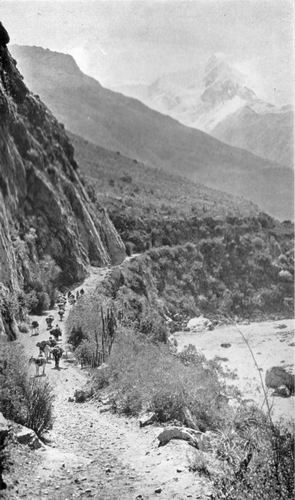 MT. VERONICA AND SALAPUNCO, THE GATEWAY TO UILCAPAMPA A league below
Ollantaytambo
the road forks. The
right branch ascends a steep valley and crosses the pass of Panticalla
near
snow-covered Mt. Veronica. Near the pass are two groups of ruins. One
of them,
extravagantly referred to by Wiener as a “granite palace, whose
appearance [appareil] resembles the
more beautiful
parts of Ollantaytambo,” was only a storehouse. The other was probably
a tampu,
or inn, for the benefit of official travelers. All travelers in Inca
times,
even the bearers of burdens, were acting under official orders.
Commercial
business was unknown. The rights of personal property were not
understood. No
one had anything to sell; no one had any money to buy it with. On the
other
hand, the Incas had an elaborate system of tax collecting. Two thirds
of the
produce raised by their subjects was claimed by the civil and religious
rulers.
It was a reasonable provision of the benevolent despotism of the Incas
that
inhospitable regions like the Panticalla Pass near Mt. Veronica should
be
provided with suitable rest houses and storehouses. Polo de Ondegardo,
an able
and accomplished statesman, who was in office in Cuzco in 1560, says
that the
food of the chasquis, Inca post
runners, was provided from official storehouses; “those who worked for
the
Inca’s service, or for religion, never ate at their own expense.” In
Manco’s
day these buildings at Havaspampa probably sheltered the outpost which
defeated
Captain Villadiego. Before the completion
of the
river road, about 1895,
travelers from Cuzco to the lower Urubamba had a choice of two routes,
one by
way of the pass of Panticalla, followed by Captain Garcia in 1571, by
General
Miller in 1835, Castelnau in 1842, and Wiener in 1875; and one by way
of the
pass between Mts. Salcantay and Soray, along the Salcantay River to
Huadquina,
followed by the Count de Sartiges in 1834 and Raimondi in 1865. Both of
these
routes avoid the highlands between Mt. Salcantay and Mt. Veronica and
the
lowlands between the villages of Piri and Huadquina. This region was in
1911
undescribed in the geographical literature of southern Peru. We decided
not to
use either pass, but to go straight down the Urubamba river road. It
led us
into a fascinating country. Two leagues beyond
Piri, at
Salapunco, the road
skirts the base of precipitous cliffs, the beginnings of a wonderful
mass of
granite mountains which have made Uilcapampa more difficult of access
than the
surrounding highlands which are composed of schists, conglomerates, and
limestone. Salapunco is the natural gateway to the ancient province,
but it was
closed for centuries by the combined efforts of nature and man. The
Urubamba
River, in cutting its way through the granite range, forms rapids too
dangerous
to be passable and precipices which can be scaled only with great
effort and
considerable peril. At one time a footpath probably ran near the river,
where
the Indians, by crawling along the face of the cliff and sometimes
swinging
from one ledge to another on hanging vines, were able to make their way
to any
of the alluvial terraces down the valley. Another path may have gone
over the
cliffs above the fortress, where we noticed, in various inaccessible
places,
the remains of walls built on narrow ledges. They were too narrow and
too
irregular to have been intended to support agricultural terraces. They
may have
been built to make the cliff more precipitous. They probably represent
the
foundations of an old trail. To defend these ancient paths we found
that
prehistoric man had built, at the foot of the precipices, close to the
river, a
small but powerful fortress whose ruins now pass by the name of
Salapunco; sala
= ruins; punco = gateway. Fashioned after famous
Sacsahuaman and
resembling it in the irregular character of the large ashlars and also
by
reason of the salients and reentrant angles which enabled its defenders
to
prevent the walls being successfully scaled, it presents an interesting
problem. Commanding as it does
the
entrance to the valley of
Torontoy, Salapunco may have been built by some ancient chief to enable
him to
levy tribute on all who passed. My first impression was that the
fortress was
placed here, at the end of the temperate zone, to defend the valleys of
Urubamba and Ollantaytambo against savage enemies coming up from the
forests of
the Amazon. On the other hand, it is possible that Salapunco was built
by the
tribes occupying the fastnesses of Uilcapampa as an outpost to defend
them
against enemies coming down the valley from the direction of
Ollantaytambo.
They could easily have held it against a considerable force, for it is
powerfully built and constructed with skill. Supplies from the
plantations of
Torontoy, lower down the river, might have reached it along the path
which
antedated the present government road. Salapunco may have been occupied
by the
troops of the Inca Manco when he established himself in Uiticos and
ruled over
Uilcapampa. He could hardly, however, have built a megalithic work of
this
kind. It is more likely that he would have destroyed the narrow trails
than
have attempted to hold the fort against the soldiers of Pizarro.
Furthermore,
its style and character seem to date it with the well-known megalithic
structures of Cuzco and Ollantaytambo. This makes it seem all the more
extraordinary that Salapunco could ever have been built as a defense
against
Ollantaytambo, unless it was built by folk who once occupied Cuzco and
who
later found a retreat in the canyons below here. 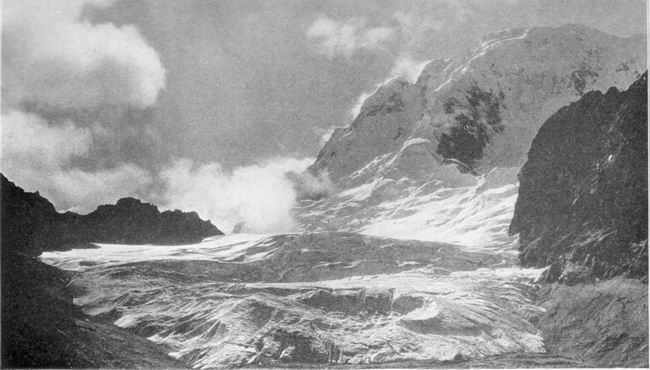 GROSVENOR GLACIER AND MT. SALCANTAY When we first visited
Salapunco
no megalithic
remains had been reported as far down the valley as this. It never
occurred to
us that, in hunting for the remains of such comparatively recent
structures as
the Inca Manco had the force and time to build, we were to discover
remains of
a far more remote past. Yet we were soon to find ruins enough to
explain why
such a fortress as Salapunco might possibly have been built so as to
defend
Uilcapampa against Ollantaytambo and Cuzco and not those well-known
Inca cities
against the savages of the Amazon jungles. Passing Salapunco, we
skirted
granite cliffs and
precipices and entered a most interesting region, where we were
surprised and
charmed by the extent of the ancient terraces, their length and height,
the
presence of many Inca ruins, the beauty of the deep, narrow valleys,
and the
grandeur of the snow-clad mountains which towered above them. Across
the river,
near Qquente, on top of a series of terraces, we saw the extensive
ruins of
Patallacta (pata = height or terrace; llacta
= town or city), an
Inca town of great importance. It was not known to Raimondi or Paz
Soldan, but
is indicated on Wiener’s map, although he does not appear to have
visited it.
We have been unable to find any reference to it in the chronicles. We
spent
several months here in 1915 excavating and determining the character of
the
ruins. In another volume I hope to tell more of the antiquities of this
region.
At present it must suffice to remark that our explorations near
Patallacta
disclosed no “white rock over a spring of water.” None of the place
names in
this vicinity fit in with the accounts of Uiticos. Their identity
remains a
puzzle, although the symmetry of the buildings, their architectural
idiosyncrasies such as niches, stone roof-pegs, bar-holds, and
eye-bonders,
indicate an Inca origin. At what date these towns and villages
flourished, who
built them, why they were deserted, we do not yet know; and the Indians
who
live hereabouts are ignorant, or silent, as to their history. At
Torontoy, the
end of the cultivated temperate valley, we found another group of
interesting
ruins, possibly once the residence of an Inca chief. In a cave near by
we
secured some mummies. The ancient wrappings had been consumed by the
natives in
an effort to smoke out the vampire bats that lived in the cave. On the
opposite
side of the river are extensive terraces and above them, on a hilltop,
other
ruins first visited by Messrs. Tucker and Hendriksen in 1911. One of
their
Indian bearers, attempting to ford the rapids here with a large
surveying
instrument, was carried off his feet, swept away by the strong current,
and
drowned before help could reach him. Near Torontoy is a
densely
wooded valley called the
Pampa Ccahua. In 1915 rumors of Andean or “spectacled” bears having
been seen
here and of damage having been done by them to some of the higher
crops, led us
to go and investigate. We found no bears, but at an elevation of 12,000
feet
were some very old trees, heavily covered with flowering moss not
hitherto known
to science. Above them I was so fortunate as to find a wild potato
plant, the
source from which the early Peruvians first developed many varieties of
what we
incorrectly call the Irish potato. The tubers were as large as peas. Mr. Heller found here
a strange
little cousin of the
kangaroo, a near relative of the coenolestes. It
turned out to be new to
science. To find a new genus of mammalian quadrupeds was an event which
delighted Mr. Heller far more than shooting a dozen bears.3 Torontoy is at the
beginning of
the Grand Canyon of
the Urubamba, and such a canyon! The river “road” runs recklessly up
and down
rock stairways, blasts its way beneath overhanging precipices, spans
chasms on
frail bridges propped on rustic brackets against granite cliffs. Under
dense
forests, wherever the encroaching precipices permitted it, the land
between
them and the river was once terraced and cultivated. We found ourselves
unexpectedly in a veritable wonderland. Emotions came thick and fast.
We
marveled at the exquisite pains with which the ancient folk had rescued
incredibly narrow strips of arable land from the tumbling rapids. How
could
they ever have managed to build a retaining wall of heavy stones along
the very
edge of the dangerous river, which it is death to attempt to cross! On
one
sightly bend near a foaming waterfall some Inca chief built a temple,
whose
walls tantalize the traveler. He must pass by within pistol shot of the
interesting ruins, unable to ford the intervening rapids. High up on
the side
of the canyon, five thousand feet above this temple, are the ruins of
Corihuayrachina (kori = “gold”; huayaya = “wind”; huayrachina = “a
threshing-floor where winnowing takes place.” Possibly this was an
ancient gold
mine of the Incas. Half a mile above us on another steep slope, some
modern
pioneer had recently cleared the jungle from a fine series of ancient
artificial terraces. On the afternoon of
July 23d we
reached a hut called “La Maquina,” where travelers
frequently stop for the night. The name comes from the presence here of
some
large iron wheels, parts of a “machine” destined never to overcome the
difficulties of being transported all the way to a sugar estate in the
lower
valley, and years ago left here to rust in the jungle. There was little
fodder,
and there was no good place for us to pitch our camp, so we pushed on
over the
very difficult road, which had been carved out of the face of a great
granite
cliff. Part of the cliff had slid off into the river and the breach
thus made
in the road had been repaired by means of a frail-looking rustic bridge
built
on a bracket composed of rough logs, branches, and reeds, tied together
and
surmounted by a few inches of earth and pebbles to make it seem
sufficiently
safe to the cautious cargo mules who picked their way gingerly across
it. No
wonder “the machine” rested where it did and gave its name to that part
of the
valley. 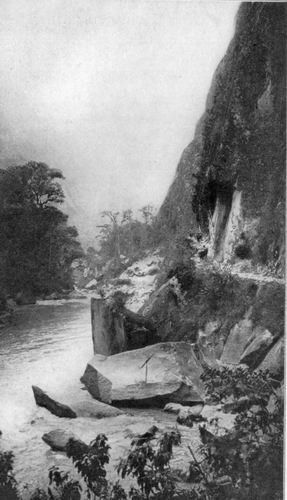 THE ROAD BETWEEN MAQUINA AND MANDOR PAMPA NEAR MACHU PICCHU Dusk falls early in
this deep
canyon, the sides of
which are considerably over a mile in height. It was almost dark when
we passed
a little sandy plain two or three acres in extent, which in this land
of steep
mountains is called a pampa. Were
the
dwellers on the pampas of
Argentina —
where a railroad can go for 250 miles in a straight line, except for
the
curvature of the earth — to see this little bit of flood-plain called
Mandor
Pampa, they would think some one had been joking or else grossly
misusing a
word which means to them illimitable space with not a hill in sight.
However,
to the ancient dwellers in this valley, where level land was so scarce
that it
was worth while to build high stone-faced terraces so as to enable two
rows of
corn to grow where none grew before, any little natural breathing space
in the
bottom of the canyon is called a pampa. We passed an
ill-kept,
grass-thatched hut, turned
off the road through a tiny clearing, and made our camp at the edge of
the
river Urubamba on a sandy beach. Opposite us, beyond the huge granite
boulders
which interfered with the progress of the surging stream, was a steep
mountain
clothed with thick jungle. It was an ideal spot for a camp, near the
road and
yet secluded. Our actions, however, aroused the suspicions of the owner
of the
hut, Melchor Arteaga, who leases the lands of Mandor Pampa. He was
anxious to
know why we did not stay at his hut like respectable travelers. Our gendarme, Sergeant Carrasco, reassured
him. They had quite a long conversation. When Arteaga learned that we
were
interested in the architectural remains of the Incas, he said there
were some
very good ruins in this vicinity — in fact, some excellent ones on top
of the
opposite mountain, called Huayna Picchu, and also on a ridge called
Machu
Picchu. These were the very places Charles Wiener heard of at
Ollantaytambo in
1875 and had been unable to reach. The story of my experiences on the
following
day will be found in a later chapter. Suffice it to say at this point
that the
ruins of Huayna Picchu turned out to be of very little importance,
while those
of Machu Picchu, familiar to readers of the “National Geographic
Magazine,” are
as interesting as any ever found in the Andes. When I first saw the
remarkable
citadel of Machu
Picchu perched on a narrow ridge two thousand feet above the river, I
wondered
if it could be the place to which that old soldier, Baltasar de Ocampo,
a
member of Captain Garcia’s expedition, was referring when he said: “The
Inca
Tupac Amaru was there in the fortress of Pitcos [Uiticos], which is on
a very
high mountain, whence the view commanded a great part of the province
of
Uilcapampa. Here there was an extensive level space, with very
sumptuous and
majestic buildings, erected with great skill and art, all the lintels
of the
doors, the principal as well as the ordinary ones, being of marble,
elaborately
carved.” Could it be that “Picchu” was the modern variant of “Pitcos”?
To be
sure, the white granite of which the temples and palaces of Machu
Picchu are
constructed might easily pass for marble. The difficulty about fitting
Ocampo’s
description to Machu Picchu, however, was that there was no difference
between the
lintels of the doors and the walls themselves. Furthermore, there is no
“white
rock over a spring of water” which Calancha says was “near Uiticos.”
There is
no Pucyura in this neighborhood. In fact, the canyon of the Urubamba
does not
satisfy the geographical requirements of Uiticos. Although containing
ruins of
surpassing interest, Machu Picchu did not represent that last Inca
capital for
which we were searching. We had not yet found Manco’s palace. ___________________________
1 Uiticos is probably derived from Uiticuni, meaning “to withdraw to a distance.” 2
Described in “Across South America.” 3 On
the 1915 Expedition Mr. Heller captured twelve new species of mammals,
but, as
Mr. Oldfield Thomas says: “Of all the novelties, by far the most
interesting is
the new Marsupial.... Members of the family were previously known from
Colombia
and Ecuador.” Mr. Heller’s discovery greatly extends the recent range
of the
kangaroo family. Click
 here to continue to the next chapter of Inca Lands
 |