 Web
and Book design, Web
and Book design, Copyright, Kellscraft Studio 1999-2006 (Return to Web Text-ures) |
Click
Here to return to History of the Great Fire of Boston Content Page Return to the Previous Chapter |
 (HOME) |
| CHAPTER VIII.
THE RUINS. THE appearance of the burnt quarter, after the fire had spent itself and the work of destruction had ended, was of a vast city of ruins, the limit of which could at no point be seen, still smoking and steaming violently from the shock that had caused its fearful overthrow. Very little, if any thing, was left to show what had been. In the stead of noble buildings of granite and marble and brick were huge, giant walls, torn and ragged, and broken columns of stone and iron. The lines of the streets were entirely obliterated; and the ways were so blocked by great bowlders of granite, and heaps of débris, — in some places from three to ten feet deep, — that those who had been most familiar with the section before the fire were utterly unable to find their way, and groped about, or clambered over the obstructing rock, brick, iron, and still hot rubbish, dazed and bewildered. Pearl-street “leather-men” searched around the vicinity of the new post-office building for the sites of their stores and warehouses, and were startled by the sudden looming-up, right before them, of that splendid pile, out of the smoke and steam which enveloped and shrouded every thing like huge banks of fog. Sight-seers peering for the ruin of old Trinity Church on Summer Street were surprised by the unexpected appearance of some familiar object in the midst of strange and foreign sights, which proved to them that they were far away from Trinity, and working in a direction, which, if followed, would lead them still farther off. A man was seen wandering around what was once the lower part of Water Street with a sign announcing the new quarters of a bank, diligently searching, as one would search for a lost jewel in a dust-heap, for some mark of the site of its old building, which was not far from the corner of Congress Street; and men were constantly inquiring of each other what section of the sixty acres of the ruin they were in. 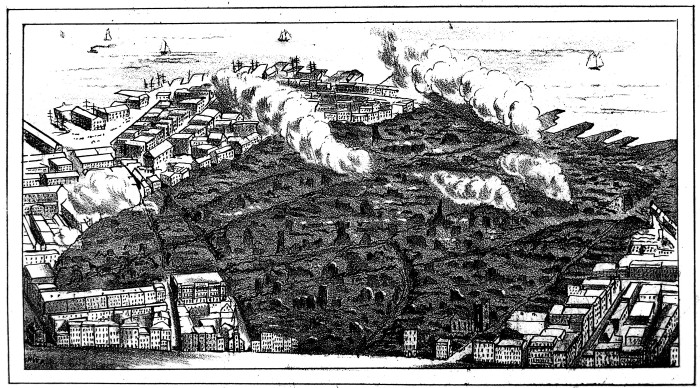 BOSTON IN RUINS. The scenes
within
the lines of the ruins were novel and picturesque in the extreme. They
were
bits of pictures only, considering the magnitude of the devastated
territory.
For three days the smoke was so thick and blinding, that no extended
view could
anywhere be had. There were life and energy and spirit at every hand.
Here, in
the midst of huge heaps of hot bricks, surrounded by fires yet
smouldering and
crackling, men were pushing the work of clearing away the wrecks, which
had
begun at the very break of dawn on Monday, or of digging out the buried
safes
and vaults, and crowded about them, picturesquely grouped, were many
interested
spectators. Here firemen were directing powerful streams of water upon
yet
powerful fires burning and roaring fiercely; and engines were puffing
in their
nervous, jerky way. Here, comfortably fixed upon mounds of rubbish,
with a huge
granite block for their table, and smaller blocks for their chairs, was
a knot
of out-of-towners, who had somehow succeeded in passing the guards
surrounding
the entire district, lunching on rural viands, — lunching, in the midst
of
awful wreck and ruin, as merrily and cheerily as in a quiet, peaceful,
country
picnicking-place. Here urchins who had stormed the lines were peddling
“relics,” bits of crockery, pieces of fantastically-twisted iron,
blackened
hard-boiled eggs, which they energetically protested had stiffened in
the fiery
furnace, — queer formations displaying brilliant hues and exquisite
tints,
strips of charred leather, and numerous other oddly-shaped pieces of
rubbish.
Here guardsmen were seen through the smoke, pacing up and down their
posts, or,
forgetful of their duty, picking out “relics” with their
bayonet-points; and
cavalry-men riding and clambering solemnly and grimly over the heaps of
broken
and smoking stuff. One standing in the midst of the ruins, and looking
about
him, noting the blue-clad sentinels, the towering walls rent and torn
in every
direction, the broken pillars and iron-work, the huge heaps of jagged
granite-blocks and débris under his feet, could easily imagine
himself gazing
upon a great city destroyed but a brief time before by a terrific
bombardment.
One wall on Milk Street, by the new post-office building, looked just
as if a
shell had plunged through it, and made dreadful havoc with what had
been
beyond. A long, narrow clearing, terminated by a fantastically ragged
tower of
masonry, looked not unlike the path of a shell; and the sure
finger-marks of
powder, rather than fire, seemed to be clear and unmistakable at every
hand. At night
the moon
shone; and the ruins were lighted up by its mellow light, and the ruddy
glow
from the still burning fires, with a strange and singular brightness. A
walk
through the quarter at this time revealed a scene of desolation, which
by
daylight, when men were toiling busily, and things were moving over and
about
the place, lending life to the picture, was absent. There was a weird,
grotesque beauty in the prospect, that was strangely fascinating. The
fantastic
proportions of the fragments of walls were sharply marked. The tower of
Trinity, the most “artistic” of all the effects
in the burnt quarter, stood out
grand and beautiful, forming with its surroundings a picture resembling
those
of the noble ruins of ancient cities; and the upright fronts of
buildings, with
their windows bright by the firelight, looked like lighted castles in
the midst
of devastation: “The mysterious, intense, Rembrandt effects of fitful
light and
shade,” wrote a journalist in one of the newspapers of the following
morning;
“the moonlight occasionally penetrating through rifts of smoke,
blending with
the flickering firelight; the exaggerated shapes of lonely columns and
irregular
masses of wall; the silence, broken only by the occasional
hoarsely-given order
of a fireman, or, mayhap, the distant chatter of a party of women whom
some one
is escorting through the wonderful scene, — all combine to produce an
impression, of which nothing we can liken it to will convey an adequate
conception. The imagination may conjure up such a scene; genius,
perhaps, might
partially represent it on canvas: no words we can command can describe
it.
Shadowy, lurid, silent, grand, awful, desolate, fantastic, it possesses
the
imagination; and the adventurer wonders whether he is still in the
body, a
creature of senses and instincts, or a being as unsubstantial and
strange and
dreary as the phantasmagoria by which he is surrounded. If it were not
for the
occasional group of firemen directing a stream of water on some flame
that the
wind is fanning to some comparative violence of passion, and the
half-dozen
explorers like- himself whom he meets, and who stare at him in a
wondering way,
as if his appearance in such a place, and not theirs, was the
questionable
thing, one might well suppose he had’ left the abodes of men, and
fallen upon
the chaotic surface of another planet, whose fires had been but
incompletely
quenched.” The aspect
of the
ruins changed from day to day. During Tuesday, Wednesday, and Thursday,
a
thousand or more laborers were engaged in the work of clearing the
rubbish from
the streets, and marking the thoroughfares; others were toiling
industriously
for the recovery of safes and valuables; and large gangs of others were
tearing
down the dangerous pieces of masonry standing, — some working, under
the
direction of the chief of the department of inspection of buildings,
with
pulleys and ropes and irons; and others, under the military
authorities, with
dualin, — a much more dangerous and noisy tool. By the end of the week
all the
streets were cleared, so that teams could with a little difficulty pass
each
other with Safety; the ways along the outer edge of the district were
open to
public travel; nearly every thing of value had been removed from the
rubbish;
and the work of building temporary structures had fairly begun. Yet the
fires
were not out. Smoke and steam continued to come up in dense volumes out
of the
cellars; burning leather, and great heaps of coal, yet crackled and
roared
furiously; and the ruins of vast proportions were yet picturesque and
fascinating, and so they remained for some time. The guards during
these days
were exceedingly strict, acting under orders from headquarters, issued
at the
request of the city authorities; but many idlers got somehow by them,
and
constantly perambulated the quarter, loading their pockets and persons
with
rubbish which they collected as “relics,” joining interestedly the
groups about
the workmen engaged in opening the safes as they were recovered from
the ruins
in the heaped-up basements, and joining in the expressions of sympathy
when it
was found — which, alas! was too often the case — that the great iron
boxes
contained, instead of money and wealth, only ashes and poverty. Photographers
also
passed the lines, and perched themselves on stone-heaps in the most
picturesque
quarters, taking views, and making of themselves pictures which
sauntering
artists outlined in their notebooks; and many of the class of
mysterious
vandals who go about o’ nights, and are seldom seen disfiguring the
landscape
of the country, overcame the barriers, and painted and posted on the
dead
walls, the sides of granite columns, and the flat surface of upturned
stone-blocks, advertisements of all manner of notions and nostrums.
When the
rubbish was cleared from the streets, it was seen that the
cobble-stones with
which some of them were paved were badly cracked and crumbled; that the
cross-walks were broken, in some instances, into many pieces; and the
curb-stones were chipped and worn as by a dull chisel, or the
ill-directed
blows of a blunt hammer. All this was caused by the intense heat. But more
interesting than these marks of the fire’s power were portions of the
Milk and
Water Street fronts of the new post-office building. The granite
columns way up
near the top of the structure appeared like partly-melted candles, and
the
granite cross-pieces were chipped fantastically. At the
time of the
fire, the face of the granite was peeled off “like a chestnut in a
toaster;”
and great granite-chips tumbled to the ground as if an invisible hand
with
mallet and steel was at work, bent on defacing the smooth surface and
sharp
lines with all the haste possible. The
militia-men
were on guard around and about the burnt quarter for two weeks, day and
night.
On the Monday morning after the fire they formed a stern, unbroken line
from
Avon Place, along Washington Street to Water; through Water to
Devonshire;
along Devonshire, through Congress Square, to Congress Street; through
Congress
to State; along State to Kilby; through Kilby to Water and Broad; along
the
Fort-hill territory and the water-front; up along behind Summer Street,
Bedford, Kingston, and around again to Avon Place; enclosing a
territory of
more than a hundred acres. Pressing against this line was a crowd of
sightseers
all through that day and during the next, peering curiously into the
smoke and
dust, pleading for a passage through, or begging for some “relic.” A
multitude journeyed
to the city, from all directions and from great distances, on the first
days
following the fire; and, by their conduct, gave Boston a strange,
unnatural
look; made it present spectacles more like what one might look for in a
French
city than a puritanical American place. On Monday “there were pictures
of awful
desolation and ruin in one great section; and immediately about and
around, in
marked contrast, pictures of a holiday or gala-day kind.” Beyond the
military
lines, but in the streets near by, on the piers on one side, and along
the
paths of the Common on the, other, “strangers thronged unceasingly from
morning
till night, looking contented, interested, and happy, watching the
cavalry as
they cantered by, examining the wares of the itinerant peddlers on the
Tremont
mall, studying the smoky sky through the big telescope, or trying the
lung-testers; carrying themselves, for all the world, as if it were a
festival
they had journeyed hither to see, rather than the destruction of a
great
section of a great city by fire.” The militia-men were quartered in
various
sections of the city; one regiment occupying the shattered Old South
Church. On
Tuesday evening we followed the officer of the night on the “grand
rounds,” and
looked into the venerable meeting-house of sacred memories upon the
strange
sight its interior presented. Here was a scene recalling that which a
visitor
to the old church in the days long passed might have seen, when his
Majesty’s
troops scandalized the patriotic citizens of Boston by quartering in
the sacred
place. Men in blue were moving about, musket in hand, or sleeping in
the wide,
old-fashioned pews. A group were lounging about the old pulpit,
chatting and
chaffing; and other knots, engaged apparently in the same comfortable
and harmless
occupation, were gathered here and there. The light was dim and dismal,
coming
from tallow-candles stuck into the gas-brackets, and held up from
bayonet-points; and the air was sharp and chilling, the shattered
windows
admitting every breeze. A week
after the
terrible devastation, there were little puffs of smoke still visible;
but the
great piles of broken granite and the shattered walls were silent and
grand,
reminding one of Pompeii and the crumbling temples of Baalbec and
Petræa. |
 Click the book image to turn
to the next Chapter.
Click the book image to turn
to the next Chapter.