


Home Page
for your Computer
Informational
Pages
Free Books on-line
|
|
|
|
|
|
Kellscraft
Studio Home Page |
Wallpaper
Images for your Computer |
Nekrassoff Informational Pages |
Web
Text-ures© Free Books on-line |
|---|
|
HISTORY OF THE
GREAT FIRE IN BOSTON NOVEMBER 9 AND I0, 1872. BY COL. RUSSELL H. CONWELL.  Sicut patribus, sit Deus nobis. BOSTON: PUBLISHED BY B. B. RUSSELL, 55 CORNHILL. PHILADELPHIA: QUAKER-CITY PUBLISHING-HOUSE. SAN FRANCISCO: L. BANCROFT & CO. DETROIT: R. D. S. TYLER. TORONTO, ONT.: JAMES SPENCER. 1873. Entered according
to Act of Congress, in the year 1872, by
B. B. RUSSELL, In the Office of the Librarian of Congress at Washington. TO THE CITY OF CHICAGO, WHO, NOTWITHSTANDING HER RECENT SUFFERING AND LOSSES, WAS THE FIRST TO OFFER ASSISTANCE IN THE HOUR OF BOSTON’S GREATEST TRIAL, This Volume IS DEDICATED. 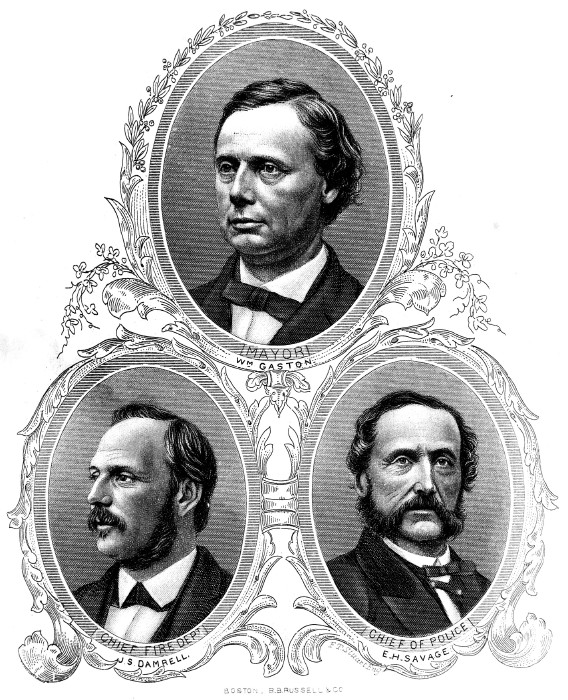 PREFACE.
SCHOLARS
often
regret, that, in their careful research, so few descriptive accounts
can be
found of the great conflagrations which destroyed the ancient cities of
Europe
and Asia; and writers frequently suffer much inconvenience because the
extensive fires of modern times have not been more fully and concisely
described by the pen of the historian. It is to
supply
such future demands, as well as to place before the present generation
a
readable and trustworthy account of the great fire in Boston, that the
author
undertakes this delicate and arduous work. COLLEGE HILL,
SOMERVILLE, MASS.,
Nov. 16, 1872.
ACKNOWLEDGMENTS. THE thanks
of the
author are due to many gentlemen for kindly assistance, and to ladies
in
securing information for this volume. The haste with which such a work
must be
prepared in order to meet the public demand has made the cheerful aid
which his
friends have so freely extended of great value to him. He would
therefore
express his gratitude in this manner to the following gentlemen: Hon.
Nathaniel
B. Shurtleff, Hon. William Gaston, Gen. James A. Cunningham, Hon.
William Gray,
Mrs. William Claflin, Col. Charles H. Taylor, Mr. Edward P. Bond of the
New-England Shoe and Leather Association, Hon. A. H. Rice, Col. E. H.
Savage,
Mr. E. M. Bacon, Mr. John S. Damrell, Mr. B. F. Priest of “The Daily
Transcript,” Mr. W. D. Hayden, Mr. L. G. Farmer, Hon. J. M. S.
Williams, Mrs.
William H. Hartshorn, and Miss Emma S. Dow.
The
First Settler.
— The Massachusetts Colony at Charlestown. — The
Wonderful Spring. — Gov.
Winthrop. — First Streets. — Growth of the Colony.
— Widow Anne Tuthill’s
Windmill. — Curious Laws. — First Church.
— North Church. — old South Church. —
King’s Chapel. — Trinity Church. — St.
Stephen’s Church. — Home of Benjamin
Franklin. — Fort Hill. — Names of Streets.
— The Mineral Spring. — Quaker
Meeting-House. — Historic Localities Address of
Hon.
Robert C. Winthrop. — Great Fire on Hanover Street. — First
Fire-Company. —
Conflagration in Dock Square. — First Fire-Department. — Blowing up
Houses. —
Destruction of Cornhill by Fire. — Second Fire on Cornhill. — First
Contributions
in Aid of Sufferers by Fire. — Church-street District. — other Fires. Saturday
Evening. —
An Hour before the Fire. — Boston Happy. —
Presentiments. — The Horse-Disease.
— ominous Indications of the Coming Calamity. —
Editorial Dinner. — Shop-Girls.
— Millionnaires. — Thoughtlessness in Time of
Alarm. — Box 52. — The Weather. —
State House. Leman
Klous’s
Building. — origin of the Fire. — Its Discovery. — Appearance. — The
Alarm. —
Arrival of the Engines. — Description of the Wild Fire. — The
Excitement. —
Beebe’s Block. — The Raging Demons of Fire. — Otis Street. — Summer
Street. —
Bedford Street. — Against the Wind. — Destruction of Dry-Goods. —
Trinity
Church Hawley
Street. —
Franklin Street. — Business-Houses destroyed. — Arch Street. —
Devonshire
Street. — Franklin Street. — Progress of the Flames. — The Flagstaff. —
Federal
Street. — Congress Street. — The Ruined Ones. — The Whirlwind. — The
Boot and
Shoe Marts. — Pearl Street. — Oliver Street. — Milk Street. New
Post-office. —
The Beginning of the End. — Battling the Flames. — Congress Street. —
Liberty
Square. — Lindall Street. — Broad Street. — The old Post-office. —
Removal of
the Mails. — The Horrid Din. — Sublime Scenes. — Boston by Firelight. —
Boston
by Gaslight.
74-78 Citizens
of Boston.
— Their Faith. — Confidence in tho Fire-Department.
— Waiting too Long. — Excited
Crowds. — Saving of Merchandise. — Fear and Dismay.
— Call for Powder. — The
Awful Uproar. — Moving Household Furniture. —
Scenes Distant from the Fire. —
The Firemen. — Crowded Streets. — The Morning.
— Sight-Seers. — The Soldiery. —
Comparison with a Bombarded City. Appearance
of the
Burnt District. — Blockaded Streets. — Bewildered Explorers. — Safes
and
Vaults. — Visitors. — Sentinels. — Cragged Walls. — The Ruins by
Moonlight. —
Gradual Expiration of the Fires. — Clearing the Streets. —
Photographers. — New
Post-office Building. — Militia Lines. — Strangers in Boston. — First
Week
after the Fire. True
Heroes. —
Death by Fire. — Frank D. Olmstead. — His Self-Sacrifice. — Albert C.
Abbott. —
Lewis Porter Abbott. — Capt. Daniel Cochrane. — Walter S. Twombly. —
Capt.
William Farry. — William S. Frazer. — others injured and killed 100-109
Turning to the
Almighty. — Sermons on the Fire. — Rev. Dr. Manning. — Rev. W. H. H.
Murray. —
Rev. W. R. Alger. — Rev. Dr. Webb. — Rev. John F. Beckley. — Rev. Dr.
Bartol. —
Rev. Phillips Brooks. — Rev. J. R. Cushing. — Rev. A. J. Gordon. — Rev.
W. H.
Baldwin. — Rev. J. F. W. Ware. — Rev. George L. Chaney. — Rev. W. F.
Mallalieu.
— Rev. S. K. Lothrop, D.D. — Rev. Robert Collyer. — Rev. James B. Dunn.
— Rev.
Dr. Lorimer. — Rev. J. J. Lewis. — Rev. V.M. Simons. — Rev. Rollin H.
Neale. —
Rev. Dr. Talmage. Rev. Henry Ward Beecher. Chicago
the First
to offer Assistance. — Wirt Dexter’s Speech.
— Boston’s Sympathy for Chicago. —
Resolutions. — Despatch from D. L. Moody. — The
Masons of Chicago. — Arrival of
Chicago Relief Committee. — Speech of Rev. Robert Laird
Collier. — Report of
the Chicago Relief Committee. — New-York Chamber of Commerce.
— Speech of Hon.
William A. Dodge. — Brooklyn, N.Y. — St. Louis.
— Other Cities. — old Boston in
England. The Section of the
City destroyed. — Homeless Ones. — Relief Committee. — Names. —
Resolutions. —
Navy-Yard Employment. — Report of a Committee Meeting. — Hesitation
about
receiving Aid from Abroad. — Miss Jennie Collins and the Sewing-Girls.
— Kinds
of Employment. — How the Work was done. — Rather work than beg. —
Generous
Giving. — Protest against the Issue of more Currency. — Temporary
Provision fox
All. Past Services of
the Fire-Department. — Lack of Water. — No Horses. — First
Hose-Carriage at the
Fire. — First Steamer. — Different Alarms. — Chief Engineer Damrell. —
Companies from out of Town. — Unadjustable Hose. — Heroic Conduct. —
Sad Fate.
— Protest of the Board of Engineers. — Blowing up Buildings. — Mr.
Damrell
objects to the Use of Powder. — Is persuaded to use it. — Effectiveness
of the
Explosion — Major-Gen. Benham. — Gifts for the Relief of Firemen. — The
Board
of Engineers Promptness of the
Soldiers. — Excellent Performance of Duty. — Gen. Cunning-ham’s order.
— Names
of the Military Organizations. — Conflict of Orders. — Ludicrous
Exhibition of
Military Rule. — Clearing City Hall. — Troops in the old South Church.
— Field
and Staff. — Farewell order of Gen. I. S. Barrill. Making Arrests. —
Capturing Stolen Property. — Mistaken Vigilance. — The Jails filled. —
Class of
People arrested. — The Small Number proved to be Dishonest. — The State
Police.
— Dark Night. — Drunkenness. — Closing of Liquor-Saloons. — New-York
Roughs. —
Their Interception. — Police Relief Fund. Boot
and Shoe
Trade. — Early Manufactories. — Shoe and Leather Trade
Fifty Years Ago. —
Wilde’s Hotel. — The First Traders. — The Hon. Amasa
Walker. — Moving into
Pearl Street. — South Street. — Pearl Street before the
Shoe-Dealers. — Amount
of Trade. — The American House. — Statement of Losses.
— Occupation of Fort
Hill. — The Wool-Trade. — Amounts imported. — Amount
destroyed. — The
Paper-Trade. — Large Houses destroyed. — Effect on the
Market. — The Dry Goods Trade. — Enormous Stock
destroyed. — The Clothing-Business. — The
Hardware-Trade. — Number of Firms burned out. Character of
Insurance. — Amount of Losses. — Companies paying in Full. — Formation
of New
Companies. — Resolution of the Relief Committee. — Necessity for a City
Loan. —
Meeting of the Governor’s Council. — Speech of the Hon. William Gray
and
Others. — Application by the Insurance-Companies. — Proclamation by the
Governor. — Convening of the Legislature
“The
Boston Daily
Evening Transcript” — Historical Notice.
— Description of the Building. — “The
Boston Post.” — Narrow Escape from Destruction.
— ”The American Homes.” —
Suffering the Second Time. — “The Pilot.”
— Mr. Donahoe’s loss. — ”
Waverley
Magazine.” — ”Boston Journal of
Commerce” — ”The Saturday-evening
Gazette.” —
List of Periodicals burned out. — State Printers. Report of
United-States Signal-officer. — The Police from other Cities. — The
Heaviest
Losers. — Resolutions by the Lumber-Dealers. — The Removal of Bullion
from the
Sub-Treasury. — The Work of opening Safes. — Destruction of the Vault
belonging
to the Freeman’s National Bank. — Five-cent Savings Bank. — Emigrant
Savings
Bank. — The Loss to Harvard College. — Remarkable Incidents. — The
Insurance-Companies. — The Methodist Seminary. — Straightening Streets.
—
Mansard Roofs. — Boston, Hartford, and Erie Railroad Station. —
Breaking-out of
the Second Fire. — Rand, Avery, and Co. — The Third Fire. — The old
South
Church. — The Chicago Fire. The
Little Leader
of the Blind. — An Heroic Boy. — Boston by
Candlelight. — Payment of Gas-Bills.
— Curiosity. — Gratitude. — The Stampede
of Irish Tenants. — Harriet Beecher
Stowe. — Generous Action of Boston Merchants. —
Relic-Hunters. — Return of
Stolen Property. — Incidents connected with Safes.
— The Burning of “The Pilot”
Office. — Appearance of the Business-Men. — Solvent
Insurance-Companies. —
Extortionate Draymen. — South Boston under Fire. —
Burning to Death. —
Ludicrous Signs. — “Her Clara.”
— “Cannot beat Chicago.” —
Passing the Guards. |