 Web
and Book design image, Web
and Book design image, Copyright, Kellscraft Studio 1999-2006 (Return to Web Text-ures) |
Return to the Previous Chapter |
 (HOME) |
|
VII. JASON
AND MEDEA
 ASON
and
Medea, unable to win to Iolcus, stayed at Corinth, at the court of King
Creon.
Creon was proud to have Jason in his city, but of Medea the king was
fearful,
for he had heard how she had brought about the death of Apsyrtus, her
brother. ASON
and
Medea, unable to win to Iolcus, stayed at Corinth, at the court of King
Creon.
Creon was proud to have Jason in his city, but of Medea the king was
fearful,
for he had heard how she had brought about the death of Apsyrtus, her
brother. Medea
wearied of this long waiting in the palace of King Creon. A longing
came upon
her to exercise her powers of enchantment. She did not forget what
Queen Arete
had said to her — that if she wished to appease the wrath of the gods
she
should have no more to do with enchantments. She did not forget this,
but still
there grew in her a longing to use all her powers of enchantment. And Jason,
at the court of King Creon, had his longings, too. He longed to enter
Iolcus
and to show the people the Golden Fleece that he had won; he longed to
destroy
Pelias, the murderer of his mother and father; above all he longed to
be a
king, and to rule in the kingdom that Cretheus had founded Once Jason
spoke to Medea of his longing. “O Jason,” Medea said, “I have done many
things
for thee and this thing also I will do. I will go into Iolcus, and by
my
enchantments I will make clear the way for the return of the Argo
and for thy
return with thy comrades — yea, and for thy coming to the kingship, O
Jason.” He should
have remembered then the words of Queen Arete to Medea, but the longing
that he
had for his triumph and his revenge was in the way of his remembering.
He said,
“O Medea, help me in this with all thine enchantments and thou wilt be
more
dear to me than ever before thou wert.” Medea then
went forth from the palace of King Creon and she made more terrible
spells than
ever she had made in Colchis. All night she stayed in a tangled place
weaving
her spells. Dawn came, and she knew that the spells she had woven had
not been
in vain, for beside her there stood a car that was drawn by dragons. Medea the
Enchantress had never looked on these dragon shapes before. When she
looked
upon them now she was fearful of them. But then she said to herself, “I
am
Medea, and I would be a greater enchantress and a more cunning woman
than I
have been, and what I have thought of, that will I carry out.” She
mounted the
car drawn by the dragons, and in the first light of the day she went
from
Corinth. To the
places where grew the herbs of magic Medea journeyed in her
dragon-drawn car —
to the Mountains Ossa, Pelion, Œthrys, Pindus, and Olympus; then to the
rivers
Apidanus, Enipeus, and Peneus. She gathered herbs on the mountains and
grasses
on the rivers’ banks; some she plucked up by the roots and some she cut
with
the curved blade of a knife. When she had gathered these herbs and
grasses she
went back to Corinth on her dragon-drawn car. Then Jason saw her; pale and drawn was her face, and her eyes were strange and gleaming. He saw her standing by the car drawn by the dragons, and a terror of Medea came into his mind. He went toward her, but in a harsh voice she bade him not come near to disturb the brewing that she was going to begin. Jason turned away. As he went toward the palace he saw Glauce, King Creon’s daughter; the maiden was coming from the well and she carried a pitcher of water. He thought how fair Glauce looked in the light of the morning, how the wind played with her hair and her garments, and how far away she was from witcheries and enchantments. 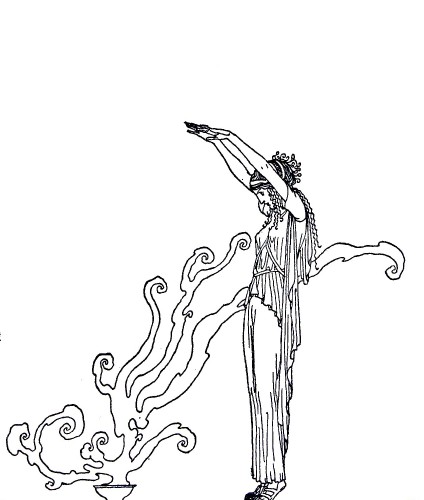 As for
Medea, she placed in a heap beside her the magic herbs and grasses she
had
gathered. Then she put them in a bronze pot and boiled them in water
from the
stream. Soon froth came on the boiling, and Medea stirred the pot with
a
withered branch of an apple tree. The branch was withered — it was
indeed no
more than a dry stick, but as she stirred the herbs and grasses with
it, first
leaves, then flowers, and lastly, bright gleaming apples came on it.
And when
the pot boiled over and drops from it fell upon the ground, there grew
up out
of the dry earth soft grasses and flowers. Such was the power of
renewal that
was in the magical brew that Medea had made. She filled
a phial with the liquid she had brewed, and she scattered the rest in
the wild
places of the garden. Then, taking the phial and the apples that had
grown on
the withered branch, she mounted the car drawn by the dragons, and she
went
once more from Corinth. On she
journeyed in her dragon-drawn car until she came to a place that was
near to
Iolcus. There the dragons descended. They had come to a dark pool.
Medea,
making herself naked, stood in that dark pool. For a while she looked
down upon
herself, seeing in the dark water her white body and her lovely hair.
Then she
bathed herself in the water. Soon a dread change came over her: she saw
her
hair become scant and gray, and she saw her body become bent and
withered. She
stepped out of the pool a withered and witchlike woman; when she
dressed
herself the rich clothes that she had worn before hung loosely upon
her, and
she looked the more forbidding because of them. She bade the dragons
go, and
they flew through the air with the empty car. Then she hid in her dress
the
phial with the liquid she had brewed and the apples that had grown upon
the
withered branch. She picked up a stick to lean upon, and with the gait
of an
ancient woman she went hobbling upon the road to Iolcus. On the
streets of the city the fierce fighting men that Pelias had brought
down from
the mountains showed themselves; few of the men or women of the city
showed
themselves even in the daytime. Medea went through the city and to the
palace
of King Pelias. But no one might enter there, and the guards laid hands
upon
her and held her. Medea did
not struggle with them. She drew from the folds of her dress one of the
gleaming apples that she carried and she gave it to one of the guards.
“It is
for King Pelias,” she said. “Give the apple to him and then do with me
as the
king would have you do.” The guards
brought the gleaming apple to the king. When he had taken it into his
hand and
had smelled its fragrance, old trembling Pelias asked where the apple
had come
from. The guards told him it had been brought by an ancient woman who
was now
outside seated on a stone in the courtyard. He looked
on the shining apple and he felt its fragrance and he could not help
thinking,
old trembling Pelias, that this apple might be the means of bringing
him back
to the fullness of health and courage that he had had before. He sent
for the
ancient woman who had brought it that she might tell him where it had
come from
and who it was that had sent it to him. Then the guards brought Medea
before
him. She saw an
old man, white-faced and trembling, with shaking hands and eyes that
looked on
her fearfully. “Who are you,” he asked, “and from whence came the apple
that
you had them bring me?” Medea,
standing before him, looked a withered and shrunken beldame, a woman
bent with
years, but yet with eyes that were bright and living. She came near him
and she
said: “The apple, O King, came from the garden that is watched over by
the
Daughters of the Evening Land. He who eats it has a little of the
weight of old
age taken from him. But things more wonderful even than the shining
apples grow
in that far garden. There are plants there the juices of which make
youthful
again all aged and failing things. The apple would bring you a little
way
toward the vigor of your prime. But the juices I have can bring you to
a time
more wonderful — back even to the strength and the glory of your
youth.” When the
king heard her say this a light came into his heavy eyes, and his hands
caught
Medea and drew her to him. “Who are you?” he cried, “who speak of the
garden
watched over by the Daughters of the Evening Land? Who are you who
speak of
juices that can bring back one to the strength and glory of his youth?”
Medea
answered: “I am a woman who has known many and great griefs, O king. My
griefs
have brought me through the world. Many have searched for the garden
watched
over by the Daughters of the Evening Land, but I came to it
unthinkingly, and
without wanting them I gathered the gleaming apples and took from the
plants
there the juices that can bring youth back.” Pelias
said: “If you have been able to come by those juices, how is it that
you remain
in woeful age and decrepitude?” She said:
“Because of my many griefs, king, I would not renew my life. I would be
ever
nearer death and the end of all things. But you are a king and have all
things
you desire at your hand — beauty and state and power. Surely if any one
would
desire it, you would desire to have youth back to you.” Pelias,
when he heard her say this, knew that besides youth there was nothing
that he
desired. After crimes that had gone through the whole of his manhood he
had
secured for himself the kingdom that Cretheus had founded. But old age
had come
on him, and the weakness of old age, and the power he had won was
falling from
his hands. He would be overthrown in his weakness, or else he would
soon come
to die, and there would be an end then to his name and to his kingship.
How
fortunate above all kings he would be, he thought, if it could be that
some one
should come to him with juices that would renew his youth! He looked
longingly
into the eyes of the ancient-seeming woman before him, and he said:
“How is it
that you show no gains from the juices that you speak of? You are old
and in
woeful decrepitude. Even if you would not win back to youth you could
have got
riches and state for that which you say you possess.” Then Medea
said: “I have lost so much and have suffered so much that I would not
have
youth back at the price of facing the years. I would sink down to the
quiet of
the grave. But I hope for some ease before I die — for the ease that is
in
king’s houses, with good food to eat, and rest, and servants to wait
upon one’s
aged body. These are the things I desire, O Pelias, even as you desire
youth.
You can give me such things, and I have come to you who desire youth
eagerly
rather than to kings who have a less eager desire for it. To you I will
give
the juices that bring one back to the strength and the glory of youth.”
Pelias
said: “I have only your word for it that you possess these juices. Many
there
are who come and say deceiving things to a king.” Said
Medea: “Let there be no more words between us, O king. To-morrow I will
show
you the virtue of the juices I have brought with me. Have a great vat
prepared
— a vat that a man could lay himself in with the water covering him.
Have this
vat filled with water, and bring to it the oldest creature you can get
— a ram
or a goat that is the oldest of their flock. Do this, O king, and you
will be
shown a thing to wonder at and to be hopeful over.” So Medea
said, and then she turned around and left the king’s presence. Pelias
called to
his guards and he bade them take the woman into their charge and treat
her
considerately. The guards took Medea away. Then all day the king mused
on what
had been told him and a wild hope kept beating about his heart. He had
the
servants prepare a great vat in the lower chambers, and he had his
shepherd
bring him a ram that was the oldest in the flock. Only Medea
was permitted to come into that chamber with the king; the ways to it
were
guarded, and all that took place in it was secret. Medea was brought to
the
closed door by her guard. She opened it and she saw the king there and
the vat
already prepared; she saw a ram tethered near the vat. Medea
looked upon the king. In the light of the torches his face was white
and fierce
and his mouth moved gaspingly. She spoke to him quietly, and said:
“There is no
need for you to hear me speak. You will watch a great miracle, for
behold! the
ram which is the oldest and feeblest in the flock will become young and
invigorated when it comes forth from this vat.” She
untethered the ram, and with the help of Pelias drew it to the vat.
This was
not hard to do, for the beast was very feeble; its feet could hardly
bear it
upright, its wool was yellow and stayed only in patches on its shrunken
body.
Easily the beast was forced into the vat. Then Medea drew the phial out
of her
bosom and poured into the water some of the brew she had made in
Creon’s garden
in Corinth. The water in the vat took on a strange bubbling, and the
ram sank
down. Then
Medea, standing beside the vat, sang an incantation. “O Earth,”
she sang, “O Earth who dost provide wise men with potent herbs, O Earth
help me
now. I am she who can drive the clouds; I am she who can dispel the
winds; I am
she who can break the jaws of serpents with my incantations; I am she
who can
uproot living trees and rocks; who can make the mountains shake; who
can bring
the ghosts from their tombs. O Earth, help me now.” At this strange
incantation
the mixture in the vat boiled and bubbled more and more. Then the
boiling and bubbling
ceased. Up to the surface came the ram. Medea helped it to struggle out
of the
vat, and then it turned and smote the vat with its head. Pelias
took down a torch and stood before the beast. Vigorous indeed was the
ram, and
its wool was white and grew evenly upon it. They could not tether it
again, and
when the servants were brought into the chamber it took two of them to
drag
away the ram. The king
was most eager to enter the vat and have Medea put in the brew and
speak the
incantation over it. But Medea bade him wait until the morrow. All
night the
king lay awake, thinking of how he might regain his youth and his
strength and
be secure and triumphant thereafter. At the
first light he sent for Medea and he told her that he would have the
vat made ready
and that he would go into it that night. Medea looked upon him, and the
helplessness that he showed made her want to work a greater evil upon
him, or,
if not upon him, upon his house. How soon it would have reached its
end, all
her plot for the destruction of this king! But she would leave in the
king’s
house a misery that would not have an end so soon. So she
said to the king: “I would say the incantation over a beast of the
field, but
over a king I could not say it. Let those of your own blood be with you
when
you enter the vat that will bring such change to you. Have your
daughters
there. I will give them the juice to mix in the vat, and I will teach
them the
incantation that has to be said.” So she
said, and she made Pelias consent to having his daughters and not Medea
in the
chamber of the vat. They were sent for and they came before Medea, the
daughters of King Pelias. They were
women who had been borne down by the tyranny of their father; they
stood before
him now, two dim-eyed creatures, very feeble and fearful. To them Medea
gave
the phial that had in it the liquid to mix in the vat; also she taught
them the
words of the incantation, but she taught them to use these words
wrongly. The vat
was prepared in the lower chambers; Pelias and his daughters went
there, and
the chamber was guarded, and what happened there was in secret. Pelias
went
into the vat; the brew was thrown into it, and the vat boiled and
bubbled as
before. Pelias sank down in it. Over him then his daughters said the
magic words
as Medea had taught them. Pelias
sank down, but he did not rise again. The hours went past and the
morning came,
and the daughters of King Pelias raised frightened laments. Over the
sides of
the vat the mixture boiled and bubbled, and Pelias was to be seen at
the bottom
with his limbs stiffened in death. Then the
guards came, and they took King Pelias out of the vat and left him in
his royal
chamber. The word went through the palace that the king was dead. There
was a
hush in the palace then, but not the hush of grief. One by one servants
and
servitors stole away from the palace that was hated by all. Then there
was
clatter in the streets as the fierce fighting men from the mountains
galloped
away with what plunder they could seize. And through all this the
daughters of
King Pelias sat crouching in fear above the body of their father. And Medea,
still an ancient woman seemingly, went through the crowds that now came
on the
streets of the city. She told those she went amongst that the son of
Æson was
alive and would soon be in their midst. Hearing this the men of the
city formed
a council of elders to rule the people until Jason’s coming. In such
way Medea
brought about the end of King Pelias’s reign. In triumph
she went through the city. But as she was passing the temple her dress
was
caught and held, and turning around she faced the ancient priestess of
Artemis,
Iphias. “Thou art Æetes’s daughter,” Iphias said, “who in deceit didst
come
into Iolcus. Woe to thee and woe to Jason for what thou hast done this
day! Not
for the slaying of Pelias art thou blameworthy, but for the misery that
thou
hast brought upon his daughters by bringing them into the guilt of the
slaying.
Go from the city, daughter of King Æetes; never, never wilt thou come
back into
it.” But little
heed did Medea pay to the ancient priestess, Iphias. Still in the guise
of an
old woman she went through the streets of the city, and out through the
gate
and along the highway that led from Iolcus. To that dark pool she came
where
she had bathed herself before. But now she did not step into the pool
nor pour
its water over her shrinking flesh; instead she built up two altars of
green
sods — an altar to Youth and an altar to Hecate, queen of the witches;
she
wreathed them with green boughs from the forest, and she prayed before
each.
Then she made herself naked, and she anointed herself with the brew she
had
made from the magical herbs and grasses. All marks of age and
decrepitude left
her, and when she stood over the dark pool and looked down on herself
she saw
that her body was white and shapely as before, and that her hair was
soft and
lovely. She stayed all night between the tangled wood and the dark pool, and with the first light the car drawn by the scaly dragons came to her. She mounted the car, and she journeyed back to Corinth. 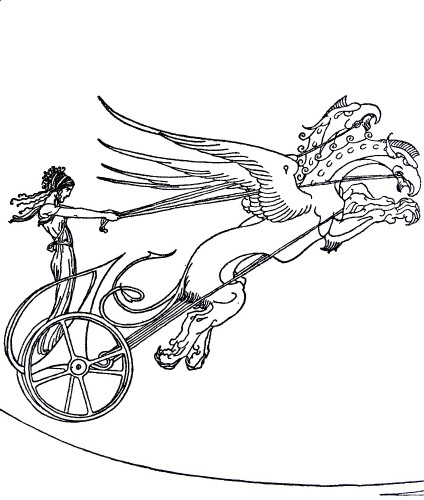 Into
Jason’s mind a fear of Medea had come since the hour when he had seen
her mount
the car drawn by the scaly dragons. He could not think of her any more
as the
one who had been his companion on the Argo. He thought of her as one
who could
help him and do wonderful things for him, but not as one whom he could
talk
softly and lovingly to. Ah, but if Jason had thought less of his
kingdom and
less of his triumphing with the Fleece of Gold, Medea would not have
had the
dragons come to her. And now
that his love for Medea had altered, Jason noted the loveliness of
another — of
Glauce, the daughter of Creon, the King of Corinth. And Glauce, who had
red
lips and the eyes of a child, saw in Jason who had brought the Golden
Fleece
out of Colchis the image of every hero she had heard about in stories.
Creon,
the king, often brought Jason and Glauce together, for his hope was
that the
hero would wed his daughter and stay in Corinth and strengthen his
kingdom. He
thought that Medea, that strange woman, could not keep a companionship
with
Jason. Two were
walking in the king’s garden, and they were Jason and Glauce. A shadow
fell
between them, and when Jason looked up he saw Medea’s dragon car. Down
flew the
dragons, and Medea came from the car and stood between Jason and the
princess.
Angrily she spoke to him. “I have made the kingdom ready for your
return,” she
said, “but if you would go there you must first let me deal in my own
way with
this pretty maiden.” And so fiercely did Medea look upon her that
Glauce shrank
back and clung to Jason for protection. “O, Jason,” she cried, “thou
didst say
that I am such a one as thou didst dream of when in the forest with
Chiron,
before the adventure of the Golden Fleece drew thee away from the
Grecian
lands. Oh, save me now from the power of her who comes in the dragon
car.” And
Jason said: “I said all that thou hast said, and I will protect thee, O
Glauce.” And then
Medea thought of the king’s house she had left for Jason, and of the
brother
whom she had let be slain, and of the plot she had carried out to bring
Jason
back to Iolcus, and a great fury came over her. In her hand she took
foam from
the jaws of the dragons, and she cast the foam upon Glance, and the
princess
fell back into the arms of Jason with the dragon foam burning into her.
Then,
seeing in his eyes that he had forgotten all that he owed to her — the
winning
of the Golden Fleece, and the safety of Argo, and the destruction of
the power
of King Pelias — seeing in his eyes that Jason had forgotten all this,
Medea
went into her dragon-borne car and spoke the words that made the scaly
dragons
bear her aloft. She flew from Corinth, leaving Jason in King Creon’s
garden
with Glauce dying in his arms. He lifted her up and laid her upon a
bed, but
even as her friends came around her the daughter of King Creon died.  ND
Jason?
For long he stayed in Corinth, a famous man indeed, but one sorrowful
and
alone. But again there grew in him the desire to rule and to have
possessions.
He called around him again the men whose home was in Iolcus — those who
had
followed him as bright-eyed youths when he first proclaimed his purpose
of
winning the Fleece of Gold. He called them around him, and he led them
on board
the Argo. Once more they lifted sails, and once more they took
the Argo into
the open sea. ND
Jason?
For long he stayed in Corinth, a famous man indeed, but one sorrowful
and
alone. But again there grew in him the desire to rule and to have
possessions.
He called around him again the men whose home was in Iolcus — those who
had
followed him as bright-eyed youths when he first proclaimed his purpose
of
winning the Fleece of Gold. He called them around him, and he led them
on board
the Argo. Once more they lifted sails, and once more they took
the Argo into
the open sea. Toward
Iolcus they sailed; their passage was fortunate, and in a short time
they
brought the Argo safely into the harbor of Pagasæ. Oh, happy
were the crowds
that came thronging to see the ship that had the famous Fleece of Gold
upon her
masthead, and green and sweet smelling were the garlands that the
people
brought to wreathe the heads of Jason and his companions! Jason looked
upon the
throngs, and he thought that much had gone from him, but he thought
that
whatever else had gone something remained to him — to be a king and a
great
ruler over a people. And so
Jason came back to Iolcus. The Argo he made a blazing pile of
in sacrifice to
Poseidon, the god of the sea. The Golden Fleece he hung in the temple
of the
gods. Then he took up the rule of the kingdom that Cretheus had
founded, and he
became the greatest of the kings of Greece. And to Iolcus there came, year after year, young men who would look upon the gleaming thing that was hung there in the temple of the gods. And as they looked upon it, young man after young man, the thought would come to each that he would make himself strong enough and heroic enough to win for his country something as precious as Jason’s GOLDEN FLEECE. And for all their lives they kept in mind the words that Jason had inscribed upon a pillar that was placed beside the Fleece of Gold — the words that Triton spoke to the Argonauts when they were fain to win their way out of the inland sea:
|
Web and Book design,
Copyright, Kellscraft Studio
1999-2006
(Return to Web Text-ures)