 Web
and Book design,
Web
and Book design, Copyright, Kellscraft Studio 1999-2006 (Return to Web Text-ures) |
Click
Here to return to Golden Fleece Content Page Return to the Previous Chapter |
 (HOME) |
|
IV. THE
LIFE AND LABORS OF HERACLES
I  ERACLES
was the son of Zeus, but he was born into the family of a mortal king.
When he
was still a youth, being overwhelmed by a madness sent upon him by one
of the
goddesses, he slew the children of his brother Iphicles. Then, coming
to know
what he had done, sleep and rest went from him: he went to Delphi, to
the shrine
of Apollo, to be purified of his crime. ERACLES
was the son of Zeus, but he was born into the family of a mortal king.
When he
was still a youth, being overwhelmed by a madness sent upon him by one
of the
goddesses, he slew the children of his brother Iphicles. Then, coming
to know
what he had done, sleep and rest went from him: he went to Delphi, to
the shrine
of Apollo, to be purified of his crime. At Delphi,
at the shrine of Apollo, the priestess purified him, and when she had
purified
him she uttered this prophecy: “From this day forth thy name shall be,
not
Alcides, but Heracles. Thou shalt go to Eurystheus, thy cousin, in
Mycenæ, and
serve him in all things. When the labors he shall lay upon thee are
accomplished, and when the rest of thy life is lived out, thou shalt
become one
of the immortals.” Heracles, on hearing these words, set out for
Mycenæ. He stood
before his cousin who hated him; he, a towering man, stood before a
king who
sat there weak and trembling. And Heracles said, “I have come to take
up the
labors that you will lay upon me; speak now, Eurystheus, and tell me
what you
would have me do.” Eurystheus,
that weak king, looking on the young man who stood as tall and as firm
as one
of the immortals, had a heart that was filled with hatred. He lifted up
his
head and he said with a frown: “There is
a lion in Nemea that is stronger and more fierce than any lion known
before.
Kill that lion, and bring the lion’s skin to me that I may know that
you have
truly performed your task.” So Eurystheus said, and Heracles, with
neither
shield nor arms, went forth from the king’s palace to seek and to
combat the
dread lion of Nemea. He went on
until he came into a country where the fences were overthrown and the
fields
wasted and the houses empty and fallen. He went on until he came to the
waste
around that land: there he came on the trail of the lion; it led up the
side of
a mountain, and Heracles, without shield or arms, followed the trail. He heard
the roar of the lion. Looking up he saw the beast standing at the mouth
of a
cavern, huge and dark against the sunset. The lion roared three times,
and then
it went within the cavern. Around the
mouth were strewn the bones of creatures it had killed and carried
there.
Heracles looked upon them when he came to the cavern. He went within.
Far into
the cavern he went, and then he came to where he saw the lion. It was
sleeping.
Heracles viewed the terrible bulk of the lion, and then he looked upon his own knotted hands and arms. He remembered that it was told of him that, while still a child of eight months, he had strangled a great serpent that had come to his cradle to devour him. He had grown and his strength had grown too. 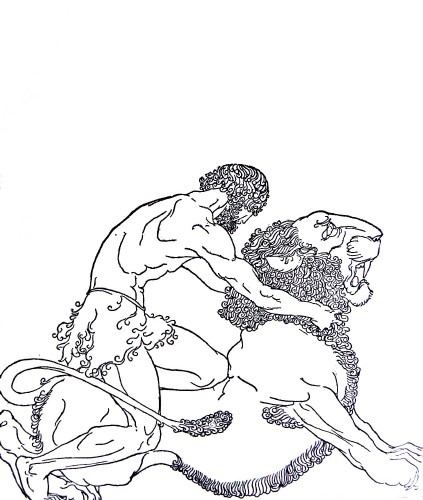 So he
stood, measuring his strength and the size of the lion. The breath from
its
mouth and nostrils came heavily to him as the beast slept, gorged with
its
prey. Then the lion yawned. Heracles sprang on it and put his great
hands upon
its throat. No growl came out of its mouth, but the great eyes blazed
while the
terrible paws tore at Heracles. Against the rock Heracles held the
beast;
strongly he held it, choking it through the skin that was almost
impenetrable.
Terribly the lion struggled; but the strong hands of the hero held
around its
throat until it struggled no more. Then
Heracles stripped off that impenetrable skin from the lion’s body; he
put it
upon himself for a cloak. Then, as he went through the forest, he
pulled up a
young oak tree and trimmed it and made a club for himself. With the
lion’s skin
over him — that skin that no spear or arrow could pierce — and carrying
the
club in his hand he journeyed on until he came to the palace of King
Eurystheus. The king,
seeing coming toward him a towering man all covered with the hide of a
monstrous lion, ran and hid himself in a great jar. He lifted the lid
up to ask
the servants what was the meaning of this terrible appearance. And the
servants
told him that it was Heracles come back with the skin of the lion of
Nemea. On
hearing this Eurystheus hid himself again. He would
not speak with Heracles nor have him come near him, so fearful was he.
But
Heracles was content to be left alone. He sat down in the palace and
feasted
himself. The
servants came to the king; Eurystheus lifted the lid of the jar and
they told
him how Heracles was feasting and devouring all the goods in the
palace. The
king flew into a rage, but still he was fearful of having the hero
before him.
He issued commands through his heralds ordering Heracles to go forth at
once
and perform the second of his tasks. It was to
slay the great water snake that made its lair in the swamps of Lerna.
Heracles
stayed to feast another day, and then, with the lion’s skin across his
shoulders and the great club in his hands, he started off. But this
time he did
not go alone; the boy Iolaus went with him. Heracles
and Iolaus went on until they came to the vast swamp of Lerna. Right in
the
middle of the swamp was the water snake that was called the Hydra. Nine
heads
it had, and it raised them up out of the water as the hero and his
companion
came near. They could not cross the swamp to come to the monster, for
man or
beast would sink and be lost in it. The Hydra remained in the middle of the swamp belching mud at the hero and his companion. Then Heracles took up his bow and he shot flaming arrows at its heads. It grew into such a rage that it came through the swamp to attack him. Heracles swung his club. As the Hydra came near he knocked head after head off its body. 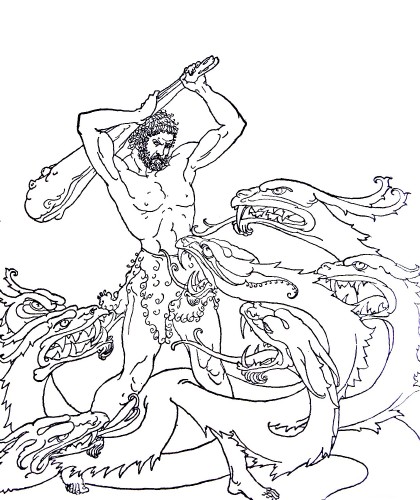 But for
every head knocked off two grew upon the Hydra. And as he struggled
with the
monster a huge crab came out of the swamp, and gripping Heracles by the
foot
tried to draw him in. Then Heracles cried out. The boy Iolaus came; he
killed
the crab that had come to the Hydra’s aid. Then
Heracles laid hands upon the Hydra and drew it out of the swamp. With
his club
he knocked off a head and he had Iolaus put fire to where it had been,
so that
two heads might not grow in that place. The life of the Hydra was in
its middle
head; that head he had not been able to knock off with his club. Now,
with his
hands he tore it off, and he placed this head under a great stone so
that it could
not rise into life again. The Hydra’s life was now destroyed. Heracles
dipped
his arrows into the gall of the monster, making his arrows deadly; no
thing
that was struck by these arrows afterward could keep its life. Again he
came to Eurystheus’s palace, and Eurystheus, seeing him, ran again and
hid
himself in the jar. Heracles ordered the servants to tell the king that
he had
returned and that the second labor was accomplished. Eurystheus,
hearing from the servants that Heracles was mild in his ways, came out
of the
jar. Insolently he spoke. “Twelve labors you have to accomplish for
me,” said
he to Heracles, “and eleven yet remain to be accomplished.” “How?”
said Heracles. “Have I not performed two of the labors? Have I not
slain the
lion of Nemea and the great water snake of Lerna?” “In the
killing of the water snake you were helped by Iolaus,” said the king,
snapping
out his words and looking at Heracles with shifting eyes. “That labor
cannot be
allowed you.” Heracles
would have struck him to the ground. But then he remembered that the
crime that
he had committed in his madness would have to be expiated by labors
performed
at the order of this man. He looked full upon Eurystheus and he said,
“Tell me
of the other labors, and I will go forth from Mycenæ and accomplish
them.” Then
Eurystheus bade him go and make clean the stables of King Augeias.
Heracles
came into that king’s country. The smell from the stables was felt for
miles
around. Countless herds of cattle and goats had been in the stables for
years,
and because of the uncleanness and the smell that came from it the
crops were
withered all around. Heracles told the king that he would clean the
stables if
he were given one tenth of the cattle and the goats for a reward. The king
agreed to this reward. Then Heracles drove the cattle and the goats out
of the
stables; he broke through the foundations and he made channels for the
two
rivers Alpheus and Peneius. The waters flowed through the stables, and
in a day
all the uncleanness was washed away. Then Heracles turned the rivers
back into
their own courses. He was not
given the reward he had bargained for, however. He went
back to Mycenæ with the tale of how he had cleaned the stables. “Ten
labors
remain for me to do now,” he said. “Eleven,”
said Eurystheus. “How can I allow the cleaning of King Augeias’s
stables to you
when you bargained for a reward for doing it?” Then while
Heracles stood still, holding himself back from striking him,
Eurystheus ran
away and hid himself in the jar. Through his heralds he sent word to
Heracles,
telling him what the other labors would be. He was to
clear the marshes of Stymphalus of the man-eating birds that gathered
there; he
was to capture and bring to the king the golden-horned deer of
Coryneia; he was
also to capture and bring alive to Mycenæ the boar of Erymanthus. Heracles
came to the marshes of Stymphalus. The growth of jungle was so dense
that he
could not cut his way through to where the man-eating birds were; they
sat upon
low bushes within the jungle, gorging themselves upon the flesh they
had
carried there. For days
Heracles tried to hack his way through. He could not get to where the
birds
were. Then, thinking he might not be able to accomplish this labor, he
sat upon
the ground in despair. It was
then that one of the immortals appeared to him; for the first and only
time he
was given help from the gods. It was
Athena who came to him. She stood apart from Heracles, holding in her
hands
brazen cymbals. These she clashed together. At the sound of this
clashing the
Stymphalean birds rose up from the low bushes behind the jungle.
Heracles shot
at them with those unerring arrows of his. The man-eating birds fell,
one after
the other, into the marsh. Then
Heracles went north to where the Coryneian deer took her pasture. So
swift of
foot was she that no hound nor hunter had ever been able to overtake
her. For
the whole of a year Heracles kept Golden Horns in chase, and at last,
on the
side of the Mountain Artemision, he caught her. Artemis, the goddess of
the
wild things, would have punished Heracles for capturing the deer, but
the hero
pleaded with her, and she relented and agreed to let him bring the deer
to
Mycenæ and show her to King Eurystheus. And Artemis took charge of
Golden Horns
while Heracles went off to capture the Erymanthean boar. He came to
the city of Psophis, the inhabitants of which were in deadly fear
because of
the ravages of the boar. Heracles made his way up the mountain to hunt
it. Now
on this mountain a band of centaurs lived, and they, knowing him since
the time
he had been fostered by Chiron, welcomed Heracles. One of them, Pholus,
took
Heracles to the great house where the centaurs had their wine stored. Seldom did
the centaurs drink wine; a draft of it made them wild, and so they
stored it
away, leaving it in the charge of one of their band. Heracles begged
Pholus to
give him a draft of wine; after he had begged again and again the
centaur
opened one of his great jars. Heracles
drank wine and spilled it. Then the centaurs that were without smelt
the wine
and came hammering at the door, demanding the drafts that would make
them wild.
Heracles came forth to drive them away. They attacked him. Then he shot
at them
with his unerring arrows and he drove them away. Up the mountain and
away to
far rivers the centaurs raced, pursued by Heracles with his bow. One was
slain, Pholus, the centaur who had entertained him. By accident
Heracles
dropped a poisoned arrow on his foot. He took the body of Pholus up to
the top
of the mountain and buried the centaur there. Afterward, on the snows
of
Erymanthus, he set a snare for the boar and caught him there. Upon his
shoulders he carried the boar to Mycenæ and he led the deer by her
golden
horns. When Eurystheus had looked upon them the boar was slain, but the
deer
was loosed and she fled back to the Mountain Artemision. King
Eurystheus sat hidden in the great jar, and he thought of more terrible
labors
he would make Heracles engage in. Now he would send him oversea and
make him
strive with fierce tribes and more dread monsters. When he had it all
thought
out he had Heracles brought before him and he told him of these other
labors. He was to
go to savage Thrace and there destroy the man-eating horses of King
Diomedes;
afterward he was to go amongst the dread women, the Amazons, daughters
of Ares,
the god of war, and take from their queen, Hippolyte, the girdle that
Ares had
given her; then he was to go to Crete and take from the keeping of King
Minos
the beautiful bull that Poseidon had given him; afterward he was to go
to the
Island of Erytheia and take away from Geryoneus, the monster that had
three
bodies instead of one, the herd of red cattle that the two-headed hound
Orthus
kept guard over; then he was to go to the Garden of the Hesperides, and
from
that garden he was to take the golden apples that Zeus had given to
Hera for a
marriage gift — where the Garden of the Hesperides was no mortal knew. So
Heracles set out on a long and perilous quest. First he went to Thrace,
that
savage land that was ruled over by Diomedes, son of Ares, the war god.
Heracles
broke into the stable where the horses were; he caught three of them by
their
heads, and although they kicked and bit and trampled he forced them out
of the
stable and down to the seashore, where his companion, Abderus, waited
for him.
The screams of the fierce horses were heard by the men of Thrace, and
they,
with their king, came after Heracles. He left the horses in charge of
Abderus
while he fought the Thracians and their savage king. Heracles shot his
deadly
arrows amongst them, and then he fought with their king. He drove them
from the
seashore, and then he came back to where he had left Abderus with the
fierce
horses. They had
thrown Abderus upon the ground, and they were trampling upon him.
Heracles drew
his bow and he shot the horses with the unerring arrows that were
dipped with
the gall of the Hydra he had slain. Screaming, the horses of King
Diomedes
raced toward the sea, but one fell and another fell, and then, as it
came to
the line of the foam, the third of the fierce horses fell. They were
all slain
with the unerring arrows. Then
Heracles took up the body of his companion and he buried it with proper
rights,
and over it he raised a column. Afterward, around that column a city
that bore
the name of Heracles’s friend was built. Then
toward the Euxine Sea he went. There, where the River Themiscyra flows
into the
sea he saw the abodes of the Amazons. And upon the rocks and the steep
place he
saw the warrior women standing with drawn bows in their hands. Most
dangerous
did they seem to Heracles. He did not know how to approach them; he
might shoot
at them with his unerring arrows, but when his arrows were all shot
away, the
Amazons, from their steep places, might be able to kill him with the
arrows
from their bows. While he
stood at a distance, wondering what he might do, a horn was sounded and
an
Amazon mounted upon a white stallion rode toward him. When the
warrior-woman
came near she cried out, “Heracles, the Queen Hippolyte permits you to
come
amongst the Amazons. Enter her tent and declare to the queen what has
brought
you amongst the never-conquered Amazons.” Heracles
came to the tent of the queen. There stood tall Hippolyte with an iron
crown
upon her head and with a beautiful girdle of bronze and iridescent
glass around
her waist. Proud and fierce as a mountain eagle looked the queen of the
Amazons: Heracles did not know in what way he might conquer her.
Outside the
tent the Amazons stood; they struck their shields with their spears,
keeping up
a continuous savage din. “For what
has Heracles come to the country of the Amazons?” Queen Hippolyte
asked. “For the
girdle you wear,” said Heracles, and he held his hands ready for the
struggle. “Is it for
the girdle given me by Ares, the god of war, that you have come,
braving the
Amazons, Heracles?” asked the queen. “For
that,” said Heracles. “I would
not have you enter into strife with the Amazons,” said Queen Hippolyte.
And so
saying she drew off the girdle of bronze and iridescent glass, and she
gave it
into his hands. Heracles
took the beautiful girdle into his hands. Fearful he was that some
piece of
guile was being played upon him, but then he looked into the open eyes
of the
queen and he saw that she meant no guile. He took the girdle and he put
it
around his great brows; then he thanked Hippolyte and he went from the
tent. He
saw the Amazons standing on the rocks and the steep places with bows
bent;
unchallenged he went on, and he came to his ship and he sailed away
from that country
with one more labor accomplished. The labor
that followed was not dangerous. He sailed over sea and he came to
Crete, to
the land that King Minos ruled over. And there he found, grazing in a
special
pasture, the bull that Poseidon had given King Minos. He laid his hands
upon
the bull’s horns and he struggled with him and he overthrew him. Then
he drove
the bull down to the seashore. His next
labor was to take away the herd of red cattle that was owned by the
monster
Geryoneus. In the Island of Erytheia, in the middle of the Stream of
Ocean,
lived the monster, his herd guarded by the two-headed hound Orthus —
that hound
was the brother of Cerberus, the three-headed hound that kept guard in
the
Underworld. Mounted
upon the bull given Minos by Poseidon, Heracles fared across the sea.
He came
even to the straits that divide Europe from Africa, and there he set up
two
pillars as a memorial of his journey — the Pillars of Heracles that
stand to
this day. He and the bull rested there. Beyond him stretched the Stream
of
Ocean; the Island of Erytheia was there, but Heracles thought that the
bull
would not be able to bear him so far. And there
the sun beat upon him, and drew all strength away from him, and he was
dazed
and dazzled by the rays of the sun. He shouted out against the sun, and
in his
anger he wanted to strive against the sun. Then he drew his bow and
shot arrows
upward. Far, far out of sight the arrows of Heracles went. And the sun
god,
Helios, was filled with admiration for Heracles, the man who would
attempt the
impossible by shooting arrows at him; then did Helios fling down to
Heracles
his great golden cup. Down, and
into the Stream of Ocean fell the great golden cup of Helios. It
floated there
wide enough to hold all the men who might be in a ship. Heracles put
the bull
of Minos into the cup of Helios, and the cup bore them away, toward the
west,
and across the Stream of Ocean. Thus
Heracles came to the Island of Erytheia. All over the island straggled
the red
cattle of Geryoneus, grazing upon the rich pastures. Heracles, leaving
the bull
of Minos in the cup, went upon the island; he made a club for himself
out of a
tree and he went toward the cattle. The hound Orthus bayed and ran toward him; the two‑headed hound that was the brother of Cerberus sprang at Heracles with poisonous foam upon his jaws. Heracles swung his club and struck the two heads off the hound. And where the foam of the hound’s jaws dropped down a poisonous plant sprang up. Heracles took up the body of the hound, and swung it around and flung it far out into the Ocean. 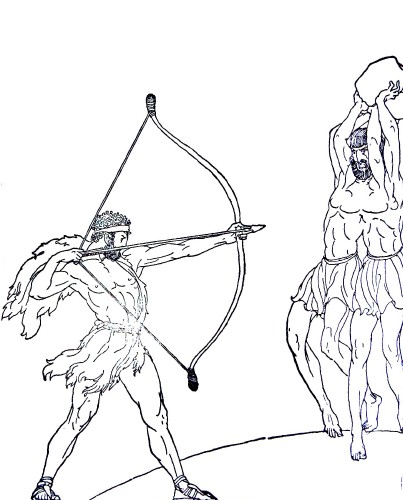 Then the
monster Geryoneus came upon him. Three bodies he had instead of one; he
attacked Heracles by hurling great stones at him. Heracles was hurt by
the
stones. And then the monster beheld the cup of Helios, and he began to
hurl
stones at the golden thing, and it seemed that he might sink it in the
sea, and
leave Heracles without a way of getting from the island. Heracles took
up his
bow and he shot arrow after arrow at the monster, and he left him dead
in the
deep grass of the pastures. Then he
rounded up the red cattle, the bulls and the cows, and he drove them
down to
the shore and into the golden cup of Helios where the bull of Minos
stayed.
Then back across the Stream of Ocean the cup floated, and the bull of
Crete and
the cattle of Geryoneus were brought past Sicily and through the
straits called
the Hellespont. To Thrace, that savage land, they came. Then Heracles
took the
cattle out, and the cup of Helios sank in the sea. Through the wild
lands of
Thrace he drove the herd of Geryoneus and the bull of Minos, and he
came into
Mycenæ once more. But he did
not stay to speak with Eurystheus. He started off to find the Garden of
the
Hesperides, the Daughters of the Evening Land. Long did he search, but
he found
no one who could tell him where the garden was. And at last he went to
Chiron
on the Mountain Pelion, and Chiron told Heracles what journey he would
have to
make to come to the Hesperides, the Daughters of the Evening Land. Far did
Heracles journey; weary he was when he came to where Atlas stood,
bearing the
sky upon his weary shoulders. As he came near he felt an undreamt-of
perfume
being wafted toward him. So weary was he with his journey and all his
toils
that he would fain sink down and dream away in that evening land. But
he roused
himself, and he journeyed on toward where the perfume came from. Over
that
place a star seemed always about to rise. He came to
where a silver lattice fenced a garden that was full of the quiet of
evening.
Golden bees hummed through the air, and there was the sound of quiet
waters.
How wild and laborious was the world he had come from, Heracles
thought! He
felt that it would be hard for him to return to that world. He saw
three maidens. They stood with wreaths upon their heads and blossoming
branches
in their hands. When the maidens saw him they came toward him crying
out: “O
man who has come into the Garden of the Hesperides, go not near the
tree that
the sleepless dragon guards!” Then they went and stood by a tree as if
to keep
guard over it. All around were trees that bore flowers and fruit, but
this tree
had golden apples amongst its bright green leaves. Then he
saw the guardian of the tree. Beside its trunk a dragon lay, and as
Heracles
came near the dragon showed its glittering scales and its deadly claws.
The apples
were within reach, but the dragon, with its glittering scales and
claws, stood
in the way. Heracles shot an arrow; then a tremor went through Ladon,
the
sleepless dragon; it screamed and then lay stark. The maidens cried in
their
grief; Heracles went to the tree, and he plucked the golden apples and
he put
them into the pouch he carried. Down on the ground sank the Hesperides,
the
Daughters of the Evening Land, and he heard their laments as he went
from the
enchanted garden they had guarded. Back from
the ends of the earth came Heracles, back from the place where Atlas
stood
holding the sky upon his weary shoulders. He went back through Asia and
Libya
and Egypt, and he came again to Mycenæ and to the palace of Eurystheus.
He brought
to the king the herd of Geryoneus; he brought to the king the bull of
Minos; he
brought to the king the girdle of Hippolyte; he brought to the king the
golden
apples of the Hesperides. And King Eurystheus, with his thin white
face, sat
upon his royal throne and he looked over all the wonderful things that
the hero
had brought him. Not pleased was Eurystheus; rather was he angry that
one he
hated could win such wonderful things. He took
into his hands the golden apples of the Hesperides. But this fruit was
not for
such as he. An eagle snatched the branch from his hand, and the eagle
flew and
flew until it came to where the Daughters of the Evening Land wept in
their
garden. There the eagle let fall the branch with the golden apples, and
the
maidens set it back upon the tree, and behold! it grew as it had been
growing
before Heracles plucked it. The next
day the heralds of Eurystheus came to Heracles and they told him of the
last
labor that he would have to set out to accomplish — this time he would
have to
go down into the Underworld, and bring up from King Aidoneus’s realm
Cerberus,
the three-headed hound. Heracles put upon him the impenetrable lion’s skin and set forth once more. This might indeed be the last of his life’s labors: Cerberus was not an earthly monster, and he who would struggle with Cerberus in the Underworld would have the gods of the dead against him. 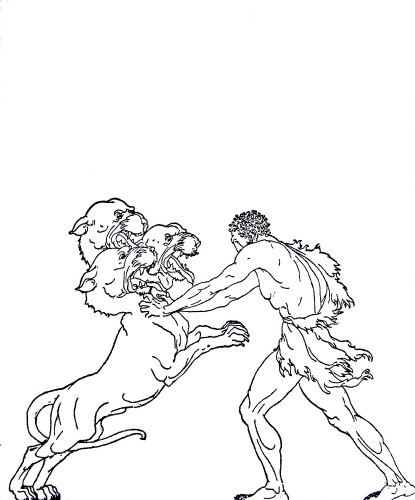 But
Heracles went on. He journeyed to the cave Tainaron, which was an
entrance to
the Underworld. Far into that dismal cave he went, and then down, down,
until
he came to Acheron, that dim river that has beyond it only the people
of the
dead. Cerberus bayed at him from the place where the dead cross the
river.
Knowing that he was no shade, the hound sprang at Heracles, but he
could
neither bite nor tear through that impenetrable lion’s skin. Heracles
held him
by the neck of his middle head so that Cerberus was neither able to
bite nor
tear nor bellow. Then to
the brink of Acheron came Persephone, queen of the Underworld. She
declared to
Heracles that the gods of the dead would not strive against him if he
promised
to bring Cerberus back to the Underworld, carrying the hound downward
again as
he carried him upward. This
Heracles promised. He turned around and he carried Cerberus, his hands
around
the monster’s neck while foam dripped from his jaws. He carried him on
and
upward toward the world of men. Out through a cave that was in the land
of
Trœzen Heracles came, still carrying Cerberus by the neck of his middle
head. From
Trœzen to Mycenæ the hero went and men fled before him at the sight of
the
monster that he carried. On he went toward the king’s palace.
Eurystheus was
seated outside his palace that day, looking at the great jar that he
had often
hidden in, and thinking to himself that Heracles would never appear to
affright
him again. Then Heracles appeared. He called to Eurystheus, and when
the king
looked up he held the hound toward him. The three heads grinned at
Eurystheus;
he gave a cry and scrambled into the jar. But before his feet touched
the
bottom of it Eurystheus was dead of fear. The jar rolled over, and
Heracles
looked upon the body that was all twisted with fright. Then he turned
around
and made his way back to the Underworld. On the brink of Acheron he
loosed
Cerberus, and the bellow of the three-headed hound was heard again. II It was
then that Heracles was given arms by the gods —the sword of Hermes, the
bow of
Apollo, the shield made by Hephæstus; it was then that Heracles joined
the
Argonauts and journeyed with them to the edge of the Caucasus, where,
slaying
the vulture that preyed upon Prometheus’s liver, he, at the will of
Zeus,
liberated the Titan. Thereafter Zeus and Prometheus were reconciled,
and Zeus,
that neither might forget how much the enmity between them had cost
gods and
men, had a ring made for Prometheus to wear; that ring was made out of
the
fetter that had been upon him, and in it was set a fragment of the rock
that
the Titan had been bound to. The
Argonauts had now won back to Greece. But before he saw any of them he
had been
in Oichalia, and had seen the maiden Iole. The king
of Oichalia had offered his daughter Iole in marriage to the hero who
could
excel himself and his sons in shooting with arrows. Heracles saw Iole,
the
blue-eyed and childlike maiden, and he longed to take her with him to
some
place near the Garden of the Hesperides. And Iole looked on him, and he
knew
that she wondered to see him so tall and so strongly knit even as he
wondered
to see her so childlike and delicate. Then the
contest began. The king and his sons shot wonderfully well, and none of
the
heroes who stood before Heracles had a chance of winning. Then Heracles
shot
his arrows. No matter
how far away they moved the mark, Heracles struck it and struck the
very center
of it. The people wondered who this great archer might be. And then a
name was
guessed at and went around — Heracles! When the
king heard the name of Heracles he would not let him strive in the
contest any
more. For the maiden Iole would not be given as a prize to one who had
been mad
and whose madness might afflict him again. So the king said, speaking
in
judgment in the market place. Rage came
on Heracles when he heard this judgment given. He would not let his
rage master
him lest the madness that was spoken of should come with his rage. So
he left
the city of Oichalia declaring to the king and the people that he would
return.
It was
then that, wandering down to Crete, he heard of the Argonauts being
near. And
afterward he heard of them being in Calydon, hunting the boar that
ravaged
Œneus’s country. To Calydon Heracles went. The heroes had departed when
he came
into the country, and all the city was in grief for the deaths of
Prince
Meleagrus and his two uncles. On the
steps of the temple where Meleagrus and his uncles had been brought
Heracles
saw Deianira, Meleagrus’s sister. She was pale with her grief, this
tall woman
of the mountains; she looked like a priestess, but also like a woman
who could
cheer camps of men with her counsel, her bravery, and her good
companionship;
her hair was very dark and she had dark eyes. Straightway
she became friends with Heracles; and when they saw each other for a
while they
loved each other. And Heracles forgot Iole, the childlike maiden whom
he had
seen in Oichalia. He made
himself a suitor for Deianira, and those who protected her were glad of
Heracles’s suit, and they told him they would give him the maiden to
marry as
soon as the mourning for Prince Meleagrus and his uncles was over.
Heracles
stayed in Calydon, happy with Deianira, who had so much beauty, wisdom,
and
bravery. But then a
dreadful thing happened in Calydon; by an accident, while using his
strength
unthinkingly, Heracles killed a lad who was related to Deianira. He
might not
marry her now until he had taken punishment for slaying one who was
close to
her in blood. As a
punishment for the slaying it was judged that Heracles should be sold
into
slavery for three years. At the end of his three years’ slavery he
could come
back to Calydon and wed Deianira. And so
Heracles and Deianira were parted. He was sold as a slave in Lydia; the
one who
bought him was a woman, a widow named Omphale. To her house Heracles
went,
carrying his armor and wearing his lion’s skin. And Omphale laughed to
see this
tall man dressed in a lion’s skin coming to her house to do a servant’s
tasks
for her. She and
all in her house kept up fun with Heracles. They would set him to do
housework,
to carry water, and set vessels on the tables, and clear the vessels
away.
Omphale set him to spin with a spindle as the women did. And often she
would
put on Heracles’s lion skin and go about dragging his club, while he,
dressed
in woman’s garb, washed dishes and emptied pots. But he
would lose patience with these servant’s tasks, and then Omphale would
let him
go away and perform some great exploit. Often he went on long journeys
and
stayed away for long times. It was while he was in slavery to Omphale
that he
liberated Theseus from the dungeon in which he was held with
Peirithous, and it
was while he still was in slavery that he made his journey to Troy. At Troy he
helped to repair for King Laomedon the great walls that years before
Apollo and
Poseidon had built around the city. As a reward for this labor he was
offered
the Princess Hesione in marriage; she was the daughter of King
Laomedon, and
the sister of Priam, who was then called, not Priam but Podarces. He
helped to
repair the wall, and two of the Argonauts were there to aid him: one
was Peleus
and the other was Telamon. Peleus did not stay for long: Telamon
stayed, and to
reward Telamon Heracles withdrew his own claim for the hand of the
Princess
Hesione. It was not hard on Heracles to do this, for his thoughts were
ever
upon Deianira. But
Telamon rejoiced, for he loved Hesione greatly. On the day they married
Heracles showed the two an eagle in the sky. He said it
was sent as an omen to them — an omen for their marriage. And in memory
of that
omen Telamon named his son “Aias”; that is, “Eagle.” Then the
walls of Troy were repaired and Heracles turned toward Lydia, Omphale’s
home.
Not long would he have to serve Omphale now, for his three years’
slavery was
nearly over. Soon he would go back to Calydon and wed Deianira. As he went
along the road to Lydia he thought of all the pleasantries that had
been made
in Omphale’s house and he laughed at the memory of them. Lydia was a
friendly
country, and even though he had been in slavery Heracles had had his
good times
there. He was
tired with the journey and made sleepy with the heat of the sun, and
when he
came within sight of Omphale’s house he lay down by the side of the
road, first
taking off his armor, and laying aside his bow, his quiver, and his
shield. He
wakened up to see two men looking down upon him; he knew that these
were the
Cercopes, robbers who waylaid travelers upon this road. They were
laughing as
they looked down on him, and Heracles saw that they held his arms and
his armor
in their hands. They
thought that this man, for all his tallness, would yield to them when
he saw
that they had his arms and his armor. But Heracles sprang up, and he
caught one
by the waist and the other by the neck, and he turned them upside down
and tied
them together by the heels. Now he held them securely and he would take
them to
the town and give them over to those whom they had waylaid and robbed.
He hung
them by their heels across his shoulders and marched on. But the
robbers, as they were being bumped along, began to relate pleasantries
and
mirthful tales to each other, and Heracles’s, listening, had to laugh.
And one
said to the other, “O my brother, we are in the position of the frogs
when the
mice fell upon them with such fury.” And the other said, “Indeed
nothing can
save us if Zeus does not send an ally to us as he sent an ally to the
frogs.”
And the first robber said, “Who began that conflict, the frogs or the
mice?”
And thereupon the second robber, his head reaching down to Heracles’s
waist,
began: A warlike
mouse came down to the brink of a pond for no other reason than to take
a drink
of water. Up to him hopped a frog. Speaking in the voice of one who had
rule
and authority, the frog said: “Stranger
to our shore, you may not know it, but I am Puff Jaw, king of the
frogs. I do
not speak to common mice, but you, as I judge, belong to the noble and
kingly
sort. Tell me your race. If I know it to be a noble one I shall show
you my
kingly friendship.” The mouse,
speaking haughtily, said: “I am Crumb Snatcher, and my race is a famous
one. My
father is the heroic Bread Nibbler, and he married Queen Licker, the
lovely
daughter of a king. Like all my race I am a warrior who has never been
wont to
flinch in battle. Moreover, I have been brought up as a mouse of high
degree,
and figs and nuts, cheese and honey-cakes is the provender that I have
been fed
on.” Now this
reply of Crumb Snatcher pleased the kingly frog greatly. “Come with me
to my
abode, illustrious Crumb Snatcher,” said he, “and I shall show you such
entertainment as may be found in the house of a king.” But the
mouse looked sharply at him. “How may I get to your house?” he asked.
“We live
in different elements, you and I. We mice want to be in the driest of
dry
places, while you frogs have your abodes in the water.” “Ah,” answered
Puff Jaw, “you do not know how favored the frogs are above all other
creatures.
To us alone the gods have given the power to live both in the water and
on the
land. I shall take you to my land palace that is the other side of the
pond.” “How may I
go there with you?” asked Crumb Snatcher the mouse, doubtfully. “Upon my
back,” said the frog. “Up now, noble Crumb Snatcher. And as we go I
will show
you the wonders of the deep.” He offered
his back and Crumb Snatcher bravely mounted. The mouse put his forepaws
around
the frog’s neck. Then Puff Jaw swam out. Crumb Snatcher at first was
pleased to
feel himself moving through the water. But as the dark waves began to
rise his
mighty heart began to quail. He longed to be back upon the land. He
groaned aloud.
“How
quickly we get on,” cried Puff Jaw; “soon we shall be at my land
palace.” Heartened
by this speech, Crumb Snatcher put his tail into the water and worked
it as a
steering oar. On and on they went, and Crumb Snatcher gained heart for
the
adventure. What a wonderful tale he would have to tell to the clans of
the
mice! But
suddenly, out of the depths of the pond, a water snake raised his
horrid head.
Fearsome did that head seem to both mouse and frog. And forgetful of
the guest
that he carried upon his back, Puff Jaw dived down into the water. He
reached
the bottom of the pond and lay on the mud in safety. But far
from safety was Crumb Snatcher the mouse. He sank and rose, and sank
again. His
wet fur weighed him down. But before he sank for the last time he
lifted up his
voice and cried out and his cry was heard at the brink of the pond: “Ah, Puff
Jaw, treacherous frog! An evil thing you have done, leaving me to drown
in the
middle of the pond. Had you faced me on the land I should have shown
you which
of us two was the better warrior. Now I must lose my life in the water.
But I
tell you my death shall not go unavenged — the cowardly frogs will be
punished
for the ill they have done to me who am the son of the king of the
mice.” Then Crumb
Snatcher sank for the last time. But Lick Platter, who was at the brink
of the
pond, had heard his words. Straightway this mouse rushed to the hole of
Bread
Nibbler and told him of the death of his princely son. Bread
Nibbler called out the clans of the mice. The warrior mice armed
themselves,
and this was the grand way of their arming: First, the
mice put on greaves that covered their forelegs. These they made out of
bean
shells broken in two. For shield, each had a lamp’s centerpiece. For
spears
they had the long bronze needles that they had carried out of the
houses of
men. So armed and so accoutered they were ready to war upon the frogs.
And
Bread Nibbler, their king, shouted to them: “Fall upon the cowardly
frogs, and
leave not one alive upon the bank of the pond. Henceforth that bank is
ours,
and ours only. Forward!” And, on
the other side, Puff Jaw was urging the frogs to battle. “Let us take
our
places on the edge of the pond,” he said, “and when the mice come
amongst us,
let each catch hold of one and throw him into the pond. Thus we will
get rid of
these dry bobs, the mice.” The frogs
applauded the speech of their king, and straightway they went to their
armor
and their weapons. Their legs they covered with the leaves of mallow.
For
breastplates they had the leaves of beets. Cabbage leaves, well cut,
made their
strong shields. They took their spears from the pond side — deadly
pointed
rushes they were, and they placed upon their heads helmets that were
empty
snail shells. So armed and so accoutered they were ready to meet the
grand
attack of the mice. When the
robber came to this part of the story Heracles halted his march, for he
was
shaking with laughter. The robber stopped in his story. Heracles
slapped him on
the leg and said: “What more of the heroic exploits of the mice?” The
second
robber said, “I know no more, but perhaps my brother at the other side
of you
can tell you of the mighty combat between them and the frogs.” Then
Heracles
shifted the first robber from his back to his front, and the first
robber said:
“I will tell you what I know about the heroical combat between the
frogs and
the mice.” And thereupon he began: The gnats
blew their trumpets. This was the dread signal for war. Bread
Nibbler struck the first blow. He fell upon Loud Crier the frog, and
overthrew
him. At this Loud Crier’s friend, Reedy, threw down spear and shield
and dived
into the water. This seemed to presage victory for the mice. But then
Water
Larker, the most warlike of the frogs, took up a great pebble and flung
it at
Ham Nibbler who was then pursuing Reedy. Down fell Ham Nibbler, and
there was
dismay in the ranks of the mice. Then
Cabbage Climber, a great-hearted frog, took up a clod of mud and flung
it full
at a mouse that was coming furiously upon him. That mouse’s helmet was
knocked
off and his forehead was plastered with the clod of mud, so that he was
well-nigh blinded. It was
then that victory inclined to the frogs. Bread Nibbler again came into
the
fray. He rushed furiously upon Puff Jaw the king. Leeky, the
trusted friend of Puff Jaw, opposed Bread Nibbler’s onslaught. Mightily
he
drove his spear at the king of the mice. But the point of the spear
broke upon
Bread Nibbler’s shield, and then Leeky was overthrown. Bread
Nibbler came upon Puff Jaw, and the two great kings faced each other.
The frogs
and the mice drew aside, and there was a pause in the combat. Bread
Nibbler the
mouse struck Puff Jaw the frog terribly upon the toes. Puff Jaw
drew out of the battle. Now all would have been lost for the frogs had
not
Zeus, the father of the gods, looked down upon the battle. “Dear,
dear,” said Zeus, “what can be done to save the frogs? They will surely
be
annihilated if the charge of yonder mouse is not halted.” For the
father of the gods, looking down, saw a warrior mouse coming on in the
most
dreadful onslaught of the whole battle. Slice Snatcher was the name of
this
warrior. He had come late into the field. He waited to split a chestnut
in two
and to put the halves upon his paws. Then, furiously dashing amongst
the frogs,
he cried out that he would not leave the ground until he had destroyed
the
race, leaving the bank of the pond a playground for the mice and for
the mice
alone. To stop
the charge of Slice Snatcher there was nothing for Zeus to do but to
hurl the
thunderbolt that is the terror of gods and men. Frogs and
mice were awed by the thunder and the flame. But still the mice, urged
on by
Slice Snatcher, did not hold back from their onslaught upon the frogs. Now would
the frogs have been utterly destroyed; but, as they dashed on, the mice
encountered a new and a dreadful army. The warriors in these ranks had
mailed
backs and curving claws. They had bandy legs and long-stretching arms.
They had
eyes that looked behind them. They came on sideways. These were the
crabs,
creatures until now unknown to the mice. And the crabs had been sent by
Zeus to
save the race of the frogs from utter destruction. Coming
upon the mice they nipped their paws. The mice turned around and they
nipped
their tails. In vain the boldest of the mice struck at the crabs with
their
sharpened spears. Not upon the hard shells on the backs of the crabs
did the
spears of the mice make any dint. On and on, on their queer feet and
with their
terrible nippers, the crabs went. Bread Nibbler could not rally them
any more,
and Slice Snatcher ceased to speak of the monument of victory that the
mice
would erect upon the bank of the pond. With their
heads out of the water they had retreated to, the frogs watched the
finish of
the battle. The mice threw down their spears and shields and fled from
the
battleground. On went the crabs as if they cared nothing for their
victory, and
the frogs came out of the water and sat upon the bank and watched them
in awe. Heracles
had laughed at the diverting tale that the robbers had told him; he
could not
bring them then to a place where they would meet with captivity or
death. He
let them loose upon the highway, and the robbers thanked him with
high-flowing
speeches, and they declared that if they should ever find him sleeping
by the
roadway again they would let him lie. Saying this they went away, and
Heracles,
laughing as he thought upon the great exploits of the frogs and mice,
went on
to Omphale’s house. Omphale,
the widow, received him mirthfully, and then set him to do tasks in the
kitchen
while she sat and talked to him about Troy and the affairs of King
Laomedon.
And afterward she put on his lion’s skin, and went about in the
courtyard
dragging the heavy club after her. Mirthfully and pleasantly she made
the rest
of his time in Lydia pass for Heracles, and the last day of his slavery
soon
came, and he bade good-by to Omphale, that pleasant widow, and to
Lydia, and he
started off for Calydon to claim his bride Deianira. Beautiful
indeed Deianira looked now that she had ceased to mourn for her
brother, for
the laughter that had been under her grief always now flashed out even
while
she looked priestesslike and of good counsel; her dark eyes shone like
stars,
and her being had the spirit of one who wanders from camp to camp,
always
greeting friends and leaving friends behind her. Heracles and Deianira
wed, and
they set out for Tiryns, where a king had left a kingdom to Heracles. They came
to the River Evenus. Heracles could have crossed the river by himself,
but he
could not cross it at the part he came to, carrying Deianira. He and
she went
along the river, seeking a ferry that might take them across. They
wandered
along the side of the river, happy with each other, and they came to a
place
where they had sight of a centaur. Heracles
knew this centaur. He was Nessus, one of the centaurs whom he had
chased up the
mountain the time when he went to hunt the Erymanthean boar. The
centaurs knew
him, and Nessus spoke to Heracles as if he had friendship for him. He
would, he
said, carry Heracles’s bride across the river. Then
Heracles crossed the river, and he waited on the other side for Nessus
and
Deianira. Nessus went to another part of the river to make his
crossing. Then
Heracles, upon the other bank, heard screams — the screams of his wife,
Deianira. He saw that the centaur was savagely attacking her. Then
Heracles leveled his bow and he shot at Nessus. Arrow after arrow he
shot into
the centaur’s body. Nessus loosed his hold on Deianira, and he lay down
on the
bank of the river, his lifeblood streaming from him. Then Nessus, dying, but with his rage against Heracles unabated, thought of a way by which the hero might be made to suffer for the death he had brought upon him. He called to Deianira, and she, seeing he could do her no more hurt, came close to him. He told her that in repentance for his attack upon her he would bestow a great gift upon her. She was to gather up some of the blood that flowed from him; his blood, the centaur said, would be a love philter, and if ever her husband’s love for her waned it would grow fresh again if she gave to him something from her hands that would have this blood upon it. 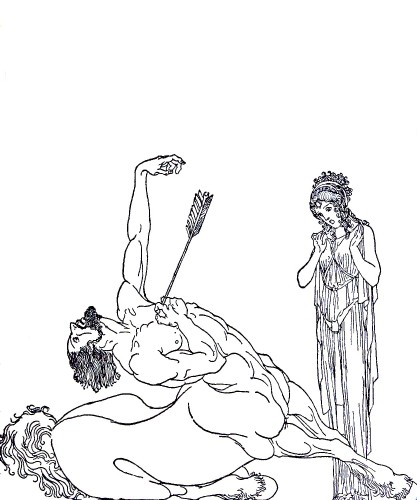 Deianira,
who had heard from Heracles of the wisdom of the centaurs, believed
what Nessus
told her. She took a phial and let the blood pour into it. Then Nessus
plunged
into the river and died there as Heracles came up to where Deianira
stood. She did
not speak to him about the centaur’s words to her, nor did she tell him
that
she had hidden away the phial that had Nessus’s blood in it. They
crossed the
river at another point and they came after a time to Tiryns and to the
kingdom
that had been left to Heracles. There
Heracles and Deianira lived, and a son who was named Hyllos was born to
them.
And after a time Heracles was led into a war with Eurytus — Eurytus who
was
king of Oichalia. Word came to Deianira that Oichalia was taken by
Heracles,
and that the king and his daughter Iole were held captive. Deianira
knew that Heracles had once tried to win this maiden for his wife, and
she
feared that the sight of Iole would bring his old longing back to him. She
thought upon the words that Nessus had said to her, and even as she
thought
upon them messengers came from Heracles to ask her to send him a robe —
a
beautifully woven robe that she had — that he might wear it while
making a
sacrifice. Deianira took down the robe; through this robe, she thought,
the
blood of the centaur could touch Heracles and his love for her would
revive.
Thinking this she poured Nessus’s blood over the robe. Heracles
was in Oichalia when the messengers returned to him. He took the robe
that
Deianira sent, and he went to a mountain that overlooked the sea that
he might
make the sacrifice there. Iole went with him. Then he put on the robe
that
Deianira had sent. When it touched his flesh the robe burst into flame.
Heracles tried to tear it off, but deeper and deeper into his flesh the
flames
went. They burned and burned and none could quench them. Then
Heracles knew that his end was near. He would die by fire, and knowing
that he
piled up a great heap of wood and he climbed upon it. There he stayed
with the
flaming robe burning into him, and he begged of those who passed to
fire the
pile that his end might come more quickly. None would
fire the pile. But at last there came that way a young warrior named
Philoctetes, and Heracles begged of him to fire the pile. Philoctetes,
knowing
that it was the will of the gods that Heracles should die that way,
lighted the
pile. For that Heracles bestowed upon him his great bow and his
unerring
arrows. And it was this bow and these arrows, brought from Philoctetes,
that
afterward helped to take Priam’s city. The pile
that Heracles stood upon was fired. High up, above the sea, the pile
burned.
All who were near that burning fled — all except Iole, that childlike
maiden.
She stayed and watched the flames mount up and up. They wrapped the
sky, and
the voice of Heracles was heard calling upon Zeus. Then a great chariot
came
and Heracles was borne away to Olympus. Thus, after many labors,
Heracles
passed away, a mortal passing into an immortal being in a great burning
high
above the sea. |
 Click the book image to turn
to the next Chapter.
Click the book image to turn
to the next Chapter.