
Web
and Book design,
Copyright, Kellscraft Studio 1999-2007 (Return to Web Text-ures) |
 (HOME)
|
|
THE DISCREET
PRINCESS  N the time of the
first crusades a certain king resolved to join the Christian princes in
the war
against the infidels in Palestine. What most disquieted this prince was
the
care of his family. He was the father of three young princesses, all
marriageable. N the time of the
first crusades a certain king resolved to join the Christian princes in
the war
against the infidels in Palestine. What most disquieted this prince was
the
care of his family. He was the father of three young princesses, all
marriageable. The
youngest of
these three princesses was of a different character. Her thoughts and
hands
were continually employed: she possessed surprising vivacity, and
applied it to
good uses. She danced, sung, and played upon music to perfection:
finished with
wonderful address and skill, all those works of the hand which
generally amuse
those of her sex, and used every vigilance in putting the king’s
household into
exact regulation and order. Her talents were not bounded there: she had
a great
deal of judgment, and such a wonderful presence of mind, that she
immediately
found the means of extricating herself out of the greatest
difficulties. This
young princess had, by her penetration, discovered a dangerous snare
which a
perfidious ambassador had laid for the king her father, in a treaty
just ready
to be signed by that prince. To punish the treachery of this ambassador
and his
master, the king altered the article of the treaty, and by wording it
in the
terms his daughter dictated to him, he in his turn deceived the
deceiver. The
princess gave, on several other occasions, such marks of her
penetration and
fine genius, that the people gave her the surname of Finetta. The king
together, that they would let her come into the castle, telling them
that she
was a wretched stranger, who knew how to do a thousand things, and
would serve
them with the utmost fidelity. ‘Do you think,’ said Pratilia to her
sister,
‘that the king’s order extends to this unfortunate wretch? I believe we
may
take her in without any consequence.’ — ‘You may do, sister,’ answered
Drona,
‘what you please:’ Then Pratilia, who only waited her consent,
immediately let
down the basket. The woman got into it, and the princesses drew her up
by the
help of the pulley. The new servant of these princesses took a hundred
turns
about the castle, under pretence of doing her work: but in reality to
see how
things were disposed in it; for this pretended beggar-woman was the son
of a
powerful king, a neighbor of the princesses’ father. This prince who
always
acted with artifice and cunning, was by the people surnamed
Rich-in-craft, but
in shortness Rich-Craft. He had a
younger
brother, who was as full of good qualities as he was of bad; and
therefore was
generally called Bel-a-voir. It was prince Rich-Craft who had put the
ambassador of the king his father upon that wicked turn in the treaty,
which
was frustrated by the address of Finetta, and fell upon themselves.
Rich-Craft,
who before that had no great love for the princesses’ father, since
then bore
him the utmost aversion; so that when he had notice of the precautions
which
that prince had taken, in relation to his daughters, he took a
pernicious
pleasure to deceive, if possible, the prudence of so suspicious a
father, and
as we see had already contrived to make two of the princess
disobedient; for
which fault they each found their distaffs broken. Finetta
was so
busily engaged in her own room, that she knew nothing of what had
happened till
she heard the screams of her sisters, whom the .prince beat severely
and locked
up together; he then went to seek Finetta, whom he resolved to marry as
a
punishment for what she had done. He went into all the rooms of the
castle, one
after another; and as he found them all open but one, which was
fastened in the
inside, he concluded for certain, that thither it was Finetta had
retired. As
he had composed a string of compliments, he went to retail them at
Finetta’s
door. But this princess heard him a good while, without making the
least
answer. At last, finding that he knew she was in the room, she told
him, if it
was true that he had so strong and sincere a passion for her, as he
would
persuade her, she desired he would go down into the garden, and shut
the door
after him, and after that, she would talk to him as much as he pleased
out of
the window of the apartment, which looked into the garden. Rich-Craft
would not
agree to this; and as the princess still resolutely persisted in not
opening
the door, this wicked prince, mad with impatience, went and got a
billet, and
broke it open. He found Finetta armed with a great hammer, which had
been
accidentally left in a wardrobe near her chamber. Emotion raised
Finetta’s
complexion; and, though her eyes sparkled with rage, she appeared to
Rich-Craft
a most enchanting beauty. ‘What!
beautiful
princess,’ cried Rich-Craft, in his hypocritical tone, ‘does the love I
have
for you inspire you with such cruel hatred?’ He added, that the only
motive he
had to put on such disguise, was with respect to offer her his hand and
heart:
and told her, that she ought to pardon, on account of the violence of
his love,
his boldness in breaking open her door. The adroit princess, feigning
herself
entirely pacified, told him, that she must find out her sisters, and
after
that, they would take their measures altogether: but Rich-Craft
answered, that
he could by no means resolve upon that, till she had consented to marry
him,
because her sisters would not fail to oppose the match, on account of
their
right of eldership. Finetta, who with good reason distrusted this
prince, found
her suspicions redoubled by this answer. But she told Rich-Craft, that
she
readily consented to marry him; but she was fully persuaded that
marriages
which were made at night, were always unhappy; and therefore desired he
would
defer the ceremony, of plighting to each other their mutual faith, till
the
next morning. She added, he might be assured she would not mention a
syllable
of all this to the princesses, her sisters, and begged him to give her
only a
little time to say her prayers; that afterwards, she would lead him to
a
chamber where he should have a very good bed, and then she would return
to her
own room till the morrow morning. Rich-Craft
consented to what the princess desired, and went away, to give her some
time to
meditate. He was no sooner gone, than Finetta hastened to make a bed
over the
hole of a sink in one of the rooms of the castle. This room was as
handsome as
any of the rest. Finetta put over the hole two weak sticks across; then
very
handsomely made the bed upon them, and immediately returned to her
chamber. A
moment after came Rich-Craft, and the princess conducted him into the
room
where she had made him his bed, and retired. The prince threw himself
hastily
upon the bed, and his weight having all at once broken the slender
sticks, he
fell down to the bottom of the sink. Finetta was delighted to hear (by
the
noise of his falling) what had happened; but her first care was to seek
her
sisters, and she was sorry to find their own misconduct had caused all
their
troubles. In the mean time Rich-Craft passed the night very
uncomfortably, and
when day came, with a great deal of painful struggling, he came to the
end of
the drain, which ran into a river at a considerable distance from the
castle.
He found means to make himself heard by some men who were fishing in
the river,
by whom he was drawn out in such a pickle, as raised compassion in
those good
people. He caused
himself
to be carried to his father’s court to get cured; and this disgrace
made him
take such a strong hatred and aversion to Finetta, that he thought less
on his
cure than on revenge. That princess passed her time very sadly, as her
sisters
continued so ill from their bruises, as to require many comforting
nourishing
things which she had not the means of procuring, and she dreaded much
her
father’s anger upon finding that their distaffs were broken. The
cunning
Rich-Craft guessed all this, and contrived that baskets of cordials and
medicines should be placed under the window at night, to tempt Finetta
to come
down for them; and though she feared there was some trick in it, she
was too
courageous and generous to let her sisters languish for what it was in
her
power to obtain for them; she therefore let herself down in the basket,
but was
no sooner there, than Rich-Craft’s officers seized hold of her and
carried her
to a country-house, where the prince was, for the recovery of his
health. When
the prince was a little better, he had her taken to the top of a high
mountain,
whither he followed immediately after. Here it was that he told her,
they were
going to put her to death. Then that base prince very barbarously
showed
Finetta a barrel stuck in the inside all round with pen-knives, razors,
and
hooked nails, and told her they were going to put her into that vessel,
and
roll her down from the top of the mountain into the valley. Though
Finetta was
no Roman, she was no more afraid of the punishment than Regulus
heretofore was
at the sight of a like destiny. Rich-Craft
bent
himself down to look into the barrel, which was to be the instrument of
his
vengeance, to examine if it was well provided with all its murdering
weapons.
Finetta lost no time, but very dexterously pushed him into it, and
rolled him
down the mountain, without giving the prince any time to know where he
was.
After this, she ran away, and the prince’s officers, who had seen after
what a
cruel manner their master would have treated this amiable princess,
made not
the least attempt to stop her, besides, they were so much frightened at
what
happened to Rich-Craft, that they thought of nothing else but stopping
the
barrel, but their endeavours were all in vain; he rolled down to the
bottom of
the mountain, where they took him out wounded in a thousand places. The
good
king his father, and Bel-a-voir his brother, were very unhappy about
him, as
they saw he could not live many days: but Rich-Craft, perfidious to his
last
moment, studied how to abuse the tenderness of his brother. ‘You have
always
loved me, prince,’ cried he. ‘and I am dying; but if ever I have been
dear to
you, grant this one thing I beg of you, which I am going to ask of
you.’
Bel-a-voir promised with the most terrible oaths, to grant him whatever
he
should desire. As soon as Rich-Craft heard these oaths, he said to his
brother,
embracing him, ‘I die contented, brother, since I am revenged; for that
which I
beg of you to do for me, is to ask Finetta in marriage immediately on
my
decease; you will undoubtedly obtain this wicked princess; and the
moment she
shall be in your power, plunge your poinard into her heart.’ Bel-a-voir
trembled
with horror at these words; but he had no mind his repentance should be
taken
notice of by his brother, who expired soon after. Finetta who had
returned to
her sisters, heard soon after of the death of Rich-Craft; and some time
after
that, news came to the three princesses, that the king their father was
come
home. This prince came in a hurry to the tower; and his first care was
to see
the distaffs. No one could show hers but Finetta: and the king fell
into such a
rage against his two eldest daughters, that he sent them away to the
fairy, who
had given him the distaffs, desiring her to punish them according to
their
deserts. The fairy gave them plenty of hard work, and long lessons to
learn.
Pratilia was never allowed to talk excepting in repeating her lessons.
Drona
could not help falling into despair at leading a life which was so
little
conformable to her inclinations, and died with fatigue and vexation.
Pratilia,
who some time after found means to make her escape by night out of the
fairy’s
castle, broke her skull against a tree, and died in the arms of some
country
people. Finetta’s good-nature made her very sensibly grieve for her
sisters’
fate; and in the midst of these troubles she was informed, that prince
Bel-a-voir
had asked her in marriage of the king her father, who had consented to
it,
without giving her any notice thereof; Finetta trembled at this news,
and went
to consult the sage fairy, who esteemed her as much as she despised
Drona and
Pratilia. The fairy
only said
to her, ‘princess, you are sage and prudent; you would not hitherto
have taken
such measures for your conduct, had you not always borne in mind, that
distrust
is the mother of security.’ Some days after, the princess was married,
by an
ambassador, in the name of prince Bel-a-voir, and she set out to go to
her
spouse in a magnificent equipage. When Bel-a-voir saw her, he was
struck with
her charms; but made her his compliments in a very confused manner.
Finetta who
was always thinking on the maxim which the fairy had revived in her
mind, had a
design in her head. This princess had gained over one of the women, who
had the
key of the closet belonging to the apartment which was designed for
her; and
she had privately given orders to that woman to carry into the closet
some
straw, and a bladder of sheep’s blood, and the entrails of some of
those
animals which had been dressed for supper. The princess, on some
pretence, went
into that closet and made a puppet of the straw, into which she put the
entrails
and the bladder full of blood: after that she dressed it up in a
woman’s night
clothes. When Finetta had finished this puppet, she returned to her
company,
where she supped with the prince; and after sometime they conducted the
princess and her spouse to their apartment. When they had allowed as
much time
at the toilet as was necessary, the ladies of honour took away the
flambeaux,
and retired. Finetta immediately threw the image of straw upon the bed,
and
went and hid herself in one of the corners of the chamber. The
prince, having
sighed three or four times very loud, drew his sword, and ran it
through the
body of the pretended Finetta: at the same instant he found the blood
trickle
all about, and the straw wife without motion. ‘Alas! what have I done?’
cried
Bel-a-voir; ‘what, after so many cruel conflicts! could any one so much
as
dream to punish a woman for having too much virtue? well; Rich-Craft, I
have
satisfied thy unjust vengeance; but now I will revenge Finetta in her
turn, by
my death. Yes, beautiful princess, my sword shall’ by these words the
princess
understood that the prince, who in his transport let fall his sword,
was
feeling for it, in order to thrust it through his body, was resolved he
should
not be guilty of such a folly, and, therefore, cried out, ‘My prince, I
am not
dead; the goodness of your disposition made me divine your repentance,
and, by
an innocent cheat, I have hindered you from committing the worst of
crimes.’
|
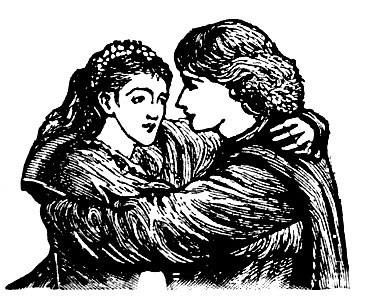 Upon which she related to Bel-avoir the
foresight she had in relation to the figure of straw. The prince, all
transported to find Finetta alive, admired the prudence she was
mistress of on
all occasions; and tenderly embracing her, renewed his vows of
unalterable
affection. Soon after, they became king and queen, and long, happy, and
glorious was their reign.
Upon which she related to Bel-avoir the
foresight she had in relation to the figure of straw. The prince, all
transported to find Finetta alive, admired the prudence she was
mistress of on
all occasions; and tenderly embracing her, renewed his vows of
unalterable
affection. Soon after, they became king and queen, and long, happy, and
glorious was their reign. Click the book image to turn
to the next Chapter.
Click the book image to turn
to the next Chapter.