 Web
and Book design,
Web
and Book design, Copyright, Kellscraft Studio 1999-2006 (Return to Web Text-ures) |
Click
Here to return to Castles of England and Wales Content Page Return to the Previous Chapter |
 (HOME) |
|
KENILWORTH
WARWICKSHIRE
is a
county of pleasant names and of many legends. The extent of the Forest
of Arden
lessened, in some degree, the influence of Roman or Saxon in the
district, and
retained for many of its villages and parks the Celtic names that
strike so
pleasantly upon the ear. Its romantic associations are no less
intriguing than
their setting. At Coventry is the home of the Godiva legend, at Warwick
the
saga of Sir Guy, at Kenilworth the Amy Robsart story, and at
Stratford-on-Avon
— may one say? — the legend of William Shakespeare. At least,
one may
in such a fashion protest that the ample and prosperous acres of
Warwickshire
have been etherealized by the lovers of romance. From countries where
Shakespeare gives precedence to Byron and Scott, pilgrims come to gaze
at the
ruins of Kenilworth, which Scott invested with glory in his inaccurate
account
of the tragedy of Amy Robsart. From America come equally enthusiastic
Shakespeare lovers to Stratford-on-Avon; to the cottage of Anne
Hathaway, which
Shakespeare deserted for so long; and to Chalcote Park, where he hung
up a
lampoon. The true lover of Shakespeare will see Stratford, certainly,
but he
will seek the poet in all English countryside, in Southwark, and on the
Thames
Embankment, where Francis Thompson held horses’ heads. Alas! that
Godiva’s
penance is a fiction! And Kenilworth’s ivy-mantled ruins bear nobler
memories
than that of the despicable Robert Dudley, or of his wife who died — by
accident for all we know — in Oxfordshire. Nevertheless, it is for
these more
superficial associations that the romantic come to Kenilworth, and, in
their
dream-wrapt innocence, they desecrate the beautiful lanes of
Warwickshire with
char-à-banc and motor-bus. “Kenilworth”
the
novel permanently changed the character of Kenilworth the castle, in
the minds
of men. The visitor brings with him his own impression of the graceful
palace
where the Earl of Leicester entertained the Renaissance court of
Elizabeth with
masques and pageantry. He is blind to the massive fortress in which the
younger
Simon de Montfort held out against Henry III after Evesham. Kenilworth
is one
of those castles in which the domestic element came gradually to
overshadow the
military aspect, but its history (except for those seventeen days of
courtiers’
revels) was a stern one of civil war, and the ruins of Dudley’s flimsy
additions should symbolize for the visitor their relative position,
architecturally and historically. Both
Kenilworth and
Warwick were Norman castles, members of the great Midland group, and in
both
cases the builders showed a keen sense of local geography. Kenilworth
was
erected at the beginning of the twelfth century upon a knoll of
sandstone and
gravel in the midst of low-lying ground intersected by many small
tributaries
of the Avon. These
conditions
were turned fully to account as the science of castle building
progressed, and
the evolution of the fortress illustrates an interesting tendency for
the
castle itself to lose its earlier character of passive strength, and to
take an
active part in its own defence, by forcing the enemy to attack on a
small
number of carefully defended points. The
earliest
buildings occupied the site of what was later the Inner Ward upon the
mound,
and they had, as their citadel, the rectangular keep, called Julius
Cæsar’s
Tower, built without the usual interior cross wall, but with massive
square
turrets at the four corners, and a fore-building to protect its
entrance. These
fore-buildings marked the principle just alluded to in its earlier
stages. In
the first keeps the defenders entered the door high in the wall by a
ladder,
drew up the ladder, and defied the enemy swarming around the unbroken
base
wall. The
fore-building
gave a permanent approach to the door of the keep by means of a covered
stair,
defended by an outer door on the ground level, by wrong turnings often
enough,
by meurtrières through which the attackers shepherded together
on the stair
could be assailed at close range, and by a strong, easily defended door
in the
keep wall. The main principle still was to defend a citadel until
relief came,
but the besiegers were, in the meantime, discouraged by these methods
of thinning
their numbers. In the
completed
Kenilworth the idea of active defence was further carried out. A
curtain wall
was built around the original buildings of the Inner Ward, making the
castle
roughly concentric in plan. Then it was necessary merely to connect the
principal watercourses by ditches and to dam the main Finham Brook, in
order to
isolate the castle behind the almost impregnable defence of a lake half
a mile
in length, with a smaller lake on the eastern side of the dam. The
parts of the
curtain undefended by the lake were covered by broad moats. These
works
narrowed the besiegers’ point of attack. The dam became a causeway
leading to
the principal entrance. On the landward end was an earthwork called the
Brayes,
with its own gatehouse and with mounds on which to place engines of
war. Behind
this was a moat, and a drawbridge giving access to the Gallery Tower,
which
held the head of the dam, while at the far end of the narrow causeway
was the
strong Mortimer’s Tower projecting from the curtain wall, a barbican in
itself,
forming a third line of defence. All these additions were probably made
about
the time of Henry III, so that they are contemporary in time and
analogous in
character to Caerphilly. Thus Kenilworth is an illustration of the many
valuable
military lessons brought home from the East by the Crusaders. It might
be
expected of a Midland castle, which defended England against no foreign
enemy,
that its history would be one of baronial ambition and of civil war.
The
nationalism of this country was hammered out on her borders and in
France; but
it cannot be said that the Barons’ Wars and the Stuart Civil Wars did
nothing
for the development of her internal order. The
lordship of
Kenilworth was granted by Henry I to his chamberlain, Geoffrey de
Clinton, who,
with his descendants, erected the castle. But the family soon died out.
In the
reign of Henry II the fortress had reverted to the King, who defended
it
against his rebellious sons, and it may be that the stone keep was
erected by
the monarchy. Certainly, John saw the value of the place. He expended
the large
sum of £937 upon its restoration and improvement, and naturally refused
to
surrender it to the Barons to whom he had promised it at Runnymede.
Henry III
also strengthened the castle, and in 1253 he granted it, foolishly
enough, to
his son-in-law, Simon de Montfort, Earl of Leicester, under whose
followers it
endured its memorable siege. Kenilworth
was one
of the main centres of the baronial strength in the Midlands. Under its
walls Prince
Edward stole upon the forces of the younger Simon when they were
resting after
a tiring march; and Simon alone, clad in a shirt, managed to escape in
a boat
across the lake to the castle. A few days later came the news of the
battle of
Evesham, and Kenilworth was converted from a hotbed of revolt to a last
refuge
of the rebels. Nevertheless, it sustained a six months’ siege. Henry
III
brought up towers and siege engines to the north curtain, but could
make no
impression. He ordered barges overland from Chester and attempted an
attack
from the lake, but with no success, for the audacious rebels even kept
the
gates open day and night, making frequent and damaging sorties. When
towers and
barges had failed, the Papal legate, Cardinal Ottoboni, afterwards Pope
Adrian
V, was called upon to excommunicate the defenders, which he did; but
they
dressed one of their number in mockery of the legate, and from the
battlements
parodied the anathemas. In the end, although Simon himself submitted,
the rest
of the Disinherited, as they were called, held out until famine and
dysentery
compelled them to yield. After its
recovery
to the Crown, Henry III granted Kenilworth to his son, Edmund
Crouchback, Earl
of Lancaster, through whom it descended ultimately to John of Gaunt. It
is to
the latter, a noble patron of architects, that Kenilworth owes the
finer parts
of its palace buildings, especially the hall, which may once have been
the
finest in England, even more beautiful than the well- preserved
Westminster
Hall, to judge from the oriel window, the panelled fireplaces, the high
springing arches that remain. But now we
see only
the hand of man, the destroyer, and of Time. Dudley “modernized “the
keep and
other portions after the Tudor manner, and the buildings that he
erected were
not fit to endure. The castle again suffered in civil war, and after
being
garrisoned by the Stuart Royalists it fell into the hands of the
Parliamentarians, who deliberately ruined it. We have to thank one,
Colonel
Hawkesworth, and his Roundhead companions for the breached curtain
walls, the
towers blown up with gunpowder, and the keep laid open to the weather
by the
destruction of one wall. It was Hawkesworth, also, who drained the lake
in
order to cultivate the land around the castle. The water which had for
so long
mirrored the walls and towers ebbed away when the beautiful reality was
shattered. And because the lake has disappeared, a modern visitor finds
it
nearly impossible to imagine either the strength or the majesty of the
older
Kenilworth. Let him try to visualize a tournament in progress in the
Tilt Yard
(half-way across the dam), with the towers behind and the water on
either side.
Or let him imagine Elizabeth’s brilliant cavalcade riding up the
causeway to
Mortimer’s Tower, being received by a person representing “one of the
ten
sibills, cumly clad in a pall of white silk, who pronounced a proper
poesie in
English rime and meeter.” Then he will realize what Kenilworth has lost
by the
draining of its lake, and what England has lost in the dismantling of
Kenilworth. The military history of Kenilworth ended appropriately with a civil war, and of its vast range of buildings, to-day only the very pacific gatehouse built by Dudley in the north-east enclosure is fit for habitation; while its neighbour Warwick has survived gloriously as a palace-castle. 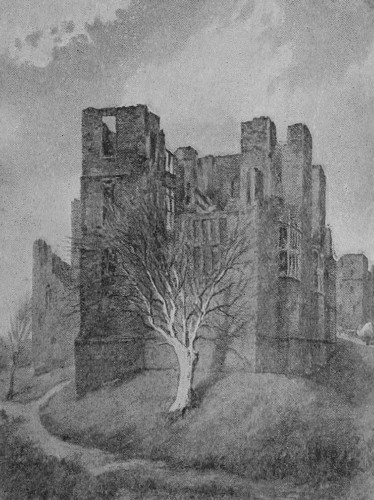 KENILWORTH CASTLE. |
 Click the book image to turn
to the next Chapter.
Click the book image to turn
to the next Chapter.