
|
Click
Here to return to Castles of England and Wales Content Page Return to the Previous Chapter |
 (HOME) |
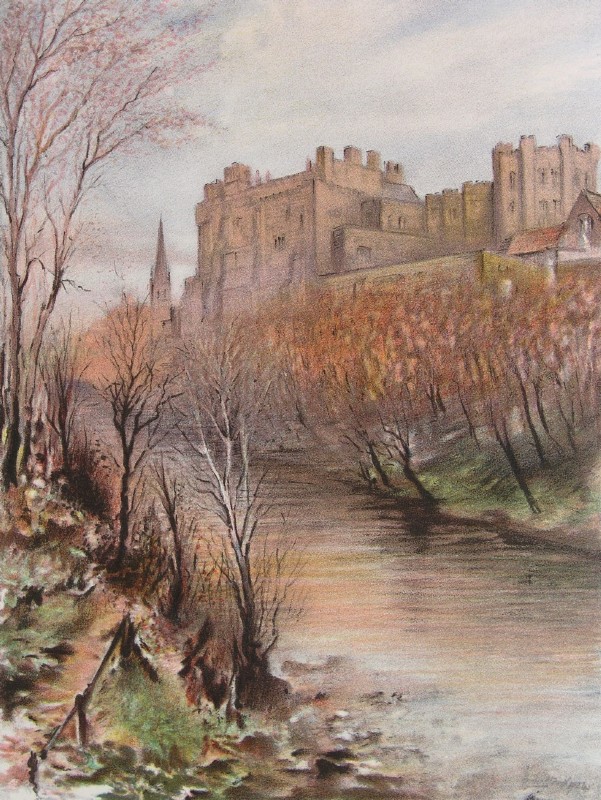 DURHAM ROBERT HEGGE, a Durham man, and Fellow of Corpus Christi College, Oxford, who wrote “The Legend of St. Cuthbert” in the time of James I, invented the most clever gibes that have been directed against the legends of St. Cuthbert, and the most beautiful phrases that have been used to describe Durham. Speaking of the promontory, where the congregation of St. Cuthbert finally settled with the body of their saint, he says: “The topographie of Dunholme at that tyme was, that it was more beholding to Nature for Fortification than Fertilitie: where thick Woods both hindred the Starres from viewing the Earth, and the Earth from the prospect of Heaven.” But the trees were cut down, and upon a plateau protected on three sides by a horseshoe bend in the River Wear grew up the cathedral, the castle, and between them, the original town of Durham. Writing a
little
sadly perhaps of his own day, Hegge remarks: “he that hath seene the
situation
of this Citty, hath seene the Map of Sion, and may save a journey to
Jerusalem.
She is girded almost around with the renowned River of Weer in which,
as in a
Glasse of Crystall, shee might once have beheld the beauty but now the
ruine of
her Walls.” Durham, with her double crown of cathedral and castle was
described
by Scott as “half church of God, half castle ‘gainst the Scot,” and
Hegge,
speaking in a more practical idiom of the subterranean galleries
supposed to
connect the cathedral with the citadel, expressed the same idea: “by
those
caverns it is certain, that the abbey and the castle shake hands under
ground.” That was,
possibly,
a confused simile, but Durham’s historical origins made it necessary
that the
religious and the military elements should shake hands. Primarily the
place was
a refuge from marauding pagans, and no doubt a town grew up as soon as
the neck
of the promontory was fortified with a stockade. At least twice before
the
Conquest — in 1018 and again in 1038 — the citizens successfully beat
off the
kings and the hosts of Scotland. After Hastings they only submitted to
William
when Sweyn of Denmark failed to send the assistance he had promised;
but soon after
their submission the people of Durham set upon Robert Cumin whom the
Conqueror
had made Earl of Northumberland. The Earl was murdered, seven hundred
of his
soldiers were massacred, and a large part of the city including, it is
thought,
the Bishop’s palace, was burnt to the ground. Then William laid waste
the
North, and in 1072, returning from an expedition against Malcolm of
Scotland,
he ordered a castle to be built at Durham. Thereafter
the
histories of monastery and castle were more closely linked together.
Durham
became even more obviously a place where the lion lay down with the
lamb, for
the bishopric was erected into a palatinate, and the palatine bishop
had
temporal as well as spiritual jurisdiction, with his own mint, his own
courts,
and every power that did not override his homage to the sovereign. He
was “rex
atque sacerdos,” the ruler of a district which was supposed to be a
buffer
state between England and Scotland. His position was expressed on many
of the
episcopal seals: the obverse represented a bishop, seated, in the act
of
blessing, and the reverse depicted a mounted warrior with drawn sword,
wearing
a mitre encircled by a crown. The
episcopal power
was also shown in Durham Castle, where princely magnificence was not
overshadowed by military necessity. Neither the Tower of London nor
Richmond
combined to a greater degree pomp with power. By 1075 the castle was
already
defensible, for, on the approach of Danish raiders, the Archbishop of
York
warned Bishop Walcher of Durham to provide his stronghold with
necessities for
a siege. And when, a few years later, Walcher was murdered by a mob,
the castle
successfully sustained a four days’ siege by his murderers. His
successor,
William de St. Carileph, in rebellion against William Rufus, defied his
sovereign’s threats in the riverside fastness. Then Ralph Flambard was
appointed to the bishopric, but, although a great builder, his only
work at
Durham was to restore the walls and to build the wall between the choir
of the
cathedral and the keep. Quite the
most
extraordinary of Durham’s rulers was William Cumin, a clerk in the
episcopal
household, who intruded himself into the see on the death of Galfrid
Rufus in
1140. During four years neither anathema nor siegecraft could dislodge
him,
assisted as he was by an unscrupulous character and political
advantages. David
of Scotland and Matilda were on his side, the majority of the chapter
which
might elect a bishop canonically were in his custody and all the
palatine
barons, except one, supported his usurpation. In addition, he procured
a
Cistercian monk of his own kidney who solemnly arrived with forged
letters of
congratulation from the Pope. Then Cumin sent his emissary to
Scotland, where
David was duly impressed by the documents, but an astute and sceptical
Abbot of
Melrose Abbey exposed the fraud. At length William de St. Barbara was
elected
at York, Henry II lending him aid for the recovery of his see, and when
a
concourse of barons and bishops appeared before Durham, Cumin suddenly
capitulated. A shivering penitent, he craved absolution before William
de St.
Barbara and the Archbishop of York, and was thenceforward hidden from
historians in a penitential obscurity. During the
episcopate of Bishop Pudsey (1153-95) one of the disastrous fires not
uncommon
in mediæval times occurred at Durham, so that much of the Norman work
at the
castle must be ascribed to him. In fact, Durham possesses some of the
finest
examples of later Romanesque work in England. As a whole, however, the
castle
is a not altogether unpleasing medley of architectural effects. A
succession of
bishops felt it their peculiar glory to add a hall, a gallery, or a
chapel, to
insert a doorway, or to buttress a wall. During the Middle Ages rich
and
powerful prelates such as Bek, Hatfield, Langley, Fox, and Tunstall,
whose
names had far more than a local significance, were not unwilling, when
they
added some new glory, to obscure thereby the equally beautiful work of
their
predecessors. But during the Common wealth the English castles
suffered from
the mutilation and desecration which had befallen the English churches
a
century before. What the good Hegge says of “abbys” may, in this
connection, be
applied also to castles. “But Time that hath the sublunary world for
her
continuall banquette, hath so fed upon these ancient buildings, that
some shee
hath quite devoured, others pickt to the bones; and what she left for
standing
dishes, hostilitie hath quite eaten up and defaced.” The Commonwealth,
in 1649,
sold Durham Castle to Thomas Andrewes, Lord Mayor of London, for £1,267
0s.
10d., and by him it was much defaced. Cosin, the first bishop after the
Restoration, declared also that the castle was spoiled and ruined by
the Scots
with gunpowder. Bishop
Cosin spent
large sums and exercised considerable taste in restoration, but he was
the last
man to whom any considerable gratitude is due in that connection. The
work of
Barrington, in the nineteenth century, was not uniformly fortunate, and
in 1833
the castle was given over to the use of Durham University. A better use
for a
fortress which serves no present military purpose could not be devised,
but the
inevitable results have been to the detriment of the buildings from an
architectural viewpoint, a noticeable misfortune being the subdivision
of a Norman
hall into smaller rooms and corridors. The castle
as
Pudsey left it was a magnificent example of Norman fortification. An
artificial
mound surmounted by an octagonal keep overlooked the courtyard which
ran
westward to the cliffs 100 feet above the River Wear. The gateway was
on the
southern side where the plateau upon which cathedral and castle stood
gave the
only easy access. The inner archways of the gateway alone show its
Norman
origin. It was restored by Tunstall, and unhappily modernized by
Barrington a
century ago, “according to the improved taste of the age,” to quote the
usual
phrase behind which our forefathers have so often sheltered themselves.
The
keep has had a similar history, but it makes no pretence to be ancient;
for the
original citadel was rebuilt by Hatfield in the fourteenth century, and
again
having suffered from decay was re-erected along the lines of the
mediaeval
foundations in 1849 for the incongruous purpose of housing
undergraduates. Pudsey was
also
primarily responsible for the range of buildings in three stories
along the
north curtain. As at Richmond the basement, under the hall, was used
for
storage, so as to preserve the open space of the enclosure for the
muster of
the garrison. But at the eastern end of the range is a chapel, or
rather the
undercroft of a chapel, which is early Norman in character and must be
aboriginal. It is badly lighted by modern windows, but it possesses
more than a
little interest for its rough herring-bone pavement and the varied
sculptures
on the capitals of its slender columns. But the glory of the Norman
castle must
surely have been the great doorway giving access to the hall on the
first
floor. This has been little restored, and the arch is a deep mass of
pattern
carving in four orders. Unfortunately Tunstall concealed the Norman
face of the
building with a corridor which, despite an oriel window opposite,
darkens the
doorway, but on the other hand may have preserved its details from
decay. Through
the archway
was the great hall, and above it on the second floor, approached by a
spiral
stairway, was another, once known as the Constable’s Hall, and to-day,
as the
Norman Gallery. In the
Constable’s
Hall the walls were constructed in a continuous arcade with windows in
every
other archway, detached shafts in couples being between the windows.
The full
effect of this can hardly be appreciated to-day. It is noticeable,
nevertheless,
how much care was lavished upon the refinements of domestic
architecture,
though not at the expense of the provisions for defence. At that time
kings
were not so nobly housed. Along the shorter western curtain Bek, at the
end of
the thirteenth century, raised a great hall on an earlier foundation.
This is
now used as the dining hall of University College, which thereby
possesses a
hall no less beautiful than those of many of the Oxford Colleges. It is
typical
of Durham that Bek’s range (very much rebuilt by his successors) has a
most
beautiful exterior not marred by buttresses added at a later period,
and a
porch erected by Cosin at the Restoration. Cosin also built the fine
staircase
within. At
Worcester,
Rochester, Hereford, and Lincoln, castle and cathedral were also
grouped
together, but none of these had sites comparable in strength or beauty
with
that of Durham, and none of these were ruled by bishops with such
powers as the
palatines of Durham. These built their cathedral to the glory of the
heavenly
ruler, and the castle to the glory of the earthly ruler. They sat
secure upon
their eminence, ready to offer to good men a sanctuary and to wicked
men a very
stout resistance. |
 Click the book image to turn
to the next Chapter.
Click the book image to turn
to the next Chapter.