 Web
and Book design,
Web
and Book design, Copyright, Kellscraft Studio 1999-2006 (Return to Web Text-ures) |
Click
Here to return to Highways and Byways of California Content Page Return to the Previous Chapter |
 (HOME) |
| VI
A VALE OF PLENTY CALIFORNIA has a number of valleys that are at the same time remarkable for their great size and their productive capacity, but the San Joaquin excels any of the others. A few decades ago it was not esteemed of much use except for grazing, though certain parts would grow excellent crops of wheat; but irrigation has changed all this, and as you pass through it on the train you marvel at the seemingly endless succession of thriving fields and orchards. My first day in the valley was a Sunday spent at a little village consisting mostly of a hotel and a few stores and saloons facing the railway. Round about was a vast level extending for miles in every direction, and nearly all of it green with wheat. At long intervals, amid this green sea could be discerned a small huddle of buildings where there was a ranch house. It was one of the regions in which, when the grain ripens, a harvester is used that is drawn by thirty-six mules or horses, and that cuts off the heads of the wheat, threshes out the grain and drops it in sacks behind. Forty acres will be covered daily on good ground and the season lasts three months. After the harvester has finished, the cattle are turned onto the land and they feed on the stubble and trample it so it can be ploughed under. For an hour or two in the morning I sat on the hotel piazza a little way from a group of men gathered near the door of the odorous barroom. The day was quiet and warm. The flies buzzed, and some sparrows chattered noisily and flitted about with bits of straw and bark and string for their nest-building beneath the cornice of the piazza. A few teams were hitched to railings under the umbrella trees along the sidewalk, and there were occasional passers on the highway. One of these passers was a man driving two burros laden with packs. The creatures walked slowly and patiently and he followed behind. He was from some mine, and all his outfit and belongings were on the donkeys. A boy on horseback rode up in front of the hotel and borrowed the proprietor’s gun that he might do a little hunting. A tramp came along and wanted something to eat, and he was set at work chopping wood. Except for him it was a day of loafing and recreation. The largest group of loiterers gathered in front of the post office to watch or participate in a game of marbles. The players were young men and boys. A little fellow named Danny was getting the advantage when I joined the on-lookers, and a young man in blue trousers, who was addressed as “Chub,” was about to snap his taw at Danny’s. “I want to kill Danny,” he said, “and make him give up his winnings.” But he missed, and his marble rolled under the piazza. “Well, I’ll be dog-goned!” he exclaimed. “That’s just the way my luck runs today.” The piazza underpinning was boarded nearly to the ground. He lay down and reached unsuccessfully into the gloom. Then several others tried it, and at last one of them got a stick to poke with, and pretty soon secured the taw. “It’s Al’s shot, ain’t it?” asked Danny. “Look out for me. I’m comin’!” cried Al. To his disgust his taw stopped in the ring, and the rules obliged him to drop in a marble to get it out. “Well, that fattens the ring, anyhow,” he said philosophically as he made the exchange. “Knock down there, Nick; it’s your turn.” Nick’s taw was near the ring, and that he might make a sure shot he punched up a little heap of dirt where a marble lay in the ring and put the marble on top. His method proved a success, and Chub said, “He sets the marble up on a nubbin and then fudges it right off. Us fellers had better holler when he gets ready again so he won’t shoot straight. That’s what the boys used to do at school. It always mixed me up and made me mad, and I’d fight. But it didn’t do no good if I did fight. I’d get licked every time.” Nick made careful preparations for a second shot, but just as he snapped his taw his comrades all shouted, and he was so confused he missed. The taw rolled along and hit someone’s foot. “Kicks on!” the players cried, and the one who had stopped it gave it a poke with his foot to carry it where he thought it would naturally have gone. “You’re havin’ a pretty hot game,” commented a newcomer. “It’s a warm one, I tell yer,” responded Al. “I was afraid this was goin’ to be a lonesome old day,” said Chub, “but I’ve had a lot of fun;” and the game continued hour after hour until dinner time. Then the participants divided the marbles, for they did not play for keeps, and went their several ways. The Sabbath as I saw it here is characteristic of the Far West. Nearly everywhere it is a holiday to a very marked extent, and church-going is decidedly less the habit than in the East. Ball games are one of the most popular of the amusements of the day; and when I chanced to spend a Sabbath at Visalia, a busy town in the heart of one of the best portions of the valley, the chief event of the day was the getting out of the fire engine for a little sport and practice squirting around the streets. It was the rainy season, and we had several heavy downpours that night which left the region pretty thoroughly soaked. However, the sun shone forth the next morning, and in spite of the miry walking I started for a long ramble among the farms. I had to do a good deal of dodging to get around the pools and puddles, and there were certain of the “slues” in the hollows which almost brought me to a stop. Yet by climbing along on fences or resorting to the embankment of an irrigating ditch, or by cutting across a field I contrived to continue my ramble. The country was good to look at in spite of the overabundance of mud and water. On the eastern horizon rose ranges of snowy mountains, but the lowlands were a green paradise. The grazing fields, in particular, were very beautiful with their cattle, horses, or hogs, and with their scattering ancient oaks. These oaks abounded, but never gathered in a thick wood. They were wide-spreading and stately and made the country look like a park. Other native trees were very few, except along the streams, which were apt to be thickly screened by willows and cottonwoods. Many great tracts of land were set out to regular rows of prune and peach trees, and every farmhouse seemed to have its packing shed and its great heap of wooden drying-trays. Formerly pears were a staple fruit, but some sort of a blight has put the trees out of business. 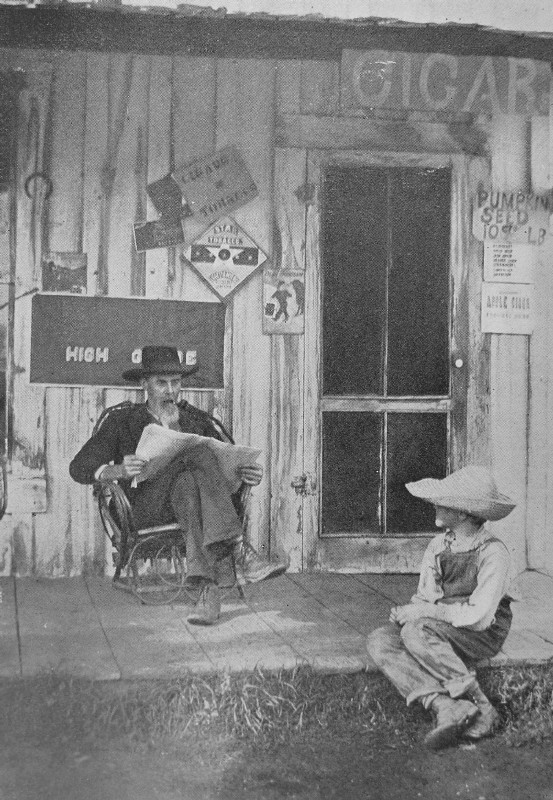 The news
The people I met and spoke with were agreed that it was an unusual condition to have too much water, and the owners of the flooded lands were not altogether happy, yet any damage they suffered was largely offset by the drowning of such pests as the gophers and ground squirrels. The local conditions therefore were on the whole satisfactory, but certain other sections had not fared so well. For instance, in the same county, there used to be a lake thirty miles broad and a hundred long. It afforded fine fishing, and the hunters resorted to it to shoot the abounding ducks and geese. Gradually it dried away and left some of the richest farmland in the world. The old lake-bed became a great wheat-producing district, but now the heavy rains had begun to fill the basin of the former lake, and the body of water was fast expanding to its former size. The wheat had grown to be waist high and was well headed out, but the lake-bed dwellers had to abandon everything except the little they could carry away, and, driving their stock before them, they sought more elevated ground. It was thought that many years must pass before the water would again dry away. As I walked on I at length wandered into a little village. Near its center I stopped on the piazza of a bakeshop. Here was a chair, a settee and several boxes occupied by a row of men smoking, spitting and talking. The weather was not propitious for field work, and the piazza group was in a very leisurely and hospitable frame of mind. If anyone passed, either walking or driving, they never failed to shout out an invitation to stop. “Come and join us,” they would say. “You’ll never find a better lookin’ crowd in your life.” If the passer was riding, the remarks would continue, “Aw! get out and tie up. Take a rest. Don’t be in such a rush.” Presently a fellow approached driving a smart span of horses attached to a gig. “Hold on to them ribbons thar!” was the cry from the piazza. The man in the gig slowed down and halted. His vehicle was old and weather-beaten, but it had a bright red whiffletree. “Why didn’t you paint the rest of your gig?” someone queried. “Well,” said the driver, “I left it that way so people’d ask questions.” “Say, but you would shine if your gig was all painted that style,” remarked one of the lookers-on. “This is a nice little team,” said the occupant of the gig. “I’ve driven ‘em about fifteen miles and now I think I’ll put ‘em in the stable.” “Oh, no, don’t do that,” said someone on the porch. “Drive ‘em some more. It’ll make ‘em eat their hay good.” Shortly after he had gone a man in a top buggy drove up in front of the bakeshop, and one of the loafers said, “Looks like you was goin’ somewhere.” The man in the buggy poked his head out and said, “Who wants to go to town with me and get drunk?” Some responded that they would like well enough to get drunk, but none of them cared to exert themselves sufficiently to go to town, and he had to continue his journey alone. The man of the piazza gathering who interested me most was an old settler of the region who had come from Tennessee in I870. “But the country had been occupied some for nearly twenty years before that,” he observed. “In I852 there was eight or ten families built a stockade at Visalia and then put up their log cabins against it around on the outside. The Indians was dangerous, you see, and even after I come, the danger wa’n’t past. They’d kill our cattle, and they’d take your scalp if they had a good chance. “This country in its natural state was a forest of oak with here and there an open where the tall grass grew. We used to cut the grass for hay. Land could be had almost for the asking. You only needed to take up a homestead right from the government, and when you had paid sixteen dollars and lived on the land five years you were owner of a quarter section — one hundred and sixty acres. Deer, antelopes and wild mustangs was plenty. You’d often see the antelopes feeding in among the cattle. People e’t their meat, but it was coarse and not so good as deer meat. You could go up there in those foothills you see to the east and kill a wagon load of deer in a day. They roamed about fifty to a hundred in a band. “Bears was common up in the mountains — brown, cinnamon, black and grizzlies; but I wa’n’t lookin’ for them fellers. I was willin’ to make friends. If they’d let me alone I’d let them alone, you bet yer boots I would. But one time I was up there helpin’ old Billy Rhoades with his sheep. Fred Stacy was with me, and we was goin’ across a little medder when we see a full-grown grizzly bear with a cub follerin’ her, and they was comin’ straight toward us. “It happened there was a cluster of smallish pine trees near by, and Fred went up one tree and I went up another. I didn’t have a thing to shoot with, and I don’t suppose I’d have used a gun if I’d had one. The bear kind o’ looked up at us but kept on down the trail. She found our camp, and she turned over our potatoes and beans and scattered them and our other things all about. Yes, she had a regular tear-up. But I was glad to git off with no worse damage. A bear with a cub will fight, you know, and I come as clost to a grizzly then as I want to, less’n the bear was in a cage. 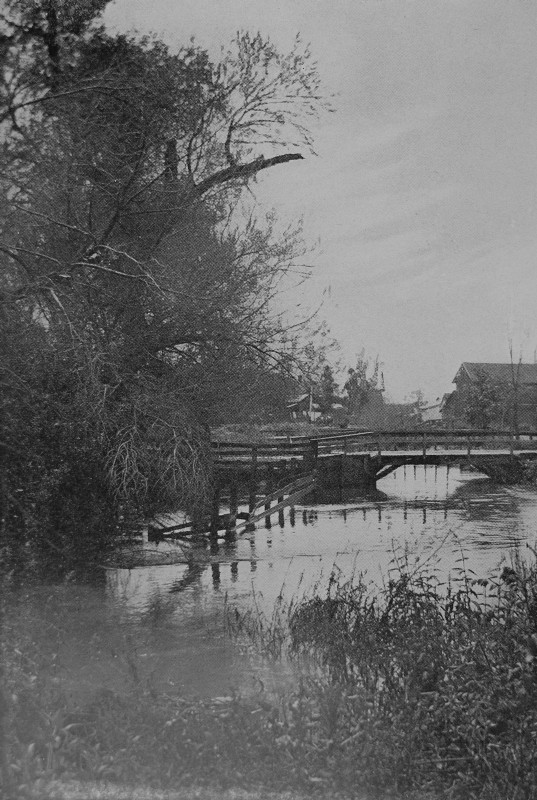 Water for irrigation
“Another time old man Rhoades and his son was fetchin’ some sheep off the mountains, and the boy went into a canyon for a drink. He lay down to git at the water when a black bear jumped out of the willers onto him and begun a-chawin’ him. He hollered for the old man, who come hurryin’ down — and there was the bear chawin’ on his boy. The only thing the old man had to attack the bear with was a pocket knife. That was a poor weapon, but he saw he had the job to do, and he didn’t hesitate. The bear was on the boy, and the old man was on the bear; and he got her, and he skinned her afterward. She mighty nigh killed the boy, and the old man was so tore and scratched he carried the scars to his grave. “Anyone could have a horse in the early days by just goin’ out and ketchin’ a wild mustang. The way we used to do that was to build a corral consisting of a fence about eight feet high around a half acre or so, with a long wing fence extending out from it. Then when we see some mustangs feeding near we’d go out on the far side of ‘em and give a yell to start ‘em, and by heading ‘em off we’d drive ‘em against the wing fence and run ‘em right into the corral. After that a man would go in and lasso one. He’d have to be on horseback or they’d run right over him. “When he got a mustang roped he’d drag him out, put on a bridle and saddle, blindfold him and get on. The mustang didn’t like that, and he’d begin to buck. Seems to me I’ve seen ‘em buck as high as that schoolhouse over across the road. No matter what the mustang did, the rider had got to stick on. That was the only way those horses could be broke. They were the meanest things you ever see. They were good saddle ponies though — fine! An ordinary horse wouldn’t stand half what they would. The mustangs were small, but they were tough and hardy — kind o’ like a Jack rabbit. You could run one all day, and it would be about as good at the end as when it started; and the next morning it would buck you off if you wa’n’t careful. “When I come here, cattle, sheep and hogs were all the go. There was very little soil cultivated; but gradually it got to be a great wheat country. Now wheat has given way to orchards, and we ship fruit all over the world. Alfalfa is grown quite a little and is more of a money-maker than fruit. It’s ready to cut now, and we’re only waiting till the weather is settled so we can cure it. We git four or five crops by the time the frosts bring the season to an end. It’s good feed for cattle and all right for horses if you use some grain hay with it. By grain hay I mean barley and wheat cut when it is in a stiff dough — that is with the grain just past the milk stage. “I used to raise wheat, but we had fifteen dry seasons right a-running which did me up. Now the weather seems to have changed and I look for fifteen wet seasons. So I’m goin’ to try wheat again. You ain’t sure of a crop unless you irrigate. When we people come here from the East we didn’t know anything about irrigation. But somebody tried it and found it a success. Then we all turned loose. It’s a good thing. At the same time there’s a lot of hard, dirty work in irrigating. 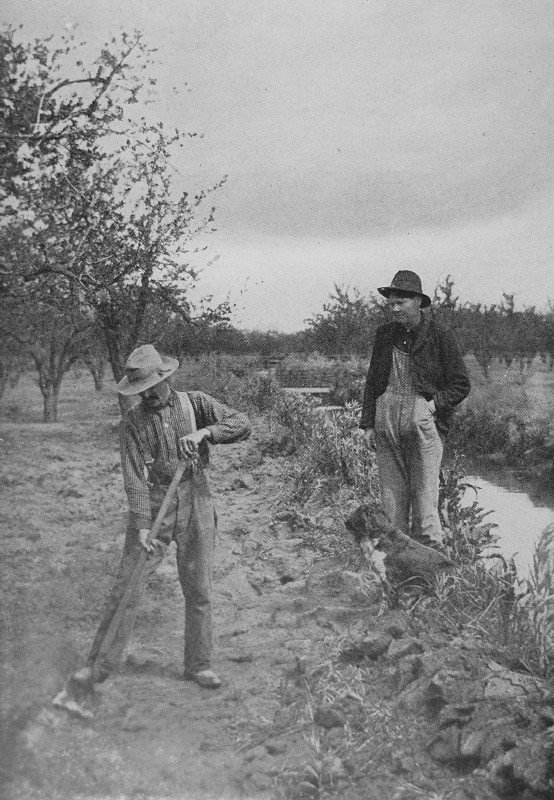 At work along an irrigating ditch
“First you’re obliged to plough and scrape till you’ve got your land level and in check. We put two or three acres in a check with a levee around it. The checks have to be smaller if the land is rough. Our land here is pretty smooth, and two men with a pair of horses can git a quarter section in order — leveling checks, making ditches and floodgates, all in about a couple of months. But you are out something right along digging to keep the channels clear and making repairs. Still, if a man would give me a place back in Tennessee whar I come from I wouldn’t take it nohow, if I had to live on it. In a wet season your corn would turn yaller as a punkin — it was aggravatin’! “To show you what can be done here I want to tell you about a little orchard of apricots I bought a year ago. Everybody claimed it was run out, but I trimmed the trees and worked the ground and I got eight tons of fruit which I sold for twenty dollars a ton. That was better than a thump on the head with a sharp stone, wa’n’t it? “You can raise anything that will grow on the top side of the earth, in this valley. I got only two objections to it — in over half the land there’s alkali, and secondly malaria is a good deal too common. You notice our houses ain’t got cellars and are set up on posts off the ground — some of ‘em three or four feet. That’s on account of malaria. “Perhaps it strikes you the houses must be cold in winter, but we don’t have such sharp weather as they have in other parts of United States. I ain’t seen but one snowfall in all the time I been here. You take a person from back East and drop ‘em down here in March and they think they’re in Paradise. Thar’s an old lady from Iowa just come lately to this place, and she says it is the prettiest country she ever cast her eyes on. When she come everybody was freezin’ and hoverin’ over the fire in Iowa, while here it wa’n’t cold worth mentioning, and she says, ‘Here I’ll live and here I’ll die.’ “But things ain’t always so pleasant in our valley as people think they’re goin’ to be. Thar’s a mighty lot gits fooled. They think they can pick up twenty-dollar gold pieces, dog-gone-it; and they have it all figured out how easy they can make their fortunes. So as soon as they see a piece of property that they fancy they just dive in and pay a good round price. Then when they find they can’t git rich in a few weeks like they expected, they’re sorry they grabbed so quick. Often they’re so homesick that they’re ready to take whatever anybody’ll give for the property they’ve bought. There’s an old negro here has picked up a lot of land from such fellers till he’s got fifteen or twenty sections, and it’s all paid for, too. He’s a mighty good darkey. What he agrees to do he does, and he’s looked up to about as much as anyone in this region. He’s a cattle-man and a hog-man and has money laid away. Every one of his girls that gets married he gives five thousand dollars and a piece of land. That’s a pretty good starter, eh? “The poor investments that are made by strangers are mostly the fault of the real estate agents. I know of a man who sold out in Kansas and come here and a real estate agent induced him to buy a section of old alkali land at forty dollars an acre — made him believe it was the richest land in the country. The agent done wrong. I call that robbery. The land wouldn’t sprout backyard peas. It wa’n’t fitten to look at. Even salt grass wouldn’t grow on some of it. You know what poor stuff salt grass is. The cattle will eat it when they can’t get anything else, but it’s tough and they got to have good teeth to bite it, and it won’t fatten ‘em any. Well, that man put up a house and a barn and a corral before he found out what sort of a bargain he’d made. He finally went back to where he come from, and his buildings are standing empty. He’s got his money in that place, and he’ll never get it out. “Of course a good many fellers have taken land and made money; but there’s a blamed sight more who have lost.” As a whole the region around Visalia looked productive and prosperous, and in order to see some of the poorer land of the valley I went on farther north. It so happened that I reached the place I had selected soon after five in the morning. There was no station — only a half dozen little homes and two or three small dilapidated stores, and a white schoolhouse that stood by itself off a quarter of a mile on the open unfenced prairie. A streak of yellow above the serrated peaks of an endless chain of snowy mountains in the east gave promise of the dawn. On the telegraph lines perched a twittering group of linnets. Near by was a box freight car, and while I stood looking around me, a tramp slid out of the car, shouldered his bag and went off along the track; but on the outskirts of the settlement he stopped, built a little fire, and I suppose cooked himself some sort of a breakfast. 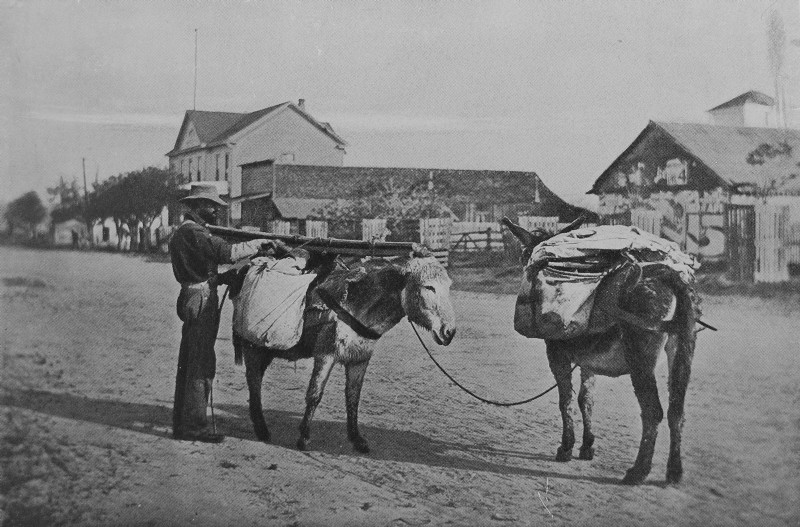 A prospector and his outfit
I walked out on the prairie. Here and there I could see scattered houses — rather forlorn-looking places, most of them, and usually with no thought whatever bestowed on appearances. The plain was perfectly treeless, except that an occasional home had about it a few shade or fruit trees, and now and then a cluster of willow bushes grew beside the irrigating ditches. The ditches conveyed water to some alfalfa farms two or three miles away where the soil was deeper. Most of the land in the neighborhood was only fit for grazing, and close under the surface lay “hardpan” — a soft sandstone. At one place I came across men at work setting out fruit trees. They were on low ground where the soil had accumulated a little, but in order that the tree roots might have a chance to develop satisfactorily the workers were blasting holes in the hardpan, one for each tree. A few horses, cows and goats were staked out near the village homes, and I saw a drove of black hogs munching along over the knolls, and late in the forenoon a vast flock of sheep drifted past. A squad of men from the nearest town were ploughing, scraping and grading the road, which heretofore had never been turnpiked. The soil was very hard, and one of the men said, “It’s rough on the tools. I had a new plough yesterday and in three hours I wore the point plumb out. I don’t see how these fellers that keep store here make a livin’. They never seem to be doin’ no outside work and there’s mighty few customers. Most o’ the time they stand at the door lookin’ for us to come in and spend the money we make on the road. Yet they wear good clothes and smoke a cigaret once in a while. One of ‘em has a sheep ranch. I guess he’s gettin’ along all right. He had a Jim Dandy little wagon come to him on the train last week.” The man now turned to his work and I went to watch some boys not far away who were gathered around a small pond grabbing for pollywogs. They said they were going to use them for fish bait, and they had started to tell me about their luck in fishing when the bell in the schoolhouse cupola gave a few jingles. At once the boys dropped the pollywogs and scudded away across the prairie to the temple of learning. For the sake of variety I went in to have a look at one of the stores. It was not much more than a shanty and the supply of goods was very meagre. “Billy” McDonald was the proprietor. I found him a good deal disturbed because his horse was missing. “I left her loose in the stable last night,” said he, “and she got out and has gone back to town where I bought her not long ago.” A customer came in. He was a stranger who happened to be driving through the place and he wanted to purchase some soap. Billy seemed surprised. He didn’t carry such an article in his stock. “Neither did the other store,” he explained. So the customer bought a glass of whiskey instead. Later in the day I again took the train and was soon in a region more favored. Indeed, in my memory of the valley I see little else than a constant succession of orchards and vineyards and great wheat fields and luxuriant pastures. But the homes did not seem in keeping with nature’s affluence. Many were unpainted, unshadowed and shabby and small, and looked as if in the heat of summer they would be blistered off the face of the earth. Few were such as we in our older Eastern states would consider at all attractive or comfortable. That the Vale of Plenty should have its imperfections is to be expected; and on the other hand its attractions are many, and there lies before it a future full of promise. NOTE. — The San Joaquin Valley is one of the great agricultural basins of the world. It is two hundred and fifty miles long by about fifty wide. In it grows half the wheat raised in the state, and wheat farms of ten thousand to fifty thousand acres are not uncommon Here, too, you may see thousands of acres of alfalfa, vast vineyards and astonishingly large orchards of prunes, peaches, apricots, figs and other fruits. It produces nearly all the raisins of the United States, and fabulous crops of asparagus, potatoes, beans and melons and it is famous for its cattle, sheep and hogs. Stop at any of the chief towns, such as Visalia, Fresno, or Stockton, and journey out into the surrounding country and see what is being done. Irrigation is the chief dependence for producing crops, and water for this purpose is abundant. Another attraction of the valley is the excursions that can be made from it into the Sierras. Best of all is a visit to the Yosemite, but scarcely less interesting is a trip to the wild canyon of King’s River. This latter journey is made from Visalia, partly by stage, partly by pack and saddle train. The gorge lacks the waterfalls of the Yosemite, and its walls are not so precipitous, but they rise into even wilder and more stupendous heights. On account of snow and flooded streams, July and August are the best months for the trip. To add to the fascination of this jaunt you have close at hand Mount Whitney, the loftiest mountain in the United States, if we except the Alaskan giants. It is easily ascended from the west side. The streams are full of trout, and game abounds. Still another attraction of the region is the General Grant National Park containing many of the famous big trees. The Sierra Nevada (in English the words mean Snowy Range) sweeps along the eastern borders of California for fully 500 miles. It abounds in scenery of marvellous grandeur, and offers many attractions to the Alpine explorer. The Union Pacific Railroad, as it climbs the mountains toward Nevada, passes through 37 miles of snowsheds. Although Mount Whitney which soars up 14,502 feet is the highest point in the United States, it is a curious fact that only 75 miles away is the lowest point, 275 feet below the sea-level, in Death Valley. This valley acquired its name from the loss of numerous emigrants who attempted to pass through it in 1849. |
 Click the book image to turn
to the next Chapter.
Click the book image to turn
to the next Chapter.