 Web
and Book design,
Web
and Book design, Copyright, Kellscraft Studio 1999-2006 (Return to Web Text-ures) |
Click
Here to return to Highways and Byways of California Content Page Return to the Previous Chapter |
 (HOME) |
| V
SANTA BARBARA AND ITS HISTORIC MISSION THERE had been rain early in the day, but as my train went northward from Los Angeles the clouds rolled away, and when we came to the seashore the sun was shining from the west in a broad dazzling path of light across the restless waves. Off in the distance were some islands nearly hidden in silvery haze. A series of fine big hills hugged the ocean, and we skirted their bases close to the beach till we reached Santa Barbara where the hills gave place to a wide valley and disclosed a noble range of mountains rising along the east. The lower portion of the town is a straggling and promiscuous set of buildings, and misses little of being squalid; but as you go farther back, homes of the suburban type become more and more numerous till you find nothing else but handsome cottages and villas hiding amid the semi-tropical luxuriance of blossoms and shrubbery. On a gentle hill at the end of the vale stands the Mission charming the beholder with its simplicity, its size, its imposing situation and its storied age. It is a structure that seems to belong to another realm and another civilization, and the only local buildings at all akin to it are a few lowly adobe houses in the town center, just off the main business street — survivals of the old Spanish village. These are usually whitewashed, and they have broad, tile-floored verandahs with roses, morning-glories or other vines growing along the front. Neither the chill of winter, nor the heat of summer can very well penetrate their massive earthen walls. As one of the dwellers said to me, “It might be August, and the sun no matter how hot, you go in this house, it be cold, nice, good.” 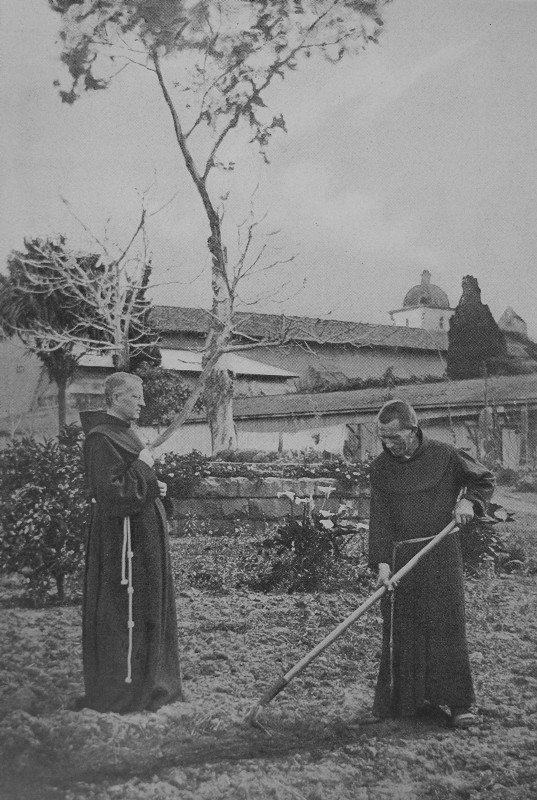 Garden work
He showed me a patch of grapevines trimmed back to the bare stubs, but the green new sprouts were already well started, and he said, “They will have on them fine grapes — good to eat, good to make wine, and the wine is more strong as whiskey. See how these vines is growing. I have all the time to cut them back. He grow fast, queek! You bet you! By gosh, give him a chance and he grow all over the place! That is cactus over there. Prickly pear, I call him. The fruit has many pins on it — what you call them? — thorns. But get them off and the skin off, and the inside is sweet, good.” I asked him the name of a little flowering plant growing underfoot, but he only knew that it was a weed which was sometimes used for medicine. “It will keep you well better than the doctor,” he continued. “If I be made sick of the stomach I boil it for a drink. Ah! the doctor can not tell what is the trouble inside of you. He get him your money. He don’t care whether you die.” I went into one old adobe. It was pretty dismal and dark and bare, and the rafters and roof-boards overhead were black with soot. The two things that most impressed me were the presence of a piano, and a sign hung on the wall that had been painted by some genius of the family and which said, DON’T SPICK IN THE TABLE. The idea of the motto was not to chatter while eating. In my wanderings about the old part of the town I came across an Irishman converting a wayside blue gum that he had felled, into firewood. The chopper was elderly, tattered and rusty, but in independent circumstances, nevertheless; for he pointed across the road and affirmed that he owned an entire block of land and the various cabins on it, property worth in his say-so fifteen or twenty thousand dollars. He mentioned that he lived over there, and I asked him in which house. He responded that he didn’t live in any house, but camped in a wagon which was hidden from view by some intervening buildings. “Have ye been up to the ould Mission?” he queried, settling himself comfortably on the blue gum log. “It is an intheresting place to look about, and soom like to go to church there on Sundays. I wint wunst mesilf. A lady who thought a heap of me had invited me to go wid her, and she sat in the front seat. But I stayed near the door; and close by me was a lobby hole or box like a little room built ag’in the wall and I could hear a priest a-muttering in it. Yes, he was in there a-gobbling away like an ould turkey — joost as if the outside wasn’t good enough for him and he moost go in there and gobble by himself; and I couldn’t understand a word he said, for he didn’t speak out plain and brave. “There was a lot o’ prayin’ to be did in the church service, and you had to be crossin’ yoursilf and pokin’ your heart most of the time. But I wasn’t coom for that. I was there to listen and look. I couldn’t make mooch sinse out of what I heard, because a good deal was in Latin or soom other haythen language. Then there was a feller walkin’ around swingin’ a thing that smoked — a cincer, they call it, and he was shakin’ it this way and that and payin’ no sort of attintion to it; and I said to mesilf, ‘That feller is no Catholic. He don’t care what he’s got there, whether it’s wather or a kag of beer or what it is.’ “I want ye to notice one place at the Mission particular. Turn off the road that goes up the hill joost beyond the main building and ye will see the ruins of three rooms. It’s telled me that the ould monks walled up some bad people in there to stay for the rest of their lives. The backmost room was very small and half under the hill, and the opening into it was only a round hole that you had to crawl through on your face and hands. It seems like that was the place for thim that was very bad — the outlawed criminals. The others stayed in the bigger rooms where it was more plisant. “But whin Fremont coom here he throwed a cannon ball or two at thim rooms, and he let the prisoners loose. He knowed what was there. I niver had thought well of his outfit — coomin’ here and raising thunder with the Spanish people, but whin I seen what he done in leaving those prisoners loose I felt different. A man in this town who was in Fremont’s army tould me about it, but he has been dead now a matther of five or six years. Ah! the ould padres had been havin’ their own way till Fremont coom. They got all the Indians workin’ for ‘em and were bossin’ thim and makin’ thim do exactly as they pleased and tellin’ thim if they didn’t obey they’d be sint to hell sure. So the padres got so rich and proud they didn’t hardly want to speak to anyone. Thim prison rooms make a strange lookin’ ruin even yit, and the firrust time I was past the hair fairly stood up on me head at the sight. I thought I would as soon have me coffin made and be put in the ground as be walled in there.” 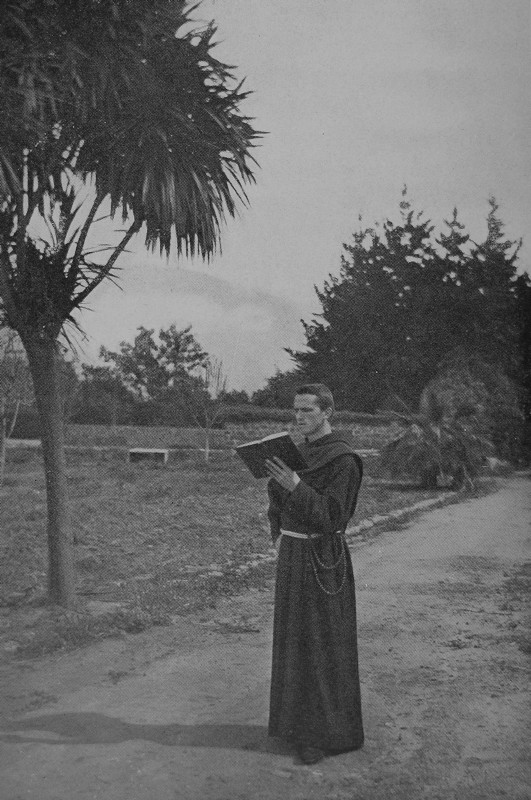 Meditation
Really, the buildings of which he spoke had something to do with the storage and filtering of the old water supply, and there never was any such grim prison as he described. The Mission itself, unlike most of the California Missions, is not a ruin, but is in excellent repair and still the dwelling of the gowned and sandaled monks, as it was a century ago. These monks are so different from ordinary folk in their garments and in the strangely decorative life they lead that it is fascinating to watch them engaged in their various duties. The furniture and all the belongings of the Mission are severely simple, but the great court back of the main building is full of flowers and trees, and its luxuriance contrasts oddly with the severity of the interiors. Throngs of visitors are constantly coming and going. They, however, only have access to certain public portions of the premises, so that those portions where the friars eat and sleep and do their daily tasks in shops and garden and fields repose in almost unbroken calm. From the Mission I went far up a mountain roadway that for a long distance clung to a hillside well up above a noisy stream coursing along in the wooded hollow. The road was muddy and gullied. Heavy wagons were going up after stone, or returning loaded, and there were many equestrians — ladies, men and children. Santa Barbara is a famous place for horseback expeditions. Nearly everyone rides, even those who before they go there never have been on a horse, and all through the day you see the riders, singly, in couples and in squads, gallivanting through the town streets, and meet them on every road and trail for miles around. The road I was on was bordered by pastures that in places were grassy, but were largely covered with gray-green sagebrush mingled with thickets of chaparral misted over at that season with blue blossoms. In favored spots grew the cactus and clumps of great century plants. When there was open grazing land it was strewn with rocks, and this rocky ground seemed to favor the growth of scattered groves of live oaks. The oaks were wonderfully twisted and distorted, their bark was gray with lichen and they looked as ancient as the rock-strewn hills on which they stood. At one point I came on a herd of cattle feeding along the brushy roadside, and three boys were watching them. The watchers were playing with a pet cow that was lying down, and which seemed to take a sort of sleepy pleasure in their proceedings. The clothing of the lads was covered with dirt and hairs, for they tumbled about on the ground or leaned on the creature and rubbed it companionably. One boy was milking into his mouth. The oldest of the trio said, “My father gave me this cow when she was a little bit of a calf, and I take care of her. If he tries to milk her he gets kicked, but I can milk her anywhere. Last December she pretty near died. There was no feed in the pastures, and the cattle was dying all over. We lost quite a few, and this cow got so weak she would tumble down. So we carried feed to her and she got stronger. We watch the cattle here all day, but at noontime take turns going home to dinner. When night comes we drive the cattle into the pasture.” I went on until the foothills began to merge into the rough steeps of the mountains, and then I wandered back to the town. On my last afternoon in Santa Barbara I again had a talk with the Irishman-of-wealth who lived in a wagon. He was still laboring at the big blue gum, but desisted from his exertion to sit down and chat, as readily as he had before. He was especially eager to know what I thought of the Mission and its monks and their religion. Soon he was relating some of his personal opinions and experiences. “I’m not mooch stuck on religion mesilf,” said he, “and a little church-going lasts me a long time. Wunst my fri’nds tould me I ought to go to confession. So I said I would, and at the church where they tuk me I wint into a little room, and there was two chairs and a priest, and he and me set down. Thin he began moombling along like a drunken man wid a pipe in his mouth. Well, I listened and listened; and as I could make no sinse at all out of his moombling, I said nothing; and at last he got up and says, ‘Adieu, coom again;’ and I says, ‘All right,’ and wint out. “Last week a Salvationist preacher was along the road here, and he stopped to speak wid me as I was hackin’ away at this tree. He wanted me to go to church. I tould him I wouldn’t care if there was niver a church in the woruld. ‘I don’t believe in your Bible,’ I says. ‘There’s good things in it, but there’s the divil and everything else besides in it, and it tells lies the same as the rest of the people.’ “‘Brother,’ he says, ‘ye moostn’t think that way.’ “‘Well,’ I says, ‘you take sooch a story as that about Noah — and how God raised the wather of the Pacific Ocean and turned it topsided like over Asia and drowned all the people — I can’t bel’ave it. Would God be that cruel?’ “‘He was not cruel,’ the Salvationist said. ‘There was an ark, and whin the flood came and the people was all a-swimming God tould thim to come into the ark, and they would not.’ “‘How could they all get in?’ I says. ‘It wouldn’t have held thim.’ “‘Eh-heh!’ he kind o’ stammered, ‘God can do anything. He made the woruld.’ “‘What did he make it out of?’ I asked. “‘He made it out of doost,’ says the Salvationist. “And who made the doost?’ I says, “Ha-ha-ha-ha-ha! I ketched him there, and he got mad at me. ‘You can get soom kids to believe thim things,’ I says; ‘but it’s no use to be arguin’ to a sinsible, intilligent man. I keep the straight thrack and I want no more of this nonsinsical talk.’” The chopper took his hat off and ran his fingers thoughtfully through his hair. Then he resumed his remarks by asking, “Did ye iver know there was gold in Ireland? Well, whin I was a kid I lived about twinty miles from the city of Cork, and near me home was a nice creek — not like these streams in California, but clear and beautiful and running all the time; and wan day I see a bright stone in the wather — it might be about the size of a goose’s egg, and I picked it up. I had niver seen anything like it — so yaller and heavy, and it took me eye. So I carried it home to me mother and she put it under the bed. “Me mother had been nurse in a gintleman’s family, a family that was way up, and the gintleman’s daughter would soomtimes coom and call on her. The young lady was there wan time all dhressed up so very fine, and me mother showed her the yaller stone from under the bed, and the young lady carried it away wid her. “I didn’t know what the stone was thin, but since I been in this country and worked in the mines I know it was a lump of pure gold. I seen in that creek other stones like it, and going right across the creek was a vein of what I called white rocks, that now I would call honeycomb quartz — gold bearing. If I broke the rock the pieces would hang together wid the gold in it. Soomtimes I would pick up one o’ the gold pebbles, and it seemed so heavy I would toss it up joost to feel it coom down chuck in the palm of me hand. If it fell on the ground it would make the doost fly, it was that heavy. Ah, there’s plinty of rich ore in Ireland, and what’s the matther they don’t give the people permission for to mine it? I s’pose if I was to go back there and try to get that gold they’d put me in jail, eh? “Well, now, I was by the creek another time where there was a deep hole wid a ruffle below it, and in this deep place I see soom throut. Wan was ahead and the others was following like a lot of dogs running after another, goin’ along in rotation. The first throut had soomthing in its mouth — oh, so shining joost like sunlight. Pretty soon the throut dropped it, and the next one picked it up and the rest kept on chasing until he dropped it and another ketched it, and away wid it. Ha-ha-ha-ha-ha! I kept watchin’ and by and by I got hold o’ the shining thing — and what was it but a di’mond. I didn’t know thin, though, what it was, and I ran home and showed it to me mother and said, ‘Oh, look what a nice little rock I got!’ But she let the gintleman’s daughter take it, and the young lady put it in a ring. I worked at her house whin I got older, and she would show me the ring wid the di’mond in it and make it flash the light over on the wall, and she would tell how she had the value of so mooch wealth on her finger. That’s the way people have cheated me all me life — because I would niver grab for anything.  The artist
“Perhaps not iveryone would have seen what I seen. Soom of us are odd from the balance of the people. I have tould you about the gold and the di’mond, but the most wonderful thing in me life is that I have seen the fairies. Me father seen ‘em too, and he said his father did before him; and so I suppose have all the ginerations in our family from the commincement of the woruld right down. I remimber the first time I seen ‘em I was a boy out in the pasture. I was all alone, and I seen forty or fifty little men goin’ along, and they were no more than three feet high. They wore stovepipe hats and bobtail coats and knee-breeches, and each had a big long pipe in his mouth, and they stood up so straight and plump and nice it was a pleasure to look at ‘em. Ye see they was dhressed in the rael ould-time Irish costume. I have seen the Scotch costume and the other national costumes, and soom are good enough, and soom are crazy-like, but none are equal to the Irish. I tell you an Irishman in that ould dhress looked like a smart, intilligent, brave man. Ivery wan o’ those fairy men carried a blackthorn stick. Ah, how mooch the ould Irish did think o’ their blackthorns! How they did bile ‘em in hot wather and rub thim wid ile, and hang thim up in the chimney to get seasoned and smoked, and they always carried thim to protict thim-silves when they wint to a fair. “Well, there was a bird in Ireland used to coom and sing to me — a little black bird like wan o’ these pewees. Whin I took shipping for this counthry I felt very bad to be leavin’ me little bird. I said, ‘Oh, I’m so sorry! I’m afraid I shall lose me luck.’ “But after we was about ten days out I looked back, and there I saw me little pewee coomin’, and he flew like he was awful tired. Finally he caught up wid us and lit on the topmast, and there he stayed the rest of the day. The next morning he was down on the first yard, and the day after that he was on the bulwarks. I was on the promenade poop forward, and I spoke to him, and he coom and hopped about and e’t soom of a piece of bread I had, and then he hollered, Pe-weewee-wee-wee!’ and flew back up in the riggin’. “After a while I wint down below, and whin I coom up again I couldn’t see him at all any more. But he visits me lots o’ times since I been in this counthry. It’s the same bird, wid the same motions and song my little bird in Ireland had. I could tell him from any other bird. He cooms and gives me warnin’ if soomthin’ is goin’ to go bad; and maybe, now and then he will appear as a cow. There was wunst I had a little bit of a log cabin down the coast a few miles, and there was a good stout fince around it, and barley a-growin’ in the yard. Well, I was settin’ in me cabin wan day whin a cow stuck her head in the door and laughed joost like a Christian. ‘How did you get inside my fince?’ I said. ‘It’s destroyin’ my barley, ye are.’ “So I drove her out of the gate, and I was astonished she wint so quick and peaceable, and not ugly and conniptious like most cows. Thin I looked at the barley, but it was not hurt at all. Another day I found the cow rub bin’ herself against the side of my little house, and I drove her off across the fields till she passed around soom bushes, and the next minute she coom in sight and a calf wid her. She passed behind soom more bushes, and as soon as she appeared again there was half a dozen more cows wid her. Ha-ha-ha-ha! I picked up a rock to throw at her, but she looked me such a look I did not throw. ‘That’s the ould fairies,’ I said, and I asked forgiveness. “The cow kept foolin’ wid me for about a month. I wa’n’t feelin’ well, and I was gettin’ worse. ‘Oh,’ I thought, I’m goin’ to die!’ “I took a walk out wan day, and I seen that cow by the side of the road, and I stopped and had a good look at her. ‘What a fine cow!’ I says, and how full your bag is wid milk! I niver noticed that before. I will bring a bucket and milk you and have soom bread and milk to eat.’ “So I got the bucket and kneeled down to milk, but the cow began to hitch around and would not stand still, and I said, ‘If you don’t quit that I’ll hit you wid the bucket.’ “She lifted up wan hind foot like she was goin’ to kick, and she turned her head around and looked at me as if she was human and had sinse. I was scared and I started to escape into a near field. Well, now thin, as I was goin’ over the fince I looked back and there was no cow to be seen. She’d gone out of sight while I was takin’ three steps. “The next evening I was out again, and there was the cow in the road, and the milk was runnin’ out of her bag and down the road in a regular stream to the gulch. I hurried and brought me bucket and caught about two inches in the bottom of it. Thin I carried it to the house and had soom bread and milk, and that milk was delicious, palatable, fine. It was the best I iver tasted. It made another man of me. I could feel the change at wunst. It braced me up and I was well. “I had soom milk left and I thought I would let it stay in the bucket and have it in the morning, but when morning came and I looked in the bucket I saw nothing but wather there. At noon I looked in again and the bucket was dry. Now, what do you call that? It was the fairies all the same havin’ fun wid me. I was sick and they cured me. They knowed it was no bother to do it. 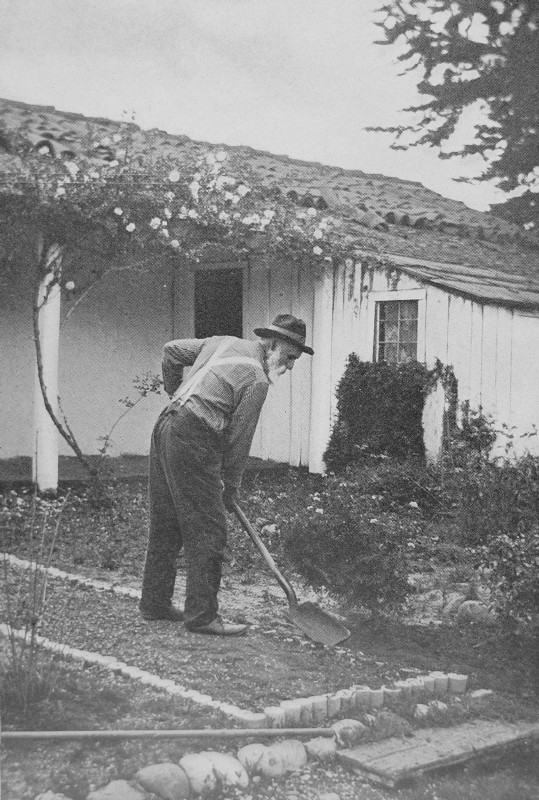 At work in a home yard
“The fairies had a hand too in my gettin’ this block of land I own. They showed me the picture of it before I left Ireland, and the minute I set eyes on it I was certain it was what they intinded I should have. Thin, wan time here, the fairies tould me I could have great herds of cattle or sheep or pigs. ‘Whativer kind of animals ye want ye can have,’ they said; and I chose the cattle, and no sooner did I say the word than up coom a band of cattle out of the ground — hoondreds av thim. ‘There they are,’ the fairies said, ‘and in twinty years thim will be yours, and the ranch they’re on, if ye want thim.’ “Well, they were on a ranch where a lady named Hale lived, and ivery cow had two calves a year, and things wint along very prosperous. The fairies was workin’ on the lady, too, and she had her eye on me, and she knew me fairy cows was on her ranch, and that I was joost givin’ up to her the twinty years’ use av thim. So whin the time was gone, she cooms and wants me to marry her; but I thought I’d go along on me own hook. Oh, this is a very peculiar sort of a woruld — this is!” My comrade rose and chopped a few strokes, but the day was drawing to an end. Some fellow-laborers passed on the street and shouted a greeting to him and he concluded to stop work. He put on his vest and coat, took up his axe and saw and started for home. I went with him, and we walked around into the lot where, back of a neighbor’s shed, he had his queer habitation. It was a big old lumber wagon with a piece of canvas spread from the high seat down toward the back. The shelter afforded was poor and cramped. A few other belongings were scattered about in the grass and there was a wreck of a stove that could still be made to serve after a fashion. But then, though to me these household effects seemed meagre and shabby, I do not know that they so impressed the owner. He had the gift of imagination; and beautiful as is nature in that region, and delightful as is the ancient Mission, there is nothing in my visit I remember with more pleasure than this man with his visions of realms beyond my ken. NOTE. — Santa Barbara is one of the most attractive towns in California, beautiful in its surrounding scenery, not so large as to be dominated by commercialism, nor so small as to be rude and lacking in comfortable accommodations. The old survives amid the new, and you can even yet find buildings and life that have the characteristics of the time of Spanish rule. Here is the best preserved of all the old Missions. Every Mission is worth seeing, but Santa Barbara has one where the gowned and sandaled monks still dwell and labor. The chief outdoor pleasures for the sojourner here are coaching, cross-country horseback riding, fishing, and hunting. Most visitors would be interested to read the account of early days in Santa Barbara to be found in Dana’s “Two Years Before the Mast.” This book, in fact, entertainingly describes the aspect and customs of every old sea town from San Francisco to San Diego. The climate in this region is mild and equable, but it is also excessively dry, with the result that the roads are dusty most of the year. In the winter and spring, however, during the rainy season, they are often so heavy as to be impassable for automobiles in the mountain sections. But, as a rule, the coast roads out of Santa Barbara are fairly good, though there are always some dubious spots. The main motor route continues south to Los Angeles and San Diego, and north to San Francisco. |
 Click the book image to turn
to the next Chapter.
Click the book image to turn
to the next Chapter.