 Web
and Book design, Web
and Book design, Copyright, Kellscraft Studio 1999-2005 (Return to Web Text-ures) |
Click Here to return to Book of Boston Content Page Return to the Previous Chapter |
 (HOME) |
|
CHAPTER
V THE
CITY OF HOLMES  HE authors of Boston seem to have been, in an
altogether pleasant sense nomads even though they kept their nomadic
activities
within a very limited district. Although there is little in the life of
Boston
authors which in the ordinary sense could be termed moving, as they
were a
happy, fortunate, conventional folk, their lives were certainly moving
in
another sense, for moving is what they spent a great deal of time in
doing.
Three homes for Aldrich, at least three for Holmes – four, counting the
beautiful early home now gone, in Cambridge, and five if the Berkshire
home
should be included; several different homes in Boston for the Alcotts,
who even
had three homes out in Concord between times; various homes for Parsons
and for
Palfrey, three for Motley, two for Parkman – thus the list goes on, and
Prescott is almost the only one I think of who did not go moving about,
and
probably even he did some moving that I have never heard of. Even Mrs.
Deland,
Bostonian by adoption, has so readily adapted herself to Boston's
literary way
as already to have lived in at least three different Boston homes. It
all
reminds me of a most interesting little place that I came across in
Europe,
Neutral Moresnet, where the inhabitants make it almost a point of honor
and
certainly a point of duty to change their houses once a year. HE authors of Boston seem to have been, in an
altogether pleasant sense nomads even though they kept their nomadic
activities
within a very limited district. Although there is little in the life of
Boston
authors which in the ordinary sense could be termed moving, as they
were a
happy, fortunate, conventional folk, their lives were certainly moving
in
another sense, for moving is what they spent a great deal of time in
doing.
Three homes for Aldrich, at least three for Holmes – four, counting the
beautiful early home now gone, in Cambridge, and five if the Berkshire
home
should be included; several different homes in Boston for the Alcotts,
who even
had three homes out in Concord between times; various homes for Parsons
and for
Palfrey, three for Motley, two for Parkman – thus the list goes on, and
Prescott is almost the only one I think of who did not go moving about,
and
probably even he did some moving that I have never heard of. Even Mrs.
Deland,
Bostonian by adoption, has so readily adapted herself to Boston's
literary way
as already to have lived in at least three different Boston homes. It
all
reminds me of a most interesting little place that I came across in
Europe,
Neutral Moresnet, where the inhabitants make it almost a point of honor
and
certainly a point of duty to change their houses once a year.On Walnut Street,
facing
down Chestnut, was the boyhood home of Motley, the historian, a house
that has
since been torn down; the best part of his life was spent in Europe,
but he
also loved his Boston, and a Chestnut Street house is pointed out, at
16, with
a brass-knockered, brass-handled door, with a wonderful fanlight,
designed in
flowing lines, as a place where he lived for a time. Chestnut Street is a
neighborhood of very felicitous doorways and at 13, well up the slope
of the
street, is a charming house that was long ago one of the several
successional
homes of Julia Ward Howe. It has an unusually striking doorway, with
four slim,
prim white pillars, and is an individual sort of house as if to befit
the
strikingly individual woman who lived here. No one else, surely, in all
literary history ever won acknowledged literary leadership through a
long life
by one single song plus personality! Mrs. Howe died a few years ago,
but when
Henry James came over to take his final look at this country to see
that it
really wasn't worth while and to shake its dust forever from his feet,
she was
still alive, and the two met at a reception, and a story was told me,
by one
who heard and witnessed the scene, of what took place at their meeting.
Mrs.
Howe had known him from his boyhood and he at once began to tell her
with
effusion of how he had thought and thought of her, so much and so
often, while
away, and of what a precious delight it now was to meet her again. But
she must
have had some doubt of his entire sincerity for, looking over her
spectacles at
him as she used to do when he was a boy, and speaking to him as if he
were
still a little boy, she melted his sugary pleasantries by saying, with
gentle
and very slow admonition and with an accented "me," "Don't lie
to me, Henry." Far down at 50
Chestnut
Street, in a section. where the typical houses have three-part windows
as the
main. windows in their front, is the house where the historian Parkman
lived
and worked for twenty years. It is a house with exceedingly tall
chimneys and a
door deeply recessed within an arch, and is almost directly through
from the
house of the historian Prescott on the next street parallel, Beacon
Street. And
nothing could be more strange, than that both of these historians,
whose homes
were so near together, were so grievously troubled with their eyesight
as to
need specially made appliances, a sort of machine or frame, to enable
them to
read and write at all; each gave a superb example of working under
almost
insuperably depressing difficulties; and that they were both
historians, both
Americans, both of them dwellers on Beacon Hill for many years adds to
the
strangeness of it. Out in front of the
State
House, at the corner of Beacon Street and Park Street, stood the
beautiful home
of the man who used so to represent Boston in the public eye that it
was
playfully suggested that the city be called Ticknorville. Here stood
the home
of George Ticknor. In a sense, the house still stands here, but it has
been so
altered in fitting it up for business and offices, for antique dealers
and
decorators and lawyers, that one's first impression is that it has
quite
vanished and that another building stands in its place. But even yet
one-half
of the distinguished horseshoe stair still remains, leading up to the
front
door, and although the fine original door has been replaced by a
window, part
of the old portico is still in place, surmounted by some exquisite old
ironwork
which is among the very finest bits of old ironwork in Boston. The
marble hall
of which Hawthorne writes and in which so many distinguished visitors
were
received, has gone, and the stairs have been altered and
new-banistered, and it
is now hard to imagine the old-time glory of the place, although the
great
height of the ceilings gives an impression of spaciousness and dignity. For many years
Ticknor lived
here, pleasantly varying his life with lengthy trips to Europe for
travel and
study. He had married the daughter of an extremely wealthy merchant,
and this
made life sufficiently easy for him to spend years and years in
producing an
agreeable and scholarly history of Spanish literature. Even yet, a
Bostonian
writing or speaking of the old house and its old-time glory, is likely
to refer
to it as "her" house, and to mention "her" hospitality and
even, incredible though it seems, "her" library! Ticknor must have been
a most likable man, for so many likable men liked him so very much
indeed, and
he was deemed an immensely distinguished man, yet he stands as a
striking
example of great fame in one generation and practical oblivion in the
next. And how impressively
all of
those old-time American writers loomed! And how neglected are most of
their
works to-day! And yet individual remembrance or forgetfulness is not
the only
test. As a class, or group, they brilliantly made the beginnings of our
national literature, they showed that American writers could mark out
paths of
beauty and learning, they made it clear that American writers could be
men of
imagination and poetical power. That most of them are now unread is
neither
discredit nor criticism. In England there has been the same forgetting
of men once
famous, for of the English authors of the past only a few of the
preeminent are
read, and the many others who meant so very, very much in their day,
are but
names and vague memories. But that does not mean, either in England or
in
America, that the now forgotten writers of the past were not excellent
and
noteworthy writers, for numbers of them were very excellent and
noteworthy
indeed, and their combined influence is a powerful and still-continuing
force. It is pleasant to
realize
that this old section is notable for its connection with other art as
well as
that of literature; in its architecture it is agreeably distinguished,
and it
has a pleasant association with the best paintings, for I remember that
in
looking over a list of those who, a few years ago, were the owners of
Gilbert
Stuart's works, I noticed that quite a proportion were still in the
possession
of residents of Beacon Hill; which is just as it ought to be. Not only is the entire hill, regarding it as a whole, a highly successful example of domestic architecture, whether the houses are considered singly or in mass, but there are individual houses notably worthy of attention. For example, at 85 Mount Vernon Street, is an especially attractive Bulfinch house of a design not usual with that unusual man, and he built it thus differently in order to match an unusually broad frontage of building space and to harmonize with an unusual depth of long and high retaining wall in front. It is a big square-fronted house, one of the largest homes of the entire neighborhood, with its entrance door not on the front of the house at all but on one side, and with its front beautifully balanced with overarched windows, with separate little balconies, with Corinthian pilasters; and it has a great octagonal lantern on the roof. In addition to all else of dignity and fineness there is the excellent feature of continuing back to the wall of the courtyard, completing a design that is architecturally an adjunct. But the house is now all gray, in one dull monotone, and it is really necessary to picture it in the beauty of its original design of red brick and white pilasters and black iron to see it as it ought to be seen. 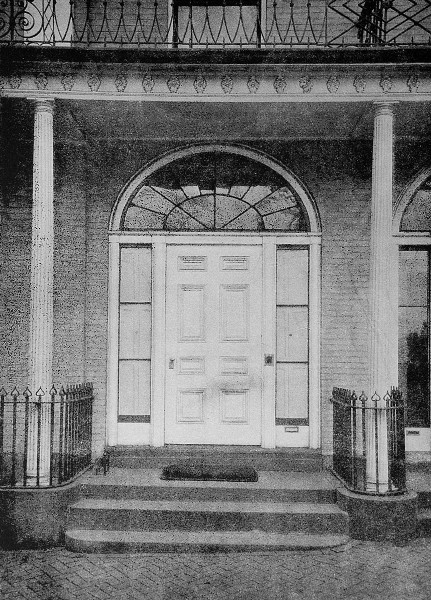 Doorway of Prescott's Home on Beacon Street Of all the writers
who by
their combined influence gave the Boston of the past its high literary
distinction
none was so important as Oliver Wendell Holmes. Not that he need
necessarily be
considered the greatest among them, although in his particular line he
was
supreme, but that he so stood for Boston, so represented Boston, so
interpreted
Boston, so gave the city definite form out of vaguely general
imaginings, so
placed it before the world, as to make himself
its definite exemplar. Boston is the City of
Holmes, and he himself was Boston epitomized. He was in himself a human
abridgment of Boston, an abstract of the city that he so loved. He was
the best
of Boston concentrated into one human form, and he was a writer of whom
any
city in the world might be proud. To read his "Autocrat" is an
intellectual aesthetic delight. Seldom has there been a man so
clear-sighted,
and at the same time so cleverly able to put his clear-sightedness into
such
delightful literary form, Montaigne would have loved him. Lamb, who
died when
the career of Holmes was just beginning, would have called him brother. Over in King's
Chapel, where
Holmes had a pew in the gallery during most of his long life, there is
a tablet
to his memory. He is not buried there, but his friends very properly
wished him
to be commemorated in that old-time building of Boston; only, the
tablet is
really entertaining, although that is the last word that would usually
be
thought of in regard to any cenotaph, for it begins its description of
Holmes
with the words "Teacher of Anatomy," letting "Essayist and
Poet" follow! Curious, you see, the
order
of precedence. No admirer of Holmes, outside of Boston, would ever have
thought
of his fame as an essayist being second to anything else, least of all
as being
second to his fame as an anatomical teacher. He was, doubtless, an
excellent
surgeon, and being of an original bent of mind he put his originality
into all
he did, and long ago some of his surgical or medical opinions led some
one of
the Teutonic name of Neidhard to write a book attacking them, and
another
controversial anti-Holmes book came from the equally Teutonic-named
Wesselhoeft, but these men and their books are themselves no more
forgotten
than is the fame of Holmes himself as a surgeon. And yet, at a dinner
in
honor of Holmes, on his seventieth birthday, when friends and admirers
gathered
from various cities, President Eliot of Harvard arose, after there had
been.
general felicitation of Holmes as a man of letters, and said: "It seems
to
me my duty to remind all these poets, essayists and storytellers that
the main
work of our friend's life has been of an altogether different nature. I
know
him as the professor of anatomy and physiology at Harvard for the last
thirty-two years. You think it is the pen with which Doctor Holmes is
chiefly
skillful. I assure you he is equally skillful with the scalpel." That is delightfully
remindful of the meeting of Voltaire and Congreve, when Voltaire
expressed his
pleasure at meeting so distinguished a literary man, and Congreve
stiffly
replied that it was not as a literary man but as a gentleman that he
wished to
be considered, whereupon Voltaire promptly replied that he did not need
to come
so far to find a gentleman. Holmes must have thought of that, though as
guest
of honor he could not speak of it! He knew perfectly well that these
admirers
had not come there to find a surgeon. And he must have remembered, with
glee
that was tempered with chagrin, that although Harvard had long honored
him as
an M.D., Boston in general had refused to take him seriously, as a
doctor,
after he had jokingly let it be known that "fevers would be thankfully
received." Of all Boston writers it would be expected that Oliver Wendell Holmes would choose the finest and most attractive house to live in, and this not alone because of his being a man of such ability but because he so loved the fine things connected with the fine old times, and because his own life began in a house that was a most charming example of old architecture. I well remember the house where he was born; it was over in old Cambridge, close to the Common, but it has been destroyed for some reason, and the spot stands empty; I well remember what a fine old pre-Revolutionary house it was, picturesque in the highest degree, the kind of house that delights the imagination, low-set, homelike, yellow and gambrel-roofed; but he has written of it himself:
The ideals of Holmes
were all of the olden-time. He
stood, as he frankly said, for the man who could show family portraits
rather
than twenty-five cent daguerreotypes, for the man who inherits family
traditions and the cumulative humanities of at least four or five
generations;
and among these cumulative humanities one would have expected Holmes,
of all
men, to rank high the possession of an old-time house, rich in the
feelings and
traditions of the past. But after living through his early years in a
house that
was a thing of beauty, Holmes did not find it a joy forever to continue
to live
in a fine house, but chose instead to live in commonplace houses! Nor,
after
writing as he did of the striking down of thousands of roots into one's
own
home, did he settle down in any one house for a lifetime! The trouble
was that,
all unconsciously, he was in this regard not living- up to his own
ideals. His
ideals led him toward the old and beautiful, the things connected with
ancestry
and the past; but with old houses it seems to have been with him as it
was with
old furniture; he writes apologetically, somewhere or other, of loving
old-time
furniture but of keeping it practically hidden in some out-of-the-way
room, and
he seems to have felt the same perverse desire to keep from showing any
outward
love for old houses. He chose a home for himself, not even on Beacon
Hill,
although close beside it; he chose to live in Bosworth Street, then
called
Montgomery Place, a court leading off Tremont Street opposite the Old
Granary Burying
Ground, and ending in a few stone steps, arched with a wrought iron
design,
leading down to an alley which borders where once stood the ancient
Province
House and where antiquarians still point out what they say is a
fragment of the
Province House foundation wall. All this region was long ago given up
to
business, but where Holmes lived is still pointed out at the farthest
left-hand, next to the corner of the court, and it was never an
attractive
place, and the next door house, still standing, is positively
commonplace.
Still, with a curious perversity, he lived here for almost twenty
years, and
here wrote almost all of his remarkable "Autocrat." It was a
well-to-do neighborhood, and perhaps even wealthy, but it missed being
distinguished. But Holmes finally
tired of
the house and died out of it. I use his own words to express his moving
away
from it: for, as he writes, after referring to his having lived in this
very
house for years and years, and then leaving it, people die out of their
houses
just as they die out of their bodies. He and his family, he narrates,
had no
great sorrows or troubles there, such as came to their neighbors, but
on the
whole had a pleasant time, but "Men sicken of houses until at last they
quit them," as he goes on to say. Whereupon one feels
sure
that this splendid Autocrat would surely, the next time, choose a home
in which
he could feel pride. But, no! He went to the Charles Street house,
which was a
house as commonplace as the one he left. Here, however, he had the
water immediately
behind the house, with its sunset glows and the distant hills. Still
restless,
he moved again, and this last time to the house in which at a mellow
age he
died, at 296 Beacon Street: not the Beacon Hill district, but in the
Back Bay
extension of Beacon Street. Again he had chosen a house with back-view
on the
waterfront, but, still perverse on this subject of homes, he had again
chosen
an undistinguished home and undistinguished environment, although it
was a
house and a neighborhood of well-to-do but monotonous comfort. One naturally wonders
whether, had he chosen a home more fitting to his ideals, he would not
have
left behind him more than the single superlative book he did leave. But
as that
single book is really in the very first class, of its kind, perhaps it
was all
for the best, after all. One likes to think,
and I am
sure it is more than a mere fancy, that the influence of that beautiful
house
in Cambridge, the birthplace of Holmes, extended in at least a
considerable
degree over his entire life, and it assuredly had much to do with
making him a
finely patriotic man, devoted to the best Americanism. For there was
much more
to that house than age and gambrel-roof and beauty; there was
association with
the most heroic deeds of our American past; for that very house was
headquarters of the Committee of Safety, and the American soldiers who
were to
fight at Bunker Hill lined up in front of that very house before making
their
night march to the battlefield, and stood with bared heads while the
President
of Harvard College, standing on the front steps of the house, prayed
for the
success of the American arms. Those associations thrilled Holmes throughout his life, for even in the house where he died, far down among the houses of the Back Bay, one likes to remember that, looking from his windows, the thing which most of all impressed him was (a fact of Boston geography surprising even to many a well-informed Bostonian) that from those windows he was able to see Bunker Hill Monument. 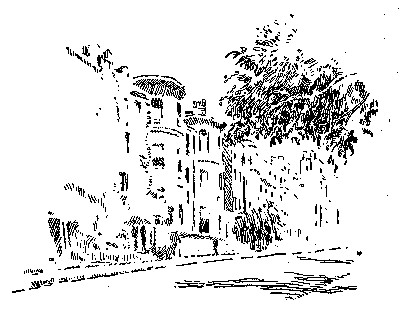 |
 Click the book image to turn to the next Chapter.