 Web
and Book design, Web
and Book design, Copyright, Kellscraft Studio 1999-2005 (Return to Web Text-ures) |
Click Here to return to Book of Boston Content Page Return to the Previous Chapter |
 (HOME) |
|
CHAPTER
IV ON
THE PRIM, DECOROUS HILL  HE streets of Boston are
peopled with shadows of the past; shadows of those connected with the historical or literary Boston that has gone.
Nor are all the figures Bostonians. Here is Dickens after a long winter
day's
tramp out into the country with James T. Fields, hilariously swinging
back to
the city in a wild snow storm; but suddenly, near the junction of the
Common
and Charles Street, disappearing from view in the swirling snow clouds,
only to
be discovered on the other side of the road helping to his feet a blind
man who
had fallen helplessly in a drift. Here is Thackeray driving down
Tremont Street
to the lecture hall, with his extremely long legs hilariously stuck out
of the
carriage window in sheer joyfulness that all the tickets for his first
lecture
had been sold! For it will be remembered that Thackeray came over to
give to
the Americans all four Georges in return for the one George that we had
concluded to do without. Can you imagine the feelings of the sedate
Bostonians
as they saw the great Englishman going to his own lecture in what
without
exaggeration could be called an informal way! HE streets of Boston are
peopled with shadows of the past; shadows of those connected with the historical or literary Boston that has gone.
Nor are all the figures Bostonians. Here is Dickens after a long winter
day's
tramp out into the country with James T. Fields, hilariously swinging
back to
the city in a wild snow storm; but suddenly, near the junction of the
Common
and Charles Street, disappearing from view in the swirling snow clouds,
only to
be discovered on the other side of the road helping to his feet a blind
man who
had fallen helplessly in a drift. Here is Thackeray driving down
Tremont Street
to the lecture hall, with his extremely long legs hilariously stuck out
of the
carriage window in sheer joyfulness that all the tickets for his first
lecture
had been sold! For it will be remembered that Thackeray came over to
give to
the Americans all four Georges in return for the one George that we had
concluded to do without. Can you imagine the feelings of the sedate
Bostonians
as they saw the great Englishman going to his own lecture in what
without
exaggeration could be called an informal way!How full of life, of
buoyancy, were those two wonderful Englishmen! How impossible to
picture any
Boston man so carried away by success unless in a condition to be
carried away
by the police! But, so far as that is concerned, it is not likely that
even
Thackeray ever rode through a street of his own England in quite such
exuberance of joy. Dickens liked Boston,
and
found what he termed a remarkable similarity of tone between this city
and
Edinburgh. Thackeray liked Boston, and used to say playfully that he
always
considered it his native city. Both men made Boston their landing-place
on
coming from England, and this could scarcely be looked upon as chance,
or
merely that Boston was the terminal point of a steamer line, but it was
also,
no doubt, because the two chose the city whose reputation in England
most
appealed to them; for Boston used to be the center of American literary
life. It was in Boston that
Thackeray first tasted American oysters; and enormous ones were
purposely set
before him at the now-vanished Tremont House, adjoining the Old Granary
Graveyard, on Tremont Street (with the "e" in "Trem" short
if you would be thought a Bostonian!), and he rejected the largest
because it
looked like the High Priest's servant's ear that Peter cut off, and
with
difficulty swallowed the smallest, gasping out that he felt as if he
had
swallowed a baby. I think people were more natural, more frank, more
full of
spontaneity in those days, less afraid of what other people might
think; or at
least our distinguished visitors from abroad gave admirable object
lessons
along that line. And picture Thackeray
– and
isn't it a delightful picture! – dashing down the slope of Beacon
Street toward
the home of the historian Prescott, gleefully waving two volumes of
"Esmond" that had just come to him from across the Atlantic and which
he was taking to Prescott because Prescott had given him his first
dinner in
America – picture him thus dashing down Beacon Street and joyously
crying out
to a friend whom he passed: "This is the very best I can do! I stand by
this book, and am willing to leave it when I go as my card!" The Prescott house is
still
there, 55 Beacon Street, well down toward the very foot of the hill and
facing
out over the Common. It is a broad-fronted house, built in balanced
symmetry, a
house of buff-painted brick with rounded swells, with roof fronted with
heavy
white balusters, with window trimmings and door pilastered in white,
with black
iron balcony light and graceful in design; it is a fine-looking house,
a house
with a distinguished air. And somehow it seems to suggest a portrait of
the
admirable Prescott himself. It is a house worth seeing on its own
account and
also because it was there that Thackeray received the inspiration for
the sequel
to the story which we see him so gleefully carrying, the sequel to "Esmond," for it was in that house
that he saw the two swords (now in the possession of the Massachusetts
Historical Society) that had been carried by relatives of Prescott in
the Revolutionary
War, one of them having been gallantly drawn in the service of the King
and the
other with equal gallantry in the service of America. Here Thackeray
pondered
the romance in such a situation, and the result was "The Virginians,"
with one Esmond to fight for the King and the other for Washington. Over and over one
realizes
what possibilities of fine romance lie about us here in America. Not
merely
romance good enough for minor writers, as some would have us believe,
but
romance good enough for the giants. For Scott made brave use of the
brave old
story of the Regicide and Hadley, and he took his most beloved of all
characters, Rebecca, from Philadelphia and Washington Irving; and
Thackeray
took his Virginians from Boston and Prescott; – and I might refer to
Dickens
and "Chuzzlewit" were that not something far different from romance. Boston could never
forgive
Dickens; and that he patronizingly wrote, years afterwards, that
America had so
changed that he could now speak well of it, aggravated rather than
mitigated
the enormity of his literary offense, which was, not that he had found
people
in America to criticise, for he had found people to criticise in his
own
England, but that, judging from "Chuzzlewit," he had found no one to
think highly of in America. He had been cordially received by fine
gentlemen,
cultivated and polished men, who would have been, and some of whom
were,
received as fine gentlemen in the very finest society in Europe, yet
none the
less he went home and wrote the book that he had planned in advance to
write,
following the advice that he had long before put in the mouth of Sam
Weller, to
be sure to make a book on America so abusive that it would be sure to
sell; he
had, with amazing baldness, followed the published prejudices of Mrs.
Trollope,
which he had absorbed before leaving England; he wrote of Americans as
ignorant
and boastful boors; and of course, in the new portions of our country,
there
had to be many such. He wrote of America as being nothing but a nation
of boors
when he well knew us to be a nation possessing not only such men as
Hawthorne
and Longfellow and Webster and Motley and Prescott and Fields but many
a
cultured man of business and many a cultured family. Fields, with whom
Dickens
loved to take long tramps, lived on Charles Street, at 148, well on the
way
that the jogging horse-car used to take towards Cambridge. It is now a
highly
undesirable street, with infinite dirt and noise, and could at no time
have
been really attractive. And the Fields house was always hopelessly
commonplace,
a house high-set and bare in a row of houses all high-set and bare,
built in an
era of architectural bad taste. It is a brick house with brown stone
trimmings,
and is empty as I write, for Fields long since died and now his widow
is dead,
and the untenanted house has been drearily splashed, across the narrow
sidewalk, from the chronically muddy street; splashed with brown and
yellow
dabs to more than the tops of the front doors and windows, and
remaining
drearily uncleaned. I sometimes think of Fields as having been Boston's most important literary man. I do not mean as a writer, although he did write one book that has endeared him to a host of readers, but what he really did for literature was as an intelligent and keenly appreciative critic and an inspirer of literary men. He won the devotion of a host of friends; he welcomed distinguished foreign writers and gave them fine impressions of American society and literature; he counseled and inspired American writers and held them up to their best; it was even owing to him and his personal urgency that the "Scarlet Letter" saw the light. He was one of those rare men who could judge of the value of writing without having to wait to see it in print and without waiting to watch its reception by the public. He was an anticipatory critic of insight and judgment. And that he was at the same time a publisher and for years even a magazine editor also, was in every respect fortunate, for he could publish what he thought worth while to the mutual advantage of himself and the authors. 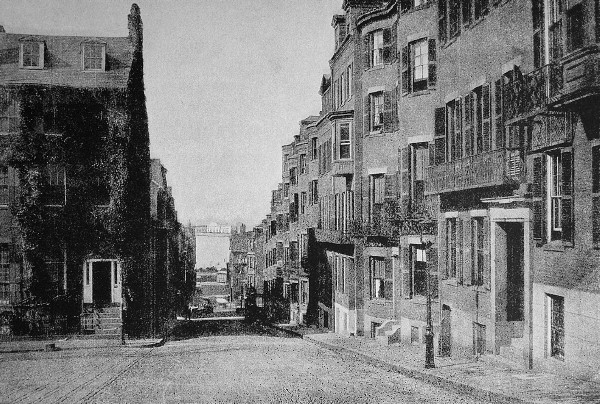 Looking Down Old Pinckney Street It is to the lasting
honor
of Fields that, as Whipple wrote of him after a life-long friendship,
he had
deliberately formed in his mind, from the start, the ideal of a
publisher who
should profit by men of letters while at the same time men of letters
should
profit by him, and that he consistently and successfully lived up to
this
ideal. In the old days there
was a
serious effort to make Charles Street a fine home street. Thomas Bailey
Aldrich
came here for a time from the slope of Beacon Hill, making his home at
131, and
Oliver Wendell Holmes came for a time to a house, since destroyed in
the
building of a hospital, at 164; but the street early showed its
hopeless
disadvantages, becoming, as it did long ago, a great teaming
thoroughfare
circling the foot of Beacon Hill from one part of the city to another. The advantages of
Charles
Street are on the waterside; for it is close to the great broadening of
the
Charles River, which has always offered a beautiful view to the windows
looking
out over its sunset sweeps of water. Holmes made his home there, not
only for
the beauty of the water views but because he intensely loved rowing,
and here
he had precisely the opportunity he wanted, with the additional
convenience of
keeping his boat at his back door. But the increasing disadvantages of
Charles
Street outweighed even these advantages of water and view. The great rooms of
the
Fields house likewise looked out over the water, and it was deemed such
a
pleasure and such an honor to be a guest of James T. Fields that in the
old
days every literary man expected to be given an invitation as. a
hallmark of
success. Those were the days when Boston authors were fine gentlemen
and when
many a Boston fine gentleman was an author. Indeed, there has never
been a Grub
Street in Boston. Those who look up the homes of authors need not
search in the
poorer parts of the city but among the homes of the socially exclusive,
and the
few exceptions are close by in neighborhoods that were once just as
exclusive.
And this is the case not only in the city but also in those near-by
suburbs
which are themselves essentially part of Boston, for it was not poor or
unattractive or commonplace towns in which Hawthorne and Longfellow and
Emerson
lived, but places of such fine distinction and beauty as Cambridge and
Concord. In this matter of the
fine
living of its authors Boston stands almost unique among cities, the
only one
which has rivaled it being Edinburgh, where the group of writers who
were so
famous a century ago lived mostly in the best residential section. In
no other
particular is the resemblance between Edinburgh and Boston so
interesting as
this. On Mount Vernon
Street, at
59, in the very heart of conservative aristocracy, is the house that
was the
latest home of Thomas Bailey Aldrich, a real mansion, broad of front,
with
classic pedimented doorway of white marble with fluted Doric pillars,
and with
entablatures of marble set between the second and third stories, and
with a
rounding swell, and a charming iron balcony, and four stone wreaths
along the
cornice, and four dormer windows above; and in front of the house there
is even
a generous grass-plot. Mount Vernon Street,
that
very citadel and center of the Brahmins, as the exclusive Boston folk
of a past
generation loved to call themselves, attracted also for a time the most
distinguished of all the Boston writers of to-day, Margaret Deland, who
lived
for a time at 76, in an old house whose front wall has long horizontal
sets of
windows that were put in for the sake of giving an unusual amount of
light and
sun to the flower-loving author. On the curbstone near this house is
the
quaintest old lamppost in Boston, a wrought iron frame set on a slim
granite
shaft. After her earlier successes Mrs. Deland left this home for one
farther
down the street, and then moved over to the Back Bay, still keeping up
the
Boston literary tradition of living among people of wealth. The other
day I
noticed in Boston's best morning newspaper a portrait of Mrs. Deland,
with a review
of her latest work, a new Old Chester book, and the review was amusing,
because
it described her as being a New England woman who writes with
remarkable
discernment of a New England village, when as a matter of fact she came
here
from western Pennsylvania, and her Old Chester is near Pittsburgh. It
is the
natural tendency of Boston to assume that an excellent thing is of
Boston or at
least New England origin. On Mount Vernon
Street, 83,
is the home of William Ellery Channing, a fine, austere house of
dignity
befitting the high standing of the man; a house with a low embankment
wall, and
grass, and a balcony of a design that is like the backs of Chinese
Chippendales. His is one of the few homes that show a tablet, and it is
the
quietest and most unobtrusive of tablets, set as it is in the ironwork
of the
gatepost. In Boston everybody knows the name of this Channing, and he
has been
honored with a public monument over beside the Public Garden, and
Longfellow
wrote a poem to him, and he is remembered as a great figure and as a
leader in
thought; yet the Channing that those who are not Bostonians most
naturally
recall is the William Ellery Channing, the relative and namesake of
this
Channing of Boston, whom Hawthorne so loved and wrote of so lovingly. On the difficult
slope of
the next street to steep Mt. Vernon, on Pinckney street, named in honor
of that
Pinckney who left us the heritage of that upstanding phrase, "Millions
for
defense but not one cent for tribute," on that Pinckney Street, at 84,
is
the home where Aldrich, early in his career, wrote his immortal
juvenile, the
"Story of a Bad Boy." It is a low-set and almost gloomy looking
house, for it is without the usual high basement of the vicinity. Still
it is a
pleasant house after all, and one wonders why friends of Aldrich always
referred to it as a "little" house, for it is four windows wide
instead of the usual three of its immediate neighbors. The house has a
peculiarly ugly over-hanging bay-window, misguidedly set by some
would-be
improver against what was once the attractive front of the house, and
the first
impulse is to say to oneself that of course this ugly bay could not
have been
there in the time of Aldrich; but a lifelong resident of the street
told me
that she well remembers the time when he lived and wrote here and that
he wrote
his "Story of a Bad Boy" in this very bay-window! Farther up the hill
on
Pinckney Street, at 54, is an attractive house which may really be
called
smallish; one feels impelled to call it "neat" even in a district of
neatness,
and except for that quality little of the distinctive is noticed except
that it
has an eight-paneled front door with the characteristic door-knob of
silver-glass. This house has a most amusing connection with literature,
for it
was here, in July of 1842, that Nathaniel Hawthorne wrote his note to
James
Freeman Clarke, asking him to perform the marriage ceremony between
himself and
Sophia Peabody, "though personally a stranger to you," as he
expressed it; and the amusing feature was that although Doctor Clarke
was told
that "it is our mutual desire that you should perform the ceremony"
and that a carriage would call for him at half-past eleven o'clock in
the
forenoon, Hawthorne quite forgot to mention the date on which the
expected
marriage was to take place! And the note itself was no guide, for it
was merely
dated "July," without the day! And Hawthorne also quite forgot to
mention where he would like the ceremony to be performed! Still, as
Hawthorne
wrote the street number on his note, it was possible to straighten the
matter
out in time. Still farther up and
on what
has now become the level-top of Pinckney Street, at 20, is one of the
houses
where the Alcotts lived, a little, very narrow, high-perched building
with its
main floor reached by queer abrupt steps up to a front door deeply
recessed in
an almost tunnel-like approach. The house is of dingy brick and has
little
windows, and is immediately back of the very best of Mount Vernon
Street and on
a queerly narrowed part of Pinckney Street. And looking off toward the
broadened Charles from this highest part of the street there comes an
impression as if the hill has dropped suddenly away and the classic
temple-like
structures on the farther side of the water are close to the foot of a
precipice. The work of Bronson
Alcott
has been absolutely forgotten and his very name would be forgotten were
it not
that he was the father of Louisa M. Alcott; yet he had some most
unusual
qualities. He wrote little and lectured much; he was not a success; he
was rather
tiresome; and yet with his transcendentalism, with his entirely vague
thoughts
in regard to what we should now call the superman, the uplift, he seems
to have
been near to something very excellent, very modern. It was to this house
on
Pinckney Street that Alcott returned to his hard-pressed family, one
cold
winter's day, after a lecture tour, with his overcoat stolen and just
one
single dollar in his pocket! And this reminds me of a story that I long
ago
heard out in Cleveland from an old resident there who told me that she
remembered how, when a girl, Alcott came to lecture, and that as they
had heard
that he and his family were in actual need of money they actively sold
tickets
enough to hand him three hundred dollars, whereupon he said, quite
beamingly, that
in Buffalo he had seen a set of valuable books that he had very much
wished for
but had been unable to buy, and that now he would go back and get them
and take
them home with him. He was an impractical
man,
yet his friends liked him and smoothed the way for him, and in his
later years
the Alcott family were delightfully mainstayed by the immense success
of the
books of his wonderful and universally loved daughter. The house where
Bronson
Alcott died at the age of almost ninety, in 1888, is also on Beacon
Hill; a
decorous, mid-block, characteristic Louisburg Square home, at 10, on
the
southern side of the square; it is a bow-fronted, white-doored house
with a
vestibule, with finely-paneled white inner door, hospitably showing to
the
street; it is a broad brick house set on a smooth granite foundation
behind a
little iron-railed space, with a plump pine-apple looking like a cheese
at the
terminal of the rail. His daughter, Louisa
M.
Alcott, who won the hearts of myriads and gave such unbounded and
wholesome
pleasure with her "Little Women" and "Little Men," was so
ill, in another part of the city, at the time of his death, that she
was not
told of it, and on the day of his funeral she herself died in the
belief that
her aged father was still living. A few doors away,
also
facing out into the greenery of Louisburg Square, over in its southwest
corner,
at Number 4, lived for a time William Dean Howells; his once-while home
being a
comfortable, dormered house of the customary brick, with long
drawing-room windows
on the second floor, next door to a larger corner house, now a
fraternity
house, out of and into which young men seem always to be dashing. Still lower on the slope of Beacon Hill, at 3 West Cedar Street, is a house that was for a time the home of the poet who figured among Longfellow's notables at the Wayside Inn; for those who were pictured as gathering there and telling their tales were all very real men, although some of them were fancifully described. The poet of the party was a certain Thomas Parsons who was thought of very highly by his famous literary contemporaries, although had it not been for Longfellow he would now be quite forgotten. He made his home for the better part of his best years on Beacon Hill Place, near the State House, but the wide-spreading State House extension has taken street and house, as it has taken many another; but his home for a while was here on West Cedar Street, in a small cozy, plain house in an entire street of similar cozy little houses, all with flowers in window-boxes and box-bushes on the doorsteps, all with brass knockers and old door-knobs and arched doorways. "A poet, too, was there whose verse was tender, musical and terse," as Longfellow expressed it; and it is pleasant to have this house mark a poet's memory, even though the memory is due to the greater poet who wrote about him. 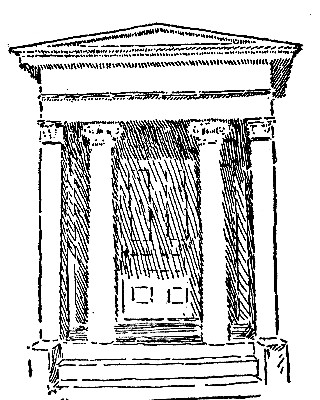 |
 Click the book image to turn to the next Chapter.