
Web
and Book design,
Copyright, Kellscraft Studio 1999-2007 (Return to Web Text-ures) |
 (HOME)
|
|
XXXII The Runaway Slave 1 I'M older maybe than you think, but I don't know just exactly how ol' I am myself. You see our owners wouldn’t tell us our age. It was the law that every slave man had to work on the road six days a year from the time he was sixteen till he was sixty. So the owners would hold back the ages of the slave boys 'bout two years to save that much time for work on the plantations. Then, too, if your owner wanted to sell you, he'd pretend you were younger than you really was. We was classed right with the brutes, and they did as they pleased with us. I haven't seen my father and mother since I was twelve or thirteen years ol'. They were sold to a speculator way down South. It was no more to separate a nigger and his wife from their child than a cow from her calf. I used to pray for the time to come when I 'd be free. One morning I was walkin' along ploughin'. It was 'bout 'leven o'clock, I reckon; and I heard a voice say, "You'll be free some day — just as free as the man that owns you." The voice
seemed to
come from above, and I turned round and leaned back between my plough
handles
and looked up. But I didn’t see anything. It was just an ordinary
voice, and
yet I felt sure it was the voice of the Lord. I knew He would fulfil
what He
had promised, and I never doubted afterward that I would be free. But the
older I got
the more I grieved about my father and mother. I'd shed tears as I was
doin' my
work. Then ag'in I heard a voice while I was ploughin'. It was in the
evening.
I'd got to the end of a furrow and was ready to start back when a voice
said,
"If you would marry some one that you love you wouldn’t grieve this
way."
The voice
was the
same kind, precisely, that I'd heard before. I couldn’t see anything
when I
looked up except the sky and the elements above. That was long, long
ago, and I
haven't heard no such voice since. But one thing I noticed — both
prophecies
come true. Just as the voice spoke so it was. Not long after I got that
second
message I married, and I did quit grieving. I had something that
comforted me
and satisfied my mind. My
marster's place
was 'bout twenty miles south of Chattanooga over the line in Georgia.
We had a
good many alarms thar with the different armies marching around the
country,
and considerable refugeein' was done — sometimes to the near mountains,
sometimes off down South. Once my marster had me refugee with his two
daughters. The oldest was fifteen and the other twelve. He had me hitch
a
couple of mules to a canvas-covered farm wagon and take the girls and a
tent
eight miles to Pigeon Mountain. He said he knew a citizen named Hall
who'd gone
thar to camp in the mountain gap, and he told me just whar to find him.
We was
to stay with him over night, and then word would be sent to us what to
do next.
The sun
was only an
hour high when we started, and it was getting dusky by the time we come
to whar
the man was supposed to be. But he wasn’t thar. We searched around till
nine
o'clock. Then we struck a man who said: "I know whar Mr. Hall is. He's
six
miles from hyar. You can't find him to-night." It was
dark, and
the girls didn’t care to travel any further. So we stopped right thar,
and I
started a little fire and made some coffee and fried some meat. We was
in the
woods and thar wasn’t no house near, but we had a good covered wagon,
and after
we finished supper the girls went to sleep in the front part of the
wagon, and
I went to sleep in the back part. It was a wild, lonely place, but I
wasn’t
feared of nothin' in them days. I'd fight with my fists if I didn’t
have
anythin' else handy. Next
morning we had
breakfast, and 'bout ten o'clock a white boy come on horseback with
orders from
my marster for us to go back home. So I hooked up and lit out from
thar. The
mules wanted to get home as much as I did, and we wasn’t long on the
road. Early in
the fall
of '63 Rosecrans come over the mountain. That was what skeered my
marster. He
asked my advice — which was it best to do — run or stand? I said:
"You
know you can't make nothin' runnin' ahead of two armies. You'd fare
better by
staying." But
thousands of
people went south with their slaves. Often a planter took every soul
off his
place. Mostly the darkies went by wagon — horse power — but plenty of
'em
walked. Their marsters couldn’t get 'em all out. The Yankees come too
quick,
but that didn’t prevent the Confederate cavalry from slipping back and
helping
to bring away a lot of the others. Every black man that the
Confederates
ketched goin' toward the Yankee lines they killed anyhow. They'd leave
no life
in him, and if they ketched a slave woman they'd treat her the same,
Old Hood
and Gatewood, who commanded the Southern cavalry, were bad fellers.
They were
scoutin' around between the two armies, and you'd get news of 'em all
the time
doin' their devilment. One quiet
morning
we heard drums and fifes seven or eight miles away at Bluebird Gap. I
knew
tereckly it was not Confederate music. Oh, yes sir-ee! I could tell the
difference, and I spoke to my old boss about it, and said, "The Yankees
are comin'." He stood
thar and
listened at it. Then he shook his head and tol' his wife: "He's right.
Those ain't our men. Well, thar's nothin' to hender them comin' if they
want
to." All that
night the
Southern cavalry was retreatin' past our place, and some of 'em was
goin'
pretty peart, too. They thought the Union army was right behind 'em. A
few days
afterward the battle of Chickamauga was fought. It was twelve miles
away, but
we could hear it all. We could even hear the men hollerin' when they
charged.
Rosecrans was beaten. He'd run afoul of the enemy without enough men,
and the
Confederates let into him so fierce he was glad to retreat back to
Chattanooga.
The second
day of
the battle I decided to go to the Yankees. That wasn’t on account of
the way I
was treated. No, sir! My folks was good folks to me — I'll say that.
But I
didn’t want to keep on bein' a slave, and I didn’t want to be refugeed
south,
which was what I expected, no matter who beat in the battle, unless the
Yankees
was all driven out of the country. Our white
people
tol' us terrible tales 'bout the folks up North. They said the Yankees
had a
horn right in the middle of their foreheads. But I didn’t believe all I
heard,
and I was determined I'd run away. Mose Matthews and two other young
fellers
agreed to go with me. Thar was others who would have liked to escape,
but they
was afeard to tackle it. We started
that
night. I guess it was twixt three and four o'clock. Daybreak was on
when we was
six or seven miles from home. We didn’t carry a thing but some bowie
knives
that a party of Southern soldiers had left on the place. Our intention
was to
go to Chattanooga, though we thought we'd get into the Union lines
sooner.
Anyway we was certain we could make the trip that day. We kept to
the road
until after sunup, when we saw a man named Jack Spears out at the
woodpile in
front of his house. He knowed some of us, and he hollered, "Hello!
boys,
whar are you-all goin'?" "To
Chattanooga," Mose said. "But the
Yankees have got Chattanooga," Jack said. "Yes,
that's
why we're goin' thar," Mose tol' him. Mose ought
not to
have said that. We kept right on, and I tol' the others: "Jack'll give
the
alarm, and we'll soon be follered. Now you fellers can do what you
please, but
I'm goin' to take to the woods." They all
went with
me. We hadn’t gone far when we heard the sound of horses on the road
comin' in
our direction — plockity, plockity; plockity, plockity — and tereckly
six men
on horseback come into sight. One of 'em was Jack Spears on his ol'
gray mare,
and the rest was Rebel soldiers. We were on a hill at the edge of the
woods
half a mile from the road, and the men never saw us but galloped on out
of
sight. We knew they'd stop befo' they reached the Yankee pickets so as
not to
get halted, and then they'd come back. So we went
on
roundabout, and that took us across the battlefield. We didn’t see a
living
soul thar, but I declare it was something to look at. The dead bodies
lay so
thick we could have walked on 'em for half a mile. Big trees grew on
the
battlefield, and some that would measure three and a half feet through
had been
cut up into frazzles, and the bushes had all been mowed down by the
bullets and
shells. A cyclone never did do any worse harm than that — no, sir! We come
right into
Chattanooga, and the Yankee officers told us we could join the army or
go to
work as laborers for the government. I accepted the team business for
my part.
But I hadn’t been at that long when I began to study on goin' back to
get my
wife, and I kept after the officers to let me go out. At last
they give
me a pass. That was 'bout sixteen days after I got to Chattanooga. In
the
evening I had some pistols and a bowie knife buckled onto me, and I was
settin'
thar with several other men in front of a tent eatin' and laughin' and
talkin'.
"I'm goin'
back to whar my wife is," I said, "and if any one bothers me thar'll
be a row. If they ketch me they'll kill me, but I'll never be taken
alive. They
can leave me a greasy spot on the ground befo' I'll let 'em capture me.
Long as
I can stand up I intend to fight, and if I fall I'll keep on fightin'
until I
can't move." Just then my wife walked in. I wouldn’t have taken a thousand dollars for her comin' and savin' me the trouble of makin' that trip. 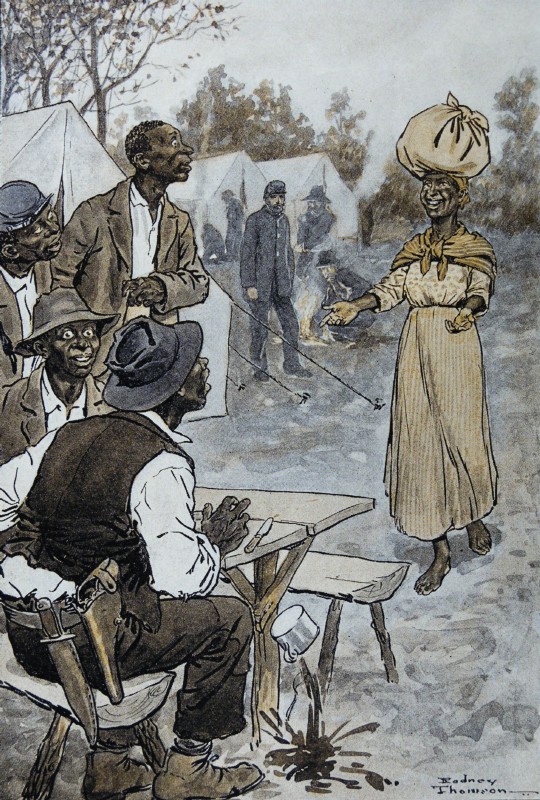 THE SLAVE WIFE JOINS HER HUSBAND I'd been
married a
year. My wife was owned by a man who had a big place near my marster's.
She had
refugeed once, and they made her do everything — the cooking, washing,
milking,
and ironing — and she wasn’t able to stand up to it all. They nearly
worked her
to death, for she wasn’t fiery or anything of that kind and did what
she was
told to do without complainin'. She fared so rough I didn’t want her to
refugee
ag'in. So befo' I left I posted her to run away when they began
carryin' the
slaves south, and she done like I told her. Pretty
soon her
marster took nearly all his slaves off on Rebel cavalry horses. My wife
got
away and went to the house of an old granny lady that was crippled, and
stayed
over night. An uncle by marriage and another neighbor man was gettin'
ready to
run away to Chattanooga, and she bundled up and come with them. She
carried a
little pillow-slip of clothes on her head. I'd only brought away what
clothes I
had on my back. I drew a
tent from
the government, and then I went to work and made it equal to a house.
The tent
part did for the roof, and I planked up the sides as high as my head,
usin' old
bo'ds and stuff that belonged to the army. You see pieces of plank that
had
been used to hold on goods sent by freight was always lyin' around, and
thar
was plenty of empty boxes; so it wasn’t much trouble to build a pretty
good
little house. I made the floor out of sugar boxes that I took to
pieces, and I
used gunny sacks for a carpet. The chimley I built out of brickbats and
mud,
and I made a good fireplace, and we got pots and skillets so we could
do the
cooking. Chattanooga
was
only a steamboat landing then, and the place was full of ponds,
bullfrogs,
water moccasins, and everything else. It was just a village, and if you
got on
top of a hill you could count every house around in ten minutes. The
houses
were thinned out some during the fightin' that fall. I guess thar
mought have
been thirty of 'em burned. The Rebels
found us
in the town, and they cut us off from the railroad so all our supplies
had to
be brought by wagon train. I was in one of the wagon trains and driv'
back and
forth hauling for the commissary. Thar was one spell of nine days when
we was
cut off entirely from our food supplies. But it would have taken a
pretty good
twist to get those Yankees out of Chattanooga. They'd have died
fightin' befo'
they'd 'a' given the town up. The soldiers got mighty mad 'bout thar
bein' so
little to eat. "Let us have our way," they said, "and we'll whip
the Rebels and get some food. We'd soon have sowbelly and hardtack." They were
so near
starved that they would pick up any little piece of hardtack they found
in the
mud of the streets. For a while they lived on parched corn and water,
and I
tell you such food goes mighty well if you can't get anything else.
Probably a
soldier could do mo' marchin' and fightin' on that than on richer food.
I've
heard tell of two fellers who was goin' to be hung, and the judge made
a
proposal to 'em. "We won't hang you," he said, "but we'll keep
you in jail, and feed you on bread and water. You can have corn bread
or wheat
bread — we'll give you your ruthers." One chose
wheat
bread in preference, and he soon played out and died. The other
undertook corn
bread, and he lived and fattened. That's what he did, and it proved
that corn
bread is a heap the healthiest bread. He seen his partner left him, and
many
another man's head was cold befo' hisn. In fact, he lived so long that
the
judge had to find some other way of gettin' rid of him. What I was
aimin'
to say was that we fared pretty hard in Chattanooga for a while, but we
didn’t
starve to death. That was whar the Rebels was fooled ag'in. We had to
do some
heavy fightin', but it was they who did the runnin' afterward and not
us. _______________ 1 We sat on the piazza
of a tidy
house in one of the negro sections of Chattanooga. My companion was an
amiable,
leisurely old man, as black as midnight. He recalled with evident
relish that
most exciting period of his life, and the visit was a mutual pleasure. |
 Click the book image to turn
to the next Chapter.
Click the book image to turn
to the next Chapter.