
Web
and Book design,
Copyright, Kellscraft Studio 1999-2007 (Return to Web Text-ures) |
 (HOME)
|
|
VIII THE HOME OF JOAN OF
ARC
Domremy is off the main routes of travel, yet pilgrims resort to it from all parts of France and from allover the world; for Joan of Arc is not a French heroine alone — she belongs to the whole human race. All nations honor her, and none render homage more heartily than the English, her ancient foes. Paris was my starting point when I essayed to visit Domremy, and I found the route a very zigzag one. A number of changes were necessary, and considerable tedious waiting at junctions. I was on the way all the afternoon and far into the evening, and was a little discouraged when I left the train at Maxey, the railroad station nearest Domremy, to learn that the place I sought was still two miles away, and that there was no conveyance thither. I was in an unknown country, and it was night. I did not enjoy the situation, but there was no help for it. The
station master
came with his lantern to the station door and gave me directions, and
I walked
away into the darkness. Maxey was only a little place, its streets
deserted at
this hour, houses black, save for here and there a lighted window,
farmyard
odors on the air, and the most noticeable sound the tinkle of water
running
from spouts into unseen troughs. On the outskirts of the hamlet I met a
laborer
who pointed out a short cut to Domremy across the fields, and I left
the main
road and followed a vague, winding meadow-way. Luckily, a quarter-moon
shone in
the west, or I should have had serious difficulty in keeping to the
path’s
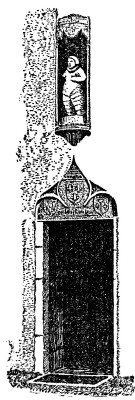
uncertain markings. I was on a wide lowland plain with hills round about. On the distant slopes I could see, here and there, dark patches of wood, but the valley was all open farm-land, with only stray trees and scattered groves. Through the meadows flowed the river Meuse, a leisurely stream, often looping and turning back on itself, and at times expanding into reedy marshes. Somewhere there was a dam, for through the dim quiet of the night I could hear the noisy overflow of water. 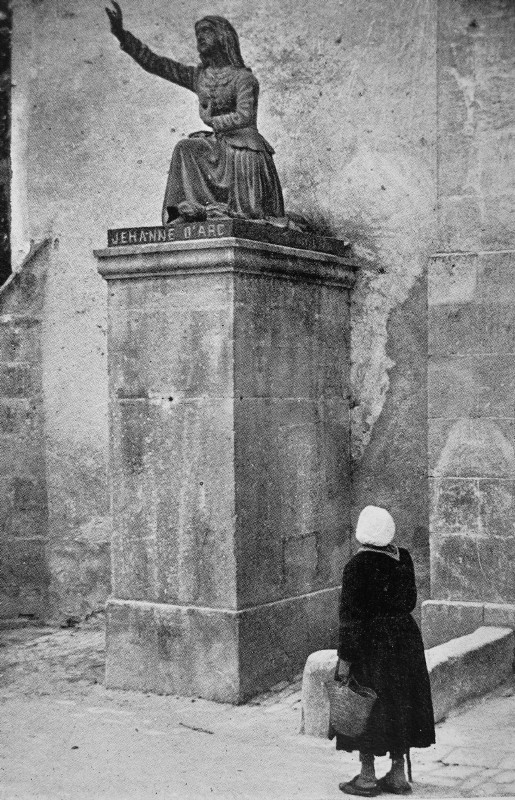 THE STATUE BEFORE THE CHURCH The
meadows were
half mown, and the hay from a few of the fields had gone to the barns;
but it
was the beginning of the harvest, and usually such grass as had been
cut lay in
swaths, as left by the scythes of the mowers, or gathered in heaps to
shed the
dew and possible rain awaited spreading and further drying on the
morrow. The
stillness and
mystery of the hour, with the pale lustre of the thin moon shining down
on the
damp meadows, were conducive to dreaming, and I thought of the old-time
heroine
whose fame had drawn me thither, realizing with a certain wonder and
elation
that this was her home region, and that I was treading a path she very
likely
had trod many times long, long ago, that in these meadows she had
worked, that
somewhere in that dark grove of trees on ahead was a village — Joan’s
village!
It seemed very fitting that she should have lived amid these
surroundings in a
region so retired, in a landscape of such gentle repose, with its broad
levels
and its protecting hills sweeping low along the horizon. Did she not
catch from
her environment some of her own brave, simple spirit? What a pity that
the
voices should have come to draw her away from the tranquil, pastoral
life that
was before her and plunge her into the midst of battles and intrigues
and
falsity! It is true that thus she won glory, but there was also the
dreadful
death at the stake. The story is one of strange contrast and pathos —
and the
tragedy of her early end, however we regard it, was perhaps necessary
to make
her fame secure. Had long life been granted there might have developed
mistakes
and weakness. We could not be sure her self-sacrificing courage would
have come
down to us so unsullied, to win for her the warm place she now has in
the
hearts of humanity. When I
reached
Domremy I found it hardly less silent and lonely than the plain. It was
the
exact counterpart of Maxey — street deserted, a few dim lights in house
windows
and a steady, musical flow of water from spouts into outdoor troughs. I
kept on
till I came to the church, near which I discovered a building that
bore the
sign of a hotel. I went in and fumbled through a dark hall to a door
that let
me into the kitchen. There I found a light burning, and a man and woman
sitting, their day’s work done, in drowsy meditation before the fire.
They were
dazed by my sudden intrusion, and it took me some time with my broken
French to
make them comprehend that I wanted a room and board for several days.
Such a
request from a tourist was rare. The place has many visitors, but
nearly all
come and go the same day. They do not care to loiter in this
out-of-the-way
little place. When I finally made my intentions clear, an extra candle
was
exhumed, and I was conducted to an apartment upstairs. My chamber had
a
decided individuality. It was large and had bare white plaster walls.
In one
corner was a long, substantial table and in each of two other corners a
bed
overhung by a lofty red canopy. The beds, independent of the canopies,
were
two-story affairs, and it was a problem just how to climb into them. On
top of
each was a fluffy feather mattress rather more than a foot thick. These
overlying feather constructions might just as well have been packed
away during
the warm summer months, but I suppose the housewives take too much
pride in
them to sanction such a proceeding. The next
morning I
began my rambling, which by the time I left made me very well
acquainted with
the hamlet and the habits of its people, and with the region lying
round about.
The village is a farming community just as it always has been from the
time of
Joan of Arc to the present. Its size has varied little with the passing
of the
centuries, and its homes and the ways of its people are simple and
primitive.
Every inhabitant, if we except the priest and a colony of nuns, works
in the
fields. The keepers of the shops, inns, and hotel have their land and
their
cattle like the rest, and when their indoor business can spare them
they turn
to their farm labor as naturally as if it was habitual. The farm buildings are very much concentrated. House, barn, and stables are all under one expansive tile roof, and a whole line of such domiciles join walls along the street. In their great size and look of age and lack of windows they savor of mediævalism. The barn is the centre and heart of a house structure, and its big, sagging, wooden doors are a prominent feature of the house front. From the broad barn floor you can step at once into the dwelling-rooms on the one side or into the stables on the other. The height of the building is usually two or two and one-half stories, and if you look in at the barn doors you find the space beautifully vast in its high, cobwebby gloom. The house part rarely occupies a section clear to the roof, but ordinarily has a hay-loft over it, just as do the stables on the other side of the barn floor. There is need of all the barn room, for crops are stored indoors, and you never see stacks of hay and grain in the fields of the Vosges, as in warmer and more fertile districts. The stables are low and dark, and show a decided lack of convenience. The only way to remove the manure is to load it on a wheelbarrow and trundle it out by hand. That is the daily task of the lady of the house. She adds the loads to the accumulating heap in the front yard, and there the hens delight to scratch all day. It is a square, well-made heap mixed with straw litter, but it speaks rather loudly for itself in warm weather. The spare space in front of the house is also the receptacle for a variety of farm machines, the wood-pile, and for whatever odds and ends it is handy to leave there. When a house has no space between it and the street, some arrangement for a farmyard in the rear of the premises is a necessity, but that is plainly not as convenient as to have everything right before the house door, open to the public way. Looks seemed not to count. 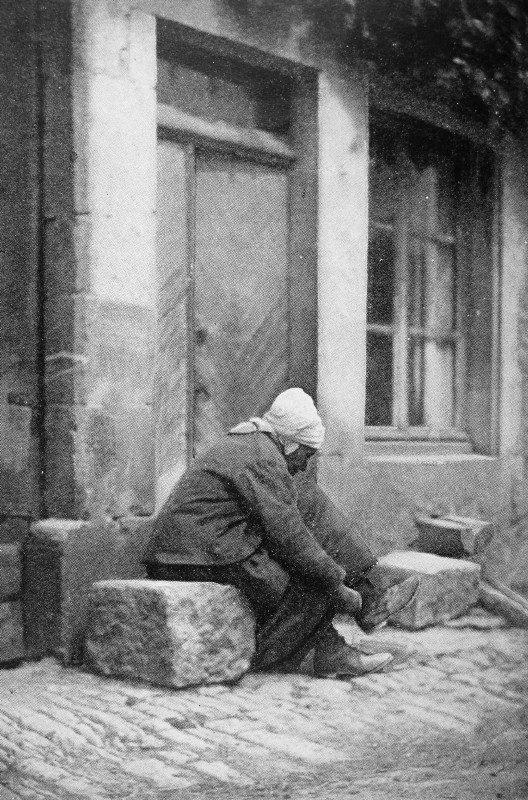 GETTING READY TO GO TO THE FIELDS Nearly all
the
farmers kept both ducks and chickens, and the fowls at night staid
somewhere
about the stables. To make ingress and egress easy for them and for the
cats, a
hole was cut at the base of one of the barn doors. The
dwelling part
of these great farm structures, as seen from the street, is apt to have
but a
single door and window. The window is curtained and perhaps has plants
in it.
Frequently it is tasteful and attractive, but Domremy fashion decrees
that
under it, inside, shall be a sink, and this sink connects with a stone
spout or
trough which conveys the waste water to the open air. The spout
projects out
from beneath the window sill, and its tricklings find their way as best
they
can, more or less directly, to the street gutter. House
walls are
whitewashed, though as often in tones of sober drab as in the natural
white.
Occasionally there are vines creeping up the walls about the house
doors, and
when this is the case the attractiveness of the premises is decidedly
enhanced. The tile roofs, too, are always pleasing with their varied
shades of
red and tawny gray, and their wrinkled irregularity. Home interiors are
simple
to the point of barrenness. There is very little furniture, almost
never an
easy-chair, and almost never a picture. But there is sure to be a
handsome,
tall clock and some capacious, metal-trimmed, hardwood wardrobes, and
on the
mantel above the fireplace are brass candlesticks and an array of
colored
crockery. Stoves of the American type are in common use in some parts
of
France, but at Domremy the broad old fireplaces that gape across half a
roomside are the rule. I liked to walk through the village in the
evening and
get glimpses through open house doors of the fires on the low stone
hearths
furnishing all the light for the dusky rooms. There was something very
cheerful
and domestic about the flicker, and the changing shadows, and the
humble family
life. Some of the household would be gathered around the table, a woman
was
perhaps lifting a black pot off the crane or laying fresh fuel on the
coals
beneath; on a bed in the corner the baby lay asleep, and over all
played the
glow of that open home fire. In the
centre of
the village, where the main road parts and one branch crosses the Meuse
by a
stone bridge to the meadows, and another turns off toward the western
hill
slopes, stands the church. It is broad and heavy and is fronted by a
stumpy
tower. Above the main entrance is a great allegorical picture painted
on
canvas, tacked snug against the wall. The painting contains many
figures,
including Joan of Arc and divers saints and angels, and its unusual
size,
strong coloring, and strange placing catch the stranger’s attention at
once,
and all pilgrims stop to study its probable significance. To the left
of the
entrance, on a high pedestal, is a bronze statue of Joan, and around on
the
other side of the church, at the time of my visit, was piled against
the wall a
great heap of brush. The brush was tied in bundles, as if in readiness
for the
burning of some modern martyr, but I suppose it was really the peaceful
property of the dweller in a neighboring farmhouse. The church
tower
had a clock on it, and a single pointer indicated rather vaguely the
time.
After the usual manner of French clocks this Domremy timepiece struck
the
hours twice with a short pause between the two series. The idea is,
that if it
struck only the first series, as do our clocks, the mind, so apt to be
preoccupied with other things, would not be alert enough to begin with
the
initial stroke and count through with certainty. The preliminary series
is
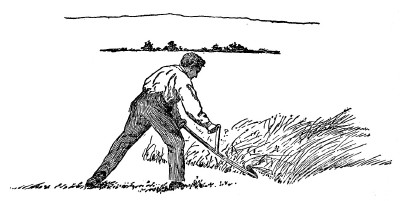
needed to warn a person to make ready to count on the repeat. Just beyond the church is the Joan of Arc cottage, an ugly building which has no charm in itself or in its surroundings. It looks more like a big shed than anything else, for the roof all slants one way from a very high wall at the front to a very low one at the back. The inside is kept as a museum, and it has all a museum’s blankness and stiffness, with no suggestion of its ever having been occupied as a home. The old garden at the rear, with its narrow paths and little plots of flowers and vegetables, happily has a real touch of humility. You can fancy it is not unlike what it was in Joan’s day, and the mind easily calls up the scene in those twilight hours of long ago when the simple shepherd maiden stood in this selfsame garden and heard mingled with the ringing of the bells from the near church those mysterious voices speaking to her. 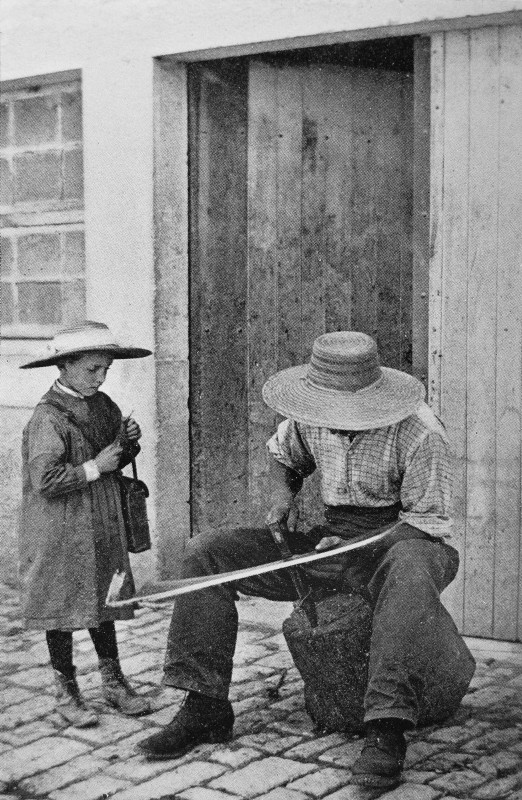 PUTTING AN EDGE ON HIS SCYTHE Three-fourths of a mile to the south of Domremy, on a hill slope overlooking the broad levels of the valley, stands a basilica with a slender golden spire, marking the spot where tradition says Joan first received the command from her voices to join the army and deliver France from its enemies. In the near view the building has a pomp and pretention not at all in keeping with its rural surroundings nor with the simple character of the peasant girl it glorifies. I only saw it once when it seemed to me truly beautiful and impressive. Conditions favored. It was late in the afternoon, and the lower part of the basilica was shadowed by the steep western hill, while the golden spire, touched by the rays of the setting sun, became a wand of flame against the sky. To follow
the
winding, ascending way that leads through the farm-lands from the
village to
the basilica imbues one with the genuine pilgrim feeling. You have the
company
of others making the journey, some on foot and some in carriages; they
go and
come all day long, singly, in groups, and at times in processions. A
cross,
halfway, bearing a life-size figure of Christ, gives the road emphasis
as a
pilgrim route and you feel transformed by some magic of the region half
a
thousand years or more into the past. Yet after all you get only a
tincture,
only a reminiscence, of the old days; for those early pilgrimages,
especially
when the destination was the Holy Land, entailed very real hardships,
and they
took a weary length of time. Most of the pilgrims did their travelling
on foot
with a long staff in the hand, a broad black hat on the head, and for
the body
a black or gray gabardine girt with a leather belt. Millions of such
pilgrims
made their lagging way to Jerusalem, and a large per cent of those who
started
lost their lives either going or returning. Our latter-day
pilgrimages, in
which one is rushed to his destination on a railroad train, and
comfortably
looks about and pays his respects at the pilgrim shrine, and then is
whirled
back home with no exertion on his part, are very pale affairs. The
basilica on the
Domremy hillside, with its elaboration of architectural detail and its
ornamentation of gold and color, stands where formerly the tall trees
grew.
Nature's woodland temple has been replaced by this gorgeous church,
and I do
not think any one will ever hear voices from the other world there
again. The valley
as I
looked down on it from the basilica lay spread out before me like a
map. There
were the roadways with their thin lines of soldierly poplars, the
tree-clumps
and bushes marking the winding course of the river, the red-roofed
villages,
and the broad grasslands busy everywhere with hay-makers. As many
women were
in the hay-fields as men, but their work was mostly confined to
turning,
raking, and opening. In some cases they handled the hay on the loads,
but they
never did the heaviest work — the mowing or the pitching on. Nearly all
the
grass is cut and cared for by hand, though mowing-machines and
horse-rakes are
owned by a few of the more progressive farmers. There were men in the
meadows
swinging their great broad-bladed scythes all day. It was in the
morning hours,
however, that they were busiest, coats off, and frequently bareheaded,
advancing
slowly, but steadily, across th,, fields and laying low the
daisy-spangled
grass. Labor began before sunrise, and when the last loads came
trundling in at
about eight o'clock in the evening there were still stray workers
scattered
about the meadow who would keep to their tasks as long as daylight
lasted. In many
parts of
France two-wheeled carts, very high and very ponderous, are the only
ones in
common use for heavy farm work, but at Domremy the type of cart in
favor was
low and had four wheels. When two horses, or, as was often the case,
three,
were attached to a wagon, they were hitched tandem, never abreast.
Sometimes
the team was made up of a horse and an ox, the former the leader, and
the
latter between the shafts. When a hay-cart went to the fields in the
early
morning or just after the noon lunch, it was apt to be the conveyance
of the
whole farm family — men and women, old and young, sitting square on
the floor
or perched along on the side racks. But it seemed to be necessary that
one man
should walk beside the team to do the driving; for even if the two or
three
draught animals were all horses, they were driven much as if they were
oxen. A
single line attached to the bridles hung on the left-hand side of the
team,
though it was seldom used except in turning corners. The driver
depended in the
main on his commands and exclamations, and on the cracking of his
long-lashed
whip. One of the most common sounds that came to my ears from the street, when I was in my room at my hotel was the ring of hammer blows on iron. This was made by men sitting before their house doors sharpening their scythes. I do not think any farmer in the village had a grindstone, but it was not necessary. To sharpen his tool he laid the edge of the broad blade on a heavy-headed spike driven in a block of wood, and pounded the scythe edge sharp with a light hammer. The spike had a flange on it midway, so that when the mower used it in the fields it could be driven in the ground and hammered on without sinking in too far to be serviceable. Some mowers carried a whetstone slung from the belt in a cow's horn sheath, but the spike and the hammer were the favorite implements when the scythe got dull. 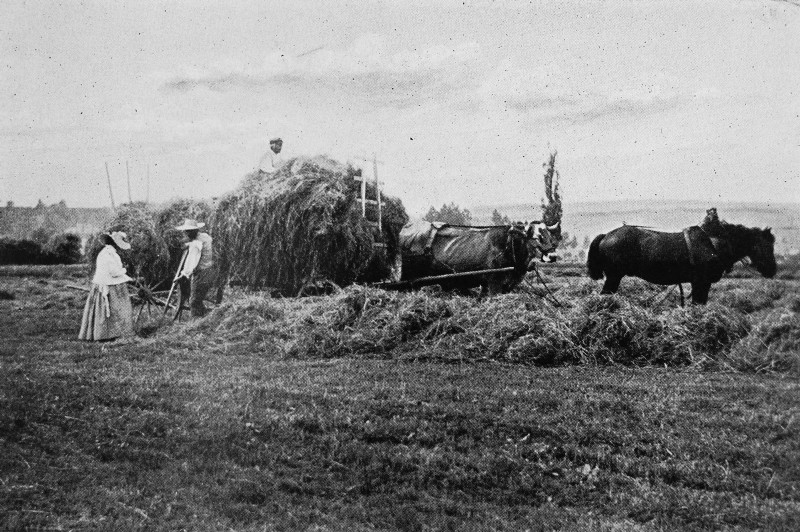 A HAY WAGON We had a
flurry of
rain one afternoon. Dark clouds had been reaching up across the sky for
an
hour, and presently the storm broke, big drops pelted thick and fast,
and there
was a rumble of thunder accompanied by flashes of lightning. The great
meadows
around the village were full of haymakers. They had seen indications at
noon
that the storm clouds were gathering, and had eaten hasty lunches and
hurried
to the fields to save the hay. They got some of it into tumbles, and a
few
half-loads on the wagons. Then the rain came and sent them scurrying
back to
the village, the first corners comparatively dry, the later arrivals
well
bedraggled. The poultry that inhabited the streets had promptly sought
shelter,
all the spouts from the conduits of the broad roofs gushed with water,
and the
wayside gutters became brooks. But the shower was soon past, the
chickens and
ducks reappeared, and the men and women put on their wooden shoes and
spent the
rest of the day working about their homes. Mornings
the
village was always enlivened with processions of cows on the way to
pasture,
with horses and colts being led to the watering troughs, and with
certain pigs
which were apparently let out for an airing. But the event most
pastoral and
interesting was the start of the sheep for the day's grazing. From
some byway
a shepherd appeared accompanied by two black dogs and a few goats and
sheep.
The man blew a long horn at every corner, and barn doors opened here
and there,
and from each farm dwelling came additions to the flock until there
were a
hundred or two of the sheep and a goodly sprinkling of the shaggy
goats. Now
they wended their way out into the country to some waste fields on the
western
slopes where they would feed until evening. I visited
the
shepherd on his hillside one day. He wore sabots and patched blue
overalls.
Slung from his shoulder was his horn and a black bag containing his
lunch and a
bottle of wine. In his hand, always ready for service, he carried a
staff with
a small iron hook and a scoop on the end. The hook he could deftly slip
around
the hind leg of one of the creatures when he wished to catch it. The
scoop he
used to shovel up pebbles and bits of earth to throw at the constantly
wandering flock. It was a very effective warning, and with the
intelligent help
of his dogs he did not have to move about much himself. Often he sat
and
meditated, looking off across the green landscape. Toward
night the
bleating flock came straggling back along the lanes to the village. The
dogs
barked, the horn blew, the sheep ran hither and thither about the
street, barn
doors were thrown open, housewives appeared, and excitement reigned.
But it was
only for a few minutes. The sheep knew their homes, and little coveys
of them
separated from the main flock of their own accord, to seek their
accustomed
stables, till none were left save three or four younglings whose
memories had
failed them. There they were, their usual companions gone, homeless and
forlorn
on the street. They were in a panic, their wits left them entirely, and
they
never would be able to find their proper domiciles were they not driven
and persuaded.
Their mistresses were after them, however, and I saw one of the
reluctant lambs
walked off by a woman who gripped it by its hind legs and pushed it
along in
the way it should go, as if it had been a wheelbarrow. The youngest of
the
stragglers on the same occasion was picked up by another woman and
carried off
in her arms. In most
places that
I visited in France, I was fortunate enough to find some one who could
talk
English, but I could learn of no such linguist in Domremy. Some one
suggested,
in response to my inquiries, that the sister superior at the convent
could
speak my language, but when I went to the convent to seek that
dignitary, and
questioned its sober, coiffured inhabitants, they shook their heads
and bowed
me outside the gates of their citadel with evident relief. I felt as if
I had
been trespassing. Perhaps I had, but I had jangled the bell at the door
in the
street wall in vain, and then, as it happened not to be latched, I had
pushed
it open and crossed the threshold. There I was in a gravelled
courtyard, and I
was looking about doubtfully, trying to make up my mind what to do next
when
one of the spooks of the place opportunely appeared. It may be a
question
whether the term "spooks," as applied to the nuns, is judicious, but
it very well describes the impression they made on me. Their dress and
manner
of life were, to my mind, distressingly unworldly and unnatural, and
their funereal
garments, prayer-books, beads, and images, gave them the air of making
piety a
business, while their barren, walled-in buildings looked like jails. It
seemed
as if the happiness of the young girls in the charge of these silent,
frigid
figures must be very much curtailed. After my discomfiture at the convent gate, I blundered into the presence of the nuns yet again. It was evening, and I was returning from a walk in the fields, when I heard singing from within the church. A service was in progress, and I decided to attend. The one pointer of the clock on the tower indicated that it was a trifle after eight o'clock, and the night was dull and clouded. I expected to step from the outer dusk into a brightly lighted interior. Instead, I found myself in dense gloom, relieved only by one faint little taper fastened against a stone pillar. This tiny spark revealed vaguely many mysterious figures kneeling among the seats in the middle of the church. I made my way hesitatingly to a bench at the extreme rear, and sat down unnoticed. As my eyes grew more accustomed to the darkness, I could make out dimly the vaulted arches of the ceiling, some colored windows beyond the altar, a statue above the little taper, and I saw that the congregation was composed of young women and girls, several nuns, and half a dozen white-capped old women. I was the lone man in the assemblage, and I would not have been surprised had I been asked to leave. 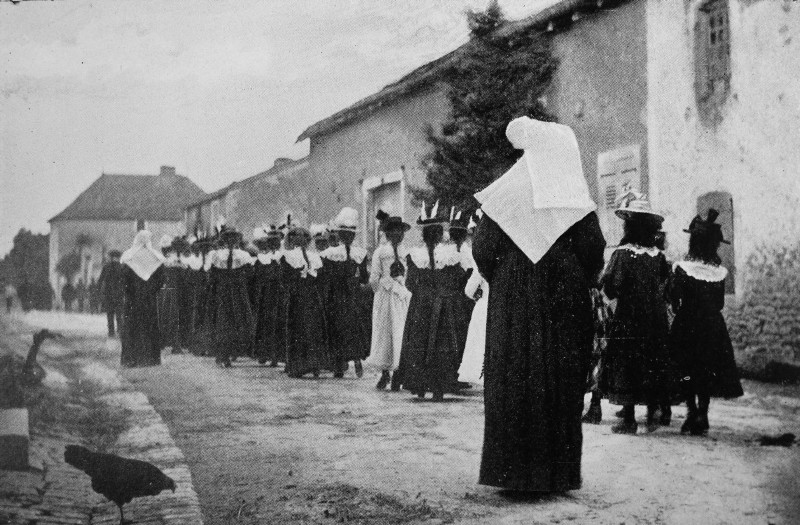 THE PUPILS FROM THE CONVENT The
singing which
was in progress when I entered was followed by a long recitative — a
chanting
medley of sound that to my ears was not unlike the evening music of a
frog
pond. They went through it unhesitatingly, and I wondered that they
were able
to retain all its dull length in memory so accurately. Presently one of
the
nuns began to read from a prayer-book, and then I saw there was a
second light
in the room, for this nun had a candle, and when she held it up to
illumine
the page she was reading, it shone into her hood, and on the cloth's
transparent folds it cast fantastic shadows from her features. At the
close of the
service, when the worshippers filed out from the church, I found they
were
nearly all private scholars of the convent school. The only village
farm folk
were three or four children and a few old women. These scattered to
their
homes, while the school, two by two, beginning with the tallest girls,
who may
have attained the age of sixteen or eighteen, and ending with the
youngest, who
were eight or ten, marched away, officered by the nuns, down a side
lane back
to the convent. They always came and went by that lane, save on
Sundays, when,
in honor of the day, or as a special privilege to the scholars, they
passed
through the main street. Sunday was
observed
by the villagers after the usual French manner, as one of mixed work,
play, and
devotion, and the devotion was both last and least. The Sabbath I was
at Domremy
was a good hay day, and nearly all the able-bodied peasantry were in
the
fields. The wagons came rolling in from the meadows to the village
barns with
their loads the whole day through, until darkness put an end to the
operations.
Yet labor was not quite as general as on week days, for I noticed that
a good
deal of fishing was going on in the river Meuse, and that more men than
usual
resorted to the inns. A good deal of the fishing was done by boys, but
I do
not think their amateur angling was very successful. Nets seemed to
meet with
better reward. A party of three or four with their nets would usually
return at
the end of half a day or so with about two fish, weighing from one to
four
pounds each. The rest of the day the fishers would spend in showing
their
prizes to their friends, and telling them how they did it. Business at
the inns
began at noon, when the landlords, after a morning spent in the
hay‑fields, got
into their best clothes and took down their shutters. Too many were
still
engaged in field labor for trade to really thrive, yet after all,
fair-sized
groups gathered at the inns, where they drank, smoked, played cards,
and talked
the hours away, with evident satisfaction. I attended
morning
mass at the village next to the south. I was early; but the day was
hot, and I
was glad to get into the cool twilight of the church and sit and wait.
The only
other person present was the gray old sexton. He was reaching up from
behind
the altar and taking down the tall candles one by one, snuffing, and
otherwise
putting them in order and replacing them. At ten o'clock a small boy
came in,
threw his wide straw hat at a seat, took a grip on one of the
bell-ropes
dangling in the rear of the room, and tolled the bell a few strokes.
Then he
came over and looked at me long and attentively. That accomplished to
his
satisfaction, he returned to his bell. There were three bell-ropes, and
presently more boys came and joined the first, and helped ring the
chimes. They
enjoyed the task thoroughly, and they made the bells send forth all the
clamor
of which they were capable. It was a kind of gymnastic performance on
the part
of the boys, and they went through it like so many jumping jacks. For
variety,
they sometimes clung to the rope on its recoil, and let it carry them
up in the
air four or five feet. That was like flying, and the resounding thump
of their
heavy shoes on the paving, when they returned to earth, rejoiced their
hearts.
Occasionally one would break his downward journey by putting his feet
on a
pew-back, and then allowing himself to sag off sideways. The
congregation had
now begun to stroll in, but no one paid any attention to the boys. When
the
time came for services, the youngsters desisted, with some reluctant
final
flourishes, and went off to the chancel to put on their robes and help
the
priest before the altar. There was no organ, but the chanting was
harmonious,
and the decorous formalities of the service were not unpleasing. The
audience
kept increasing till nearly time for the benediction, but even when the
last of
the eleventh-hour worshippers had come, the church was but thinly
filled. No
doubt the number would have been much larger had it not been such good
hay
weather. The next
morning I
left Domremy. I made an early start, for I had a long journey before
me; but,
though I was up at four o'clock, the village was already bestirring
itself, and
its people were beginning to appear on the street. At five, just as I
left my
hotel to walk to the station, the Angelus rang from the church tower.
Work had
begun in earnest by then. Hay wagons were being unloaded in the barns,
there
were men before the house fronts pounding out a sharp edge on their
scythes,
and the women were getting breakfast, or were milking in the stables,
or were
driving the cows to pasturage in the meadow enclosures. In the fields
were
laborers plodding along the paths on their way to work, and mowers
swinging
their scythes through the dewy grass; and that was the last impression
I had of
the homeland of Joan of Arc —peaceful meadows and hills and stream, and
peasant
workers beginning their day's labor under a clouded sky threatening
rain.
 . .
|
 THE birthplace and
girlhood home of Joan of Arc, peasant‑saint and noblest of all French
heroines,
was Domremy, a village in the hilly eastern department of the Vosges.
The
Vosges is a poor country compared with most parts of France; but such
is nearly
always the nature of the region that produces saints. Comfort and
wealth and
adjacency to the great towns are not congenial, apparently, to growths
so
delicate.
THE birthplace and
girlhood home of Joan of Arc, peasant‑saint and noblest of all French
heroines,
was Domremy, a village in the hilly eastern department of the Vosges.
The
Vosges is a poor country compared with most parts of France; but such
is nearly
always the nature of the region that produces saints. Comfort and
wealth and
adjacency to the great towns are not congenial, apparently, to growths
so
delicate.  Click the book image to turn
to the next Chapter.
Click the book image to turn
to the next Chapter.