
Web
and Book design,
Copyright, Kellscraft Studio 1999-2007 (Return to Web Text-ures) |
 (HOME)
|
|
IX ON THE BORDERS OF
SAVOY
So we went
on
through the moonlit night until half-past ten, when we reached
Bellegarde,
where I alighted and had my drowsiness shaken off by the tumult of a
custom-house examination conducted by government officers in the
railway
station. As soon as I was released bag and baggage, I sought the
nearest hotel
and retired. The next
day was
clear and warm. If one sat within doors and had the windows open a
little
breeze wandered in that was comfortably cooling, but for the pedestrian
who
chose to ramble near and far as I did, the weather was decidedly hot,
and the
white, chalky roads were blinding in the sunlight. The
country about
Bellegarde was wrinkled into a great medley of monster hills and
valleys, while
lofty mountain ranges loomed on the horizon. Winding in and out through
the
lowest valley depths was the river Rhone, a tumult of hurrying green
water,
seething and boiling along in a manner very unlike the serene leisure
of the
other French rivers I had known. It seemed a very demon of a stream,
and
perhaps with reason, for it was bearing to the sea the spirits of the
Alpine glaciers
that for thousands of years had been held imprisoned in the ice-fields
of the
mountain tops. No wonder that they should be in a frenzy of haste to
reach
their old home, the ocean. The river was not broad, but it must have
been deep,
for it gave a sense of immense power. In the Bellegarde neighborhood
it flows
for a long distance through a narrow, high-cuffed gorge that it has
carved for
itself down into the strata of the chalky rock. The gorge drops from
the
ordinary valley levels suddenly and without any preliminary shelving,
and at a
little remove you lose sight not only of the stream, but of its channel
as
well; the landscape appears to be without a break, and if it were not
for the
roar of the waters you would have no suspicion of the river's
existence. I crossed the stream twice in my walk that first morning, once by the high arches of a stone bridge near the town, and again, some distance down the valley, by a slender wooden footbridge that connected two small villages. The latter crossing was deep in the shadowed chasm, and I had to descend to it by a steep, zigzag path. From the bridge I could look down on the writhing turmoil of the waters and up to the great crags which overhung the narrow channel. On the summit of the cliffs was a fringe of bushes, and, at one point, several cottages peeped over the verge of the precipice. 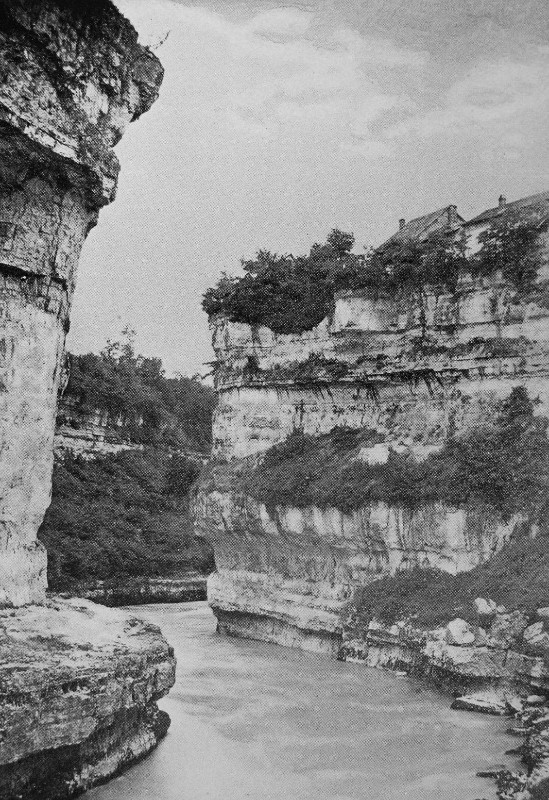 THE RHONE AT BELLEGARDE Bellegarde
is a
frontier town, and all its highways and even its most secluded byways
are
guarded by revenue officers. No loopholes are left for the entry of
contraband
goods. Thus, when I reached the farther side of this little bridge
across the
Rhone I came to a diminutive hut, before the door of which stood a
uniformed
official. He stopped me and asked if I had a bicycle. I did not
comprehend very
clearly what he wanted, and he had me step inside his sentry box and
read a
notice which said no one could come into French territory on a bicycle
without
a permit, and this permit would cost sixty centimes. I certainly
showed no
signs of having a bicycle, and the sentinel's challenge seemed hardly
necessary, especially as a man would have to risk his neck to get his
machine
down and up the attenuated and precipitous pathways on either side of
the
stream. Probably the guard, in his French love of talk, simply wanted
to relieve
the tedium of his position by a little visiting. He was quite ready to
take my
word for it that I had no wheel concealed about my person, and, that
matter
settled, he very sociably volunteered information concerning points of
interest in the neighborhood. He had a lonely time, no doubt, in that
shadowy
canyon, and must have envied the more stirring life of his fellow
officials
posted in Bellegarde town. The squad
most in
evidence there, aside from that which kept watch on the passengers
arriving by
train, was one stationed where the main highway from the Swiss
direction comes
over a bridge that spans one of the branches of the Rhone. From a
guardroom by
the roadside the officials looked out on the highway, and no person or
vehicle
entered the town without being seen by them. Once in a while a passer
was
challenged. It might be a woman with a market basket on her arm; it
might be a
man trundling a bag of sawdust on a wheel barrow, or a driver jogging
past with
an empty keg in his cart. The cloth covering the basket is lifted, and
the
guard takes a critical look at its contents; the man with the sawdust
waits
while a rapier is brought out and thrust through the bag to betray the
presence
of any smuggled goods that are possibly concealed within; and in the
case of
the empty keg in the cart a guard must needs climb up and have a look
in at the
bunghole. I did not think the duties of the revenue officers were very
arduous.
Their challenging and their investigations seemed to be undertaken more
for
their personal entertainment than for anything else, or just to keep up
a
reputation for attending to business. The
section of the
town in which the guardhouse was situated lay in part across the
stream, and
the bridge was a busy thoroughfare. All sorts of folks were coming and
going —
bareheaded school children, and men and women of high degree and low;
and there
were carts and carriages and now and then a slow ox-team. Somewhere
near there
was a bakery, and whenever I was in the vicinity toward evening I found
many of
the passers burdened with great round loaves of bread. The loaves were
in form
very like monster doughnuts, each with a hole in the middle, making it
very
convenient to carry them hung on the arm. The most ingenious use of the
hole
that I noticed was made by a driver of one of the ox-teams, who was
conveying
his loaf home safely suspended on a pole of his cart. In what I
saw of
the farming round about the town, it seemed to me the tillers of the
soil had
to contend with great difficulties. There were no levels. All the land
was on a
slant, often very steep and much broken by ravines and outjutting spurs
of
rock. Most of the work had of necessity to be done by hand, even if
there was
the enterprise to use modern machines and the prosperity that could
afford them.
At this season the men were busy with their scythes mowing the little
grass-fields, or, with the help of the women, were spreading, turning,
raking,
and getting in the hay. Their tools, compared with the lightness and
grace of
those commonly used in America, were curiously clumsy. The rakes, for
instance,
had perfectly straight handles, and at the working end a double set of
teeth,
one set on either side of the crosspiece. The theory seemed to be that
the
workers were as likely to put their rakes down wrong side up as right,
and this
double row of teeth was provided so there could be no wrong side. The forks used were not so angular as the rakes, but were hardly less primitive. They were wholly of wood, had three curved, wide-spreading tines, were all very large, and some of them enormous. The especial purpose of the biggest forks was to enable a man to pick up and carry great heaps of hay on his shoulders from the less accessible plots to those more favorably situated. Sometimes he conveyed the hay in that way clear to the house-barn. Usually, however, if a man had to carry his hay on his back any considerable distance to reach home he packed it into a big blanket. Blanket transportation was resorted to more, higher among the mountains than immediately about Belle-garde, where most of the farmers had oxen and brought their hay from the fields, up or down the steeps, as the case might be, in little jags on their clumsy ox-carts. 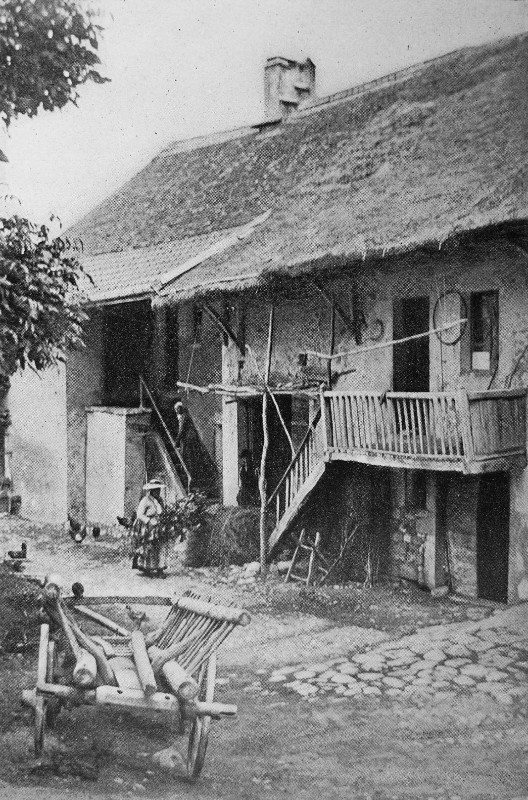 A HOUSE-PORCH The manner
of
attaching the oxen to the carts was peculiar, and I thought rather
harassing.
The yoke was not on the oxen's shoulders, but was strapped to their
horns and
rested on their heads just over the ears. You could not help fancying
that the
jolting of the cart must make the yoke thus placed quite distressing
at times,
yet the oxen seemed as well pleased to have it there as anywhere, and
the
ponderous tranquillity which characterizes their race appeared not
even to be
disturbed by the femininity of wearing veils. Veils were the fashion
for oxen
in that part of the country, and every creature had one. They were a
kind of
screen of strings intended to keep the flies out of the eyes, and as
the heads
of the oxen were fast to the yoke so that they could not free
themselves from
the troublesome pests, the veils were humane and necessary. In
favorable spots
on the Bellegarde hillsides there were vineyards set full of slender
stakes
about a yard high that were fast being hidden by the green vines. Each
vine's
this year's sprouts all grew from a stub cut back within a foot of the
ground.
In the newer vineyards the stubs were hardly noticeable, but in some of
the
older ones they had attained a considerable size, and showed that
their years
were many. The vines were set so thickly that a person could barely
walk
between them. No weeds were allowed to grow in the vineyards, and the
women
were constantly at work in them hoeing and mellowing the ground, tying
the
straggling shoots with wisps of straw to the upright stakes, and
otherwise
caring for the vines. One
afternoon I
climbed in the swelter of the clear sunshine far up the steep of a
great hill
slope to a little village that had as a background a big mountain range
seamed
with stony ravines. The farm buildings of this and all the other
villages of
the region were quite different from those of the north where I had
been
travelling previously. They betokened a warmer climate and sought
protection
from the heat by allowing the roof to project all around far out from
the
walls. On the side of the house most exposed to the sun the roof was
continued
still more to make a kind of shed sheltering a veranda, the house
entrance,
racks of tools, and gatherings of rubbish. The door to the living-room
was
usually in the second story up a flight of outdoor stairs and opened on
the
veranda. This little upstairs porch was a very good place to sit and
work, and
it was utilized, more or less, by all the family; but it was
essentially a
kitchen adjunct and mainly used by the women. One porch I observed was
occupied
by a mother sewing and at the same time caring for a small child that
she kept
from tumbling down the stairs by clasping her feet about its body. This
upland village
impressed me strongly with its picturesqueness, but the calling of the
inhabitants was too apparent for unalloyed charm. If truth be told, the
farm
hamlets throughout the region were best seen from a distance. At close
quarters
you found them always so dolefully dirty that their streets looked and
smelled
more like stable-yards than public ways. I wanted to go farther on up the mountain that afternoon, but now a thunder-storm came gloaming over the vast landscape, warning me back, and under the shadow of its portentous blackness I hastened down a steep pathway that brought me to Bellegarde just in time to escape the downpour.  |
 IT was evening. All
day we had been speeding across the monotonous plains of central
France, but
these were now left behind, and we were beginning to encounter the
outlying
foothills of the Alps. My destination was Bellegarde, still far away,
the last
stop on the route before the express train for Geneva, on which I was
travelling, entered Switzerland. When I looked out into the dusky
moon‑light of
the night, I could see that we were following up a narrow valley
bordered by
steep hills, and occasionally there were great up‑thrusting turrets of
rocks
crowning the slopes like vast and ruinous old castles. In the hollow
was a brawling
mountain stream full of boulders, its shores strewn with windrows of
waterworn
stones and pebbles. But the stream had its spells of quiet, where it
crept
along in pool-like reaches and mirrored the adjoining landscape's
slender
poplar trees and the hills and castellated rocks. Now and then a
little
village hugged the face of one of the big cliffs, usually a
manufacturing
place with some white-walled mills in its midst.
IT was evening. All
day we had been speeding across the monotonous plains of central
France, but
these were now left behind, and we were beginning to encounter the
outlying
foothills of the Alps. My destination was Bellegarde, still far away,
the last
stop on the route before the express train for Geneva, on which I was
travelling, entered Switzerland. When I looked out into the dusky
moon‑light of
the night, I could see that we were following up a narrow valley
bordered by
steep hills, and occasionally there were great up‑thrusting turrets of
rocks
crowning the slopes like vast and ruinous old castles. In the hollow
was a brawling
mountain stream full of boulders, its shores strewn with windrows of
waterworn
stones and pebbles. But the stream had its spells of quiet, where it
crept
along in pool-like reaches and mirrored the adjoining landscape's
slender
poplar trees and the hills and castellated rocks. Now and then a
little
village hugged the face of one of the big cliffs, usually a
manufacturing
place with some white-walled mills in its midst.  Click the book image to turn
to the next Chapter.
Click the book image to turn
to the next Chapter.