 Web
and Book design,
Web
and Book design, Copyright, Kellscraft Studio 1999-2006 (Return to Web Text-ures) |
Click
Here to return to From St. Lawrence to Virginia Content Page Return to the Previous Chapter |
 (HOME) |
|
XIV
JUNE IN THE SHENANDOAH VALLEY MOST of my time in the
valley was
spent at Luray, not because that particular vicinity is superlatively
attractive, but because I wanted to see the world-famed Luray Caverns.
The town
is in a region of big, sweeping hills, and its chief street climbs an
especially steep slope. At a little remove, to east and west, are long
ranges
of lofty mountains, some bulwark-like and level-topped, but the
majority
running up into rounded or sharp-pointed peaks. They are tree-clad
clear to the
summits, and as I saw them in the warm, hazy days of early summer they
were
always dreamily blue and serene. Indeed, the region had an almost
Swiss-like
charm in its combination of pastoral lowlands and ethereal heights. The caverns are a mile
east of the
town beneath the summit of the highest hill in the neighborhood. They
are
remarkable for their size, but still more so for the wealth of the
calcite
formations they contain. In the latter respect they are unexcelled. The
circuitous course over which visitors are taken is a mile and a half
long. As
soon as you go down the entrance stairway into the depths, no matter
whether
there is summer heat outside or the frosty keenness of winter, you are
in a
cool, pure atmosphere that remains always at about fifty-four degrees.
Stalactite and stalagmite ornamentations abound everywhere in the
labyrinthine
passages and chambers, and a system of electric lighting makes it
possible to
see this to admirable advantage. It is a weird place — so silent and so
fantastically decorative — full of impenetrable shadows, chasms here,
gloomy
rifts there, and now and then a pool of water that seems like liquid
air it is
so clear. You go on with resonant footsteps, your guide’s voice and
your own
echoing in the stillness. You gaze on the pendants from the roof and
their
reverses rising from the floor, the fluted columns and draperies, and
the stony
cascades with their marvellous variations in color, and you feel that
you are
in the royal chambers of the monarchs of the underworld. The formations
often
strikingly resemble animals, vegetables, and other objects of the realm
above
ground, and the guide calls them all faithfully to your attention
until you
get the impression that you are in a petrified museum. Somewhere in the journey
the guide
allows you to learn what absolute darkness is like by turning off the
lights.
The gloom was not simply black — it was blank, and I stood in an
illimitable
void so far as the sense of sight was concerned. “There was one time,” the
guide
said, “that I took a visitor through here, who was a great large
Dutchman —
about the type of man you see driving around on a brewery wagon, and
when we
had made the rounds he asked, ‘Was it made, or did it come so?’ “Another visitor would
n’t go in the
cave at night because he said he’d rather see it by daylight.” Just then the guide
halted and threw
the light of the oil torch that he carried down into a depression
beside the
path. “Look,” he said, “and you’ll see the bones of an Indian boy
almost
imbedded from sight in the lime. They must have been there for at least
one
hundred and fifty years. Thirty-five feet above us another passage
opens into
the one we are following. No doubt the boy was groping along that
passage, and
when he stepped off the edge of this wall up there he fell to his
death.” One of the chambers to
which a
sentimental interest attaches is the ballroom. “This is where we have
weddings,” the guide explained. “There’ve been seventeen of ‘em. It’s
just a
freak idea, and started with the wedding of a girl who wanted the
ceremony in
the cave because she’d promised her mother she would n’t marry any man
on the
face of the earth.” The discovery of the
caverns dates
back only to 1878, and the story of it as commonly related in the town
runs
about like this: “On the far side of the
hill east of
the village was a cave the existence of which was known from pioneer
times. The
Ruffner family were the first settlers of the valley, and one day a
member of
this family went out hunting and failed to return. Searchers scoured
the region
for nearly a week and then found the missing man’s gun and powderhorn
at the
mouth of this cave, and rescued from the cave itself the almost
famished
hunter. “The years passed, and there at length drifted to Luray a wandering school-teacher and photographer named Stebbins. His photograph outfit was in a wagon to which a pair of horses could be hitched and draw it from town to town. He would maybe stay two or three months in a place as long as he could do well — established on some vacant lot. Stebbins knew something of geology, and he thought there was likely to be caverns of considerable extent in the vicinity of the old Ruffner Cave. This impression he confided to Andrew Campbell, a native of the town who had been all over the country hunting and fishing, and was a keen and capable woodsman, but who got along from day to day with very little provision for the future. He accumulated an interestering fund of information, but while he was out roaming around perhaps his wife was at home wondering what the family would have for dinner. 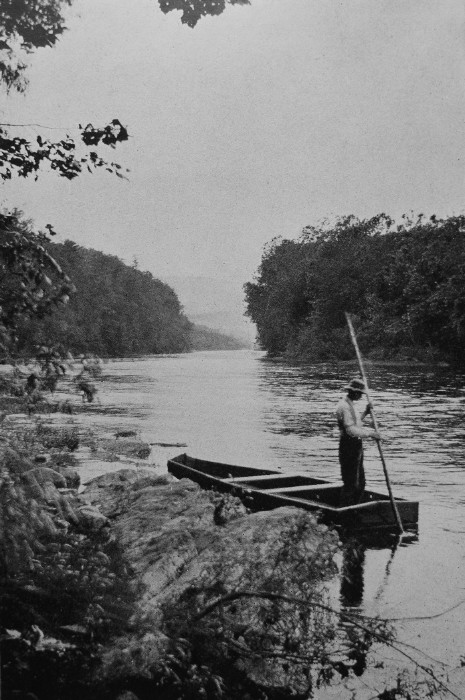 The Shenandoah River “The upshot of the
consultation with Stebbins was that
Campbell and his brother Williams and the schoolmaster started out
cave-hunting. Sink holes draining into underground cavities were common
in the
region, and the three men ranged about examining them for possible
openings. At
last, one August day, they turned their attention to a sink hole in a
wheat
field on the north slope of Cave Hill. It was some fifteen or twenty
feet
across and twelve deep, and was overgrown with briars and bushes. When
a man
had a sink hole like that in cultivated land he would use it to get
shut of a
lot of stumps and stones. It served as a kind of dump, and a good deal
of
refuse had been thrown into this one in the wheatfield. Formerly it had
been
much deeper. The men were poking around in it when one of them
exclaimed, ‘Why,
here’s cold air!’ “The air was coming out
of a hole
about four inches in diameter, and the men worked with a will to clear
out the
rubbish. As they went deeper they used a bucket attached to a rope to
pull up
the dirt and stones. In five hours’ time they had made an aperture
large enough
for a man to crawl through. This gave access to a black abyss below,
and Andrew
Campbell, clinging to the rope, descended till he found a firm
foothold. Then
he let go of the rope, lit a candle, and looked about him on the
unexpected
splendors of the chamber to which he had gained entrance. He left his
companions
so long to their conjectures that they became uneasy at his absence,
and his
brother presently descended in search of him. Together the two went on
for
several rods to where they were stopped by water — water so cle’r you’d
hardly
realize it was there. This has since been called Chaplin’s Lake,
because a
fellow of that name stepped into it up to his knees. The Campbell
brothers
agreed to keep quiet about their discovery and when they came up to the
surface
they told Stebbins and some loafers who’d gathered around to see what
was
doing, ‘Oh, there’s nothing in it!’ “But when the three
partners in the
exploring enterprise were by themselves the facts were revealed to
Stebbins,
and later they returned to make a more extended exploration of the
caverns.
The land under which the caverns lay was a bankrupt property soon to be
disposed of at a sheriff’s sale, but the three ne’er-do-wells who knew
the
secret of the cave had no money. Probably not a man among ‘em could
raise
twenty-five dollars. So they divulged their discovery to another man
who had
means, and persuaded him to back them. Such land was then worth eight
or ten
dollars an acre, and they bid it in for about twice that to the great
surprise
of the townsfolk. Their friends naturally guyed them a good deal over
their
bargain, and they could not stand the ridicule and prematurely revealed
their
reason for buying. That roused the heirs of the bankrupt property to
start a
lawsuit, and two years later the property was restored to them. It was
then
disposed of a second time, but instead of bringing about three hundred
dollars,
as it did before, the seventeen acres this time sold for forty
thousand. “Meanwhile the three
discoverers had
opened up the caverns and exploited them with some success, and enjoyed
the
only period of prosperity in their lives. A spirit of adventure had led
to the
finding of the caverns, and the management of them afterward by
Stebbins and
his comrades was simply childish. If a man came to see the caverns, as
like as
not Bill Campbell, who was supposed to act as guide, would be lying on
a bench
feeling too lazy to make the trip, and he’d put the man off. It seems a
pity
that the discoverers should not have had larger returns, but doubtless
the
public fared better for the shift to another management.” The
geologist of the trio “drifted
around from pillar to post,” and died in a neighboring town a
public charge.
Andrew Campbell is still a resident of Luray, and I met him. He was
evidently
confident that he knew the caverns much more thoroughly than those now
in
charge. “They’ll tell you there’s
practically no life in the cavern,” he said,
“but I’ve seen tracks of coons, ‘possums
and bears in there — thousands of ‘em;
and I’ve seen places where animals have stayed, most likely
to get away from
the cold above ground in winter. Rats and mice live in there.
I’ve set traps
for ‘em, but they were too slick for me. A very little fly,
and a spider, both
almost microscopic, are found in the caverns, and I’ve come
across bats hangin’
upside down. Where the animals come in, or where the air comes in, no
one can
tell, but it’s plain that the entrance we found
ain’t the only one.” Another subject which
loomed large
in Mr. Campbell’s experience was the Civil War. “I was a Union man who
fought
on the Southern side,” he said. “Just before Lincoln was elected I
raised a
flag in this town to show my sentiments. On the cloth was painted an
American.
eagle as big as a turkey, and he had a scroll in his mouth that bore
the motto,
‘The Union must be preserved.’ I hoisted the flag on a spliced hickory
pole
that was one hundred and fifteen feet high; but after the state seceded
the
pole had to be cut down. “Then they conscripted
me, and I
volunteered to go as a musician. They kept me three years. At first I
played
the fife, and later a tenor drum. I was with Stonewall Jackson. Yes,
old
Jackson heard me beat the drum many a time. We made some great marches.
He did
n’t let much grass grow under his feet while he was on the move; but I
did n’t
like him. He was a regular tyrant, and he did n’t care how many of his
men were
killed if he only carried his point. That’s the kind of a hairpin he
was.
Generally the discipline in the Southern army was not very strict, and
if a man
thought he ought to go home for a while he went. But he wa’n’t a
deserter,
because by and by he’d come back. That way of doing things did n’t suit
Jackson, though, and if a man from his command was caught goin’ off
home he’d
order him shot. I’ve beat more’n one man’s dead march on the way to the
spot
where they was goin’ to seat him on his coffin and shoot him. “People don’t realize what war is. Some of ‘em ask me about my drummin’ along in front of the troops and leadin’ ‘em into battle. But that would be a ridiculous thing would n’t it? Each side wants to get in the first lick, and they try to steal up and take the other by surprise. When there’s likely to be fighting, the troops make a little noise as possible, and if it’s a dusty time they march in the hollow at the side of the road, as they approach the enemy, lest the dust should be seen and betray them. No I did n’t furnish music durin’ the fightin’. I helped in the field hospital.” 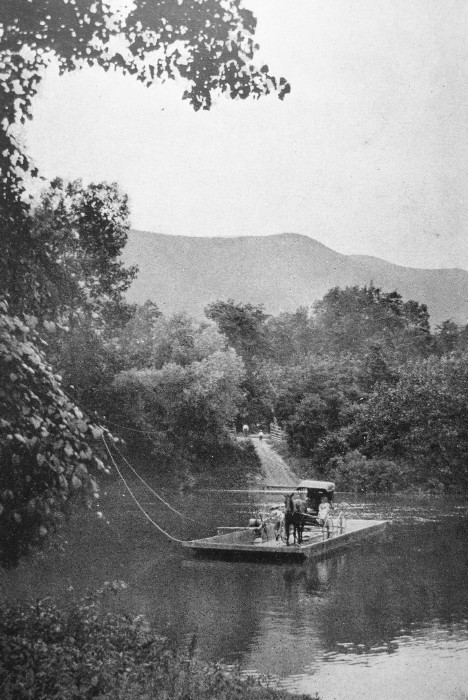 A ferry The region that environs
Luray is
decidedly attractive to a rambler, and I made several interesting
excursions
into the outlying districts. One day I came to a grist mill, which I
was
informed was “tolerable old,” but it had been built since the war to
replace
one that had been burned by Yankee raiders. It was primitive in itself
and in
its surroundings. A big outside overshot wheel furnished power, and
near by
was a ford where the creek in the hollow encountered the highway.
Vehicles and
equestrians went right through the stream at the ford, but
foot-travellers
crossed on a slender bridge high up above the water with steps giving
access
to it from either side. In the shade of some trees at the door of the
mill
several teams were hitched, and there I came across a burly farmer
lounging on
his wagon seat, waiting for his grist. We were soon discussing the
characteristics of the countryside, and he said: “I reckon harvesting
will be
in full blast in about two weeks. Thar’s a heap of wheat raised in this
country
hyar. Some of these fellers will raise thirty-five acres or more, but
others
raise as low down as half an acre. A man with just a little patch will
cut it
with a cradle, but most use a binder. “Round hyar now the crops
are just
as fine as a man would want to look at, but last summer we had an awful
drought. Usually we raise a little bit of corn to sell, but not any was
shipped
away last year. It was the poorest corn year I ever remember — indeed,
it was.
Some of our best farmers had to buy corn. “The people through this
section are
right smartly mixed up, but they used to be all German and Dutch.
You’ll find
those who can talk Dutch even yet. There’s a good many poor people with
only an
acre or two of land. They have to work out for a living. But thar ain’t
any
great difference between the comforts enjoyed by the man who hires and
the man
who is hired. They eat ‘bout the same food and wear ‘bout the same sort
of
clothes. In some cases the hired man don’t work so hard as the feller
he’s
workin’ for does gettin’ him to do things. Some hands takes interest in
their
work and do as much alone as when the farmer is with ‘em. Others try to
beat
all they can. They fool around and want the sun to go down as soon as
possible.
On the farms near town they work on the ten hour system, but out in the
country
it’s from sunup to sundown, and in busy times they work as long as they
can see.
The farmer boards his hands, and pays ‘em fifty cents a day as a
general thing,
but during haymaking, harvest, and thrashing you have to pay a dollar a
day. “I’ve got two men
a-workin’ for me.
They live half a mile away and come for breakfast about sunup. I get up
at
daylight. That’s half after four now. If I want to make an early start
I get up
at four; and even in winter I’m hardly ever up later than five. But
every
farmer works accordin’ to his own notion, to suit himself, and some
are mo’
rushing than others. They can keep body and soul together if they work
hard.
Yes, thar’s opportunity to make dollars now whar thar was to make cents
when I
was a boy. It’s a man’s own fault if he suffers. Mostly the farmers are
a
pretty industrious people, always a-goin’. But thar’s exceptions. Some
are
almost too lazy to move. “The first thing in the
morning the
men go to the field and bring the horses in, give ‘em a little grain,
curry
‘em, and gear ‘em up, and we give the hogs some corn and slop, and
perhaps we
grease a wagon. We do that while the women folks get breakfast. When
we’ve
eaten, we put the bridles on the horses and go to work, but we don’t
work hard
and steady all the day. The horses get tired, and we stop every couple
of hours
or so to blow ‘em — that is, we let ‘em stand and rest; or perhaps
we’ll stop
on our own account and go and get some water to drink. But under the
ten hour
system the workers keep movin’ along and ain’t supposed to sit down to
rest at
all. “I unhook at half after
eleven, and
if thar’s a right smart distance to go it may be half after one when I
get
back. ‘Bout the time the sun is goin’ behind the mountain I quit, take
the
horses home, and turn ‘em into the field, but in winter they stay in
the barn
and I give ‘em hay and bed ‘em. “After supper a man will
go to the
sto’ if thar’s a sto’ anywhere near. I loaf at the one near my place a
good
bit. We talk about the weather and about our wheat and grass and corn,
and if
thar’s any gossip in the country we talk about that. Sometimes we talk
a little
politics. I advocate the men I think the most of, and others advocate
the men
they think the most of, but politics ain’t run right high for ten or
twelve
years. “Sometimes we take a day off and go on an excursion, or a circus may come through hyar, and we go to that. A good many of the boys shoots marbles or plays ball, and on Sunday, these late years, the majority of the youngsters goes courtin’. They start in courtin’ at an earlier age than they used to. Nearly every young feller has a buggy that he’ll be sportin’ around in every pleasant Sunday. He’ll drive to church if thar’s preaching somewhar not too far away, and after the service he’ll take a little ride with his girl. In the evening the youngsters will gather in one of the homes to talk and laugh and carry on. When the gathering breaks up a feller that has a girl is likely to sit up with her till midnight, and if the case is very serious he’ll be mighty apt to stay longer. 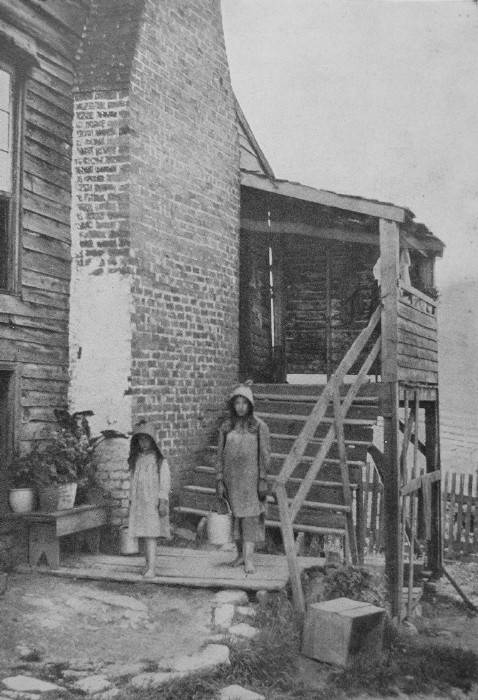 The great chimney “We have plenty of
different
churches. Thar’s New School Baptist, and Old School, and Methodists,
and
Dunkards, and the Campbellites who call themselves Christians or
Disciples, and
the Seventh Day Adventists, and the Faith Healers who are right strong
in
places. A man ought to be able to choose something to suit him among
them all.
Thar’s very few infidels but now and then you’ll strike a man who talks
that-a‑way.
He’s as likely to go to church as the rest of us, though I s’pose it’s
out of
curiosity and to get something to argue about. In our country churches
we
generally have preaching once a month. Each preacher has several
churches in
his charge and takes ‘em in turn. Most of us goes quite regular, and on
Monday
when a couple of fellers get together you’ll hear one of ‘em say,
‘Well, what’d
you think of the sermon yesterday?’ and perhaps the other’ll say he
don’t
believe that way, and they’ll have considerable of a discussion.” Just then the miller came
to the
door and announced that the grist of my farm friend was ready. So the
farmer
loaded his wagon and drove away, and I returned to the town. As I was
loitering through one of its outlying streets I stopped to speak with a
young
man who was sitting on the shady side of his house in the narrow front
yard. I
commented on the pleasant farming country I had been seeing. “Yes,” he
responded,
“the farmers are prosperous and they live good. They raise their own
fowls, and
if they feel like havin’ one they know where to get it. They grow their
own
fruit, and they’re sure to have a good bunch of cows, so they always
can have
nice milk and butter and cottage cheese, and the like of that. I was
raised on
a farm, and it kind o’ goes tough to live in town. But we’re not so
badly off
as we might be. D’you see those big earthenware jars hangin’ in the sun
on the
fence pickets? Those are preserve jars, and we’re gettin’ ready to fill
‘em,
and they’re hangin’ out there so if there’s any germ about ‘em the hot
sun’ll
kill it. You take the people in this country, they don’t buy
preserves. No,
they get the stuff out and put it up themselves. They don’t think they
live if
they don’t put up their own fruit. In our family there’s just me and my
wife
and two children, but we put down twenty-five jars like those. We
generally
make eight or ten gallons of apple butter; and we mus’ have at least a
couple
of each of all kinds of berries. The season is just on now, and we’ll
soon be
putting down our strawberries and cherries and currants. “When we make apple
butter all the
neighbors come in to help us peel the apples. They make a frolic of it,
and are
here through the afternoon and on into the night till ten o’clock. We
do the
peeling and coring with a machine, and finish by hand. It takes quite a
number
of bushels; and we plan to make enough of the apple butter so we can
send
messes around to the folks who came in and helped. That’s like when
people
butcher in the country — they do it at different times, and send meat
to each
other. In that way they have fresh meat all the fall.” The next day I made an
excursion
that took me through the negro quarter of the town, and among its
various
phases of picturesqueness I recall a sign extending across the
sidewalk which
read GEN. ULYSSES SIMPSON
GRANT FRY
RESTAURANT Another local sign which I found quite fascinating was this: CONCREATE
BLOCKS FOR SALE ALKIND I went on over the hills
and down to
where the limpid Shenandoah flows through the depths of the vale. The
region
had become increasingly wild, and the houses few and far between. The
final
dwelling on the road to the river was a big, neglected old mansion that
was
little more than a gaunt timber skeleton. Most of the roof was gone,
and the
building was plainly a rotten wreck not worth repairing. Yet a colored
family
that included numerous children lived in it. A man I met on the highway
said in
explanation: “Last spring we had a right hard wind hyar that taken off
part of
the house, and dog-goned if I don’t believe that the darky who’s
rentin’ the
place would rather get wet than work a little mendin’ the roof.” The meandering road at
last brought
me to a ferry, and on the opposite side of the river was a rude,
flat-bottomed
scow, but there was no sign of a ferryman. While I was considering the
possibility of getting across a buggy arrived from the direction I had
come,
and a man got out and remarked: “When the boat is on that side a skift
is
generally left on this side so a man who wants to cross with a team can
go over
and get it. The ferry is free, but you have to manage gettin’ back and
forth
yourself. Sometimes the water floods the bottoms and we can’t cross at
all. One
feller, who wa’n’t as keerful as he ought to ‘a’ been, tried it when
the water
was a little too high, and the rope broke — the rope that goes from the
boat to
the cable that you see up thar in the air swung across the stream. He
drifted
down mighty near half a mile befo’ he got to shore. It skeered him
some. I live
right over thar not far from the landing. I’ll see if I can make any of
the
folks hear me.” He called again and again
with a
clear, high-voiced whoop, and by and by there was an answering call,
and a boy
came down to the boat and poled it over to us. On the other side were a
few
farms scattered along the base of a mountain range that rose in a steep
and
lofty wooded height close behind, and there were log houses, and the
conflict
with the wilderness seemed still not ended. There is something
peculiarly
delightful about a region where the over-refinements of civilization
have not
penetrated. Closeness to nature and simplicity and the necessity of
rough
living appeal to one’s own primitive humanity. I found the people very
generously sociable, and on the most slender acquaintance they would
show me
freely about their premises and urge me to partake of such fruits as
were ripe.
On my way back a friendly
farm
family who were just sitting down to supper invited me to share the
meal with
them. The man ushered me into the dusky rag-carpeted sitting-room where
we
waited while the women got ready a few extras for their guest. Fried
eggs and
pork were the mainstay of the meal, but they set forth a most
impressive array
of jellies and preserves, and cut an extraordinary cake, six stories
high, in
alternate layers of pink and white. The heartiness and warmth of their
hospitality won my affection, and my visit with them will always remain
one of
my pleasantest memories of the charming Shenandoah Valley. NOTES. — The Shenandoah
Valley is a
part of the so called Valley of Virginia which stretches between the
Blue Ridge
and the Allegheny Mountains southward from the Potomac for about 300
miles. It
has much natural beauty, and the added interest of the campaigns of
Jackson,
Sheridan, and other leaders here in the Civil War. The Caverns of Luray
furnish the
greatest attraction in the valley to tourists, and are justly ranked
among the
most wonderful natural phenomena of America. They are unequalled for
their
profuse decorations of stalactites and stalagmites. Five miles to the
east is
Strong Man, one of the highest summits of the Blue Ridge. A trip to its
top
makes a pleasant one-day horseback excursion, and the fine view from
its top is
an ample reward. The scenery of the valley
as one
travels south is increasingly picturesque, and 100 miles from Luray in
this
direction is the famous Natural Bridge. From Hagarstown,
Maryland, to
Staunton, Virginia, at the head of the Shenandoah Valley, 134 miles,
there is a
stone road all the way. But 19 tollgates occur in this distance, and a
toll of
15 cents is collected at each. Winchester, 42 miles from Hagarstown,
changed
hands 70 times during the Civil War. Four of the changes took place in
a single
day. Sheridan’s ride was from Winchester south along the Valley Pike to
Cedar
Creek. Luray is 14 miles east of the main route. Go to it from
Newmarket. The
road passes over Massanutton Mountain, and is difficult in wet weather.
|
 Click the book image to turn
to the next Chapter.
Click the book image to turn
to the next Chapter.