 Web
and Book design,
Web
and Book design, Copyright, Kellscraft Studio 1999-2006 (Return to Web Text-ures) |
Click
Here to return to From St. Lawrence to Virginia Content Page Return to the Previous Chapter |
 (HOME) |
|
XII
MARYLAND DAYS I WAS in that part of
Maryland which
Whittier describes in his “Barbara Frietchie” — a region of “meadows
rich with
corn,” of “green-walled hills,” and of orchards “fair as the garden of
the
Lord.” Nevertheless, when I rambled out from one of the larger places
into this
bounteous farm region, I felt no especial disposition to linger, but
went on
and on until I came to where the billowing fields of wheat and corn
began to
merge into woodland, with a sturdy mountain ridge rising in the near
distance.
Here was a quaint, scattered, old-fashioned village, Smoketown by name,
and I
fell in love with it at first sight. Many of the houses were of logs,
and
certain of the rickety sheds and barns were thatched with rye straw.
The public
buildings included two plain, spireless churches, a schoolhouse, and a
store. I had loitered along
through the
village to its farther borders when a dash of rain made me hasten to
seek
shelter in an adjacent log house. A sunbonnetted woman welcomed me into
the
kitchen and gave me a chair which I took care to place near the open
door, for
the odors of the apartment were rather dubious. There was one other
room on the
ground floor, and some sort of a low, cramped sleeping-place over head.
Out in
the yard were two small children. The increasing rain had put a stop to
their
play and made them want to come in, but they regarded me as an ogre in
their
path and stood looking from a safe distance. Nor would they come in
when their
mother ordered them to do so, and she had to go out and fetch them one
at a
time. The storm soon became
quite fierce,
rain fell in torrents, and there was an ominous gloom brightened
momentarily
by flashes of lightening, and the thunder boomed and muttered, while
through it
all the numerous flies in the kitchen buzzed monotonously. The
furnishings of
the room were meagre and the walls unpapered. A board partition
separated it
from the next room. There were three carpet-rag rugs on the floor. “I
hooked
them when I was at home before I was married,” said the woman, by which
she did
not mean that she had stolen them, but referred to the process of
making. On the walls hung a
lantern, a
broken mirror, an advertising calendar, and two patent medicine
almanacs. The
older child climbed on the table and got the almanacs, whereat the
younger
protested vehemently that one was his. “Now you get down there,”
the mother
ordered, and she restored quiet by seating herself in a rocking-chair,
taking
in her lap the baby, as she called the smaller urchin, and giving him
his
almanac. “Solly can’t have your
book,” she
said. I could look out of the
door and see
a long line of crocks turned bottom upward on the garden palings, and I
made
some comment on them that elicited the information that the family kept
their
“spreadin’s and such things in ‘em.” “And what are
spreadin’s?” I
inquired. She glanced toward me,
surprised at
my ignorance, and said: “Why! them are apple butter and peach butter
and
jellies and preserves. Yes, sir, we spread ‘em on our bread, but we use
cow’s
butter, too, usually. Some of ‘em we put in glasses, but if you want to
make
right smart, glasses cost too much. The crocks hold a gallon. Do you
make
apple-butter where you live? No? What do you do with your specked
apples then? “We raise lots of
peaches. My! we
had an awful crop last year and cleared eleven hundred dollars, but we
had to
give half of that to the man who owns the land. Fruit and berries are
the main
crops here on the mountain. You’ll find very little wheat, and we only
grow
enough corn to fatten our hogs in the fall. Our peach trees got quite a
setback
last winter. It was so everlastingly cold the bark was bursted off of
‘em, and
a good many was killed dead. “Land is sellin’ terrible
dear
around here. The man who lives jus’ down the road from us asks three
thousand
dollars for that place of hisn, and he’ll get what he asks one of these
times,
too. Somebody will come along and buy it. There’s forty acres, but it’s
growed
up bad to briars and bushes, and the buyer’ll have to clear off a mess
of rocks
and blast out stumps or plough around ‘em. The house is a little old
log house
like this one, and the stable is ready to fall down any time — ‘tain’t
no good.
“Mrs. Cromer sold her
place the
other day. She’s a widow woman. Her man died long ago. There was only a
small
house, and not more than an acre of land, and you could n’t farm all of
that it
was so wet, and yet she got nine hundred dollars. A man who cuts
tombstones
bought it. He said rents were so high in the town he could live cheaper
out
here, and, besides, his children would have a chance to earn something
pickin’
berries. “When the black
raspberries are
ripenin’ fastest we pick fifteen or twenty crates every other day, and
they
raise lots of ‘em on the mountain farms all along. We have to board our
hired
pickers, and some keep ‘em over night yet. Often we get men from the
railroad.
They could earn two and a half and three dollars a day harvesting
wheat, but
they’d sooner pick berries. We have to pay the pickers a cent and a
half a
basket and furnish their dinner. It’s kind o’ hard farmin’ when help is
so
dear. You can’t get hands any more at less’n a dollar a day. Most men
would
sooner work in a shop. I have to get three breakfasts when we have
hired help.
The regular time for breakfast is five o’clock, but we are all done
with ourn
and ready to go to the field before the hands come for them. After they
finish
I have to get breakfast for the children. We have dinner at half-past
eleven,
and supper at half-past four. It’s very seldom that the big ones eat
again
until the next morning, but the children gen’rally have something just
before
they go to bed. “The men you hire are always ready to quit at sundown, but a man that’s workin’ for himself has to put in a good deal longer day than that, specially if he’s going to market. There’s three market days each week, and we start at midnight, or by one or two o’clock. You see we got eight miles to pull. The load has to be made ready, and a man don’t get much sleep the night before a market day — only an hour or hour and a half. It’s a lonesome road, though of course lots of wagons travel it on the way to market, and may be five or six will string along together. At one place on the pike a good many people have been robbed. It’s in between two hills where there are no houses. One time a cousin of mine — Charlie, his name is — was going to market, and he was asleep on his wagon. It was Monday night, and on the night before he’d been to see a girl; so he had n’t had much sleep for quite a while. His horse stopped, and he woke up, and there was a man standin’ right at the horse’s head. Charlie said it looked like the man had gray hair and a gray beard. The horse Charlie drove was blind, and if she was hit with the lines she’d jump, and away she’d go. It did scare Charlie like sixty, and he hit the horse with the lines, and off she went like a streak, and you betcher he got to town pretty quick. 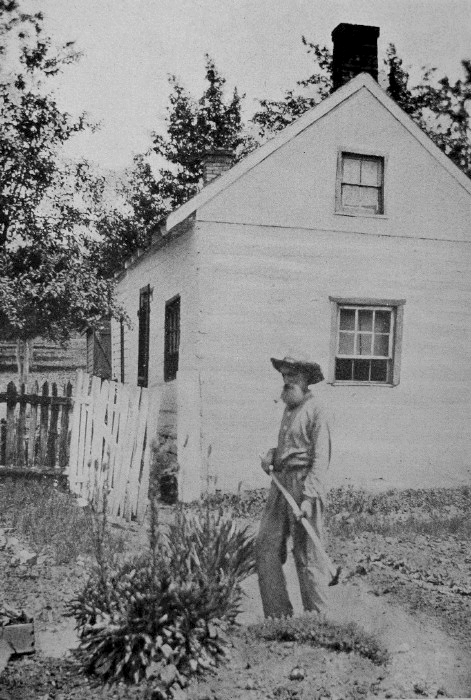 In the garden “The earlier you hit the
market the
better it is for you. Seems like the rich people and all try to get
down on the
market as early as they can to have first choice from the produce
before it’s
been picked over, and lots of farmers are sold out by seven o’clock.
The buyers
are there as soon as it gets good daylight. Everything is fixed so the
market
is the best place to buy the nicest produce. Wholesale men dassen’t
come to buy
there., It’s against the law; and the farmers are not allowed to go and
peddle
the town from house to house until after ten. “An inspector is there
every market
day, and your butter can’t be under weight — not a wee bit — or he
takes it. “I never was on the
market but seven
or eight times. I don’t like it. I don’t like the way people does you.
Often
sales are slow, and you have to stand a long time, and you feel sleepy
and
cranky from losin’ so much of your rest the night before. It may be
that one
day you’ll get a good price and people will buy straight along, and the
next
day the price is perhaps most awful low. I’ve sold berries for five
cents a
quart, a’ready. The customers want to make out they’re poor and ain’t
got money
to pay what you ask. They tell you some other person has got the same
stuff
cheaper or nicer. Very few will pay your price until they go up and
down the
market a couple of times. They’ll stand there five minutes and jew you
and root
all through your produce, and even then won’t take anything, but will
turn up
their snoot and go along. “Sometimes they want you
to trust
‘em, but by Jiminy! if you do they tell one another, and they all want
to be
trusted. The trouble is you don’t get your money for so long. We
trusted a couple
last year — a storekeeper and a woman — and we’ve run after ‘em and run
after
‘em. We did get a dollar out of the woman, but she still owes another
dollar.
The storekeeper died in the spring and his business broke up. We tried
to
collect from his widow, but she said she did n’t pay his debts. “You can sell most
anything at the
market — don’t matter what it is. We make potato chips and these hyar
what you
call crullers to sell, and we bake bread to take, and we sell
buttermilk.
Saturday is a great day for selling flowers. We carry garden flowers,
and we
pick wild-flowers and make bouquets. When the arbutus is in blossom we
can sell
it at five cents a bunch as fast as we can hand it out. “One man here makes a
business of
getting things out of the woods, and he’s at the market with ‘em every
Saturday. He don’t raise none of the stuff, but gathers it all up wild.
His
name is Bud Lester. He lives in what used to be a schoolhouse, but he
has
divided it off so there’s three rooms in it now. People along the
mountain
don’t care much what sort of a house they live in just so they keep dry
and
warm. Bud has got ten children and they’re pretty near all small, but
he
dresses ‘em real nice for that many. Oh, he makes a good living. He’ll
dig the
horse radish that grows wild in the little meadows and grates it and
puts it up
in baking powder tumblers. Sassafras is another thing he gets. He digs
that
there in the woods. Even freezing weather and snow on the ground don’t
stop
him. He digs it anyhow. Late in the year he makes laurel wreaths, and
cuts
small cedars for Christmas. I’ve seen him sellin’ mistletoe, but I
don’t know
just edzactly where he gets it at. I saw him come down with a bagful of
fern
last week. It don’t take a very large bunch for five cents. He digs ‘em
up root
and all so people can plant ‘em in their yards, and for the biggest and
nicest
bunches he gets forty or fifty cents. He sells bouquets of black-eyed
Susan,
and wild carrot, and dogwood, and such flowers. All winter he picks
watercress
that grows on the spring branches. There’s plenty of it now, but it’s
gone to
seed and has too many snails and bugs on it. He can’t get much from the
woods
right in the dead summer time, and he has to hire out some then. You’ll
find
him doing odd jobs around till after corn-cutting and husking are done.
But
he’s a man that wants to make money without workin’, and often he’s
goin’
through the mountains huntin’ gold when he might be earnin’ good
wages.” By this time the storm
had passed
on, and the sun began to glimmer through the breaking clouds. I called
the
woman’s attention to the jubilant singing of the birds. “Them birds are in our
cherry
trees,” was her comment. “That’s the reason they are singin’ so. Up
the hill
we’ve got some of these hyar white cherries, and they’re nice. There’s
a whole
lot of meat, and only a little bit of a seed. But the birds take nearly
all of
‘em. Are you thinkin’ of startin’ now?” she asked, as I rose to go.
“Well, the
shower is over, but they say if you get a storm in the morning you’ll
get one
in the afternoon. That pretty near always comes true, too.” The outdoor world was
thoroughly
water-soaked. However, a breeze soon shook the lingering drops from the
tree
foliage, and a hot, bright sun dried off the grass and the ground, and
only in
the ruts and hollows of the road did there continue to be pools and
mud. I presently left
Smoketown and
betook myself to a byway that skirted the mountain. It was a narrow,
unfenced
road through a park-like forest of stately oak, hickory, and chestnut
trees.
After tramping several miles I suddenly emerged in a forlorn little
hamlet,
which, with its small log houses huddling close along the stony main
highways
and half-wild lanes, seemed a remnant of some former rude civilization.
Back of
the village loomed the highest part of the mountain, crowned by a
gloomy ledge
known as Black Rock. The hamlet itself was called Bagtown. One of the
men I met
told me how it got its name. “This has been an old settled place for
years,” he
said, “and every fellow who lived here in the early days, when he went
to
Beaver Crick, where the nearest store was, brought home some provisions
in a
bag. There was n’t nobody hardly kept horses, and they went back and
forth on
foot. A stranger happened to be here one time, and he see that all the
men
comin’ from Beaver Crick carried bags, and he said, ‘Well, this is
certainly
Bag-town;’ and it has gone by that name ever since. The next village
north on
this mountain road is Jugtown. There they used to come home carrying
jugs
instead of bags.” The afternoon was drawing
to a
close, and I returned to the lowlands and began to seek lodging for
the night.
My appeals at the farmhouses met with a cold response. The people were
wholly
unsympathetic and took not the slightest interest in my plight. They
would go
right on with their work and scarcely bestow a glance on me or offer
any help
in the way of suggestion. The truth of the matter was that, though
their
environment was seemingly secluded, and their homes primitively
rustic, the
people were rich. They had no fellow-feeling for a roving stranger. I was plodding on
discouraged by
continued rebuffs when I observed a young fellow, a little aside from
the
highway, watering a horse in a stream that flowed through an outlying
portion
of a barnyard. Once more I ventured a request for lodging, and this
time the
response held a ray of hope. They sometimes kept travellers, and
perhaps they
would keep me, but I would have to go up to the barn and ask “Pop.” I
went
through the straw-strewn yard to the barn and interviewed “Pop,” who in
turn
referred me to the women at the house, and they, after warning me that
“everything was all torn up” in house-cleaning operations, agreed that
I might
stay. The house was a massive
structure of
stone backed up against a steep hill, and its surroundings were quite
idyllic.
Several enormous, thick-foliaged willows shadowed it, and it had a
very
inviting aspect of cool comfort and repose. In front was a narrow,
grassy
yard, across which a roughly flagged path led through a gate to the
same stream
that a few rods farther on invaded a corner of the barnyard. At the
edge of the
stream, beyond the gate, was a platform, and a dam just below made a
pool which
served as a washing-place. Along the pool’s muddy borders were some
lively
colonies of polliwogs, or “mulligrubs” as they were called locally.
Close by
was a bench with soap and a basin on it, but the men and children
preferred to
resort to the platform and stoop and wash their hands and faces with a
copious
splashing of the water. The women used the bench, as a rule, though
they often
did minor washing of garments right in the pool. For drinking water they
depended on
a wonderful spring that came forth from the earth at the foot of the
hill,
between the house and the barn, and flowed away a full-fledged crystal
brook.
The spring’s broad expanse was stoutly walled about, and two or three
steps led
down to it. On the verge of the brook was the springhouse in which the
milk,
cream, and butter were kept in stone or metal receptacles standing
right in the
cool water. In this vicinity, too, was the washhouse with its ponderous
chimney
at one end and an open fireplace inside. After the heat and stress of
the day
it was delightful to sit on the porch of this pleasant old mansion and
hear the
murmur of the stream, and the clear call of a Bob White off across a
neighboring pasture field, and the domestic sounds indoors and out, and
to
watch the bevies of twittering swallows darting hither and thither
above the
trees and roofs, and the fowls and dogs and cats with which the place
was populous,
and the workers coming and going about their tasks. The family consisted of a
man and
his wife, their son and daughter-in-law, and two small boys and a baby.
By and
by the farmer came to the house and brought out a United Brethren
religious
weekly for me to read, but its pages looked so glum and serious that I
did
little more than glance it through. Now and then I had a chance to chat
with
the women as they were getting supper. “It’s nothing but cook
and eat, cook
and eat,” the older woman said with a sigh. “There’s lots of work on a
big
place like this, and it keeps a body hustling around. We’ve got a good
bit over
two hundred acres, and we harvest nice big crops of corn and hay and
wheat. Oh
my! we’re goin’ to have a fine crop of wheat this year if nothin’
happens to
it. This farm dates back an awful ways. The house was built when there
was only
woods here. It’s very well situated to be comfortable no matter what
the
weather is. Last winter was won’erful cold — colder than was ever known
by any
of our old people; but we were protected by this hill on the north side
of the
house. In summer the water and the willow trees help to keep us cool. I
have a
heap of company then. Saturday week we’re goin’ to have a little setout
here
for our Sunday-school. Well, supper’s ready.” After considerable effort she got the members of the family together, and we ate. Then the women took their pails and went to the barnyard to milk, and I soon followed them and looked on from outside of the high rail fence. The two small boys lingered at the gate. The lesser one was a little toad of a fellow who was always tumbling down, and he was tired and sleepy so that he often had a spell of squalling, and his mother had to give him her attention to comfort him. The youngsters wore shoes, but no stockings. Overalls, shirt, and a straw hat turned up behind made up the rest of their costume. Presently the larger boy took off his shoes and amused himself by throwing them around till one of them went down the hill into the stream, whence I rescued it. 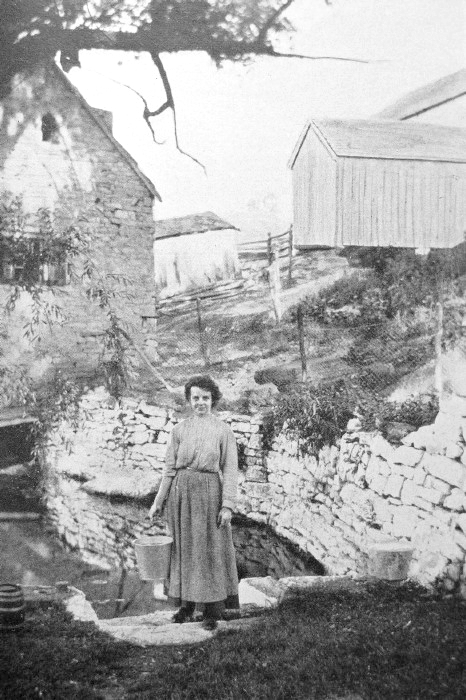 Coming from the spring The sun had set, and the
dusk was
thickening into night. Two turkeys flew up with a great flutter to
roost in one
of the trees. Several of the neighbor’s boys were wandering about in
the
pasture meadow opposite the house. “They’re lookin’ for their
goslings,” the
shoeless boy said, “but I reckon the goslings have gone up the crick.” There were five cows
chewing their
cud in a corner of the barnyard near a dilapidated but still sizable
straw
heap. The older woman stood and leaned against the cow she was milking.
The
younger sat on her heels. They put their pails on the ground. “Very few men around here
does any
milking,” the former said. “Lots of ‘em don’t know how. Just after we
were
married we spent a year in Illinois and hired out on a farm. The men
there
thought it was a terrible thing for a woman to milk, but I said to ‘em,
‘I
don’t want any milk that you fellers milk.’ I did n’t like the way they
slopped
and sloshed around; and they’d curry the horses and go to milking
without ever
washing their hands. There were no boys in my father’s family, and we
girls
did the housework and helped Paw, too. I could drive a six horse team.
I wa’n’t
the sort to lay around not doin’ anythin’, but, my goodness! them
Illinois
women looked lazy to me. The farmer we worked for was an old bach, and
he said
to my man, when we left him, ‘I’ll give you a horse and buggy and ten
dollars
if you’ll git me a wife like yours.’” This evening her man had
driven away
on some errand. Harry, the son, busied himself feeding the horses and
the
“shoats.” Alice, his wife, called to him that she had cut her finger
and wanted
him to take her place, but he did not. She only milked one cow, and
that an
“easy” one. Her energetic mother-in-law milked the other four and then
hurried
down to the springhouse, where six cats were awaiting her coming. They
purred
ingratiatingly, and she “slopped off” some of the warm frothy milk from
the top
of one of the brimming pails into a dish for them. The pails were soon
emptied
into the proper receptacles, and she swashed them in the brook and hung
them on
some pegs to dry. That done, she went to the house and tidied herself
up. “I’m
goin’ over to our church at Smoketown practisin’ tonight,” she said.
“We’re
gettin’ ready for a special service next Sunday.” Three young people had
come in from
the neighbors, and one of them, a young woman with a music book under
her arm,
went with the farmer’s wife to the practisin’. The others were a neat
young
girl and a barefooted boy in overalls. Alice showed them the baby.
“He’s got
Harry’s frown and my complection,” she said; “and just look at how big
his feet
are — ten cent shoes won’t do for him a great while. I’ve just got the
two boys
off to bed. I tell you what, I’m kept busy now. Clarence ain’t much
more than a
baby, and it’s about all one person wants to do to look after him.
Perhaps you
think he can’t travel fast, but he’s out of sight in no time. Yesterday
he and
David were at the spring suckin’ water through straws, and he fell in
head over
heels. The water was just up to his neck.” “Who does the milking at
your house
now, Grace?” Harry inquired. “I milk three cows,”
Grace replied,
“and Maw milks three and Tommy here milks one. Wes’ used to help, but
he’s got
above milkin’ since he put on long pants and joined the church. You
know he got
religion lately at the big meetin’ at the Beaver Crick Disciples
Church. We all
went every evenin’ and I’d go to bed so tired they’d have to call me
‘bout a
dozen times before I’d get up in the mornin’.” “What is a big meeting?”
I asked. In response Alice said:
“It’s a
revival meeting — that’s the right pronounciation of it. ‘Twas only
last Sunday
night that it broke up. They’d been havin’ it for two weeks.” “There was fifteen
converts, I
think,” observed Tommy. “Naw, sir, more than
fifteen,” Harry
declared, and he named them one by one and counted them up on his
fingers. “I’m goin’ up home to
stay a while
soon,” Alice remarked. “They want me to help pick berries.” “Her father’s a trucker
and lives on
the mountain,” Harry explained to me. “He says he don’t know
where he’s
goin’ to get pickers at,” Alice continued, “but there’s a good many
just in our
family, and it’s our way to all take hold and help. Even my brother
Ned’s
little girl helps. She was only three last year, but she would pick
right along
with her mother, two boxes in the forenoon and two in the afternoon.
That was
her idea of what she ought to do, and as soon as the two boxes were
full she’d
quit. I picked one hundred and
forty-three
quarts of black raspberries one day. Ned picked the other side of my
row, and
he carried out all my berries with his’n, or I would n’t have picked so
many. I
commenced that morning ‘bout five o’clock and kept at it on into the
evening
till I could n’t see to pick a bush clean. It threw Ned back carryin’
out the
boxes or he’d have picked more than I did. He can beat me all to
pieces. He’s
got a sleight of hand at it, but, as papa says, his berries don’t look
as nice
as mine. In his hurry he grabs off red ones, and he don’t fill up his
boxes
like mine. “Papa ain’t one who makes
you work
too hard. You don’t have to get back to pickin’ tireckly after dinner,
but can
rest half or three-quarters of an hour while the men are takin’ the
berries
into the smokehouse. But of course we don’t stop if it looks like a
gust was
comin’ on. After supper some of us have to wash the dishes and take
care of the
peepies and milk the cows, and only a few go out picking. “Last year papa’s
raspberries were
like good big marbles. I’d rather pick ‘em than strawberries. You don’t
have to
stoop so much and don’t get so wet in the dew. We don’t have many
strawberries
on this place, and today we bought some. I’m kind o’ sorry we did. We
got ‘em
of a Bagtown man, and every time he says a word he spits. I’m afraid
the
berries are not clean.” Harry had taken up a
local paper and
was reading it. Alice asked him for the middle sheet. “They always tell
about
the weddings and parties on the inside,” she said, “and that’s what I
like to
read about.” But Harry was loth to
part with that
interesting portion of the paper, and his wife induced him to
surrender it by
snapping him playfully with a toy whip of the children’s. Soon afterward I retired,
and then
the young people gathered about the family organ and enjoyed
themselves
singing hymns. At half-past five the
next morning I
was aroused by a rap on my door and the announcement that breakfast was
ready.
The work day of the older members of the household had begun some time
before,
and, when I descended to the kitchen the women were carrying the food
for the
morning meal to the dining room. In the latter apartment I could hear
the
farmer reading in a mumbling monotone. Once he came out to the kitchen
bringing
a Sunday-school lesson paper in his hand and pointed out to Alice some
religious statement that seemed to settle to his satisfaction a point
on which
they had differed. Then he went back and resumed his mumbling. I
washed my hands and face at the
pool in the crick, and wiped on a towel in the kitchen. When I
finished, Harry
said to me, “We’re goin’ to have
pra’rs;” and the several members of the family
who were scattered about the two rooms kneeled while the head of the
house
prayed long and fervently. As soon as breakfast had
been eaten
the men went off to the barn, and Mrs. Farmer remarked to me that she
did n’t
get home from the practicin’ till after eleven. “They was all talkin’
about you
there,” she said. “The way you looked around and talked with ‘em made
some of
‘em think you was takin’ a census of the world, and others thought you
was
workin’ for agriculture.” I expressed surprise that
she was
able to start the day’s tasks at the usual early hour after being out
so late.
“Well,” she said, “ if you’ve got a big lot to do like I have you must
go at it
whether you want to or not. I’ve sat up many a time sewing till twelve
and one
to have clothes for the children. We need an extra helper in the house,
but
hired girls are pretty dear. You have to pay ‘em two dollars a week,
and you
can’t hire a woman by the day for less’n fifty cents.” She took up a pail and
went out to
fill it at the spring. I was looking in that direction from an open
window when
she observed a cat prowling in the chicken yard. “Scat cat!” she cried.
“If I
ketch you ketchin’ the peepies ‘twill be the worse for you;” and she
heaved
several stones at the creature, which scampered off in a panic. A few moments later she
came in with
the pail of water. “Daddy’s goin’ to plough the preacher’s truck patch
this
mornin’,” she said. “That truck patch is where the preacher of our
United
Brethren church grows his potatoes, and Lima beans, and the like o’
that. He
takes good care of it, but don’t work in it every day. Some days he works out at
carpentering. The United Brethren have two churches at Smoketown. One
is
radicals and one is liberals. All the difference in ‘em is that the
liberals
allow their members to belong to lodges, and the radicals don’t. The
radicals
contend that to belong to these here lodges and secret societies draws
away a
person’s attention from religious things, and their support from the
church. I
was only a girl when they had their split on that subject. The church
pretty near
went under. Oh, they had bitter feeling at first, but now they’re about
ready
to make up.” When I left the old stone
house
where I had been so hospitably entertained I continued for some time my
wanderings in the vicinity, for the region seemed to me particularly
delightful. The highways were very narrow and were flanked by gray
fences of
post and rails or quarterboards, with sudden transitions to whitewashed
palings
in front of home premises. Life here was evidently quaint and quiet,
like a
leaf out of the past. It was a nook uninvaded by modern conditions — an
eddy in
the current of national progress undisturbed by the hurrying tides of
business.
Year after year the land produced great crops to feed mankind, and the
money
returns were generous. The people worked persistently, and their days
of labor
were long, yet they did not lack incidental breathing spells, and had
the
pleasures of prosperity, of interest in the neighbors, and of religious
recreation and contemplation. At one of the old wayside
homes the
farmer showed me about the place. Among other things he called my
attention to
a great ash tree and said: “Ain’t he a bird? — ain’t he a dandy? How
fur do you
guess those branches spread? I think seventy feet anyhow. Yah, you bet!
You see
this grindstone? I fixed those cog wheels myself to make it go fast.
But the
stone is most worn away. I’m goin’ to get a new stone and then I’ll cut
the
buck (do rapid work). There’s a lot of goslings yust goin’ into the
crick.
Them’s ourn. That hen hatched ‘em out. Hear her cackle. Now she flies
over the
stream. She has a big time with ‘em all right. They don’t give her any
peace,
and she’s runnin’ around a-cluckin’ all day long. She’s afraid now
they’re
goin’ to drown, I reckon. “Look into this holler
tree, and you’ll
see an old goose settin’ in there. She found the place herself and
drove out
some tame rabbits that had been living in there with their young ones. “My wife’s been makin’ butter this mornin’ — her ‘n’ our oldest girl. Hyar’s the churn in front of the springhouse. Yust step through the springhouse door. The water comes in at that little hole no bigger than your thumb, in the corner. Yah, and you may think I’m lyin’ to you, but it always flows yust the same, no matter how dry or how wet the weather is. Last year eighteen pounds of butter that we had in hyar was stolen. A huckster had engaged to take it, but he was beat out. When he came there wa’n’t none for him. I keep everything locked now. Ha, ha! There’s a clique of fellers up along the mountain who would help themselves a little too often, if I did n’t. A short time ago one of the neighbors was goin’ to have company for Sunday, and he shut up some chickens intendin’ to eat a chicken dinner with his visitors. But Saturday night the chickens were stolen. We think we know the thief. He’s got a wife and children, and they live good and dress good, and yet they don’t work none at all. This feller goes in town every market day and he comes out with a whole big basket full of stuff. I been talkin’ to the sheriff about this hyar feller. ‘You folks in town,’ says I, ‘have got loads and loads of police. Yust watch the roads on market days and see what that feller brings to market.’ 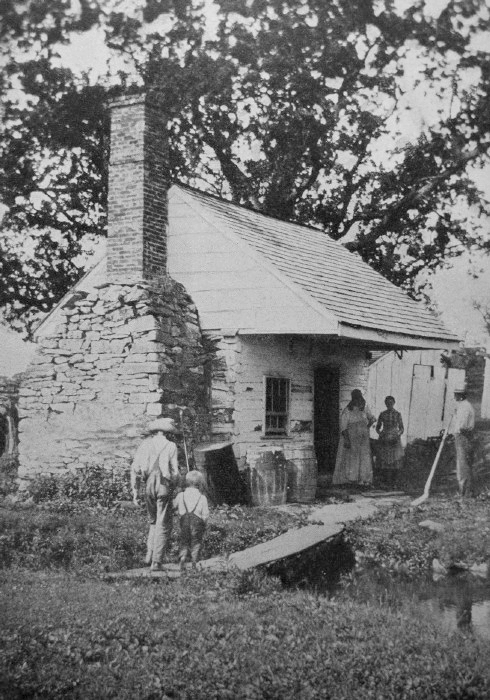 The wash-house “But the sheriff would
n’t do
anything, and I’m goin’ to see what I can do myself. If I ketch him
stealin’ on
this place I’ll fix him all right. I’ve got the guns, and I’ve got the
ammunition. Come in the house, and I’ll show ‘em to you. I’ve spoken
about my
intentions to the preacher, and he wants me to use a shotgun and only
yust
burn the feller a little. But that would make him mad, and like enough
he’d
come and burn my buildings. No, I ain’t goin’ to shoot to scare. I’m
goin’ to
shoot to kill, and he’ll never trouble us any more. A man that steals
is too ornery
to live. “There’s no need of
stealing in
these days. Every industrious man around hyar does well, and this is an
awful
rich settlement. The man I rented this place from seven years ago was
worth
nearly a hundred thousand dollars. I’d been living in another town, but
I came
to see him when I heard that the place was for rent. “‘Ach!’ he says, for he
always
grunted every time he started to speak, ‘I don’t know nuttin’ about
you. What
sort of a reputation have you got?’ “‘People talk about me
yust like
they do about you,’ I said. Some’ll tell you I’m a blame rascal, and
others
that I’m all right.’ “‘Ach!’ he says, ‘how
many children
have you got?’ “‘Six,’ I says. “‘Ach! that’s too many,’
he says. “‘How many have you got?’
I asked
him. “‘Ach! two,’ he says. “‘You’re luckier’n I am,’
I says.
‘But what’ll I do with mine — kill ‘em?’ “‘Ach! well,’ he says, ‘I
think
you’re a pretty good feller,’ and he rented me the farm. “But for all he was so
rich he was
greatly worried for fear he was goin’ to get poor and have to work for
somebody, and at last he committed suicide. He was one of the nicest
men I ever
knowed. The landlord I had before I came here was rich, too, but he was
grabbin’ and scrapin’ after every cent, I tell yer, and he was always
gettin’
into a splutter, with his mouth runnin’ like a bell clapper. He thought
it was
yust throwin’ away money when some of his relatives made a trip to
California. “But what’s the use of
bein’ so
chinchy? Men come along asking for food or lodging — and they may be
tramps or
beggars, but whatever they are, we never turn ‘em away. If a man is too
dirty
to sleep in the house we let him take a blanket or something like that
and
sleep in the barn. It’s curious, but some of those fellers with no
place to lay
their heads except what the Lord gives ‘em seem perfectly contented;
and after
all, what does it amount to, if you have this whole world and ain’t
happy?” This man’s attitude
toward the
stranger and the unfortunate was akin to that of the family with which
I had lodged.
I suppose it was a matter of religion with them. They belonged to the
sect of
United Brethren or Dunkards. The latter word is derived from a German
word
meaning to “dip,” and the Dunkards were originally German Baptists.
They are
particularly numerous in Maryland and the several states adjacent. They
accept
the Bible with extreme literalness and try to follow the example of
Christ with
technical faithfulness. Their garments are very plain, yet are not so
peculiar
as to attract marked notice except in the case of the women, who, when
they don
their best clothes, wear a queer little bonnet without any trimmings. One day I had a chance to
observe a
considerable number of Dunkards on a train. They were returning from an
annual
conference in a Pennsylvania town. I sat in the same seat with an
elderly
Dunkard who told me something of their beliefs. He acknowledged that
the trend
away from simplicity was irresistable, and said: “I don’t think the men
need to
have clothes just alike. If your heart is all right, you can put on a
good
suit, and it ain’t goin’ to hurt you. But you can’t go too far. You see
the
women’s bonnets — they can have ‘em any color and different in shape,
if only
the bonnets are modest and small. About the next thing they’ll be after
will be
flowers and ribbons on the bonnets. We’d feel obliged to take a woman
to task
if she was to put on one of the big hats that are fashionable now. As a
preacher said at the conference, ‘A woman with her heart full of Jesus
Christ
would n’t run around with a dishpan on her head.’ “I don’t believe a man
who chews
tobacco ought to be a delegate to the conference. The church don’t
approve of
tobacco, or whiskey, or neckties, and we think dancing and all such
stuff is
wrong. I used to drink whiskey, but I knowed it was n’t right, and I
just made
up my mind to give it up. How can you jump on a man for wearing a
necktie if he
can pick on you for chewing tobacco or drinking whiskey? “Parents are supposed to
instruct
their young ones, and train ‘em, and keep ‘em under if they can, but
what the
older one are used to don’t always content the young ones. Some want an
organ
in the church, and we’re fightin’ that. Our churches are plain and
substantial,
with no spire, and I never see one that had a bell on it. “Every three months we
have a
council at which we’re supposed to tell on one another if we know any
have done
things that ain’t proper. A person who’s shown not to have done right
has to
promise to do better, or out he goes. “If one of the brethren
lends money
to another he don’t charge interest, but he expects to be paid back at
the time
agreed on. Perhaps the debtor don’t do that. Then the other can tell
some of
the deacons, and they talk with the man, and if he still won’t pay they
throw
him out. After than he can be sued. “We have a love feast
every fall,
and you’ve got to be pure, or you don’t feel like steppin’ up there and
takin’
the loaf. If I’m mad at you, and you’re mad at me we have to make up.
But in
other denominations people can be so mad they won’t speak to each other
and yet
will go through all the church ceremonies just the same.” Some other details that I
gathered
from an outsider may be of interest in this connection. “I like to go
to their
fall meeting,” he said. “It’s worth while just for the singing. When
all those
Dunkards cut loose singing I’d as soon hear ‘em as a crack band. “They go through the
Lord’s Supper
just as it’s described in the Bible. A mutton has been killed and a big
kittle
of soup made, or perhaps a piece of beef has been boiled because some
don’t
like mutton. They sit down on benches along either side of tables in
the
church, and each person has a bowl of the broth. You ought to see those
old
fellows go down into it. You can hear their lips sippin’ all over the
church, and
they take bites of bread big as my fist. After they finish eating they
wash
each other’s feet. The men have their tub, and the women have theirs. A
man
will sit down and put his feet in the water, and another man with a
towel
fastened around his waist washes and wipes the brother’s feet.
Afterwards they
kiss — yes, kiss right square in the mug and distribute their germs. It
makes a
sound about like slapping two shingles together. They kiss and smollok
too on
Sunday when they meet at church. Seems kind o’ queer, don’t it? That
reminds me
of old man Broil. He always took the contrary side in an argument. He’d
argue
with the preacher till he had him wound up so tight it was like havin’
him down
with Broil’s thumb on his mouth. Well, Broil said it would be a pity to
have
everybody believe alike. ‘Why,’ said he, ‘if they did that, all the
other men
would want my wife and there’d be a dickens of a time.’” MARYLAND NOTES. — A
number of good
pikes radiate from Hagarstown and make sightseeing easy for the
motorist, and
railroads and trolley lines are available to visit many interesting
places in
the region. The rude mountain settlements are only a few miles away.
Twenty-six
miles from Hagarstown, on the route to Washington, is Frederick, the
scene of
Barbara Frietchie’s exploit with the flag and Stonewall Jackson.
Frederick,
too, is of interest as the burial place of Francis Scott Key, author of
“The
Star Spangled Banner.” The great battle of
Antietam was
fought 12 miles south of Hagarstown, and the battlefield of Gettysburg
is 28
miles north. Two places in the eastern part of the state that are
particularly
worthy of a visit are Baltimore, the “City of Monuments,” and
Annapolis, the
capital. The former is one of the chief Atlantic seaports. Before the
days of
railroad transportation it was the principal center for the trade with
the
West. Goods and produce were carried across the mountains in huge
broad-wheeled
wagons, usually covered, and especially adapted for travelling in soft
soil. On the road to
Washington, 10 miles
from Baltimore, is the town of Relay, so named because here horses were
changed
that drew the coaches on the first railroad built in America. The cars
were
shanty-like structures, 12 feet long, with 3 windows on each side, and
a table
in the middle. The first American
telegraph line
was built from Baltimore to Washington, 42 miles, in 1844. In 1904 a conflagration
swept over
an area of 150 acres and destroyed property to the value of
$70,000,000. On Monument Street are
the buildings
of Johns Hopkins University, founded in 1876 by a bequest of $3,500,000
from a
Baltimore merchant, whose name the institution bears. Among the former
residents of the
city was Francis Scott Key who wrote “The Star Spangled Banner” while a
prisoner on board one of the British men-of-war which were bombarding
Fort McHenry
at the entrance to Baltimore harbor in 1814. Edgar Allen Poe, another
poet
associated with Baltimore, wrote “The Raven,” one of his most notable
poems,
while living here, and his tomb is in the graveyard of the Westminster
Presbyterian Church. Quaint old Annapolis is
27 miles
south of Baltimore. Its chief industry is oyster packing. In the
grounds of St.
John’s College here is the famous “Tree of Liberty,” with a girth of 30
feet
and an estimated age of 700 years. Under it a treaty is said to have
been made
with the Indians by the early settlers. The town is best known as the
seat of
the United States Naval Academy, founded in 1845, the buildings of
which are
picturesquely located on the Severn River. |
 Click the book image to turn
to the next Chapter.
Click the book image to turn
to the next Chapter.