 Web
and Book design,
Web
and Book design, Copyright, Kellscraft Studio 1999-2006 (Return to Web Text-ures) |
Click
Here to return to From St. Lawrence to Virginia Content Page Return to the Previous Chapter |
 (HOME) |
|
X
A GLIMPSE OF DELAWARE THE landscape had been
freshened by
showers the previous day and now was smiling in the caresses of the
bright
sunshine. A brisk breeze wafted the grain in the big wheatfields into
long
green waves, and brought in at the open car windows the odor of
strawberries
and clover blossoms. The level farmlands looked fertile and
well-tilled, and
the farm homes had a pleasing aspect of prosperity and comfort. “Delaware farmers are
more
industrious than when I was a boy,” a train acquaintance remarked.
“These are
nice places we’re seein’, and kep’ up in good style. Corn and wheat
used to be
about all the farmer raised, but now they put their dependence more on
berries
and early produce. It’s a good place for a poor man to raise everything
he
wants to eat with very little exertion and have some to spare. “See those pine logs
lyin’ there by
that freight station. We would n’t use to ship such like stuff — we
would n’t
touch it. It’s bull pine, and that’s nothin’ more than a tree weed, and
is
tough and warps around so you can’t hardly manage it. But if you want
to put up
a barn or a shed it does for a makeshift. “They’re
gettin’ to have very good roads. I can remember when
travellin’ on ‘em was a hardship. They were all
standin’ water in the winter
time. Farm work used to be done by cattle power, and if a man wanted to
go to a
place that was farther away than he could walk he stayed at home. Many
a man
had no horse at all and lived and died without ever owning one. Log
houses were
common till after the war, and the people were land poor. The principal
part of
the young men went to sea, but by and by they came home tired of that
and
bought land. That air cut the farms up, and they’ve learned
to make the land
profitable so that I bet you now two-thirds of the farmers have bank
accounts.
You ask ‘em how they’re gettin’ on and
they’ll say, ‘Oh, we’re
a-livin’, but we
ain’t a makin’ much.’ “Then you ask if they’ve
got a bank
account, and they’ll acknowledge they have. All the towns have banks
these
days, and they take in money hand over fist. New York and Philadelphia
always
used to be afraid to trust any man livin’ in the state of Delaware for
a five
cent piece, but I guess they’re changin’ their minds now. It looks that
way to
me.” I went as far as Lewes at
the mouth
of Delaware Bay. It was here that the first settlers of the state from
across
the Atlantic established themselves. The place has never grown rapidly
and is
still half rustic, and abounds in delightful old mansions that are
humanized
by their association with past generations, and that nestle amid a
charming
luxuriance of greenery and blossoms. The dwellings on the
seaward borders
of the town stand on ground that drops abruptly away to a wide level of
salt
marshes, and the homes on “the bank” are commonly spoken of
collectively as
“Pilot-town,” because so many pilots live there. The situation is
peculiarly
satisfactory to them, for they like to live where they can “spy out on
the
water.” At the far edge of the marshes are sand dunes, one of which
rises in a
vast yellow ridge that is slowly enveloping a pine wood. “Sand is always in
motion,” a local
man observed to me. “ It’s as unstable as water. You sit down to eat a
lunch
off there on the shore, and you may think there’s not any wind at all,
but
you’ll find that sand gets into your bread and butter just the same.
I’ve known
of a long row of bath-houses that in a single winter were nearly all
buried out
of sight by the drifting sand.” One day I followed a
roadway across
the marshes to the shore of the bay. Vessels were coming and going on
the misty
gray waters and, northward, twelve miles away, was Cape May, a low blue
streak
in the dim distance. I went along the beach toward the ocean. At one
spot were
a few fishermen’s shacks on the dunes, and farther on was a factory
that made a
business of extracting fish oil from “porgies.” During the season a
fleet is
kept on the sea catching the fish, and thousands of barrels are filled
with
oil each week. I thought the vicinity was odorous to the limit of
endurance,
though it was affirmed that the season’s work had not yet begun, and
that I
only smelled the ghosts of last year’s oil-extracting. “Besides,” this
informant said, “they say the smell is healthy, and you get used to it
and
don’t notice it after a while. But it went pretty hard with the town
folks when
the factory was first built. The smell blows right over there when the
wind is
to the east’ard. One lady said she had to get up in the night to
perfume
herself.” At length I crossed a
sandy point
where the bones of many a staunch ship lay imbedded, and had before me
the
restless billows of the open ocean, and could hear a bell buoy tolling
its
somber, warning notes. Where sand and water met was a recent wreck with
most of
its masts still standing. But the hull was badly broken, and the waves
were
roaring and dashing about it like ravenous beasts. For a considerable
distance
I continued to stroll along the shore, just out of reach of the slither
of foam
that each breaking wave sent far up the incline of the beach. When I
presently
turned my footsteps toward the town I decided to make a short cut
across the
marshes. But as soon as I left the dunes and was down on the low ground
I
stirred up a horde of mosquitoes in the coarse, thin grass. They
settled on my
clothing and clung there, and made such savage assaults on my face and
hands
with their poisoned lances that I shifted my course to the sandhills
where
these pests were comparatively few. It was supper-time when I reached
my hotel,
and most of the guests, and the proprietor and his family, had sat down
to eat.
As I took my place the landlord remarked to a lady at a table adjacent
to his,
“It’s blustering this evening.” “Oh, yes,” she responded,
“the wind
comes up every evening and blows like the dickens. You know that, don’t
you?” “Well,” he said, “I don’t
know much
of anything, and half I do know ain’t so.” “Did you go to that dance
last
night?” she asked. “Yes,” he replied, “and my girl was the best lookin’ girl there. The only fault I had to find was that she would n’t stand straight. We all have our troubles. I hearn one feller complain that his girl could n’t dance without steppin’ on his feet. Then there was a girl from Wilmington that I tried to be pleasant to; but she was mad because she’d sat on a strawberry and spotted her dress. So she would n’t talk.” 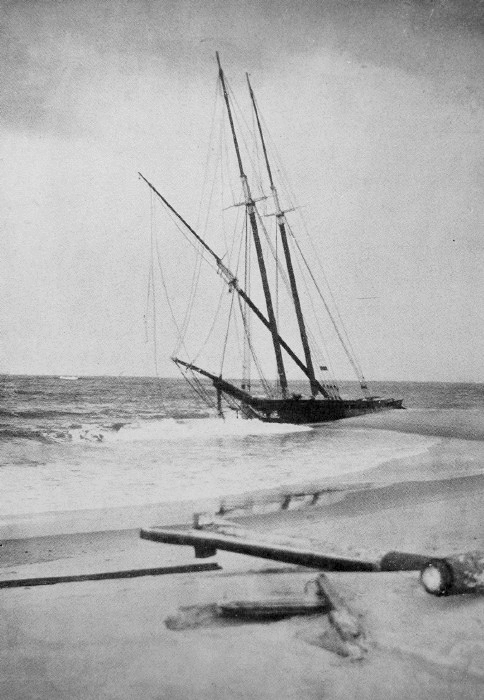 The wreck In the lingering twilight
that
evening I visited a negro cemetery. The graves clustered about a plain
little
church. A few of them had headstones or wooden markers, but evidently
there was
nothing to show the location of most of them when the mounds
disappeared. The
two most conspicuous headstones were flat slabs of cement, each with a
heart
incised near the top. The lettering had been roughly cut into the
cement before
it hardened. Here are the inscriptions:
That peculiar word in the
final line
of the Burton stone is probably meant for “quickening.” While I was looking at
these cement
works of art a negro laborer on his way home from the fields came
through the
cemetery, stopped, and said: “A colored boy described those out and
made them
himself. He was only about fifteen, but he did a right good job.” Along the path that led
from the
street to the church were many seemingly new-made graves. I fancied an
epidemic
had been sweeping off the negro dwellers of the town, but the colored
worker
said: “Oh, no, sir, the graves have been renewed and freshened up for
Decoration Day. They look neater to keep the grass off, but we only
trouble to
do these along the walk. That’s the oldest part of the cemetery over
there next
to the dividation line. Often when we are digging a grave there we find
skull
bones and leg bones and arm bones. Of co’se we naturally did n’t know
any one
was buried at the spot we’d picked out. Ginerally we put the bones back
right
where they were and dig in another place. “A good many have died
this past
year. For one thing we’ve had a fearful winter — the worst in
thirty-five
years. It’s the coldest we ever experienced — I don’t except none. You
just bet
you had to keep as near the stove as you could without gettin’ burnt. I
hearn
sev’ral talkin’ of a man who suffered with cold feet. It seemed he
could n’t
get ‘em warm nohow, and finally he pulled off his shoes and slapped his
feet up
on the stove. That way he got ‘em a little warmer than he wanted to,
and they
held so much heat that afterward he could n’t get ‘em cool. “You mought think that
lots o’ the
houses you see was so poorly built or in such bad repair they would n’t
be much
protection, but it’s my idea that most houses are too tight to be
healthy. I
know a white gen’leman who lives in an old house that’s never been
fixed up in
years. If he goes to bed at night and there comes a snow, he feels the
flakes
droppin’ down on his face from the leaky roof; and in the mornin’ he
jumps
right out of bed into a snowbank. He has six or eight children, and he
says to
me, ‘They never have had a day’s sickness. But I confess,’ says he,
‘that many
a time I would n’t have cared if the house had been a little tighter.’ “The crops are lookin’
very
prosperous this season, ain’t they? Last year we had n’t broke up any
ground at
this time it was so dry. You could n’t get a plough point into the clay
land.
But at last, some way or ‘nother, most men managed to get a little seed
planted. The wheat was n’t putt in early enough though for it to git a
holt,
and the dry weather just killed it dead. Our corn was so parched up we
did n’t
have none noway, and the strawberries dried and cooked right on the
vines, and
wa’n’t anything. We did n’t have no luck with our potatoes either.
Gosh! the
for’ard potatoes was nothin’, and the late crop was a failery, too. We
was cut
short on everything. Oh, the farmers was torn all to pieces last year.”
Another negro who
furnished me
enlightenment of a picturesque sort was a gray, elderly man whom I
accosted the
next day as he was hoeing a little patch of potatoes beside his house. “Potatoes are not up
where I live,”
I said. “Where do you come from?
he inquired.
“From Massachusetts,” I
replied. “Good land!” he
exclaimed, “you’re a
long way from home, I reckon. Is Massachusetts in the north part of the
climate
or the south part?” “The north,” I said. “How long does it take to
come from
there to here?” was his next question. When
I had satisfied him on that
point he remarked that he did not usually hoe his garden except in the
evening.
“I’m hired out to work durin’ the
day,” he said, “but this mornin’ I been
helpin’ my wife to wash some. She’s kind
o’ been paralyzed. “See, there’s some potato-bug eggs on that leaf. About a thousand bugs would hatch out of them eggs, so I’ll just pinch ‘em with my fingers. Along about the last o’ March the bugs are flyin’ all over this country. If there’s easterly weather at that time vessels meet great rafts of ‘em on the water, and you find ‘em heaped up on the beach. That shows they come from some foreign place where it don’t freeze. But a good many of ‘em stay in the ground here all winter. I’ve dug ‘em out in February, and they were as much alive as ever they are. You plant your potatoes, and the bugs come right up with ‘em ready to begin eatin’. Most people fight ‘em with poison, but I don’t keer to do that. I think some of the poison might get in the potatoes. So I go to work and ketch the bugs and pull their heads off. Then I know they’re done. If I pick ‘em in a bucket and undertake to mash ‘em with my foot I’m satisfied that some of ‘em live. They’re pretty tough. I wonder that they don’t try to get away by flyin’. They’ve got wings. But they act like a possum — soon as you touch ‘em they drop and act as if they was dead — ha-ha-ha-ha! They’re jus’ tryin’ to fool you. Everything has to have its little smart ways. I keep pickin’ ‘em off, and ‘bout the time I think I’m cle’r of ‘em the eggs are comin’ on to hatch. I don’t know what them bugs ever originated from, but I’ve always kind o’ thought in my own mind it was from guano. We never had no such thing before the guano and stuff began to be brought across the ocean here.  Setting the net “There was a different
kind o’ bugs
on the potatoes when I was a boy a-comin’ up, and I’m somewhere about
sixty-five years old now. Those bugs were slim most like a big ant, and
they
had shell wings that were black with a little white streak. There were
lots of
‘em, but you could drive ‘em off with a switch. You can’t drive these
bugs.
There’s no drive in ‘em. “Things change, don’t
they? Even the
weather ain’t what it used to be. Every year the season gets a month
later it
‘pears. If we’d ketch a good open spell in the old times we’d get all
our
ploughin’ done in March. But sometimes we’d have snows and blowin’ and
freezin’
chuck down to the last of the month. Many a time I’ve been ploughin’
and had to
knock off on account of a storm. I’d leave the plough, and the snow
would kiver
it up. But we used to be through thinnin’ our corn by the last of May,
and we’d
commence to lay by the crop right after the Fourth of July — quit work
into
it, you understand. Before the end of September the harvest would be
all in,
and winter begun and we’d have little scuds of snow. Now winter don’t
start so
soon, but you got to look out for hard weather later in the spring, and
you can
sleep with all the covers on till June. Take it weather, bugs, and all,
the
farmin’ man ain’t got but a very little left when he’s
paid his help and his fertilize bill. He has
to sell off all he’s raised, and that
leaves him down with nothin’.” This colored man could
hardly be
vouched for as a competent authority on agriculture, and I quote with
more
confidence a town farmer with whom I later became acquainted. “Land
sells
higher and higher all the time,” he said. “Well, sir, the farmers are
wakin’
up, and we get more out of an acre raisin’ vegetables and small fruits
than we
used to get out of a half dozen acres of corn; and I’ll tell you
another thing,
Mister, that is drivin’ the price of land way up — people with capital
are not
foolin’ with coal and oil stocks as they did once, but if a man has a
few
thousand dollars, he says, ‘I’ll loan it out here on farm property
where I know
what I’ve got.’ Farmin’ has become profitable because the cities have
grown so
enormously. They look to us to supply ‘em with food. We could n’t do it
by the
old methods. In my early days we cut all our wheat with a cradle, and
it was
pretty near a day’s work to cut an acre. Now we go in with a reaper and
cut
twenty acres in a day. Then we cut all the hay with scythes, and raked
it up by
hand. Riding-machines are common on the farms now, and the work is far
less
laborious. Fifty years ago oxen were the farmers’ usual draught
animals, but
now they’re too slow and have nearly disappeared. “Most of us are
descendants of the
old-time inhabitants and have been around these diggings all our
lives. There’s
very few furriners, but we have a good many negroes, and they’re a very
prosperous people. They’ve got schools, and they’ve got churches, and
where a
colored man ten years ago could n’t pick up a dollar he can now pick up
five. “When I was a boy this
town had
about a thousand inhabitants, and there was only two free schools in
the place,
and those two did n’t amount to a great deal. We had ‘Select Schools’
that were
better, but if you went to them you had to pay tuition every quarter.
I’d
venture to say that the little clapboarded free school buildings did
n’t cost
over three hundred dollars apiece. The seats had no backs, and they
were too
high for the small children. So the little ones would sit with their
feet
dangling and kicking. Oh, mercy! we did n’t have much comfort in them
times. We
were expected to be on hand to start the school day at eight in the
morning and
were n’t turned loose till five in the evening. “School commenced in the
fall in
September and went on about six months. Out in the country they’d have
only a
three months’ winter school with possibly another month in the summer
if they
could raise the money to pay the teacher. People had to have their
children to
work. Wood for the schoolhouse stove was furnished by the families that
sent
children. It’s pretty skearce around here now, but ‘t was plenty then,
and each
family give a load. We had men teachers who were paid twenty-five to
thirty
dollars a month. They were men who followed teaching for a business,
and often
were well advanced in years. They did n’t teach much but ‘rethmetic and
history
and grammar and writing, and the books was few and poor; and yet if I
only knew
all there was in them books I’d be satisfied. “Most of the teachers
were pretty
severe. Generally they taught for what there was in it, and as a
natural
consequence they were cross. If a boy did n’t behave the teacher would
take him
by the hand and rule him. I used to be punished that way or switched
pretty
often, and I needed more punishing than I got, but I did n’t think so
then.
Some boys were always in trouble and they’d get terrible whippings.
There was
no inducement to study — nothin’ to interest them, and they were much
inclined
to play truant. They’d sneak around and go fishing, even if they knew
they’d be
corrected for it. ‘Tain’t so now. The boys want to go to school, they
have so
much fun there. But, as the feller says, ‘You can never tell much about
a boy.’
One of the most ornery boys that ever lived in this town is now captain
of a
big ship that makes voyages out to Chiny.” On another day, in my
quest for
information, I spoke with a woman who was feeding some chickens that
were in a
coop near the street fence. She was proud of her chickens, but was
still more
proud of the garden back of the house, which she presently invited me
to visit,
so she could show me all the varied growing things that crowded its
narrow
limits. Her remarks ran on something in this wise:  The pump at the back door “See that little cherry
tree. She’s
loaded full and she bears every year. Next beyond is a dwarf apple
tree, and
that never fails to have fruit on it either, though we’re too bleak
here for
apples to do first-rate. Most of what we raise we use in our own
family, but
I’m always sellin’ a little somethin’ or ‘nother. Last spring I sold
enough
kale and mustard greens from the garden to buy a barrel of flour. I
scatter the
seed around in the fall, and it keeps coming up all the time. I’ll give
you
some and you can sow it in your garden. “We’ve got a nice soil to
work in
hereabouts. You can’t hardly find a stone large enough to throw and
scare the
birds away in this part of Delaware. My husband does the heavy garden
work.
That’s him hoeing over by that grapevine. Here ‘s a bunch of ribbon
grass, and
it’s a curious thing that you can’t find two blades striped alike.
That’s a
mystery, ain’t it? And yet it’s the same with people. As many as there
are in
the world no two look exactly like each other. “Next to the ribbon grass
is an
old-time lily. It used to belong to my great aunt, who died when she
was in her
eighties. The root is good for a salve, and people come to me from way
back of
Georgetown for it. “I’m a great hand for
herbs. I guess
I inherit my liking for ‘em from my mother. She was a regular herb
doctor, and
they would send for her from far and near. “I work in the garden
just about all
the time in pleasant weather, even if I neglect things that ought to be
done in
the house. For thirteen years I had dispepsia and was troubled with
heart
trembling. My stomach was always cold and I was so weak I could n’t
walk across
the floor without holding on to a chair or table. I nearly wore out our
carriage going out riding. Somebody had to help me in, and I would sit
with a
pillow at my back, and yet I could n’t bear to have the horse trot. It
would
shake the wind all out of me. One night I dreamed I saw our doctor just
as
plain as I see you now. He stood lookin’ at me, and I said, ‘Why ain’t
you
givin’ me some medicine?’ “‘Go out and feed your
chickens,’ he
says, and went away. “Next day I remembered my
dream, and
I said to myself: ‘That meant something. It meant for me to cure myself
by
outdoor exercise and air.’ “I begun at once, and now
I’m a well
woman. I’m gettin’ so stout I can’t wear hardly any of the clothes I’ve
got,
and I can eat most any food — except of course something like boiled
cabbage
late in the day. Nobody ought to eat that then. “I was raised on a farm,
and I think
I’m naturally active, but I don’t work the way my mother did. She was
very
industrious, and though the family was large I never knew her to have a
servant
in her life. There was n’t an idle minute about her. We’d make as much
as sixty
dollars some seasons knitting in the long evenings after the farm was
laid by.
We grew sheep, and mother handled the wool and spun it into yarn. While
I was
still very young I used to get my little straight-backed chair every
evening
and place myself right by her to pick wool. She learned me to knit my
own stockings
when I was eight years old.” The woman’s husband had
now joined
us, and he remarked: “Things were much like that in all the farm
families.
Where I lived the boys as well as the girls learned to knit and darn
their own
stockings. Everybody had homemade clothing that the women cut out and
sewed by
hand. The cloth for the men’s clothes was what was called fustian, and
for the
women’s clothes it was linsey-woolsey. I would get one suit a year
just before
Christmas, and it did n’t matter how it fitted if ‘twas so I could get
it on.
There was no such thing as a vest for young boys — just pants and a
jacket.
Neither did we have an undershirt or drawers. I never wore any till I
was grown
up, and I did n’t wear stockings except in winter. The boys in a family
that
lived right along side of us did n’t wear either shoes or stockings the
year
through. Their feet would turn purple in winter and sometimes crack
between the
toes and bleed, but they claimed they did n’t suffer from the cold any
more
than if they’d worn shoes. “Every fall the shoemaker
came to
our house to make us a pair of boots or shoes all around. I used to
have little
low shoes with just four eyelets in ‘em for lacing, and they were lined
with
red sheepskin. The soles were pegged. The shoemaker would punch holes
with his
awl and drive in two rows of pegs right around the edge. We never had a
box of
blacking, but we’d turn the stove lid over and rub on soot from it with
a
brush. That made our shoes black, or at least they was n’t white, you
know. I would
carry ‘em under my arm on the way to Sunday-school to save ‘em. Just
before I
got to the church I’d sit down in some pines that grew by the roadside
and put
the shoes on. I never wore ‘em in the spring longer than I could help.
The
country then was all in timber and more protected than now, and as
early as
March we’d strip off our shoes and go for the woods and crawl in the
hog beds
in the pine shats. It was nice, in a sunny place where the wind did n’t
hit. We
preferred to go barefoot even if we did have stone bruises and what
they call
cowitch.” “The way my father had me
wear my
shoes,” the wife said, “was to change them to the other foot each day
so as to
keep ‘em from getting’ lopsided. They were rights and lefts a little
bit, but
you would n’t hardly know it. “Fashions did n’t change
much, and
all of us, rich and poor, wore about the same kind of clothes. The
women wore
sunbunnets and aprons to church. I’ve did it. I used to think our
linsey-woolsey dresses were beautiful, but when I was seventeen I wore
mine to
church in town, and they made fun of it because it was sheep’s wool. So
I would
n’t wear linsey-woolsey again. “We used to walk to
church in the
morning, but it was too much to walk again in the evening, and we’d put
the
oxen to the cart and ride, and perhaps take along some of the
neighbors.” “I was a bound boy,” the
man
resumed, “but I was treated same as the man’s own children except that
I did
n’t get much schoolin’. I stayed at home and worked when the weather
was fit,
and at the time I went into the army I could n’t read or write. The man
I
worked for was kind o’ rich, for he not only had a pair of oxen but he
kept a
horse. Oh, laws, yes! anybody that owned a horse was somebody. But most
of the
people around here was poor, and all they cared for was a little
something to
wear and to eat. Ther buildings were very common. Cattle sheds, for
instance,
were roofed with brush on which pine shats were thrown. The shats would
shed
rain if there was enough of ‘em, but they’d rot in two or three years,
and then
we had to take the oxen and haul more. The sheep and cattle in them
days stayed
outdoors mostly, and after a heavy snow we’d have to dig ‘em out from
where
they’d crowded up to the hayrack or some other slight shelter.” “At our place,” the wife
remarked,
“we used to thresh our wheat in the cattle pound, or barnyard as some
would say
now. We’d rake everything off as clean as we could and then lay the
wheat
bundles in a circle, heads in. Oxen that the men would drive were used
for
treading out the grain, or perhaps two or three horsebackers went
around on it.
I’ve rode one of the horses threshing wheat a many a time. In the
center stood
some of the men with turning-forks keeping the wheat bundles stirred
up. After
a while they’d take the stock all off and upend the bundles and turn
‘em right
over. Then there was more treading. It was no long job. We did n’t
raise much.
Why, my dear man, if we had ten bushels we thought we had a big crop.
There’s
more raised now on one farm than was grown then in the whole county.
Any bread
made of flour we called cake, but we had plenty of cornbread. There
were no
stoves then with us, and we placed the cornbread on a board and baked
it on
the hearth in front of the fire. “If my father went
visiting after church,
or most any time, the people he visited would probably send the
children a
little something to eat, and often, if he come home and did n’t say
nothing
about what he’d brought, we’d wait till he took his coat off and search
his
pockets. Sometimes he’d carry around a biscuit two or three days before
we got
hold of it. By then it was right dirty and black, and so hard we could
n’t
break it. But that made no difference. We’d take a hatchet, and chop it
up, and
it tasted good to us.” After I parted from these friends I wandered out into the farming region that lies back of the town. Its fertility was very evident, and its flourishing crops were a joy to behold. Often there were hedgerows between fields or along the roadsides. These were decidedly more pleasing to the eyes than fences, but a man whom I accosted as he sat on the edge of his piazza, and who whittled the piazza floor very industriously while we talked, said: “They ain’t puttin’ in no new hedges, and they’re tearin’ up the old. People are kickin’ against ‘em on account of the snow. We have a good bit of snow here some years, and the hedges ketch the drifts. I’ve walked from here clean in town on snow that blew in and filled the roadway up even with the tops of the hedges that were on both sides. We had to cut a road through for the teams same as a canal.  The Capitol “Another thing we got
against the
hedges is that they’re wasteful. Take that field yander — the wheat
next to the
hedge is mighty slim. It’s like havin’ a field long side of the woods —
the
hedge roots take all the substance and moisture out of the ground. You
lose
more or less on a strip ten or twelve feet wide.” But I found one advantage
in the
hedges — they protected the wild strawberries, and the berries were so
abundant
and delicious that I lingered picking and eating them a long time, and
was
tempted to continue in Delaware till the strawberry season was past. NOTES. — An automobile
route goes
down through Delaware from Wilmington to Cape Charles, a distance of
212 miles.
The roads are macadam and dirt. Wilmington, the largest city in the
state, has
extensive manufactories and considerable historic interest. About 13
miles to
the northwest Washington was defeated by the British in September,
1777, in the
Battle of the Brandywine. Dover, 47 miles south,
the capital
of the state, was founded in 1700 by William Penn. Between it and
Felton, 12
miles farther on, are immense apple orchards. Old Lewes and some of the
other
towns at the mouth of the Delaware have a good deal of attraction as
vacation
resorts. |
 Click the book image to turn
to the next Chapter.
Click the book image to turn
to the next Chapter.