 Web
and Book design,
Web
and Book design, Copyright, Kellscraft Studio 1999-2006 (Return to Web Text-ures) |
Click
Here to return to From St. Lawrence to Virginia Content Page Return to the Previous Chapter |
 (HOME) |
|
VIII
THE WATER GAP AND BEYOND I HAD seen pictures of
the Delaware
Water Gap, I had read of its beauty, yet I had wandered into many out
of the
way nooks and corners of our country from the Atlantic to the Pacific
before I
visited this easily accessible and famous Water Gap. It is almost due
west from
New York City on the Delaware River which forms the boundary line
between New
Jersey and Pennsylvania. Here the stream, before escaping from the
rough,
broken country to the north and entering the gentle pastoral region to
the
south, encounters a bold mountain ridge, and passes through a narrow
cleft,
where rise on either side great gray cliffs, raggedly clad with trees.
The
scene is impressive, and the jagged savageness of the Gap itself is
pleasantly
relieved by the milder and better forested heights that are close at
hand. Big
wooden hotels crown the prominent view points, and the vicinity is a
favorite
summer resort. I preferred to seek a more rustic region, and after I
had
enjoyed loitering about the immediate neighborhood of the Gap for a
time, I
followed a wagon road on the Jersey shore northward along the stream.
Soon I
had left the hotels behind, and also the railroads, which take
advantage of the
Gap to slip through the mountain barrier and then go on westward. Often
the
road I trod skirted the riverbank with only an intermittent screen of
trees
and bushes between it and the water, and I caught many an enchanting
glimpse of
the stream, and of high hills or serene mountain ranges dreaming in the
distance. Among the wayside trees
were
frequent chestnuts with wide-spreading limbs and shaggy-barked trunks,
and on
the ground was a strewing of burs. As I was passing under one of these
trees a
chipmunk began to scold me, and to scurry around through the brush as
if to
frighten me by conveying the impression that he was a dozen times his
actual
size. Then I observed that burs and nuts were dropping from aloft, and
I
fancied that the chipmunk on the ground had a confederate in the tree
who was
busy throwing down nuts for him to gather. I secured a share of the
toothsome
woodland treasures for myself, in spite of the protests of the chipmunk
in the
adjacent brush, and resumed my walk, munching the nuts at my leisure
from a
pocket half filled. When my supply became depleted I found I could
easily
replenish it almost anywhere along the way. The road presently entered
a fine
stretch of woodland, tall-treed and damp, with a thick undergrowth of
dark-foliaged rhododendrons. Frequent brooks came plashing down rocky
ravines
from the hills, and this wilderness voice of the waters was almost the
only
sound that broke the silence. Once I saw a group of deer hastening
ghostlike
through the leafage, and as soon as their flitting forms vanished
loneliness
reigned once more. After a time I emerged
among farm
fields, but always as I went on the woodland was not far away. Late in
the
afternoon I was overtaken by the mail-carrier, a thin, hook-nosed
ancient, with
long gray hair hanging about his stooping shoulders. He had an open
buggy drawn
by a big, bony, black horse, and as there was room for a passenger and
I was
getting footweary I arranged to ride with him to the next village. It
was a
somewhat jerky journey, for he stopped at every house to leave a little
mail
bag, which he either hung on the dooryard fence, or thrust into a box
fastened
on a post. Once he drove into a yard and asked a man there if he had
any lard
to sell. “Yes, we got a little,”
the man
said. “How much d’ye tax for
it?” the
mail-carrier questioned. “Oh, the goin’ price,
whatever
‘tis,” the farmer replied. They discussed the lard
and various
other topics, addressing each other by their first names, and I
learned that
my companion’s name was Isaiah. “I sell considerable produce during a
season,”
he said when we resumed our journey. “The hotels down around the Gap
are good
customers, and I always carry a load when I start from up here in the
country.
I’m ashamed to tell it, but since the first of April there hain’t been
a Sunday
when I did n’t have to put in my time getting sweet corn, eggs, and
such
things. But I’m obliged to make a living somehow.” I asked if the house we
had just
left was an old Dutch dwelling. It was a spreading structure of stone
shadowed
by tall trees. At the rear was a long and broad piazza, and at the
front was a
porch with a settee on either side suggestive of tranquil evening
loitering. “Yes, that’s a Dutch
house all
right,” Isaiah said, “and it was built way back in Colonial times.
We’re all
Dutch through here. “D’ye see that big field
of
buckwheat up on the hillside? The grain is all reaped and stacked and
ready for
the threshing machine. That field is a part of Hiram Robock’s farm, but
he’s
only been living on it for the last two or three years. Now he’s got
sick of
it, and a few days ago he moved back to Newark where he come from.
Well, it was
like this — he did n’t git along with his neighbors. He wa’n’t very
sociable,
and he thought they was too inquisitive about his business, and too
much
inclined to trespass. You see when a man here needs to use a stick of
timber he
goes up on the mountain, and if he don’t find it handy on his own land
he goes
somewheres else on land that lies next to his and gets what he wants.
We all do
that way, and nobody cares; but Hiram thought it was stealing, and he
made a
row. “His buckwheat had n’t
been cut when
he moved away, and his neighbors got quite anxious because it looked to
them as
if he was goin’ to let that buckwheat go to waste. They thought he must
be
crazy. They were right about his intentions. He wa’n’t goin’ to bother
with the
buckwheat, and I went to him and made a bargain to harvest it to
halves. We
raise a good deal of buckwheat around here, and all through the winter
we have
buckwheat cakes for breakfast every morning. Oh, we can beat the city
people
all to hollow on makin’ buckwheat cakes.” My companion talked with
considerable animation, and he often gestured with an upward, outward
throw of
his hands, and he emphasized the good points in his discourse by giving
me a
hunch with his shoulder. Presently, in response to a question of his, I
told
him that I was from Massachusetts. “Do you know Dr. Prout of
Boston?”
he at once asked. “He’s a specialist on stomick troubles, and he’s
helped me
wonderful. Until ‘bout six years ago I’d been a well man all my life.
I’d hired
out on a farm at that time and was workin’ in oats. I remember I was
talkin’
with the woman of the house after dinner, and she said: ‘I’ve never
knowed you
to lay down like other men to take a noon spell. Don’t you never get
tired?’ “There come up a shower
in the
afternoon, and I was goin’ to the house when suddently I begun belching
up gas.
‘What under the sun ails me?’ I says. I was fairly blind, and I went
and sot
down on the stoop. But I got worse instead of better and liked to ‘a’
choked to
death. One of the other men helped me into the house and went for the
doctor,
who relieved me some, so that the next day I was out and around. But I
was too
sick to work. I doctored with him all winter, and wa’n’t improvin’ a
bit. I had
nervous prostration, you know. It was just as if death was staring me
right in
the face. I can’t describe it to you. Dr. Prout’s advertisements was in
the
paper, and I decided to try him. I told the man I’d been doctorin’
with, of my
intentions, and he said, ‘I don’t think much of these advertising
doctors. They
just take your money and don’t cure you.’ “‘That’s a little the way
of the
local doctors, too,’ I says. ‘You pledged me your word of honor that
you was
goin’ to do suthin’ to cure me, and here I am.‘ “‘I told you that in good
faith,’ he
says, ‘but your trouble is more stubborner than I expected.’ “‘You was on a wild goose
chase all
the time,’ I says. “So I wrote to Dr. Prout
and told
him how I was afflicted. After that we had considerable
correspondence, and
his portrait was right on the corner of every letter he wrote. In his
first
letter he asked, ‘What does the local doctors pronounce your trouble to
be?’ “I replied that they said
I had a
weak stomick, and I described my feelin’s and symptoms. He wrote back
that he
had diagonized my case, and I had catarrh of the stomick, and that the
inside
of the stomick was covered with a thick mucus. ‘We must kill the germs
of
that;’ he said, ‘and I can guarantee you a permanent cure; but it will
perhaps
require a five month’s treatment, and the charge would be nine dollars
a
month.’ “I got the medicine from
him, and I
had n’t taken it no time at all when I began to be better, and at the
end of
five months I was well.” Now we were entering a
village. It
was a chaotic little place with what was known as “the mountain” rising
easterly, and a high hill on the west, and right through the midst of
the
hamlet ran a swift, noisy stream. The valley road was here crossed by
another,
and near the meeting of the ways was a store, a hotel, a gristmill, and
a
church. The store was neatly painted, and in good repair, and had a
mild aspect
of prosperity. In front of the hotel across the way hung a somewhat
pretentious
sign, but the building was now a tenement occupied by two families. It
had been
years since the wheels had turned in the gloomy gristmill, and the
barnlike
little church was pastorless and seldom used. In the village were
perhaps a
dozen homes. Most of them were distinctly humble, and often they were
forlornly
so. The yards and fields were inclosed by staggering nondescript
fences. Every
home had its ordorous hogpen, and this was very apt to be next to the
road
where the passer could neither avoid the view of its filth nor help
inhaling
some of its aroma. Along either side of the narrow village ways, among
the
weeds and stones, it seemed to be convenient to leave the farm wagons,
and
other weatherworn vehicles, some entirely past use; and for variety
there were
mingled with them woodpiles, old wheels, broken mowing-machines, and
similar
rubbish. With the help of a
ceremonious
introduction from Isaiah I engaged lodging at the storekeeper’s, and
then I
went for a ramble about the hamlet in the evening dusk. I found its
quaint
picturesqueness quite appealing. There was even a wellsweep at one of
the
homes still in use, and this harmonized very agreeably with the
sunbonneted
women and rudely clothed men. The storekeeper’s
dwelling and place
of business were both under one roof, and after eating supper in the
kitchen I
stepped into the adjacent store where a few dim lamps were burning. A
box stove
occupied the center of the apartment, and near it was a long bench. I
took possession
of a lone chair, and chatted with the men who dropped in from time to
time.
Most of them settled down on the bench to stay for the evening, and
when that
would hold no more they perched on the counters and on boxes of goods.
One man,
after feeling of the stove to make sure there was no fire in it, sat
down on
that. Some had resorted to the store to get their mail, some to trade,
others
merely to loaf and gossip. One of them was a stutterer who seemed to
try to
overcome his defect by speaking very loud. A dog had come tagging along
at the
heels of the man who sat on the stove, and when the creature saw that
his
master was going to linger he curled up and went to sleep. At a
convenient spot
on the floor was a pan with a little sawdust in it. Some of the men
were
smoking, some were chewing, but they all, whether using tobacco or not,
spit at
the pan. Their marksmanship was not very good. If it had been I fear
the pan
would have overflowed. A woman brought in a bag
of
chestnuts. The storekeeper weighed them and said, “Eleven pounds,
fifty-five
cents. What’ll you have?” She asked for some coffee
and a few
other small items, and remarked that the coffee she bought last did n’t
seem as
good as what she’d been getting. “It’s what I have on my
own table,”
the storekeeper responded, “and I don’t see any difference. Maybe you
used skim
milk in it.” He emptied the bag behind
a counter
on the floor. “I shall be glad when the chestnut season is over,” he
said, “and
I get these out of here. I’m tired of walkin’ over ‘em, and of having
the grubs
crawl around. I’m obliged to spread ‘em or they’d heat. There’s quite a
number
of bushels here now.” “This is a good year for
chestnuts,”
a man on the bench remarked. “It don’t take long to go out and fill one
of them
air big pails.” “How many can you pick up
in a day
if they’re right thick?” another asked. “A bushel,” the first man
replied. “Well, if you did,” the
other said,
“you’d have to hustle and pick up all the time.” “It don’t pay to wait
till all the
chestnuts fall themselves,” the storekeeper said, “because the leaves
come
down, too, and the nuts are hidden. As soon as the burs are open good
you want
to climb up in the branches with a pole and lick the burs off.” “I’d rather get out on
the limbs and
jar the burs off with an ax,” was the comment of a man whom the others
addressed as Jase. “No, don’t do that,” the
storekeeper
said, “or you’ll bruise the bark and injure the trees. But whipping a
tree and
keeping your foothold ain’t easy. It’s too risky a job for me. My neck
is so
long I believe I could tie a knot in it, and the chances would be that
I’d
break it if I made a slip. One time my brother was beating off burs,
and he
fell and cut his head open bad. He hit a stone, and no wonder. There’s
nothing
but stones round this country. You put your shoe down on one or more at
every
footstep.” “It’s likely pretty soon
that we
won’t get no more chestnuts,” Jase observed. “I think this ‘ere
chestnut tree
blight is goin’ to clean up all the trees of that sort on our
mountain.” A man came in eating a
raw turnip.
He wore a faded felt hat that had lost its ribbon and fitted over his
head like
an extinguisher. His other clothing, and even his beard and face had a
faded
hue also. “Set down here, Bill,”
one of the
men said, making room for him on the bench. “You ought not to be eatin’
raw
turnips. It’s only three weeks since you got out of the Trenton
Horspital.” “Turnips won’t hurt me
none,” Bill
responded. “I kin eat anything now; and I’m hungry all the time. They
kind o’
starve you at the horspital. For two days before they operate they
don’t feed
you at all, and your stomick gits flat as a board. You don’t have much
appetite
for a while afterward, but I tell you, when you begin to walk around,
you want
some grub. The food was good, but there wa’n’t enough of it. There’d be
a
little meat, and a little cabbage and potato, and little messes of
several
other things, and I could n’t hardly eat some of the stuff it was so
darn
sweet. Course they would n’t want to give you a swill pail full, but I
thought
they might have given me more than they did. Just as soon as the doctor
let me
out of the horspital I went over to a butcher’s shop and got me fifteen
cents’
worth of boiled ham. Gorry! that was fine. “I did n’t like the eggs
there at
the horspital. They’d been in cold storage. I kin tell a cold storage
egg with
my eyes shut. People that say they’re just as good as fresh eggs don’t
know
what they’re talkin’ about. Such eggs ain’t first-class, and neither is
creamery
butter.” “But creamery butter brings a better price than homemade,” the storekeeper said. “The public knows it’s at least half way decent, and they’re not sure about the other. I buy and sell butter that the farmers bring in here, and some of it is fierce. By gee! I’ve handled some rotten butter. You could n’t hire me to eat it myself.” 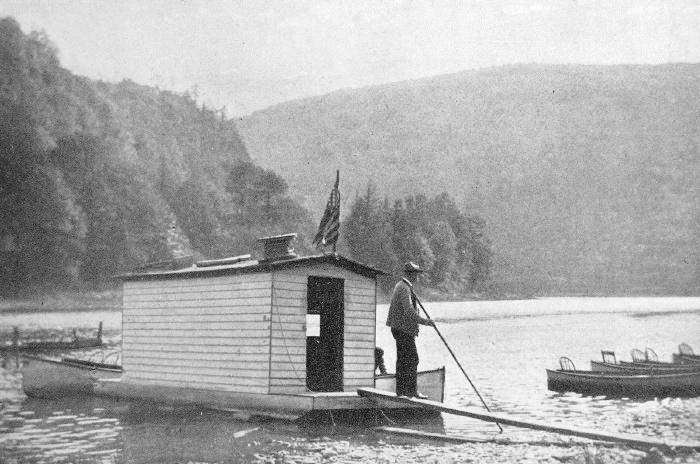 A boatman at the Gap “My
dad went to a horspital in New
York once,” the man on the stone said, “and they
kep’ delayin’ and delayin’ and
not havin’ any operation. Finally he asked the doctor if he
could go out for a
while, and the doctor told him he could if he’d promise to
come back. ‘Yes,’
Pap say, ‘I will come back.’ “But he did n’t want to
pay out no
more money for board at a horspital where they wa’n’t doin’ nothin’ for
him,
and so he got fixed up by an outside doctor, who did such a good job
that Pap
was around all right in a little while, and for years afterward he
could beat
any man in this country dancin’ a jig.” “It costs something to go
to a
horspital,” Bill affirmed. “If you have a private room they sock it to
you like
the Old Harry. Everything costs high nowadays. They told me in Trenton
that
the carpenters git three dollars and a half a day, and only work eight
hours,
and not at all on Saturday afternoon. That kind o’ thing is goin’ to
ruin this
country in time. “I was lookin’ out o’ the
window one
day there and saw an airship. You would n’t git me to ride in one of
‘em for a
million dollars. But I’d like to have an auto. They say autos’ll be
cheap as
wheelbarrows after a few years. You know bicycles used to be a luxury.
Now they
ain’t fashionable no more, but are kind o’ gone by. I have an idea
it’ll be the
same with autos, and common people kin have ‘em as well as the
wealthy.” At times I had difficulty
in
catching what Bill said, for he had a thick-tonged way of speaking, and
when he
had to struggle with a thought more than commonly profound he would
lean over
with his elbows on his knees and run his fingers up under his hat into
his
tangled hair, and his muffled voice would go down toward his cowhide
boots. I
made some remark to the effect that airships and automobiles both had a
long
list of fatal accidents charged up to them, and that I had been glad to
ride
into the village with the mail-carrier. “You ‘n’ me are a good
deal alike,”
Bill commented. “I’d rather go safe than fast any day.” “Did Isaiah sing you one
of his
songs?” the occupant of the stove asked. “He composes ‘em himself. He’s
got
just one tune, but he’s made up a good many sets of words, and he
thinks he’s
quite a singer.” “Isaiah has to make a
long hard trip
every day,” Bill said. “This is a mountainious country and it ain’t
easy to git
to any big town or to the railroad. That’s where we’re handicapped when
it
comes to marketing the stuff from our farms, and this year we’re extra
bad off
in a money way because the weather has been too dry for things to grow
good. We
had a May drouth that cut the hay crop, and a drouth in August that
just cooked
the corn and everything like that. I ginerally have hay to sell. Las’
year I
stacked or put in the barn fifty ton. I keep a number o’ head o’ cow
and
they’ll eat all I got this season. There won’t be nawthin left by the
time they
can go to pasture in the spring.” “‘Bout our worst road is
the one
over the mountain, ain’t it Jase?” the storekeeper said. “Yes,” Jase agreed, “it’s
pretty
darn steep, I tell you, but in the summer I drawed twenty-two hundred
up it
with that old Sally horse of mine.” “There’s ten thousand
railroad ties
wanted from here next winter,” one of the men said. “We’ll raft ‘em
down to the
Gap in the spring, I s’pose. When my father was young rafting on the
Delaware
was quite a business. Every raft had to have a steersman and three
other men.
They each had an oar near one of the corners, and they had to keep
workin’ the
oars a good deal of the time so the raft would drift along properly.
The men
would make trip after trip in the spring and fall when there was plenty
of
water. They’d go down on the rafts and come back on the stagecoaches.
Any
farmer along shore who had an eddy near his house where the rafts could
tie up
had a chance to make money. The raftsmen would pay well for lodging and
food,
and they had to have a little something strong, you know. Many of the
rafts
were run clear to Trenton. There’s some pretty dangerous places on the
river
when the water is a little low, and sometimes a raft would git stove up
in a
rocky rapids. That’s a time when the men needed to keep their wits
about ‘em. If
they were thrown into the water and got scairt they’d sure drown. Foul
Rift is
a bad place. That’s where the Lehigh joins the Delaware, and unless you
butt
right into the cross current you’re carried over agin’ the Jersey
shore. Oh!
you’ve got to keep your eyes skint there. “My land won’t furnish
many ties on
account of that fire a few years ago. It was an April fire that started
in the
night. Early the next morning it could easily have been put out. Only a
little
bit of place had been burnt over, but as the fire was smudging in the
wet swale
where it could n’t do much damage we paid no attention to it. There the
wind
got behind the fire and drove it right up the mountain faster’n a man
could
run. In some places there was down timber, and in other places the
woods had
been lumbered off and the brush lay thick. When the fire struck those
it swept
everything pretty near, and often burnt down into the turf three or
four feet
deep. Lots of young chestnuts are still standing dead and bare that was
killed
then. We been drawing them dry poles down ever since as we needed ‘em
for
firewood. The ground that was burned over is covered with wintergreens
now.” “We got a good many maple
trees up
on our place,” Bill said. “When I was a boy we used to tap ‘em and make
sugar,
but that takes a power of work. It don’t pay.” “Tony’s in the jug,” Jase
remarked.
“They got him locked up for twenty days. He had a little rumpus with
his wife
and used a stick of firewood on her, and she used another on him. Then
she went
and had him arrested.” “They could n’t ‘a’
missed hittin’
every time they struck,” one of the listeners said. “She’s so big
around,” and
he stretched his arms to form an impressive circle; “and Tony looks
like a
beer kag.” “After they’d taken him
to jail,”
Jase said, “she went to see him and stood a-talkin’ to him through a
window.
She asked him to come home with her and help husk corn; but he says; ‘I
won’t
go today. I need to rest, but I’ll go tomorrer.” A
woman who was buying some calico
of the storekeeper turned to the group of men and said:
“I think Tony’s wife
is an old crank. You would n’t ‘a’
ketched me goin’ to see my husband after I’d
got him locked up.” “I don’t believe they get
very good
grub at the jail,” the ever-hungry Bill said. “But then, long as you
don’t git
in no trouble you don’t have to go there.” “Well b-b-boys,” the
stammerer said,
“it’s m-m-most nine o’clock, and I want to git some m-m-medicine to
break up a
cold before this sh-sh-shebang closes.” “I c’n give you some
quinine pills,”
the storekeeper said. “What good are pills?”
Jase said.
“They’re all made of buckwheat flour.” But the storekeeper
supplied his
customer with something from a closet in a rear corner and turned out
one of
the lights as a signal that it was closing time. The men got on their
feet from
bench and counters and the stove, each made a final spit in the
direction of
the pan of sawdust, and off they shambled. The next day was Sunday.
It was a
day of loafing and visiting, but once in a while a customer dropped in
at the
store and made a purchase. Most of the men wore their old clothes, and
these
were often marvelously patched, ragged, and shabby. They would gather
about one
of the wagons in the street, adjust their limbs or bodies on or against
it, and
then talk as the spirit moved; or they would chat at some gateway or
barnyard
fence, or on a home porch. In the early dawn I had
heard the
sound of axes and knew the people were cutting up firewood with which
to get
breakfast. Practically all of them brought a little jag at a time from
the
mountain and threw it off in front of the house by the roadside and cut
it up
as it was needed day by day. Some, however, spent a little of the
Sunday
leisure in chopping up more than usual. Bevies of little pigs ran about
the
roadways rooting and investigating, and there were cows wandering and
browsing
where they chose. When I looked from the kitchen window of my lodging place, after breakfast, I observed signs of life about a large old house adjoining. It was a somewhat dilapidated building, and certain of its window sashes lacked so much glass that they had been boarded up. The most noticeable decoration of the structure was a great hornet’s nest under the peak of the gable. On the previous day the house had been vacant, but a family had moved in from another village house during the night. A mule was grazing in the yard, and a dog was hitched to a clothesline along which the restraining leash slipped and gave him a limited amount of liberty. At the rear door was a platform and a pump, and one at a time the members of the household scrubbed their hands and faces there in a wash-dish. The family included two or three bewhiskered men, a frowsy old woman with a corncob pipe almost constantly in her mouth, a young woman, and a barefooted little girl. 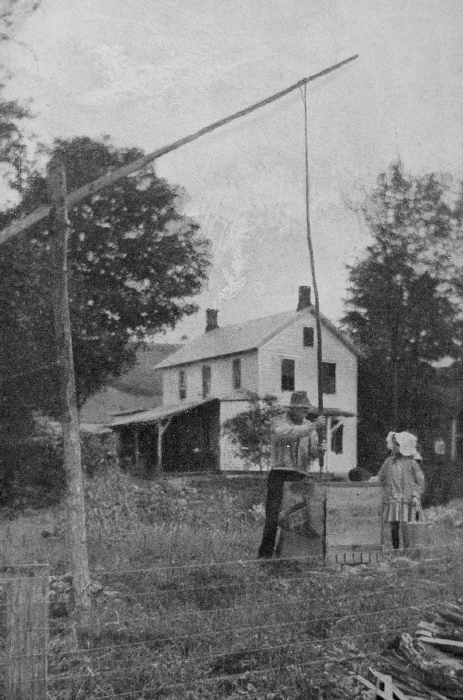 The old wellsweep “That old woman looks
brown as her
pipe, don’t she?” the storekeeper said. “There’s a few other old ladies
roundabout who smoke, but the habit ain’t common. This country is
pretty well
civilized. See, that woman is in the front room now cleaning a window
and still
smokin’. That’s her daughter cleaning the other window. She’d be a
pretty rosy
lookin’ woman if she was dressed up. There are the men comin’ in the
gate.
They’ve got their hog and are drivin’ it along hitched by the hind leg.
I
wonder how they got it across the bridge. Pigs are awful mean about
crossin’ a
bridge. Often you have to take right hold and get ‘em over by main
strength. “These people ain’t got
cows or
chickens or anything like that, and they don’t cultivate any land. They
have to
depend on day wages for their living. Their home, until last year, was
over in
Pennsylvania in the scrub oak barrens. That’s a peculiar region, and it
begins
not far back from the Delaware River. It’s just a dreary level of
little oaks
that don’t get much higher than six feet, but there are spots where
pine,
chestnut, and hickory grow. Every fall of the year the natives let the
fire run
through so as to have pasturage for their cows. Mostly the cows browse
on the
tender new sprouts that start up from the roots of the oaks. There’s no fences, and
the hogs and
cattle run in the woods. You might think that the creatures belonging
to
different families would get mixed up, but the houses are so far apart
that I
guess the cattle never get together. The buildings are of logs. Big
families
are the rule, and yet very likely the house will have only one room
downstairs,
and the ceiling of that room is the log crosspieces and loose floor
boards of
the loft above. It’s a wonder they don’t freeze in winter, but they
seem to
come out all right in the spring. They trap and hunt and fish, and they
have
little garden patches. Whenever they get an unusual supply of food they
eat it
all up at one time. It’s either a feast or a famine with them. If
anyone kills
a hog all the neighbors borrow some of the pork and return it when they
kill.
Each family keeps an old horse, or a mule, or a yoke of oxen; and now
and then
they haul out some railroad ties, or perhaps they cut a little batch of
hoop
poles and shave ‘em and take ‘em to town. In exchange they git some
tobacker
and a sack of flour and a few other things and feel rich. The old women
all
smoke, and their teeth are as black as that stove — what there is left
of ‘em. “I suppose these
neighbors of ours
think this place has about all the advantages anyone need want. But I
don’t
care to spend my life here. There’s no chance for variety and
amusement, and we
have only a poor little primary school for my children to attend. Each
year we have
a green teacher. We can’t keep one a second year or get one that’s had
experience because the salary is so small and it’s so inconvenient
getting
here. Sometimes a local girl applies for the job, and then you run up
against
all sorts of prejudices. There was a case here a few years ago where
the girl
was all right, but she had the majority of the school board against
her. I and
three other fellers contributed two and a half apiece, and I folded up
a nice
ten dollar bill, put it in an envelope, and went to see one of the
opposing
men on the board. I says, ‘It’s worth ten dollars to you to vote for
that
girl,’ and I give him the envelope. The girl got the school, and it was
that
ten dollar bill what done it. She’d be doin’ housework today if she had
n’t had
that start. As it is, she’s a very successful teacher who’s now in a
first-class position.” “I’m not wanting to stay
any more
than he is,” Mrs. Storekeeper said. “He’s away a good deal, and I have
to wait
on customers besides doing my own work. In winter it’s worst, for then
there’s
loafers hanging around the store all the time, and I get so sick and
tired of
‘em I don’t know what to do.” “Well, but you have a
chance to hear
all the news, don’t you?” her husband said. “I would n’t object to
that,” she said,
“if they did n’t tell the same thing over and over. There’s Bill — ever
since
he came home from the hospital I’ve heard him tell about his operation
until
I’m ready to stop my ears and run. Bill’s as proud over that operation
as a
nigger with a new shirt.” “I’ll say this for our
people,” the
storekeeper remarked — “they’re generally industrious. In summer
they’re up at
half-past four, and they work after supper till about dark, then sit
around a
little while and get off early to bed. Six o’clock is getting-up time
in
winter. During hot weather they rest in the middle of the day from
eleven to
two. The girls all learn to milk, and it’s the women that do the
milking on
most farms. “Nearly every family
takes a local
weekly, but they don’t take any dailies or general periodicals with the
exception of a farm paper that one man subscribes for. They don’t have
much
ambition to see the world. It’s no great journey to New York or
Philadelphia,
and yet very few feel they can afford any such luxury, even if they’re
well-to-do, which, as a rule, they’re not. Some have mortgages on their
places,
and more would have, but I tell you, mister, a farm won’t mortgage for
much
when the land is goin’ down in value as it is here. However, you can’t
judge
people’s poverty by the clothes they wear. Style don’t bother us much
in this
region. I know a man who you might think was a beggar or pauper. He’s
‘bout as
rough a lookin’ old piece as there is around, but he owns many a farm.
Lots of
poor men have had more comforts than he’s ever had. His wife goes
barefoot. I
saw her the other day watching her cows that she’d got hoppled and was
letting
feed along the road. She was a tough-lookin’ specimen. “Eventually I don’t
believe there’ll
be any village left here. The old people die, and the young people
won’t stay.
I’m goin’ to sell out and leave soon, and I’ll never come back, not
even to be
buried. Our cemetery is too forbidding a spot for any one to want to go
to,
alive or dead. It’s overgrown with blackberry briers, bushes, and
weeds, and
the groundhogs dig holes in the graves and scratch out the bones.
Hundreds of
people have been buried there whose graves were only marked by a plank
set up
with perhaps the initials cut on it. Of course the wood soon decayed,
and now
no one knows where the graves are.” As the day advanced the
sky became
solidly gloomed with clouds, and a foggy moisture began to fall. When I
presently went for a walk it was a sober, diminished world I had about
me, and
after I left the village the silence was almost oppressive. Not a
breath of air
was stirring, and there was only the drip of waterdrops from the trees,
the
rustling of an occasional brook, and now and then the lonely twitter of
some
little bird. The weather, and the wet slippery ground did not encourage
me to
ramble far, and I soon returned to the hamlet. On the vine-draped porch
of one of
the humbler homes were two men and an elderly woman. I paused to ask
them why
every field and yard in the place was fenced, and the woman replied:
“If it
wa’n’t for the fences the cows that run around loose would come right
into our
houses. I dassen’t go off away from the house and leave a gate or
barn-door
open, and I have to keep the barn shut up tight all through the summer
with the
horse sweating away inside.” “Here, want an apple?”
one of the
men said, offering me a beauty that he took from his pocket. “Apples
are so
plenty this year they ain’t worth nothin’. We shuck ours right off and
sold ‘em
for cider.” “There’s Isaac’s ducks
down here on
the millpond,” the other man remarked. “You don’t tell me,” the
woman said,
and she stepped out to the edge of the porch and looked to assure
herself. Across the road was a
brook, and a
little above was a dam and a small pond on which we could see several
ducks
paddling about. “You would n’t think that
little
stream over there would do any damage,” the woman observed, “but I can
remember
once when it flooded half the village. Must have been ‘bout this time
of year,
along in the fall. There’d been awful heavy rains, and a pond above
here
busted. When the flood swept through it was pretty near morning, and
some of
the people here in town had n’t got up yet. The water tore a great
gulley along
this side of the road, and undermined a house just below us. There was
a man
into it, and he was asleep. They had to hound him out. He might not
have
escaped if the back of the house had n’t been against higher ground.
Well, he
made out to git his pants on, and that was about all, I guess; and no
sooner had
he left the house than it went right down all to smash. Another house
was
partly wrecked. It sot so slanting after the flood was over you could
hardly
walk across the floor. That flood was forty years ago, wa’n’t it Dick?”
“Must ‘a’ been as much as
that,”
Dick replied. “I’m forty-six; and they say I was quite a little chunk
at the
time, but I can’t seem to recall anything about it.” “Dick,” the woman said,
“I want you
to move them rattlesnakes out of my weave-room. I’ve got to work in
there; and
you take them skunk-skins out, too. They don’t smell good.” Dick went to a door at
the far end
of the piazza and entered a dingy little room which contained a rusty
stove and
a rude loom, and much else that had been thrust in there for
convenience. On
the loom was a partly woven rag carpet. Nearly everyone in the region
saved
their carpet rags, and this woman did quite a business in weaving them.
From
amongst the litter Dick picked up a box about fifteen inches square,
with a
pane of glass fastened on top, and brought it out on the piazza. Inside
were
three big rattlesnakes. He reached up to a crosspiece overhead and took
down a
pair of wooden tongs. Then he slid the glass back, gripped a snake just
behind
its head, and pulled it forth, writhing and showing its fangs and
rattling
ominously. “Look out; your tongs
might slip,”
the woman cautioned. But Dick was careful, and
after
exhibiting the monster for a few minutes he restored it to the box.
They make
nice belts,” he said. “I git a couple of dollars a hide. When I go
lookin’ for
‘em I carry a smaller box. They ain’t very numerous, and like enough I
might go
half a dozen times and not git one. They like warm sunshiny weather.
Then I
find ‘em in the fields and around stone walls up on the side of the
mountain. A
while ago one was found right here in the village and it bit a dog. The
poison
made him sick — you bet it did, and his head swelled up big as a
water-pail.” While we were talking,
Bill, the man
who had been to the hospital, joined us, and soon we all went into the
kitchen
and sat down. “These two men are brothers,” Bill said to me, “but they
don’t
look no more alike than a dog and a sheep.” Then turning to them, he
said; “That
was a pretty good p’rade at Newton las’ week wa’n’t it? My! what a
crowd! The
automobiles was goin’ all the time on the streets, and every stoop way
up in
the buildings stood full of people. I don’t know where they all come
from. Lots
of money was left there that day. B’gosh, if I had it all I don’t think
I’d
need to work any more. I guess every man there spent much as a dollar.”
“I liked the music,” the woman said. “My good gracious! they had the bands from everywhere around, and fed ‘em all free.” 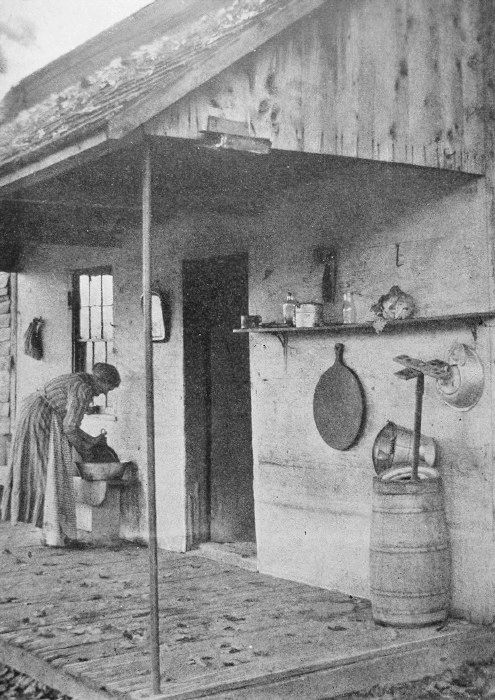 Housework “Did you see the big
drum?” Dick
asked. “Must have been pretty near four foot across. The drummer
understood his
business. By golly! if he could n’t use his arms! They played the band,
sir, up
till ten o’clock, when the last train left. People from here had to
drive over
the mountain. There’d been rain the night before; so the mud was deep,
and it
was awful nasty goin’.” “Bill,” the woman said,
“I want you
to look at this picture,” and she wiped the dust off a faded, rudely
framed
photograph and handed it to him. It showed the village
schoolhouse
with the children seated on a low pile of wood beside the building.
“That was
made when I went to school,” Bill said, “and here’s me right in the
middle. I
ain’t much bigger’n a big rabbit. There used to be forty or fifty
children went
in those days.” “When I was a girl,” the
woman said,
“I lived farther up the valley and went to a stone schoolhouse that
they called
the little stone jug. We mostly had men teachers. They were hired for
three
months, and paid ten dollars a month, and they would board round. A man
would
teach for three months on the money that was raised in the taxes, and
then
perhaps he’d go through the deestrict and git signers who’d agree to
pay him so
much a head to have the school another three months. There’s men I
knowed who
teached steady till they were fifty or sixty years old — made a
business of it.
I remember one woman, too, who was at it nearly all her life. She went
from one
deestrict to another, and they could n’t down her. She was smart, but
as she
got older she wa’n’t up-to-date enough. She was like a minister — he
gits
behind the door a little, and they want some one younger. “In my time every scholar
had to
find his own books. Now they’re found for ‘em. I never got to go to
school such
an awful sight, but I know I had an Elementary Spelling Book. The
schoolbooks
hain’t near as easy as they used to be. I see that the spelling books
now have
the pronounciation into ‘em besides just the words, and the children
have to
learn how to talk high-toned. Some of the new notions ain’t sensible.
George’s
kids are learning to spell cow and such words, and they don’t know
their
letters. How can they git along that way? We used to have to behave
pretty
good. The master had a big twisted hickory, and when a boy would n’t
mind he’d
take that and give him a lickin’.” “Nowadays,” Bill said,
“if the
children do anything, the teacher talks to ‘em and let’s ‘em go, and
they do it
again directly; or she makes ‘em stand up on the floor, and what do
they care
for that? But Lord God! in my own time I’ve seen children ruled till I
bet
their hands was sore next day.” “I hear you’re goin’ to
take some of
your sheep to market tomorrow,” Dick said. “Yes,” Bill responded,
“if the
weather’s good. Have you seen them of Ormy’s? His lambs are older’n
mine, but
mine are bigger’n hisn are, they’ve growed so fast. That’s the trouble
with
these extra early lambs — they don’t grow, and besides you have to set
up
nights and fool around with ‘em or the cold weather’d kill ‘em. The
other day
that buck of mine that I been keepin’ tethered near the house got
loose. The
children was playin’ in the road, and how they did scatter when they
see him
comin’. “That ‘ar sheep come
clean down here
past our hogyard,” the woman said.” I was workin’ at the woodpile
cuttin’ some
wood, and I got over the fence. He went in the dooryard and knocked
Dick
endways. Buck was just a-makin’ to come at him again; but Dick got up
and
slammed him with a board and sent him down the road a-sailin’.” “He butted me off my feet
once in
the spring,” Bill observed, “and I caught him by the leg and pounded
him with a
stone. I give him a good trimmin’ down. Since that time he don’t bother
me.
He’ll stand and shake his head and look at me through the fence —
‘Baa!’ but
that’s all.” When I returned to the
store, dinner
was ready. Included among those who gathered about the table was the
village
schoolma’a’m. She was quite youthful and shy, and seemed more like a
pupil than
a teacher. I noticed that she helped with the lighter housework.
Probably she
paid a lower rate for her board in consequence. The storekeeper
jokingly
remarked that she already had a beau. “Girls of courting age are about
as
scarce as white mice around here,” he said. “The same fellow that was
goin’
with the last teacher is goin’ with this one. The other teacher, after
she
left, turned him down. He felt pretty bad, but he wa’n’t heartbroken,
and soon
as this one come he was right onto his job. He calls on her, and takes
her for
a drive now and then, and if she goes home over Sunday or on a vacation
he’ll
take her to the station and meet her there when she comes back. But the young people
don’t have the
advantages they used to have for courting, now that there’s nothin’
doin’ at
the church. Last summer a minister volunteered to come and preach
every other
Sunday, and he had to drive from a town eight miles away. Hardly anyone
went,
and yet fifteen years ago we had services regularly, and there was
good-sized
congregations. People would come three or four miles from all around
and hitch
their teams to tieposts in the yard there at the church. Every year we
had
Protracted Meetings when there’d be services in the evening right along
for a
spell. I was always glad when the dominie announced ‘em, because I
knew I’d
have a sporty good time with the girls. The dominie generally tried to
strike a
time in the early fall when there was a full moon, but ‘twould have
suited me
better to have it a little dark. There was one fellow who, after
meetin’, when
he was takin’ his girl to where she lived, always stopped at his home
in the
village to get his overcoat, and while he was gone I’d hug her and give
her two
or three blame nice kisses. “I remember one Sunday
afternoon I
went to the new teacher’s boarding-place to see how she looked, and the
people
there had me stop and eat supper with ‘em. Afterward the teacher said
she was
goin’ to meetin,’ and I says, ‘Guess I might as well walk along, too.’ “We had n’t gone far when
I says:
‘It’s kind o’ gloomy on the road. Take hold of my arm, and I’ll assist
you.’ “Things was progressin’
very nicely,
and by and by I says: ‘If you’ve no objection I’ll walk home with you
tonight.
But no foolin’. I would n’t go out before that crowd at the church and
ask you
and get a refusal for twenty dollars.’ “She said she would n’t
disappoint
me, and I left her at the church door and went in and sat in the choir.
Oh, we
had a good meetin’, but I got away as soon as I could when it was over.
The
schoolma’am was outside, and another feller was askin’ if he might go
home
with her. “‘No I thank you,’ she
says, ‘I’ve
got company this evening.’ I had a triumph that time. “I don’t know just how
much religion
people got at those meetings. It was more excitement than anything
else. One
man who was always there was Jake Stickles. How he would pray! What he
said was
pretty sensible, but there was no end to it. Sometimes the dominie
would have
us sing to get Jake stopped, and very likely after we’d sung the whole
piece he
would n’t have stopped yet. “People would get up and
tell their
experiences, and they’d urge the sinners to repent, and finally they
got me on
the anxious seat. I was taken in on probation, and the prospects were
I’d be
received into full church membership on the final night. Gee! what a
crowd
there’d be on that last Sunday night! But I did n’t think I could keep
store
and join the church without bein’ a hypocrite, and I did n’t want
people to
say, ‘What a backslider he is!’ So I made a date with a girl for that
night and
sat up with her till three o’clock in the morning. I wa’n’t at the
church at
all and they gave me up as a bad case. “Naturally, after the
Protracted
Meetings, you could look for weddings. Those are very simple affairs
here. You
go to a justice of the peace and get hitched and return home. We don’t
indulge
in wedding trips, but I know one feller with new-fangled notions who
did, and
he had n’t been gone more’n a day or two before his wife got so
homesick he had
to bring her hack. The cost of getting married is very moderate. A fee
of a dollar
or two satisfies the justice, of the peace, and Squire Styers used to
do the
job for a bobsled load of wood.” Sunday passed and Monday
came. The
village work began at dawn, and by the time I was up the men were busy
at their
various outdoor tasks, and the women had started washing. Presently I
betook
myself to the highway and turned my footsteps toward the Water Gap. It
was a
beautiful day, warm and bright. I could see the glistening wings of
many little
flies and other insects playing in the sunshine, and the fields were
alive with
grasshoppers and crickets fiddling merrily and wholly unaware that the
frosts
would soon put an end to them. Sometimes I heard the clear, vigorous
call of a
white-throated sparrow migrating southward, or I heard the rhythmic
“hammering”
of a partridge in the woodland, and once I scared up as many as twenty
quail
from a roadside tangle and saw them whir away in wild fright. Men were ploughing on the
hillsides,
sowing grain, and husking corn. The generous heaps of yellow ears and
the
scattered pumpkins among the stacks were grateful to the eye, and
cheered one
with the suggestion of winter comfort. Around the houses too were many
evidences of the harvest — strings of seed corn, ripening tomatoes
brought in
from the garden, heaps of melons and squashes, apples and nuts. So I went on, sometimes
picking up
an apple to eat under a roadside tree, or perhaps pausing to gather a
few frost
grapes; and though I doubt not that the valley here has charm at any
season, it
seemed to me that it must be at its best as I saw it in those mellow
days of
autumn. NOTES. — The gorge where
the
Delaware flows through the Kittantinny Mountains is supposed to be the
result
of a large lake breaking its bounds. This theory is borne out by the
Indian
name Minisink which applied to the country above, and which means “the
water is
gone.” Only by taking a trip through the gap in one of the rowboats or
power
boats that are for hire can you get an adequate impression of its
two-mile
length and of the height of its rocky walls rising 1,500 feet almost
from the
water’s edge. There are in the vicinity numerous vernal roadways,
sylvan paths,
waterfalls, and outlooks from cliff and hill and mountain-top that
entice one
to a prolonged stay. The automobile route from
here to
New York by way of Morristown, 79 miles, is mostly good macadam. A
more
interesting route is that along the river south to Philadelphia, 118
miles,
mostly good roads. Trenton, 73 miles, is the capitol of the state. It
is at the
head of navigation of the Delaware. Great quantities of peaches and
cranberries
are raised in the tributary region. General McClellan is buried in
Riverview
Cemetery here. Washington crossed the Delaware, 8 miles to the north on
Christmas night, 1776, in a storm of sleet and snow, to attack 1,000
Hessians
quartered in the city. He captured them all, evaded Cornwallis,
defeated the
British at Princeton and retired northward to Morristown. Cornwallis,
who had
sent his trunks on board ship, intending to return to England, with
the idea
that the war was over, changed his mind. At Bordentown, 7 miles
below
Trenton, Joseph Bonaparte, elder brother of Napoleon, and at one time
King of
Naples and King of Spain, bought an estate of 1,400 acres after
Waterloo. Here
he lived from 1815 to 1832 entertaining many illustrious Frenchmen. The
estate
is now public property and known as Bonaparte Park. At Burlington, 13 miles
farther on, is
the house in which J. Fennimore Cooper was born, and the birthplace of
Captain
James Lawrence of “Don’t give up the ship” fame. General Grant had his
home
here during the Civil War. Giant sycamores to which the early settlers
tied
their boats, still enhance the beauty of drives along the riverbank. At Camden, just across the river from Philadelphia, can be seen the house of Walt. Whitman, the “Good Gray Poet.” 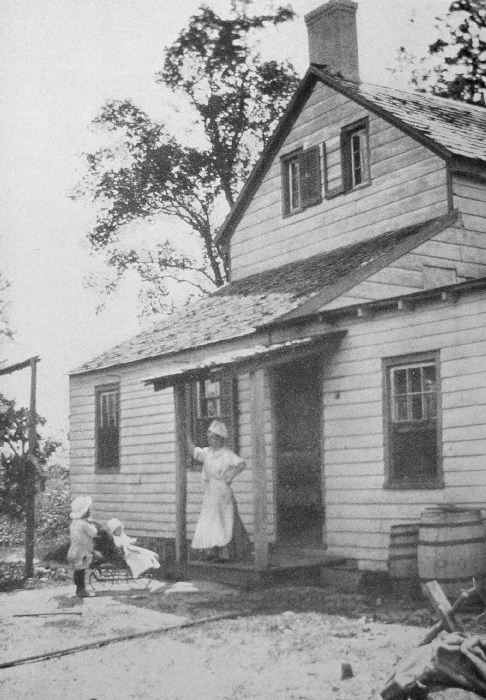 A back porch |
 Click the book image to turn
to the next Chapter.
Click the book image to turn
to the next Chapter.