 Web
and Book design,
Web
and Book design, Copyright, Kellscraft Studio 1999-2006 (Return to Web Text-ures) |
Click
Here to return to From St. Lawrence to Virginia Content Page Return to the Previous Chapter |
 (HOME) |
|
VI
A VALE OF ANTHRACITE IT was with some
misgivings that I
journeyed to the Lackawanna Valley. I feared the coal country would
prove
wholly black and forbidding, and the towns dubiously monotonous, and
labor
conditions sordid and depressing. My first pause was at Scranton, but
that is a
great business center, and though coal is being mined under and all
about it, I
preferred to get away to some smaller and more comprehensible places to
the
northward. Through the midst of the
valley runs
the Lackawanna River, a swift, inky stream, whose waters, in this
mountain
region, are no doubt naturally crystal pure, but are now so stained
with coal
washings that it might be a veritable stream of Hades. Where there
should be
yellow sandbars are dubious deposits of black, and the midstream rocks
have
caught unsightly masses of rotting railroad ties and other rubbish that
is due
to the presence of a busy and rather irresponsible hive of human
industry along
the banks. The sky, too, even when it is cloudless, nearly always has a
murky,
threatening aspect due to the smoke that fills the atmosphere. This
smoke
comes in part from the numerous breakers at the mouth of the mines, and
in part
from the engines on the railroad tracks that crisscross the valley in
an
intricate network. The trains of heavy coal cars, and the lighter
trains on the
narrow gauge roads from the mines moved hither and thither in
apparently
hopeless confusion, and wherever I went, the thunder of iron wheels on
the
tracks was always sounding in my ears. Very few trees are found
in the
valley, yet the great stumps that are still to be seen in places where
the surface
has not been torn up show that the land was heavily wooded at no very
remote
time. If a chestnut tree or a beech has by any chance been spared it is
a
treasure trove to the youngsters, and when the nuts ripen they assail
it with
sticks, and climb up and shake the branches. They feast on the nuts as
they
gather them, for the trees are too few, and the boys too many to allow
the nut-gatherers
to fill their pockets. The coal deposits are
tapped along
the sides of the valley, somewhat back from the stream, and there stand
the
giant breakers — lofty, sinister-looking structures, with a
wide-spreading
base, but terracing upward to a small peak. The trestled tracks from
the mines
run to the very top, and a cable drags the loaded cars up the steep
incline.
Close beside each dingy, towering breaker is a pigmy engine-house with
a row of
stout metal smokestacks sticking up through the roof, and this is the
center of
an inferno of smoke and steam and gas. The loaded cars are
dumped far up
aloft, their contents are crushed, and the slate and sulphur-stained
pieces
are picked out by the breaker boys. A series of chutes carries all the
material
down to the ground level, and delivers the good coal into cars on the
railroad
tracks, and the refuse into much smaller narrow-gauge cars to be
dragged by
cable to the top of a vast black heap of culm, as it is called. Once on
the
crest of the culm pile, a mule is attached to the car, and it is
dragged away
to the farthest verge, and there its contents are released and slide
down the
declivity. These culm dumps are the
most
conspicuous feature of the valley landscapes. They loom huge and somber
above everything
else, and dwarf the loftiest breaker and the highest of the village
church
spires. It is surprising how small the men and mules on top appear as
you look
up at them from below. Some of these gloomy, steep-sided, barren
mountains of
coal waste are four or five hundred feet high, but they are not
destined to be
permanent. Most of the material in their soaring heights is burnable in
the
modern furnaces. A few of the piles have already been entirely worked
over, and
probably nine-tenths of what was in them was shipped away. On the lower edges of the
dumps one
often sees women at work rescuing some of the better coal that is
mingled with
the stony refuse. Most of these gleaners are elderly, but there are
comely,
vigorous young women, too, and occasional little girls. Now and then a
woman
will climb far up the slippery slides, with her skirts fluttering in
the wind.
Some carry a hammer, and some delve and claw among the fragments with
a
short-handled hoe or hook. In their opinion the pieces they hammer free
from
the slate, and the other fragments they glean, are just as good coal as
they
could buy from a dealer. They carry it to near-by homes in pails, and
to the
more distant ones in bags. Ordinarily, the bags are trundled away on
wheelbarrows, yet frequently an old woman will get a full, heavy bag on
her
back and stagger off with it. The dumps and the coal
mine vicinity
were by no means so desolute and lacking in human cheer as I had
expected.
Perhaps the oddest source of pleasure that I observed was the use of a
dump as
a sliding place. The material just there was finely broken, and two
small negro
boys with a sled would start at the top, one sitting and the other
standing
behind and clinging to the sitter’s shoulders, and down they would come
with a startling
rush. It looked like a wild and reckless ride, but evidently their
nerves were
not at all shaken. They lived just beyond the farthermost outthrusting
ridge of
the irregular culm pile, and their little cabin home was quite a
curiosity — a
makeshift dwelling to which odds and ends picked up by chance had
contributed
largely. If one could judge by the number of children playing about the
porch,
it was thickly inhabited. With the brushy woods close around, the
house was
not without a rude charm that was suggestive of the sunny South. Few of the miners’ homes
that I saw
were exactly squalid, yet a careless disregard for appearances seemed
to be
general. Little attention was given to securing shade trees, or to
beautifying
the premises with flowers and vines. Often there was unkemptness, yet
not such
a degree of it as would prove especially unhealthy. The people seemed
hardy,
and the children as a rule apparently had sound bodies and were
attractively
intelligent. The miners themselves, going homeward from work with their
blackened hands, faces, and clothing, looked almost demoniac, but when
the
grime had been removed and they had changed their garments they were
much like
other men. Workers recently from
Europe are apt
to hive together unreasonably, not because they receive starvation
wages, but
because they have been used to that sort of crowding, or because they
want to
save every last penny in order to bring over their families. As soon as
they
get a thrifty start in the world they adopt a more generous mode of
living. The
laborers certainly have money to spend, for they are among the best
patrons of
the cheap shows, and they support an excessive number of dubious
saloons.
Lawlessness often manifests itself in the mining towns, but it is
seldom the
recent arrivals who are the mischief-makers. No, most of the “deviltry”
is
attributed to young fellows of American birth. In the part of the valley
where I
spent the larger portion of my time the mountains to right and left
were near
and steep. Their raggedly wooded slopes were very stony, and even the
land
along the river had the same thin-soiled, rocky character. It never
could have
offered much encouragement to agriculture. Over the heights, however,
in either
direction is fertility. Nevertheless, because of the coal, here is
wealth and
a dense population, while over there is comparative poverty and only
scattered
dwellers. The coal valley is the market for the latter, and there is
much
toilsome teaming over the rugged ridges. One day I walked with a
sturdy farmer
who was on his way homeward trudging up the hill beside his team and
stopping
often to rest his horses. “This is a hard old
mountain to go
over,” he said, “but the steepest, roughest part of the road in the
whole seven
miles that I have to go is right here as we’re leaving the town. Do you
see the
cracks in the sidewalk by this house we’re passin’? That’s caused by
the
ground settling. The railroad company that owns the coal mines had been
robbing
the pillars that were left to support the roof above the coal vein.
They don’t
care nothin’ if they let the whole thing drop. When they sell any land
they
only sell surface rights so they can do as they please underground, and
a man
puts up a house at his own risk. Often the house settles and racks,
and one
corner’s up and another down so the doors won’t shut. Oh! it warps ‘em
up in
great shape. Every day or two you see in the paper that some house has
settled.
Last summer the ground caved under a man who was workin’ in his garden
and let
him right down into a mine. In some places I’ve noticed houses tipped
right
sideways. They were so bad that the people in ‘em had to leave. One
night a
house went down about twenty feet, and a stove inside was capsized, and
the
whole thing burned up. There’s trouble from buildings settling on some
of the
best streets in Scranton. “Of course, the closter a
vein is to
the top of the surface and the thicker it is the more chance there is
for
trouble after the coal has been taken out. Even where big enough
pillars are
left, and they are not robbed, you are only safe for a while. The
exposure to
the air, and the action of water that finds its way down from the
surface make
the coal crumble, and pieces of the roof are always falling. But if the
vein is
down as deep as seventy-five or a hundred feet the vacant space fills
up
roughly without making a disturbance at the surface. “Now we’re up the worst
of the hill
on more level ground, and just ahead is a place where the whole road
has
settled five feet. You can see cracks and ragged holes on either side
there in
the brush. The ground settles most in the spring when everything is
soft. I’ll
take you down into a hollow near here to show you better what’s
happening.” He turned off onto a
grassy woodroad
and left his horses standing under a tree. We were on a wild upland
where the
scrubby forest growth showed the ravages of recent fires, and where the
ground
was nearly hidden by the crimson autumn glory of tangles of huckleberry
bushes.
Soon we reached the ravine, and my guide pointed out to me the effects
of the
work underground in shattering the bordering cliffs, making holes in
the earth,
and slanting the trees out of the perpendicular. In the depths of the
glen was
a stream dropping over the ledges and worrying along its
boulder-strewn
channel with much fume and clamor. At one place it flowed over an
outcropping
of virgin coal that showed distinctly on either side of the hollow.
Probably
it was just such a dark crumbling mass that first gave a hint of the
fuel
riches of this wilderness. When I was again back in
the town
descending the precipitous hill I stopped to speak with a corpulent old
Irish
woman who sat in the corner of her yard, just inside of the fence,
hammering
away at a heap of coal. She was reducing the big lumps to stove size.
“This is
the way it comes from the mine,” she said. “It’s awful dear if you buy
it after
it’s made ready for your fire. I break a little every day, but the work
is too
hard for me.” She pulled the old shawl she had on her shoulders closer about her, heaved a sigh, and looked out at me over her spectacles with exaggerated pathos from under the cowl-like brown cloth she wore wound around her head. After a moment’s pause she asked, “Are you an agent, or are you a boss up at the tunnel?” 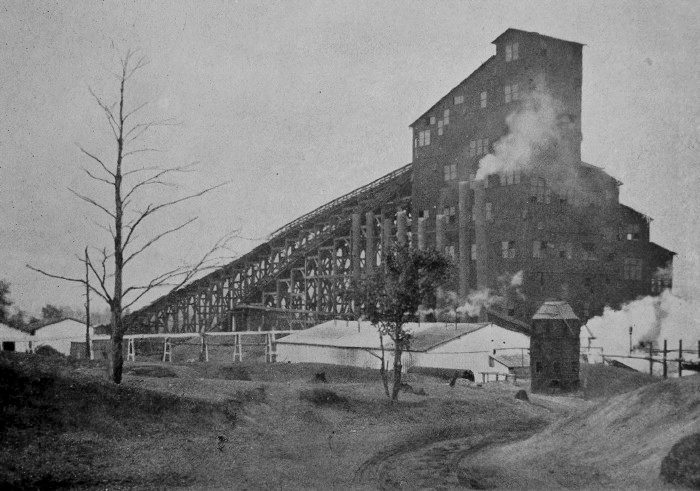 A breaker I satisfied her as to
that and
mentioned that my home was in New England. “Yes,” she said, “I know
about New
England. That was the first settled part of this counthry. I like to
read in
history about thim Pilgrims comin’ across the ocean and of the hard
times they
had. It’s intherestin’. I have fri’nds out in Boston. That is in New
England.
I’ve often heard tell of Boston, and I think I was near it once. My
daughter
had married, and I went to live with her in Connecticut at a place
called
Derby. But it was not nice there. Oh! I did n’t like it at all. The
wather was
bad, and that made drunkards of ‘em, you know. I could n’t drink that
Derby
wather. But we have the grandest wather here. It tastes good, and it’s
soft and
all right for washing. “This is a healthy place,
too. We
have pure air. But at Derby, Connecticut, I’d see so many complainin’
of ager
and malaria. They have two big rivers there, and a great many people
were
drowned. The people could get a living all right, but I’d see the women
go off
workin’ and the men idle at home. I did n’t like that. House rent was
awful dear
there, and so was other things. I paid three dollars and a quarter for
half a
ton of coal, and you could put it all in three bags, and I had to pay
twenty-five cents for a couple of little bundles of wood. “Well, I came back here
after a
while, and here I’ll stay the rest of my days; but this is no cheap
place
either for buying most things. Pork is expensive, and so is other kinds
of
food. That’s what they call the high cost of living. I like pork and
cabbage.
You bile the pork a little while; then you put the cabbage in the pot.
Yes,
that’s what I like. Are potatoes dear where you live? They are here.
Potatoes
don’t grow so productive in our gardens as they used to. The ground is
too old
or something. I think the mines soak away all the good from the land.
But the
Eyetalians here does have grand gardens; and they are not a bad sort of
people.
They fight a good deal among themselves, but they don’t bother the
rest of us.
“That’s my old man just
goin’ in the
gate. He’s finished his day’s work in the mines. He can’t do heavy work
any
more, but they don’t discharge him. He’s been workin’ for the company
so long
they think a lot of him, you know. They don’t give him no special job,
but just
tell him to find something to do. So he opens doors for the mule cars
to go
through, and picks coal off the tracks, and such things. He’s a very
industrious
old man. He says he’d be cold if he did n’t keep goin’. “It’s dirty work. You see
how black
they get. I s’pose it must be good for the soap factories. They wash up
as soon
as they get home, and change their clothes — what they call shifting
‘em. Every
week they have clean mine clothes, except the coat. That don’t get very
dirty
because they don’t keep it on while they’re workin’. Their clothes are
not so
hard to wash as those of men who are in mills. The coal dust comes
right out
unless they’ve got ile on their clothes. They wear a lamp on the front
of their
caps, and sometimes they carry ile for it in one of their pockets and
very
likely a little of the ile leaks out or they spill it on themselves. “I went into the mine
once with my
man long ago, but not so far that I could n’t look back and see a
little
glimpse of daylight. He worked away, and by and by he says, ‘Now I’ll
put off a
little blast and let you hear it;’ and bang it went. “I was scared. I thought
I was gone.
Everything shook and shook and shook. It shook so heavy and shook so
hard it
seemed like the whole earth was comin’ down. I thought it was the last
of me,
and the world was at an end, and I says to myself, ‘If I was a man I
would n’t
be workin’ in a mine.’ “But the men who are used
to it
would n’t work anywhere else. They can earn more than at most other
jobs. We
have silk mills around here, but they don’t pay any wages at all. One
good
thing about mining is that it don’t wear the men out. Generally their
health is
pretty good, but sometimes the dust gets down on their lungs and they
take the
miner’s asthma and are short of wind, you know. When they have it bad
they have
to stop. They may take medicine to kind of ease them, but there’s no
cure for
it. “Then, too, we have
accidents in the
mines. Yes, indeed. My son-in-law came in kilt to me, and my brother
was kilt
dead, and only five months between ‘em. But it’s very seldom we have
bad
accidents now. Of course, they can’t be helped once in a while.
Accidents
happen in every place — in the mines, and on the railroads, and around
the
water. There’s no safe place to work unless it is in the stores, and
I’ve heard
that people get kilt there with the elevators.” The old woman now got on
her feet
with considerable effort, shook the wrinkles and the dust out of her
skirts and
remarked that it was getting cold and she must go in, but she paused to
ask me
if I had seen the Forty Foot Falls up on the mountain. “People come
clear from
Philadelphia to see those falls,” she said. “Philadelphia, that’s a
city — did
n’t you ever hear of it? “There’s an Indian cave
up on the
mountain, too, but people are afraid to go in it. The Indians used to
say that
there was more gold around here than out West. They must have meant the
coal.
That cave is only three miles away, but we have great wild mountains
here — oh
dear! acres and acres of woods; I would n’t care to go there.” Farther down the hill was
a rude
little building that served as a grocer’s storehouse. A man was busy
inside
putting things in order and mending some flour bags. I sat down in the
doorway,
and while he worked we talked. At first we commented on some little
boys who
were playing ball in the street watched by a bunch of smaller children
that
included a baby in a baby carriage. They had a ragged old ball, and
some
nondescript sticks served for bats. One of the liveliest players was a
poor
fellow who had lost a leg. He used one of his crutches for a bat, and
when he
hit the ball or had struck at it three times he put the crutch to its
intended
use, and away he hobbled to the base with astonishing celerity. A drunken man staggered
past, and
the grocer’s clerk exclaimed: “My! this would be a rich country if it
was n’t
for the saloons; and if all the men were like me the saloon-keepers
would have
to go to work for a living. The saloons have a harvest time every day
and every
night, and if a customer don’t have money they’ll trust him, for it’s
well
known that a man will pay his whiskey bill before he will any other.
He’ll buy
drink whether work is slack or not and he’ll generally keep
good-natured while
he’s in the saloon half drunk, but when he comes home, if everything
ain’t just
so he’s ugly. “The people here are well
off in one
way — they don’t any of ‘em need to pay a cent for their fuel. Those
that ain’t
lazy get it from the culm heaps. Some who can afford to buy picks all
their
coal. Yes, people with a pretty good bank account will go to the culm
bank for
their fuel supply. The more wealth they have the more they economize
and try to
make. There’s cellars where you’d find enough coal to do ‘em a couple
of years.
We used to be allowed to go to the dumps with wagons to bring away
coal, but
men got to make a business of it, so the company put a stop to that.
These
foreign women is great people to pick coal, and they back it home for
the most
part. “The culm piles are
valuable, and a
good share of what’s in ‘em can be broken up and sold. Nearly all coal
has got
more or less slate in it, but this boney coal, as we call it, that’s in
the
dumps can be mixed with good coal, and one will sell the other. In the
early
days there was no sale for the finer coal, and they’d throw it away.
This big
dump on the edge of the town has been growing for forty years, and I
dare say
that in the bottom you’d find pea coal and chestnut — lots of it. Now
they use
down to buckwheat and birdseye sizes. “Besides getting fine
coal, there’s
a chance to make a good bit here pickin’ huckleberries. If there’s a
slack time
in the mines during the berry season, the men go right out with the
women and
children. I’ve known a big family to make five dollars in a day.
They’ll be
goin’ up along the mountains at three o’clock in the mornin’. Late in
the day
you’ll see ‘em comin’ back. Often a woman will have her berries in a
pan such
as is used to wash dishes in, and she’ll carry that pan balanced on her
head
with a little cloth underneath to keep it from hurtin’. She has to come
down
some awful steep places, but she’ll walk right along with her two hands
folded.
They sell the berries to a man here who’s a flowerist — has a flower
house you
understand — and he ships ‘em to the cities. He buys ‘em by the quart,
and
sells ‘em by weight. I guess he gets a little more measure that way. A
quart
will maybe make a quart and a half. Our mountains have been so cut off
and
burned over that huckleberries is about all they’re good for, though
once in a
while someone brings down a backload of dead sticks for to kindle the
fire.” The work in the
storehouse was now
finished, the dusk of evening was thickening, and the squad of
ballplayers in
the street had dispersed. I went with the grocer’s clerk to the
adjacent store
where the lights had been lit. Just inside, only a few feet from the
entrance,
sat the proprietor, a heavy elderly man with his hat on his head and a
cane in
his hand. I thought he looked rather grim and crusty, but I presently
observed
that his face could light up with a pleasant smile, and I had no
further doubts
as to his being good-humored and kindly at heart. People were
constantly
dropping in to get groceries. Most of them were children sent by their
mothers.
The youngsters invariably came to an awed stop in front of the old man,
and he
called them by name and demanded what they wanted, and then he repeated
the
items of their requests to an alert young woman behind the counter. She
served
them and entered the charges in the little passbooks the children
brought, and
in a large store account book. The customers seemed never to pay cash,
and I
asked the grocer the reason. “It’s the habit,” he
said. “The men
get their wages twice a month, and the majority of ‘em will hand most
of the
money to their women, who will come in and pay me. But mind you, they
won’t
kill themselves hurrying to get here with it, or by the size of the
load they
bring. Many a one don’t square up. I’ve been selling on credit for the
last
thirty-two years, and if I tell the slow ones that they must pay they
are quick
to give me a rap, and that’s the thanks I get for trusting ‘em. They’d
crush my
bones in the grave. Ah, yes! if I dun them they tell me to go where I
don’t
want to go — tell me to go to the last place where I would want to go;
and they
name the place whether they know anything about it or not. Some move
away and
leave a dirty book behind them, and there are others I can’t collect
from
unless I give the case to a lawyer; and if I do that there’s very
little comin’
to me after he gets through.” Just then a small
redheaded boy came
from outside and held the door half open while he looked in. The grocer
ordered
him to go away, and the boy paid no attention to this command. The old
man
shook his cane at the lad with no better result. “You’d better stand
there yet
awhile!” the storekeeper exclaimed, getting onto his feet and lurching
belligerently toward the door. The boy vanished. “Give me some tobacco,” the old man said to his clerk as he settled back into his chair. 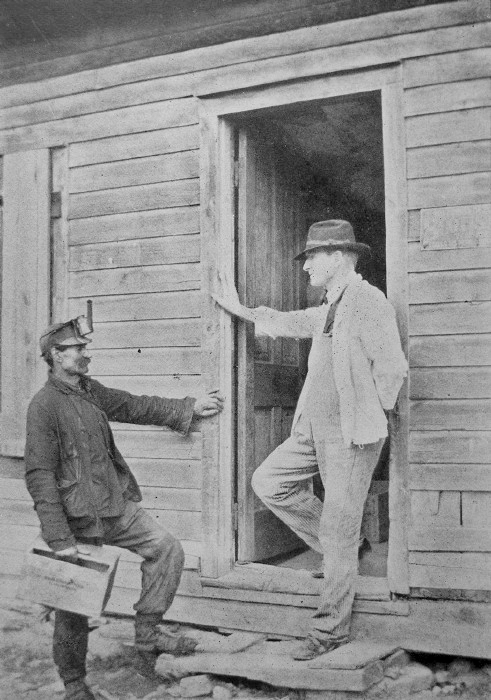
A miner and an above-ground friend He filled and lit his
pipe, and
after a few puffs regained his equanimity. Then he turned to me and
remarked:
“When I came here in 1854 the valley was all woods and laurel. There
were big
trees everywhere — hemlock, pine, and
ash — and you could build a house out of one of them trees they were so
large
and so long. You’d be under the shade wherever you went, and you did
n’t need
an umbrella in the hardest rain that come, for the thick leaves
overhead would
keep the water off from you. We’d let our hogs run in the woods from
April to
November, and they’d take care of themselves
— they would, sir. Our cows, too, could go where they
pleased and be in
no danger from the railroads. Now, good gracious! it’s all railroads,
you might
say, here in the valley. The best of the trees was carried away to the
sawmills, and afterward you could get no income from the land it was so
poor,
and a good deal of it was sold for taxes. “At first I worked for
sixty-three
cents a day — ten hours, too — ten long hours, but when the Civil War
broke out
wages boomed up. I’ll tell you what miners get now. Two men work
together — a
miner and a laborer. The miner blasts the coal loose, and the other
fellow
loads it. If they are in a good place the miner will perhaps knock
enough down in
a couple of hours for the other to handle, and he’s earned three and a
half or
four dollars. He used to go off home then, but now, for fear of
accidents to
the laborer, he has to stay till the loading is done. The laborer will
earn
close to three dollars, but there’s times when they’re working where
the place
is not so good, or they can’t get cars to load. Then you may hear a man
say he
has n’t made but a dollar that day. “One advantage of the job
is that
you are your own master. There’s no boss standing over you. Besides,
you are
away from the cold in winter time, and away from the heat in summer
time. But
you have the discomfort of wet clothing. The water is dripping from
the roof
all the time onto your back. Maybe you would n’t be in there ten
minutes until
you’d be like they’d kept puttin’ the hose on you all day, but you
don’t mind
that while you’re busy. In winter, when a man comes out, his pants
often freeze
to his legs before he gets home. Very likely he’ll stop in at a saloon
and stay
awhile by the stove, and drink a couple of glasses of beer. Then he’s
hot
inside and out. When it’s very warm in summer, and he comes up from the
cool
mine he has to sit down in the shade and get used to the change a
little or
he’d be sunstruck. “A miner is a miner all
his life,
and as a general thing he brings up his boys to do the same work. First
the
boys are put into the breakers, and from those they go into the mines.
They are
brought up to that one thing, and they think they could n’t do anything
else,
and often they won’t try. If a man can’t get his special kind of a job
he’ll
tramp the country through. “On the whole the people
here are
prosperous, and there’s five times as many own their homes as there are
renters; but when a miner has to support a big family he’s got all he
wants to
do to keep his head above water with prices as they are nowadays.” So I gathered from what
the old
grocer and others said, and from my own observation, that life among
the
anthracite workers is a mixture of cloud and sunshine just as it is
elsewhere.
They are not satisfied, yet nevertheless there are no other workers
with whom
they would willingly change places. NOTES. — Historically,
the most
interesting portion of the anthracite coal district is the Wyoming
Valley. The
largest town in the valley is Wilkes-Barre, named in honor of the two
chief
upholders of American liberty in Parliament. The name of the valley is
derived
from an Indian word that means “large plains.” It applies to an
expansion of
the Susquehanna basin about 20 miles long and 4 or 5 broad. Were it not
for the
coal this gentle valley would have a good deal of pastoral charm. Near Wilkes-Barre, in
July, 1778,
occurred one of the most harrowing of Indian massacres. A force of
British
troops and Indians entered the valley, defeated the settlers, and the
massacre
followed. The British officers could not restrain their savage allies,
who
butchered some 300 men, women and children. A monument, four miles
north of the
town, on the opposite side of the river, marks the scene of the battle.
Three
miles farther on is Queen Esther’s Rock, where the half-breed queen of
the
Senecas tomahawked 14 defenceless prisoners. The original fireplace in
which
anthracite coal was first burned in 1808 is preserved at the old Fall
House on
Washington Street in Wilkes-Barre. Many relics of local Indian and
pioneer life
can be seen at the Wyoming Historical and Geological Society rooms. The
height
known as Giant’s Despair, east of the city, is the scene of the annual
hill-climb of the Wilkes-Barre Automobile Club. The valley has paved
roads from
end to end. A particularly fine
scenic route is
that from Wilkes-Barre to Elmira, N. Y., 109 miles. There are good dirt
roads
much of the way, but with some steep hills that require great care on
the part
of the motorist when the roadway is wet. The route to Scranton, 18
miles
north, by way of Pittston, is through the heart of the Anthracite
region and
abounds in collieries and villages of foreign laborers. For much of the
way the
road is rough and poor. The town streets are narrow, and are crowded
with
children and animals, and there are frequent dangerous railroad
crossings. |
 Click the book image to turn
to the next Chapter.
Click the book image to turn
to the next Chapter.