 Web
and Book design, Web
and Book design, Copyright, Kellscraft Studio 1999-2006 (Return to Web Text-ures) |
Click
Here to return to From St. Lawrence to Virginia Content Page |
 (HOME) |
|
IV
THE LAND OF OIL THE existence of mineral
oil in the
valley of Oil Creek in northwestern Pennsylvania was known to the
Indians from
time immemorial. The Senecas, who inhabited the region in the pioneer
days of
the white men, resorted thither at stated seasons to gather the oil for
medical
purposes; and in connection with procuring it there were certain
ceremonies
ending with setting fire to the oil that gathered on the surface of the
pools,
and a dance around the flames. The early settlers
adopted the
Indian practice of using the oil as a medicine, and they had a good
deal of
confidence in its efficacy as a cure for rheumatism. It was even put on
the
market and attained a large sale in the drugstores under the name of
“Seneca
Oil.” At length some New York
men
conceived the idea that the oil had value as an illuminant, and that it
might
be obtained in larger quantities. They bought a seventy-five acre tract
of land
near Titusville, for which they paid five thousand dollars. It was
practically
worthless except for its oil possibilities. The new owners hired a man
to
trench the land and to pump the surface oil into vats by means of
apparatus
attached to that of an adjacent sawmill, but they gave most of their
attention
to selling stock. Several years passed, and the stockholders became
dissatisfied. Some of them arranged to have one of their number, Col.
E. L.
Drake, at that time a conductor on the New Haven railroad, go to
Titusville and
take charge of operations on their land. He attempted to find oil by
boring,
and after prolonged and discouraging labor he tapped an underground
reservoir
of the oil, in August, 1859, and thus started a vast industry which
made the
valley of Oil Creek the scene of one of the wildest bonanza
excitements of
modern times. Everyone who owned land
near the
Drake well either sunk wells or leased the right to others. The
uncertainties
of the enterprise were, however, very great. By far the larger portion
of the
wells obtained no oil at all, or in unrenumerative quantities, but
there were a
considerable number of the early wells that pumped from five to twenty
barrels
a day. In June, 1861, a flowing well was discovered on the property of
a man
named Funk, and to the astonishment of everyone the oil came forth at
the
daily rate of two hundred and fifty barrels. Many spoke of the Funk
well as an
Oil Creek humbug, and they looked day after day to see the stream stop,
yet the
flow continued with little variation for fifteen months. Such a
prodigal supply
of grease upset all calculations. The public were suspicious of the
new
illuminant and thought it dangerous; so the demand for it was as yet
small, and
this Funk well and other flowing wells that were soon discovered
glutted the
market. For a time the pumping wells were nearly all abandoned. The
price of
oil fell as low as ten cents a barrel, and great quantities ran to
waste for
want of any adequate way of storing it. In summer most of the oil
was
shipped down the creek on flatboats, and at the mouth of the creek,
eighteen
miles from Titusville, the oil barrels were transferred to larger boats
and
went on down the Alleghany. When there were not enough boats the oil
barrels
were lashed together in rafts for the creek trip, and might even
continue in
that way to Pittsburg. The creek boats were towed back upstream by
horses. Not far below Titusville
was a dam
that furnished power for a lumber mill. In dry weather the creek was
too
shallow for navigation, and the water held back by the dam was utilized
for
creating “pond-freshets.” Once or twice a week several hundred boats,
some of
them square-ended scows, and others pointed and slim, were loaded with
oil,
below the dam, and then the sudden release of the water through
floodgates created
a sufficient flow to carry the fleet along down to the Alleghany. Often
a boat
that cast loose too hastily would ground in the shallows, and the
following
boats, hurried on by the rush of the current, would batter the stranded
boat
into kindling wood, and there might result a general jam with much
damage to
vessels and a considerable loss of oil. The nearest railroad
shipping points
were twenty-five miles away, and great quantities of oil were carted
thither,
especially in winter when the creek was not available. It was not an
uncommon
sight to see a solid line of teams a mile or more in length on the
highways
leading to the railroads. Rubber boots and flannel shirts were
recognized
necessities in the attire of the teamsters, who were as rough and ready
in
their manners as in their clothing. They were big-hearted, honest,
hard-working fellows, skilled in profanity and the vigorous use of the
whip.
Some earned ten dollars or more daily. Yet however much they earned
they were
apt to spend it all in revelry on Saturday night, heedless of anything
but
present pleasure. One afternoon, in May,
1863, a
spouting well was struck that proved the most fabulous money-maker the
region
produced. A column of water and oil rose into the air a hundred feet
enveloping
the derrick and near trees. The gas roared and the ground quaked, and
the
amount of oil ejected at first amounted to three thousand barrels a
day. The effect of this and
the previous
excitements was to throng the entire valley with a restless, ambitious
population, and naturally among those who came were hundreds of loafers
and
numerous gamblers and other persons of evil intent. Within the next few
years
land anywhere near the producing territory soared to fabulous prices,
and the
region swarmed with a hungry horde of Eastern capitalists. A new town
named
Pithole grew in four month’s time to a place of ten thousand people.
During
this period any kind of a shelter was a luxury, and a stranger on his
first
night there was lucky to be allowed to sleep in the shavings under a
carpenter’s workbench. At the hastily improvised restaurants long
lines of men
waited their turn to pay twenty-five cents for a thin sandwich and a
small
plate of beans, and men of wealth elbowed greasy drillers and grimy
teamsters
at the lunch boards. A one course dinner without tea or coffee cost one
dollar.
Water to supply the hotels and boarding-sheds had to be hauled, and
this water
often commanded a better price per barrel than the oil. The place
reached the
summit of its glory in 1866. Then the oil pool, which was about one
mile broad
by two long, showed signs of exhaustion, and the decline of the magic
city was
rapid. In a single year it had grown from a quiet nook of five farms to
a place
of twenty thousand people. A half dozen years later there were as few
inhabitants as at the beginning, and now, the once populous streets are
plowed
fields or the browsing ground for cattle. The history of the
deserted valley
of Pithole Creek is similar to that of various other places in the
region.
Among these I might mention Red Hot, which for a time was like its
name, but
soon cooled off and died a natural death and left no trace behind; and
there
was Shamburg, which actually is a sham burg now, but was by no means
such in
the boom days. My own acquaintance with
the
oilfield wells that are still producing began on the southern outskirts
of
Titusville. One of them had been pumping for more than forty years.
They were
in irregular groups, each group with its pumping station, and all
connected by
pipes which delivered the oil to a refinery. Four-posted derricks with
much
crisscrossing of braces are over the older wells, but the increasing
expense of
lumber has led to making three long poles, set up to form a tripod,
serve
instead. Often these poles are transferred from well to well as new
borings are
made, and at the completed wells there perhaps will be only an
inconspicuous
pump and a small storage tank. From each power house there radiate to
the
scattered wells slender lines of rods suspended by ropes from posts
four or
five feet high. These sway steadily back and forth and keep the pumps
working.
The power houses are rude shanties with a gas engine inside. Usually a
single
man takes care of the engine, and often he is not at the building much
of the
time, and the shanty is left locked with the engine still going. In
that case
the steam exhaust is likely to be equipped with a whistle that keeps up
an
intermittent tooting. The cessation of the toots is a prompt warning
that
something is wrong. These vocal engines are known as “barkers.” Gas drawn from the same source as the oil furnishes the fuel for the engines, and if there is more than is needed it is allowed to escape through a pipe and burn. You see these torches flaring unceasingly both day and night. When darkness shrouds the landscape their flickering glare in the lonely fields and on the wooded slopes is quite mysterious. 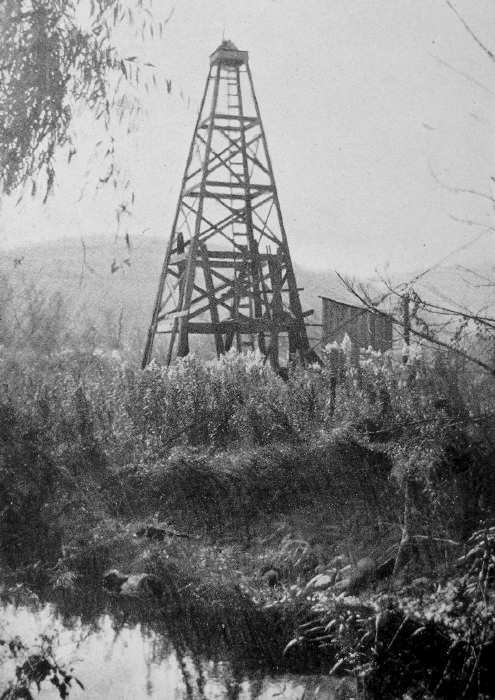 An old-time well that is still pumped Were it not that the fuel
is
costless, this pioneer oilfield would perhaps be wholly abandoned, for
the
average yield per well is decidely less than a barrel a day. “We think
they’re
dandy wells if they yield two or three barrels,” one of the engine
attendants
said, “and we pump for an eighth of a barrel. Some of the wells are
pumped only
every other day, and maybe then for no more than an hour or two. We get
to know
about how long it takes to pump up what has gathered, and then we turn
off the
power to let more oil drain into the sand down below. Water seeps in
with the
oil — sometimes a great deal of it. I’ve pumped over two hundred
barrels of
water to get one of oil from a well.” I visited the spot where
the original
Drake well was sunk. It is a short walk aside from the highway amid the
weeds
and brush, and you find there only a water-hole into which some one has
thrust
endways a large piece of iron pipe. Roundabout are swampy farmlands,
and at a
little remove, on either hand, rise rugged heights whose sides are
thinly
covered with forest. Near by I observed what seemed to be an abandoned
railroad
track, but a man whom I met informed me that it was still in use. “The
Pennsylvania Railroad has a line on the other side of the crick,” he
said, “and
it does n’t propose to let any rival build on this side. It’s got a
ninety-nine
year lease of the right of way here, but the lease has in it some
provision
compelling the running of trains. So in order to technically keep
within the
law a single train is run over the track each year. They have to cross
the
crick just above, and as a permanent bridge would be expensive they put
up a
slight affair that they take away after the train has made its journey,
for if
they did not remove the bridge it would be destroyed by the ice
freshets. All
there is to the train is a little dinkey engine and one car. They could
n’t use
a big engine. It would flatten the tracks right out. Even as things
are, the
weight makes the water squush out of the rotten ties as the train goes
along.
Oh! they have an awful time, and usually land in the ditch. They run
out here
about six miles. It’s a free picnic, and they always manage to have a
few
passengers on board. One of our legislators tried to pass a law
annulling such
fake leases; but the Pennsylvania Railroad owns the state, and he got
notice to
keep his hands off, and his efforts amounted to nothing.” I went on southward
following a
winding way up and down interminable hills. It was a rather lonely
farming
country. The houses were small, the outbuildings shabby, and there was
much
litter about them. Sometimes an oil well or two would be right in the
dooryard,
and I was rarely out of sight of the derricks, or beyond the sound of
the
pumping operations, and nearly always there was the odor of oil in the
air.
But it was a beautiful day with drifting clouds overhead that now
gloomed the
landscape with their shadows, and then allowed a burst of sunshine to
play over
the green, new-seeded grainfields, and the browner grass and cornlands,
and the
patches of woodland with their half bare branches still adorned in part
by
clinging leaves of many varied hues. At noon I visited a
little while
with two men who were sitting on a bank eating their lunch in a
roadside nook
among the ruddy-foliaged oaks. Near by were two stout spans of horses
munching
a feed of oats that had been poured down on the mossy turf, and beside
the
highway were two loaded wagons. The men were drillers on their way to a
neighboring village where they were to put down a well. They mentioned
that the
last well they drilled was somewhat over a thousand feet deep, and it
took them
eight days to sink it. Drilling was their business, and they kept at
it, if
they had jobs, all the year through except in winter. They explained
that
there were four different streaks of oil-bearing sand down below, but
none of
them yielded very generously now. “We don’t get half what we did ten
years
ago,” they said, “and the wells are getting lighter all the time.” At length I came to the
village of
Petroleum Center. It occupies a turn of the Oil Creek valley where the
abrupt
environing hills recede somewhat and leave a fairly level stretch of
lowland.
Once a mushroom city had grown here almost in a night. Now only the
ghost of it
was left. The stream flows on as of yore, and the unchanging hills
continue to
look down on the scene through winter snows and summer heats. Only man
and his
works seem puny and ephemeral. One of my chance acquaintances in the
place called
my attention to the fact that even the hills and the stream have not
always
presented the same appearance. Out of the low ground at the bend of the
creek
rises a round, steep hill. “We call that the Hogback,” the man said.
“It looks
curious, don’t it, right in the middle of the valley. I used to think
that God
made the world just as we see it but water has had a good deal to do
with
shaping things, and that accounts for the Hogback. Once the stream must
have
run in behind that hill as well as on this side of it and worn the land
down.” Among the few scattered
village
structures that have survived the boom period the only substantial one
was a
brick store that was originally a bank. Even that had a dejected air,
many of
its windows were broken, and there was no display of goods behind the
dusty,
fly-specked panes at the front of the store. The interior was equally
unattractive. It was crowded and dingy. In one corner were mail boxes,
and the
contents of the boxes looked faded and musty as if the mail never was
called
for. Most of the adjacent buildings were deserted and ruinous, and the whole aspect of the place conveyed a sense of dilapidation and hopelessness. I wanted to talk with someone who knew personally the city that had been, and my quest led me to a little house at the upper end of the village. I was ushered into a tidy sitting room where I was somewhat abashed to find myself in the midst of what seemed to be a ladies’ sewing-circle. But when I hinted that I was intruding on a public occasion they said they were simply old friends who had got together to while away the afternoon visiting. There were half a dozen of them, mostly elderly, and all long-time residents of the region who plainly enjoyed recalling the exciting past; but my chief informant was the spectacled, white-haired lady of the house. 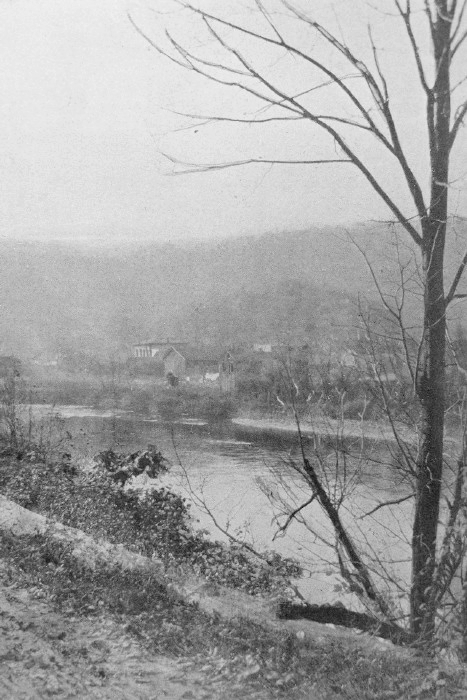 Oil Creek at Petroleum Center “Everybody in the country
seemed to
be migrating to Oil Creek when I come,” she said. “At first my husband
and I
lived in a boarding-house at Funkville just above here. It was a pretty
good-sized building — two and a half stories — but very hastily and
rudely
built, without lath or plaster, and yet they charged eight dollars a
week for
board. Our chamber was the only one in the house that had wallpaper. It
was better
than the others, too, because there was a boughten bedroom set in it.
A party
that had occupied it before we did brought the set with ‘em, but got
hard up,
and the set went toward paying the board bill. The walls of the
dining-room
were papered with newspapers. The big dining-table, around which
twenty-five or
thirty persons could gather comfortably, was so roughly made it looked
as if it
had been whittled out, pretty near. Often the boys would have in the
girls of a
night and dance in the dining-room. Then the big table would have to be
taken
out. Up in the attic were nine homemade, corded, wooden beds with low
bedposts
and little small headboards. They had straw mattresses on ‘em, and
every day
the servant girl would stir up the straw to make ‘em level. “The way that
boarding-house was
built and furnished was a fair sample of what you’d find then all
through the
valley. We had just shanty houses that were n’t put up for to stay. If
the oil
failed in one place a man could take his worldly goods, house and all,
and go
somewhere else. I remember one house here that was taken down in the
morning
and carted eight or ten miles, and then it was set up and the owner
slept in it
that night. “We had ten thousand
people in
Petroleum Center one while. Now I doubt if there’s a hundred. It’s a
lovely
place, ain’t it! I think a person would have to put on his spectacles
to find
it as he went past on the train. When it was largest it was full of
hotels, restaurants,
and saloons, and was about as tough a place as was ever heard of.
Derricks,
buildings, and roads was all jumbled together hit or miss. We used to
have
three churches. They done well, and the Catholic priest and the two
ministers
all lived here, and crowds of people attended the services. Two of the
buildings
still stand, but it’s hard work to get any congregation together in
either of
‘em. There’s just a handful gather every other week when the priest
comes; and
no regular preaching service is held in the other church, but we have
Sunday-school. A few years ago some Episcopal lay-workers volunteered
to try
to keep things going, and quite a nice little crowd came out off and on
for a
while. But the workers could n’t get enough to pay expenses, and they
threw up
the job. Some of the people was n’t able to pay, and some would n’t.
Just now
two revivalists are trying to have meetings every night, but the
attendance is
slim. They had only three grown persons and a few children the first
night.
People ain’t interested, and they simply won’t go.” My hostess paused while
she went to
a small stove that was in the room and adjusted a stopcock at one side.
“It’s
getting toward evening,” she said, “and the air is growing cooler. I
thought
I’d turn on a little more gas. In the early years that I was here soft
coal was
our fuel, and I’d have liked it very well if it had n’t burnt out our
chimleys
so quick and been so dirty. If you took off a stove lid to have your
griddle
right over the flames, the bottom of the griddle would get all coated
with
stringers of sut. I’d feel discouraged, too, when I hung out my washing
and the
clothes got covered with little smut balls. That would happen in moist
weather
— on days, you know, when the smoke would blow down instead of going
up. Now we
have gas piped to our houses to furnish all the heat and light. It
costs us
twenty-eight cents a thousand. Besides this little stove we have a
range in the
kitchen. Our gas bill last month was a dollar-twelve, and it was less
than
three dollars the coldest month last winter. I think it would be awful
to have
a coal or wood stove with all the ashes and dirt. “Lots of gas used to be
wasted. I
know that near one of the refineries there was a good-sized pipe
sticking up
from which the gas flamed night and day all the year around, and there
was a
place in winter as large as a big room where the grass grew green with
the
snowbanks all about.” Another person whose
reminiscenses
particularly interested me was a Titusville merchant who had aided in
financing
the first well, and without whose help the well might have been a
failure.
“Drake was a jovial, kind-hearted, polished gentleman,” he said. “It
was his
habit to wear a silk hat and a white necktie, and he was quite
distinguished
looking. He hired two or three men and set ‘em to digging with the hope
that a
good deep hole would strike a plentiful supply of oil. As they dug they
put a
cribbing of logs around the sides of the hole to keep the earth from
caving in.
Soon so much water soaked in that it put a stop to digging. Then they
rigged up
a pump, but the water came in as fast as they could pump it out, and
presently
Drake said: ‘This won’t do. We’re pumping all Oil Creek here.’ “He thought the matter
over and got
the idea of drilling. To drill through rock would n’t have been very
difficult,
but at that spot was a lot of mud and water and earth that would have
filled
the drill hole right up. He had a difficult task. To set a man to get
at a
supply of underground oil at that time was like blindfolding him and
telling
him to do something that had never been heard of before. But he got
some four
inch pipe which he rudely jointed together, and that served to carry
him
through the soft upper material to the rock. It was slow, discouraging
work,
and he worried a great deal and evidently was under a great mental
strain. I’ve
heard him say many times, while he was putting that well down, that he
wished
he’d gone to the penitentiary instead of coming here. At length he was
hard up
for money, and he asked me to indorse his note for five hundred
dollars. I had
confidence in him as a man, and I did as he requested. He did n’t have
much to
say about his drilling enterprise, and let it be inferred that he was
after
salt. The people would have thought he was a crazy fool if he’d said he
was
boring for oil. “The actual labor of
drilling was
done by Uncle Billy Smith, assisted by his son. Uncle Billy was a
mechanic
accustomed to salt boring, but things went slowly. Drake had been here
sixteen
months and was about to go back home and apply for his old position on
the railroad
when they struck oil at a depth of seventy feet. That was the
shallowest
successful well ever drilled in this oil field. If he’d had to go any
deeper
he’d have abandoned the enterprise. Either fortune or Providence
favored him.
The oil rose within five inches of the surface. When pumped, it yielded
four
hundred barrels a day. Drake was a big man then. ‘I’ve got any amount
of
friends now,’ he said when he came into the store to pay his account. “He might have leased
land up and
down the valley and got rich; but he was n’t what you’d call a good
business
man, looking out for the dollars. He liked his ease too well. Besides,
he
thought he had all the oil there was right at that one place. For a
while he
set down here and became a justice of the peace. His friends let him
into some
of the oil companies, but he never made much. A place he bought here in
town
proved to be his best investment. Property advanced very rapidly in
price on
account of the oil excitement, and he sold out at a profit of twenty
thousand
dollars. Then he thought he was rich, and he went to New York and lost
every
cent within a few months. Finally the Pennsylvania legislature was
induced to
grant him a pension, and his wife still draws it. “We all begun to put down
wells
after Drake made his strike, and sometimes we’d have only a wet hole,
and be
flooded out, and sometimes a dry hole with never a smell of oil in it.
But
enough good wells were found to keep up the excitement. There were
fellows who
did first-rate gathering up territory here and taking it to New York to
sell. I
sold a fifty-acre tract of swamp myself there. My customers were
important New
York bankers. They figured out so many wells to an acre and were
convinced
there was a magnificent future in that piece of swamp. It could have
been
bought for twenty-five dollars before the boom. They paid me a hundred
thousand
for it, and they never got any oil at all from the property. Another
deal that
I helped put through was one involving a quarter of a million dollars,
and I
was given five thousand dollars worth of stock for my services.
Unluckily, I
did n’t get a chance to unload before the bubble burst, and my stock
was
practically worthless.” I wish to quote one other
man. His
memory covered the entire period of the rise and fall of the oil
industry in
the region. He was a grizzled, bushy-browed man, still alert of mind
and
vigorous in body, but age was beginning to tell on him, and his hands
were
contorted with rheumatism. “According to a record in
my
mother’s old Bible,” he said, “I discovered America here in Titusville
in 1840.
So I was nineteen when Drake struck oil. This was a lumbering hamlet
then, and
there were two good-sized sawmills here. The logs were run down the
cricks to
‘em, and the sawed lumber was made into small rafts. After the rafts
reached
the Alleghany they were coupled up into river fleets and floated on
down to
Pittsburg. The country was heavily wooded, principally with pine. It
had not
been cleared to any extent, and the mills run their business till up
along
pretty near 1870. Then the pine timber was about exhausted. But new
firms
sprung up later that gathered up the remnants in our woodlands, and
those
remnants were worth more, at the higher prices that prevailed, than the
original timber. “The sawmills employed
all the
laboring men in this region when I was a boy. They paid them with
orders on the
companies’ stores. We saw very little money. If a man had a quarter it
was got
away from him in about fifteen minutes. But in the spring, after the
mills sold
their lumber, they distributed enough cash so their workmen could pay
their
taxes. Few people raised any crops except a little buckwheat and a
small patch
of potatoes. The families along the creek led a rough life, and two
thirds of
their houses were logs. In winter they’d make a few shingles, and in
spring
you’d find ‘em hired out rafting lumber to Pittsburg. Often they were
so poor
they’d return on foot. “We probably had two
hundred
inhabitants here in Titusville. There were a couple of hotels that
depended
mostly on the men engaged in the spring lumbering operations, and
there were
three stores. My brother-in-law kept what was called the drugstore, and
the
principal drug was whiskey. Every store sold liquor them days. They did
n’t
have to have any licence. “Our mail come and went twice a week. Old man Cook was the carrier. He drove an ancient sorrel horse hitched to a rattletrap buggy. When it suited him to get here with the mail on the days it was due he got here. Otherwise he did n’t, and he considered that was no one’s affair but his own. There was n’t much mail anyway, and it did n’t matter. Often he stopped for the night with an old lady who lived three miles out. Sometimes we boys would go there and steal the mail and bring it to town. 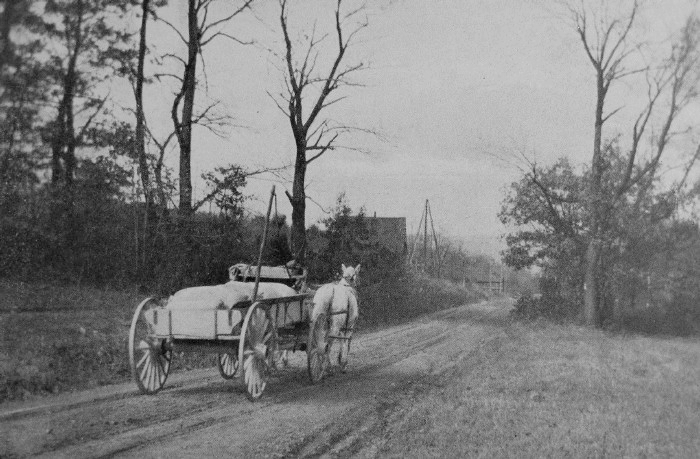 Going to town “When Drake struck oil
three of us
young fellows got a little bit excited and thought we’d try our luck.
So in the
fall of that same year we leased five acres of land and organized “The
Great
American Oil Company.” The justice of the peace charged us a dollar
for
drawing up the lease, and as we only had sixty cents he had to trust us
for the
rest, and he died without getting it. We kind o’ forgot that debt, and
he never
asked us for the balance due him. The owner of the land was a poor —
very poor
farmer. We agreed to give him five dollars a month and an eighth of the
oil.
That looked big to him. “For shelter we built a
shanty on
the property, and I did the cooking. We started work in a very modest
way by
digging a pit on our land near the crick. At a depth of four feet we
struck bed
rock, and we brought an old wooden pump from town and rigged it up to
pump the
water out of the hole. A little oil oozed in with the water and formed
a thin
skin on top. By putting half a woolen blanket down flat on the surface
we could
soak up the oil, and then we’d wring the blanket out into a pail. Any
water
that was soaked up with the oil would settle to the bottom of the pail,
and
we’d pour off the top into a barrel. After the oil was sopped off from
our pool
we pumped the water out into the crick. That was a half-hour job, and
it took
the pit an hour to fill again. We got about eight gallons of oil a
day, and
when we filled the barrel we took it to a grocer here, and he gave us
thirty
dollars. I thought that was a big amount of money, for I’d never had
two
dollars in my life before. The oil was high-grade, and was sold for
lubricating
and medical purposes. It was no humbug either as a medicine. I’d been
having
trouble with my throat, and I would put a leaf down on that crude oil
and lick
if off. That cured my throat entirely, and I’ve never had a sore throat
since. “We worked that blanket
process for
three or four months. Then we hired a couple of men to drill a well.
They
brought their tools on their backs from Oil City. The whole outfit did
n’t
weigh more’n a hundred pounds. We drilled all winter. The well was
kicked down,
just as most of the early wells were. A long slender pole was adjusted
on a
post, and the drill was suspended from the small end. To the rope that
held the
drill a leather loop was attached into which the driller could put his
foot,
and by giving a downward kick the drill would be brought into action.
Then the
spring of the pole raised it ready for another kick. “After getting down I
s’pose a
hundred and fifty feet we struck oil, and the next morning, when I went
to the
well and stepped inside of the shack we’d built above the drill hole,
my foot
went into about eight inches of oil that had flowed during the night.
It was thick,
like molasses, and we scooped up half a dozen barrels full. But when we
went to
pumping we got mostly water, and it did n’t pay. Then we put down
another well,
and that was no go either. By that time I did n’t have a dollar, and I
was
ready to give away my third interest in the Great American Oil Company.
While I
was in that frame of mind a man come lookin’ around our property, and
after
some talk he asked me what I’d take for my third. At first I was going
to say
two hundred dollars, but on second thought I said to myself, ‘I’ll just
paralize the old gent;’ and I told him my price was four thousand
dollars. “I expected he’d kick me
into the
crick, but he closed the bargain. He was from Jamestown, New York, and
two
other men there were interested in the deal. They paid me a thousand
dollars in
gold and gave me a note for the balance. “It seemed to me I was
rich enough
to be satisfied for a while, and I went down to Pittsburg and attended
school
for a year. At the end of that time I started for home. On the way I
stopped
one evening at a tavern where the local school board was having a
meeting. A
teacher had recently had a row with his pupils and they had thrown him
out and
would n’t let him come back. So he left, and the authorities were
looking for a
new teacher. I told ‘em I’d take the job if I did n’t have to board
round. The
president of the committee said I could make my home with him, and I
accepted
his proposal. He was a great talker and wanted me for company. “The schoolhouse was a
clapboarded
frame building, but the clapboards were off in a good many places, and
it was
delapidated and pretty near ready to tumble down. In the schoolroom
there was a
continuous bench against the wall around three sides, with a desk in
front. On
the remaining side was my desk on a platform. The children got the fuel
we
burned from a soft coal bank back of the building. I taught reading,
writing,
and arithmetic, and it was a part of my work to set the copies for the
children
in their writing-books, and sharpen their goose-quill pens. It’s quite
an art
to sharpen a goose-quill, but I had that art all right. Books were n’t
very
plentiful. However, most of the pupils had a spelling-book. “I did n’t like teaching.
I’d rather
do anything else than teach school. The committee hired me for three
months,
and I was glad it was n’t for a longer period. I guess the pupils were
gladder
than I was. One little fellow, when I began to teach, knew all his
letters but
four, and by the time I was through he’d forgotten all but four. “Meanwhile I had n’t got
my money on
that three thousand dollar note. The property had proved to be
valueless, and
the whole thing had been shut down and abandoned. So the Jamestown men
did n’t
want to pay me, and I had to hire a lawyer to make ‘em see things
in the right
light. Then I was obliged to go to Jamestown to get my money. I put up
over
night there at a hotel, and in the morning went to a bank, which turned
over
the cash to me. It was in bills of small denomination, mostly ones and
twos,
and they made a great big package that I could just crowd into my
inside
overcoat pocket. I went back to the hotel, and after sitting a while in
the
office it occurred to me that I would go out for a walk and see the
town. The
day was warm and I took off my overcoat and left it hanging in the
hotel
office. By and by I thought of my money and rushed back to the hotel in
a great
sweat. It had n’t been stolen, and I was much relieved. Then I put the
overcoat
on with a determination to wear it the rest of the time. I even wore it
while I
ate my dinner. “In the early afternoon I
took a
train for home. The train did n’t go clear through and I had to change
and wait
at a junction. Rather than loaf around the station there I decided to
go for a
stroll, and to relieve myself of any anxiety I had the express agent
put my
money in his safe. When I came back to the station my train was just
leaving,
and I ran and jumped on the last car. The train was going at a good
speed
before I thought of my money. It was left behind. “I came to Titusville,
and gave the
express agent here an order so the money could be forwarded. Generally
the
train ran off the track every day and of course there had to be a
smashup when
my money was coming. The little iron express box lay in the woods two
or three
days, but it got here in the end. My money was turned over to me on a
Saturday,
and I put in all the next day counting it. Eleven hundred dollars I
spent to
build a house. It was a good investment. A few years later a man come
along and
looked at the house and says, ‘What’ll you take for this shebang?’ “‘Six thousand dollars,’
I said, and
he bought it at my figure. “You see property in
Titusville and
the entire valley took a great boom. Such crowds rushed in here that
they had
the greatest difficulty to find lodging at night. The hotel-keepers
would put a
man to bed, and as soon as he was asleep would take him to the hall and
hang
him on a hook and give someone else the bed. To show you how rapidly
population
could grow let me tell you about the postmaster at Pithole. He began
there on a
salary of twelve dollars and a half a year. He was expected to keep
track of
the stamps sold, and in most such places the results would n’t warrant
raising
the pay more than a very little, but in less than three months he was
handling
such an amount of mail that the salary was raised to four thousand
dollars, the
same as was paid at Pittsburg. “As for the oil business
its
character was wildly speculative for a long time. Many came here rich
and went
away poor, and very few came poor and went away rich. Numerous wildcat
wells
were sunk all around the region that cost good money and were
perfectly
worthless. If a fellow made one or two good investments and lucky sales
he
began to think he was a master of frenzied finance, and he’d most
likely strike
for Wall Street. He and his money were soon parted there. “Loss and gain in large
amounts were
a commonplace here. They tell of two strangers who occupied the same
room in
one of our crowded hotels. One of ‘em went to bed, but he could n’t
sleep
because his fellow-roomer persisted in walking the floor. Finally he
says,
“What’s the matter with you?’ ‘I’ve given a note for
five thousand
dollars that’s due tomorrow,’ was the reply. “Have you got the money
to pay it?’
says the first man. “‘No,’ says the second
man. “‘Then you’d better come
to bed’,
says the first man, ‘and let the other fellow do the walking.’ “Most of the poor
backwoods farmers
in the valley sold their land at fabulous prices, or arranged leases
that
brought great and sudden wealth, but they could n’t stand the change.
They did
n’t know how to spend the money, or how to keep it intact. Their sons
became
drunkards, and the money vanished in dissipation, extravagance, and
poor
investments. I know of only one land owning family of that period in
this
valley that has retained the money which came to it.” NOTE. — In the oil
region, even in
travelling on the train, one sees numerous oil-wells, both in operation
and
deserted. The great center of the Pennsylvania oil district is Oil
City, and
the traveller can see there all the processes of procuring, preparing,
and
shipping the oil and its products. In 1892 a large oil tank in the city
caught
fire, and the burning oil overspread the water of the creek and caused
the destruction
of many buildings and a considerable loss of life. It is estimated that from
the valley
of Oil Creek, north of Oil City, oil to the value of $200,000,000 was
taken in
the ten busy early years. The present yield is insignificant.
Titusville has an
especial claim on the sightseer because there the oil was discovered.
Interesting visits may be made to the hamlets down the creek which grew
with
magic rapidity into populous cities in the boom period, and almost as
suddenly
vanished. There are automobile
routes from
Titusville north and south and east and west. The one north goes to
Erie, 53
miles, by way of Cambridge Springs, and the one south to Pittsburg, 113
miles,
by way of Mercer. The roads are good dirt or gravel. For more about northwestern Pennsylvania see “Highways and Byways of the Great Lakes.” 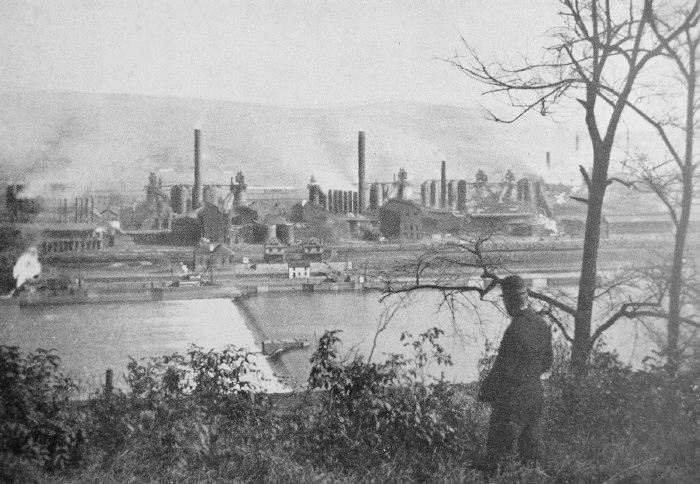 Braddock’s battlefield, viewed from across the Monongahela |
 Click the book image to turn
to the next Chapter.
Click the book image to turn
to the next Chapter.