 Web
and Book design,
Web
and Book design, Copyright, Kellscraft Studio 1999-2007 (Return to Web Text-ures) |
Click
Here to return to Sand Dunes and Salt Marshes Content Page Return to the Previous Chapter |
 (HOME) |
|
CHAPTER VIII SALT MARSHES
A RECENT
writer on
the geology of salt marshes says: “As scenic features they are
monotonous and
uninteresting in the extreme because of their lack of relief and
uniformity of
appearance.” To such one can but reply in the words of Lowell quoted at
the
head of this chapter. While
there is a
peculiar charm of the sand dunes, so also is there a charm of the salt
marshes
— a salty flavor all their own. At all seasons there is a pleasure in
their contemplation,
and a joy in their exploration, whether it be in canoe or sail boat
along their
winding water-ways, or on foot over their treacherous surface. 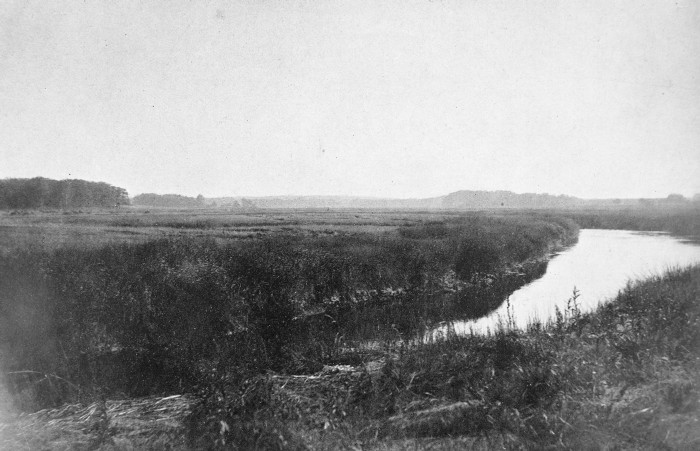 A CREEK IN THE MARSHES Whether one looks from the elevation of a marsh island on these great level floors, extending for miles into the land, framed by the white sand dunes on the one side, by the dark hills on the other, or loses oneself in their midst, one feels with Sidney Lanier that
I can
heartily
agree with Coventry Patmore, who, in writing of the Sussex marshes,
says: “The
beauty of these marsh views is beyond all description, and has never
been
expressed even in painting.... I have looked upon these marshes year
after year
and always with new delight.” There is a
restful
and satisfying character in marsh views which grows with acquaintance.
One
never tires of them, perhaps because they are never the same, and
because they
are even more changeful than the restless sea. Looking out on the broad
bosom
of the marshes one cannot be lonely, if the sense of their beauty is in
the
heart. As in the sand dunes, so here in the marshes one’s enjoyment of the beauty of the surroundings is not impaired but rather enhanced by an intimate knowledge of the life there. It is well worth while to study first the vegetation which plainly groups itself into four zones. Fortunately for the unbotanical, the hostile power of salt is such that it makes friends with but few plants, and these are easily learned. Lanier doubtless did not refer to botanical simplicity when he said:
but
they are good lines and will do here.
The lowest
zone of
all from the point of view of sea level is the zone of eel grass, a
plant which
belies its name and station, for it is not a grass nor even a seaweed,
as is
often supposed, and is not lowly, but is a member, albeit a humble one,
of the
lofty group of flowering plants, where it is placed above the pines
but below
the grasses. The flowers are small and are hidden in the sheath-like
base of
the leaves, which, in narrow ribbons but a quarter of an inch wide,
wave in long
thickly matted streamers in the channel beds, and shelter in their
shady forest
groves snails and worms, crabs and eels. While living, the eel grass is
a good
friend to these creatures, and dead and cast up on the marshes or
beaches it
serves many a useful purpose. Under its sheltering windrows the
sharp-tailed
and Savannah sparrows build their homes, while the oriole, red-wing and
robin
weave it into their nests; the gunner stacks it up into a blind, in
front of
which he places his decoys to beguile the wandering shore-birds, and
the
clammer, fisherman and farmer pack it about the foundations of their
houses
to keep out the frost and the winter winds. The next
plant zone
is equally simple and also limited to one species, the thatch grass,
that grows
from within two or three feet of low-tide level to the level of the
ordinary
high tide. Where the marsh is built up so high that it ceases to be
washed by
every tide, then the thatch ceases to grow, for it needs daily contact
with old
ocean. It is replaced by the vegetation of the third zone. The thatch
is a
sturdy grass, a wonderfully strong but pliant fringer of the creeks.
It grows
from two to five or even six feet high, and bears great waving plumes
of simple
straw-colored flowers and seeds. One always sinks into soft mud when
struggling through it, for it is a great builder-up of the marshes and
holds
the fine detritus among its stalks and roots. The thatch is prized for
bedding
and for mulch, but most of that which is cut is carried off by the
tides before
it is harvested, and that which escapes the scythe is broken off by the
ice and
lines the edges of the marsh in great windrows, — not a spear is left
standing
after the winter. As a mulch for trees or shrubs it has no equal, for
it is of
course entirely free from weed seeds, and with the spring it
disintegrates and
loosens and enriches the soil. The third
zone is
that of the salt-grass or marsh hay proper. This constitutes the firmer
part of
the marsh, reached only once or twice a month by the tides, where one
may walk
fairly dry shod if he instinctively and from long practice knows how to
avoid
embryo creeks, concealed ditches and treacherous sloughs, — the good
old name
used by Bunyan is still common parlance in these old New England
regions. The
tenderfoot may suddenly sink to his hips in a draining ditch,
overgrown at the
surface, while the experienced may walk about safely. 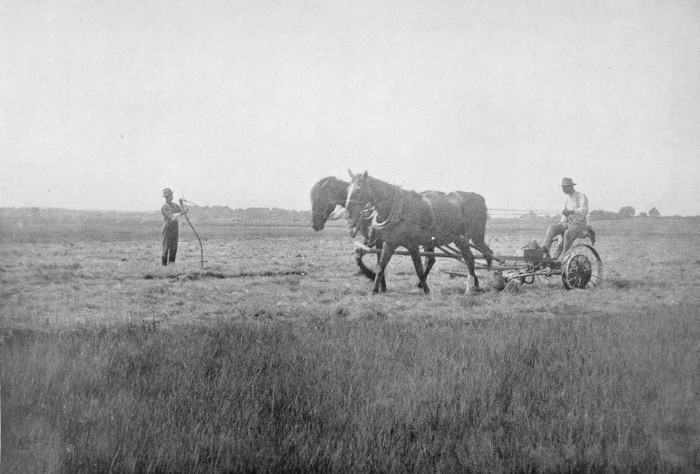 CUTTING THE MARSH HAY The flora
of this
region is more varied, although most of the ground is covered with but
three
grasses: — a short slender relation of the thatch, sometimes called fox
grass,
a sea-spear grass and a spike grass. None of these grows much beyond a
foot in
height. These three are the chief components of the marsh hay, which in
this
era of the gasoline engine is not so assiduously and thoroughly
harvested as
in the days gone by. In cutting
the
grass, which is done in August at periods of a low run of tides,
mowing
machines are used, except in the lower, softer places, where the
scythes are
swung. The horses wear broad, wooden marsh shoes, and a novice horse is
practised in the security of the barn-yard with the awkward, clanking
things
before he is ventured on the unstable marsh. It is no trifle for a pair
of
horses to become mired in the salt marsh, and only those men born and
bred to
the work can manage them in that treacherous region. The hay is piled
in small
cocks, under which are thrust two long poles. These serve like the
handles of a
Sedan chair for the removal of the hay to the higher land beyond the
reach of
the tides. Hay boats,
or
canoes as they are inappropriately called, are also used to harvest
the hay.
These are long, narrow, flat-bottomed, square-ended scows that work in
pairs
covered with a broad platform, on which the hay is piled. With great
sweeps, long
unwieldy oars, the haymakers slowly urge them along the winding creeks,
while
the steersman, with a huge oar resting on a supporting oar-lock in the
stern,
directs their course. In many places the hay is piled in huge stacks,
that are
elevated above the highest tides on small piles or “staddles,” as they
are
called, and the stacks dot the marsh for miles like clustered tents.
When the
marsh is fast bound by winter frost the farmer goes his rounds and
carries off
the savory, salty hay on sledges, his horses’ iron shoes now well
sharpened. No
need of wooden marsh shoes; all is hard and solid as the rocky ledges. Nearly all
the
farms of this region, even those several miles from the marshes, have
their
patches of salt marsh, each reached by an ancient right of way. Most of
the
marsh hay is fit only for bedding, but when cut at the proper season
and
carefully harvested it makes valuable fodder for cattle. 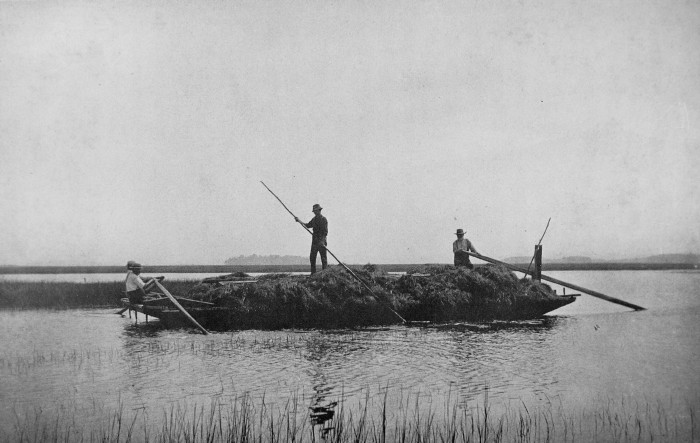 BRINGING IN THE MARSH HAY Besides
the fox,
sea-spear, and spike grasses of the broad marshes, one comes on patches
of a
salt marsh sedge, which, with its sturdy brown bunches of fruit, grows
in protected
regions, while the seaside plantain with its narrow grass-like leaves
is common
everywhere. Another plant with narrow leaves, and therefore mistaken
for a
grass and called arrow grass, is common in this zone. Perhaps
the most
striking plant, when it emerges from its inconspicuous green of
summer, and
changes in the fall to a modest red and later to a flaming scarlet, is
the
glasswort or samphire, a plant of universal distribution in salt
marshes, both
in this country and in Europe and Asia. The sea
milkwort, a
humble saline member of the primrose family, surnamed glaux from its sea-green
color, bears tiny flowers of pink and lavender, and grows prostrate or
erect
among the grasses. Another
marine
plant of the salt marshes — four in this small company rejoice in the
specific
name maritima — is the
seaside gerardia, which has little rose-purple
fox-gloves on its slender stalks. But the most prominent flowering
plant of
this region, and one that forms great nosegays of tiny lavender flowers
in
delicate interlaced sprays, is the marsh rosemary or sea lavender. This
is a
sturdy perennial with a clump of oblong leaves rising from the root,
and it is
one that blossoms from July to September. The fourth
and
highest zone, — the fringing edge where it joins the upland, — a region
that is
visited only by the unusual spring and autumn tides, or when easterly
storms
reinforce the moon, is the black-grass zone. This zone averages from
half a
dozen feet to as many yards in width, but may extend over many acres
that are
shut out except from the highest tides. The black-grass also occurs as
islands
elevated slightly above the level of the general marsh. This
black-grass, the
main component of the zone, is so called because of its dark color,
which looks
almost black when the plant is in fruit. It is a rush, however, and not
a
grass. Extending
down into
the black-grass grow clumps of the handsomest of all the goldenrods,
the
seaside golden-rod, while the silver weed abounds in places, and the
delicious
sweet-grass can occasionally be found on its borders. I have attempted
to measure
the vertical range of the last three of these four zones, and have
found that
the thatch ranges through approximately six feet, extending from within
about
three feet of low-water mark to the lowest high-water mark; that the
zone of
marsh hay ranges vertically about two feet, while the zone of
black-grass has
a vertical range of only about a foot. 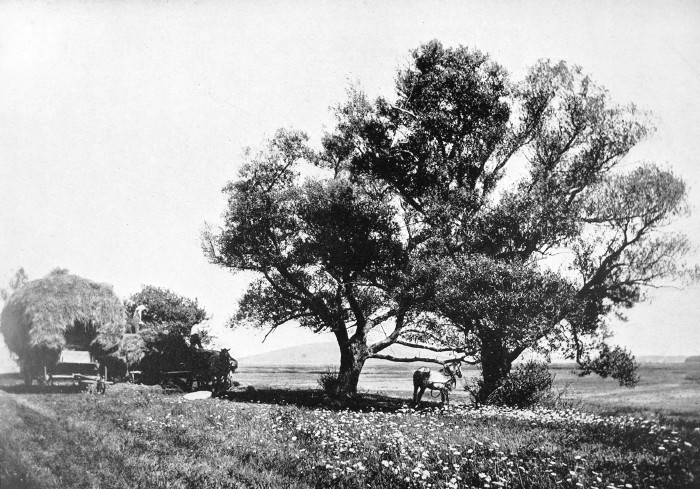 HARVESTING THE MARSH HAY All the
marsh vegetation
is at its height of luxuriance in mid-August. Then the marsh lies
brilliant in
the sunlight, a broad expanse, flat as a floor and glowing in
yellow-greens,
touched here and there with washes of buff and of chestnut. Fringing
its upper
edge is the broad band of the mourning black-grass, while the rich dark
green
of the thatch threads invisible serpentine creeks, and borders the
ribbons of
water that wander hither and thither like tortuous veins through the
marshes,
reflecting the brilliant blue of the skies. There are wonderful plays
of light
and shade as cloud shadows chase each other over the surface of the
marshes, or
as the lengthening shadows of the hills extend their range with the
declining
sun. On windy days the tall thatch bends before the blasts, and
shimmering
waves like those on the surface of the water pass over it. On such days, with the wind in the northwest quarter, the air is exceedingly clear, and every wooded island and distant hill stands out with great distinctness, while the creeks take on an intense blue which contrasts strongly with the light green of the marshes. The tides creeping over the sand flats, swelling the creeks, obliterating the brown banks and drowning the tall thatch, bursting out in unexpected veins and pools throughout the marshes, — all this, notwithstanding its twice daily repetition, is never other than a miracle.
And when at the full of the moon in the night, the sea spreads silently over the broad marsh, reflecting the silvery light in the sky, the miracle is at its height! 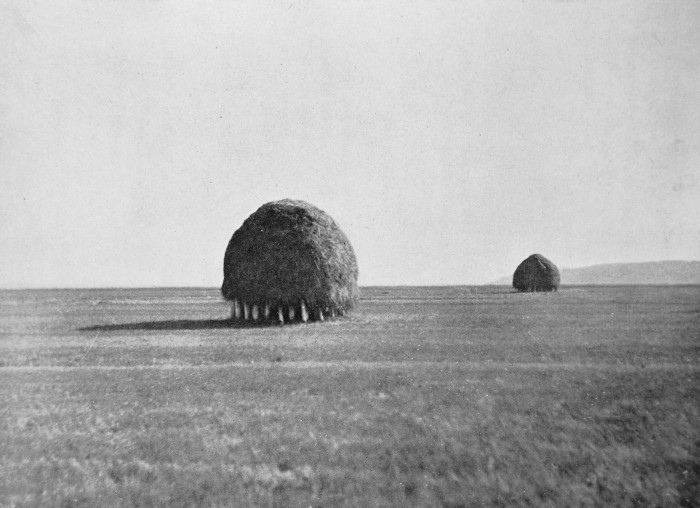 HAYSTACKS IN THE BROAD MARSH
Sidney Lanier was a true lover of the marshes, and saw and appreciated their every detail. And again:
The ebbing tide is as wonderful as the flood: and the sunrise is as wonderful as the sunset.
To float down in a canoe with the ebb tide, to explore the narrow channels now sunk deep below the marsh level, to surprise the marsh birds on the broad sand and mud flats, to push over the waving forests of eel grass with their varied inhabitants, affords much enjoyment, and opens up an entirely different world from that of the same water courses when they are brimming over on to the marsh. Partly from prejudice, partly from ignorance, dead low tide is not appreciated as it deserves. The clean sand of the estuaries and the fine mud of the smaller creeks and inlets, and the clear Water of the sea, are all very different from the foulness to be found at low tide in the neighborhood of sewer-discharging cities. 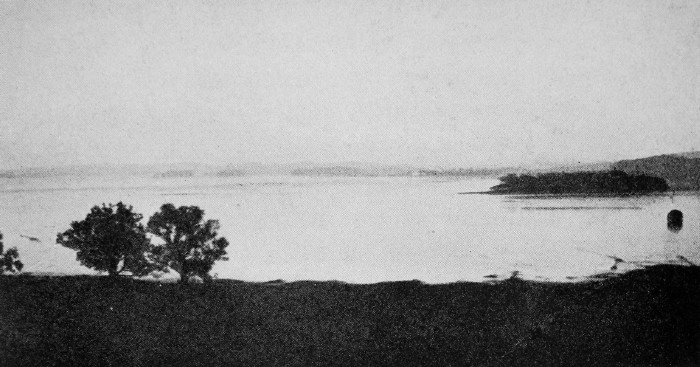 HIGH TIDE. — TAKEN BY THE LIGHT OF THE FULL MOON 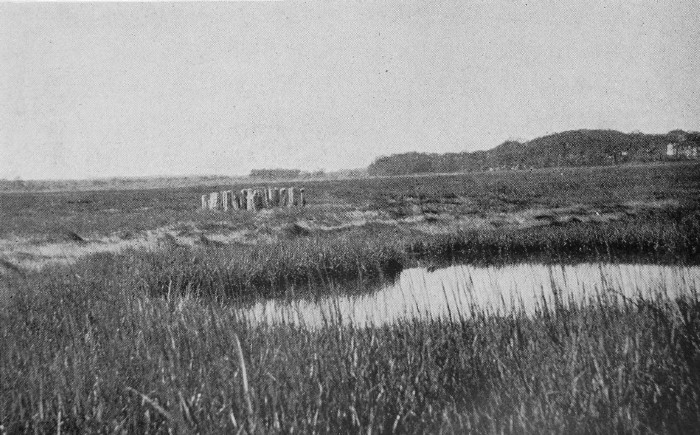 A STADDLE IN THE MARSH In the
fall of the
year the marshes take on a yellowish brown color, varying in different
lights
from silvery yellow to russet-brown, threaded in places with bands of
light
pea-green, in places with dingy red, while the samphire, hitherto
invisible in
its common green, blazes out in broad crimson patches. Still later in
the year
before the ice and snow cover it all, the marshes wear a uniform
russet-brown
livery, a restful, neutral brown shade, a shade that hair and skin and
clothing
alike of all marsh dwellers assume in time. Yet one finds places where
the
grass is a pale, almost silvery gray, varying to straw color, and again
to a
rich chestnut, while rarely a patch of brilliant orange appears under
certain
conditions of light and moisture.
Early in
the
morning in the wonderful days of Indian summer, when the whole east is
aglow,
the marsh is often white with hoar frost, and each grass blade that
crunches
under the foot sparkles as if beset with innumerable diamonds. As the
sun
rises from the sea, the white veil dissolves and tiny drops of water
hang from
every blade-tip. Later in
the year,
with the creeks lined and for the most part coated with ice, with ice
in all
the pools and sloughs, the marshes in their patchwork dress of white
and brown
resemble ptarmigans that are moulting from summer to winter plumage. Again the
scene
shifts, and winter with its white pall covers the marsh. The creeks are
fast
bound, but expand and contract their groaning bosoms with the flood and
ebb. At
times all is smooth and white except on the borders of the creeks,
which mark
their tortuous courses by eruptive blocks of ice, so dark in the
shadows that
they stand out black and distinct. The smaller creeks are arched with
ice, and
the water comes and goes in concealed channels, but the main creeks and
large
estuaries are generally partly open and show patches of dark blue in
contrast
with the universal whiteness. In the times of the month when the moon
and the
sun pull together, or when the normal level of the tide is disturbed
by fierce
northeasters, the waterways burst their bonds with force irresistible,
carrying all before them, and great ice cakes are tossed and piled
about on the
broad marshes. Between the stranded floes the poured-out tide freezes
fast to
the stubble, and each returning tide adds to the icy coating. The
water
flowing over the ice and collecting in pools assumes a pale green
color that
contrasts strongly with the surrounding whiteness. 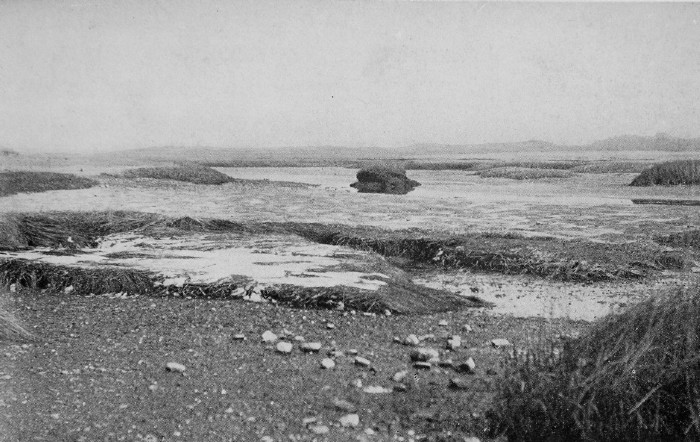 LOW TIDE 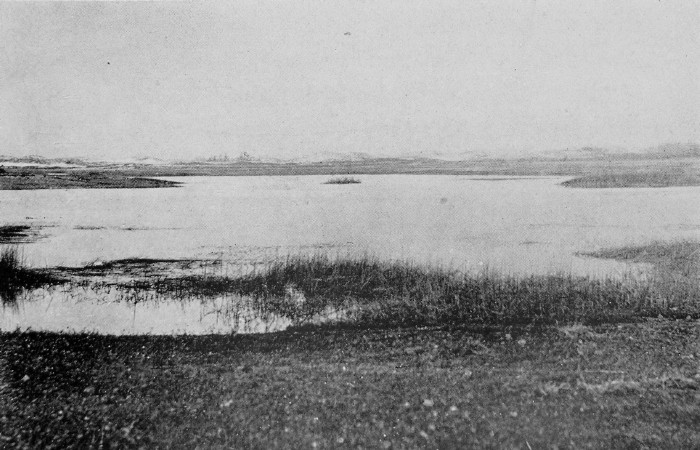 HIGH TIDE In the
sunlight the
white salt ice sparkles and glitters with dazzling splendor, but the
full
arctic glory of the scene is brought out to best advantage in the still
cold
nights when the moonlight permeates everything. Many such scenes have I
enjoyed
in times gone by when I hunted the black duck by moonlight, and I think
I may
be forgiven when I confess that I never succeeded at Ipswich in
shooting a
single duck at this unholy time. The wonderful beauty of these nights
well
repaid the long cold vigils. Everything seemed as bright as day, and
one felt
sure that an object as large and dark as a black duck would easily be
visible.
Yet many a time ducks have flown by so closely that their wing strokes
whistled
loud in my ears, but peer as I might, they remained invisible, unless
perchance
they flew across the moon or its beams reflected from the ice or water.
All things
come to
an end in time, and the last ice cake, honeycombed and darkened with
sand and
mud gathered on its journeyings to and fro, vanishes, and the marsh is
left
brown and prostrate from its winter’s battle. All the graceful thatch
is broken
off and lines the edges of the uplands in great mats, and the mud where
it grew
is open to the sky. Spring has long visited the uplands, soaked in
fresh water
from melting snow and spring rains, before it awakens the salt marshes.
These
emerge from their winter mantle a uniform drab or yellowish-gray,
lighter in
the sunlight and darker in the shadow. 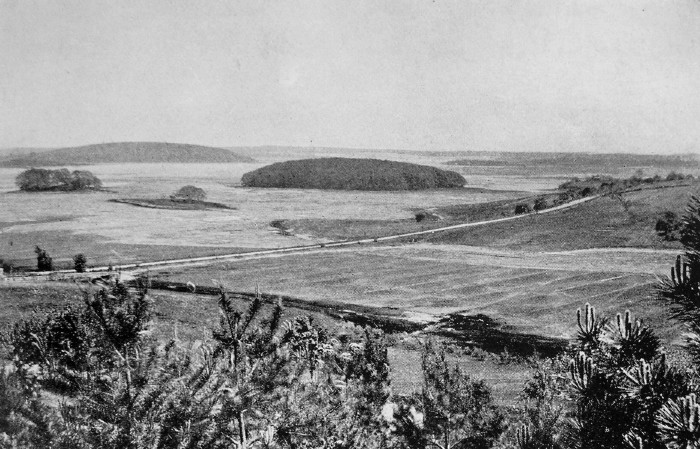 MARSH ISLANDS 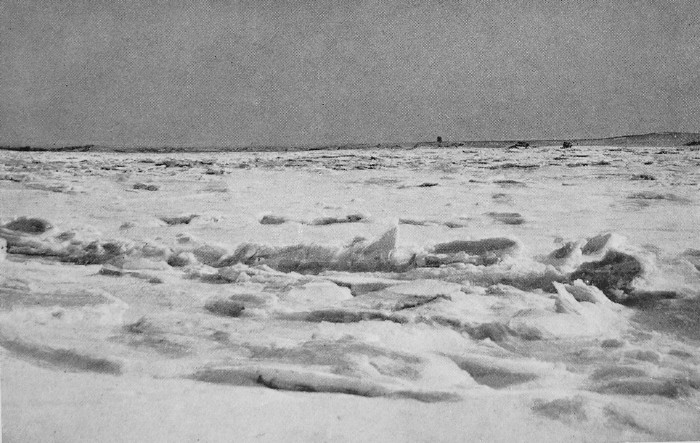 THE MARSH IN WINTER When the
tender leaves
of the willow are first showing, early in May, and the dog’s-tooth
violets are
spreading their yellow carpets on the islands, the marsh shows its
first sign
of returning life by patches of dark green in the black-grass zone. A
little
later and a tinge of pale green appears on the borders of the creeks,
where the
thatch is sending up a few sparse sprouts. By the middle of May the
creeks,
large and small, are edged with the pale green of the young thatch, a
green
with much yellow in it, while the black-grass is now even darker than
before
and has taken on a bluish tint. Only here and there in the great middle
zone is
there a suspicion of pale green in the universal drab, but by the first
of June
this pale greenness has spread in bands and patches over the marsh, and
has
become dark green interspersed and tinged with the drab of the old
rowan. And
so the seasons come and go and the marsh is always beautiful. |
 Click the book image to turn
to the next Chapter.
Click the book image to turn
to the next Chapter.