
Web
and Book design,
Copyright, Kellscraft Studio 1999-2007 (Return to Web Text-ures) |
Click
Here to return to Sand Dunes and Salt Marshes Content Page Return to the Previous Chapter |
 (HOME) |
|
CHAPTER II TRACKS AND TRACKING
ON the snow the study of the tracks of birds and beasts is an interesting one, although often of short duration, limited to the winter and to favorable snowfalls; but at all seasons, in the white fields of sand he who runs may read the history of the dune inhabitants. In the exposed places the wind may speedily efface the records, or the frosts of winter may render parts of the surface unyielding to the impress of feet, but there are always places in the dunes where the tracks are wonderfully perfect. In the summer, creatures that never are seen in the winter, and consequently never make tracks in the snow, such as toads, snakes and grasshoppers, spread their strange hieroglyphs over the sand. 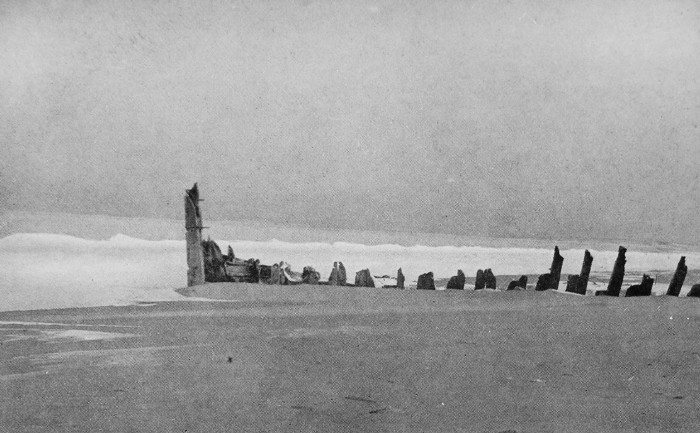 WRECK ON THE BEACH ABOVE THE ICE WALL 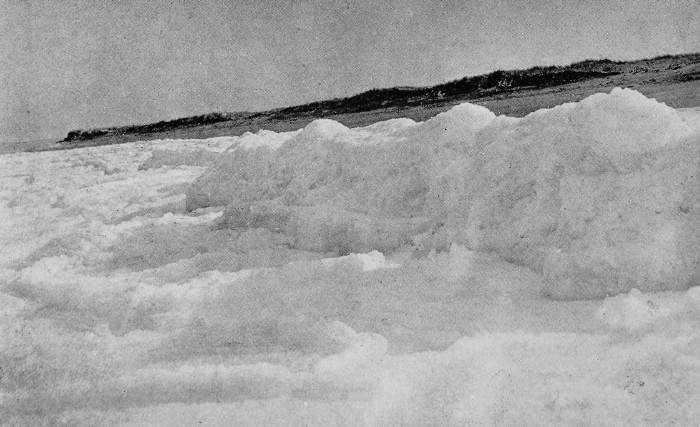 ICE WALL The most
favorable
time for the study of tracks is in the early morning when the oblique
sunlight
makes deep shadows, when the morning dew moistens the surface so that
it
retains best the shape of the imprints, and before the wind has arisen
to
obscure them with the blowing sand. The dune
lover
comes to recognize the common tracks as quickly as he does the face of
an old
friend, and the study of the new and less familiar ones is always
enticing. Not
only can one learn the nature of the animal that makes the tracks, but
often a
good deal about its manner of life. In the case of most of the makers
of
tracks, with the exception of birds and insects, the creature is rarely
or
never seen, and all the insight we can get into- its life is from the
telltale
footprints and perhaps from its droppings. This is the case very
largely with
the mammals, for most of them are nocturnal in their habits, lying
concealed
during the hours of daylight when their deadly enemy, man, stalks
abroad. One of
these night
walkers is the Virginia or white-tailed deer, that charming animal
which,
thanks to the well-enforced protective laws, is more abundant in
densely
settled eastern Massachusetts to-day than it has been for over a
hundred years,
and it is possible that in some localities it is even more abundant
than has
ever been the case. At first thought this seems a rash statement and an
unreasonable conjecture, but it is within the bounds of possibility,
for not
only has white man ceased to persecute the deer, but he has eliminated
its
natural enemies, such as wolves, lynxes and panthers, as well as the
Indians.
Thoreau wrote in 1853: “Minot says his mother told him she had seen a
deer come
down the hill behind the house and cross the road and meadow in front.
Thinks
it may have been eighty years ago,” — that is about 1770. I was told
that half
a dozen deer were recently seen in one field in Concord, and single
deer are
almost every-day occurrences. Since about the year 1900 deer have been appearing in increasing numbers in this seashore region, but not until 1906 did I have indubitable evidence of their presence in the dunes. In May of that year I found the tracks of two deer in the sand, but, although I occasionally saw deer in the daytime elsewhere, it was not until 1910, owing largely to their nocturnal habits, that I actually saw the animals in the dunes. I have no doubt, however, that I have frequently passed close to them in the sunlight as they lay crouched in the dune thickets. Their presence has not been an entirely unmixed pleasure to all, for the lone farmer of the dunes, whose arable land and orchards were first covered by the sand, and whose planted peas were later scratched up by the imported pheasant, has recently been obliged to erect high wire fences around his small, sandy vegetable gardens to prevent their total consumption by the deer. Near the farmhouse on Castle Hill are some Japanese yew trees which prove in winter a most attractive diet for the deer. To protect these, scarecrows of red flannel wave their flimsy arms in the breeze, and I have recently been obliged to protect in a similar manner some of my own white cedars to prevent their total destruction. However, the occasional sight of these graceful animals, and the more frequent discovery of their delicate tracks, is well worth while. 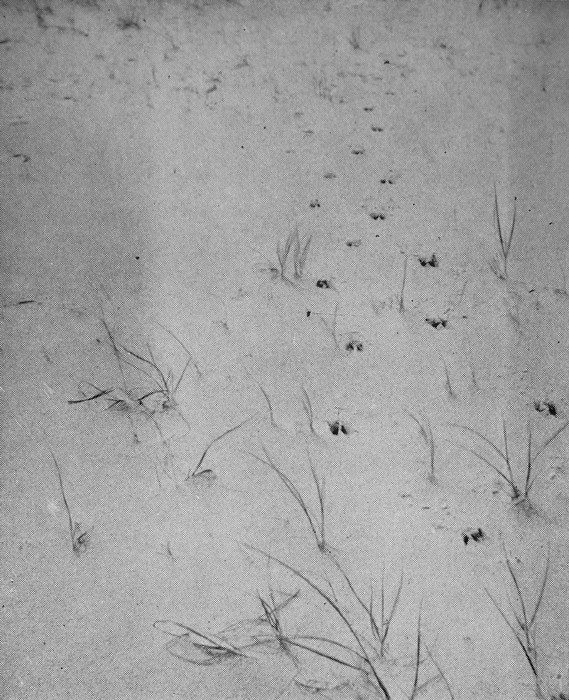 DEER TRACKS 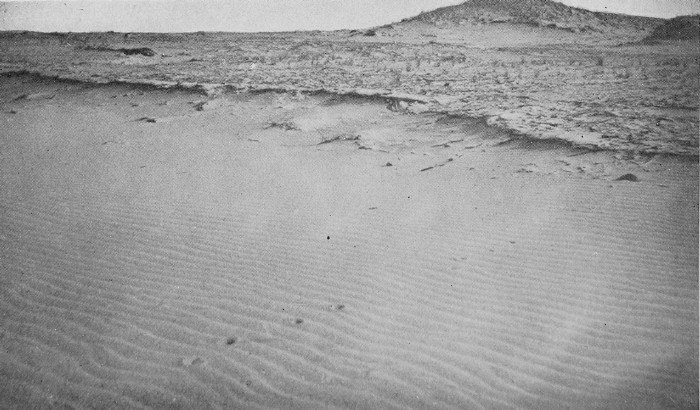 JACK RABBIT TRACKS, IPSWICH, 1903 I shall
never
forget a splendid buck with spreading antlers that trotted over the
broad marshes
one beautiful summer morning in full view of my house. Into the tide he
plunged, and swam until he came within sight of some boats at their
moorings.
Turning in alarm he regained the bank and by leaps and bounds
disappeared over
the marsh in the direction of a wooded island. The Virginia deer takes
to salt
water as to the manor born. On a bleak March day in 1909 I landed with
Ralph
Hoffmann and Glover Allen on Milk Island, a good half-mile off the end
of Cape
Ann, to watch at closer range a snowy owl. The owl flew to the
mainland, but to
our surprise a lovely doe began bounding over the low bushes, throwing
up her
white flag of a tail in a manner that seemed to light up the whole
islet. It is
impossible to accept Abbott Thayer’s ingenious theory — which only an
artist
could have invented — that the white tail against the sky in the
night-time so
cuts up the outline of the animal that the wolf, stealing up for the
fatal
leap, is confused at the crucial moment and the “obliterated” deer
escapes. A stuffed
deer, skilfully disposed by the enthusiastic artist, seems to prove
this
theory so forcibly that some are led to ‘accept it, forgetting the
wonderful
sense of smell on the part of the wolf, which must be so overwhelming
at such
close range, that, even blinded, he would leap true. The strongest
argument
against such a fantastic theory, however, is that in the daytime, as
well as in
many situations at night, when the trees or hillsides cut out the sky,
the
flashing tail does not obliterate, but renders much more conspicuous
its owner,
even to the crouching foe. I once saw two deer at dusk in a meadow
surrounded
by woods. The light was so poor that I could hardly distinguish the
creatures
until in alarm they raised their white tails. Even when I assumed the
position
of the “crouching wolf,” the white tails were most conspicuous and
advertised
the deer. It was impossible to bring the tails against the sky. If
there were
not some other reason for this flashing tail it would on account of its
conspicuousness
long ago have been itself obliterated by natural selection. There are
many
facts in nature that are difficult to understand, and it is far better
to admit
ignorance than to accept an untenable theory. In the case of this deer,
however, as in the case of other creatures similarly marked, the theory
that
the white spot is intended to be conspicuous and to be used as a
directive mark
or as a danger-signal to others of the same species seems a
common-sense view,
and will answer for most naturalists as a good working hypothesis. Early one
May
morning, while the sun was still low over the sea, I was walking up
wind along
the beach, when I noticed a doe standing like a statue with ears
erect, gazing
out into the east, a worshipper of the two greatest mysteries, the sea
and the
sun. Although I stopped and myself stood motionless, the nervous
twitching of
her tail from side to side showed she was uncertain as to the identity
of the
object on the beach, but when she turned and ambled off into the dunes
her tail
remained down, the flag did not show, and I concluded from the absence
of this
instinctive danger-signal of her race, that she had not recognized me
and was
not alarmed. One
January day in
1912 I had been watching a herd of twenty seals on the bar, and many
sea birds
in the water, when I looked towards Steep Hill and saw, standing in the
snow
and against the sky line, a group of seven deer — two stags and five
does or
full-grown fawns. The stags, with heads erect and splendid spreading
antlers
borne on high, stood like statues peering at what they suspected was
evil but
did not know, for the wind was not in their favor. The does with
feminine
curiosity stretched their slender necks in my direction and erected
their great
ears. The group formed a picture long to be remembered. Finally one
stag, more
knowing than the rest, raised his white flag, spread the long white
hairs on
his rump, and ambled off, and the others at once followed suit. Deer
tracks in the
dunes are often abundant and easily recognized. Usually the marks of
the split
hoofs only are seen, but in the softer sand the imprints of the two
additional
dew-claws show. When the animal trots the hind feet are placed so
exactly in
the marks of the front, that one rarely sees the double imprint, but
when the
deer bounds away in fright or play, all four feet strike the ground
separately.
One such set of bounding prints I measured and found that each jump was
four
feet long. One can almost see the graceful animals as one follows the
clean-cut
tracks, sometimes of a great bounding stag, sometimes of a doe with a
little
fawn. Usually these two trot along together, but sometimes the fawn
springs
about in small circles near its sedate mother. When the
prairie-hare or western jackrabbit was introduced in Ipswich I do not
know,
but throughout the nineties and up to about the year 1907 it was common
in the
dunes, and its tracks were everywhere. In the last named year it began
to
diminish in numbers, and in 1909 it was no longer to be found in its
old haunts,
and to-day is, I am afraid, entirely extirpated. Whether this
extirpation was
due to the foreign and unfavorable environment, or to the fox, which
has
increased considerably in numbers since 1907, is an open question,
although the
jack-rabbit ought to be able to escape the fox in a fair race. Seton
calls it
“the speediest wild four-foot left on the Manitoban prairie to-day,”
and says
it can outrun the fox. The fox, however, does not restrict himself to
fair
means and the open chase in obtaining his prey, neither does he decline
the fat
and tender young. When jack-rabbits were common, I could almost always in a day’s walk start one, and I never ceased to be astonished by the creature that looked almost as large as a calf, as it bounded off through the dunes. 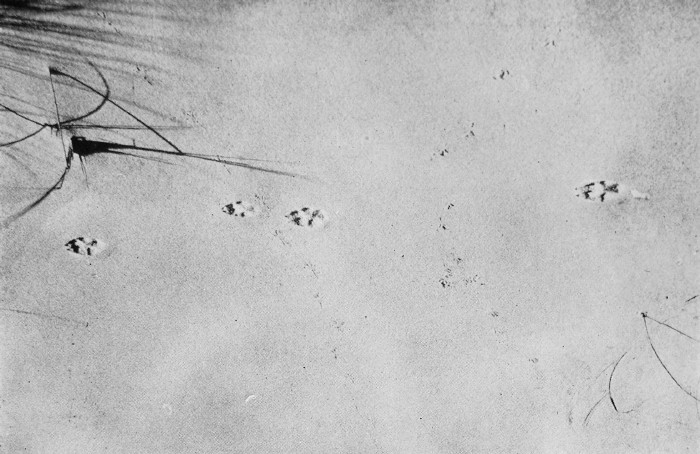 TRACKS OF FOX AND CROWS 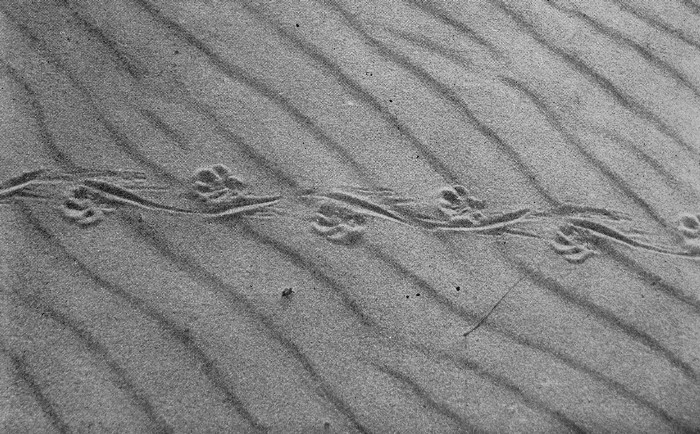 MUSKRAT TRACKS Both Coues and
Seton describe this starting up and bounding away of the jack-rabbit
so vividly
that I cannot do better than quote them here. And first Seton: “You
never know
where you may find a Jack — no one does — you never see it till it
leaps at
close range and lopes away in stiff four-cornered bounds, rising
without
effort, like an Antelope, and switching its great white brush from side
to side
like a miniature White-tailed Deer; blazing with snowy white and
punctuated
with sharp black spots on his ears, it is the king of all his kind, the
largest
and finest of the Hares.” And then Coues: “The first sign one has
usually of a
Hare which has squatted low in hopes of concealment, till its fears
force it to
fly, is a great bound into the air, with lengthened body and erect
ears. The
instant it touches the ground it is up again, with a peculiar springy
jerk,
more like the rebounding of an elastic ball than the result of
muscular
exertion. It does not come fairly down and gather itself for the next
spring,
but seems to hold its legs stiffly extended, to touch only its toes,
and
rebound by the force of its impact.” In running
rapidly
this great hare spreads its foot-prints in a line so that the track
suggests
that of a fox until the marks are critically examined. At a slower gait
it
jumps like the familiar little cottontail, also found in the dunes,
putting its
hind feet in front and outside of its fore feet, and the tracks appear
in
patterns of fours. I have often followed the tracks of a jack for long
distances, as he bounded in and out among the dunes, sometimes going
down to
the beach or up to the top of a sand peak. The abundance of tracks on
the tops
of some lofty dunes would suggest midnight sessions of the tribe. It is
a great
pity that this interesting animal is a thing of the past here, for he
was
certainly a charming feature of the dunes. My most
intimate
relations with a jackrabbit occurred on January 27, 1907. Snow was
spitting in
biting gusts from the northeast and the thermometer was only twelve
degrees
above zero, a day when bird and beast might feel fairly secure from
man. But
the jack, whose tale I now relate, reckoned without his host, for in
an Eskimo
koolatuk and on snow-shoes I could comfortably defy the storm. My
friend, the late
Mr. Julian Dodge, who was ranging in front of me in the dunes, suddenly
threw
himself like a foot-ball player on a ball, and emerged from a
snow-drift with a
great kicking jack-rabbit. He afterwards explained that he had caught
sight of
the rabbit’s eye among some protecting grasses under a curling
snowbank, and
without hesitating a moment had pounced on his prey. To one who has
tried to
shoot this swift-running, elusive beast the tale may sound
apocryphal, and I
must in justification quote the following from Seton: “It is well known
that
the English Hare and the Common Cottontail will lie up, under stress of
bad
weather, letting the snow drift over them. There they continue several
days
without eating, and in a semi-torpid state, until aroused by some
outside
change for the better.” This description fits the case exactly, except
that the
outside change was for the worse! Reynard
the fox now
reigns supreme among the dunes. He has been a large element, doubtless,
in the
infant mortality of the jackrabbits and their untimely destruction.
All is
game, living or dead, that comes in his way, and he is fond of the fish
and
birds washed up on the beach, but the various wild mice are probably
his chief
dependence. His tracks
are
everywhere in the sand, but should be carefully distinguished from
those of his
cousin the dog, who unfortunately also ranges the dunes at times. As a
rule the
tracks of the fox have such a clear, clean-cut appearance that they are
easily
recognized. Each foot is put down with care; there is no slouching or
shuffling, and each step is usually a stride. Most important of all,
each footmark
of the fox almost always shows two toes and claws projecting in front,
while
the footmarks of most dogs are nearly round. The one is slender and
aristocratic, the other stubby and commonplace. One cannot always be
sure of
the identity of every track, but long practice lessens the chance of
mistakes. On a hot
August day
I followed some fox tracks, made evidently the night before, until they
crossed
the path of a toad. Suddenly the leisurely gait changed to bounds,
there were
some conspicuous scratch marks, and the toad tracks ceased. After that
the fox
tracks ambled on as before. Near some other fox tracks I found a dead white-footed mouse with no mouse tracks near. Foxes apparently have a way of carrying mice in their mouths, and this must have slipped out unnoticed from an overfull receptacle. Captain Cartwright in his Labrador Journal speaks of finding inside a trap, which had been sprung without catching the fox, “five large mice, which the fox had dropped out of his mouth.” 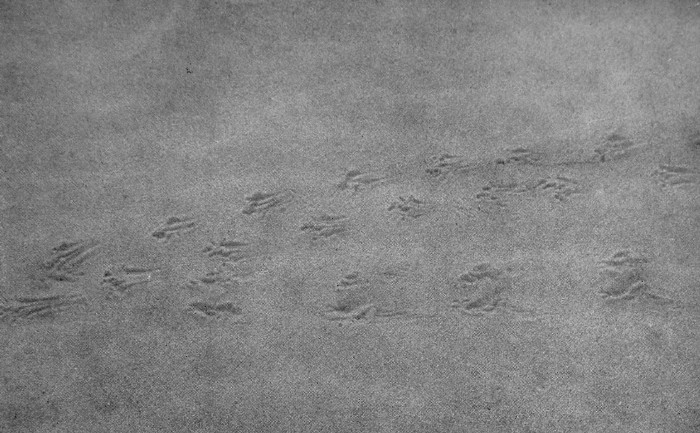 TRACKS OF TOADS 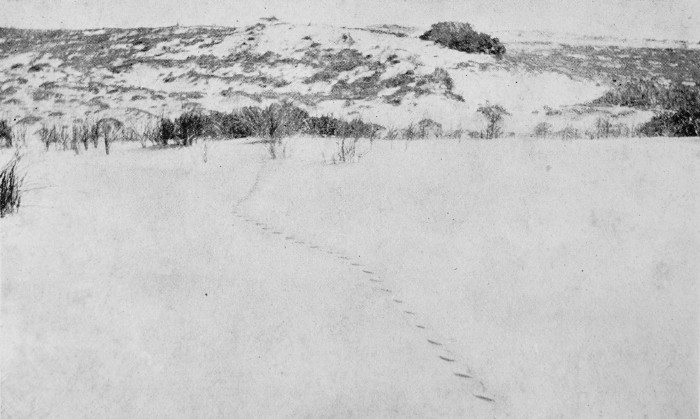 TRACK OF SNAKE Some years
ago,
from a study of tracks in fresh snow in the dunes, I concluded that
crows
sometimes spent the night roosting on the ground. With the increase of
foxes there,
I am inclined to think that this is no longer the case, but in April,
1910, I
found fox tracks and the remains of a crow, — but this of course may
have been
only a dead crow feast. Live crows are generally well able to take care
of
themselves; they need no protective coloration and have none. Although
foxes are
abroad largely at night, I have not infrequently seen them by day. When
first
started they bound away in great leaps, showing the edges of their
white
bellies in contrast with their red sides; later they streak along, to
use an
appropriate slang phrase, close to the ground, their great brushes held
straight out behind. As they disappear into a distant thicket the white
tips of
their tails are the last to show. One winter’s day I followed some
fresh fox
tracks till they led me to some bushes overarched with a snow-drift. As
I
cautiously approached, a splendid fellow bounded out and fled to the
peaked top
of a dune several hundred yards away, where he deliberately sat down to
watch
me. I returned the compliment by levelling my binoculars on him, and
found he
was not the common red fox, but of the color-phase known as the cross
fox. As I
was watching him a flock of snow buntings swirled about him like a
miniature
snow-squall. He crouched low, with his eyes upon them, but they avoided
the
trap and swept on. At another
time I
heard sounds of anger and indignation from the mouths of crows, and
discovered
three or four of these birds in the act of mobbing a fox, who, however,
sauntered along, apparently not a whit disturbed, with his brush held
straight
out behind. One can
learn a
good deal about the ways of the fox from these tracks without ever
catching
sight of the animal. Another source of information is the droppings,
which are
easily recognized and are common in the dunes. As these are made up
largely of
fur and feathers, and have been exposed to the purifying action of the
sun and
sand, they are as clean as balls of worsted. In fact their unravelling,
with
here and there an object in the form of a bone, a tooth or a claw,
recalls the
old form of lottery once popular at church fairs, where for a stipend
one might
unroll a ball of worsted until a prize dropped out. In both instances
there is
an element of chance which makes the game interesting, — it is more or
less of
a gamble. Sometimes there are no prizes, for the fur composes the whole
of the
droppings, which then resemble tapering cylinders of felt 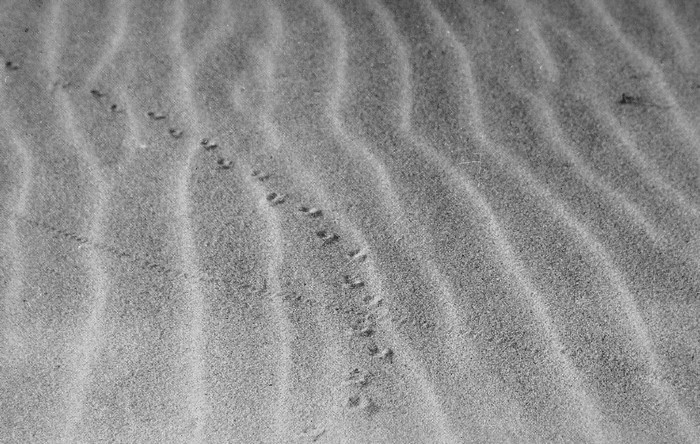 TRACK OF MEADOW-MOUSE AND OF A WOOLLY BEAR CATERPILLAR 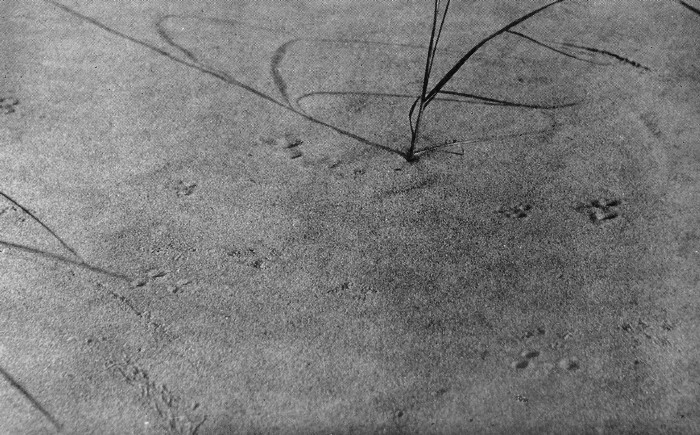 TRACKS OF WHITE-FOOTED MICE As a
result of many
unravellings of fur and feathers, I am able to present the following
fox menu:
portions of sand-fleas and sea-scuds and other small crustaceans;
portions of
June beetles and tiger beetles; bones of toad and frog; feathers of
domestic
fowl and of wild birds, large and small; bones of birds; claws of night
heron
and portions of skin of foot; sclerotic or eye bones of some bird; fur
of mice
and rabbits; bones of mammals; teeth of meadow mouse; teeth of young
skunk. The weasel
bounds
like a hobby-horse and leaves his foot-marks in pairs on the sand, —
round
impressions about the bigness of one’s thumb nail. These tracks are not
common,
but it is easier to find them than the beast itself, which, however,
does not
appear afraid when seen. I once heard the piteous squeaking of a
meadow mouse,
and saw a weasel bounding along, carrying the dying mouse in his jaws.
He
dropped it and retired to some bushes, but soon reappeared and bore off
his prey,
although I stood within a few feet of it. The brown summer coat of the
weasel
is exchanged in winter for the royal ermine — pure white with the
exception of
a black tip to the tail. One winter morning before it was fairly light
I was
walking to the dunes when I saw what appeared to be a piece of white
paper
blowing towards me. Within a few feet it suddenly developed into a
lovely
ermine that scurried by and disappeared among the snowdrifts. The mink —
midway
between the weasel and the otter — is both a land and a water animal.
Although
I have often seen him on pebbly shores of the ocean bordering on woods,
running
out slyly and unconscious of my presence as long as I was motionless, I
have
never caught sight of him on the sandy shore of Ipswich. In the salt
marshes,
however, he delights to roam both summer and winter, swimming the
creeks and
tidal pools in the summer, and climbing in and out among the ice cakes
in
winter. In the latter season he is a conspicuous object, for he does
not turn
white like his cousin, the crafty weasel, and his rich glossy brown fur
contrasts well with the ice. One of these fellows, wandering among the
ice
floes stranded on the marsh, met death at my hands in those days when I
“observed” as frequently along the shining barrel of a gun as through a
glass,
and his beautiful skin still serves in arctic weather as head-gear for
his
slayer. A dozen
small fish
left on a log on a marsh island during a cold night disappeared
utterly, so
that my breakfast was a scanty one, while a mink was undoubtedly
pleased with
this singular change of habitat on the part of the fish. If the
mink
combines in himself the weasel and the otter, he also shows some
relationship
with the skunk, for he is capable of producing a most abominable odor,
but little
inferior to that of the latter well known animal. His tracks I have
often
found; they resemble those of the skunk but are considerably smaller,
and the
claws are more prominent. A drop of bright blood near his tracks stamps
his murderous
character. Only
occasionally,
when there is plenty of water in the dune bogs, do the tracks of
muskrats
appear on the sand, and strangely enough I have found them leading from
one bog
to another over dry stretches of dune land. The marks of the webbed
hind foot
can sometimes be plainly made out, while the median groove formed by
the
dragging tail is a conspicuous feature, and makes the diagnosis easy. The skunk is certainly a beach-comber, but his visits to the strand are with very rare exceptions made only at night. The beach is a happy hunting ground for him, because, like the fox, he enjoys the varied and gamey diet that the place affords, and his tracks abound there. They are also spread like a network over the dunes, with here and there a small pit where he has dug for grubs or cut-worms. The footprints are often beautifully distinct in the sand, and show each toe and claw, and these as well as the gait are characteristic. 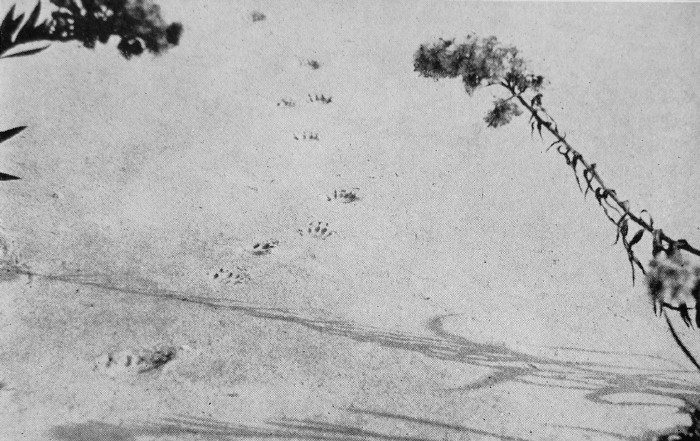 SKUNK TRACKS 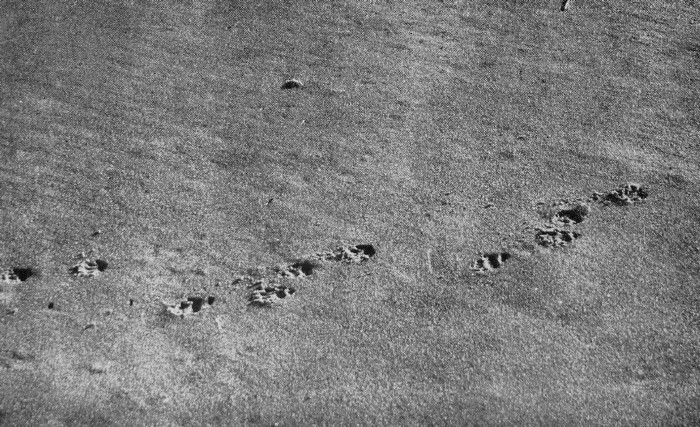 TRACKS OF A SKUNK IN A HURRY I once had
an
excellent opportunity to study the gait, not merely in the tracks, but
in the
living animal. With a friend I came upon a skunk on the upper beach,
and, by
heading him off from the dunes, we were able to drive him down to the
edge of
the waves, although we always kept at a discreet distance and watched
his tail.
The animal was evidently enraged by our manoeuvres, and showed his
displeasure
by turning and facing us from time to time and stamping his fore feet
on the
sand. One of us then walked behind him as he ran along the beach, while
the
other prevented his escaping from the water’s edge by walking between
him and
the dunes. When once started, this triangular procession continued
along the
beach for about half a mile. At the end of this march, owing to human
caprice,
the order became single file, with the skunk in the middle, and the
extremities
of the column closing up on the centre. Each of the out-guards
endeavored to
drive the centre towards the other, but each out-guard was secretly
and
cowardly prepared to turn and flee, if the centre showed the
danger-signal by
elevating its tail. The climax was disappointing and unsensational,
for the
skunk, no longer debarred from its haven, the dunes, made off at right
angles
for this refuge and disappeared, leaving the end-guards discomfited,
but in an
atmosphere undefiled. However, my notes say that the speed of the
animal along
the beach was about four miles an hour, and that the gait was a
peculiar one in
that the fore legs trotted while the rear legs seemed to hop or gallop,
so that
the front part of the body kept an even level while the back part
bobbed up and
down. Although
the
ordinary gait of the skunk is a very leisurely one, I once found tracks
which
showed that the animal was bounding over the sand in long strides or
leaps,
because his four feet came down in linear patterns with considerable
gaps
between each set. He must have been frightened by a ghost for, well
armed as he
is, he is afraid of nothing made of flesh and blood. The odor
of the
skunk is almost never noticed in the dunes. Its presence generally
means a meeting
with a dog or a gunner. Skunk
droppings are
often made up wholly of insects, such as beetles and crickets,
although I have
found the bones of birds and mice, their feathers and fur, as well as
bits of
grass and seeds. It is possible that the last named were accidental
additions
to the diet. Mice
tracks in the
dunes are for the most part made by white-footed mice and meadow mice.
The
former often bounds along, leaving tracks in fours like a miniature
rabbit,
while the meadow mouse leaves his tracks in a line or in pairs, and
near
together. The marks are often very clear, showing all the toes and foot
pads.
Noticing a multitude of tracks of the white-footed mouse near an old
log in the
dunes, I lifted it, and there curled up in a soft nest were a pair of
these
delicate large-eyed mice. Occasionally
one
comes across tracks of a larger size made by rats. Where the beasts
come from I
do not know, but it is evident that they exist in these sands, for they
once
made an entrance into my dune camp and left traces of their destructive
work,
which might have been serious had it not been discovered early. By far the
commonest of all-the-year-round bird tracks in the dunes are those of
the crow.
One can observe the force with which the birds alight, the fact that
after
alighting they sometimes bound forward once with both feet together,
and that
they are very apt to drag their middle toe or even all their toes when
they are
particularly tired or lazy. Nevertheless they walk with long strides,
and on
rare occasions only do they hop. Their toe-marks show knobby
protuberances, as
if they suffered from the gout. As they rise into the air, their
wing-marks
are sometimes imprinted on the sand, and I have seen places on the
snow where
they have slipped in walking and spread out one wing to save
themselves. Crows give an easy clew to their feeding habits, as they have a custom of ejecting from their mouths pellets of partially digested food. These pellets are plentifully distributed in the dunes, especially in certain localities where the birds roost. They are one or two inches long, tapering at the ends, and a half to three-quarters of an inch thick. In summer these pellets soon fall to pieces, but in freezing weather they retain their shape. Their most common constituents, by which they may be recognized at a glance, are bayberry or wax myrtle seeds. A few of these seeds are ejected with the waxy coat still intact, but most of them are entirely denuded of it. Cranberries, whole and in fragments, the red furry seeds of the sumach, the seeds of the poison sumach, of grapes and of the bitter-sweet are also common. I have found pellets that were made up almost entirely of whole cranberries or whole bitter-sweet berries, so that it would seem as if their greediness had led the crows to adopt the old Roman custom, that they might gorge the more. 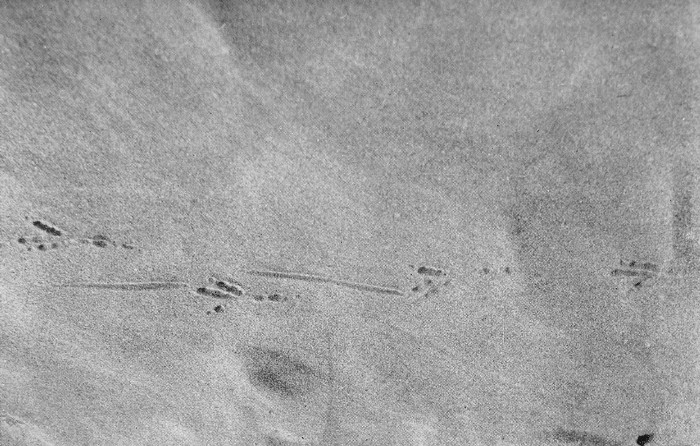 TRACKS OF A CROW 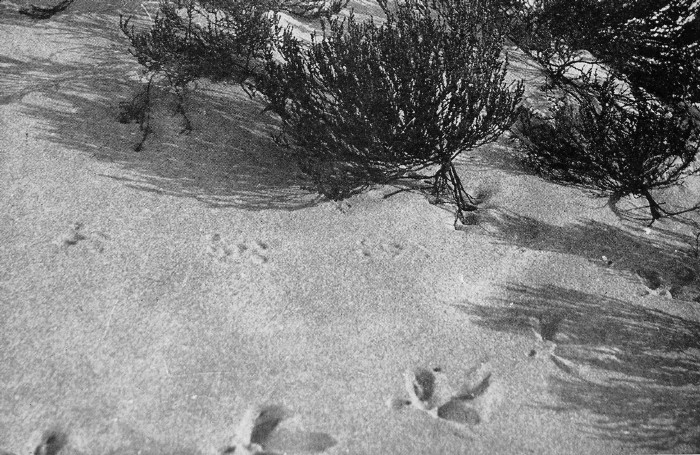 HUDSONIA PLANTS, TRACKS OF WHITE-FOOTED MOUSE AND OF PHEASANT IN SOFT SAND Besides
seeds and
berries the pellets are very apt to contain the shells of the little
black-footed univalve — Melampus
— so abundant in the salt marshes, as well as
those of periwinkles, sea-snails, mussels and clams. Portions of crabs
are also
common, and occasionally one finds bits of June bugs and of tiger
beetles, and
bones of fish, frogs and mice. The
fondness of
crows for other birds’ eggs was clearly revealed to me one May day. A
few
broken remains of a red-winged blackbird’s egg, surrounded by the
tracks of a
crow — that was all, yet it explains the insistent ferocity with which
red-wings chase crows from the thickets. The bill of fare of the crow
is a
varied one! The ring
pheasant
frequently strides among the dunes, leaving tracks very different from
those of
the crow; the three toe-marks in front are widely spread, and there is
no mark
of the hind toe except where he goes down an incline or the sand is
soft, and
then only a dot shows. In an ordinary walk the distance between the
foot-marks
is seven or eight inches, but when running the bird sometimes strides
twenty-two inches. I once
watched a
bald eagle perched on a dune overlooking the sea, and after he had
flown away
the markings of his tail and wings, as well as of his feet, were
plainly to be
seen where he had stood in the sand. Prior to
1904, the
tracks of piping plover might occasionally be found in the spring
spread
thickly about the spot where their eggs were laid in slight depressions
in the
sand of the dunes, but now these birds no longer breed there. In the latter part of the summer, tree swallows alight among the dunes and leave tracks of their brief walks made with short steps, bordered here and there by marks of unmanageably long wings, and punctuated with an occasional dropping containing bayberry seeds. Footprints of many birds are always to be found in the sands, but when the winter birds come in great flocks, — the snow buntings, horned larks and Lapland longspurs, all walkers, — then indeed is the sand well inscribed. All of these, but particularly the last named, have long hind toes and claws. 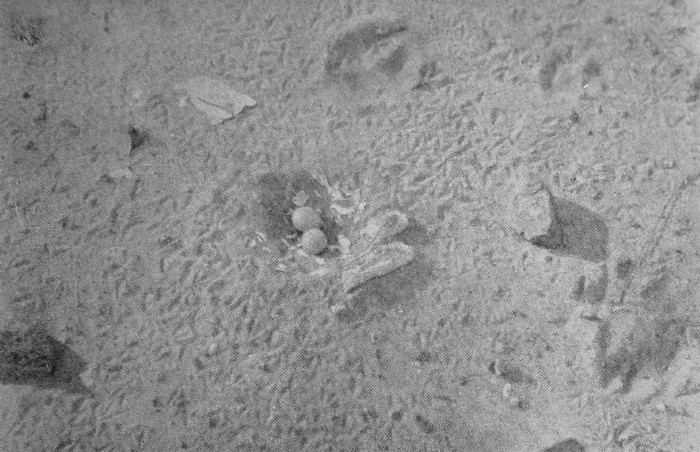 TRACKS AND EGGS OF PIPING PLOVER 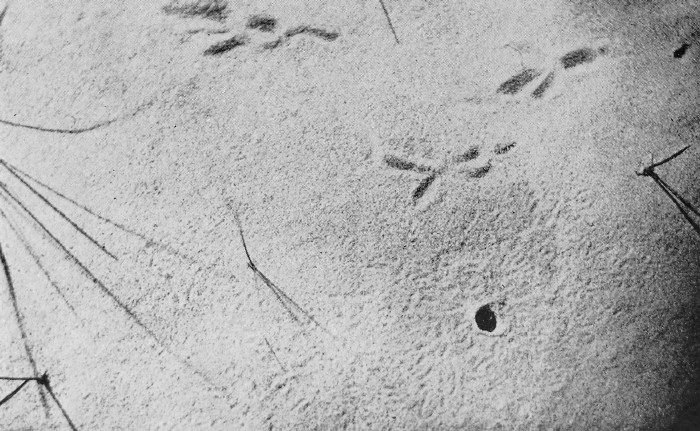 TRACKS OF SAVANNAH SPARROW AND SAND DUNE SPIDER AND HOLE OF LATTER It is very
seldom
that one finds the tracks of flickers, but they are easily
distinguished by the
two toes in front, the two behind and the hopping gait. Although
gulls
often alight and leave their tracks in the dunes, the footprints of sea
birds
are best studied on the damp beach, and a chapter might be written on
this
subject alone. The most characteristic of these tracks are those of the
shore
birds, and one can easily distinguish the records of plover from the
records of
sandpipers, both by the footprints and by the bill-marks. Flocks of
plover
spread out irregularly on the sand, and leave tracks running in various
directions and constantly crossing, while the sandpipers have more
team play,
and run along the beach, up and down before the advancing and
retreating
waves, but always together. The sandpiper, with head down nearly all
the time,
drills the sand with his long bill, and leaves behind him an almost
uninterrupted series of holes close together for the space of a foot or
more,
then a blank space where only his footprints show as he hurries along,
swallowing his prey, then another series of holes, and so on. Not so
the
plover; he strides along with head up, but every few seconds he strikes
the
sand a blow with his short bill for a minute crustacean or worm below
the
surface. These dabbings of the semi-palmated or ring-neck plover are
small,
while those of the black-bellied plover are large and are usually two
or three
feet apart and generally double, which means that the eager bird struck
the
sand with bill partly open. The footprints show three toes wide apart. At night
the beach
is often lined with night herons, and their tracks, as well as those of
their
much larger but less common relative, the great blue heron, and also of
the
small green heron, are easily recognized. When the herring gull alights on the beach, both feet come down together, or nearly so, with considerable force, and thrust slightly forward, as is shown by the deep impressions in the sand at the back of the track. Occasionally the birds strike so flat-footed that the tarsus cuts the sand like a long hind toe. Their webbed footprints sometimes cover the sand thickly for many yards, with here and there a pellet of fish bones, and with feathers as thick as in a poultry yard. If there is a strong wind, gulls are able by a step or two directly toward it to launch their great aeroplanes into the air, but on calm days they run forward vigorously with wings spread, and, as they are gradually borne aloft, the feet still push at the sand until the tips only of the claws make imprints. The distance of the run is inversely proportionate to the velocity of the wind. 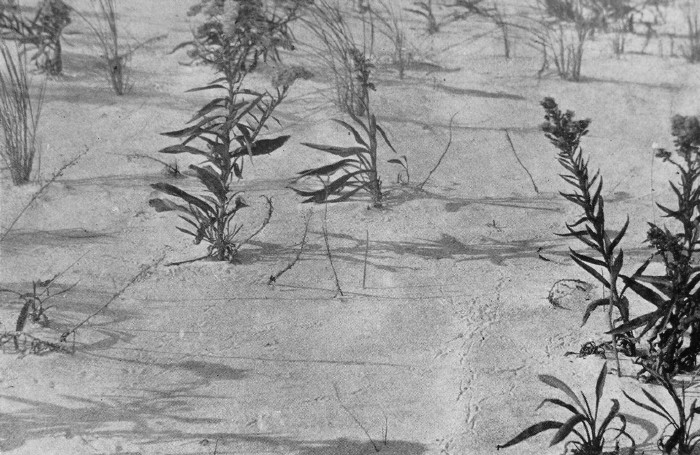 TRACKS OF HORNED LARKS 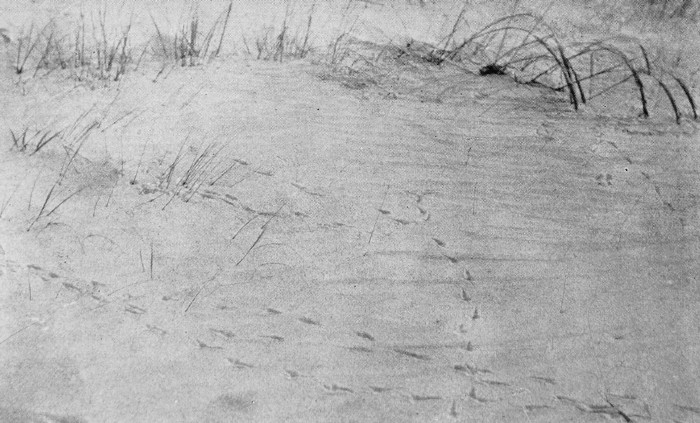 SEASIDE GOLDENROD A curious
habit of
herring gulls leads to peculiar tracks. I refer to the fact that they
not
infrequently drag dead fish in tortuous courses from the upper beach
down to
the water. A dead hake eighteen inches long I found had been dragged
one
hundred and thirty-four paces to the water, and, from the tracks, it
was
evident that the gull had laboriously walked backwards all the way,
pausing
from time to time and relinquishing its beak-hold on the fish. The fish
was
certainly gamey enough to need a salt water souse, but the gull’s
object was
possibly to soften it. This action on the part of the gull seems to me
to
deserve credit for something more than mere instinct. I cannot help
thinking
that the lower animals, in unusual actions of this sort, display an
intelligence akin to our own, and that the sharp line between instinct
for them
and reasoning power for us should not be drawn. The Lord only knows how
much of
our own boasted intelligence is merely instinctive; I have known dogs
that
have shown more reasoning power than I have seen displayed by some
stupid
people. I have a parrot that shows its intelligence in the same manner
as the
gull by taking hard bits of cracker to its water jar and soaking them
before it
eats them. The common
habit of
herring gulls, as well as of crows, of dropping’ clams, sea-snails or
crabs
from a height in order to break their shells, accounts for the
multitude of
these objects both in the dunes and on marsh islands. As its prey
falls, the
bird drops down after it, and sometimes repeats the process again and
again. On
disturbing a
pair of sheldrakes or red-breasted mergansers one calm day from their
comfortable nap on the beach, I found in the sand record that they were
obliged
to stride forward twenty-nine yards before they could push the beach
away from
them. Their strides were three feet long, and the duck led the drake in
the
race. They were unable to head for the little wind that was stirring,
for I was
on their windward side and the ocean was to leeward, so they were
doubly
handicapped. Had the wind been blowing harder, they would undoubtedly
have
risen against it, — towards me. The case of the black duck is very
different.
Its leisurely walk, with short steps and toes turned in, is easily
traced in
the sand to where the track ends abruptly as the powerful wings take
the bird
straight up. The final footprints are not perceptibly deeper than those
that
precede, showing that it is their wings and not the push of their feet
on
which they depend. It is not
often
that double-crested cormorants or shags alight on the beach, but their
tracks
are worth recording. With their stiff tail feathers they scratch the
sand in
places, while the base of the curious foot makes a deep depression in
the sand,
and the three front toes with nails are plainly shown, as well as the
nail of
the fourth toe, which makes a mark at the side; in places there are
indications
of the web which connects all the toes. In rising both feet strike out
together
in a hop instead of a stride. On some
desert
sands the tracks of many reptiles are found, but in these northern
seashore
dunes it is rare that one comes upon the winding track of a snake. A
member of
the group of batrachians, the common or garden toad, here, however, so
sandy
in color as to deserve the name of dune-toad, leaves his tracks
everywhere in
the summer, and from their bizarre shape and great abundance they are
certainly
a surprise to the uninitiated. Concealed in the daytime beneath a board
or log
or in a burrow in the sand, the toad is rarely seen, but he makes up
for his
sluggish days by great activity at night. I have often followed a toad
track
until I became tired of the pursuit, for the animal travels surprising
distances, often, curiously enough, in a straight line over hill and
dale among
the dunes. Of insect
tracks in
the dunes there is a goodly quantity, from those of the grasshopper,
which,
owing to the multitude of footprints, suggests a milliped, but whose
hop-marks
are deep and abrupt, to the transitory ones of the restless tiger
beetle, as he
alights for a moment, and from those made by the excursions of the
staghorn
beetle to the worm-like marks of various larvae. Like the toad and the
Ipswich
sparrow, the dune grasshopper, and to a less extent the dune tiger
beetle have
become sandy in appearance — protectively colored. 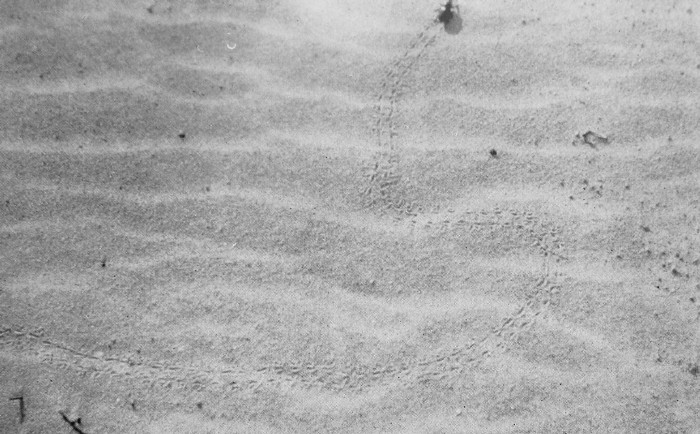 STAGHORN BEETLE AND TRACKS Another
creature
that is protectively colored is the sand dune spider — or to speak
more
correctly, the male sand dune spider, for he alone spreads his tracks
in the
sand. The female, who lives in a hole, needs no protective coloration.
The study
of
ichnology and scatology in these sandy wastes is as absorbing as a
detective
story. |
 Click the book image to turn
to the next Chapter.
Click the book image to turn
to the next Chapter.