 Web
and Book design, Web
and Book design, Copyright, Kellscraft Studio 1999-2006 (Return to Web Text-ures) |
Click
Here to return to Isle of the Shamrock Content Page Return to the Previous Chapter |
 (HOME) |
|
VIII
PEASANT LIFE IN CONNEMARA
I was more than ever
impressed by
this aspect of melancholy in an August trip I made across the Island
from
Dublin to Galway. The country, as seen from the car window, was
uniformly flat,
and much of it was bogland — wide, brown, unfenced grazing wastes with
black
stacks of peat scattered over them, and dark pools gleaming in the
cuttings.
Now and then there were places in the bogs where the heather grew in
great
masses of pink bloom; but it was only in patches, and never covered
acres and
miles as on the Highland moors of Scotland. I travelled third class,
and though
that gave me a chance to see more of life than in one of the better
apartments,
the discomfort was rather greater than I anticipated. In England the
average
third-class carriage, in spite of its being very plain and boxy, is
quite
satisfactory for a ride of moderate length. But in Ireland it is
entirely
cushionless, and the men smoke and spit with the most barbaric freedom.
The
people were, however, lively and talkative, and almost without
exception were
good-natured and accommodating. They were much inclined to excitement
at the
stations, and there was always a commotion and a scramble to get hold
of the
baggage as it was unloaded from the van. A tendency to loiter till
the last
moment on the platform was manifest among intending travellers, and
when the
train prepared to start the guard had to cry, “Take your sates!”
vehemently, to
get the passengers on board. At one place several
girls entered
my apartment, and an old man, who was seeing them off and giving them
all sorts
of directions, presently bethought himself to step to the lunch room
and buy
some ginger beer for a treat. He carne back with a bottle and a glass
just as
the conductor was slamming the doors and warning everybody to get on.
That put
the old gentleman in a flurry, and when he tried to pour the beer he
did not
hold the bottle right, and the glass ball in the neck kept rolling down
and
stopping the passage, so that with each attempt he only got a few
drops. The
train began to move, and one of the girls snatched bottle and glass.
She was
more successful in her pouring, but the old gentleman was reaching in
at the
window in great turmoil to get the things back. “Here,” said the girl,
handing out
the bottle, “I’ll give you that, anyway.” “The glass, the glass
too!” cried
the old man, now breaking into a trot to keep pace with the
accelerating speed
of the train. After taking one more hasty gulp the girl relinquished the glass, and then to our surprise the train slowed up sharply and came to a standstill. We had made a false start — been switching or something of that sort — and we had only gone a few rods. In a moment the old gentleman was at the window, panting, with beads of perspiration on his forehead. He handed in the glass and the bottle again, and the girls finished the beverage at their leisure. The passengers were all much pleased over the performance, especially a man with a bottle of his own sticking out the inside pocket of his coat. “Ah,” said he, “sure, we’d be nearly arrivin’ at Galway now if it wasn’t for your drinkin’!” 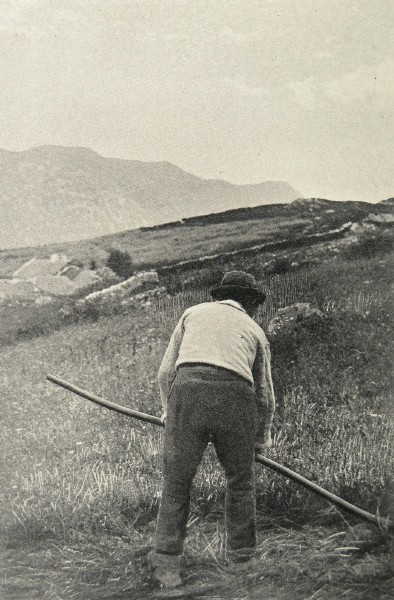 MOWING We passed many little,
gray, stone
towns along our route, and now and then a ruined tower or castle. The
cottages
that I saw from the car window were small, with whitewashed walls,
thatched
roofs, and a good deal of filth and rubbish about the yards. In the
fields were
numerous cattle feeding, goats and geese were common, and donkeys, the
national
beasts of burden, popularly believed to be equal to anything, and to be
able to
live on air if occasion demands, were omnipresent. The fields were
pleasantly
green, and looked fairly fertile, and a most attractive touch was
bestowed on
the landscape by the old hedgerows. These were at this season just
maturing
their fruit — little hawthorn apples with so strong a reddish tinge as
to give
the bushes the appearance of being full of bright blossoms. At Galway I stayed over
night. It is
a battered old town, with many lofty stone warehouses in the business
section,
but a large fraction of these were grimly vacant, and the place did not
look as
if it was thriving. A few years ago there was hope of rejuvenating it
by making
it the terminus of a line of Atlantic greyhounds. The harbor furnished
a fine
anchorage, and the port is nearer New York than any other in Europe.
The
passage would be eight hours shorter than to Queenstown, and the mail
expenses
would be materially reduced. A million dollars were spent in jetties,
quays,
docks, and basins, but the entrance to the harbor is difficult, and the
loss of
a large steamer which struck a forgotten reef and foundered in sight of
the
town damped all enthusiasm, and, except for a few small emigrant ships,
Galway
has as little sea traffic as ever. In ancient times the port
was much
frequented by merchants from Spain, with which country it had a
considerable
commerce. The town still retains architectural peculiarities, due to
the
old-time Spanish influence — houses decorated with fantastic,
weather-worn
carvings, and buildings that have a court in the centre with a gateway
opening
into the street. Perhaps the most interesting reminiscence of the past,
to the
stranger, is that recalled by a tablet on the wall of St. Nicholas
Churchyard
commemorating the “stern and unbending justice” of James Lynch
Fitz-Stephen,
who was mayor of the city some four hundred years ago. A son had
conspired with
the crew of a ship in which he was returning from a voyage, to murder
the
captain and convert the property to their own use. For this crime the
son was
tried and condemned to death by his father, the mayor. The young man
had
numerous friends, and they laid their plans to go enmass and intercede
for him,
but the father learned of their intentions, and lest their pleadings
should
swerve him from fulfilling the demands of the law, he caused the
condemned man
to be executed before their arrival. When they approached the house
they saw
the son’s lifeless body dangling from one of the windows. Down by the shore of
Galway Bay, on
the outskirts of the city, live the fishing folk in a community by
themselves.
Their houses are whitewashed cabins, with thatch roofs, and the
inhabitants are
purely Celtic, clinging to the Irish language and to antiquated customs
and
costumes. They elect their own chief magistrate or “King” yearly, and
although
under the same municipal rule as the rest of the city, they acknowledge
the
authority of their king as supreme in regard to many of their affairs.
While I
was loitering in their village, I made the acquaintance of a boy
carrying a
scrawny black kitten. He was all in tatters from head to foot, but he
was
entirely unconscious of his attire, and was wholly cheerful. “It is me
own
cat,” he said, referring to the creature in his arms; “and, bedad, it
runned
away yisterday, and sure, I have hunted the town all over, till to-day
I found
it.” The lad looked as if he
had gone
through as many trials in his quest of rescue as any knight of the old
legends.
He was going on to relate these in detail, when a woman coming down the
street
hailed him. She was apparently his mother, for she spoke with
authority. “Will
you come home, thin?” said she, and she picked up a stone and threw it,
to show
him she meant business. We both dodged, and in haste parted company. From Galway I went by
rail northward
into a much more rugged region than any I had seen in the journey
across the
island. The bogs bordered desolate lakes, and the stony Connemara
Mountains
rose in ragged outlines. This railroad on the west coast had been built
only a
year, and .it gave easy access to a district where the Irish peasant
could be
seen unaffected by the march of modern improvement. Not that the life
there is
exceptional; for what is true of Connemara, is just as true of many
other parts
of Ireland, and even in the sections most favored the peasant life is
exceedingly
primitive, and the home surroundings dubiously poverty-stricken. I left the train at a
place called
Recess, and found myself on the platform of a lonely little station in
the
midst of a bog. No houses were in sight, but a man with a jaunting-car
took me
aboard, and raced his horse for a hotel a mile away, as if he was going
to a
fire. I hung on for dear life, and was thankful when I alighted without
mishap. At the hotel — a whitewashed stone building in a little wood on the edge of a lough — I was welcomed by a slick waiter, with an expansive shirt-bosom, and a posy in his buttonhole. He gave one the impression that the hotel was a very high-toned establishment; but the interior was rather forlorn, nevertheless, with its stained and out-of-date wall-paper, its decrepit furniture, and an odor that suggested a need of scrubbing and renovation. 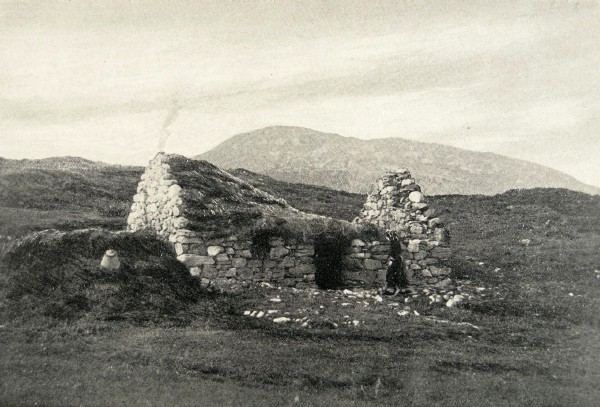 THE HUMBLEST HOME IN IRELAND Soon after I arrived it
was
announced that the table d’hôte dinner was ready, and about fifteen
people
gathered around the long dining room table. Most of them were persons
touring,
who were just stopping at Recess for a day or so. They would indulge in
the
exertion of a mountain climb, would walk or ride to several spots in
the
neighborhood that were recommended as interestingly picturesque, and
then be
off to do the same at the next place. But there were two men at the
head of the
table whose stay was less fitful. They had come for the fishing, and
every
morning they went off to toil on the windy loughs, rowing up and down,
and up
and down, all day, through sunshine and showers, and heat and cold. At
dusk
they returned with the local peasants who had been with them to do the
pulling
at the oars, and they were met at the hotel door by the women of their
respective families with the question, “What luck?” Neither man caught more
than three
or four fish as a rule in any one day, and as they had to pay roundly
for the
fishing privilege, the fish often cost them half a guinea or more
apiece. They
had a good deal to say about their experiences, but it had very much of
a
sameness, I thought, and the most entertaining incident I heard related
was of
a rainy day when one of the boats neglected to carry along anything
with which
to bail out the water, and a rower had taken off a shoe and made that
serve the
purpose. I failed to see any pleasure in spending two months, as these
men had,
in that lonely spot fishing those solemn loughs. The dining room was a
curious
combination of fine intentions and shabbiness. The floor was uneven,
and the
doors and windows were warped, and had to be wrestled with whenever the
attempt
was made to either open or close them. At one end of the room stood a
piano,
but it was badly marred and out of tune. The table linen was dirty, the
sugar
bowls were pewter, and the knives and forks were rude and much worn. In
the
daytime a number of hornets were buzzing about and disputing the
possession of
the jam with the guests. But as an antidote to these flaws and
imperfections
there was our waiter with his starched linen and a flower in his
buttonhole, and
there were the fine big bouquets set along the middle of the table, and
there
were the trout, freshly caught and beyond criticism. The day following that on
which I
reached Recess was Sunday, and at breakfast I asked the waiter where I
could
attend service. He said there was no church anywhere near, but that the
people
went to mass every other Sunday at a farmhouse a mile down the road.
This was
the alternate Sunday, and service would begin at nine o’clock in the
morning. I
started as soon as breakfast was over and, warned that I would be late
by the
intermittent running along the road of three women who passed me, I
walked
rapidly. When I approached the farmhouse I could hear the monotonous
voice of
the priest going through the service in the kitchen. The door was open
and I
could see that the room was packed with kneeling worshippers. But the
house
interior could not accommodate all who had come, and in the yard were
thirty or
forty persons more. They gathered as near as they could conveniently
get to the
doorway, and knelt like their fellow-worshippers inside. The yard was
narrow
and grassless, and entirely open to the highway. On one side of it were
a
number of jaunting-cars with their shafts tipped up skyward, and, tied
to the
walls of a neighboring stable, was a saddled pony. I felt a little doubtful
as to how
to deport myself, and I took my place on the outskirts of the open air
portion
of the congregation near the carts, whence, through the single small
kitchen
window, I sometimes caught a glimpse of the priest in his white robes.
The
service was an hour long, and most of that time the people were on
their knees.
The yard was rough, and not over-and-above neat, and the worshippers
got down
on its grit and stones with reluctance and caution, evidently picking
out the
softer and cleaner spots. Sometimes a man would ease a kneepan by
putting under
it his red bandana or his cap. A part of the time he would be down on
one knee,
then he would change to the other, then get down on both. One old man,
with bushy
gray whiskers sticking out from under his chin in a prehistoric
semicircle,
found even these changes insufficient, and now and then would get down
on all
fours. In that posture he looked very like a monstrous toad. The sounds of the
priest’s voice came
to us outside indistinct and confused, and the people in the yard
apparently
kneeled and rose in unison with a man next the door who had a better
opportunity to hear than the rest, and who occasionally peeked inside.
The open
air devotees were not specially attentive. Their eyes were constantly
wandering
to me or to each other, and their hands kept up a lively rubbing and
slapping
in a losing warfare with the abounding midges. At one point the priest came to the threshold, and the outdoor worshippers all hurried into a huddled group about him, while he threw holy water on them. He did the job by wholesale, using a stick with a swab on the end. This swab he dipped into a bowl that he held in his left hand, and then made sudden flings this way and that out on the audience, the members of which would keep up an awkward hopping movement, as if in an ecstatic eagerness to feel some of the precious drops trickling over them. 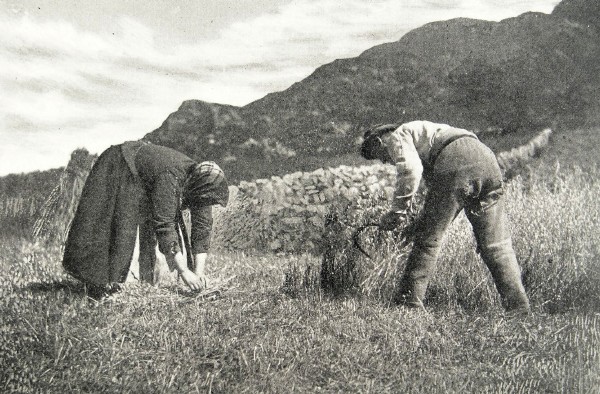 HARVEST TIME When the service ended
the
congregation straggled off, some up the road, some down, some following
paths
across the bogs, and a few lingering in the yard to visit. A young
fellow
mounted the saddled horse, and other horses were brought from the
stable and
hitched into the jaunting-cars. Such men as had a team would light
their pipes
as soon as they finished hitching up, then would start the horse and
clamber up
to the seat from either side, just as the creature was breaking into a
trot.
This hit-or-miss tumbling on looked reckless to me, but its spice of
gymnastic
unconventionality seemed to just suit the Irish nature. I chose to make a detour
in
returning to my hotel, and went off on a bog road that led to a
straggling
group of four or five cottages. The road grew more crooked and narrow
and
fuller of ledges and loose stones with each house I passed, till it
conducted
me into the barnyard of a final dwelling and stopped. But I climbed
over the
wall and went on across the water-soaked barren of the bog. My route
was one of
frequent zigzags, to avoid the spots that looked wettest and softest,
but in
spite of all my care in jumping from grass-tuft to grass-tuft, I could
not
avoid getting wet feet. I thought I knew just how to cut across the bog
to my
hotel, but the heaving surface of the marsh was so uniformly sober and
so
without mark of tree or stone that as soon as I lost sight of the
hamlet
through which I had passed, I was confused and had naught to guide me
but a
general idea of direction. I went on thus for some time, and then came
to a
lonely little ruin. It was a single small building with walls still
entire. The
roof was there, too, but it had fallen down within the walls at one
end. At first glance I took it
for
granted that the place was deserted, yet a closer approach revealed a
potato
patch by the door, and wisps of smoke were streaking up from the peak
of the
gable that had not yet parted company with the thatch. I was about to
look in
at the open door when two cows walked out. A third stood inside chewing
her
cud. She turned her head and regarded me with mild-eyed interest. It
was a
curious apartment, with the half-fallen roof high at one end and
slanting down
to the floor at the other. By chance the rafters had so dropped that
the thatch
remained complete, or else it had been made weather-proof where it lay,
by
adjusting and patching. Against the farther wall were set two chairs,
and above
them was a shelf holding a few dishes, and there was a little fireplace
with
some fragments of peat smouldering on the hearth. Otherwise the room
looked
like a rude stable. The house had one tiny window, but even that was
unglazed,
and was just a square hole in the wall. No doubt it was stuffed with
sedge in
bad weather — that is, if this really was a human habitation. But I saw
neither
man, woman, nor child, and came away wondering. Did those three cows
keep house
there on the remote bogland unbeknown to every one, after the manner of
animals
in the fairy tales, or was it all a dream? I continued for some
distance over
the bog, in what I judged was the direction of my hotel, and was
beginning to
fear I had gone hopelessly astray, when I espied a boy on donkey-back
riding
across the waste. I called and beckoned to him, and he stopped and
waited till
I came up. In response to my questions he told me where to find a path
that
would lead me back to civilization, and I left him seated stock-still
on his
donkey, twisted half around, gaping at me as if I was beyond his
comprehension.
But after the space of a minute or two I noticed he had slipped off his
creature’s back and was searching in the bog. Then he remounted with
something
in his hand, and came cantering along awkwardly in my wake to offer me,
in the
hope of a tip, a sprig of white heather he had picked. White heather is
comparatively rare, and besides, it has a touch of romantic interest;
for if a lover
presents to his lady a bouquet of it, she understands that he has in a
delicate
way proposed marriage. I gave the boy a bit of silver, and then it
occurred to
me to inquire about the little ruin of a house back on the bog. “Oh,” he said, “that’s
the house of
an ould body by the name o’ Mary McCarty, and sure, here comes hersilf,
now.” A barefoot woman with a
colored
handkerchief tied about her head was approaching. She greeted the boy
familiarly when she came near, and asked him, with a good deal of angry
and
distressed perturbation, if he had seen any of “thim villains” who had
been
stealing her hay. It seemed she had mowed a little piece near her cabin
with
her hand sickle, and while she was away some men had come — “the
nagurs! and
they got two loads off from me — as much as they could carry on their
backs.” The crime was all the
blacker
because she had no one but herself to “depind on.” She lived alone in
the hut,
save that with her in the tiny broken-roofed apartment were housed her
three
cows. The bit of land she cultivated and the cows barely kept her from
starvation. Then, too, she did not know when the house would be down on
her
head. “Many’s the time,” said she, “in a storrum, when in fear of me life I have gone out and stayed in the open sandpit at the back till the storrum was over. Ah, it is a poor place, sir, and sure, there’s no worse in all Erin!” 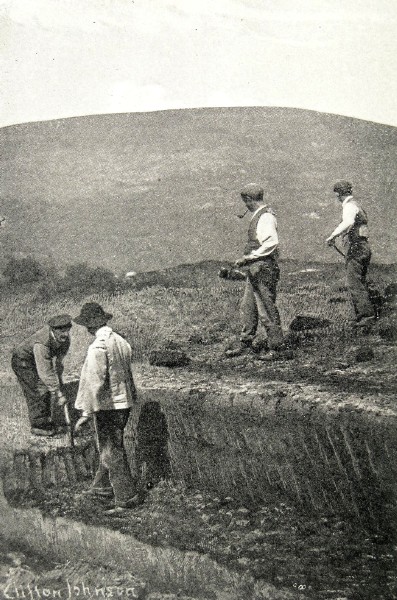 GETTING OUT PEAT And it seemed to me then,
as it does
now, in recalling all I have seen of the Irish cabins in various parts
of the
island, that she was right. When we parted, the woman
and boy
went away in company across the bogland desolation, and I kept along a
vague
path that led me in time to several houses straggling along a steep
slope, at
the foot of which flowed a little river. The single village lane, with
a tiny
rivulet trickling among its stones, was about as much like the bed of a
brook
as it was a roadway, and whenever there was a heavy rain it must have
contained
a torrent. I followed the lane through the house dooryards until I met
an old
man driving two cows up to their pasturage on the moor. He stopped me,
apparently for the express purpose of imparting the information that he
was one
hundred years old. With his lean figure, his faded eyes, and his
loose-hung
chin covered with gray stubble, he looked as old as he said he was, but
driving
cows seemed a rather sprightly occupation for a centenarian. I asked him how I should
get to my
hotel, and when, with some difficulty, he got his mind off his age and
concentrated on this new topic, he led me to a knoll a little higher
up, and
pointed out the hotel’s white walls a half mile distant on the other
side of
the river in the hollow. He said I could cross the stream by some
stepping-stones “down beyant.” I descended the hillside to the spot
indicated,
but the stones, though they made what would be a fair crossing for a
goat, or
the barefooted natives, were too unstable for a Christian used to
bridges. Some
children had followed me from the village, after the manner of their
kind, and
were watching my hesitation with interest. From them I learned that
there were
better stepping-stones farther up. I kept along the marshy
shores, over
walls, through briers and sloughs, with now and then a pause to pick
some of
the luscious blackberries that abounded. Far up above sat a man on a
boulder
smoking his pipe, and meditatively watching me, but when he noted
presently
that I was having difficulty in getting through a thorny hedge, down he
came to
my assistance and broke aside the bushes. Then he led the way across
several
little fields to the stepping-stones, and went skipping over them with
a
nimbleness that was far beyond my abilities. He said the water often
came up
and covered the stones clean out of sight. “How do you cross, then?”
I asked. “We have to wade it,
bedad!” was the
response. “Thim as hasn’t a harsey to ride, is the worst aff — for,
sure, sir,
thim that is on foot go through the wather at the danger of their
lives.” It was a relief to get
across the
stream, and it was a relief to escape from the bog, and I was heartily
glad
when I reached my hotel, thoroughly tired, hungry, and belated. On the evening of the day
following
I went for another bogland walk, up a long hillocky slope near the
hotel. The
earth was spongy and yielding. A mass of moss overspread its surface,
intermingled with scanty and unthrifty grasses, clumps of heather, and
a
scattering of reeds. Here and there the moor was brightened with
touches of
delicate yellow green, but the general tone was brownish and sombre.
Frequent
gray boulders thrust up into view. These became more numerous as the
land rose
higher, till I climbed a ridge where the soil was thin and strewn
everywhere
with shattered rock. Beyond this ridge was a little huddle of houses
with an
accompaniment of tiny stone-walled fields running down into a green
valley. The
houses were low, and their walls and thatched roofs were dark colored,
and so
like the surrounding bog that they seemed not the work of human beings,
but
some huge mushroom growths of nature. Not a tree was in sight, nor
anything
related to a tree, save a few little osier beds in the garden patches,
and
these osiers were quite inconspicuous, for they were cut off
periodically to
furnish wands for weaving creels. As soon as I began to
descend the
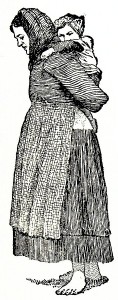
ridge, a barefoot woman with a shawl over her head and a big baby in
her arms
came hurrying to me from an outlying cabin of the village. She arrived
breathless, and thrust a bit of green marble into my hand, and called
down
blessings on my head in her fervent jargon. All this was intended to
soften my
heart and coax forth a tip. She told with pride how fond the little
“Pat” in
her arms was of money — how if he saw strangers coming, he would run to
her and
say, “Gentlemens! gentlemens! come and get money.” When any one gave him a
bit he would
say, “Thank God, I’ve got my money.” He was two years old, but
she said
he made her carry him everywhere she went. Even if she had a big sack
of peat
on her back, she must take him along under one arm. Once, she said, she
gave him
a little flat stone and tied it in the corner of a handkerchief, and he
carried
it about in his bosom all day and called it his money. Rough, narrow, stone-walled lanes, crooked and rocky, connected cottages. Blackberry bushes, thickly dotted with ripe fruit, straggled over the walls. I thought it a wonder, in such a starved-looking community where there were plenty of children, that the berries were left to ripen. All through that region blackberries were plenty and delicious, but few were ever picked in consequence of an old superstition that they are a cause of cholera. This belief is still rife among the Irish peasants. But I, ignorant of the dire possibilities that lay in the berries, picked and ate wherever I went. 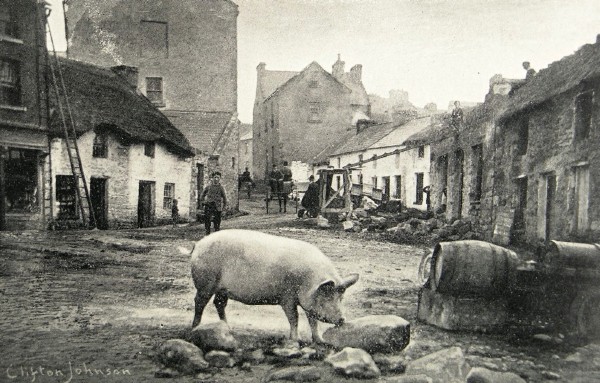 AN INSPECTOR OF STREETS While thus engaged in a
village lane,
a young man approached me, said, “Good evening to your honor,” and
jumped over
a wall and snapped off some choice clusters for me. After that he
walked about
in my company, a self-constituted guide. But he was a quick,
intelligent
fellow, and I did not object. His name was Michael. Just above the
village was
a quarry, and many great blocks of stone, curiously grained and
colored, were
lying round about. This quarry had been a short-lived experiment, and
was not
worked now. Michael said it had given employment to a number of the
village
men, and they were paid half a crown a day, while some men that were
“brought
from away earned as much as five shillings, sir — they did, sir!” Now there was no
employment to be
had in the neighborhood. The villagers could only work their little
farms or
leave. About all the young men and young women went away to the towns
or to
America. Michael had two brothers in Boston. They did not write what
they were
doing, but every year they sent home some money to “the ould man,” his
father. The rents of these little
farms were
from two to six pounds. Each cottager grew a little field of oats,
another of
potatoes, another of grass, and some raised patches of cabbages or
turnips. The
crops were grown mostly on the thin-soiled, stony hillsides. If a man
took a
field in the meadow below, his neighbors thought he was too well off,
and
accused him of an inclination to put on airs and ape the aristocracy.
Besides
all this, it added an extra pound to the rent. Most of the people kept
two or
three cows, several sheep, and a few hens. In some cases they owned a
pony or a
goat or a flock of geese. There were also two half-grown pigs that
frequented
the village lanes. They were sharp-nosed, long-legged creatures, nimble
of
foot, and apparently capable, in their wanderings, of picking up their
own
living. When at home they lived in their master’s house. This house had
but a
single room, and the pig-pen was in one corner. Aside from the pigs,
the family
was composed of a man and wife and three or four children. Their abode
was
windowless, and light came in only through the two doors and possible
chinks in
the walls. Michael said that in old
times they
used to keep the pigs under the bed, but they did not do so in this
village of
Lisouter, nowadays. The people sold their poultry at the hotel, and
other
produce they took to market at the nearest town. Potatoes, of course,
stood
chief on their bill of fare, as they do among the Irish peasantry
everywhere.
Some occasionally indulged in mutton, and most families had oatmeal
frequently.
Now and then they bought fish, and bacon was more or less familiar; but
many of
them never knew the taste of beef. The oats raised are fed
out to the
stock, and the oatmeal for house use is bought, a bagful at a time.
Flour is
purchased in the same way, and bread is baked in a flat kettle on the
hearth.
Very little butter or cheese is made, and what little milk the poorly
fed cows
give is drunk with the potatoes and oatmeal. Since the railroad came,
tea has
become a family necessity, and all the eggs the hens lay go in exchange
for it. About the only farm tools
to be
found in Lisouter are spades — primitive, narrow-bladed, and one-sided,
but
apparently effective. No such contrivance as a plough has ever been
seen in the
village. The people dig their fields over by hand. Potatoes are planted
in rows
that are nearly three feet wide, known as “drills,” and the space
between each
drill and the one next it is dug out like a ditch and serves for
drainage. The
potato tops grow in a spindling jungle on the drills, much too close
together
to do well. Crops are not rotated, but are grown over and over on the
same
ground, and are never what they might be. Often the potatoes fail to
come up
except scatteringly, in which case cabbage plants are set to fill out
the
blanks. This year had been wetter than usual, and the “blight had come
on the
p’taties too early,” so that it seemed likely the Lisouter folk would
go on
short rations before the next harvest time. Michael and I ascended a
crag at the
rear of the hamlet to get a view. Several of the village children
tagged after
all the way, taking turns at begging. “Please give me a copper, sir —
only one,
sir,” they said; and refusals had no effect whatever on them. One boy
of eight,
still in skirts, had a baby on his back — a solemn, watchful baby that
never
let out a sound. The boy did not seem to mind his burden, but clambered
everywhere the others did. These shoeless children were sure-footed and
nimble,
and they skipped about the rocky hillside like wild creatures of the
bog. I
went high up to where I could look down on the long stretches of dreary
marshlands that are omnipresent in the region, spotted and linked all
over by
the loughs, large and small. Far away in the west I could catch a gleam
of the
sea, while in the near landscape the mountain crags were darkling, and
in the
hollow close below were the hovels of Lisouter and their little
patchwork of
varicolored fields. On the way back through the village a stout, fairly
well-dressed young man got off the wall where he had been loafing, and
came
hulking after me. “Please, sir, give me the price of an ounce of
tobacco,” he
said. The children beggars followed me far down the hill. Begging
seemed to be
constitutional with the Connemara peasantry, and I always had a
persistent
group in my wake every time I visited Lisouter. When I approached the
village a day
or two afterward, a woman came hurrying across two or three fields with
a
bundle of cloth on her arm, and greeted me with, “Good marnin’, sir,
an’ sure
it’s a fine marnin,’ sir. Then she spread out the
cloth along
with a few coarse socks and urged me to buy. “Plaze, sir,” she said,
“buy the
friz, for the love o’ God and a poor woman who’s lost her b’y an’ pit
him in
the grave only five weeks past.” She
went on to tell me that she had
borrowed the money for the boy’s burial from a poor neighbor
woman who must be
paid now, and she with nothing to pay. Her husband after the funeral
had gone
far away to get work, “but he soon come back, for there were
a big weight on
his heart, and he could eat nothing at all, at all.” She
spoke of her eight
children — “Four of ‘em I’ve
given to God, and four of ‘em’s alive —
God bless
‘em.” I went across the fields
to her
cottage, squatted among the stony patches of oats and potatoes. Like
the rest
of the Lisouter cabins, its stone walls were loosely chinked with peat.
Roofs
were of sedge tied on with straw ropes thickly drawn over and fastened
to pegs
under the eaves or to stones hung along the edges. The thatch was
renewed every
year. It would last two if new ropes were put on each time, but few
would do
that. The chimneys were insignificant, and hardly showed above the
roofs. Peat
was the only fuel burned. It all came from the bog, a sack at a time,
on the
women’s backs. The Lisouter folk never saw coal till some was brought
for use
in an engine at the quarry. Then they thought it was rock, and it was a
great
wonder to them that the stuff burned. Most never saw a railroad till
the local
one was put through, the year before. As soon as it was finished they
all must
ride; but when it came to getting aboard, they felt they were taking
their
lives in their hands, and at the start the old women were all jumping
up and
screaming they would be murdered and their friends would never see them
any
more. The woman with the cloth to sell showed me into her cottage. The door was low, and I had to stoop to enter. She hunted up a level place on the dirt floor, and set out a chair for me. A dim fire burned among the rough stones of the fireplace, and sent a little smoke up the chimney and a great deal of smoke out into the room. The kitchen was full of flies, and it had the odor of a stable. The floor was much littered with heather and rushes that had been brought in to bed the cow and calf that had a home in one end of the kitchen. On some tattered blankets thrown over a heap of sedge near the fireplace two of the children slept. The rest of the family had a bedroom beyond a thin partition. 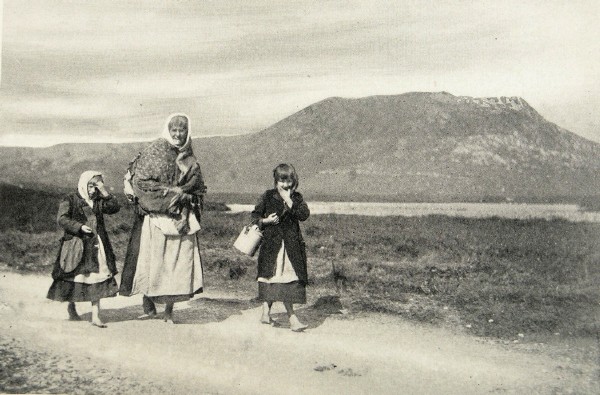 JOURNEYING ON FOOT My hostess, in the midst
of her talk
with me, pulled a short pipe from her pocket and made much mourn that
she had
no tobacco to fill it. She said a smoke was very comforting. “It’s
loike
medicine to me.” My former guide, Michael,
had come
up to the cottage, and was talking outside with some of the beggar
children.
The woman saw him and sent out her ragged little girl, Bridget, to
“borrow the
loan of the pipe” he was smoking. Michael relinquished his pipe
readily, and as
the woman whiffed she blessed him again and again. When I left, she
blessed me
likewise, saying, “Long life to ye! An’ may your journey home be better
than
the one over. God bless ye, an’ give ye a safe crossin’!” In a cabin a little
farther up the
hill lived a woman all alone. She was still young and not unattractive.
Her
husband had gone to America, and he would have taken her with him, but
she
would not leave. A letter had come from him only the week before in
which he
sent £3, and the villagers thought that was doing pretty well. Her
cottage was
hedged in by great growths of nettles that flourished all about. The
roof
leaked and the cabin had but one room, which the woman shared with two
cows. I
looked in, but did not care to enter. It was more like a floorless
stable, that
had not been cleaned for a week, than a human habitation. The house at
some
time had had a single window, but this was now loosely closed with
stones. Most
of the Lisouter houses, however, had at least one window, and several
of them
had two, though occasionally these lacked glass. All were small,
varying in
number of panes from one to four. Mud and refuse were
almost universal
about the doorways, and a “midden” (manure heap) was always handy near
the
house front. A skeleton horse was feeding in a waste near the quarry;
some old
men, working-days past, were sunning themselves on the rocks; one or
two old
women were sitting or leaning on the walls near their cabin doors, some
in
idleness, some knitting. In the oat fields the men were reaping
laboriously
handful by handful with their sickles, and the barefoot women followed
behind
to bind the sheaves. The women gleaned over the ground as they worked,
and
picked up every straw. I spoke with one man, and
he said he
had two or three acres in his farm, but it was very poor land, and in a
wet
year his crops were well-nigh failures. Still, he considered himself
better off
than most of his neighbors. Nearly every day I saw
the children
going to school in the morning, and met them returning in the evening.
Their
aspect had the same untamed wildness then that it had as I saw them
running
about the bogs and crags that surrounded the home village. The
schoolhouse was
four miles distant, and the route thither was along a desolate road
winding
through the dun marshes. The children went barefoot and bareheaded,
except for
a few of the older boys, who wore caps. They each carried a piece of
dry bread
for their noon lunch, and that was all the food they had till they
returned
home late in the afternoon. But, with all their hardships, they looked
sturdy
and healthy. Probably weaklings do not survive long. Once I noticed
that a boy
in a group of children returning from school carried a book, and I
asked to see
it. It was a most forlorn little Third Reader — a wreck of a book —
covers
broken, marked and greasy within, and many pages torn or gone
altogether. As I handed back the book
I noticed
a great black bug crawling along the path, and I pointed it out to the
children, and said, “That’s a beetle, isn’t it?” But they said, “No, it is
a
prumpalong, sir.” They had never heard of
such a thing
as a beetle. “We do not have thim here, sir, I think,” explained one of
the
older children; “but we have prumpalongs — plinty of thim.” The schoolhouse was a
bare modern
building with gray plaster walls. It stood in the centre of a rough,
rocky
yard, that was surrounded by a high stone wall. Outside the enclosure
all was
bog, save for three or four houses with their little fields straggling
along
the road not far away. I inquired of the children what games they
played at
school, and they replied that they raced after each other some, and
that was
all. Indeed, their intermissions were usually spent in just sitting
around and
doing nothing. They indulged in no games, even about their homes in the
village. Apparently, they had lost the impulse to play, and I thought
nothing
could be more eloquent than this of the depressing environment in which
they
lived. One of the things I looked specially for in Ireland was the shamrock. I had no clear idea of what it was like, except that it was green and triple-leaved, and I supposed it was a native of the bogs. Often in my moorland wanderings I saw a coarse, fleshy plant that grew in thin clumps where the water gathered in pools. The leaves were three-parted, but larger than the largest clover. Still, I thought it must be shamrock, and picked some of it and showed it to a native. The native did not even know the name of my bogland weed, but he stooped down and showed me some of the true shamrock growing by the roadside. It is an insignificant, yet delicate, little plant that loves to grow on stone walls and along roadways where the soil is poor and often scraped away. It was more like the downtrodden white clover that in America one finds growing in dooryard paths than anything else. The peasantry feel a real affection for the shamrock, and it is beautiful in their eyes. Like themselves, it lives amid hard conditions, and it seems pathetically appropriate that it should be the Irish national emblem.  |
 AS compared
with the other divisions
of Britain, Ireland has a run-down, out-at-the-heels look that is
depressing.
Both the country districts and the towns show
marked signs of dilapidation, decay, and thriftlessness. There are
broken walls
and litter in the neighborhood of all the villages and cities, and the
land
commonly has the appearance of being tilled neither energetically nor
carefully.
AS compared
with the other divisions
of Britain, Ireland has a run-down, out-at-the-heels look that is
depressing.
Both the country districts and the towns show
marked signs of dilapidation, decay, and thriftlessness. There are
broken walls
and litter in the neighborhood of all the villages and cities, and the
land
commonly has the appearance of being tilled neither energetically nor
carefully.  Click the book image to turn
to the next Chapter.
Click the book image to turn
to the next Chapter.