 Web
and Book design,
Web
and Book design, Copyright, Kellscraft Studio 1999-2006 (Return to Web Text-ures) |
Click
Here to return to Isle of the Shamrock Content Page Return to the Previous Chapter |
 (HOME) |
|
VI
AN IRISH WRITER AND HER HOME
Great was his surprise
when J.
Barlow proved to be no Mister at all, but Miss Jane Barlow, daughter of
a
Dublin professor. Forthwith the editor introduced Miss Barlow to the
literary
public, and induced her to write a series of short stories in prose.
These form
her “Irish Idylls,” so far the best-known book she has produced. They
deserve
to grow in public favor, for truer and more entertaining transcripts of
peasant
life we have never had. Yet they will not appeal to the masses; they
are too
quiet, too simple, too delicate in flavor, to stir minds that crave
high-seasoned action and a plot full of turmoil and mystery. Such
stories as
Miss Barlow’s are reserved for the enjoyment of those who like
sometimes to see
nature and life as loiterers, and to catch the slighter odors and tints
and
twinklings that escape the person who must go through a book on the
jump or not
at all. The stories lack the spice of sensation; but to the lover of
sweet and
simple realities they are full of interest and sparkle. I do not recall anything in imaginative literature that deals with life that in itself and in its environment is so humble as in the several books written by Miss Barlow. The scene of her stories is always the Connemara district of the Irish west coast, a forbidding region of water-soaked bogland, sombre loughs, and stony mountains. In the forlorn little villages on this bogland live the people she describes. Lisconnel is the place that appears oftenest in her stories — a hamlet of ten houses, counting one with the roof fallen in. It is seven miles to a neighbor village. No one in Lisconnel owns a cow, such is the poverty of the inhabitants, and the live-stock is limited to a few goats, pigs, and chickens; even these disappear speedily in bad seasons. The cabins are small, their furnishings meagre, wind and frost find easy entrance through their un-chinked stone walls, and the rain drips through the rush-thatched roofs. The wet fields, fenced off by stone walls into tiny squares about the houses, yield scant crops of potatoes and oats. The pinch of poverty makes itself felt in every household, and hunger is a not infrequent visitor. 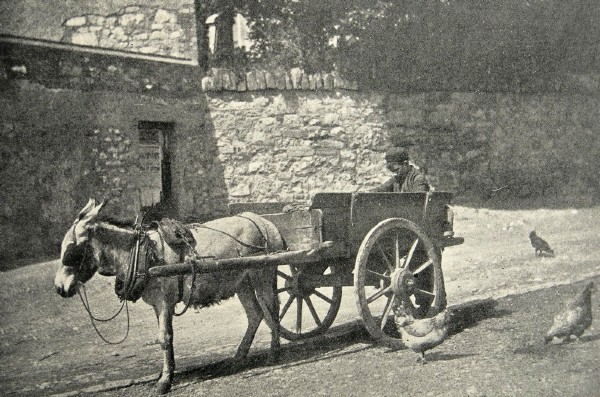 A PEDDLER OF DISTILLERY WASTE Could one have more
scanty material
for story-writing? Yet, as the Irish say in one of their proverbs,
“There are
plenty of things beside turf to be found in a bog;” and one of the
things that
Miss Barlow finds there is human nature. The sympathetic reader sees
himself in
these humble villagers, and he feels a strange interest in their
struggles,
their loves, their sacrifices and heroism, their quaint conversations
and views
of the world; and he could not be more vividly impressed with the
loneliness of
the bog and the cheer of its sunshine and the frowning frequency of its
showers
were he himself a bogland dweller. The descriptions are indeed all so
convincing it was something of a shock to me to learn that Lisconnel
was not a
real village at all, and that the author neither lived in nor anywhere
near
such a place. Miss Barlow’s home is on the other side of the island, at Raheny, a suburb of Dublin, four miles out of the city. Raheny is a shapeless, straggling little hamlet with parklike, tree-dotted fields round about. It has two inns, two churches, the same number of schoolhouses, and a single shabby little shop. On the day I was there the most notable human feature of the village was a row of men near its chief inn, sitting or standing along a house wall. They were laborers waiting to be hired. It did not seem a very energetic way of finding work, but it saved shoe-leather and perhaps nervous wear and tear, and it is the Irish custom. 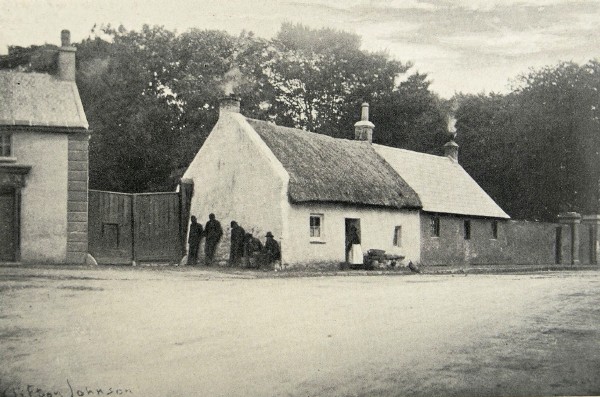 WAITING TO BE HIRED The station-master said
there was no
middle class in the village — they had only “swells and laborers.” The
dwellings seemed to bear out his statement; for they were either the
retiring
homes of gentlefolk, with lawns and shrubbery about, shut away from the
gaze of
the street-passers by high stone walls, or the barren little cottages
of the
peasantry. The cottages congregated thickest along a small stream that
ran
through the village centre. Many of them had thatch roofs, often weedy
and
green-mossed. Their surroundings were very untidy, and quite in keeping
with
the dilapidated aspect of the buildings themselves. Several dogs were
lazing
about the doorways, scratching at the fleas that infested their scraggy
coats.
One of them, which looked rather younger and brighter than the rest,
was
sitting on a bag near a cottage doorway. This luxury of having a seat
suggested
that he was the household pet; and, by way of introducing myself to the
woman
of the house, I remarked, “That’s a nice dog you have.” “He’s more than nice —
he’s good,”
was her proud response. I had not intended my
words to be
taken too literally, and I did not pursue the subject further, but
looked into
the woman’s kitchen. It had a rough and not overclean dirt floor. The
walls
were of rudely plastered stones, partly hidden, as was the ceiling, by
newspapers pasted together, forming a queer sort of tapestry. It was a
tiny
room, yet there were in it two rickety beds, some scantily filled
shelves of
crockery, several chairs, and various other household belongings. Not
much
spare standing room was left. The hens of the
neighborhood
wandered in and out of the cottage doors, and with the other fowls held
conventions around the house fronts, very much as they pleased. While I
was
looking in at the living-room of the woman who owned a “good” dog, a
boy drove
up a flock of turkeys. They stopped in front of the cottage, and the
woman came
out with a pan of feed. She knelt down before them and doled out the
food, and
saw that they all had a fair chance, at the same time giving a smart
rap every
once in a while at her neighbor’s ducks that showed a tendency to steal
up and
grab for a share. The cottage dwellers had no water supply in their homes, but went for it either to the convenient stream or to an iron pump in the middle of the street. The women were mostly frowzy-headed and slovenly, and the children were ragged and dirty. But what the little folk lacked in immaculateness of attire and person was more than made up by their liveliness and piquant individuality. They had nothing of the shyness of English children. One of them, a small boy, carrying a crooked sapling with a line attached, wanted me to go down to the stream and see him catch “pinkeens”; and they all showed a good deal of volubility and the spirit of investigation. 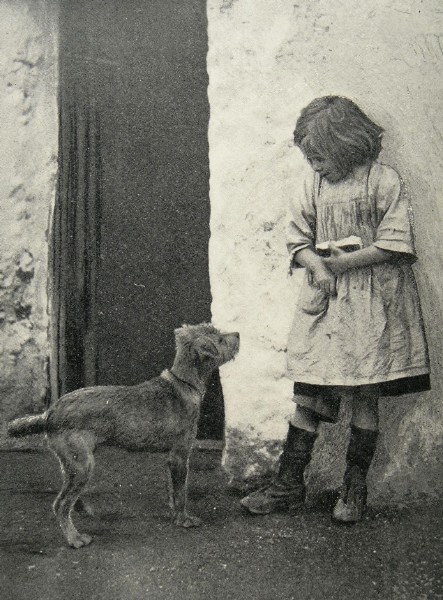 HUNGRY I saw one little drama of
child life
that illustrates the methods of child training in general vogue in
Ireland —
methods not unknown in some other parts of the world. It took place in
a field
back of a cottage where two venerable goats were feeding. In the shadow
of the
cottage stood a woman waiting for a little boy, who had crawled through
the
hedge at the far side of the field, and now came running toward her
with a
bottle hugged tight in his arms. I suppose he was returning from some
errand.
Then, in the middle of the field, there was a false step, a tumble, and
a smash
of glass. The mother started forward and picked up a switch, and the
boy got up
whining and began edging away, while the goats looked on in
long-whiskered
surprise. The nearer the mother came, the more the little one dodged,
and
presently he took to his heels and ran back of the house with his
mother in
close pursuit. Donkey carts were the
most frequent
vehicles seen on the Raheny streets. Both carts and donkeys seemed very
small,
and when a grown man or a woman sat perched on the seat, the size of
the rider
seemed quite disproportionate to that of the cart and the creature
which drew
it. But the donkeys were sober beasts, and apparently were contented
with their
lot, though I did encounter a single exception — a tiny specimen
pulling a cart
with two young men in it up a hill, and braving in a manner distinctly
alarming
and protesting. One donkey, with a lad in charge, was drawing a load of
sour-smelling distillery waste about the village. The stuff looked like
wet
sawdust, but the boy said it was barley, and that he sold it a pailful
at a
time, to feed hens and pigs. Both the village schools
were
supervised by the government, but one was conducted under Protestant
auspices
and the other was controlled by the Catholics. The Protestant building
was neat
and modern. The Catholic schoolhouse, on the contrary, was dismal and
old-fashioned. It was low and broad, with gray plaster walls. Within
were two
rooms — one for the boys, one for the girls — each in charge of a
separate
teacher. The girls’ room was nearest the street, and, as the door was
open, I
went in. Thirty or forty scholars
were
present, between the ages of four and twelve. The room was of fair
size, with
grimy, whitewashed walls and long, unpainted benches. Near the entrance
was a
small, much-battered organ and a table for the teacher’s use, behind
which was
the room’s one chair. The table drawers were gone, and it was as cheap
and
shaky a specimen of a table as I have ever seen. The thin, middle-aged
woman
who presided over the school politely offered me the one chair as soon
as I
entered the room, and I carelessly accepted, and nearly lost my balance
sitting
down in it, for the chair toppled sideways in a manner to suggest that
it had
only three legs. I braced myself accordingly, and as soon as the
teacher looked
away I took advantage of the opportunity to slide my hand back and
investigate.
The fourth leg was there, after all, and the only trouble was that it
was an
inch short at the bottom, making the chair a sort of primitive rocker. The teacher gave all her
time to
entertaining me, and turned the school over to three of her oldest
pupils, each
in charge of a section. The youngest section, composed of infants,
adjourned to
the back of the room, where they arranged themselves in a double
semicircle and
began picking out words on a wall chart. They were aided in their
efforts by
the girl monitor, armed with a long stick which was intended for a
pointer, but
which she did not confine strictly to that use. This girl was nervously
disposed, and when a child missed and had to go to the foot she would
take the
delinquent by the shoulders and push it along to its new place with
quite
unnecessary energy. If a child’s answer came too slowly, she would
brisken its
ideas by a tap from her stick. Once, when one of her charges was out of
order,
she gave the culprit a slap with her hand. Another section of the
school sat in
a group among the seats, and the girl who acted as their teacher stood
facing
them between a bench and desk. The third section were on
their feet
gathered about a girl who was sitting on a bench at the side of the
room with
her back against the wall, eating a lunch. The children in her care had
slates
in their hands, and were doing “sums.” On the whole, the scene
in the
schoolroom was very easy-going, social, and domestic, but I was not
impressed
that the children were making any very determined progress in the
acquisition
of knowledge. As for their surroundings, they were rather cheerless and
depressing. The only attempt at brightness in the room was a row of
colored
prints that the teacher had pinned up on the wall. After a time I carefully
rose from
my crippled chair and bade the teacher “Good day,” with the intention
of paying
a visit to the boys’ room. I went around to the other side of the
building and
rapped. No response. I rapped again, and failed to attract attention as
completely as I had before. I could see the children through the
keyhole, but
there was such a clatter of voices and buzz of lips that, though I
rapped two
or three times more, I did not make myself heard. This was too much,
and I
abandoned them to their uproar and came away. I thought, from what I
saw of the
village, that Raheny held plenty of raw material for a writer who made
peasant
life her field in fiction, and it seemed odd that Miss Barlow should
neglect
this for distant Connemara. Miss Barlow’s home is about five minutes’
walk from
the station, in what is known as “The Cottage.” As you approach it, you
glimpse
over the intervening street wall a long thatched roof shadowed by
tree-foliage.
I wondered if it could be that Miss Barlow lived under that humble
thatch.
After all, it would not be out of keeping, considering the subjects she
chooses
to write of and the quiet manner in which she tells her stories. But a
little
farther on I came to a mildly imposing gateway, with a little shadowed
lodge at
one side. Thence a tidy driveway led to a near mansion. It was not a
pretentious mansion, but just of comfortable size, with a homelike air
about
its vine-clad walls that was attractive. The structure was rather
unusual. It
was in three parts, beginning near the street with the low thatched
cottage,
which was followed in the middle by a larger and more recent structure,
while
at the rear it rose in a modern dwelling of comparatively imposing
proportions.
It was like some slow vegetable growth pushing out successively into
newer and
larger forms, or as if here was a house with its own father and
grandfather
under its protection on the ancestral grounds. The cottage section of
the house is
inconvenient, but its age and associations protect it. Miss Barlow
acknowledges
a good deal of fondness for it, and pains are taken to get it
rethatched when
the roof gets bad. The thatch, in the accumulation of many renewals,
has grown
to a ponderous thickness, and makes the cottage look like some vast
mushroom.
There were holes in the roof torn by rats and birds that build their
nests in
it, and a young plane tree had shot up from one of its depressions to a
height
of two feet. But my visit shortly antedated the coming of a thatcher,
under
whose hand I suppose these touches of picturesqueness disappeared. Indoors the house is what
any
gentleman’s of moderate means might be, except that the upstairs parlor
is
given a churchlike air by a pipe organ filling one end of the room.
This is
used by Professor Barlow, the author’s father. The station-master
mentioned to me
that all the members of the family were very nice people, and “not
swells, if
they did belong to the gentry.” He had read some of Miss Barlow’s
books, and he
was quite appreciative; for he declared she “got the talk of the
Connemarese
fine.” One of the village women with whom I spoke, and who said she
frequently
did scrubbing at the Barlows’, was, like the station-master, a warm
admirer of
the family, and agreed with him about the merits of “Miss Jane’s”
books. The
comment of these two critics was not praise that meant they caught the
atmosphere and delicate flavor of the stories, but which showed that
the life
portrayed in the printed pages was most accurately interpreted. The stories convey the same sense of reality to the stranger who has never seen the country, and as he reads he feels that Miss Barlow understands the peasant ways and their thought and conversation in every detail. I was curious to know how she acquired this minute knowledge. It seems that the family took a house one season and lived for a summer on the Connemara coast, and it was then that Miss Barlow absorbed the impressions of local color and character which she uses in her stories with such fidelity. One would suppose she must have been very intimate with the people themselves, she gives such full reports of their work, their homes, and their speech; yet this was not the case. What she knows she has gained mostly from outside observation, and the rest is imagination. But wherever she gets it, the bogland life of her books has the ring of truth, and it lingers long in the reader’s mind, a sweet and fascinating memory. 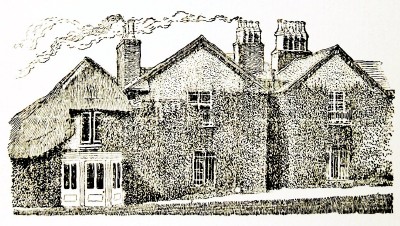 |
 IN 1891 there
was published in
Dublin a thin book of poems entitled “Bogland Studies,” and the author,
as
announced by the title-page, was J. Barlow. Like most books of poems by
unknown
writers, Bogland Studies was brought out at the author’s expense; but,
unlike
the common run of them, the verse was characterized by striking
originality,
refined feeling, and great aptness and vigor of expression. Still the
world was
very full of books, and few bought the modest volume. Its writer was
nearly as
unknown as before, when, presently, the book fell into the hands of a
London
editor, who read it with such interest that he looked up the name on
the
title-page and wrote a letter to “Mr. J. Barlow.”
IN 1891 there
was published in
Dublin a thin book of poems entitled “Bogland Studies,” and the author,
as
announced by the title-page, was J. Barlow. Like most books of poems by
unknown
writers, Bogland Studies was brought out at the author’s expense; but,
unlike
the common run of them, the verse was characterized by striking
originality,
refined feeling, and great aptness and vigor of expression. Still the
world was
very full of books, and few bought the modest volume. Its writer was
nearly as
unknown as before, when, presently, the book fell into the hands of a
London
editor, who read it with such interest that he looked up the name on
the
title-page and wrote a letter to “Mr. J. Barlow.”  Click the book image to turn
to the next Chapter.
Click the book image to turn
to the next Chapter.