
|
|
 (HOME) |
|
III
THE LAKES OF KILLARNEY
I suppose when the
imagination has
dwelt long on the fascination of a place beforehand, there is bound to
be a
certain degree of disappointment in seeing the reality; but at
Killarney the
combination of lakes and streams, mountains and varied foliage, is so
fine that
even in one’s fancy it could hardly be more attractive. The lakes are
three in
number, each with a character and beauty of its own, and the only
serious fault
I had to find was that they were too much shut away from the public by
the
bordering estates of the gentry. One of these estates — that of a Mr.
Herbert —
had, at the time of my visit, recently come on the market, and was the
subject
of a good deal of newspaper comment, both in Britain and America. The
items and
the headlines not infrequently gave the impression that the lakes
themselves
were to be sold, and that this single estate held them all within its
boundaries. The fear was expressed that the domain would pass into the
hands of
speculators, and be exploited as a vulgar commercial show place, or,
worse still,
that it would be purchased by some aristocrat who would exclude
outsiders
altogether. Efforts were made to have the government buy the estate and
convert
it into a public park; and when this project failed, the suggestion was
offered
that the Irish in America might unite in contributing the needful sum,
and do
themselves honor by turning the domain over to their homeland for a
national
pleasure-ground. The estate is hardly as
vital as
would be inferred from much that was published; yet it includes nearly
all of
the middle lake and a considerable strip along the east shore of the
lower
lake. I heard the laboring folk speak of Mr. Herbert as a good landlord
and
employer, and they all regretted his financial embarrassment, and
looked
forward to a change of proprietors with misgiving. Whenever they
mentioned his
having “gone broke,” I noticed they added the information that he had
an
American wife whom he had married for her beauty, wholly reckless of
the fact
that she did not possess wealth. It seemed to be taken for granted that
such a
match on the part of a British subject of the upper classes was very
unusual
and unwise, and the dismal sequel was held to be a natural consequence.
The lakes lie in a basin between several mountain groups, and they convey an impression of permanence and of age coeval with that of the heights which overlook them. A native of the region, however, informed me there once were no Lakes of Killarney at all. Where they now are was just a low valley, and in the valley were farms and a town. Unluckily, one of the dwellers in the vale had a charmed well. Still, everything was all right if he kept it covered nights, and this he took great care to do. But late on a certain evening, after the owner of the well had gone to bed, a neighbor visited it, drew a bucketful, and went away without restoring the cover. The next morning a great river was pouring out of the well, and the farms and the town were fathoms deep under water. There they are to this day, and when conditions are favorable, the old-time houses of the vale can be clearly seen at the bottom of the lakes, and so can the charmed well. Into it runs one stream, and out of it runs another — at least, that was the story as it was told me. 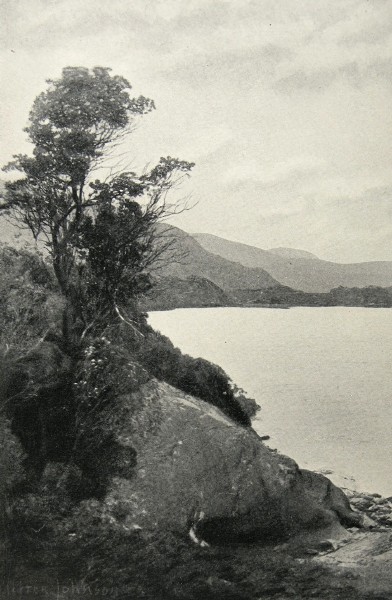 THE UPPER LAKE My acquaintance with the
lakes began
with an extended walk along their eastern side. Killarney town, on
their
northern borders, was my starting point, and I continued to the
opposite end of
the group, ten miles southward. Around the large lower lake is a
pleasant,
alluvial country of gentle slopes, where the grass flourishes, and the
trees
grow spreading and stately. But of this I saw less than I could wish,
for the
ribbon of winding roadway which I followed was so hemmed in by the
walls of the
adjoining estates of the aristocracy, that I might almost as well have
been in
a tunnel. Not until the middle lake was half passed did I find freedom.
Then
the wayside walls dwindled and disappeared, and the road, instead of
being
crowded far back from the shore by the broad parks of the gentry, came
down to
the borders of the water. The landscape, meanwhile,
had
undergone a change, and was wrinkled into little hills that constantly
grew
more rugged, and the shade trees gave way to wild forest growths that
had an
almost tropical luxuriance. There were beeches, elms,
and oaks
clad in their spring greens, and there were pines and drooping larches.
Ivy
vines crept up the tall tree trunks, and the ground was hidden by a
tangle of
dark, glossy holly and arbutus. I doubt if any woodland rivalling this
in rich
and varied profusion exists in all Britain. The forest, however, is not
extensive, and after a few miles the trees are less lofty and less
exuberant,
and I found little left of the woods in the vicinity of the upper lake
save
stunted and infrequent patches growing among the rude gray crags at the
foot of
the mountain ridges. Where there was soil here, it was mostly a barren
heath or
a peaty bogland; but in the rocky ravines were streams of crystal as
refreshing
as they were pellucid, and I could hear the pleasant sound of distant
waterfalls. Best of all, the waste was wholly unfenced, and there was
nothing
to prevent my wandering through it at will, and getting all the
changing views
the region afforded. I enjoyed this thoroughly, and by the time I was
ready to
turn back I had concluded that the little upper lake, with its many
islets and
irregular shores and wild surroundings, was the most satisfying of the
three. On all the long road I
had come
there had been scarcely a village worthy the name, and even the
cottages were
infrequent. I saw few people, and the busiest scene was on a spongy
peat moss
where several groups were getting out their year’s supply of fuel. Four
or five
men composed each gang. One of them, using a spadelike cutter, dug out
the
long, soggy bricks of peat; another with a fork tossed them up on the
turf as
fast as cut; and the rest of the company, also armed with forks, spread
the
sods to dry. Instead of returning as I
came, I
took a side way, and paid a shilling at a lodge gate for the privilege
of
following a devious road across several bridges and large islands
through the
Herbert estate. At length I was again on the main land and had before
me the
ruins of Muckross Abbey — a great ivy-grown church minus roof and
windows, but
otherwise practically complete. It had a fine situation on a hill, with
the
lake in sight not far away, and the peaks of the big mountains looming
across
the water. Close about was a burying-ground where rest the remains, if
tradition is to be trusted, of many Irish kings and chiefs. The
churchyard
continues to be used as a place of interment, and white modern crosses
are
mingled with gray moss-grown slabs, many of the latter fallen and worn
blank by
the storms of the passing years. The usual place of burial now is on
the south
and east sides, for the north is regarded as the Devil’s side, and on
the west
are buried only unbaptized children, soldiers, and strangers. Within the abbey are many
dim vaults
and passages and several great halls open to the sky, in which are
graves and
sombre tombs and headstones. One cloistered court contains a yew tree
grown to
maturity with branches reaching out so thickly over the upper walls
that
scarcely more light comes from above than if the room had a roof.
Naturally a
tree so strangely placed has its mystic attributes, and the saying is
that
whoever takes a twig from the venerable yew will die within a year. A century ago a hermit by the name of John Drake lived in the abbey for the space of eleven years. By covering an open cell of one of the upper apartments with fragments of tombs and coffins he protected himself against the inclemencies of the weather and made himself a home. He acquired a wide reputation for piety and for a demeanor that combined solemnity and cheerfulness. Pilgrims were in the habit of coming from a considerable distance to do penance at Muckross Abbey, and they exhibited their devotion to the saint of the place by going around the building a certain number of times reciting prayers. The neighboring peasantry supplied the hermit with food, and everything was quite idyllic, until he was seen reeling intoxicated among the graves, and it was discovered that the holy man was given to solitary whiskey indulgences. In consequence the superstitious veneration of the Killarney folk and pilgrims diminished, and one night the hermit left for parts unknown. 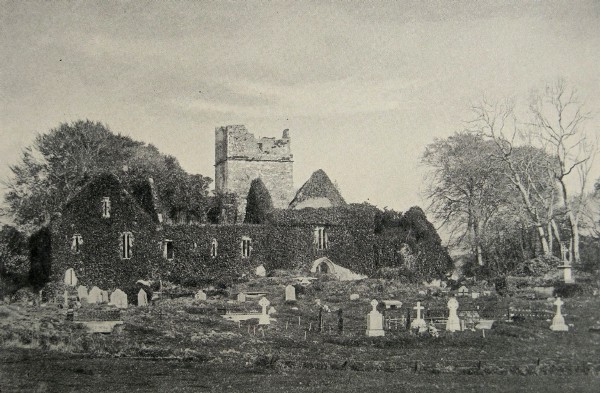 MUCKROSS ABBEY The final touch is given
to the
story by the relation that, some years later, a lady speaking with a
foreign
accent arrived at Muckross accompanied by two servants who knew no
English
whatever. She asked many questions about the hermit, passed some weeks
in
praying and weeping over his stony couch, and then, after distributing
alms,
went away never to return. When I reached my hotel
in Killarney
town at the conclusion of the long day’s tramping, I was weary enough
to find
it a very welcome haven. It was a humble establishment on one of the
town
byways; yet, in spite of certain drawbacks, there was something about
it
decidedly congenial and interesting. It was a good place to see life
and to
meet everyday people, and this went far toward palliating its
shortcomings. Of
these I will not make a list further than to say that my room was a
mixture,
very characteristic of Ireland, of attempts at tidiness and of what was
pretty
closely related to dowdyishness and dirt; and the kitchen, of which I
had
glimpses as I went in and out, appeared not to have been cleaned or put
in
order for a month; while the hotel parlor looked like an asylum for
second-hand
furniture. I was sitting in this
parlor one
evening when my landlady requested me to vacate in favor of two men who
wanted
to talk over a marriage which they hoped to consummate between their
children.
Nearly all the Irish marry young, and among the poorer class they do so
quite
improvidently, with no question as to how rude the new home must be,
and how
barren its furnishings, and how meagre the prospect of income. Those
who have
property, however, do not make matrimonial alliances without careful
calculation. A hotel is very apt to be chosen as a convenient
meeting-place for
the parents, and there they discuss the matter of dowry at great
length, and
the marriage depends more on their amicable agreement than on the love
of those
most concerned. Indeed, the match is frequently made by the elders
before the
young people have settled it themselves. The respective fathers haggle
over
what they will give with all the adroitness at their command, each
trying to
make as good a bargain as he can. If they fail to agree, they may call
in a
mutual friend to arbitrate; but, more likely, when one or the other
concludes
his companion will not donate enough, he goes elsewhere to seek some
parent
more liberal, and the difference of a cow or a donkey or so often
breaks off a
match. Most of the day following
my walk to
the upper lake I spent in rambling through the town. There were several
streets
of shops, but nearly all these shops were small and the majority of
them looked
cheap and slovenly. Shabby buildings were common, and on the by-lanes
were
frequent low cottages with thatched roofs. The town forms part of the
Kenmare
estate, and about a century ago it was entirely rebuilt by the lord of
the
soil. He was careful to have garden space behind each house, but in the
leases
omitted to prohibit the use of this space for other purposes. The
tenants,
therefore, took advantage of their liberty, and the meagre bits of
ground
intended only for lawn or tillage were soon sublet and built over with
hovels.
Irish landlords everywhere have the greatest difficulty in preventing a
mischievous subdivision of holdings. The tenantry persist in this
practice even
to the starving point, and, aided by dirt and shiftlessness, they
quickly
transform what is planned to be a model village into a rookery. Killarney is a place of
some five or
six thousand inhabitants, yet in some ways it was as rustic as any farm
hamlet.
Cows, goats, and fowls of various sorts were familiar features of its
streets,
and went in and out the houses with surprising freedom. It was clear
that the
townsfolk lived on hardly less intimate terms with the farmyard
creatures than
did their brethren in the country. Once, as I passed a corner saloon, I
saw a
party of geese (not human ones) waddle in with an air of frequenters of
the
place which was emphasized by their crooked gait. They looked this way
and
that, and I thought cast thirsty glances at the array of bottles on the
shelves, and then, no bartender chancing to be present, began nosing
about the
sawdust-sprinkled floor. The cows enlivened the
town ways with
their coming and going every morning and every evening. At this season
of the
year they spent most of their time in the fields, and after each
milking they
were driven back to their pasturage. Their owners had stalls for them
near
their dwellings, in which the creatures were kept in winter. The costumes of the women
of the
laboring class added a good deal to the picturesqueness of the town.
When near
home they appeared on the street bareheaded, and on more extended
errands they
donned an old shawl. If the weather was chilly, they pulled the shawl
about
their faces and looked out on the world from its hooded seclusion.
Women with
bare feet were common, and even those who wore shoes did not always
esteem it
necessary to have on stockings. One feature of Killarney
that was
particularly noticeable when I was there was the number of broken
windows right
through the town, both in dwellings and in shops. It gave the place a
depressing air of poverty, decay, and drunkenness. In explanation of
this
wreckage I was informed that a county council election had recently
taken
place. “Ah, we had hot work here, we did that!” was the comment. 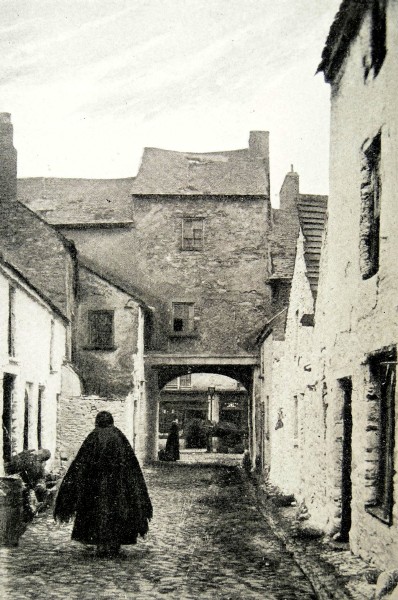 A TOWN BYWAY In most districts of
Ireland the
election had passed off peacefully enough; for nearly everywhere the
national
party was so dominant that no outside opposition existed, and the
contest was
between two home-rulers. Thus it was all in the family, and there were
no very
marked explosions of partisan ardor. But at Killarney the
rivals were a
home-ruler and a unionist, and resort was had to methods of dealing
with
political heresy that in most places are now becoming a little
old-fashioned.
As a matter of course, the enthusiasm of the patriots on both sides was
braced
with drink, and the persuasiveness of ardent spirits was used freely on
the
doubtful ones to make clearer to them the way they should vote; but
this was
not all. On Easter Sunday the home-rulers gathered for a rally on the
public
square, where they had erected a platform. The speaking had begun and
everything was moving smoothly when the unionists made a descent on the
meeting, armed with eggs and a great number of little paper bags filled
with
flour. The invaders pelted right and left, aiming more especially at
the
orators and dignitaries on the platform. The air was full of yells, and
blows
mingled with the crack and spatter of the eggs, and the soft bursting
of the
flour bags. The crowd got well
smeared, to say
nothing of the bruises of the hand-to-hand hostilities, and the meeting
was
effectually broken up. To the home-rulers the mortification was the
deeper
because this was the last gathering of the campaign and they were
robbed of the
chance to retaliate. But the thing about the assault which grieved them
most
was that the eggs used on them were in part bought from their own
leader’s
wife. She kept a poultry yard, and the evening before had
unsuspiciously sold
to the enemy all the eggs she had on hand — some eight or ten dozen. During my stay in
Killarney there
was a funeral in one of the thatched cottages on a lane neighboring my
hotel. I
was not as close and personal a witness of it as I could wish, but it
served to
set my landlady talking, and I learned a good deal about Irish funeral
customs.
The body of the deceased, from the time of death until it leaves the
house for
burial, lies in state in the “best” room, which means the kitchen in
the
average home. It is wrapped in a shroud, face uncovered, on a table
lightly
sprinkled with salt. Flowers decorate the shroud if the body is that of
a child
— otherwise ribbons — black ribbons for a married person and white for
unmarried. Such tables and other
articles of
furniture as are not immediately required are piled up on the bed, and
forms
are brought from the nearest public house to help seat the numerous
company
certain to be at the wake. Two candles are kept burning on each side of
the
departed one’s head, and it is deemed imperative that these shall not
be in
common tin or iron candlesticks, but in the aristocratic brass ones of
the
olden time. Rather than do without brass candlesticks the bereaved
family will
search over half a township to borrow them. The funeral expenses are
usually
heavy as compared with the people’s means. Among other outgoes, a
coffin must
be bought, goods for the wake purchased, and food and drink provided
for the
mourners. The family spend freely if they have money; and where their
poverty
is so pronounced as to prevent adequate preparations, some neighbor is
pretty
sure to go about and take up a collection in their behalf. The wake, which begins
the night
after the death, is in most instances resumed the night following, and
may be
continued three or even four nights before the funeral takes place, if
the
fortune of the deceased will permit, and if the temperature of the
season will
allow the burial to be deferred that long. The friends all come, for to
stay
away would be to slight the memory of the dead. The house is much
crowded, and
there are seats for only a small portion of those present. Formerly a
wake was
apt to degenerate into a carousal, no matter how well the melancholy
proprieties were observed when it began. But now the common feeling is
that for
people to get drunk on such an occasion “gives a bad look to things,”
and,
besides, the priests threaten not to hold a service at the house if the
mourners at the wake indulge in strong spirits. A sup of whiskey for
those who
want it is still, I believe, not lacking; yet it is imbibed sparingly,
and, on
the whole, the gathering is decorous and quiet. There may be some
telling of
stories, and joking in the back shed to while away the tedium of the
slow
hours, but it is never boisterous. Prominent among the
mourners are the
old women of the neighborhood. Long pipes and snuff are provided for
them, and
they are given the most comfortable seats around the fireplace. There
they sit
and puff and solemnly meditate, and every time the snuff saucer is
circulated
they each take a pinch, and say in Irish, referring to the deceased,
“May God
be merciful to his (or her) soul!” About midnight light
refreshments
are passed, ordinarily bread and butter with tea and wine, or porter.
After
this repast most of the company scatter to their homes; but some linger
until
daylight, and a few elderly women stay by the corpse, in relays, from
the death
until the funeral. There is seldom any
keening at the
wakes now, save in out-of-the-way villages. Usually, the only
lamentations are
the words that the old women address spontaneously to the corpse.
Suppose the
deceased is a young man, and an old woman comes in and stands looking
down to
view the remains. She says, “Wisha, sure, ‘twas well! I knew your
father, and
‘twas he was the dacint man; and little I thought I’d see you lying
there
to-day; and sure ‘twas yoursilf was the dacint boy! ‘Tis well I
remimber when I
used to rock you in the cradle mesilf; and sure I expicted ‘twas you
who’d be
at my wake instead of my comin’ to lament over you!” If it was an aged person
who had
died, the woman would say, “God be merciful to you, and God be with the
ould times!
Sure, ‘tis many the long day we’ve had together! But, sure, God’s will
be done;
we’ll all have to go the same road some day!” The old woman also
addresses words
of comfort to members of the family of the departed, as, for instance,
these to
a mother who has lost a little girl. “You mustn’t be frettin’ now, poor
woman.
‘Tis well for you to have the little angel gone to heaven before you.
Look at
the way I lost my poor little Johnny; and, sure, hadn’t I to bear it;
and
wasn’t he the strong b’y when he wint on me? What loss is yours, after
all,
compared with others I could name! Look at Mary Nolan, poor woman, and
hadn’t
she to put up with the loss of the provider of the family? So you
mustn’t be
frettin’ now, agra! That little angel will be intercedin’ for you in
the next
worruld!” When there is keening an
old woman
sits rocking back and forth at the foot of the corpse, her face covered
with
her hands. “Och hone! why did you die?” she chants, and continues with
dirgelike cadence, in a long lamentation that in part mourns the death,
and in
part exalts the virtues, of the departed. At frequent intervals in this
monody
she breaks out into a keen — a wail thrice repeated in which her
companions
join. Some old women become experts in the art of keening, and are
called on to
be chief mourners at all the wakes throughout their home region. Fifty years ago the
merits of a man
who died were celebrated with much emphasis on his valor in the fights
of the
local clans, and it was recalled with pride how well he wielded the
blackthorn
in his day. Nearly every neighborhood had its “factions “then, each
with a
leader who was its champion fighter. Fortunately, the dispositions of
the
members of opposing factions were not so warlike that enemies fought
indiscriminately wherever they met. It was mainly when the people got
together
in force at the fairs or the markets that there was trouble. They only
needed
to drink a bit and they wanted to try their strength on each other. If
a row
did not occur naturally, some man would take off his coat, trail it in
the
dust, and dare any one to step on the tail of it. This provocation
never failed
of its purpose, and you would hear the sudden, startling yells ringing
through
the town calling together the partisans, and then there would be “a
wild whirl
of shillalahs, and God knows what!” Some of the combatants would have
to be
carried home, possibly maimed for life, or even to die. Feuds were
handed down
from generation to generation; yet fights seldom occurred without the
participants first having their valor strengthened by whiskey, and
tales are
told of encounters on the seashore where the tide has come in and
drowned those
that have fallen in the fray too drunk to rise. The shillalah was the
only weapon
considered entirely orthodox in these combats. It derives its name from
a
famous wood in County Wicklow, where the best oaks and blackthorns for
its
making are reputed to grow. The old-time peasantry-were very careful in
selecting a weapon, and also in its preparation after it was cut from
hedge or
woodland. The usual mode was to rub it over repeatedly with butter and
place it
up the chimney, where it was left for several months. Shapes varied,
but the
favorite style was that of a cane three or four feet long. Occasionally
a man
would arm himself with a shillalah having a length of eight or ten
feet, known
as a “wattle,” or with what was called a “kippeen” — a short club that
had a
burly knot on the end. This last was the deadliest of the three, but
could not
be carried with the innocent appearance of a staff, as could the other
two. That the aggressive use
of the
shillalah is of the past is witnessed by the fact that at the wakes,
instead of
a paean over a dead warrior, there is substituted the praise of a good
father.
“‘Twas he who reared his children well,” cries the keener, “the quite
(quiet)
poor man — sure, you wouldn’t know whether he was there or not!” That
is, he
never made his presence a disturbing factor in his home. Killarney has the name of being a place where the beggars, by reason of their numbers and their persistence, make a real pest of themselves. But while I was there I encountered only one genuine specimen of the genus. I suppose it was as yet too early in the tourist season for visitors to be numerous, and the beggars had not begun to ply their trade in earnest. 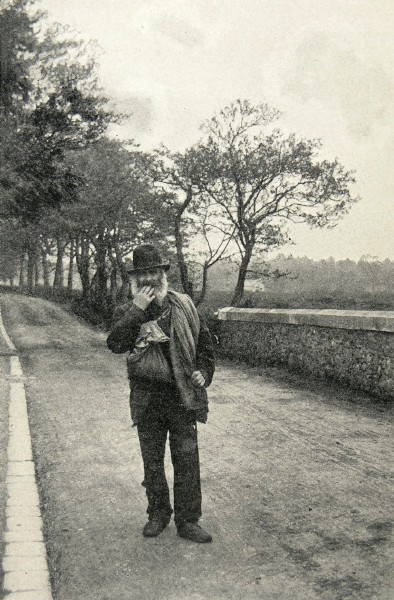 AN ABLE-BODIED BEGGAR My
beggar was a man accompanied by a
little boy. I had started for a walk, and he overtook me, and remarked
on the fineness of the weather, though it looked very threatening
at the time, and
then he kept on with me for a mile or more. His tongue wagged
unceasingly, and
he commented on what was to be seen along the way, on the condition of
Ireland,
of England, and of America, and wove into it all the tale of his own
troubles,
— how he was a shoemaker, but could find no work these two years,
how he had
been evicted, and how he had this little boy and four other children to
provide
for, and would I be good enough to help them a bit to get some food,
etc., etc.
After the beggar left me
I went on
along the lakes. The air darkened as I proceeded, and I could see that
a storm
was brewing among the mountain peaks. Presently there came a report of
distant
thunder, and a little girl whom I met at the moment made the sign of
the cross
and hurried on faster. I stopped and watched the clouds in doubt; but
the storm
seemed to be swinging off in another direction, and I walked on again,
intending to climb one of the mountains and see the country from the
heights. At length I took a road
that wound
high up the slopes of the hills, and as I went on I discovered that the
rain
had swept over this portion of my route and the road grew constantly
wetter and
more muddy. I continued to ascend until, in passing along the borders
of the
last patch of woods, before the land gave way to the stony upper wastes
of
heather and furze, I saw a tall, tattered man on ahead. He had a staff
in his
hand, and a cloak thrown loosely over his shoulders. Near him lay two
dead
sheep. I thought he looked as if he was some Robin Hood of the forest,
who very
likely had slain the creatures and was going to bear them stealthily
away, and
for a moment I entertained the fancy that he might treat me as he had
them. He
was peering about in a curious manner that I could not understand, but
his mild
greeting, as I drew near, reassured me. The dead sheep, he said, had
been
killed by the lightning, and he had just found them there. He showed me
some
scorched streaks on their bodies, and when I resumed my walk and left
him, he
still hovered around the spot, as before, considering what was to be
done. The road now faded into a
dim,
grassy trail, leading away across a boggy level to a steep slope that
mounted
high toward the craggy mountain summits. I was crossing this marshy
stretch
when another shower approached. Behind me the landscape was being fast
enveloped in murky blue mist, and a sombre twilight had crept over all
the
earth. I had a waterproof cape with me, and was about to put it on,
intending
to sit down on some rock and let the fast-gathering storm sweep over
me, when I
saw a woman not far ahead, moving off to the right, with a great bag on
her
shoulders. A glance in that direction revealed several thatched cabins
among
some tiny fields on a low hillside. Between me and this gray,
earth-hugging little hamlet the ground was a watery, boulder-sprinkled
bog,
which looked like a vast plum pudding. Had the menacing blackness of
the storm
been less near and ominous, I would have made a detour. As it was, I
took a
beeline across the marsh, keeping to the stones as much as possible,
and with
the first onset of the rain I reached the borders of the village. In a
stableyard adjoining a dwelling I found an old woman relieving her
shoulders of
a plethoric bag full of heather, — bedding for her cow or goats, I
presume, —
and I concluded she was the person I had seen a few minutes previous
toiling
over the bog. She readily granted me permission to go into the house
out of the
downpour, and I hastened to seek the welcome shelter. When I stooped through
the low
doorway, the house interior looked perfectly black, save for a feeble
gleam of
red in the fireplace; but as my eyes grew accustomed to the gloom, the
surroundings gradually disclosed themselves. The room was open above to
the
smoke-blackened rafters. Light entered through one small window and the
door.
This door, after a fashion very common in Irish cabin architecture, was
divided
horizontally in halves, and while I was present only the lower half was
closed.
The floor, partly of hard-trodden earth and partly of cobbles, was very
uneven,
and nothing set level on it. There were two small tables, a dresser
sparsely
filled with dishes, three chairs, and in odd places about the floor was
a
varied assortment of black kettles, pots and pans, shoes and rubbish. A
good-sized clock was fastened to the wall, and ticked with steady
solemnity in
the dusk. The old woman had
followed me in and
given me a chair, and had herself sat down by the fire. She was telling
me how
their clock had been up there on the wall where I saw it for twenty
years, and
what good company it was, when there came a clap of thunder. “O God Almighty, save
us!” she
exclaimed, and made the sign of the cross, and then bowed forward and
spread
out her hands in supplication. The posture was awkward, perhaps, yet
was eloquent
of a childlike fear and faith. “God bless us and save us,” she
continued, “and
save his honor (meaning me), and save the people, and all of us.” The intonations of the thunder were of frequent recurrence after this, for the space of half an hour, and at every clap the old woman crossed herself and prayed something as above, though often mumbling more which I could not catch. The storm reminded her of a story — she would like to know if I had heard it, and whether I thought it might be true or no. 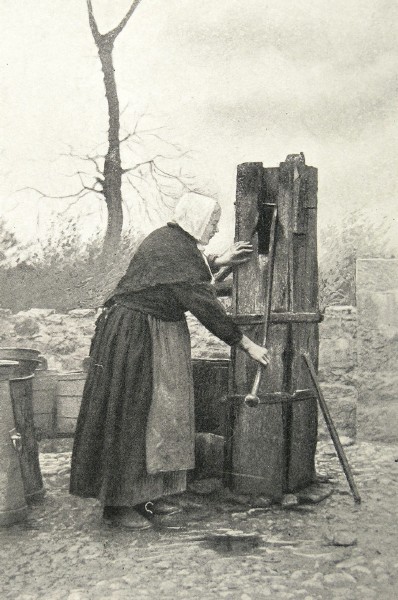 A FARMYARD PUMP “There was a man, and he
was workin’
in a field like, and it came on to thunder, and he put his head in a
hole in
the wall, and he said, ` God save what’s out o’ me.’ But he ought to
have
prayed for the whole of him, for he no sooner said that, than the wall
fell and
took his head clean off. It was telled to me that this was a judgmint
on the
crathur, because it is not right to pray small, just for yoursilf. But
you
should pray large — to save us all — pray big and open-hearted. But
that may be
only a story, sir.” The fire beside which the
woman sat
was made on the floor at the end of the room under the wide hood of a
chimney
that flared out from the wall about five feet above the blaze. A sooty
kettle
hung over the flames and simmered cheerfully. Now and then the woman
reached
down to a heap of dry brushwood by her side, took up a few twigs, broke
them
across her knee, and laid them on the coals. If the fire was low, she
would
stoop and brighten the embers by blowing. It would flare up then, and
its light
would shine out into the dusky room. Her supply of pine twigs she
obtained from
the woodland down below, where the villagers were allowed to gather
what they
needed. The household store of peat, their usual fuel, was gone. They
cut it on
the mountain a mile above, and when it was dry carried it down on their
backs,
a task in which both the men and the women shared. No one in the
village owned
a horse, and the only beasts of burden, aside from the human ones, were
two
donkeys. Even for them the task of bringing the “turf” down from the
mountain
was thought too severe, the path was so steep and rugged, and they were
chiefly
used “to take to town for some messages.” A good deal of smoke
drifted out
into the room, and the woman explained that the chimney was bad, “but
some days
we haven’t a bit of smoke, and other days we have a good dale. It’s as
the wind
turns.” The woman had two sons
and a
daughter living with her, as she told me with a fervent “Thank God! And
I had
another son who wint to Australia, and for two years I heard from him
regular,
and he sint me money; but I have had no account since, and I suppose he
is
dead. God help it, sir! And I had a daughter, too, that wint to
America, to
Worcester it was, sir, and her name it was Mrs. John Dwyer; but I have
had no
account from her, aither, this long time, and I suppose she is dead,
too, sir.”
The family had a cow and
a calf and
nine or ten sheep. The sheep were grazing on the mountain at this
season, but
in the winter they were kept in the walled fields near the house. “We
sells the
wool,” the woman said, “but it brings no price at all, now — it do not,
sir.” Few pigs were owned in
the hamlet,
but fowls were plenty, as I realized when the woman stepped outside for
a
moment and left the half-door open. Almost at once a bedraggled rooster
skulked
in and stood with his head well down between his shoulders, and his
tail
drooping to let the water run off. He did not look very attractive, but
a hen,
which seemed to think his company desirable, came with a startling
flutter and
cackle from a nest in a room corner, lit near the rooster, and began
looking
about the floor for something to eat. Then a bevy of geese came in from
the wet
outer world. The place was getting pretty populous, but the woman
presently
returned and shooed these two-legged friends all out into the yard with
a
“Begone, you thieves, you!” The woman’s sons were at
work for
one of the gentry in the valley, so the family was not dependent on the
little
farm, and they ate the eggs their hens laid, instead of selling them as
they
would have to do, “if they were badly off.” They bought oaten meal, and
occasionally fish and bacon, and they made a trifle of butter now and
then for
home use, and raised a few cabbages and enough potatoes, in a good
season, to
last through the year. As soon as the potatoes matured, they dug day by
day
what they needed for immediate eating, and just before the winter set
in placed
the residue in a pit to which they had access in renewing the household
supply.
“If it is wet,” explained
the old
woman, “or the blight do come too soon, the p’taties do not last, and
thin we
eats bread; and our crops do none of thim do well unless we have the
sun — the
foine time, sir!” However, they fared much
better than
when she was a “gaffer “(a girl of ten or twelve). “Thin the times was
tight,
and we lived on p’taties altogither. Sometimes we ate thim with only
salt, and
sometimes we ate thim with milk. We niver had bread ixcipt at
Christmas, and
very little mate at all.” Continuing her story of
the local
life, the old woman said that for the cattle they raised hay and oats,
“and we
might have plinty of provender, by the will of God, if it was not for
the deer
comin’ here from the forest. There do be ony amount of thim crathurs
back here
on the mountains. They gets into the corn and spoils it on us. Every
night now,
when the stalks gets big, the deer come and do be atin’ them so the
corn will
not be worth the cuttin’. They feeds on our grass, too, when it gets
strang.” On Sunday all the
mountain folk go
to mass at Killarney, four miles distant. Winter or summer, it makes
little
difference. “All the people around go, sir, except it may be those who
are too
old or feeble.” I mentioned the fact that
Ireland
had no snakes, and the woman said, “You have them in your country, I
believe,
sir, and I suppose they’d eat a person nearly, sir.” While we were talking the
daughter
of the house came in very wet with the rain, and the mother got up and
had her
sit by the fire. A great long-legged dog had entered with the daughter,
and
after shaking himself vigorously, and sending the water-drops flying
all around
the room, he, too, drew near to the fire, and his damp fur was soon
steaming in
the heat. As I was leaving, the old
woman
said, “You are an Irishman, sir, I suppose?” My negative seemed to
surprise the
two women greatly, for they said one to the other, “God help us, but he
looks
like an Irishman, does he not, now?” When I stepped outside I found the water still dripping from the eaves of the thatch, but the storm was over, and by the time I was well started on my way toward the valley the sun came out. It silvered the green-isleted lakes far down below, and even brought a faint gleam of brightness to the watery heights of dun-colored heather; and as the clouds dissolved, and the gauzy mists drifted away from the blue mountain peaks, I saw that their loftier summits were whitened with a film of snow. 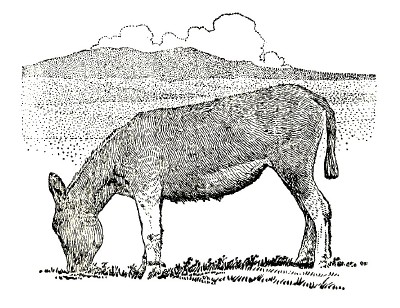 |
 THE Lakes of
Killarney — there is
something melting and delicate about the phrase that draws one
strangely. It
has a melody that charms with a vague suggestion of gentle, dreamy
landscapes,
peaceful waters, and mild blue mountains.
THE Lakes of
Killarney — there is
something melting and delicate about the phrase that draws one
strangely. It
has a melody that charms with a vague suggestion of gentle, dreamy
landscapes,
peaceful waters, and mild blue mountains.  Click the book image to turn
to the next Chapter.
Click the book image to turn
to the next Chapter.