 Web
and Book
design,
Web
and Book
design,Copyright, Kellscraft Studio 1999-2006 (Return to Web Text-ures) |
Click
Here to return to Isle of the Shamrock Content Page |
 (HOME) |
|
THE ISLE OF THE SHAMROCK I THE CASTLE OF ELOQUENCE
I followed more leisurely and prosaically, and, after breakfasting, looked about the town. That I was in Ireland was plain from the start, for the brogue and the peculiar piquancy of the faces were unmistakable. Then there were the women with shawls drawn over their heads, and the numerous beggars, and the barefoot newsboys selling green-tinted papers, and there was the omnipresent donkey-cart, and, scarcely less conspicuous, that other distinctively Irish vehicle, the jaunting-car, with the seats hung above the wheels. 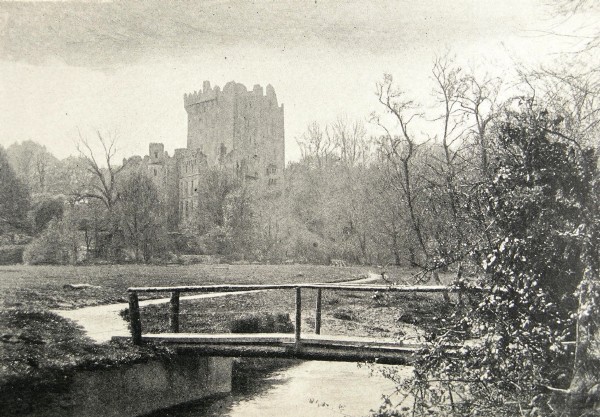 BLARNEY CASTLE Some of the natives were
no better
than walking scarecrows, so dilapidated was their attire; yet, as a
whole, Cork
is a city that shows evidence of a good deal of business prosperity. A
rich
farming region lies round about which reminds one of England. I saw
something
of this on a trip I made to Blarney Castle, eight miles distant, and
would have
seen more had I walked as I at first planned. But the day was too
bright and
warm for comfortable tramping, and I went instead by a convenient steam
tram. Blarney town is a small
manufacturing place. The castle, however, is well outside the village,
in
surroundings wholly rural, and the way thither is by a footpath and
across a
slight wooden bridge, spanning a swift, clean little river. The old
fortress
stands on a low hill, whence it looks down on a broad field from amid a
grove
of trees. This field is used as a public pleasure-ground, and rustic
seats
engird the bases of its noble oaks and elms, and a number of framework
swings
have been erected in the opens. The castle makes an
imposing ruin,
for the main structure has suffered little from the ravages of time
except that
the roof and the wooden floors have fallen. You can climb winding
stairs and
follow devious passages into vaulted chambers and chilly cells to your
heart’s
content. All this is very romantic; but it is worth while remembering
that, in
spite of its historic charm and its strong appeal to the imagination,
the
castle is a relic of an age of barbarism when the country was divided
among
many petty chiefs, each distrustful of the other, even when on terms of
nominal
friendship. These dwellings of the chieftains were built primarily for
defence.
They were dark, damp, and cold, and their thick-walled gloom must have
been
decidedly more prisonlike than homelike. Everything in their
construction
speaks of a time of universal insecurity, and the knightly chivalry
attributed
to the period is not nearly so characteristic as its wanton fighting,
robbery,
and cruelty. I could not help feeling therefore that Blarney was better
as a
peaceful ruin than it was in its proud completeness devoted to its
original
purposes. The castle is many stories high, and in the topmost cornice is the far-famed Blarney Stone — that powerful talisman which you have only to kiss to be endowed with eloquence for life. But as the vertical measurement of the cornice is about six feet and its projection beyond the main wall fully three feet, and as the Stone is at the bottom of the cornice, the kissing is not as easily accomplished as might be. Formerly it was customary to lower the candidate for eloquence over the rampart, head foremost. A friend clung to either heel, but at such a dizzy height the proceeding smacked so seriously of danger that of late years the parapet has been guarded against further attempts of the sort by a row of great spikes. 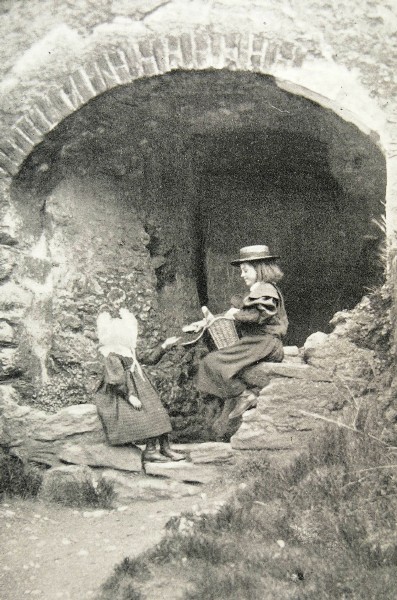 PICNICKERS The Stone Eloquent at one
time
dropped out. It was, however, promptly restored, and is now fixed in
place by
two heavy iron rods that clasp it to the cornice. Were it not that the
Blarney
Stone comes opposite one of the frequent gaps which alternate with the
out-thrust of the supporting stones of the cornice, it would be
practically
inaccessible. As things are, the only way to bestow the mystic kiss is
to get
down on your knees, double up like a jack-knife, and crane your neck
across the
yawning vacancy. I regarded the Stone with interest and wished I was
more of an
acrobat, or more courageous; but I was deterred by that lofty hole,
which,
though not much more than a foot broad and four long, was still plenty
large
enough to fall through, and I decided to get along without the
eloquence. The story of the Stone
dates back to
the middle of the fifteenth century, when Cormac MacCarthy the Strong,
a
descendant of the ancient kings of Munster, and builder of the
fortress,
chanced one day to save an old woman from drowning. In her gratitude
the old
woman offered Cormac a golden tongue which should have the power to
influence
men and women, friends and foes, as he willed. She told him to mount
the keep
and kiss a certain stone in the wall five feet below the gallery
running around
the top. He followed her directions, and obtained all the fluent
persuasiveness
she had promised. The tale of this new accomplishment of Cormac’s and
its
miraculous origin spread, and the Blarney Stone has been drawing
pilgrims to
itself ever since. It is said that all the
innumerable
MacCarthys who swarm in the barony are more or less descended from
Cormac the
Strong, and that even the meanest day laborer of the name considers
himself the
rightful owner of the domain of Blarney. They have never become
reconciled to
the fact that it was confiscated by the government, though two
centuries have
passed since the authorities took it in charge and conveyed it by sale
to other
hands. Tradition declares that the treasures of the MacCarthy family
are sunk
under the waters of the Lake of Blarney, which sleeps in a hollow a
quarter of
a mile from the castle. The secret hiding-place is supposed to be known
to only
three MacCarthys in each generation, and the treasures will be
recovered the
day that one of the family enters into possession of the ancestral
estate. While I was on the
highest walls of
the castle a party of small girls came clambering up from below. They
were
laden with baskets and bundles, and were evidently on a picnic. I had
first
noticed them on the green before the castle, where my attention was
attracted
to the group by a sharp explosion from one of their baskets. There was
instant
consternation, the basket was hastily opened, and a bottle of lemonade
was
revealed fizzing itself to waste. To stop the foaming overflow of the
precious
fluid they drank it, and thus to some degree restored their equanimity.
When the party had
finished the
ascent of the winding, irregular flights of stone stairs to the top of
the
great castle walls, they at once approached me and asked where the
Blarney
Stone was. I pointed it out, and, one by one, they crept up and hung on
to the
parapet while they took a scared, distant look, appalled by the Stone’s
uncanny
position, so far above the earth and separated from them by that
abysmal gap. “Mother of God, and is
that it!” exclaimed
the oldest girl; and then the smallest of the squad, a child of four in
a white
sunbonnet, began to cry. This overtaxed the
emotions of the
others, and threw them into a panic, and off they went with
ejaculations and
chatter enough for a hundred. But when they reached the stairway they
paused
and looked down into the vacancy where the roof and wooden floors had
fallen
and long ago mouldered away and entirely disappeared. Awed by the vast
emptiness of the space before them, one of the girls turned to me with
the
inquiry, “And where is the castle, sir?” “It is right here,” I
responded. “Sure, then,” said she,
quickly,
“this is no castle, sir — this is just a hole with some walls around
it.” Soon after this ingenuous
company of
picnickers had gone, I descended also, and overtook them in a path
under the
castle walls. They had been brought to a stop by another mishap to
their
provisions. A basket cover had come off, and the bread and butter and
cakes had
gone flying all over the premises. Every soul took part in an excited
scramble
to the rescue, and I arrived just as the last of the food was being
gathered up
and crammed back into the basket. There were no lamentations.
Apparently it
never occurred to them that any harm had been done. They had seen all they
wished to of
the castle, though they declared they liked it very well except for
“thim
horrid stairs,” and the Blarney Stone, which they “didn’t think nothing
at all
of.” Now they were betaking themselves to the green, where they piled
into the
swings, and all talked together all the time. I sat down near by, and
was treated
like an old acquaintance. Where was I from? they asked. “America? Lord
save
us!” ejaculated the oldest of the party, “and do you know Katie
Donovan, sir?
She is me cousin, and she is in America, sir.” They were much
disappointed that I
did not know Katie Donovan. At their request I pushed them in the
swings for a
few minutes. They were very appreciative. “It is fine — it is
exquishite, sir!”
they said. So grateful were they
that they let
loose one of their bottles of lemonade into a glass for me, and they
brought me
a plum cake and a knife to cut it, and requested me to take as much as
I liked.
They also brought me some sweet biscuits and candies. In their
generosity they
would even take the candies out of their mouths and offer them to me.
Finally
they gave me an orange. I was afraid they were robbing themselves, and
tried to
refuse, but they insisted with the affirmation that they had more than
they
could eat, and if I didn’t take it, they would have to throw it away,
so they
would! Mamie, the youngest,
could dance,
they said. “Her sister sings the tune, and she dances — indeed she do!”
Then Mamie was wheedled
and her
sister sang the tune, and the tot shuffled her feet and bobbed up and
down.
What a happy-go-lucky lot they were, and they were to stay all day and
not
return to Cork until seven in the evening! When I bade the little
Corkers
good-by they wanted to know was I going to America now? “No,” I replied, “I shall
go to
Killarney first.” “And who is that, sir?”
asked one of
the smaller girls. “I don’t know him, sir!” I parted from them with real regret. What lively tongues, what quick imaginations, what racy wildness! They had no need to kiss the Blarney Stone.  |
 IT was the
first gray of a May
morning, and the coasting steamer on which I had taken passage the day
before
at Plymouth, in southern England, was sliding along up the quiet of the
river
Lee toward Cork. The air was chilly, and the night mists still lingered
in the
hollows of the green landscape and floated in filmy wraiths over the
surface of
the water. All the little steamer’s passengers were astir and were
watching the
scene from the upper deck. The most interested spectators among us were
a score
of Irish boys from her Majesty’s ship Renown, going home for a month’s
leave of
absence after a two years’ cruise in the West Indies. They wore loose,
blue
uniforms, and flat caps with their ship’s name on the bands, and they
carried
their belongings tied up in colored handkerchiefs or squares of calico.
To them
the low-lying shores between which our boat was moving were
superlatively
beautiful. They eagerly picked out familiar points as we passed them,
and declared
that altogether this was the finest sight they had seen in their lives.
When we
at length approached the dock, their impatience to land was such that
as soon
as we came within jumping distance they tossed their little bundles
ashore and
made flying leaps after them. The officers of the steamer declared the
man-of-war lads were as bad as a menagerie of wild animals. Attempts to
restrain them were wholly futile, and by the time the gang-plank was in
position they had helter-skeltered off up the neighboring streets and
alleys
and were lost to view.
IT was the
first gray of a May
morning, and the coasting steamer on which I had taken passage the day
before
at Plymouth, in southern England, was sliding along up the quiet of the
river
Lee toward Cork. The air was chilly, and the night mists still lingered
in the
hollows of the green landscape and floated in filmy wraiths over the
surface of
the water. All the little steamer’s passengers were astir and were
watching the
scene from the upper deck. The most interested spectators among us were
a score
of Irish boys from her Majesty’s ship Renown, going home for a month’s
leave of
absence after a two years’ cruise in the West Indies. They wore loose,
blue
uniforms, and flat caps with their ship’s name on the bands, and they
carried
their belongings tied up in colored handkerchiefs or squares of calico.
To them
the low-lying shores between which our boat was moving were
superlatively
beautiful. They eagerly picked out familiar points as we passed them,
and declared
that altogether this was the finest sight they had seen in their lives.
When we
at length approached the dock, their impatience to land was such that
as soon
as we came within jumping distance they tossed their little bundles
ashore and
made flying leaps after them. The officers of the steamer declared the
man-of-war lads were as bad as a menagerie of wild animals. Attempts to
restrain them were wholly futile, and by the time the gang-plank was in
position they had helter-skeltered off up the neighboring streets and
alleys
and were lost to view.  Click the book image to turn
to
the next Chapter.
Click the book image to turn
to
the next Chapter.