Web
and Book design, Web
and Book design, Copyright, Kellscraft Studio
1999-2003
(Return
to Web
Text-ures)
|
Click Here to return to Inca Lands Content Page |
 (HOME) |
|
Web
and Book design, Copyright, Kellscraft Studio
1999-2003
(Return
to Web
Text-ures)
|
Click Here to return to Inca Lands Content Page |
(HOME) |
|
INCA LAND
CHAPTER I CROSSING THE DESERT
SKETCH
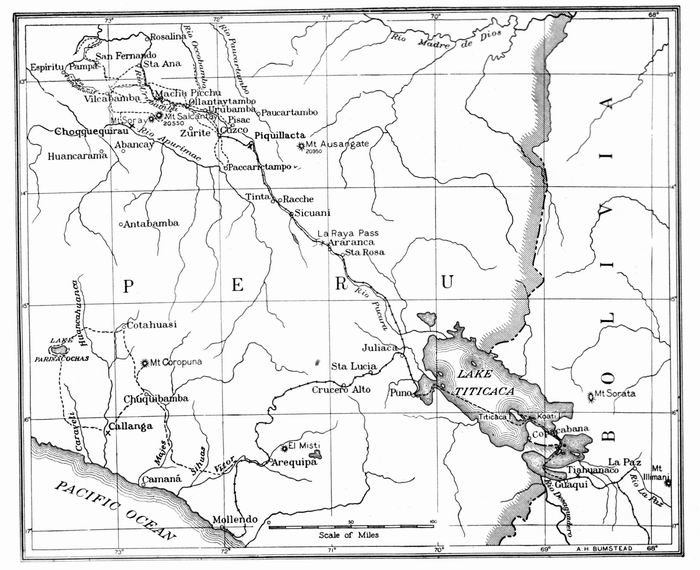
MAP OF SOUTHERN PERU.
A KIND friend in Bolivia once placed in my hands a copy of a most interesting book by the late E. George Squier, entitled “Peru. Travel and Exploration in the Land of the Incas.” In that volume is a marvelous picture of the Apurimac Valley. In the foreground is a delicate suspension bridge which commences at a tunnel in the face of a precipitous cliff and hangs in mid-air at great height above the swirling waters of the “great speaker.” In the distance, towering above a mass of stupendous mountains, is a magnificent snow-capped peak. The desire to see the Apurimac and experience the thrill of crossing that bridge decided me in favor of an overland journey to Lima. As a result I went to Cuzco, the ancient capital of the mighty empire of the Incas, and was there urged by the Peruvian authorities to visit some newly re-discovered Inca ruins. As readers of “Across South America” will remember, these ruins were at Choqquequirau, an interesting place on top of a jungle-covered ridge several thousand feet above the roaring rapids of the great Apurimac. There was some doubt as to who had originally lived here. The prefect insisted that the ruins represented the residence of the Inca Manco and his sons, who had sought refuge from Pizarro and the Spanish conquerors of Peru in the Andes between the Apurimac and Urubamba rivers. While Mr. Clarence L. Hay and I were on the slopes of Choqquequirau the clouds would occasionally break away and give us tantalizing glimpses of snow-covered mountains. There seemed to be an unknown region, “behind the Ranges,” which might contain great possibilities. Our guides could tell us nothing about it. Little was to be found in books. Perhaps Manco’s capital was hidden there. For months afterwards the fascination of the unknown drew my thoughts to Choqquequirau and beyond. In the words of Kipling’s “Explorer”: “. . . a voice, as bad as Conscience,
ranges interminable changes To add to my unrest, during the following summer I read Bandelier’s “Titicaca and Koati,” which had just appeared. In one of the interesting footnotes was this startling remark: “It is much to be desired that the elevation of the most prominent peaks of the western or coast range of Peru be accurately determined. It is likely . . . that Coropuna, in the Peruvian coast range of the Department Arequipa, is the culminating point of the continent. It exceeds 23,000 feet in height, whereas Aconcagua [conceded to be the highest peak in the Western Hemisphere] is but 22,763 feet (6940 meters) above sea level.” His estimate was based on a survey made by the civil engineers of the Southern Railways of Peru, using a section of the railroad as a base. My sensations when I read this are difficult to describe. Although I had been studying South American history and geography for more than ten years, I did not remember ever to have heard of Coropuna. On most maps it did not exist. Fortunately, on one of the sheets of Raimondi’s large-scale map of Peru, I finally found “Coropuna — 6,949 m.” — 9 meters higher than Aconcagua! — one hundred miles northwest of Arequipa, near the 73d meridian west of Greenwich. Looking up and down the 73d meridian as it crossed Peru from the Amazon Valley to the Pacific Ocean, I saw that it passed very near Choqquequirau, and actually traversed those very lands “behind the Ranges” which had been beckoning to me. The coincidence was intriguing. The desire to go and find that “something hidden” was now reinforced by the temptation to go and see whether Coropuna really was the highest mountain in America. There followed the organization of an expedition whose object was a geographical reconnaissance of Peru along the 73d meridian, from the head of canoe navigation on the Urubamba to tidewater on the Pacific. We achieved more than we expected. Our success was due in large part to our “unit-food-boxes,” a device containing a balanced ration which Professor Harry W. Foote had cooperated with the assembling. The object of our idea was to facilitate the provisioning of small field parties by packing in a single box everything that two men would need in the way of provisions for a given period. These boxes have given such general satisfaction, not only to the explorers themselves, but to the surgeons who had the responsibility of keeping them in good condition, that a few words in regard to this feature of our equipment may not be unwelcome. The best unit-food-box provides a balanced ration for two men for eight days, breakfast and supper being hearty, cooked meals, and luncheon light and uncooked. It was not intended that the men should depend entirely on the food-boxes, but should vary their diet as much as possible with whatever the country afforded, which in southern Peru frequently means potatoes, corn, eggs, mutton, and bread. Nevertheless each box contained sliced bacon, tinned corned beef, roast beef, chicken, salmon, crushed oats, milk, cheese, coffee, sugar, rice, army bread, salt, sweet chocolates, assorted jams, pickles, and dried fruits and vegetables. By seeing that the jam, dried fruits, soups, and dried vegetables were well assorted, a sufficient variety was procured without destroying the balanced character of the ration. On account of the great difficulty of transportation in the southern Andes we had to eliminate foods that contained a large amount of water, like French peas, baked beans, and canned fruits, however delicious and desirable they might be. In addition to food, we found it desirable to include in each box a cake of laundry soap, two yards of dish toweling, and three empty cotton-cloth bags, to be used for carrying lunches and collecting specimens. The most highly appreciated article of food in our boxes was the rolled oats, a dish which on account of its being already partially cooked was easily prepared at high elevations, where rice cannot be properly boiled. It was difficult to satisfy the members of the Expedition by providing the right amount of sugar. At the beginning of the field season the allowance — one third of a pound per day per man — seemed excessive, and I was criticized for having overloaded the boxes. After a month in the field the allowance proved to be too small and had to be supplemented. Many people seem to think that it is one of the duties of an explorer to “rough it,” and to “trust to luck” for his food. I had found on my first two expeditions, in Venezuela and Colombia and across South America, that the result of being obliged to subsist on irregular and haphazard rations was most unsatisfactory. While “roughing it” is far more enticing to the inexperienced and indiscreet explorer, I learned in Peru that the humdrum expedient of carefully preparing, months in advance, a comprehensive bill of fare sufficiently varied, wholesome, and well-balanced, is “the better part of valor.” The truth is that providing an abundance of appetizing food adds very greatly to the effectiveness of a party. To be sure, it may mean trouble and expense for one’s transportation department, and some of the younger men may feel that their reputations as explorers are likely to be damaged if it is known that strawberry jam, sweet chocolate and pickles are frequently found on their menu! Nevertheless, experience has shown that the results of “trusting to luck” and “living as the natives do” means not only loss of efficiency in the day’s work, but also lessened powers of observation and diminished enthusiasm for the drudgery of scientific exploration. Exciting things are always easy to do, no matter how you are living, but frequently they produce less important results than tasks which depend upon daily drudgery; and daily drudgery depends upon a regular supply of wholesome food. We reached Arequipa, the proposed base for our campaign against Mt. Coropuna, in June, 1911. We learned that the Peruvian “winter” reaches its climax in July or August, and that it would be folly to try to climb Coropuna during, the winter snowstorms. On the other hand, the “summer months,” beginning with November, are cloudy and likely to add fog and mist to the difficulties of climbing a new mountain. Furthermore, June and July are the best months for exploration in the eastern slopes of the Andes in the upper Amazon Basin, the lands “behind the Ranges.” Although the montaña, or jungle country, is rarely actually dry, there is less rain then than in the other months of the year; so we decided to go first to the Urubamba Valley. The story of our discoveries there, of identifying Uiticos, the capital of the last Incas, and of the finding of Machu Picchu will be found in later chapters. In September I returned to Arequipa and started the campaign against Coropuna by endeavoring to get adequate transportation facilities for crossing the desert. Arequipa, as everybody knows, is the home of a station of the Harvard Observatory, but Arequipa is also famous for its large miles. Unfortunately, a “mule trust” had recently been formed — needless to say, by an American — and I found it difficult to make any satisfactory arrangements. After two weeks of skirmishing, the Tejada brothers appeared, two arrieros or muleteers, who seemed willing to listen to our proposals. We offered them a thousand soles (five hundred dollars gold) if they would supply us with a pack train of eleven mules for two months and go with us wherever we chose, we agreeing not to travel on an average more than seven leagues1 a day. It sounds simple enough but it took no end of argument and persuasion cm the part of our friends in Arequipa to convince these worthy arrieros that they were not going to be ever-lastingly ruined by this bargain. The trouble was that they owned their mules, knew the great danger of crossing the deserts that lay between us and Mt. Coropuna, and feared to travel on unknown trails. Like most muleteers, they were afraid of unfamiliar country. They magnified the imaginary evils of the road to an inconceivable pitch. The argument that finally persuaded them to accept the proffered contract was my promise that after the first week the cargo would be so much less that at least two of the pack mules could always be free. The Tejadas, realizing only too well the propensity of pack animals to get sore backs and go lame, regarded my promise in the light of a factor of safety. Lame mules would not have to carry loads. Everything was ready by the end of the month. Mr. H. L. Tucker, a member of Professor H. C. Parker’s 1910 Mt. McKinley Expedition and thoroughly familiar with the details of snow-and-ice-climbing, whom I had asked to be responsible for securing the proper equipment, was now entrusted with planning and directing the actual ascent of Coropuna. Whatever success was achieved on the mountain was due primarily to Mr. Tucker’s skill and foresight. We had no Swiss guides, and had originally intended to ask two other numbers of the Expedition to join us on the climb. However, the exigencies of making a geological and topographical cross section along the 73d meridian through a practically unknown region, and across one of the highest passes in the Andes (17,633 ft.), had delayed the surveying party to such an extent as to make it impossible for them to reach Coropuna before the first of November. On account of the approach of the cloudy season it did not seem wise, to wait for their cooperation. Accordingly, I secured in Arequipa the services of Mr. Casimir Watkins, an English naturalist, and of Mr. F. Hinckley, of the Harvard Observatory. It was proposed that Mr. Hinckley, who had twice ascended El Misti (19,120 ft.), should accompany us to the top, while Mr. Watkins, who had only recently recovered from a severe illness, should take charge of the Base Camp. The prefect of Arequipa obligingly offered us a military escort in the person of Corporal Gamarra, a full-blooded Indian of rather more than average height and considerably more than average courage, who knew the country. As a member of the mounted gendarmerie, Gamarra had been stationed at the provincial capital of Cotahuasi a few months previously. One day a mob of drunken, riotous revolutionists stormed the government buildings while he was on sentry duty. Gamarra stood his ground and, when they attempted to force their way past him, shot the leader of the crowd. The mob scattered. A grateful prefect made him a corporal and, realizing that his life was no longer safe in that particular vicinity, transferred him to Arequipa. Like nearly all of his race, however, he fell an easy prey to alcohol. There is no doubt that the chief of the mounted police in Arequipa, when ordered by the prefect to furnish us an escort for our journey across the desert, was glad enough to assign Gamarra to us. His courage could not be called in question even though his habits might lead him to become troublesome. It happened that Gamarra did not know we were planning to go to Cotahuasi. Had he known this, and also had he suspected the trials that were before him on Mt. Coropuna, he probably would have begged off — but I am anticipating. On the 2d of October, Tucker, Hinckley, Corporal Gamarra and I left Arequipa; Watkins followed a week later. The first stage of the journey was by train from Arequipa to Vitor, a distance of thirty miles. The arrieros sent the cargo along too. In addition to the food-boxes we brought with us tents, ice axes, snowshoes, barometers, thermometers, transit, fiber cases, steel boxes, duffel bags, and a folding boat. Our pack train was supposed to lice started from Arequipa the day before. We hoped it would reach Vitor about the same time that we did but that was expecting too much of arrieros on the first day of their journey. So we had an all-day wait near the primitive little railway station. We amused ourselves wandering off over the neighboring pampa and studying the médanos, crescent-shaped sand dunes which are common in the great coastal desert. One reads so much of the great tropical jungles of Smith America and of well-nigh impenetrable forests that it is difficult to realize that the West Coast from Ecuador, on the north, to the heart of Chile, on the smith, is a great desert, broken at intervals by oases, or valleys whose rivers, coming from melting snows of the Andes, are here and there diverted for irrigation. Lima, the capital of Peru, is in one of the largest of these oases. Although frequently enveloped in a damp fog, the Peruvian coastal towns are almost never subjected to rain. The causes of this phenomenon are easy to understand. Winds coming from the east, laden with the moisture of the Atlantic Ocean and the steaming Amazon Basin, are rapidly cooled by the eastern slopes of the Andes arid forced to deposit this moisture in the montãna. By the time the winds have crossed the mighty cordillera there is no rain left in them. Conversely, the winds that come from the warm Pacific Ocean strike a cold area over the frigid Humboldt Current, which sweeps up along the west coast of South America. This cold belt wrings the water out of the westerly winds, so that by the time they reach the warm land their relative humidity is low. To be sure, there are months in some years when so much moisture falls on the slopes of the coast range that the hillsides are clothed with flowers, but this verdure lasts but a short time and does not seriously affect the great stretches of desert pampa in the midst of which we now were. Like the other pampas of this region, the flat surface inclines toward the sea. Over it the sand is rolled along by the wind and finally built into crescent-shaped dunes. These médanos interested us greatly. The prevailing wind on the desert at night is a relatively gentle breeze that comes down from the cool mountain slopes toward the ocean. It tends to blow the lighter particles of sand along in a regular dune, rolling it over and over downhill, leaving the heavier particles behind. This is reversed in the daytime. As the heat increases toward noon, the wind comes rushing up from the ocean to fill the vacuum caused by the rapidly ascending currents of hot air that rise from the overheated pampas. During the early afternoon this wind reaches a high velocity and swirls the sand along in clouds. It is now strong enough to move the heavier particles of sand, uphill. It sweeps the heaviest ones around the base of the dune and deposits them in pointed ridges on either side. The heavier material remains stationary at night while the lighter particles are rolled downhill, but the whole mass travels slowly uphill again during the gales of the following afternoon. The result is the beautiful crescent-shaped médano. 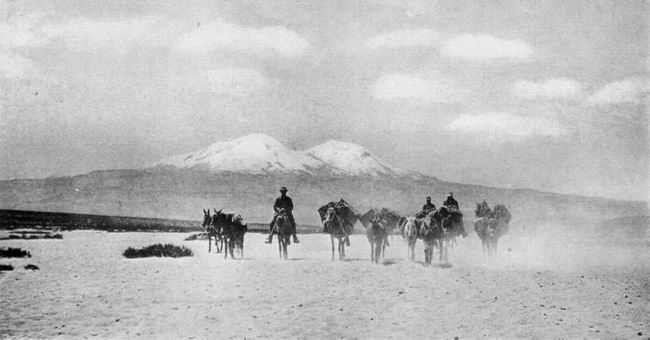 MT. COROPUNA FROM THE NORTHWEST. About five o’clock our mules, a fine-looking lot — far superior to any that we had been able to secure near Cuzco — trotted briskly into the dusty little plaza. It took some time to adjust the loads, and it was nearly seven o’clock before we started off in the moonlight for the oasis of Vitor. As we left the plateau and struck the dusty trail winding down into a dark canyon we caught a glimpse of something white shimmering faintly on the horizon far off to the northwest; Coropuna! Shortly before nine o’clock we reached a little corral, where the mules were unloaded. For ourselves we found a shed with a clean, stone-paved floor, where we set up our cots, only to be awakened many times during the night by passing caravans anxious to avoid the terrible heat of the desert by day. Where the oases are only a few miles apart one often travels by day, but when crossing the desert is a matter of eight or ten hours’ steady jogging with no places to rest, no water, no shade, the pack animals suffer greatly. Consequently, most caravans travel, so far as possible, by night. Our first desert, the pampa of Sihuas, was reported to be narrow, so we preferred to cross it by day and see what was to be seen. We got up about half-past four and were off before seven. Then our troubles began. Either because he lived in Arequipa or because they thought he looked like a good horseman, or for reasons best known to themselves, the Tejadas had given Mr. Hinckley a very spirited saddle-mule. The first thing I knew, her rider, carrying a heavy camera, a package of plate-holders, and a large mercurial barometer, borrowed from the Harvard Observatory, was pitched headlong into the sand. Fortunately no damage was done, and after a lively chase the runaway mule was brought back by Corporal Gamarra. After Mr. Hinckley was remounted on his dangerous mule we rode on for a while in peace, between cornfields and vineyards, over paths flanked by willows and fig trees. The chief industry of Vitor is the making of wine from vines which date back to colonial days. The wine is aged in huge jars, each over six feet high, buried in the ground. We had a glimpse of seventeen of them standing in a line, awaiting sale. It made one think of Ali Baba and the Forty Thieves, who would have had no trouble at all hiding in these Cyclopean crocks. The edge of the oasis of Vitor is the contour line along which the irrigating canal runs. There is no gradual petering out of foliage. The desert begins with a stunning crash. On one side is the bright, luxurious green of fig trees and vineyards; on the other side is the absolute stark nakedness of the sandy desert. Within the oasis there is an abundance of water. Much of it runs to waste. The wine growers receive more than they can use; in fact, more land could easily be put under cultivation. The chief difficulties are the scarcity of ports from which produce can be shipped to the outer world, the expense of the transportation system of pack trains over the deserts which intervene between the oases and the railroad, and the lack of capital. Otherwise the irrigation system might be extended over great stretches of rich, volcanic soil, now unoccupied. A steady climb of three quarters of an hour took us to the northern rim of the valley. Here we again saw the snowy mass of Coropuna, glistening in the sunlight, seventy-five miles away to the northwest. Our view was a short one, for in less than three minutes we had to descend another canyon. We crossed this and climbed out an the pampa of Sihuas. There was little to interest us in our immediate surroundings, but in the distance was Coropuna, and I had just begun to study the problem of possible routes for climbing the highest peak when Mr. Hinckley’s mule trotted briskly across the trail directly in front of me, kicked up her heels, and again sent him sprawling over the sand, barometer, camera, plates, and all. Unluckily, this time his foot caught in a stirrup and, still holding the bridle, he was dragged some distance before he got it loose. He struggled to his feet and tried to keep the mule from running away, when a violent kick released his hold and knocked him out. We immediately set up our little “Mummery” tent on the hot, sandy floor of the desert and rendered first-aid to the unlucky astronomer. We found that the sharp point of one of the vicious mule’s new shoes had opened a large vein in Mr. Hinckley’s leg. The cut was not dangerous, but too deep for successful mountain climbing. With Gamarra’s aid, Mr. Hinckley was able to reach Arequipa that night, but his enforced departure not only shattered his own hopes of climbing Coropuna, but also made us wonder how we were going to have the necessary three-men-on-the-rope when we reached the glaciers. To be sure, there was the corporal — but would he go? Indians do not like snow mountains. Packing up the tent again, we resumed our course over the desert. The oasis of Sihuas, another beautiful garden in the bottom of a huge canyon, was reached about four o’clock in the afternoon. We should have been compelled to camp in the open with the arrieros had not the parish priest invited us to rest in the cool shade of his vine-covered arbor. He graciously served us with cakes and sweet native wine, and asked us to stay as long as we liked. The desert of Majes, which now lay ahead of us, is perhaps the widest, hottest, and most barren in this region. Our arrieros were unwilling to cross it in the daytime. They said it was forty-five miles between water and water. The next day we enjoyed the hospitality of our kindly host until after supper. So sure are the inhabitants of these oases that it is not going to rain that their houses are built merely as a shelter against the sun and wind. They are made of the canes that grow in the jungles of the larger river bottoms, or along the banks of irrigating ditches. On the roof the spaces between the canes are filled with adobe, sun-dried mud. It is not necessary to plaster the sides of the houses, for it is pleasant to let the air have free play, and it is amusing to look out through the cracks and see everything that is passing. That evening we saddled in the moonlight. Slowly we climbed out of the valley, to spend the night jogging steadily, hour after hour, across the desert. As the moon was setting we entered a hilly region, and at sunrise found ourselves in the midst of a tumbled mass of enormous sand dunes — the result of hundreds of médanos blown across the pampa of Majes and deposited along the border of the valley. It took us three hours to wind slowly down from the level of the desert to a point where we could see the great canyon, a mile deep and two miles across. Its steep sides are of various colored rocks and sand. The bottom is a bright green oasis through which flows the rapid Majes River, too deep to be forded even in the dry season. A very large part of the flood plain of the unruly river is not cultivated, and consists of a wild jungle, difficult of access in the dry season and impossible when the river rises during the rainy months. The contrast between the gigantic hills of sand and the luxurious vegetation was very striking; but to us the most beautiful thing in the landscape was the long, glistening, white mass of Coropuna, now much larger and just visible above the opposite rim of the valley. At eight o’clock in the morning, as we were wondering how long it would be before we could get down to the bottom of the valley and have some breakfast, we discovered, at a place called Pitas (or Cerro Colorado), a huge volcanic boulder covered with rude pictographs. Further search in the vicinity revealed about one hundred of these boulders, each with its quota of crude drawings. I did not notice any ruins of houses near the rocks. Neither of the Tejada brothers, who had been past here many times, nor any of the natives of this region appeared to have any idea of the origin or meaning of this singular collection of pictographic rocks. The drawings represented jaguars, birds, men, and dachshund-like dogs. They deserved careful study. Yet not even the interest and excitement of investigating the “rocas jeroglificos,” as they are called here, could make us forget that we had had no food or sleep for a good many hours. So after taking a few pictures we hastened on and crossed the Majes River on a very shaky temporary bridge. It was built to last only during the dry season. To construct a bridge which would withstand floods is not feasible at present. We spent the day at Coriri, a pleasant little village where it was almost impossible to sleep, on account of the myriads of gnats. The next day we had a short ride along the western side of the valley to the town of Ahlao, the capital of the province of Castilla, called by its present inhabitants “Majes,” although on Raimondi’s map that name is applied only to the river and the neighboring desert. In 1865, at the time of his visit, it had a bad reputation for disease. Now it seems more healthy. The sub-prefect of Castilla had been informed by telegraph of our coming, and invited us to an excellent dinner. The people of Majes are largely of mixed white and Indian ancestry. Many of them appeared to be unusually businesslike. The proprietor of one establishment was a great admirer of American shoes, the name of which he pronounced in a manner that puzzled us for a long time. “W” is unknown in Spanish and the letters “a,” “l,” and “k” are never found in juxtaposition. When he asked us what we thought of “Valluck-ofair’,” accenting strongly the last syllable, we could not imagine what he meant. He was equally at a loss to understand how we could be so stupid as not to recognize immediately the well-advertised name of a widely known shoe. At Majes we observed cotton, which is sent to the mills at Arequipa, alfalfa, highly prized as fodder for pack animals, sugar cane, from which aguardiente, or white rum, is made, and grapes. It is said that the Majes vineyards date back to the sixteenth century, and that some of the huge, buried, earthenware wine jars now in use were made as far back as the reign of Philip II. The presence of so much wine in the community does not seem to have a deleterious effect on the natives, who were not only hospitable but energetic — far more so, in fact, than the natives of towns in the high Andes, where the intense cold and the difficulty of making a living have reacted upon the Indians, often causing them to be morose, sullen, and without ambition. The residences of the wine growers are sometimes very misleading. A typical country house of the better class is not much to look at. Its long, low, flat roof and rough, unwhitewashed, mud-colored walls give it an unattractive appearance; yet to one’s intense surprise the inside may be clean and comfortable, with modern furniture, a piano, and a phonograph. Our conscientious and hard-working arrieros rose at two o’clock the next morning, for they knew their mules had a long, hard climb ahead of them, from an elevation of 1000 feet above sea level to 10,000 feet. After an all-day journey we camped at a place where forage could be obtained. We had now left the region of tropical products and come back to potatoes and barley. The following day a short ride brought us past another pictographic rock, recently blasted open by an energetic “treasure seeker” of Chuquibamba. This town has 3000 inhabitants and is the capital of the province of Condesuyos. It was the place which we had selected several months before as the rendezvous for the attack on Coropuna. The climate here is delightful and the fruits and cereals of the temperate zone are easily raised. The town is surrounded by gardens, vineyards, alfalfa and grain fields; all showing evidence of intensive cultivation. It is at the head of one of the branches of the Majes Valley and is surrounded by high cliffs. The people of Chuquibamba were friendly. We were kindly welcomed by Señor Benavides, the sub-prefect, who hospitably told us to set up our cots in the grand salon of his own house. Here we received calls from the local officials, including the provincial physician, Dr. Pastór, and the director of the Colegio Nacional, Professor Alejandro Coello. The last two were keen to go with us up Mt. Coropuna. They told us that there was a hill near by called the Calvario, whence the mountain could he seen, and offered to take us up there. We accepted, thinking at the same time that this would show who was best fitted to join in the climb, for we needed another man on the rope. Professor Coello easily distanced the rest of us and won the coveted place. From the Calvario hill we had a splendid view of those white solitudes whither we were bound, now only twenty-five miles away. It seemed clear that the western or truncated peak, which gives its name to the mass (koro = “cut off at the top”; puna = “a cold, snowy height”), was the highest point of the range, and higher than all the eastern peaks. Yet behind the flat-topped dome we could just make out a northerly peak. Tucker wondered whether or not that might prove to be higher than the western peak which we decided to climb. No one knew anything about the mountain. There were no native guides to be had. The wildest opinions were expressed as to the best routes and methods of getting to the top. We finally engaged a man who said he knew how to get to the foot of the mountain, so we called him “guide” for want of a more appropriate title. The Peruvian spring was now well advanced and the days were fine and clear. It appeared, however, that there had been a heavy snowstorm on the mountain a few days before. If summer were coming unusually early it behooved us to waste no time, and we proceeded to arrange the mountain equipment as fast as possible. Our instruments for determining altitude consisted of a special mountain-mercurial barometer made by Mr. Henry J. Green, of Brooklyn, capable of recording only such air pressures as one might expect to find above 12,000 feet; a hypsometer loaned us by the Department of Terrestrial Magnetism of the Carnegie Institution of Washington, with thermometers especially made for us by Green; a large mercurial barometer, borrowed from the Harvard Observatory, which, notwithstanding its rough treatment by Mr. Hinckley’s mule, was still doing good service; and one of Green’s sling psychrometers. Our most serious want was an aneroid, in case the fragile mercurials should get broken. Six months previously I had written to J. Hicks, the celebrated instrument maker of London, asking him to construct, with special care, two large “Watkins” aneroids capable of recording altitudes five thousand feet higher than Coropuna was supposed to be. His reply had never reached me, nor did any one in Arequipa know anything about the barometers. Apparently my letter had miscarried. It was not until we opened our specially ordered “mountain grub” boxes here in Chuquibamba that we found, alongside of the pemmican and self-heating tins of stew which had been packed for us in London by Grace Brothers, the two precious aneroids, each as large as a big alarm clock. With these two new aneroids, made with a wide margin of safety, we felt satisfied that, once at the summit, we should know whether there was a chance that Bandelier was right and this was indeed the top of America. For exact measurements we depended on Topographer Hendriksen, who was due to triangulate Coropuna in the course of his survey along the 73d meridian. My chief excuse for going up the mountain was to erect a signal at or near the top which Hendriksen could use as a station in order to make his triangulation more exact. My real object, it must be confessed, was to enjoy the satisfaction, which all Alpinists feel, of conquering a “virgin peak.”
Click
 here to continue to the next chapter of Inca Lands
 |