 Web
and Book design image, Web
and Book design image, Copyright, Kellscraft Studio 1999-2006 (Return to Web Text-ures) |
 (HOME) |
|
XII
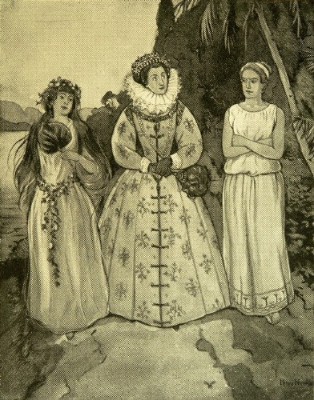
Queen Elizabeth, attended by Ophelia and Xanthippe, was walking along the river-bank. It was a beautiful autumn day, although, owing to certain climatic peculiarities of Hades, it seemed more like midsummer. The mercury in the club thermometer was nervously clicking against the top of the crystal tube, and poor Cerberus was having all he could do with his three mouths snapping up the pestiferous little shades of by-gone gnats that seemed to take an almost unholy pleasure in alighting upon his various noses and ears. Ophelia
was doing most of the talking. “I am sure
I have never wished to ride one of them,” she said, positively.
“In the
first place, I do not see where the pleasure of it comes in, and, in
the
second, it seems to me as if skirts must be dangerous. If they
should
catch in one of the pedals, where would I be?” “In the
hospital shortly, methinks,” said Queen Elizabeth. “Well,
I
shouldn’t wear skirts,” snapped
Xanthippe. “If a man’s wife
can’t borrow
some of her husband’s clothing to reduce her peril to a
minimum, what is the
use of having a husband? When I take to the bicycle, which,
in spite of
all Socrates can say, I fully intend to do, I shall have a
man’s wheel, and I
shall wear Socrates’ old dress-clothes. If Hades
doesn’t like it, Hades
may suffer.” “I don’t
see how Socrates’ clothes will help you,” observed Ophelia. “He
wore
skirts himself, just like all the other old Greeks. His toga
would be
quite as apt to catch in the gear as your skirts.” Xanthippe
looked puzzled for a moment. It was evident that she had not
thought of
the point which Ophelia had brought up — strong-minded ladies of her
kind are
apt sometimes to overlook important links in such chains of evidence as
they
feel called upon to use in binding themselves to their rights. “The women
of your day were relieved of that dress problem, at any rate,” laughed
Queen
Elizabeth. “The women
of my day,” retorted Xanthippe, “in matters of dress were the equals of
their
husbands — in my family particularly; now they have lost their rights,
and are
made to confine themselves still to garments like those of yore, while
man has
arrogated to himself the sole and exclusive use of sane
habiliments.
However, that is apart from the question. I was saying that I
shall have
a man’s wheel, and shall wear Socrates’ old dress-clothes to ride it
in, if
Socrates has to go out and buy an old dress-suit for the purpose.” The Queen
arched her brows and looked inquiringly at Xanthippe for a moment. “A
magnificent old maid was lost to the world when you married,” she
said.
“Feeling as you do about men, my dear Xanthippe, I don’t see why you
ever took
a husband.” “Humph!”
retorted Xanthippe. “Of course you don’t. You didn’t need a
husband. You were born with something to govern. I wasn’t.” “How about
your temper?” suggested Ophelia, meekly. Xanthippe
sniffed frigidly at this remark. “I never
should have gone crazy over a man if I’d remained unmarried forty
thousand
years,” she retorted, severely. “I married Socrates because I
loved him
and admired his sculpture; but when he gave up sculpture and became a
thinker
he simply tried me beyond all endurance, he was so thoughtless, with
the result
that, having ventured once or twice to show my natural resentment, I
have been
handed down to posterity as a shrew. I’ve never complained, and I
don’t
complain now; but when a woman is married to a philosopher who is so
taken up
with his studies that when he rises in the morning he doesn’t look what
he is
doing, and goes off to his business in his wife’s clothes, I think she
is
entitled to a certain amount of sympathy.” “And yet
you wish to wear his,” persisted Ophelia. “Turn
about is fair-play,” said Xanthippe. “I’ve suffered so much on
his
account that on the principle of averages he deserves to have a little
drop of
bitters in his nectar.” “You are
simply the victim of man’s deceit,” said Elizabeth, wishing to mollify
the now
angry Xanthippe, who was on the verge of tears. “I understood
men,
fortunately, and so never married. I knew my father, and even if
I hadn’t
been a wise enough child to know him, I should not have wed, because he
married
enough to last one family for several years.” “You must
have had a hard time refusing all those lovely men, though,” sighed
Ophelia. “Of course, Sir Walter wasn’t as handsome as my dear
Hamlet, but
he was very fetching.” “I cannot
deny that,” said Elizabeth, “and I didn’t really have the heart to say
no when
he asked me; but I did tell him that if he married me I should not
become Mrs.
Raleigh, but that he should become King Elizabeth. He fled to
Virginia on
the next steamer. My diplomacy rid me of a very unpleasant duty.” Chatting
thus, the three famous spirits passed slowly along the path until they
came to
the sheltered nook in which the house-boat lay at anchor. “There’s a
case in point,” said Xanthippe, as the house-boat loomed up before
them.
“All that luxury is for men; we women are not permitted to cross the
gangplank. Our husbands and brothers and friends go there; the
door
closes on them, and they are as completely lost to us as though they
never
existed. We don’t know what goes on in there. Socrates
tells me
that their amusements are of a most innocent nature, but how do I know
what he
means by that? Furthermore, it keeps him from home, while I have
to stay
at home and be entertained by my sons, whom the Encyclopædia Britannica
rightly
calls dull and fatuous. In other words, club life for him, and
dulness
and fatuity for me.” “I think
myself they’re rather queer about letting women into that boat,” said
Queen
Elizabeth. “But it isn’t Sir Walter’s fault. He told me he
tried to
have them establish a Ladies’ Day, and that they agreed to do so, but
have
since resisted all his efforts to have a date set for the function.” “It would
be great fun to steal in there now, wouldn’t it,” giggled
Ophelia. “There
doesn’t seem to be anybody about to prevent our doing so.” “That’s
true,” said Xanthippe. “All the windows are closed, as if there
wasn’t a
soul there. I’ve half a mind to take a peep in at the house.” “I am with
you,” said Elizabeth, her face lighting up with pleasure. It was
a great
novelty, and an unpleasant one to her, to find some place where she
could not
go. “Let’s do it,” she added. So the
three women tiptoed softly up the gang-plank, and, silently boarding
the
house-boat, peeped in at the windows. What they saw merely
whetted their
curiosity. “I must
see more,” cried Elizabeth, rushing around to the door, which opened at
her
touch. Xanthippe and Ophelia followed close on her heels, and
shortly
they found themselves, open-mouthed in wondering admiration, in the
billiard-room of the floating palace, and Richard, the ghost of the
best
billiard-room attendant in or out of Hades, stood before them. “Excuse
me,” he said, very much upset by the sudden apparition of the
ladies.
“I’m very sorry, but ladies are not admitted here.” “We are
equally sorry,” retorted Elizabeth, assuming her most imperious manner,
“that
your masters have seen fit to prohibit our being here; but, now that we
are
here, we intend to make the most of the opportunity, particularly as
there seem
to be no members about. What has become of them all?” Richard
smiled broadly. “I don’t know where they are,” he replied; but it
was
evident that he was not telling the exact truth. “Oh, come,
my boy,” said the Queen, kindly, “you do know. Sir Walter told me
you
knew everything. Where are they?” “Well, if
you must know, ma’am,” returned Richard, captivated by the Queen’s
manner,
“they’ve all gone down the river to see a prize-fight between Goliath
and
Samson.” “See
there!” cried Xanthippe. “That’s what this club makes
possible.
Socrates told me he was coming here to take luncheon with Carlyle, and
they’ve
both of ’em gone off to a disgusting prize-fight!” “Yes,
ma’am, they have,” said Richard; “and if Goliath wins, I don’t think
Mr.
Socrates will get home this evening.” “Betting,
eh?” said Xanthippe, scornfully. “Yes,
ma’am,” returned Richard. “More
club!” cried Xanthippe. “Oh no,
ma’am,” said Richard. “Betting is not allowed in the club;
they’re very
strict about that. But the shore is only ten feet off, ma’am, and
the
gentlemen always go ashore and make their bets.” During
this little colloquy Elizabeth and Ophelia were wandering about,
admiring
everything they saw. “I do wish
Lucretia Borgia and Calpurnia could see this. I wonder if the
Cæsars are
on the telephone,” Elizabeth said. Investigation showed that both
the
Borgias and the Cæsars were on the wire, and in short order the two
ladies had
been made acquainted with the state of affairs at the house-boat; and
as they
were both quite as anxious to see the interior of the much-talked-of
club-house
as the others, they were not long in arriving. Furthermore, they
brought
with them half a dozen more ladies, among whom were Desdemona and
Cleopatra,
and then began the most extraordinary session the house-boat ever
knew. A
meeting was called, with Elizabeth in the chair, and all the best
ladies of the
Stygian realms were elected members. Xanthippe, amid the greatest
applause,
moved that every male member of the organization be expelled for
conduct
unworthy of a gentleman in attending a prize-fight, and encouraging two
such
horrible creatures as Goliath and Samson in their nefarious
pursuits.
Desdemona seconded the motion, and it was carried without a dissenting
voice,
although Mrs. Cæsar, with becoming dignity, merely smiled approval, not
caring
to take part too actively in the proceedings. The men
having thus been disposed of in a summary fashion, Richard was elected
Janitor
in Charon’s place, and the club was entirely reorganized, with
Cleopatra as
permanent President. The meeting then adjourned, and the invaders
set
about enjoying their newly acquired privileges. The smoking-room
was
thronged for a few moments, but owing to the extraordinary strength of
the
tobacco which the faithful Richard shovelled into the furnace, it
developed no
enduring popularity, Xanthippe, with a suddenly acquired pallor, being
the
first to renounce the pastime as revolting. So fast
and furious was the enjoyment of these thirsty souls, so long deprived
of their
rights, that night came on without their observing it, and with the
night was
brought the great peril into which they were thrown, and from which at
the
moment of writing they had not been extricated, and which, to my
regret, has
cut me off for the present from any further information connected with
the
Associated Shades and their beautiful lounging-place. Had they
not been
so intent upon the inner beauties of the House-boat on the Styx they
might have
observed approaching, under the shadow of the westerly shore, a long,
rakish
craft propelled by oars, which dipped softly and silently and with
trained
precision in the now jet-black waters of the Styx. Manning the
oars were
a dozen evil-visaged ruffians, while in the stern of the approaching
vessel
there sat a grim-faced, weather-beaten spirit, armed to the teeth, his
coat
sleeves bearing the skull and cross-bones, the insignia of piracy. This boat, stealing up the river like a thief in the night, contained Captain Kidd and his pirate crew, and their mission was a mission of vengeance. To put the matter briefly and plainly, Captain Kidd was smarting under the indignity which the club had recently put upon him. He had been unanimously blackballed, even his proposer and seconder, who had been browbeaten into nominating him for membership, voting against him. 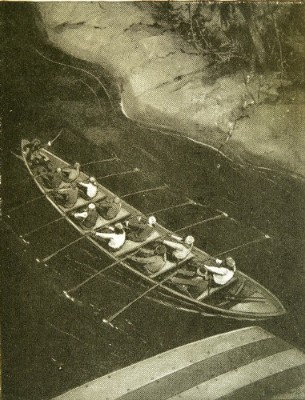 “IT WAS CAPTAIN KIDD AND HIS PIRATE CREW” “I may be
a pirate,” he cried, when he heard what the club had done, “but I have
feelings, and the Associated Shades will repent their action. The
time
will come when they’ll find that I have their club-house, and they have
— its
debts.” It was for
this purpose that the great terror of the seas had come upon this, the
first
favorable opportunity. Kidd knew that the house-boat was
unguarded; his
spies had told him that the members had every one gone to the fight,
and he
resolved that the time had come to act. He did not know that the
Fates
had helped to make his vengeance all the more terrible and withering by
putting
the most attractive and fashionable ladies of the Stygian country
likewise in
his power; but so it was, and they, poor souls, while this fiend,
relentless
and cruel, was slowly approaching, sang on and danced on in blissful
unconsciousness of their peril. In less
than five minutes from the time when his sinister-craft rounded the
bend Kidd
and his crew had boarded the house-boat, cut her loose from her
moorings, and
in ten minutes she had sailed away into the great unknown, and with her
went
some of the most precious gems in the social diadem of Hades. The rest
of my story is soon told. The whole country was aroused when the
crime
was discovered, but up to the date of this narrative no word has been
received
of the missing craft and her precious cargo. Raleigh and Cæsar
have had
the seas scoured in search of her, Hamlet has offered his kingdom for
her
return, but unavailingly; and the men of Hades were cast into a gloom
from
which there seems to be no relief. Socrates
alone was unaffected. “They’ll
come back some day, my dear Raleigh,” he said, as the knight buried his
face,
weeping, in his hands. “So why repine? I’ll never lose my
Xanthippe
— permanently, that is. I know that, for I am a philosopher, and
I know
there is no such thing as luck. And we can start another club.” “Very
likely,” sighed Raleigh, wiping his eyes. “I don’t mind the club
so much,
but to think of those poor women —” “Oh,
they’re all right,” returned Socrates, with a
laugh. “Cæsar’s wife is
along, and you can’t dispute the fact that she’s a
good chaperon. Give
the ladies a chance. They’ve been after our club
for years; now let ’em
have it, and let us hope that they like it. Order me up a
hemlock sour,
and let’s drink to their enjoyment of club life.” Which was
done, and I, in spirit, drank with them, for I sincerely hope that the
“New
Women” of Hades are having a good time. |
Web and Book design,
Copyright, Kellscraft Studio
1999-2006
(Return to Web Text-ures)