 Web
and Book
design,
Web
and Book
design, Copyright, Kellscraft Studio 1999-2006 (Return to Web Text-ures) |
Click
Here to return to A House-Boat on the River Styx Content Page |
 (HOME) |
|
A HOUSE-BOAT ON THE STYX
I CHARON MAKES A DISCOVERY CHARON, the Ferryman of
renown, was cruising slowly
along the Styx one pleasant Friday morning not long ago, and as he
paddled idly
on he chuckled mildly to himself as he thought of the monopoly in
ferriage
which in the course of years he had managed to build up. “It’s a great thing,” he
said, with a smirk of
satisfaction — “it’s a great thing to be the go-between between two
states of
being; to have the exclusive franchise to export and import shades from
one
state to the other, and withal to have had as clean a record as mine
has
been. Valuable as is my franchise, I never corrupted a public
official in
my life, and —” Here Charon stopped his soliloquy and his boat simultaneously. As he rounded one of the many turns in the river a singular object met his gaze, and one, too, that filled him with misgiving. It was another craft, and that was a thing not to be tolerated. Had he, Charon, owned the exclusive right of way on the Styx all these years to have it disputed here in the closing decade of the Nineteenth Century? Had not he dealt satisfactorily with all, whether it was in the line of ferriage or in the providing of boats for pleasure-trips up the river? Had he not received expressions of satisfaction, indeed, from the most exclusive families of Hades with the very select series of picnics he had given at Charon’s Glen Island? No wonder, then, that the queer-looking boat that met his gaze, moored in a shady nook on the dark side of the river, filled him with dismay. 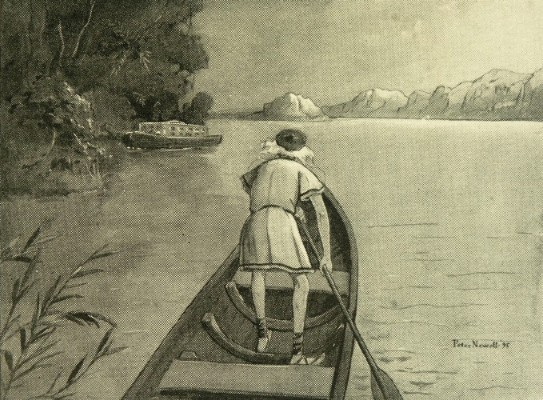 CHARON DISCOVERS A STRANGE-LOOKING CRAFT “Blow me for a landlubber
if I like that!” he said,
in a hardly audible whisper. “And shiver my timbers if I don’t
find out
what she’s there for. If anybody thinks he can run an opposition
line to
mine on this river he’s mightily mistaken. If it comes to
competition, I
can carry shades for nothing and still quaff the B. & G.
yellow-label
benzine three times a day without experiencing a financial panic.
I’ll
show ’em a thing or two if they attempt to rival me. And what a
boat! It looks for all the world like a Florentine barn on a
canal-boat.” Charon paddled up to the
side of the craft, and,
standing up in the middle of his boat, cried out, “Ship ahoy!” There was no answer, and
the Ferryman hailed her
again. Receiving no response to his second call, he resolved to
investigate for himself; so, fastening his own boat to the stern-post
of the
stranger, he clambered on board. If he was astonished as he sat
in his
ferry-boat, he was paralyzed when he cast his eye over the unwelcome
vessel he
had boarded. He stood for at least two minutes rooted to the
spot.
His eye swept over a long, broad deck, the polish of which resembled
that of a
ball-room floor. Amidships, running from three-quarters aft to
three-quarters forward, stood a structure that in its lines resembled,
as
Charon had intimated, a barn, designed by an architect enamoured of
Florentine
simplicity; but in its construction the richest of woods had been used,
and in
its interior arrangement and adornment nothing more palatial could be
conceived. “What’s the blooming
thing for?” said Charon, more
dismayed than ever. “If they start another line with a craft like
this,
I’m very much afraid I’m done for after all. I wouldn’t take a
boat like
mine myself if there was a floating palace like this going the same
way.
I’ll have to see the Commissioners about this, and find out what it all
means. I suppose it’ll cost me a pretty penny, too, confound
them!” A prey to these unhappy
reflections, Charon
investigated further, and the more he saw the less he liked it.
He was
about to encounter opposition, and an opposition which was apparently
backed by
persons of great wealth — perhaps the Commissioners themselves.
It was a
consoling thought that he had saved enough money in the course of his
career to
enable him to live in comfort all his days, but this was not really
what Charon
was after. He wished to acquire enough to retire and become one
of the
smart set. It had been done in that section of the universe which
lay on
the bright side of the Styx, why not, therefore, on the other, he asked. “I’m
pretty well connected even if I am a boatman,”
he had been known to say. “With Chaos for a
grandfather, and Erebus and
Nox for parents, I’ve just as good blood in my veins as
anybody in Hades.
The Noxes are a mighty fine family, not as bright as the Days, but
older; and
we’re poor — that’s it, poor —
and it’s money makes caste these days. If
I had millions, and owned a railroad, they’d call me a
yacht-owner. As I
haven’t, I’m only a boatman.
Bah! Wait and see! I’ll be
giving swell functions myself some day, and these upstarts will be on
their
knees before me begging to be asked. Then I’ll get
up a little
aristocracy of my own, and I won’t let a soul into it whose
name isn’t
mentioned in the Grecian mythologies. Mention in
Burke’s peerage and the
Élite directories of America won’t admit anybody
to Commodore Charon’s house
unless there’s some other mighty good reason for
it.” Foreseeing an unhappy
ending to all his hopes, the
old man clambered sadly back into his ancient vessel and paddled off
into the
darkness. Some hours later, returning with a large company of new
arrivals, while counting up the profits of the day Charon again caught
sight of
the new craft, and saw that it was brilliantly lighted and thronged
with the
most famous citizens of the Erebean country. Up in the bow was a
spirit
band discoursing music of the sweetest sort. Merry peals of
laughter rang
out over the dark waters of the Styx. The clink of glasses and
the
popping of corks punctuated the music with a frequency which would have
delighted the soul of the most ardent lover of commas, all of which so
overpowered the grand master boatman of the Stygian Ferry Company that
he
dropped three oboli and an American dime, which he carried as a
pocket-piece,
overboard. This, of course, added to his woe; but it was
forgotten in an
instant, for some one on the new boat had turned a search-light
directly upon
Charon himself, and simultaneously hailed the master of the ferry-boat. “Charon!” cried the shade
in charge of the
light. “Charon, ahoy!” “Ahoy yourself!” returned
the old man, paddling his
craft close up to the stranger. “What do you want?” “You,” said the
shade. “The house committee
want to see you right away.” “What for?” asked Charon,
cautiously. “I’m sure I don’t
know. I’m only a member of
the club, and house committees never let mere members know anything
about their
plans. All I know is that you are wanted,” said the other. “Who are the house
committee?” queried the Ferryman. “Sir Walter Raleigh,
Cassius, Demosthenes, Blackstone,
Doctor Johnson, and Confucius,” replied the shade. “Tell ’em I’ll be back in
an hour,” said Charon,
pushing off. “I’ve got a cargo of shades on board consigned to
various
places up the river. I’ve promised to get ’em all through
to-night, but I’ll
put on a couple of extra paddles — two of the new arrivals are working
their
passage this trip — and it won’t take as long as usual. What boat
is
this, anyhow?” “The Nancy Nox,
of Erebus.” “Thunder!” cried Charon,
as he pushed off and
proceeded on his way up the river. “Named after my mother!
Perhaps
it’ll come out all right yet.” More hopeful of mood,
Charon, aided by the two
dead-head passengers, soon got through with his evening’s work, and in
less
than an hour was back seeking admittance, as requested, to the company
of Sir
Walter Raleigh and his fellow-members on the house committee. He
was
received by these worthies with considerable effusiveness, considering
his
position in society, and it warmed the cockles of his aged heart to
note that
Sir Walter, who had always been rather distant to him since he had
carelessly
upset that worthy and Queen Elizabeth in the middle of the Styx far
back in the
last century, permitted him to shake three fingers of his left hand
when he
entered the committee-room. “How do you do, Charon?”
said Sir Walter,
affably. “We are very glad to see you.” “Thank you, kindly, Sir
Walter,” said the
boatman. “I’m glad to hear those words, your honor, for I’ve been
feeling
very bad since I had the misfortune to drop your Excellency and her
Majesty
overboard. I never knew how it happened, sir, but happen it did,
and but
for her Majesty’s kind assistance it might have been the worse for
us.
Eh, Sir Walter?” The knight shook his head
menacingly at Charon.
Hitherto he had managed to keep it a secret that the Queen had rescued
him from
drowning upon that occasion by swimming ashore herself first and
throwing Sir
Walter her ruff as soon as she landed, which he had used as a
life-preserver. “’Sh!” he said, sotto
voce. “Don’t say
anything about that, my man.” “Very well, Sir Walter, I
won’t,” said the boatman;
but he made a mental note of the knight’s agitation, and perceived a
means by
which that illustrious courtier could be made useful to him in his
scheming for
social advancement. “I understood you had
something to say to me,” said
Charon, after he had greeted the others. “We have,” said Sir
Walter. “We want you to
assume command of this boat.” The old fellow’s eyes
lighted up with pleasure. “You want a captain, eh?”
he said. “No,” said Confucius,
tapping the table with a
diamond-studded chop-stick. “No. We want a — er — what the
deuce is
it they call the functionary, Cassius?” “Senator, I think,” said
Cassius. Demosthenes gave a loud
laugh. “Your mind is still
running on Senatorships, my dear
Cassius. That is quite evident,” he said. “This is not one
of them,
however. The title we wish Charon to assume is neither Captain
nor
Senator; it is Janitor.” “What’s that?” asked
Charon, a little
disappointed. “What does a Janitor have to do?” “He has to look after
things in the house,” explained
Sir Walter. “He’s a sort of proprietor by proxy. We want
you to
take charge of the house, and see to it that the boat is kept
shipshape.” “Where is the house?”
queried the astonished boatman. “This is it,” said Sir
Walter. “This is the
house, and the boat too. In fact, it is a house-boat.” “Then it isn’t a
new-fangled scheme to drive me out
of business?” said Charon, warily. “Not at all,” returned
Sir Walter. “It’s a
new-fangled scheme to set you up in business. We’ll pay you a
large
salary, and there won’t be much to do. You are the best man for
the
place, because, while you don’t know much about houses, you do know a
great
deal about boats, and the boat part is the most important part of a
house-boat. If the boat sinks, you can’t save the house; but if
the house
burns, you may be able to save the boat. See?” “I think I do, sir,” said
Charon. “Another reason why we
want to employ you for
Janitor,” said Confucius, “is that our club wants to be in direct
communication
with both sides of the Styx; and we think you as Janitor would be able
to make
better arrangements for transportation with yourself as boatman, than
some
other man as Janitor could make with you.” “Spoken like a sage,”
said Demosthenes. “Furthermore,” said
Cassius, “occasionally we shall
want to have this boat towed up or down the river, according to the
house
committee’s pleasure, and we think it would be well to have a Janitor
who has
some influence with the towing company which you represent.” “Can’t this boat be moved
without towing?” asked
Charon. “No,” said Cassius. “And I’m the only man who
can tow it, eh?” “You are,” said
Blackstone. “Worse luck.” “And you want me to be
Janitor on a salary of what?” “A hundred oboli a
month,” said Sir Walter, uneasily. “Very well, gentlemen,”
said Charon. “I’ll
accept the office on a salary of two hundred oboli a month, with
Saturdays
off.” The committee went into
executive session for five
minutes, and on their return informed Charon that in behalf of the
Associated
Shades they accepted his offer. “In behalf of what?” the
old man asked. “The Associated Shades,”
said Sir Walter. “The
swellest organization in Hades, whose new house-boat you are now on
board
of. When shall you be ready to begin work?” “Right away,” said
Charon, noting by the clock that
it was the hour of midnight. “I’ll start in right away, and as it
is now
Saturday morning, I’ll begin by taking my day off.” |
 Click the book image to turn
to
the next Chapter.
Click the book image to turn
to
the next Chapter.