 Web
and Book design,
Web
and Book design, Copyright, Kellscraft Studio 1999-2006 (Return to Web Text-ures) |
Click
Here to return to Golden Fleece Content Page Return to the Previous Chapter |
 (HOME) |
|
VII. THEY
COME TO THE DESERT LAND
 ND now
with sail spread wide the Argo went on, and the heroes rested at the
oars. The
wind grew stronger. It became a great blast, and for nine days and nine
nights
the ship was driven fearfully along. ND now
with sail spread wide the Argo went on, and the heroes rested at the
oars. The
wind grew stronger. It became a great blast, and for nine days and nine
nights
the ship was driven fearfully along. The blast
drove them into the Gulf of Libya, from whence there is no return for
ships. On
each side of the gulf there are rocks and shoals, and the sea runs
toward the
limitless sand. On the top of a mighty tide the Argo was
lifted, and she was
flung high up on the desert sands. A flood
tide such as might not come again for long left the Argonauts on the
empty
Libyan land. And when they carne forth and saw that vast level of sand
stretching like a mist away into the distance, a deadly fear came over
each of
them. No spring of water could they descry; no path; no herdsman’s
cabin; over
all that vast land there was silence and dead calm. And one said to the
other:
“What land is this? Whither have we come? Would that the tempest had
overwhelmed us, or would that we had lost the ship and our lives
between the
Clashing Rocks at the time when we were making our way into the Sea of
Pontus.”
And the
helmsman, looking before him, said with a breaking heart: “Out of this
we may
not come, even should the breeze blow from the land, for all around us
are
shoals and sharp rocks — rocks that we can see fretting the water, line
upon
line. Our ship would have been shattered far from the shore if the tide
had not
borne her far up on the sand. But now the tide rushes back toward the
sea,
leaving only foam on which no ship can sail to cover the sand. And so
all hope
of our return is cut off.” He spoke
with tears flowing upon his cheeks, and all who had knowledge of ships
agreed
with what the helmsman had said. No dangers that they had been through
were as
terrible as this. Hopelessly, like lifeless specters, the heroes
strayed about
the endless strand. They
embraced each other and they said farewell as they laid down upon the
sand that
might blow upon them and overwhelm them in the night. They wrapped
their heads
in their cloaks, and, fasting, they laid themselves down. Jason
crouched beside the ship, so troubled that his life nearly went from
him. He
saw Medea huddled against a rock and with her hair streaming on the
sand. He
saw the men who, with all the bravery of their lives, had come with
him,
stretched on the desert sand, weary and without hope. He thought that
they, the
best of men, might die in this desert with their deeds all unknown; he
thought
that he might never win home with Medea, to make her his queen in
Iolcus. He lay
against the side of the ship, his cloak wrapped around his head. And
there
death would have come to him and to the others if the nymphs of the
desert had
been unmindful of these brave men. They came to Jason. It was midday
then, and
the fierce rays of the sun were scorching all Libya. They drew off the
cloak
that wrapped his head; they stood near him, three nymphs girded around
with
goatskins. “Why art
thou so smitten with despair?” the nymphs said to Jason. “Why art thou
smitten
with despair, thou who hast wrought so much and hast won so much? Up!
Arouse
thy comrades! We are the solitary nymphs, the warders of the land of
Libya, and
we have come to show a way of escape to you, the Argonauts. “Look around and watch for the time when Poseidon’s great horse shall be unloosed. Then make ready to pay recompense to the mother that bore you all. What she did for you all, that you all must do for her; by doing it you will win back to the land of Greece.” Jason heard them say these words and then he saw them no more; the nymphs vanished amongst the desert mounds. 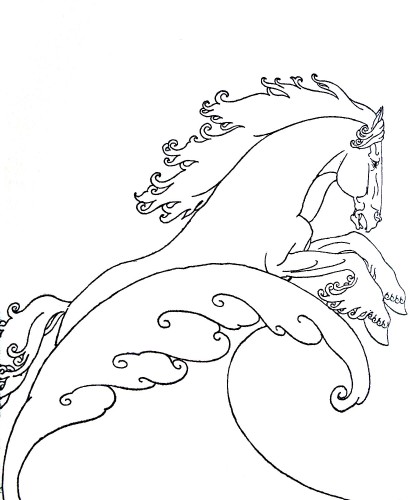 Then Jason
rose up. He did not know what to make out of what had been told him,
but there
was courage now and hope in his heart. He shouted; his voice was like
the roar
of a lion calling to his mate. At his shout his comrades roused
themselves; all
squalid with the dust of the desert the Argonauts stood around him. “Listen,
comrades, to me,” Jason said, “while I speak of a strange thing that
has
befallen me. While I lay by the side of our ship three nymphs came
before me.
With light hands they drew away the cloak that wrapped my head. They
declared
themselves to be the solitary nymphs, the warders, of Libya. Very
strange were
the words they said to me. When Poseidon’s great horse shall be
unloosed, they
said, we were to make the mother of us all a recompense, doing for her
what she
had done for us all. This the nymphs told me to say, but I cannot
understand
the meaning of their words.” There were
some there who would not have given heed to Jason’s words, deeming them
words
without meaning. But even as he spoke a wonder came before their eyes.
Out of
the far-off sea a great horse leaped. Vast he was of size and he had a
golden
mane. He shook the spray of the sea off his sides and mane. Past them
he
trampled and away toward the horizon, leaving great tracks in the sand.
Then
Nestor spoke rejoicingly. “Behold the great horse! It is the horse that
the
desert nymphs spoke of, Poseidon’s horse. Even now has the horse been
unloosed,
and now is the time to do what the nymphs bade us do. “Who but
Argo is the mother of us all? She has carried us. Now we
must make her a
recompense and carry her even as she carried us. With untiring
shoulders we
must bear Argo across this great desert. “And
whither shall we bear her? Whither but along the tracks that Poseidon’s
horse
has left in the sand! Poseidon’s horse will not go under the earth —
once again
he will plunge into the sea!” So Nestor
said and the Argonauts saw truth in his saying. Hope came to them again
— the
hope of leaving that desert and coming to the sea. Surely when they
came to the
sea again, and spread the sail and held the oars in their hands, their
sacred
ship would make swift course to their native land! |
 Click the book image to turn
to the next Chapter.
Click the book image to turn
to the next Chapter.