 Web
and Book design,
Web
and Book design, Copyright, Kellscraft Studio 1999-2006 (Return to Web Text-ures) |
Click
Here to return to Golden Fleece Content Page |
 (HOME) |
|
IV. THE
SLAYING OF APSYRTUS
 HAT
silver veil was to be splashed with a brother’s blood, and the
Argonauts,
because of that calamity, were for a long time to be held back from a
return to
their native land. HAT
silver veil was to be splashed with a brother’s blood, and the
Argonauts,
because of that calamity, were for a long time to be held back from a
return to
their native land. Now as
they went down the river they saw that dangers were coming swiftly upon
them.
The chariots of the Colchians were upon the banks. Jason saw King Æetes
in his
chariot, a blazing torch lighting his corselet and his helmet. Swiftly
the Argo
went, but there were ships behind her, and they went swiftly too. They came
into the Sea of Pontus, and Phrontis, the son of Phrixus, gave counsel
to them.
“Do not strive to make the passage of the Symplegades,” he said. “All
who live
around the Sea of Pontus are friendly to King Æetes; they will be
warned by
him, and they will be ready to slay us and take the Argo. Let us
journey up the
River Ister, and by that way we can come to the Thrinacian Sea that is
close to
your land.” The
Argonauts thought well of what Phrontis said; into the waters of the
Ister the
ship was brought. Many of the Colchian ships passed by the mouth of the
river,
and went seeking the Argo toward the passage of the
Symplegades. But the
Argonauts were on a way that was dangerous for them. For Apsyrtus had
not gone
toward the Symplegades seeking the Argo. He had led his soldiers
overland to
the River Ister at a place that was at a distance above its mouth.
There were
islands in the river at that place, and the soldiers of Apsyrtus landed
on the
islands, while Apsyrtus went to the kings of the people around and
claimed
their support. The Argo
came and the heroes found themselves cut off. They could not make their
way
between the islands that were filled with the Colchian soldiers, nor
along the
banks that were lined with men friendly to King Æetes. Argo was
stayed.
Apsyrtus sent for the chiefs; he had men enough to overwhelm them, but
he
shrank from a fight with the heroes, and he thought that he might gain
all he
wanted from them without a struggle. Theseus
and Peleus went to him. Apsyrtus would have them give up the Golden
Fleece; he
would have them give up Medea and the sons of Phrixus also. Theseus
and Peleus appealed to the judgment of the kings who supported
Apsyrtus. Æetes,
they said, had no more claim on the Golden Fleece. He had promised it
to Jason
as a reward for tasks that he had imposed. The tasks had been
accomplished and
the Fleece, no matter in what way it was taken from the grove of Ares,
was
theirs. So Theseus and Peleus said, and the kings who supported
Apsyrtus gave
judgment for the Argonauts. But Medea
would have to be given to her brother. If that were done the Argo
would be let
go on her course, Apsyrtus said, and the Golden Fleece would be left
with them.
Apsyrtus said, too, that he would not take Medea back to the wrath of
her
father; if the Argonauts gave her up she would be let stay on the
island of
Artemis and under the guardianship of the goddess. The chiefs
brought Apsyrtus’s words back. There was a council of the Argonauts,
and they
agreed that they should leave Medea on the island of Artemis. But grief
and wrath took hold of Medea when she heard of this resolve. Almost she
would
burn the Argo. She went to where Jason stood, and she spoke
again of all she
had done to save his life and win the Golden Fleece for the Argonauts.
Jason
made her look on the ships and the soldiers that were around them; he
showed
her how these could overwhelm the Argonauts and slay them all. With all
the
heroes slain, he said, Medea would come into the hands of Apsyrtus, who
then
could leave her on the island of Artemis or take her back to the wrath
of her
father. But Medea
would not consent to go nor could Jason’s heart consent to let her go.
Then
these two made a plot to deceive Apsyrtus. “I have
not been of the council that agreed to give you up to him,” Jason said.
“After
you have been left there I will take you off the island of Artemis
secretly.
The Colchians and the kings who support them, not knowing that you have
been
taken off and hidden on the Argo, will let us pass.” This Medea and
Jason
planned to do, and it was an ill thing, for it was breaking the
covenant that
the chiefs had entered with Apsyrtus. Medea then
was left by the Argonauts on the island of Artemis. Now Apsyrtus had
been
commanded by his father to bring her back to Aea; he thought that when
she had
been left by the Argonauts he could force her to come with him. So he
went over
to the island. Jason, secretly leaving his companions, went to the
island from
the other side. Before the temple of Artemis Jason and Apsyrtus came face to face. Both men, thinking they had been betrayed to their deaths, drew their swords. Then, before the vestibule of the temple and under the eyes of Medea, Jason and Apsyrtus fought. Jason’s sword pierced the son of Æetes; as he fell Apsyrtus cried out bitter words against Medea, saying that it was on her account that he had come on his death. And as he fell the blood of her brother splashed Medea’s silver veil. 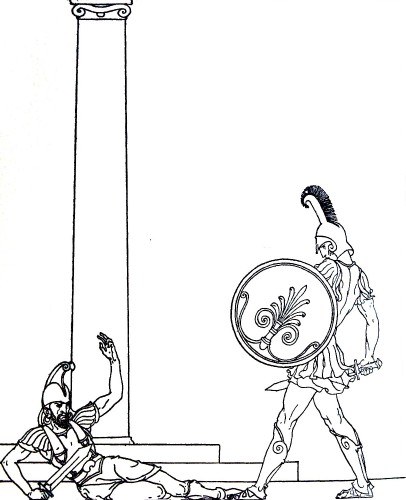 Jason
lifted Medea up and carried her to the Argo. They hid the
maiden under the
Fleece of Gold and they sailed past the ships of the Colchians. When
darkness
came they were far from the island of Artemis. It was then that they
heard a
loud wailing, and they knew that the Colchians had discovered that
their prince
had been slain. The
Colchians did not pursue them. Fearing the wrath of Æetes they made
settlements
in the lands of the kings who had supported Apsyrtus; they never went
back to
Aea; they called themselves Apsyrtians henceforward, naming themselves
after
the prince they had come with. They had
escaped the danger that had hemmed them in, but the Argonauts, as they
sailed
on, were not content; covenants had been broken, and blood had been
shed in a
bad cause. And as they went on through the darkness the voice of the
ship was
heard; at the sound of that voice fear and sorrow came upon the
voyagers, for
they felt that it had a prophecy of doom. Castor and
Polydeuces went to the front of the ship; holding up their hands, they
prayed.
Then they heard the words that the voice uttered: in the night as they
went on
the voice proclaimed the wrath of Zeus on account of the slaying of
Apsyrtus. What was
their doom to be? It was that the Argonauts would have to wander
forever over
the gulfs of the sea unless Medea had herself cleansed of her brother’s
blood.
There was one who could cleanse Medea—Circe, the daughter of Helios and
Perse.
The voice urged the heroes to pray to the immortal gods that the way to
the
island of Circe be shown to them. |
 Click the book image to turn
to the next Chapter.
Click the book image to turn
to the next Chapter.