 Web
and Book design,
Web
and Book design, Copyright, Kellscraft Studio 1999-2006 (Return to Web Text-ures) |
Click
Here to return to Golden Fleece Content Page |
 (HOME) |
|
X. THE
DEPARTURE FROM LEMNOS
 DAY
came
when Heracles left the Argo and went on the Lemnian land. He
gathered the
heroes about him, and they, seeing Heracles come amongst them, clamored
to go
to hunt the wild bulls that were inland from the sea. DAY
came
when Heracles left the Argo and went on the Lemnian land. He
gathered the
heroes about him, and they, seeing Heracles come amongst them, clamored
to go
to hunt the wild bulls that were inland from the sea. So, for
once, the heroes left the Lemnian maidens who were their friends.
Jason, too,
left Hypsipyle in the palace and went with Heracles. And as they went,
Heracles
spoke to each of the heroes, saying that they were forgetting the
Fleece of
Gold that they had sailed to gain. Jason
blushed to think that he had almost let go out of his mind the quest
that had
brought him from Iolcus. And then he thought upon Hypsipyle and of how
her
little hand would stay in his, and his own hand became loose upon the
spear so
that it nearly fell from him. How could he, he thought, leave Hypsipyle
and
this land of Lemnos behind? He heard
the clear voice of Atalanta as she, too, spoke to the Argonauts. What
Heracles
said was brave and wise, said Atalanta. Forgetfulness would cover their
names
if they stayed longer in Lemnos — forgetfulness and shame, and they
would come
to despise themselves. Leave Lemnos, she cried, and draw Argo
into the sea, and
depart for Colchis. All day
the Argonauts stayed by themselves, hunting the bulls. On their way
back from
the chase they were met by Lemnian maidens who carried wreaths of
flowers for
them. Very silent were the heroes as the maidens greeted them. Heracles
went
with Jason to the palace, and Hypsipyle, seeing the mighty stranger
coming,
seated herself, not on the couch where she was wont to sit looking into
the
face of Jason, but on the stone throne of King Thoas, her father. And
seated on
that throne she spoke to Jason and to Heracles as a queen might speak. In the
hall that night the heroes and the Lemnian maidens who were with them
were
quiet. A story was told; Castor began it and Polydeuces ended it. And
the story
that Helen’s brothers told was: Epimetheus
the Titan had a brother who was the wisest of all beings — Prometheus
called
the Foreseer. But Epimetheus himself was slow-witted and
scatter-brained. His
wise brother once sent him a message bidding him beware of the gifts
that Zeus
might send him. Epimetheus heard, but he did not heed the warning, and
thereby
he brought upon the race of men troubles and cares. Prometheus,
the wise Titan, had saved men from a great trouble that Zeus would have
brought
upon them. Also he had given them the gift of fire. Zeus was the more
wroth
with men now because fire, stolen from him, had been given them; he was
wroth
with the race of Titans, too, and he pondered in his heart how he might
injure
men, and how he might use Epimetheus, the mindless Titan, to further
his plan. While he
pondered there was a hush on high Olympus, the mountain of the gods.
Then Zeus
called upon the artisan of the gods, lame Hephæstus, and he commanded
him to
make a being out of clay that would have the likeness of a lovely
maiden. With
joy and pride Hephæstus worked at the task that had been given him, and
he
fashioned a being that had the likeness of a lovely maiden, and he
brought the
thing of his making before the gods and the goddesses. All strove
to add a grace or a beauty to the work of Hephæstus. Zeus granted that
the
maiden should see and feel. Athene
dressed her in garments that were as lovely as flowers. Aphrodite, the
goddess
of love, put a charm on her lips and in her eyes. The Graces put
necklaces
around her neck and set a golden crown upon her head. The Hours brought
her a
girdle of spring flowers. Then the herald of the gods gave her speech
that was
sweet and flowing. All the gods and goddesses had given gifts to her,
and for
that reason the maiden of Hephæstus’s making was called Pandora, the
All-endowed. She was
lovely, the gods knew; not beautiful as they themselves are, who have a
beauty
that awakens reverence rather than love, but lovely, as flowers and
bright
waters and earthly maidens are lovely. Zeus smiled to himself when he
looked
upon her, and he called to Hermes who knew all the ways of the earth,
and he
put her into the charge of Hermes. Also he gave Hermes a great jar to
take
along; this jar was Pandora’s dower. Epimetheus lived in a deep-down valley. Now one day, as he was sitting on a fallen pillar in the ruined place that was now forsaken by the rest of the Titans, he saw a pair coming toward him. One had wings, and he knew him to be Hermes, the messenger of the gods. The other was a maiden. Epimetheus marveled at the crown upon her head and at her lovely garments. There was a glint of gold all around her. He rose from where he sat upon the broken pillar and he stood to watch the pair. Hermes, he saw, was carrying by its handle a great jar. 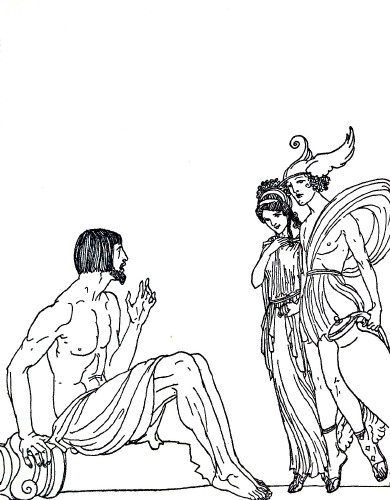 In wonder
and delight he looked upon the maiden. Epimetheus had seen no lovely
thing for
ages. Wonderful indeed was this Golden Maid, and as she came nearer the
charm
that was on her lips and in her eyes came to the Earth-born One, and he
smiled
with more and more delight. Hermes
came and stood before him. He also smiled, but his smile had something
baleful
in it. He put the hands of the Golden Maid into the great soft hand of
the
Titan, and he said, “O Epimetheus, Father Zeus would be reconciled with
thee,
and as a sign of his good will he sends thee this lovely goddess to be
thy
companion.” Oh, very
foolish was Epimetheus the Earth-born One! As he looked upon the Golden
Maid
who was sent by Zeus he lost memory of the wars that Zeus had made upon
the
Titans and the Elder Gods; he lost memory of his brother chained by
Zeus to the
rock; he lost memory of the warning that his brother, the wisest of all
beings,
had sent him. He took the hands of Pandora, and he thought of nothing
at all in
all the world but her. Very far away seemed the voice of Hermes saying,
“This
jar, too, is from Olympus; it has in it Pandora’s dower.” The jar
stood forgotten for long, and green plants grew over it while
Epimetheus walked
in the garden with the Golden Maid, or watched her while she gazed on
herself
in the stream, or searched in the untended places for the fruits that
the Elder
Gods would eat, when they feasted with the Titans in the old days,
before Zeus
had come to his power. And lost to Epimetheus was the memory of his
brother now
suffering upon the rock because of the gift he had given to men. And
Pandora, knowing nothing except the brightness of the sunshine and the
lovely
shapes and colors of things and the sweet taste of the fruits that
Epimetheus
brought to her, could have stayed forever in that garden. But every
day Epimetheus would think that the men and women of the world should
be able
to talk to him about this maiden with the wonderful radiance of gold,
and with
the lovely garments, and the marvelous crown. And one day he took
Pandora by
the hand, and he brought her out of that deep-lying valley, and toward
the
homes of men. He did not forget the jar that Hermes had left with her.
All
things that belonged to the Golden Maid were precious, and Epimetheus
took the
jar along. The race
of men at the time were simple and content. Their days were passed in
toil, but
now, since Prometheus had given them fire, they had good fruits of
their toil.
They had well-shaped tools to dig the earth and to build houses. Their
homes
were warmed with fire, and fire burned upon the altars that were upon
their
ways. Greatly
they reverenced Prometheus, who had given them fire, and greatly they
reverenced the race of the Titans. So when Epimetheus came amongst
them, tall
as a man walking with stilts, they welcomed him and brought him and the
Golden
Maid to their hearths. And Epimetheus showed Pandora the wonderful
element that
his brother had given to men, and she rejoiced to see the fire,
clapping her
hands with delight. The jar that Epimetheus brought he left in an open
place. In
carrying it up the rough ways out of the valley Epimetheus may have
knocked the
jar about, for the lid that had been tight upon it now fitted very
loosely. But
no one gave heed to the jar as it stood in the open space where
Epimetheus had
left it. At first
the men and women looked upon the beauty of Pandora, upon her lovely
dresses,
and her golden crown and her girdle of flowers, with wonder and
delight.
Epimetheus would have every one admire and praise her. The men would
leave off
working in the fields, or hammering on iron, or building houses, and
the women
would leave off spinning or weaving, and come at his call, and stand
about and
admire the Golden Maid. But as time went by a change came upon the
women: one
woman would weep, and another would look angry, and a third would go
back
sullenly to her work when Pandora was admired or praised. Once the
women were gathered together, and one who was the wisest amongst them
said:
“Once we did not think about ourselves, and we were content. But now we
think
about ourselves, and we say to ourselves that we are harsh and
ill-favored
indeed compared to the Golden Maid that the Titan is so enchanted with.
And we
hate to see our own men praise and admire her, and often, in our
hearts, we
would destroy her if we could.” “That is
true,” the women said. And then a young woman cried out in a most
yearnful
voice, “O tell us, you who are wise, how can we make ourselves as
beautiful as
Pandora!” Then said
that woman who was thought to be wise, “This Golden Maid is lovely to
look upon
because she has lovely apparel and all the means of keeping herself
lovely. The
gods have given her the ways, and so her skin remains fair, and her
hair keeps
its gold, and her lips are ever red and her eyes shining. And I think
that the
means that she has of keeping lovely are all in that jar that
Epimetheus
brought with her.” When the
woman who was thought to be wise said this, those around her were
silent for a
while. But then one arose and another arose, and they stood and
whispered
together, one saying to the other that they should go to the place
where the
jar had been left by Epimetheus, and that they should take out of it
the salves
and the charms and the washes that would leave them as beautiful as
Pandora. So the
women went to that place. On their way they stopped at a pool and they
bent
over to see themselves mirrored in it, and they saw themselves with
dusty and
unkempt hair, with large and knotted hands, with troubled eyes, and
with
anxious mouths. They frowned as they looked upon their images, and they
said in
harsh voices that in a while they would have ways of making themselves
as
lovely as the Golden Maid. And as
they went on they saw Pandora. She was playing in a flowering field,
while
Epimetheus, high as a man upon stilts, went gathering the blossoms of
the
bushes for her. They went on, and they came at last to the place where
Epimetheus had left the jar that held Pandora’s dower. A great stone
jar it was; there was no bird, nor flower, nor branch painted upon it.
It stood
high as a woman’s shoulder. And as the women looked on it they thought
that
there were things enough in it to keep them beautiful for all the days
of their
lives. But each one thought that she should not be the last to get her
hands
into it. Once the lid had been fixed tightly down on the jar. But the lid was shifted a little now. As the hands of the women grasped it to take off the lid the jar was cast down, and the things that were inside spilled themselves forth. 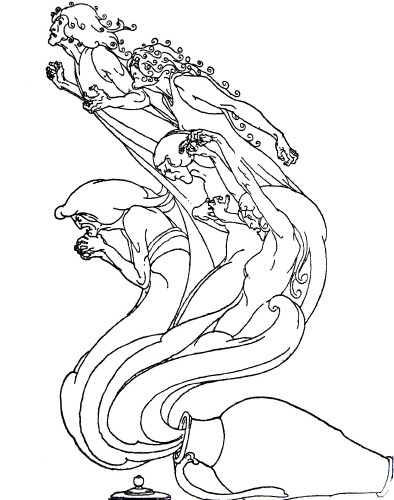 They were
black and gray and red; they were crawling and flying things. And, as
the women
looked, the things spread themselves abroad or fastened themselves upon
them. The jar,
like Pandora herself, had been made and filled out of the ill will of
Zeus. And
it had been filled, not with salves and charms and washes, as the women
had
thought, but with Cares and Troubles. Before the women came to it one
Trouble
had already come forth from the jar — Self-thought that was upon the
top of the
heap. It was Self-thought that had afflicted the women, making them
troubled
about their own looks, and envious of the graces of the Golden Maid. And now
the others spread themselves out — Sickness and War and Strife between
friends.
They spread themselves abroad and entered the houses, while Epimetheus,
the
mindless Titan, gathered flowers for Pandora, the Golden Maid. Lest she
should weary of her play he called to her. He would take her into the
houses of
men. As they drew near to the houses they saw a woman seated on the
ground,
weeping; her husband had suddenly become hard to her and had shut the
door on
her face. They came upon a child crying because of a pain that he could
not
understand. And then they found two men struggling, their strife being
on
account of a possession that they had both held peaceably before. In every
house they went to Epimetheus would say, “I am the brother of
Prometheus, who
gave you the gift of fire.” But instead of giving them a welcome the
men would
say, “We know nothing about your relation to Prometheus. We see you as
a
foolish man upon stilts.” Epimetheus
was troubled by the hard looks and the cold words of the men who once
had
reverenced him. He turned from the houses and went away. In a quiet
place he
sat down, and for a while he lost sight of Pandora. And then it seemed
to him
that he heard the voice of his wise and suffering brother saying, “Do
not
accept any gift that Zeus may send you.” He rose up
and he hurried away from that place, leaving Pandora playing by
herself. There
came into his scattered mind Regret and Fear. As he went on he
stumbled. He
fell from the edge of a cliff, and the sea washed away the body of the
mindless
brother of Prometheus. Not
everything had been spilled out of the jar that had been brought with
Pandora
into the world of men. A beautiful, living thing was in that jar also.
This was
Hope. And this beautiful, living thing had got caught under the rim of
the jar
and had not come forth with the others. One day a weeping woman found
Hope
under the rim of Pandora’s jar and brought this living thing into the
house of
men. And now because of Hope thy could see an end to their troubles.
And the
men and women roused themselves in the midst of their afflictions and
they looked
toward gladness. Hope, that had been caught under the rim of the jar,
stayed
behind the thresholds of their houses. As for
Pandora, the Golden Maid, she played on, knowing only the brightness of
the
sunshine and the lovely shapes of things. Beautiful would she have
seemed to
any being who saw her, but now she had strayed away from the houses of
men and
Epimetheus was not there to look upon her. Then Hephæstus, the lame
artisan of
the gods, left down his tools and went to seek her. He found Pandora,
and he
took her back to Olympus. And in his brazen house she stays, though
sometimes
at the will of Zeus she goes down into the world of men. When
Polydeuces had ended the story that Castor had begun, Heracles cried
out: “For
the Argonauts, too, there has been a Golden Maid — nay, not one, but a
Golden
Maid for each. Out of the jar that has been with her ye have taken
forgetfulness of your honor. As for me, I go back to the Argo
lest one of these
Golden Maids should hold me back from the labors that make great a
man.” So
Heracles said, and he went from Hypsipyle’s hall. The heroes looked at
each
other, and they stood up, and shame that they had stayed so long away
from the
quest came over each of them. The maidens took their hands; the heroes
unloosed
those soft hands and turned away from them. Hypsipyle
left the throne of King Thoas and stood before Jason. There was a storm
in all
her body; her mouth was shaken, and a whole life’s trouble was in her
great
eyes. Before she spoke Jason cried out: “What Heracles said is true, O
Argonauts! On the Quest of the Golden Fleece our lives and our honors
depend.
To Colchis — to Colchis must we go!” He stood
upright in the hall, and his comrades gathered around him. The Lemnian
maidens
would have held out their arms and would have made their partings long
delayed,
but that a strange cry came to them through the night. Well did the
Argonauts
know that cry — it was the cry of the ship, of Argo herself.
They knew that
they must go to her now or stay from the voyage for ever. And the
maidens knew
that there was something in the cry of the ship that might not be
gainsaid, and
they put their hands before their faces, and they said no other word. Then said Hypsipyle, the queen, “I, too, am a ruler, Jason, and I know that there are great commands that we have to obey. Go, then, to the Argo. Ah, neither I nor the women of Lemnos will stay your going now. But to-morrow speak to us from the deck of the ship and bid us farewell. Do not go from us in the night, Jason.” 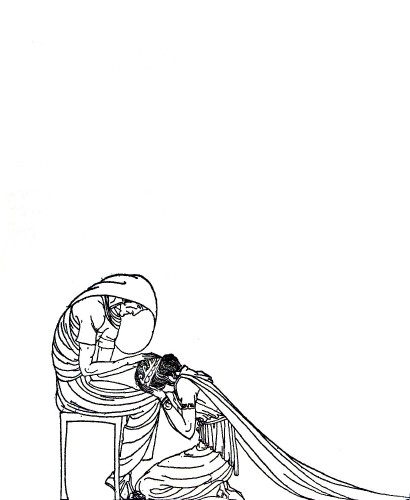 Jason and
the Argonauts went from Hypsipyle’s hall. The maidens who were left
behind wept
together. All but Hypsipyle. She sat on the throne of King Thoas and
she had
Polyxo, her nurse, tell her of the ways of Jason’s voyage as he had
told of
them, and of all that he would have to pass through. When the other
Lemnian
women slept she put her head upon her nurse’s knees and wept; bitterly
Hypsipyle wept, but softly, for she would not have the others hear her
weeping. By the
coming of the morning’s light the Argonauts had made all ready for
their
sailing. They were standing on the deck when the light came, and they
saw the
Lemnian women come to the shore. Each looked at her friend aboard the
Argo, and
spoke, and went away. And last, Hypsipyle, the queen, came. “Farewell,
Hypsipyle,”
Jason said to her, and she, in her strange way of speaking, said: “What you
told us I have remembered — how you will come to the dangerous passage
that
leads into the Sea of Pontus, and how by the flight of a pigeon you
will know
whether or not you may go that way. O Jason, let the dove you fly when
you come
to that dangerous place be Hypsipyle’s.” She showed
a pigeon held in her hands. She loosed it, and the pigeon alighted on
the ship,
and stayed there on pink feet, a white-feathered pigeon. Jason took up
the
pigeon and held it in his hands, and the Argo drew swiftly away
from the
Lemnian land. |
 Click the book image to turn
to the next Chapter.
Click the book image to turn
to the next Chapter.