
Web
and Book design,
Copyright, Kellscraft Studio 1999-2007 (Return to Web Text-ures) |
Click
Here to return to
Autobiography of Benjamin Franklin Content Page Return to the Previous Chapter |
 (HOME)
|
|
XVII FRANKLIN’S DEFENSE
OF THE FRONTIER WHILE the
several
companies in the city and country were forming, and learning their
exercise,
the governor prevail’d with me to take charge of our North-western
frontier,
which was infested by the enemy, and provide for the defense of the
inhabitants
by raising troops and building a line of forts. I undertook this
military
business, tho’ I did not conceive myself well qualified for it. He gave
me a
commission with full powers, and a parcel of blank commissions for
officers, to
be given to whom I thought fit. I had but little difficulty in raising
men,
having soon five hundred and sixty under my command. My son, who had in
the
preceding war been an officer in the army rais’d against Canada, was my
aid-de-camp, and of great use to me. The Indians had burned Gnadenhut,1
a village settled by the Moravians, and massacred the inhabitants; but
the
place was thought a good situation for one of the forts. In order
to march
thither, I assembled the companies at Bethlehem, the chief
establishment of
those people. I was surprised to find it in so good a posture of
defense; the
destruction of Gnadenhut had made them apprehend danger. The principal
buildings were defended by a stockade; they had purchased a quantity of
arms
and ammunition from New York, and had even plac’d quantities of small
paving
stones between the windows of their high stone houses, for their women
to throw
down upon the heads of any Indians that should attempt to force into
them. The
armed brethren, too, kept watch, and reliev’d as methodically as in any
garrison town. In conversation with the bishop, Spangenberg, I
mention’d this
my surprise; for, knowing they had obtained an act of Parliament
exempting them
from military duties in the colonies, I had suppos’d they were
conscientiously
scrupulous of bearing arms. He answer’d me that it was not one of their
established principles, but that, at the time of their obtaining that
act, it
was thought to be a principle with many of their people. On this
occasion,
however, they, to their surprise, found it adopted by but a few. It
seems they
were either deceiv’d in themselves, or deceiv’d the Parliament; but
common
sense, aided by present danger, will sometimes be too strong for
whimsical
opinions. It was the
beginning of January when we set out upon this business of building
forts. I
sent one detachment toward the Minisink, with instructions to erect one
for the
security of that upper part of the country, and another to the lower
part, with
similar instructions; and I concluded to go myself with the rest of my
force to
Gnadenhut, where a fort was tho’t more immediately necessary. The
Moravians
procur’d me five waggons for our tools, stores, baggage, etc. Just before we left Bethlehem, eleven farmers, who had been driven from their plantations by the Indians, came to me requesting a supply of firearms, that they might go back and fetch off their cattle. I gave them each a gun with suitable ammunition. We had not march’d many miles before it began to rain, and it continued raining all day; there were no habitations on the road to shelter us, till we arriv’d near night at the house of a German, where, and in his barn, we were all huddled together, as wet as water could make us. 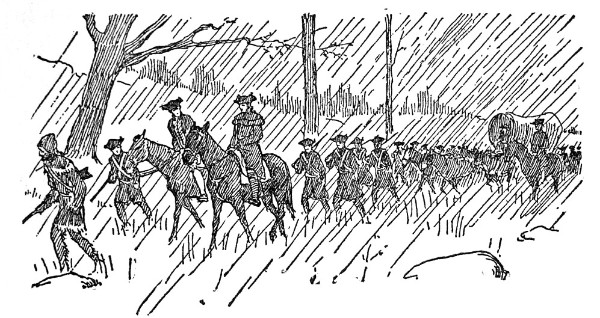 It was
well we were
not attack’d in our march, for our arms were of the most ordinary sort,
and our
men could not keep their gun locks dry. The Indians are dexterous in
contrivances for that purpose, which we had not. They met that day the
eleven
poor farmers above mentioned, and killed ten of them. The one who
escap’d
inform’d that his and his companions’ guns would not go off, the
priming being
wet with the rain.2 The next
day being
fair, we continu’d our march, and arriv’d at the desolated Gnadenhut.
There was
a saw-mill near, round which were left several piles of boards, with
which we
soon hutted ourselves; an operation the more necessary at that
inclement
season, as we had no tents. Our first work was to bury more effectually
the
dead we found there, who had been half interr’d by the country people. The next
morning
our fort was plann’d and mark’d out, the circumference measuring four
hundred
and fifty-five feet, which would require as many palisades to be made
of trees,
one with another, of a foot diameter each. Our axes, of which we had
seventy,
were immediately set to work to cut down trees, and, our men being
dexterous in
the use of them, great despatch was made. Seeing the trees fall so
fast, I had
the curiosity to look at my watch when two men began to cut at a pine;
in six
minutes they had it upon the ground, and I found it of fourteen inches
diameter. Each pine made three palisades of eighteen feet long, pointed
at one
end. While these were preparing, our other men dug a trench all round,
of three
feet deep, in which the palisades were to be planted; and, our waggons,
the
bodys being taken off, and the fore and hind wheels separated by taking
out the
pin which united the two parts of the perch,3 we had ten
carriages,
with two horses each, to bring the palisades from the woods to the
spot. When
they were set up, our carpenters built a stage of boards all round
within,
about six feet high, for the men to stand on when to fire thro’ the
loopholes.
We had one swivel gun, which we mounted on one of the angles, and fir’d
it as
soon as fix’d, to let the Indians know, if any were within hearing,
that we had
such pieces; and thus our fort, if such a magnificent name may be given
to so
miserable a stockade, was finish’d in a week, though it rain’d so hard
every
other day that the men could not work. This gave
me occasion
to observe, that, when men are employ’d, they are best content’d; for
on the
days they worked they were good-natur’d and cheerful, and, with the
consciousness of having done a good day’s work, they spent the evening
jollily;
but on our idle days they were mutinous and quarrelsome, finding fault
with
their pork, the bread, etc., and in continual ill-humour, which put me
in mind
of a sea-captain, whose rule it was to keep his men constantly at work;
and,
when his mate once told him that they had done everything, and there
was
nothing further to employ them about, “Oh,”
says he, “make them scour the anchor.” This kind
of fort,
however contemptible, is a sufficient defense against Indians, who have
no
cannon. Finding ourselves now posted securely, and having a place to
retreat to
on occasion, we ventur’d out in parties to scour the adjacent country.
We met
with no Indians, but we found the places on the neighbouring hills
where they
had lain to watch our proceedings. There was an art in their
contrivance of
those places that seems worth mention. It being winter, a fire was
necessary
for them; but a common fire on the surface of the ground would by its
light
have discover’d their position at a distance. They had therefore dug
holes in
the ground about three feet diameter, and somewhat deeper; we saw where
they
had with their hatchets cut off the charcoal from the sides of burnt
logs lying
in the woods. With these coals they had made small fires in the bottom
of the
holes, and we observ’d among the weeds and grass the prints of their
bodies,
made by their laying all round, with their legs hanging down in the
holes to
keep their feet warm, which, with them, is an essential point. This
kind of
fire, so manag’d, could not discover them, either by its light, flame,
sparks,
or even smoke: it appear’d that their number was not great, and it
seems they
saw we were too many to be attacked by them with prospect of advantage.
We had for
our
chaplain a zealous Presbyterian minister, Mr. Beatty, who complained to
me that
the men did not generally attend his prayers and exhortations. When
they
enlisted, they were promised, besides pay and provisions, a gill of rum
a day,
which was punctually serv’d out to them, half in the morning, and the
other
half in the evening; and I observ’d they were as punctual in attending
to
receive it; upon which I said to Mr. Beatty, “It is, perhaps, below the
dignity
of your profession to act as steward of the rum, but if you were to
deal it out
and only just after prayers, you would have them all about you.” He
liked the
tho’t, undertook the office, and, with the help of a few hands to
measure out
the liquor, executed it to satisfaction, and never were prayers more
generally
and more punctually attended; so that I thought this method preferable
to the
punishment inflicted by some military laws for non-attendance on divine
service. I had
hardly
finish’d this business, and got my fort well stor’d with provisions,
when I
receiv’d a letter from the governor, acquainting me that he had call’d
the Assembly,
and wished my attendance there, if the posture of affairs on the
frontiers was
such that my remaining there was no longer necessary. My friends, too,
of the
Assembly, pressing me by their letters to be, if possible, at the
meeting, and
my three intended forts being now compleated, and the inhabitants
contented to
remain on their farms under that protection, I resolved to return; the
more
willingly, as a New England officer, Colonel Clapham, experienced in
Indian
war, being on a visit to our establishment, consented to accept the
command. I
gave him a commission, and, parading the garrison, had it read before
them, and
introduc’d him to them as an officer who, from his skill in military
affairs,
was much more fit to command them than myself; and, giving them a
little
exhortation, took my leave. I was escorted as far as Bethlehem, where I
rested
a few days to recover from the fatigue I had undergone. The first
night, being
in a good bed, I could hardly sleep, it was so different from my hard
lodging on
the floor of our hut at Gnaden wrapt only in a blanket or two. While at
Bethlehem,
I inquir’d a little into the practice of the Moravians: some of them
had
accompanied me, and all were very kind to me. I found they work’d for a
common
stock, ete at common tables, and slept in common dormitories, great
numbers
together. In the dormitories I observed loopholes, at certain distances
all
along just under the ceiling, which I thought judiciously placed for
change of
air. I was at their church, where I was entertain’d with good musick,
the organ
being accompanied with violins, hautboys, flutes, clarinets, etc. I
understood
that their sermons were not usually preached to mixed congregations of
men,
women, and children, as is our common practice, but that they assembled
sometimes the married men, at other times their wives, then the young
men, the
young women, and the little children, each division by itself. The
sermon I
heard was to the latter, who came in and were plac’d in rows on
benches; the
boys under the conduct of a young man, their tutor, and the girls
conducted by
a young woman. The discourse seem’d well adapted to their capacities,
and was
deliver’d in a pleasing, familiar manner, coaxing them, as it were, to
be good.
They behav’d very orderly, but looked pale and unhealthy, which made me
suspect
they were kept too much within doors, or not allow’d sufficient
exercise. I inquir’d concerning the Moravian
marriages, whether the report was true that they were by lot. I was
told that
lots were us’d only in particular cases; that generally, when a young
man found
himself dispos’d to marry, he inform’d the elders of his class, who
consulted
the elder ladies that govern’d the young women. As these elders of the
different sexes were well acquainted with the tempers and dispositions
of their
respective pupils, they could best judge what matches were suitable,
and their
judgments were generally acquiesc’d in; but if, for example, it should
happen
that two or three young women were found to be equally proper for the
young
man, the lot was then recurred to. I objected, if the matches are not
made by
the mutual choice of the parties, some of them may chance to be very
unhappy.
“And so they may,” answer’d my informer, “if you let the parties chuse
for
themselves;” which, indeed, I could not deny. Being
returned to
Philadelphia, I found the association went on swimmingly, the
inhabitants that
were not Quakers having pretty generally come into it, formed
themselves into
companies, and chose their captains, lieutenants, and ensigns,
according to the
new law. Dr. B. visited me, and gave me an account of the pains he had
taken to
spread a general good liking to the law, and ascribed much to those
endeavours.
I had had the vanity to ascribe all to my Dialogue;
however, not knowing but that he might be in the right, I let him enjoy
his
opinion, which I take to be generally the best way in such cases. The
officers,
meeting, chose me to be colonel of the regiment, which I this time
accepted. I
forget how many companies we had, but we paraded about twelve hundred
well-looking men, with a company of artillery, who had been furnished
with six
brass field-pieces, which they had become so expert in the use of as to
fire
twelve times in a minute. The first time I reviewed my regiment they
accompanied
me to my house, and would salute me with some rounds fired before my
door,
which shook down and broke several glasses of my electrical apparatus.
And my
new honour proved not much less brittle; for all our commissions were
soon
after broken by a repeal of the law in England. During
this short
time of my colonelship, being about to set out on a journey to
Virginia, the
officers of my regiment took it into their heads that it would be
proper for
them to escort me out of town, as far as the Lower Ferry. Just as I was
getting
on horseback they came to my door, between thirty and forty, mounted,
and all
in their uniforms. I had not been previously acquainted with the
project, or I
should have prevented it, being naturally averse to the assuming of
state on
any occasion; and I was a good deal chagrin’d at their appearance, as I
could
not avoid their accompanying me. What made it worse was, that, as soon
as we
began to move, they drew their swords and rode with them naked all the
way.
Somebody wrote an account of this to the proprietor, and it gave him
great
offense. No such honour had been paid him when in the province, nor to
any of
his governors; and he said it was only proper to princes of the blood
royal,
which may be true for aught I know, who was, and still am, ignorant of
the
etiquette in such cases. This silly
affair,
however, greatly increased his rancour against me, which was before not
a
little, on account of my conduct in the Assembly respecting the
exemption of
his estate from taxation, which I had always oppos’d very warmly, and
not
without severe reflections on his meanness and injustice of contending
for it.
He accused me to the ministry as being the great obstacle to the King’s
service, preventing, by my influence in the House, the proper form of
the bills
for raising money, and he instanced this parade with my officers as a
proof of
my having an intention to take the government of the province out of
his hands
by force. He also applied to Sir Everard Fawkener, the
postmaster-general, to deprive
me of my office; but it had no other effect than to procure from Sir
Everard a
gentle admonition. Notwithstanding
the
continual wrangle between the governor and the House, in which I, as a
member,
had so large a share, there still subsisted a civil intercourse between
that
gentleman and myself, and we never had any personal difference. I have
sometimes since thought that his little or no resentment against me,
for the
answers it was known I drew up to his messages, might be the effect of
professional
habit, and that, being bred a lawyer, he might consider us both as
merely
advocates for contending clients in a suit, he for the proprietaries
and I for
the Assembly. He would, therefore, sometimes call in a friendly way to
advise
with me on difficult points, and sometimes, tho’ not often, take my
advice. We acted
in concert
to supply Braddock’s army with provisions; and, when the shocking news
arrived
of his defeat, the governor sent in haste for me, to consult with him
on
measures for preventing the desertion of the back counties. I forget
now the
advice I gave; but I think it was, that Dunbar should be written to,
and
prevail’d with, if possible, to post his troops on the frontiers for
their
protection, till, by reënforcements from the colonies, he might be able
to
proceed on the expedition. And, after my return from the frontier, he
would
have had me undertake the conduct of such an expedition with provincial
troops,
for the reduction of Fort ‘Duquesne, Dunbar and his men being otherwise
employed; and he proposed to commission me as general. I had not so
good an
opinion of my military abilities as he profess’d to have, and I believe
his
professions must have exceeded his real sentiments; but probably he
might think
that my popularity would facilitate the raising of the men, and my
influence in
Assembly, the grant of money to pay them, and that, perhaps, without
taxing the
proprietary estate. Finding me not so forward to engage as he expected,
the
project was dropt, and he soon after left the government, being
superseded by
Captain Denny. 1 Pronounced
Gna’-den-hoot. 2 Flint-lock guns,
discharged by
means of a spark struck from flint and steel into powder (priming) in
an open
pan. 3 Here the pole
connecting the front
and rear wheels of a wagon. |
 Click the book image to turn
to the next Chapter.
Click the book image to turn
to the next Chapter.